
Gardner Bender DS-110N Duct Seal Compound
4.7Editor score
Thumb-moldable dough texture
Seals drafts and moisture
Reduces panel noise
Duct seal putty compound fills irregular gaps around HVAC openings, pipe penetrations, electrical conduit, service entrances, and other exposed connections. A useful product should conform without tools, resist moisture and drafts, remain workable when appropriate, and suit the surface and installation conditions rather than simply relying on a strong general-purpose claim.
This guide compares ten duct seal putty products using their supplied ratings, formulations, packaging, application guidance, and stated capabilities. The list includes traditional soft putty, non-hardening silicone-style compounds, individually packed blocks, continuous rolls, and a liquid fiber-reinforced HVAC sealant to clarify the important differences.
Each review identifies the product's strongest use cases, practical limitations, and ideal buyer. Ratings reflect the information supplied for each listing, while availability and prices can change, so readers should confirm current product details and retailer terms before purchasing.
4.7Editor score

4.7Editor score

4.8Editor score
As an Amazon Associate we earn from qualifying purchases.
The table below compares the ten products by format, intended applications, handling characteristics, and stated sealing performance, making it easier to match each option with a particular repair.



RectorSeal Duct Seal 81880 combines a soft putty consistency with broad utility across HVAC/R, plumbing, electrical, metal fabrication, and general home repairs. Its supplied rating is 4.7, and its standout qualities include easy hand molding, immediate paintability, and a formulation described as non-corrosive, non-irritant, and asbestos-free.
We may earn a commission when you buy through this link, at no additional cost to you.
The compound adheres to most clean, dry surfaces and can be shaped by hand between 25°F and 120°F. It is particularly useful around electrical conduit ends and boxes, flashings, and service mast entries. Its stated resistance to water, alcohol, mild acids, and bases gives it broader appeal than a basic product intended solely for small indoor gaps.
The main trade-off is format rather than performance. A one-pound block is convenient for contractors handling several tasks but offers more material than a homeowner may need for one penetration. Users must also follow the clean-and-dry surface requirement, and the product should not be interpreted as a structural adhesive or a solution for active plumbing leaks.
This is the strongest general recommendation for someone who wants one dependable putty for professional or multipurpose household sealing. It is particularly appealing when the repair may need to be painted immediately, and its reusable hand-molded nature makes it practical for electrical, plumbing, HVAC, and metalworking jobs.
Because the compound can be painted immediately after application and is described as not bleeding through a dry paint film, it suits visible installations where a neat finished appearance matters. Shaping the material by hand also reduces the need for special tools during routine service work.
The combination of duct-sealing performance, surface compatibility, and resistance to mild chemical exposure makes this block relevant to more than one repair discipline. It is a sensible choice for technicians or homeowners who want a reusable general-purpose sealant in a familiar putty format.
We may earn a commission when you buy through this link, at no additional cost to you.
Gardner Bender DS-110N is a straightforward duct seal compound for holes, gaps, conduit openings, and related installation points. It carries a 4.7 rating and uses a dough-like material that can be thumbed directly over openings without mixing. Its noise-dampening use around switchgear panels gives it a purpose beyond closing air passages.
We may earn a commission when you buy through this link, at no additional cost to you.
The listing specifically highlights sealing conduit openings against drafts, dust, moisture, and noise. It can also protect terminal boxes, pot heads, and bushings from corrosive elements. These details make it appealing for electricians and maintenance personnel handling penetrations where both environmental sealing and vibration or sound control matter.
Its simple format is the main advantage, although the supplied information does not make broad claims about paintability, extreme temperatures, or prolonged outdoor performance. Buyers with visible finished surfaces may prefer a product that explicitly states it can be painted immediately after application.
Gardner Bender DS-110N is a compelling choice for routine electrical and HVAC opening work where a technician wants a simple, hand-moldable compound. It is also suitable for anyone seeking an established one-pound putty without needing a multi-pack of individually wrapped portions.
The ability to deaden switchgear panel noise makes this compound useful in installations where a conventional filler would not address vibration-related sound. It provides a practical secondary benefit alongside blocking drafts, dust, and moisture.
The dough-like texture can be shaped over holes and gaps with minimal preparation. This makes the product convenient for quick service repairs and for locations where introducing a caulk gun or shaping tool would be unnecessarily cumbersome.
We may earn a commission when you buy through this link, at no additional cost to you.
This 12-pack is built for installers who regularly handle small gaps around pipes, HVAC line openings, outlet edges, cable entry points, and wall openings. Its supplied rating is 4.6. The soft material is pressed and shaped by hand, while individual 30-gram packs help keep unused portions clean and make the product easy to organize for multiple jobs.
We may earn a commission when you buy through this link, at no additional cost to you.
Its most important characteristic is that it remains flexible after application rather than hardening, which the listing says helps reduce cracking and shrinking. The product is intended to block drafts in indoor or covered areas, including kitchens, bathrooms, and utility spaces where small penetrations affect comfort or airflow.
The main limitation is scope. It is expressly not designed to repair plumbing leaks or pressurized water leaks, and the indoor or covered-use recommendation makes it less appropriate for exposed outdoor installations. Buyers should not treat the putty as a pipe sealant or structural repair compound.
This is a useful pick for property maintenance, HVAC service, or a toolkit containing several small sealing tasks. The multi-pack format is particularly convenient when work is scattered across multiple openings and technicians want to carry individually sealed pieces rather than one exposed block.
Twelve individually packed blocks divide the material into manageable portions. That organization is useful for repair kits, service vehicles, and jobs involving several separate penetrations because unused material can remain protected from handling and debris.
The compound is well matched to pipe entries, cable openings, wall holes, and HVAC line openings inside homes. Its non-hardening behavior also allows it to remain adaptable around small irregular spaces where a rigid filler would be less suitable.
We may earn a commission when you buy through this link, at no additional cost to you.
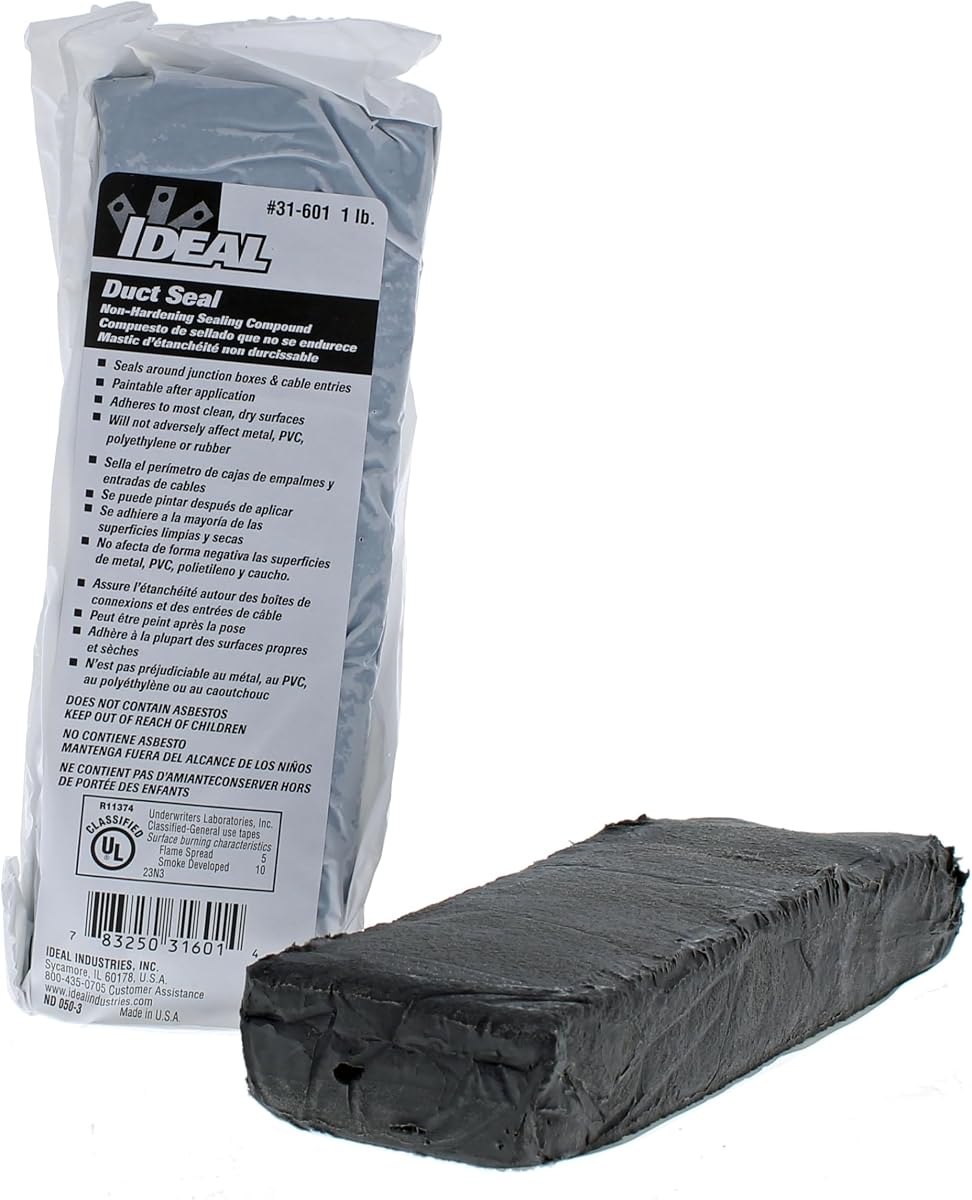
IDEAL Industries 31-601 is a gray, permanently soft putty built around junction boxes, service entrances, conduit, and HVAC penetrations. It has a supplied rating of 4.7. Its permanent softness, broad substrate compatibility, and immediate paintability distinguish it from compounds that become rigid after installation.
We may earn a commission when you buy through this link, at no additional cost to you.
The product adheres to metal, masonry, wood, and plastic and is described as safe around wiring and other surfaces without causing corrosion. It creates a barrier against air leaks, moisture, dust, and drafts, while its flexible character is intended to resist hardening, cracking, and shrinking over time.
Buyers should note that the listing describes sealing around penetrations rather than repairing a pressurized leak. The one-pound block also provides substantial material for a single small opening, so a homeowner with one minor repair may have more material than necessary. Surface preparation remains important for a reliable bond.
This is a particularly good fit for electricians and installers working around boxes, conduit, and service entrances. It is also a versatile choice for general indoor or outdoor sealing jobs where the ability to remove, re-work, and paint the material after application is valuable.
The putty is intended to remain flexible over time, allowing it to be removed and reshaped as needed. That makes it more forgiving than a rigid compound when an installation must be adjusted or the penetration needs to be accessed later.
Adhesion to metal, masonry, wood, and plastic broadens the range of suitable jobs. The non-corrosive formulation is especially relevant around electrical boxes, conduit, and service entrances where material compatibility matters.
We may earn a commission when you buy through this link, at no additional cost to you.
This five-foot roll is the highest-rated product in the supplied data, with a rating of 4.8. Its continuous format distinguishes it from block putties and small prepacked portions. Contractors can cut the three-eighth-inch-thick material to the required length, knead it, and press it into HVAC, pipe, conduit, cable, vent, and wall openings.
We may earn a commission when you buy through this link, at no additional cost to you.
The listing emphasizes a weather-resistant, flexible, and durable seal that helps block air leaks, moisture, and dust. Because the material is continuous, it can be sized to different jobs without dividing a larger block into multiple preformed pieces. The tool-free process also makes it practical for quick field adjustments.
The roll may be less convenient to carry or store than a small block, and clean, dry surfaces are required for best adhesion. The product is designed for gap sealing, not structural repair or active leak fixing. Slight shipping deformation is also noted as something that should not affect performance.
This is the strongest pick for users who want a flexible, weather-resistant sealant with the flexibility to cover multiple penetrations of different shapes. It suits maintenance crews, HVAC installers, and serious home repairers who value continuous material and straightforward installation.
The roll can be cut to suit each opening, reducing the need to ration a fixed block and making it easier to complete several penetrations in one session. This is especially useful when gap shapes and dimensions change from one location to another.
The stated weather resistance and durable flexible formula are intended to handle exposure around ducts, pipes, conduits, vents, and wall penetrations. That makes the roll more broadly applicable than products limited to indoor or covered locations.
We may earn a commission when you buy through this link, at no additional cost to you.
Red Devil 0841DX F-Seal 181 is a liquid, fiber-reinforced duct sealant rather than a hand-moldable putty. Its supplied rating is 4.5, and its strongest distinction is certification to UL 181 A-M and B-M for metal, fiberglass, and flexible HVAC ductwork.
We may earn a commission when you buy through this link, at no additional cost to you.
The water-based formula is described as fast drying, low VOC, weather resistant, and suitable for interior or exterior conditions. It also states that it surpasses SMACNA pressure and sealing classes. Those characteristics position it as a professional ductwork sealant for larger or more formal HVAC sealing requirements.
Its format is the principal trade-off. Unlike a soft block that can be pressed into a small opening, this gallon-sized liquid sealant requires an application process and appropriate tooling, making it less convenient for isolated household gaps. Buyers seeking the literal feel of duct seal putty should note the difference in consistency.
This product is best for HVAC professionals who need a certified, fast-drying sealant for ductwork. Despite appearing in a putty comparison, it is a valuable alternative when standardized duct sealing, broad material compatibility, and low-VOC application matter more than a reusable hand-molded compound.
UL 181 A-M and B-M certification gives this product a clear professional distinction. It is intended for metal, fiberglass, and flexible ductwork and is better aligned with formal HVAC sealing requirements than an unrated general-purpose putty.
The water-based formula is designed to dry quickly while limiting volatile organic compounds. These properties can be useful in occupied or sensitive environments where odor, drying time, and efficient application are important considerations.
We may earn a commission when you buy through this link, at no additional cost to you.
This eight-pack of waterproof duct sealing putty is marketed for drain holes, wall holes, AC-unit gaps, pipe connections, and odor-blocking repairs. It has a supplied rating of 4.3. Each 30-gram portion is individually packaged, helping protect unused material while making the set convenient for several household projects.
We may earn a commission when you buy through this link, at no additional cost to you.
The soft clay is kneaded and shaped by hand without mixing or special tools. Once applied, it cures for three to five days into a hard, durable, waterproof barrier intended to keep out air and moisture. The stated uses extend beyond HVAC work into sink drains, pipe connections, and general household hole filling.
It is important to distinguish this product from permanently soft or non-hardening putties. It becomes rock hard after curing, so it is less suitable for adjustments or reusable applications. It also should not be exposed to moisture during the stated curing period, and its drain-related positioning should not be confused with a solution for an active pressurized leak.
This is a practical pick for homeowners who want several individually packed portions for a collection of wall, drain, and AC openings. It works best when a permanent, rigid seal is acceptable and the application area can remain dry until curing is complete.
After curing, the compound is intended to form a hard, durable barrier against air and moisture. That permanent result suits gaps where the finished seal is not expected to be removed, reshaped, or reused later.
The listing presents the putty as a general solution for wall holes, AC-unit gaps, drain connections, and odor-blocking applications. That versatility makes the eight individual portions useful for a varied household repair kit.
We may earn a commission when you buy through this link, at no additional cost to you.
This three-pack of silicone putty provides 8.8 ounces in total and is designed for gaps where water, air, dust, and moisture need to be restricted. Its supplied rating of 3.8 is the lowest among the listed products, but the defining feature is its non-hardening, removable, and reusable construction.
We may earn a commission when you buy through this link, at no additional cost to you.
The material is kneaded and molded by hand around irregular surfaces, cracks, holes, and crevices without mixing or curing. It is compatible with metal, glass, wood, ceramic, plastic, and masonry, covering many common household surfaces. It can be removed, reshaped, and reapplied when an installation requires adjustment.
The supplied information describes the putty as water resistant rather than necessarily waterproof in every exposed condition, and recommends indoor or covered outdoor projects. Its relatively low rating may also reflect more mixed customer experiences, so buyers should consider whether the emphasis on reusability outweighs any need for a more specialized permanent seal.
This product is a sensible option for temporary or adjustable sealing around pipes, sinks, bathtubs, conduit entries, cable holes, and other small openings. It is especially attractive to users who value the ability to correct an installation without scraping, sanding, or discarding the material.
The removable, reusable nature gives users a chance to lift, reshape, and reapply the putty when a fit is not correct. This avoids the cleanup often associated with curing sealants and makes the product practical for adjustable installations.
The putty is ready to knead and shape by hand. No mixing or curing stage is required, so it can fill irregular gaps quickly where simplicity and immediate handling are more important than a rigid, permanent finish.
We may earn a commission when you buy through this link, at no additional cost to you.
The single gray silicone putty roll measures 1.5 feet by 1 inch and is marketed for filling voids, cracks, and seams where air, water, or wildlife may enter. It has a supplied rating of 4.4. Its broad material compatibility and custom-molding capability make it useful for unusual gaps that do not suit standard caulk shapes.
We may earn a commission when you buy through this link, at no additional cost to you.
The material can be hand-shaped into a barrier, removed and reused when necessary, and applied to plastic, metal, masonry, wood, ceramic, and glass. The listing also describes it as weatherproof, heat resistant, and suitable for electrical applications because of its dielectric strength. Electrical conduit ends, boxes, flashings, and service mast entrances are specifically mentioned.
The description contains a potentially confusing point: it calls the product non-hardening and reusable, yet also states that it provides a long-lasting bond once cured. Buyers should verify the exact handling expectations and finished consistency with the seller before using it where permanent rigidity or indefinite reuse is important.
This is a useful pick for creating custom seals and barriers across mixed materials, particularly where a roll can be cut or shaped to fit an irregular opening. It is also relevant to wildlife-intrusion concerns, provided installation is completed according to the seller's instructions and local requirements.
Hand molding allows the putty to be adapted to irregular cracks, penetrations, and service openings rather than being restricted to a uniform bead. This is useful for odd shapes that are difficult to cover with a conventional cartridge sealant.
The stated dielectric strength makes the product relevant around conduit and electrical boxes, while its claimed heat and weather resistance broadens its intended use. The seller should be consulted if a project requires a specific certification or defined exposure limit.
We may earn a commission when you buy through this link, at no additional cost to you.
This two-pack of gray moldable silicone putty is intended for voids, seams, penetrations, custom barriers, and general gap sealing. Its supplied rating is 4.0. It stays soft, can be removed and reused, and is shaped by hand without scraping or sanding when an installation needs correction.
We may earn a commission when you buy through this link, at no additional cost to you.
The listing names plumbing, electrical, HVAC, wildlife-intrusion, moisture, and custom-gasket uses. It also claims compatibility with plastic, metal, masonry, wood, ceramic, and glass, along with weather resistance, heat resistance, and dielectric strength. The two-roll format provides more material than a single-roll option while retaining the convenience of separate pieces.
The broad claims should be interpreted carefully. The material is presented as non-hardening and reusable, but the listing also uses cured-bond language, so buyers who require a specific final consistency should confirm the instructions. It is a gap-sealing compound, not a substitute for a pressure-rated pipe fitting or an engineered structural joint.
This product is best for maintenance work involving several small openings and for users who value the ability to correct or relocate a seal. The two-pack format makes it a practical choice for plumbing or electrical tool collections where reusability and multi-material compatibility are priorities.
Because the silicone putty can be removed, reshaped, and reapplied, a poorly fitted seal can be adjusted with less cleanup. This is useful for trial fitting around conduit entries, pipe penetrations, and service openings.
The two-roll configuration provides additional material for multiple projects while making the pieces easier to organize separately. It is a sensible format for technicians or homeowners who expect more than one small sealing task.
We may earn a commission when you buy through this link, at no additional cost to you.
The right compound depends on the opening, environment, material, and whether the finished seal must remain flexible, harden permanently, or be reworked later. These factors help narrow the category before comparing package size and convenience.
Duct seal putty is available primarily as a soft block, a continuous roll, or a liquid sealant. Blocks are convenient for isolated openings and can be kneaded or pressed by hand. Rolls allow material to be cut to different lengths and may be easier to apply along longer seams. Liquid products require a more involved installation process but may suit formal HVAC ductwork. The Red Devil 0841DX is the clearest example of a liquid alternative in this list, so shoppers should not assume every option labeled for duct sealing will feel like putty.
An indoor penetration may only need to block drafts, dust, and minor moisture, while an exterior opening requires a product that explicitly claims weather resistance. The 12-pack and 3-pack silicone products are framed primarily for indoor or covered use, whereas the IDEAL Industries block and five-foot roll state broader indoor and outdoor performance. The Red Devil sealant is described as weather resistant for both interior and exterior ductwork. Always verify whether a product is approved for direct exposure, and do not assume a general-purpose seal is suitable for an active leak.
Soft and non-hardening putties are valuable when an opening may need to be revisited, adjusted, or sealed around moving or irregular components. The RectorSeal, IDEAL Industries, Gardner Bender, 12-pack, and silicone options are presented as moldable and workable. By contrast, the eight-pack waterproof clay is designed to cure into a hard barrier. Choosing a permanent hard seal can improve resistance to disturbance, but it removes the option to lift and reshape the material later.
The compound must adhere without damaging the materials it touches. Metal, plastic, masonry, wood, ceramic, glass, and electrical components each have different considerations. The IDEAL Industries 31-601 and the silicone putty rolls list broad compatibility, while the RectorSeal is described as safe around plastics and metals. Electrical applications also make non-corrosive behavior and dielectric properties important. A product that works well on one substrate may not be appropriate for another, especially where solvents, heat, or outdoor weather are involved.
Most of these products seal openings around ducts, pipes, conduits, and wall penetrations; they do not repair the pipes or ducts themselves. The 12-pack explicitly says it is not for plumbing leaks or pressurized water leaks, while the five-foot roll is limited to gap sealing rather than active leak fixing or structural repair. A putty can reduce airflow around a service entry without making a damaged duct pressure-tight. For a pressurized or active leak, use the appropriate plumbing or duct repair method instead.
Visible installations may require a neat finish. The RectorSeal can be painted immediately after application and is described as not bleeding through dry paint film. The IDEAL Industries product is also listed as immediately paintable. Other products do not provide the same explicit claim, so buyers should verify compatibility with the intended coating and allow appropriate drying where necessary. A non-paintable putty can still perform well in concealed locations, but it may be less suitable for a visible finished installation.
A one-pound block is suitable for multiple trades, service kits, and a series of openings, but it may leave excess material after one small repair. Individually packed 30-gram blocks keep portions clean and make them convenient to distribute among jobs. The three-pack and two-pack silicone formats balance portability with capacity, while the five-foot roll supports longer or more varied sealing work. The one-gallon liquid sealant is designed for a different scale of professional application and should be selected for the whole duct-sealing job rather than a single penetration.
Some options provide claims that may matter more than general convenience. The Red Devil sealant carries UL 181 A-M and B-M certification and a stated low-VOC formula. The 3-pack silicone product emphasizes removability and reusability. The RectorSeal lists resistance to water, alcohol, and mild acids and bases. These specialized attributes can justify a selection, but they should be matched to the actual installation rather than treated as general guarantees for every environment.
Start by identifying the opening and confirming that the product is intended for that environment and substrate. Remove loose debris, dust, oil, and other contamination from the contact area, then allow the surface to become clean and dry. Products in this comparison repeatedly specify clean, dry surfaces for best adhesion, so preparation is not merely a cosmetic step.
Cut or portion the compound as needed, then knead it until soft and workable. Press the material firmly into the gap with a thumb or hand tool, shaping it to follow the edges of the pipe, conduit, wall, box, or duct opening. Fill voids without creating unnecessary buildup, and remove excess material for a neat installation. For a continuous roll, cut the required length before kneading and pressing it into place.
Follow the product-specific finishing instructions. Some compounds can be painted immediately, while curing products must remain dry for the stated period, and soft reusable putties can be removed and reshaped later. Store unused block putty in a sealed container, keep individually wrapped portions in their original packaging, and close liquid sealant containers securely after use.
Duct seal putty is primarily used to close irregular gaps around HVAC openings, pipe penetrations, electrical conduit, junction boxes, service entrances, vents, and wall holes. It can help block drafts, dust, moisture, noise, and unwanted airflow. Most putty products are intended to seal openings around a system component rather than repair a cracked or pressurized pipe.
It depends on the formula. The RectorSeal 81880 and IDEAL Industries 31-601 are explicitly described as paintable immediately after application. Other products may be paintable after a suitable drying or curing period, but that is not stated in the supplied information. Check the product instructions and test a small area when appearance and coating compatibility are important.
Some products are explicitly described as waterproof, while others are only water resistant or intended for indoor and covered areas. The five-foot roll and eight-pack clay make waterproof claims, and the three-pack silicone putty is described as water resistant. Outdoor exposure, standing water, and active leaks should be evaluated separately rather than assuming every putty is suitable.
No. The 12-pack explicitly says it is not intended for plumbing leaks or pressurized water leaks, and the five-foot roll is limited to gap sealing rather than active leak fixing. Putty can seal the space around a pipe penetration, but a leaking pipe, fitting, or pressurized vessel requires a suitable structural or pressure-repair method.
Soft or non-hardening putty remains pliable and may be removed, reshaped, or reused, which is useful when an opening may need later adjustment. Hard-curing clay becomes rigid after its curing period and is better suited to a permanent barrier. The eight-pack waterproof clay is an example of the latter, while several RectorSeal, Gardner Bender, IDEAL Industries, and silicone products emphasize soft handling.
Only when the specific product states that it is intended for outdoor use. The IDEAL Industries 31-601 and five-foot roll describe indoor and outdoor performance, and the Red Devil liquid sealant is described as weather resistant. The 12-pack is intended for indoor or covered areas, and the 3-pack silicone putty is also framed around indoor and covered outdoor projects.
It depends on the job. Liquid sealant can be appropriate for professional HVAC ductwork, especially when certification, fast drying, and low-VOC characteristics are required. Putty is usually more convenient for small, irregular openings that can be filled by hand. The Red Devil 0841DX is the liquid option in this comparison and offers a different application process from the nine moldable products.
Clean and dry the contact area before applying the compound, knead it until uniformly soft, and press it firmly into every edge of the gap. Avoid leaving dust, oil, or moisture between the putty and the substrate. For products that cure, also observe the full stated curing period before exposing the seal to water or other demanding conditions.
The RectorSeal Duct Seal 81880 is the strongest all-around choice because it combines a 4.7 rating, hand-moldable putty, broad sealing performance, and immediate paintability. Gardner Bender DS-110N stands out for straightforward electrical and panel work, while the five-foot roll earns the premium recommendation for continuous material, weather resistance, and flexible use across varied penetrations.
For the right job, prioritize the claimed environment, substrate compatibility, and final behavior over packaging alone. Non-hardening compounds suit reworkable penetrations, curing clay suits permanent gaps, and certified liquid sealant suits professional ductwork. Individual packs are convenient for scattered repairs, while larger blocks and rolls make sense for frequent service work.
Before ordering, confirm the current product listing, application instructions, package contents, and seller information. Ratings and availability can change over time, and prices fluctuate, so compare the latest details for the exact product rather than relying solely on this guide. The right compound is the one that matches the opening, exposure, surface, and need for flexibility.