
Power Probe 3 Circuit Tester
4.7Editor score
Twelve to twenty-four volt compatibility
Twenty-foot power cable
Digital voltage monitoring
Power Probe Circuit Tester guide comparing ten tools for voltage, continuity, component activation, wire tracing, overload protection, accessories, and ease of
A power probe circuit tester combines several automotive electrical functions in one handheld diagnostic tool. Rather than repeatedly moving a multimeter lead or carrying separate test lights, technicians can measure voltage, check continuity, identify polarity, trace wiring, and activate components with one instrument.
The products in this guide were compared using their published specifications, included accessories, operating ranges, protection features, and customer ratings. The list covers dedicated circuit probes, multimeter-equipped models, tracer kits, and two-function tools designed for vehicle electrical diagnosis and wire fault location.
Each review highlights the capabilities that distinguish one model from another, along with practical trade-offs to consider. Ratings and configurations can change over time, and current prices fluctuate, so readers should confirm the latest listing details and vehicle compatibility before purchasing.
4.7Editor score

4.7Editor score

4.7Editor score
The comparison below places all ten testers side by side, emphasizing operating voltage, diagnostic functions, circuit protection, cable length, and the type of vehicle electrical work each model is best equipped to handle.



The Power Probe 3 Circuit Tester, Supplies Power & Ground (PP3CSRED) earns a 4.7 rating and stands out as a well-rounded choice for technicians who want a focused automotive power probe without carrying a larger meter. Its principal strengths are direct power and ground delivery, digital voltage measurement, minimum and maximum tracking, and audible circuit monitoring.
We may earn a commission when you buy through this link, at no additional cost to you.
The tool operates across 12- to 24-volt DC systems, giving it broad relevance for common passenger vehicles and heavier electrical platforms. Its 20-foot cord provides practical reach around a vehicle, while the included battery hookup clips support a straightforward connection to the electrical system. The 4mm standard banana jack and auxiliary ground add flexibility for routine testing setups.
One limitation is that this model concentrates on power-probe functions rather than reproducing the measurement range of a full digital multimeter. It also does not present the extensive back-probe assortment seen in the larger VDIAGTOOL bundle. For users focused on energizing and monitoring circuits, however, those are reasonable compromises rather than fundamental drawbacks.
This is a strong recommendation for automotive technicians, repair shops, and serious do-it-yourself users who want a versatile power-and-ground probe in a familiar format. It is especially useful when checking live circuits, testing components, and working with vehicle wiring in areas where a conventional meter probe may be less convenient.
Supplying power or ground to a circuit is central to this model's diagnostic workflow. That makes it useful for checking whether a component responds when its supply or return path is controlled, without relying on a separate temporary jumper arrangement.
Audible monitoring, digital voltage readings, and minimum and maximum values provide several ways to interpret changing circuit conditions. These features help users notice intermittent behavior that might be overlooked with a basic test light alone.
We may earn a commission when you buy through this link, at no additional cost to you.
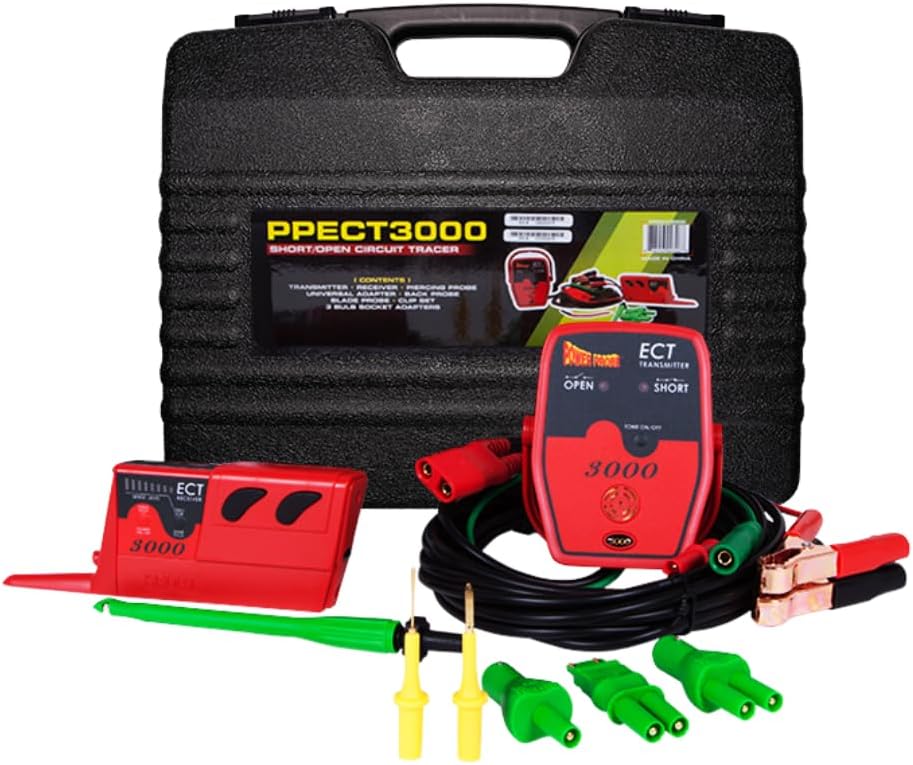
The Power Probe Circuit Tracer for Shorts & Opens, Complete Kit (ECT3000) has a 4.5 rating and is built for technicians whose priority is finding wiring faults. Its intelligent transmitter and receiver distinguish the tool from conventional power probes by emphasizing circuit tracing, direction indication, shorts, opens, and intermittent conditions.
We may earn a commission when you buy through this link, at no additional cost to you.
The 6- to 48-volt DC operating range covers a broad set of vehicle electrical systems. Direction indicators for grounded and open signals can make the process of following a circuit more intuitive, while the complete accessory package supports connection to different terminals, connectors, and harness locations.
Included accessories include an alligator clip, blade probe, piercing probe, back-probe adapter, universal adapter, and blow-molded case. That is a more specialized and potentially more useful kit than a basic power probe package, especially for routing through panels, molding, or carpets without immediately removing them.
The principal trade-off is that component activation is not the stated focus of this model. Buyers whose work revolves around energized component tests may prefer the Autel models, while those regularly confronting hidden shorts or opens will find this circuit tracer's dedicated approach more relevant.
Tracing a circuit without dismantling nearby trim can save considerable diagnostic time. The transmitter and receiver approach is particularly relevant when a fault appears intermittent, is difficult to reproduce, or lies within a harness that would otherwise require extensive disassembly.
Blade, piercing, back-probe, universal, and alligator options allow the tool to approach the same circuit from different physical angles. The supplied case also helps protect the tracer and its many small accessories between jobs.
We may earn a commission when you buy through this link, at no additional cost to you.
The Autel PowerScan Automotive Circuit Tester, 12-24V Power Circuit Probe Tool has a 4.7 rating and offers one of the broadest feature sets in this roundup. It supports voltage and polarity testing, continuity checks, signal circuit testing, component activation, ground assessment, short-circuit location, and breaker protection.
We may earn a commission when you buy through this link, at no additional cost to you.
Four modes organize the core measurements: DC voltage, AC voltage, resistance, and tone. DC voltage is presented at 0.1-volt resolution, while the AC mode reports minimum and maximum voltage, frequency, and duty cycle. Resistance can be measured between the probe tip and auxiliary ground, giving users a way to investigate fuse and line continuity.
The component activation function is particularly useful for testing lights, blower motors, power windows, wipers, rear defrosters, radiator fans, and fuel injectors. Red and green polarity indicators provide an immediate visual guide, while the long main cable and additional 20-foot extension expand access around larger vehicles. A built-in flashlight supports work in dim areas.
Its only notable trade-offs concern support and broad marketing language rather than missing core functions. Users should follow the listed operating instructions, connect the tool correctly, and interpret results alongside the vehicle's wiring diagram. For a technician seeking a versatile probe, tracer, and component tester in one package, it remains a compelling option.
Minimum and maximum readings, frequency, and duty cycle make the AC mode useful beyond a simple voltage check. These measurements can help reveal changing signals from sensors or control modules when the relevant component is operated.
A resettable internal breaker is included to protect the tester and reduce the consequences of overload. The 40-foot combined cable setup and cigarette-lighter connection improve access without requiring a connection directly to the battery for every task.
We may earn a commission when you buy through this link, at no additional cost to you.
The Power Probe 3 Circuit Tester Kit with Case & Accessories (PP319FTCRED) carries a 4.8 rating, the highest listed score among these products. It delivers a clear set of core diagnostic functions: supplying power or ground, measuring DC voltage, checking continuity, and testing components across 12- to 24-volt systems.
We may earn a commission when you buy through this link, at no additional cost to you.
Its resettable eight-amp circuit breaker is an important feature for users who intend to apply power while investigating a circuit. DC voltage indicators supply active feedback, and the included case and accessories make the package easier to organize and transport. The 20-foot power cable offers useful reach for common automotive work.
Compared with the more elaborate V200 Pro or premium multimeter-equipped probes, this kit is more focused. It does not list advanced signal measurements, a large back-probe collection, or temperature capability. However, those omissions do not undermine the basic workflow of testing voltage, continuity, grounds, and component operation.
The kit is a strong fit for mechanics, mobile repair technicians, and advanced hobbyists who value a high rating, straightforward operation, and core circuit-probe functions in one bundle. It is especially attractive when a protective case and organized accessories matter as much as the broadest possible measurement set.
The eight-amp resettable breaker allows controlled circuit testing while adding a layer of overload protection. That balance is useful when a technician needs to energize a suspected circuit but wants protection if the load is too high.
A dedicated case and included accessories reduce the chance of losing small leads or adapters. It also gives mobile technicians a more compact way to carry a complete set of core testing tools between service calls.
We may earn a commission when you buy through this link, at no additional cost to you.
The V200 Pro Automotive Circuit Tester, 12-24V Power Circuit Probe Tester earns a 4.5 rating and combines a power circuit probe with a circuit breaker finder. Mode I covers AC and DC voltage, resistance, and diode testing, while Mode II focuses on locating breaker points, opens, broken wires, current leaks, and wire routes.
We may earn a commission when you buy through this link, at no additional cost to you.
The circuit-breaker-finding capability broadens the tool beyond routine voltage checks. Tone changes can help indicate a path or fault location, and the listed 6- to 42-volt DC compatibility applies to cars, SUVs, vans, trucks, tractors, boats, and recreational vehicles. The tool can also generate activation signals for lights, motors, wipers, fans, relays, and fuel injectors.
A 20-foot cord and additional 20-foot extension provide substantial reach, while cigarette-lighter and alligator-clip power options simplify different working arrangements. Overload protection shuts the tool down and restarts it after an overload, helping protect vehicle electronics during high-current work.
One operational detail deserves attention: the second mode is powered by a 9-volt battery, so users should carry a suitable spare. The lower 4.5 rating also suggests some variation in buyer experience. Even so, the V200 Pro offers considerable versatility for users who want a probe and tracer without managing separate instruments.
A one-button transition between power-probe testing and breaker finding is convenient when a diagnosis moves from checking a component to following a wire. It also reduces the need to carry a separate tracer for many common automotive tasks.
The stated voltage range extends beyond a typical 12-volt passenger-car system. The listed vehicle applications include larger trucks, tractors, boats, and recreational vehicles, making the tool potentially useful beyond a single type of garage.
We may earn a commission when you buy through this link, at no additional cost to you.
The Autel PowerScan PS100 Circuit Tester 2.0, 12-24V Power Circuit Probe Tool has a 4.7 rating and stands out for professional-style features presented through an intuitive backlit display. It works across 6- to 30-volt systems and covers polarity, continuity, signal circuit, ground, short and open circuit, component, and trailer-light testing.
We may earn a commission when you buy through this link, at no additional cost to you.
Its four modes include DC voltage, AC voltage, resistance, and adjustable tone. DC readings use 0.1-volt resolution, while AC mode provides minimum and maximum voltage, frequency, and duty cycle. Resistance mode displays values such as 0.0 ohms for a low-resistance connection and OL for an open circuit, allowing technicians to inspect wiring and ground quality.
Component activation can check lights, motors, wipers, radiator fans, and relays without requiring jumper wires. A resettable 10-amp circuit breaker protects against overload and can assist in locating shorts. Red and green LEDs indicate polarity, and a sharp stainless-steel probe helps reach tight areas or penetrate insulation where appropriate.
The device includes a 20-foot cable, another 20-foot extension, a cigarette-lighter plug, an alligator clip, dual lighting, and a backlit LCD. It is more sophisticated than a basic probe, so beginners may need time to understand each mode. For experienced users, that added capability represents the main appeal.
Frequency, duty cycle, and minimum and maximum readings help confirm whether a changing sensor signal is present. This is more informative than a static voltage check when the system under test only becomes active during operation.
The backlit digital screen and dual head lights make the tester easier to use in dark or cramped areas. Polarity LEDs add a quick visual confirmation, reducing the need to rely on the display alone for every basic connection.
We may earn a commission when you buy through this link, at no additional cost to you.
The Power Probe 3 Circuit Tester with PowerFlow Load Testing (PP3PFRED) has a 4.8 rating and is built around a distinctive concept: actively loading circuits during testing. Instead of treating every circuit as a passive measurement target, it can place a defined load on a circuit to evaluate how that circuit behaves under demand.
We may earn a commission when you buy through this link, at no additional cost to you.
PowerFlow technology is the model's defining feature. It can power components with battery voltage or ground, measure resistance from 1 ohm to 25 kilohms, and use a built-in latch for continuous power application. These functions make it relevant for deeper diagnosis of wiring and component behavior rather than simple live or dead checks.
A 10-amp self-resetting circuit breaker provides protection while current is applied. The self-resetting design helps the tool recover after an overload without requiring the user to replace a fuse. Although it shares the familiar Power Probe form, its internals are oriented toward more active diagnostic procedures.
Its main limitation is specialization. Buyers looking for broad temperature and current measurements from a full multimeter may prefer the premium Power Probe 3 kit. For technicians who specifically need controlled load testing and latched power delivery, however, this model provides a clear and sophisticated advantage.
Loading a circuit can reveal behavior that a high-impedance voltage reading may not expose. The PowerFlow approach gives the tester a more active role, which is valuable when evaluating whether a supply path or component can perform under load.
The built-in latch is convenient when a component must remain powered while the technician moves the probe or checks another point. Continuous application can make hands-on functional testing more controlled and repeatable.
We may earn a commission when you buy through this link, at no additional cost to you.
The VDIAGTOOL V200 PRO Upgrade Kit combines the V200 Pro circuit tester with a 30-piece back-probe assortment, earning a 4.4 rating. Its distinguishing strength is not simply the number of accessories but their variety: the set includes 15 back-probe pins, five banana-to-alligator test wires, five wire-piercing probes, and five nickel-plated alligator clips.
We may earn a commission when you buy through this link, at no additional cost to you.
The back-probes come in 90-degree, 135-degree, and straight styles. Their 0.07-millimeter needles are intended for connectors, fuel injectors, and automotive sensors, while the piercing probes make it possible to connect with certain insulated wires without stripping them. The alligator clips use 4-millimeter banana plugs and different colors to simplify identification.
The tester itself covers AC and DC voltage, resistance, diode, polarity, continuity, and ground tests in Mode I. Mode II adds breaker-point, open-connection, broken-wire, current-leak, and cable tracing. Component activation is supported for lights, motors, wipers, fans, relays, and injectors, with a stated 6- to 42-volt DC range.
The 4.4 rating is the lowest among these ten products, and some users may find the extensive kit more than their needs require. For a technician who frequently works at harness connectors, however, the added probe geometry can be more valuable than a larger number of basic functions. The package is especially relevant to advanced hobbyists and electronics engineers.
Multiple needle angles make it easier to reach terminals inside dense harness connectors. This matters when space is limited or a connector's shape prevents a conventional probe from making reliable contact.
The wire-piercing probes are designed to access insulated conductors while helping protect the test lead. They can be especially helpful during circuit diagnosis, provided the piercing technique is controlled and appropriate for the wire.
We may earn a commission when you buy through this link, at no additional cost to you.
The Power Probe 3 Circuit Tester with Multimeter & Accessories (PPROKIT01) has a 4.7 rating and provides the most expansive measurement specification in this collection. It combines the convenience of supplying power and ground for functional testing with a CAT-IV 600-volt hybrid-safe AC and DC voltmeter.
We may earn a commission when you buy through this link, at no additional cost to you.
Resistance measurement extends to 60 megohms, current measurement covers 0.001 amps through 10 amps, and temperature readings span approximately minus 4 to 1,832 degrees Fahrenheit, equivalent to minus 20 to 1,000 degrees Celsius. Those ranges make it useful for broader electrical and thermal checks than a conventional circuit probe alone.
Its main strength is consolidation. A technician can move from identifying a live or open circuit to investigating a component's resistance, current draw, or operating temperature without switching to a separate meter. The hybrid-safe CAT-IV rating also signals attention to measurement-category protection.
That breadth is also the main drawback for occasional users. Basic voltage and continuity checks do not require this much capability, and the controls may take time to master. Serious technicians who want one instrument to cover multiple diagnostic categories will find the consolidation more valuable than the added complexity.
Combining a circuit probe and multimeter reduces tool changes during a diagnosis. The user can apply circuit power, check voltage, assess resistance, measure current, and investigate temperature with one device rather than maintaining several separate instruments.
The CAT-IV 600-volt hybrid-safe specification distinguishes this package from basic vehicle probes. It is particularly relevant for users who may also measure electrical systems beyond a standard 12-volt passenger-car environment.
We may earn a commission when you buy through this link, at no additional cost to you.
The Power Probe 3 Circuit Tester, Supplies Power & Ground (PP3CSCARB) has a 4.7 rating and offers a focused version of the classic power-probe format. It is designed for automotive electrical diagnosis across 12- to 24-volt DC systems, with power and ground supply as its central functions.
We may earn a commission when you buy through this link, at no additional cost to you.
A digital voltmeter, minimum and maximum tracking, audible circuit monitoring, and a 4mm standard banana jack with auxiliary ground give the user more information than a basic test light. The 20-foot cord provides useful reach, while the battery hookup clips make connection to a vehicle straightforward.
Unlike feature-heavy products in the list, this version does not emphasize signal analysis, extensive back-probing, or a built-in breaker finder. The package includes an instructional DVD rather than a large assortment of test leads. That makes it less suited to advanced connector work or independent wire tracing.
The included training material can be useful for owners learning basic circuit testing, while the audible and digital feedback supports quick interpretation. This is a sensible selection for a technician who needs a dependable power-and-ground probe but does not require a tracer, full multimeter, or extensive accessory system.
Digital readings support precise observation, while audible monitoring allows the user to focus on the circuit rather than continuously watching the screen. That combination is helpful for quickly checking live, intermittent, or changing conditions.
The limited feature set gives this model a straightforward learning curve. The supplied instructional DVD also provides an additional avenue for learning the controls and basic diagnostic workflow.
We may earn a commission when you buy through this link, at no additional cost to you.
The best power probe circuit tester depends on whether your priority is basic voltage and ground testing, component activation, signal analysis, short tracing, or comprehensive multimeter measurement. Consider vehicle voltage, protection, cable reach, accessories, and the complexity of the diagnostics you routinely perform.
Start by listing the tasks you expect to perform. Basic users may need live voltage, polarity, continuity, and power or ground delivery, while advanced technicians may also require AC readings, duty cycle, frequency, diode checks, component activation, signal testing, and wire tracing. A probe with more modes offers greater flexibility, but it can also require more training and menu navigation.
Choose a model whose functions match your work rather than simply selecting the largest feature list. Confirm that component activation and signal analysis are important to you before choosing one of the multifunction Autel or VDIAGTOOL models.
Most passenger-car electrical systems operate at 12 volts, while 24-volt systems appear on many trucks, buses, heavy equipment, and trailers. Verify the tester's stated operating range and whether it applies to every mode you plan to use. A model rated for a broad DC range can be useful across a mixed fleet, but it should not be treated as compatible with every system merely because it handles a wider voltage range.
For a mixed workshop, a six- to thirty, forty-two, or forty-eight-volt specification may provide useful flexibility. For one vehicle class, a 12- to 24-volt probe may be sufficient.
A resettable circuit breaker is valuable when the tester supplies power to a circuit. It can limit the consequences of an overload and avoid the inconvenience of replacing a conventional fuse. Models with protection around 10 amps are especially relevant to higher-current automotive circuits, while an eight-amp breaker may be sufficient for many lighter diagnostic tasks.
Look for clear overload behavior and a straightforward reset process. Protection does not eliminate the need for correct polarity, sound connection techniques, and careful circuit identification.
Cable length determines whether you can test a circuit from a comfortable position or must stretch the tool across a large vehicle. A 20-foot lead handles many cars and SUVs, while systems offering 20 feet plus another 20 feet provide more flexibility for trucks, trailers, and work that moves between the engine compartment and cabin.
Longer is not automatically better. Extra cable can become cumbersome in confined spaces, so consider storage method, connector arrangement, and whether a cigarette-lighter power connection is sufficient for the work you perform.
Component activation lets a technician command or simulate an active circuit at a component connector. Depending on the tool, this can be used with lights, motors, relays, wipers, radiator fans, and other electrical devices. It reduces the need to fabricate temporary jumper connections and can make functional testing more controlled.
Check exactly which components the manufacturer lists as supported. Do not assume that activation can safely test every electronic module, sensor, or controller on a modern vehicle.
Troublesome shorts, opens, and broken wires often require access inside connectors or through insulated conductors. Back-probes, piercing probes, blade probes, universal adapters, and alligator clips broaden the ways a tester can connect. Multi-angle needles can be especially useful in crowded harnesses where a straight probe cannot reach the terminal.
For connector-intensive work, the 30-piece VDIAGTOOL set is a notable option. For general repair, the ECT3000's more specialized tracer accessories may provide a better fit. Avoid buying many adapters that your typical diagnostic process will never use.
A backlit LCD is useful in dim engine compartments and under dashboards, while audible tone indicators can reduce the need to watch the display continuously. Polarity LEDs provide a quick visual cue for positive, negative, or open states. Min and max readings, frequency, and duty-cycle data make a tool better suited to intermittent and changing signals.
Consider whether you need a simple screen or a detailed display. A basic power probe is easier to operate, while a multifunction meter-style interface gives more diagnostic context.
Some users need more than a circuit probe. The Power Probe 3 with Multimeter measures current, resistance across a very broad range, and temperature while still supplying power and ground. Such capability can reduce tool switching and support investigations that involve heat-related behavior or current consumption.
This added breadth comes with greater complexity and a premium feature set. If your work is limited to vehicle voltage, continuity, and ground checks, a simpler model will be easier to use and may provide better value.
Begin by identifying the circuit, its expected voltage, and the correct ground path. Inspect the tester, cables, clips, and probe tips for damage, then connect power according to the instructions. When working around stored energy, control modules, airbags, or other sensitive systems, consult the vehicle service information and disconnect power where the manufacturer directs.
Select the measurement mode that matches the task. For polarity, verify the reading and LED or tone indication; for continuity or resistance, isolate the circuit appropriately before testing; for component activation, use a protected connection and only test components supported by the tool. Watch for abnormal current, unexpected breaker trips, heat, or readings outside the expected range, and stop if any appear.
After use, disconnect the tester from the battery or accessory socket, remove piercing probes from conductors, and return loose accessories to their case or organizer. Keep the instrument dry and away from excessive heat, clean the probe tips with an appropriate lint-free method, and periodically inspect the cords for cuts or weakened insulation. Replace damaged accessories before the next diagnostic session.
A power probe circuit tester is used to diagnose vehicle electrical systems by measuring voltage, checking polarity and continuity, supplying power or ground, and sometimes activating components. More advanced models can trace short or open circuits, display AC signal measurements, and report frequency or duty cycle. The exact functions vary by model, so the included instructions and vehicle service information should guide every test.
A basic power probe is not always a complete replacement for a multimeter. It excels at vehicle power, ground, and continuity work, while a full meter may offer broader resistance, current, temperature, and measurement-category coverage. The Power Probe 3 with Multimeter is specifically designed to combine both roles, and the Autel PS100 provides several multimeter-like readings for users who need a more versatile instrument.
A tester must support the vehicle system's voltage to provide reliable results. A 12- to 24-volt probe is suitable for many automotive applications, while broader six- to forty-two-volt or six- to forty-eight-volt models cover more mixed equipment. Check the stated range for every diagnostic mode, not just the headline product description.
A circuit probe primarily measures electrical conditions and may supply power, ground, or activation signals. A circuit tracer is designed to follow a wiring path and identify where a short, open, or break occurs. Some products combine both functions, such as the V200 Pro, while the ECT3000 places stronger emphasis on tracing.
Improper use of any powered diagnostic probe can cause harm, particularly around sensitive control modules. Use only the activation function with compatible components, maintain a correct ground path, and consult vehicle service procedures before testing electronic modules. If the tester overheats, the breaker trips unexpectedly, or readings appear implausible, disconnect it and reassess the connection.
A tripped breaker generally indicates that the applied load exceeded the protected limit. This may mean a short circuit, an incorrectly connected ground, or a component drawing more current than expected. Disconnect the tester, identify the circuit, and check the wiring before resetting or continuing the test.
They are not required for every basic voltage check, but they greatly improve access to terminals inside sealed connectors. They are especially useful for sensor circuits, fuel-injector connectors, and harnesses that are difficult to reach with a standard probe. A full set with multiple angles, piercing probes, and alligator adapters is most valuable for frequent connector-level diagnostics.
Store the tester in a dry, moderate-temperature environment after disconnecting it from the vehicle. Coil cables without creating sharp bends, remove piercing needles from wires, and keep accessories in the supplied case or a divided organizer. Periodic inspection of insulation, probe tips, clips, and battery compartments helps prevent damaged equipment from producing misleading results.
The Autel PowerScan PS100 Circuit Tester 2.0 is the leading all-around choice for its four diagnostic modes, component activation, 10-amp resettable breaker, signal readings, backlit display, and extended cable system. For a simpler core workflow, the Power Probe 3 supplies and monitors power and ground with a compact, proven format, while the premium Power Probe 3 with Multimeter is ideal for users who need broad resistance, current, and temperature measurement.
The right choice depends on the work rather than the number of buttons. Prioritize the voltage range, protective breaker, tracing or activation functions, connector access, and cable reach that your diagnostics genuinely require. A simpler tool can be more effective for routine voltage and ground checks, while a mixed fleet or advanced signal work may justify a more comprehensive model.
Ratings, package contents, manufacturer details, and prices can change over time. Before ordering, confirm the current listing, compatibility, included accessories, warranty terms, and operating instructions for the exact model. Comparing those details with the vehicle systems and diagnostic tasks you routinely handle will lead to the most suitable power probe circuit tester.