
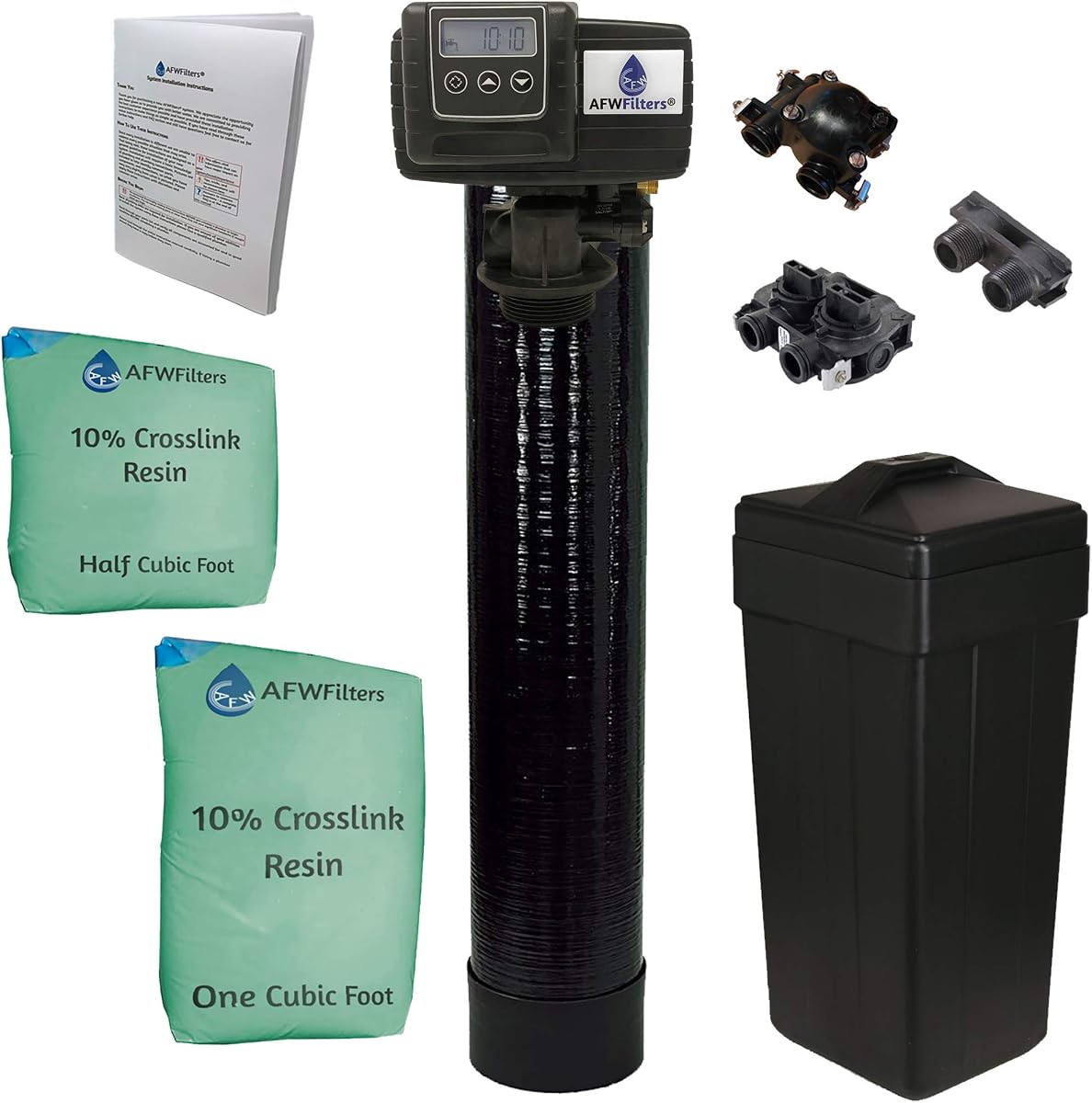
AFWFilters 48K Grain Fleck 5600 SXT
4.8Editor score
48,000-grain softening capacity
Fleck 5600 SXT control valve
10% crosslink resin tank
Large 250-pound brine tank
Discover the best cheap water softener options by comparing capacity, control features, resin quality, installation needs, and whole-home coverage.
Hard water can leave behind scale, spots, soap scum, and stiff laundry throughout an entire home. A budget-friendly water softener can reduce those mineral deposits without requiring a complex filtration system, but the right model depends on household size, hardness level, plumbing layout, and how much maintenance you are comfortable handling.
We compared all 10 systems by examining grain capacity, control technology, tank and valve construction, filtration capabilities, flow considerations, warranty coverage, and suitability for different households. The guide includes floor-standing and cabinet-style models, budget picks for smaller homes, higher-capacity systems, and options with pre-filtration or upgraded resin.
Each review explains the standout features, practical trade-offs, and ideal home for that model. Ratings reflect the supplied customer feedback, while specifications come from the manufacturer descriptions. Product prices and promotions can change, so compare the current listing, installation requirements, and ongoing salt needs before buying.
4.8Editor score

4.7Editor score

4.1Editor score
This side-by-side comparison highlights each system's grain capacity, control method, physical configuration, and intended household fit so buyers can narrow the field before reviewing the detailed evaluations.




The Aquasure Harmony Series 32,000-grain system is a flexible whole-house option aimed at homes with one or two bathrooms. Its 4.4 customer rating reflects a generally positive reception, while the digital metered head stands out for allowing users to adjust automatic flushing and monitor operation. The system also includes prefilled premium-grade resin and a durable bypass valve.
We may earn a commission when you buy through this link, at no additional cost to you.
Its main advantage is the combination of useful capacity and adaptable control. The metered valve can be programmed according to incoming water quality and household consumption, making it a practical choice for families that do not want to depend on a fixed regeneration schedule. The fiberglass-lined polyethylene tank is designed to resist corrosion, while the bypass valve makes routine service more manageable.
The main drawback is that this is a floor-standing installation with separate components, so suitable space near the main water line is necessary. Buyers should also account for the salt tank, drain connection, and potentially professional installation. Like all ion-exchange softeners, it requires regular salt replenishment and maintenance rather than operating as a maintenance-free appliance.
This is a strong choice for small to medium homes seeking an established whole-house configuration without a large cabinet footprint. Choose it when the priority is dependable digital control, a practical 32,000-grain capacity, and responsive support. Confirm available space and connection requirements before ordering, especially if the installation area is narrow or unusual.
The programmable digital valve lets households tailor flushing behavior to water quality and consumption. This flexibility is especially useful in homes where occupancy or water use varies substantially.
By reducing calcium and magnesium, the system can help limit scale in pipes and water-using appliances. That makes it useful for protecting fixtures, dishwashers, washing machines, and water heaters over time.
We may earn a commission when you buy through this link, at no additional cost to you.
The iSpring WCSTB45KG offers substantial 45,000-grain capacity with a programmable automatic valve and digital display. It has a 4.2 rating and is marketed for households, schools, businesses, and light commercial settings. The supplied description states that third-party testing found the system reduces water hardness by 99.71 percent by removing calcium and magnesium.
We may earn a commission when you buy through this link, at no additional cost to you.
This model is appealing to buyers who want more capacity than a compact household model without moving to the largest available system. The control valve calculates regeneration cycles based on water quality and usage, supports hardness adjustments, and is designed to conserve salt and water. Compatibility with both municipal and private well supplies adds flexibility, although local pretreatment may still be necessary.
The trade-off is that its rating and warranty position are less compelling than some competing systems. The stated coverage includes a 30-day money-back guarantee, a one-year manufacturer warranty, lifetime technical support, and optional extended warranty plans available online. Its floor-standing layout also requires adequate space for the mineral and brine tanks.
This system best suits value-focused buyers who need generous whole-home capacity, automatic operation, and broad water-source compatibility. It is particularly relevant for larger households or light commercial applications, provided the space and plumbing arrangement accommodate the installation. Prospective buyers should review the warranty terms carefully and confirm that their incoming water quality falls within the system's operating expectations.
A 45,000-grain rating creates room for homes with several occupants or higher water demand. Correct sizing still depends on hardness, daily usage, and regeneration frequency, so capacity should not be selected in isolation.
The digital control valve monitors usage and calculates regeneration timing. This metered approach is intended to avoid unnecessary softener cycles and reduce salt and water consumption compared with older time-clock controls.
We may earn a commission when you buy through this link, at no additional cost to you.
The Kenmore 350 combines a 32,000-grain capacity with IntelliSoft Technology, which learns family water use and regenerates according to demand. It has a 4.3 rating and is aimed at households of one to four people. Its digital display tracks flow rate and salt levels, while the compact layout and three-quarter-inch valve are designed to preserve usable flow and simplify installation.
We may earn a commission when you buy through this link, at no additional cost to you.
Its most distinctive feature is the adaptive control system. Rather than relying only on a timer, it learns consumption patterns and aims to regenerate only when necessary. The description also says it monitors salt levels to reduce waste. For homeowners who want fewer manual interventions, that combination of automatic control and clear status information is valuable.
The system's scope should be understood carefully. It is intended to reduce hardness minerals and clear-water iron, but it is not presented as a comprehensive treatment solution for every contaminant. The high-flow three-quarter-inch valve may also be less accommodating than one-inch connections in homes with high simultaneous demand, particularly if properly sized filtration or treatment equipment is already installed.
This is a good fit for small families or homeowners with limited installation space who value intelligent operation. It suits consumers who want softer water, scale reduction, and appliance protection without selecting the largest tank available. Before installation, verify flow requirements, available space, drain access, and the presence of clear-water iron in the incoming supply.
IntelliSoft learns when a household consumes water and schedules regeneration accordingly. That focus on demand can make operation more efficient for families whose routines vary during vacations, weekends, or seasonal changes.
The compact footprint is a meaningful advantage in utility rooms and basements. Buyers should still leave enough access for salt, filters, and service, and should verify that the valve and drain line fit the available plumbing layout.
We may earn a commission when you buy through this link, at no additional cost to you.
The CS21H 2026 is a 34,000-grain cabinet-style system designed for one to five people. It has a 4.6 rating and combines an integrated salt tank, digital control system, and Gen2 up-flow regeneration. The stated regeneration design can use up to 40 percent less salt and up to 36 percent less water than conventional down-flow regeneration.
We may earn a commission when you buy through this link, at no additional cost to you.
Its integrated cabinet measures 20.52 inches deep, 10.63 inches wide, and 40.93 inches high, making it practical for garages, basements, utility rooms, and mechanical closets. The 128-pound salt tank supports regular operation, while a push-open lid and enlarged salt opening simplify refilling. One-inch NPT connections and a three-quarter-inch straight connector support common residential plumbing arrangements.
There are important limitations. The system is designed to remove calcium and magnesium ions, not iron, and the manufacturer strongly recommends a prefilter for well water or sediment concerns. Buyers must also confirm local codes and site-specific fittings. Its efficiency claims depend on proper sizing, installation, water quality, and settings rather than operating automatically without those conditions.
This model is an appealing choice for a household seeking one integrated unit with modern controls and reduced regeneration consumption. It suits buyers who want easy salt access without a separate freestanding brine tank. It is less suitable for iron removal or untreated sediment-heavy well water unless the recommended pretreatment is added.
The Gen2 process is designed to move more water through the resin bed during regeneration. That helps explain the claimed reductions in salt and water use compared with conventional down-flow systems.
Vacation Mode can reduce unnecessary operation while the home is unoccupied, and power-failure memory restores settings after an outage. These conveniences are useful for homeowners who want the system to preserve settings without repeated manual configuration.
We may earn a commission when you buy through this link, at no additional cost to you.
The Aquasure Harmony 40,000-grain model is a strong all-around choice for homes with three or four bathrooms. It carries a 4.7 rating, one of the highest among the rated systems reviewed, and pairs whole-house ion exchange with a triple-purpose sediment, GAC, and zinc pre-filter. Its digital metered valve includes a programmable backlit display for monitoring and adjustment.
We may earn a commission when you buy through this link, at no additional cost to you.
The integrated pre-filter distinguishes this model from basic softeners that only address hardness. The supplied description states that it removes 99 percent of listed contaminants, including chlorine, VOCs, PFAs, odors, taste, soil, silt, sand, rust, and sediment. That broader filtration makes it attractive to households that want softer water plus some protection against particles and certain taste-and-odor issues.
The system still requires space, salt, drainage, and periodic filter attention. It is a floor-standing arrangement rather than a compact cabinet model, and buyers should verify that the pre-filter and brine tank can be serviced without obstructing access. Claims about removing PFAs and other contaminants should be evaluated against the included filter's specified function and replacement schedule.
This is our top overall recommendation because it combines a high customer rating, useful capacity, digital control, and a more substantial filtration package than most basic models. It is well suited to homes with three to four bathrooms that want one point-of-entry system to reduce hardness, scale, sediment, and certain water-quality concerns.
The sediment, GAC, and zinc pre-filter expands the system's role beyond mineral exchange. It is particularly relevant for households concerned about sediment, chlorine taste, odors, or other contaminants listed in the product description.
A 40,000-grain system gives medium-sized households room to operate without moving to the largest capacity in this guide. The metered control can be tuned for actual hardness and consumption, supporting more efficient regeneration.
We may earn a commission when you buy through this link, at no additional cost to you.
The AFWFilters 48K Grain system earns a 4.8 rating, the highest customer rating among the products with published scores. It combines a 10-by-54-inch mineral tank containing 1.5 cubic feet of 10 percent crosslink resin with a Fleck 5600 SXT valve. A separate 14-by-36-inch brine tank holds up to 250 pounds of salt.
We may earn a commission when you buy through this link, at no additional cost to you.
The upgraded resin is designed to withstand chlorinated municipal water better than standard eight-percent media, which may be a meaningful advantage where chlorine levels are a concern. The Fleck control valve provides a familiar digital platform for monitoring and adjusting operation, while one-inch NPT connections, bypass, and drain fittings support a standard residential installation.
This is not the smallest option. Its separate mineral and brine tanks require enough floor area, and the large salt capacity means regular refilling will be necessary. High capacity also does not automatically solve poor water quality, so incoming hardness, iron, sediment, and actual household demand must still be evaluated before selecting the tank size.
This is the premium pick for buyers who prioritize a high rating, robust control valve, large resin volume, and chlorine-resistant media. It is well suited to larger households or anyone seeking a conventional professional-style residential layout. Choose it when installation space is available and long-term maintenance can be handled consistently.
The 10 percent crosslink formulation is intended to improve chlorine resistance and maintain exchange performance. That makes the resin a sensible choice for homes receiving chlorinated municipal water.
Separate tanks make each major component easier to access than in a tightly enclosed cabinet. The included bypass and drain fittings also provide the core connection pieces needed for a conventional installation.
We may earn a commission when you buy through this link, at no additional cost to you.
The AFWFilters Fleck 5600 SXT digital softener is a conventional high-capacity option built around a Fleck 5600 SXT valve. It has a 4.6 rating, a 1.5 cubic foot load of 10 percent crosslink resin, and a mineral tank measuring 10 inches in diameter by 54 inches. The separate brine tank has a listed 250-pound salt capacity.
We may earn a commission when you buy through this link, at no additional cost to you.
Its strengths are straightforward: digital operation, one-inch connections, a durable resin choice for chlorinated water, and ample brine storage. The USA-assembled positioning and the manufacturer's stated experience in water treatment add confidence for buyers who value established components. Installation instructions and product support are also included to help with setup.
As with the other large floor-standing systems, the layout requires planning. The installed mineral-tank height is listed as 62 inches, and the brine tank adds another large component to the available floor area. Because the description emphasizes a long service life, that footprint may be worthwhile for a homeowner with adequate space, but it is less convenient for tight utility areas.
This model makes sense for buyers who want the Fleck 5600 SXT platform, 48,000-grain capacity, and upgraded resin without changing to a cabinet-style unit. It is a strong alternative for larger homes with steady water demand and sufficient installation room. Review the valve settings, drainage plan, and local plumbing requirements before purchasing.
The Fleck 5600 SXT digital valve gives users an established control interface with monitoring and adjustment options. It is a familiar choice for homeowners who value serviceable, standard residential components.
Holding up to 250 pounds of salt reduces the need for extremely frequent refills compared with a smaller tank. The tank must still be kept at an appropriate salt level for the control system to work correctly.
We may earn a commission when you buy through this link, at no additional cost to you.
The Aquasana SimplySoft 40K is a cabinet-oriented softener designed for homes with as many as five people and four bathrooms. It has a 4.4 rating and is certified to NSF/ANSI Standard 44 and CSA B483.1 for hardness reduction. Its LCD and metered operating mode are central to the system's efficiency-focused design.
We may earn a commission when you buy through this link, at no additional cost to you.
Aquasana states that the SimplySoft can be configured to use 50 percent less salt and 28 percent less water in metered mode than standard time-based regeneration. It can be used with municipal or well water and is intended to reduce scale while supporting softer skin, cleaner dishes, and improved laundry. The five- and ten-year limited warranty options add long-term coverage for qualifying purchases.
The product is described as a base tank and cabinet system, and its recommended optional prefilter is sold separately under a different Amazon listing. Buyers should not assume that sediment filtration or additional protection is included. Well-water users should also assess sediment and other pretreatment needs before installation, because softening alone does not address every water-quality issue.
This model is best for households that value certification, efficient metered operation, and a compact cabinet format. It is particularly attractive to buyers who want a professional presentation without the separate salt tank footprint. Review the exact contents of the package, the separately sold prefilter, and the warranty registration details before ordering.
Certification to NSF/ANSI Standard 44 and CSA B483.1 provides a formal performance reference for hardness reduction. That is useful for buyers who prioritize verified specifications over marketing claims alone.
The LCD and metered mode are designed to reduce unnecessary regeneration, saving salt and water. Actual savings vary with hardness, demand, and how the system is configured for the installation.
We may earn a commission when you buy through this link, at no additional cost to you.
The H&G Lifestyles 24,000-grain system is the budget-focused selection in this guide. It has a 4.1 rating and is designed for point-of-entry installation on the main water line. Its supplied details state that it removes 99.3 percent of calcium and 99.5 percent of magnesium, uses NSF-certified 5A food-grade resin, and supports flow up to seven gallons per minute.
We may earn a commission when you buy through this link, at no additional cost to you.
The system includes one-inch PVC piping and two control valves, giving buyers several essential installation components in one package. The regenerable 10 percent crosslink cation resin is designed for chlorinated municipal water and can be reused through repeated regeneration cycles rather than discarded after a fixed service interval.
Capacity is the central compromise. A 24,000-grain system is smaller than most of the alternatives here, so it may require more frequent regeneration in a high-use home or where incoming hardness is severe. The 4.1 rating is also the lowest among products with numerical customer feedback. Buyers should ensure that the softener's stated flow figure matches the home's actual demand and plumbing pressure.
This is the best budget option for smaller homes, apartments with approved plumbing arrangements, or households seeking a straightforward whole-house system with fewer included components than some premium models. It offers useful flow support and durable resin in a simpler package, but it is most appropriate when the 24,000-grain capacity matches demand.
The included one-inch PVC piping and two control valves support a practical whole-house setup. Planners should confirm drain access, sufficient floor space, and compatibility with local plumbing requirements before installation.
Regenerable resin can be reused for continued operation after salt-based regeneration. Keeping the correct salt level and following the manufacturer's service schedule are essential to maintaining performance.
We may earn a commission when you buy through this link, at no additional cost to you.
The VEVOR 48,000-grain system is a large whole-house option for homes with three or four bathrooms and approximately four to five residents. It includes an automatic digital control head, bypass valve, resin, and salt-based regeneration capabilities. The supplied description says the resin can reduce over 90 percent of calcium and magnesium ions.
We may earn a commission when you buy through this link, at no additional cost to you.
The digital head automates softening, backwash, brine draw, and refill cycles, while the bypass allows users to switch between softened and untreated water. The stated regeneration interval is eight to 30 days depending on local hardness and household use. High-strength polyethylene is used for the resin and salt tanks, which are intended to withstand regular operation.
A key consideration is the absence of a published customer rating in the supplied data, so this model cannot be compared using established feedback. The description also notes that items may be shipped in separate packages and arrive in batches. That is not necessarily a quality issue, but it can require more careful tracking and planning during delivery and setup.
This model is best for buyers who want substantial capacity and automatic controls at a budget-oriented level. It may suit a medium-sized household with steady demand and adequate installation space. Because the model lacks published rating information, buyers should pay particular attention to current customer feedback, warranty terms, installation guidance, and the completeness of the delivered package.
The control head coordinates the main stages of ion-exchange operation, including regeneration and refill. Automatic controls reduce the need for routine timing but do not remove the need to maintain salt and check for leaks.
An included bypass valve provides a way to route water around the softener when needed for servicing or if untreated water is temporarily desired. Its placement and operation should be understood before installation.
We may earn a commission when you buy through this link, at no additional cost to you.
A useful budget water softener should fit your water demand, available space, plumbing setup, and maintenance habits. Comparing these factors before purchasing can prevent under-sizing, installation surprises, and unnecessary operating costs.
Grain capacity is one of the most visible specifications, but the largest number is not automatically the right choice. Capacity should reflect daily water use, the hardness of the incoming supply, and how often you want the system to regenerate. A home with several occupants, multiple bathrooms, frequent laundry, or appliances that use a lot of water may need more capacity than a small household. A 24,000-grain system may be sufficient for lighter demand, while 40,000- and 48,000-grain systems offer more flexibility for larger homes.
Choose capacity based on a professional assessment when possible, not household size alone. Select a system that can meet your actual demand without constantly cycling.
Hardness is measured in grains per gallon, but other characteristics can affect how a softener should be installed. Iron, sediment, chlorine, pH, and well-water conditions may require pretreatment or a different type of treatment. Several products in this guide explicitly remove calcium and magnesium only, while the Aquasure Harmony 40K includes a more comprehensive pre-filter.
Do not assume a standard ion-exchange system will solve every water-quality issue. Test the supply and address contaminants that could damage resin or control components before installation.
Metered and digital controls can adjust regeneration around actual consumption rather than following a rigid schedule. Features such as real-time flow displays, salt monitoring, vacation modes, and power-failure memory make routine care easier. The Kenmore 350 learns household usage, while the Aquasure and iSpring systems offer programmable automatic valves. The CS21H also includes vacation controls and outage memory.
Prioritize a control head that you can understand and service. Clear status information and automatic scheduling are more useful than an advanced interface you rarely consult.
Floor-standing systems usually separate the mineral tank and brine tank, creating a larger footprint but making individual components easier to access. Cabinet systems combine more of the equipment into one enclosure. Before ordering, measure the intended location, including height needed to remove tanks or service the valve, and locate a suitable drain and air-gap arrangement.
Choose the format that fits comfortably without obstructing maintenance access. Avoid planning around only the system's width; working space around the valve, salt opening, and connections matters too.
Connection diameter and maximum supported flow should match the home's plumbing and typical simultaneous demand. Some models use one-inch connections, while the Kenmore 350 uses a high-flow three-quarter-inch valve. The H&G system lists support up to seven gallons per minute, and the CS21H uses one-inch NPT connections. These figures are not directly interchangeable because actual performance also depends on incoming pressure and plumbing configuration.
Verify the existing main-line size, available shutoff valves, bypass requirements, and drain placement. A compatible-looking product can still require additional fittings or a plumber when local codes and site conditions are complex.
Resin quality affects chlorine resistance, exchange performance, and expected service life. The AFWFilters systems, the H&G model, and the Aquasure Harmony 40K use 10 percent crosslink media, while the Aquasure Harmony 40K also includes a sediment, GAC, and zinc pre-filter. Added filtration can broaden the system's usefulness but may create additional replacement and maintenance responsibilities.
Look for media that matches your water supply rather than assuming all upgrades are necessary. Separate sediment filtration is especially important for wells or water with visible sediment.
Ion-exchange softeners regenerate resin using salt and water, so ongoing ownership includes replenishing the brine tank and following a service schedule. Brine tank capacity varies widely, from the compact system integrated into the CS21H to 250-pound tanks in the AFWFilters models. A larger tank reduces refill frequency but requires more floor space and occasional heavy lifting.
Budget for salt, filters where applicable, periodic inspection, and eventual service. Simple monitoring habits matter more than choosing the smallest possible maintenance component.
Warranty length varies considerably across the products reviewed. The Aquasure Harmony models include a five-year extended manufacturer warranty when activated, the Aquasana SimplySoft lists five- and ten-year limited warranty options, and the Kenmore system includes tiered coverage for electronics and the tank. Other systems offer shorter stated terms or optional extensions. Lifetime technical support is listed for several Aquasure and iSpring products.
Read activation deadlines, covered components, exclusions, and service requirements. Good support can be as valuable as a long warranty when troubleshooting settings or installation questions.
Begin by confirming that the incoming water has been tested and that the system has been sized for household demand. Installation should follow the manufacturer's instructions and local plumbing requirements. Position the mineral and brine tanks where they remain accessible, connect the drain safely, verify flow direction, and check the bypass and control settings before placing the system into regular service.
Keep the brine tank supplied with the type and amount of salt specified by the manufacturer. Do not allow the tank to run empty, and periodically check the salt level, connections, drain line, and brine tank for leaks or visible damage. Use the control display to review usage, salt status, water hardness, and regeneration history, adjusting settings only when the water test or consumption pattern supports a change.
Clean or replace applicable pre-filters on schedule and service the system as directed. If water pressure changes, soft water becomes hard again, the drain sounds abnormal, or salt usage rises unexpectedly, check the settings and common service issues before assuming the resin has failed. Arrange qualified service when plumbing changes, leaks, electrical concerns, or repeated performance issues require it.
An ion-exchange softener installed at the main water line is the standard approach because it treats water before it reaches household outlets. The most economical choice is the smallest system that reliably meets your household's hardness and daily demand. Avoid sizing solely by the number of residents, and include the cost of salt, drainage, installation, and maintenance when comparing systems.
The required daily capacity depends on incoming hardness, measured in grains per gallon, and the household's water use. Multiply daily gallons by grains per gallon to estimate the load that must be softened between regenerations. A professional sizing calculation is preferable because reserve capacity and regeneration frequency also affect whether a system can perform reliably.
No. A larger tank can handle higher hardness or greater consumption with longer intervals between regenerations, but it may cost more, require more salt, and take up additional space. The best system is the smallest properly sized option that can meet your demand without frequent cycling. Very hard water or high household usage may justify a larger capacity.
Most standard ion-exchange systems in this guide focus on calcium and magnesium, the minerals associated with hardness. Some specify limited clear-water iron reduction, while the Aquasure Harmony 40K includes a sediment, GAC, and zinc pre-filter. Test your water and add appropriate pretreatment when needed, especially for sediment-heavy wells or significant iron levels.
Installation generally involves plumbing the main line, attaching a bypass, creating a drain route, and programming the control valve. Experienced DIYers may handle some installations, but beginners should consider professional help because leaks, incorrect drain connections, reversed fittings, and unsuitable plumbing can cause expensive damage. Local codes and warranty requirements should also be checked.
Salt frequency depends on hardness, consumption, tank capacity, and the control settings. Larger brine tanks can hold more salt between refills, while metered systems may adjust regeneration demand automatically. Keep enough salt for the next scheduled cycle, avoid overfilling, and follow the manufacturer's specified type of salt and operating range.
Excessive salt use can result from incorrect hardness settings, an undersized system, frequent regeneration, a salt bridge, a faulty valve, or unusually high water demand. Check the programmed hardness, compare usage with the manufacturer chart, and inspect the brine tank and control head. Repeated overconsumption should be evaluated by a qualified technician.
Cabinet models consolidate the mineral tank, brine tank, and valve into one footprint, which can simplify appearance and placement. Separate tanks often provide easier access to individual components but require more floor space. Installation complexity also depends on drain configuration, plumbing, and local requirements, so the physical format alone does not determine difficulty.
The AFWFilters 48K Fleck system is the premium choice for buyers who prioritize customer feedback, a proven digital valve, substantial resin capacity, and chlorine-resistant media. The Aquasure Harmony 40K is the strongest all-around option for medium-sized homes because it combines a high rating with digital controls and a multi-stage pre-filter. For a more modest budget, the H&G Lifestyles 24K offers a straightforward whole-house design with dual valves and strong flow support.
Before choosing, prioritize correct sizing, suitable control features, sufficient installation space, and a valve that you understand. Test the incoming water before purchase, particularly if it comes from a private well. Remember that capacity is only one consideration: salt consumption, drainage, filter replacement, warranty terms, and ongoing maintenance can affect the true cost of ownership.
Finally, check the current listing and live retailer information before ordering, since prices, promotions, package contents, and customer feedback can change. Confirm that the selected model includes the required components for your plumbing arrangement and that any recommended prefilter is purchased separately when applicable.