
Surfans F20 Pro
4.1Editor score
Dual ESS9018K2M DACs
Balanced 500mW output
DSD512 playback support
Android 12 streaming
Expandable one-terabyte storage
Our Android Dap guide compares ten portable hi-fi players for streaming, local files, balanced output, wireless codecs, battery life, and build quality.
An Android DAP combines the focused hardware of a traditional digital audio player with the flexible app support of a smartphone. The best models deliver strong headphone drive, reliable wireless performance, broad file support, and enough battery life for commuting, travel, and extended listening without asking you to compromise convenience.
This guide compares ten Android DAPs using the specifications provided for each model. We focus on processor and operating-system capability, DAC architecture, wired outputs, streaming options, wireless codecs, storage, battery claims, display size, and physical controls, while also considering how each design serves different listeners and headphone systems.
Each review explains the most important strengths and trade-offs so you can match a player to your music library and habits. Color and storage variants appear separately where they have distinct listings. Product details and availability can change, so readers should verify current specifications, accessory details, and prices before purchasing.
4.1Editor score
4.3Editor score

4.0Editor score
The table below compares all ten Android DAP listings by audio architecture, software, connectivity, output capability, and practical features, making it easier to identify the model that best fits your listening setup.


The JadeAudio/FiiO JM21 3+32GB Black earns a 4.0 rating and stands out for a rare combination of compact dimensions, Android flexibility, and unusually assertive balanced output. Its dual Cirrus Logic CS43198 DACs, fully balanced architecture, and two SGM8262 operational amplifiers provide a strong technical foundation for listeners who want more flexibility than a conventional offline MP3 player.
We may earn a commission when you buy through this link, at no additional cost to you.
At the center is a Snapdragon 680 built on a 6nm process with an eight-core Kryo 265 configuration reaching up to 2.4GHz. The customized Android 13 system supports installation of streaming services such as Spotify and Apple Music, while DAPS digital audio purification, a fifth-generation FPGA, and dual femtosecond crystal oscillators are intended to preserve the original sampling rate during local playback, third-party app use, and external USB DAC output.
The principal limitation is its 32GB internal memory, which leaves relatively little room for a high-resolution collection without adding a memory card. The supplied information also does not state its wireless codec support in detail, even though Bluetooth and WiFi are included. For a buyer who already uses cloud streaming or a modest library, however, those omissions matter less than the strong balanced drive and portable dimensions.
This black JM21 is a compelling choice for travelers and commuters who want app access, local high-resolution playback, and enough power for larger over-ear headphones. It is especially attractive for balanced-system users, although those planning to store extensive hi-res albums should compare it with a higher-capacity configuration or make expandable storage their priority.
The JM21's balanced circuit is rated to deliver up to 700mW plus 700mW, giving it considerably more authority than many similarly compact Android players. That makes it relevant to listeners who use demanding headphones while still wanting a player that fits comfortably in one hand.
Android 13 and the DAPS purification system allow the player to serve as both a streaming device and a local hi-res source. The claim about maintaining original sampling rates is especially relevant when comparing app-based listening with dedicated local playback.
We may earn a commission when you buy through this link, at no additional cost to you.
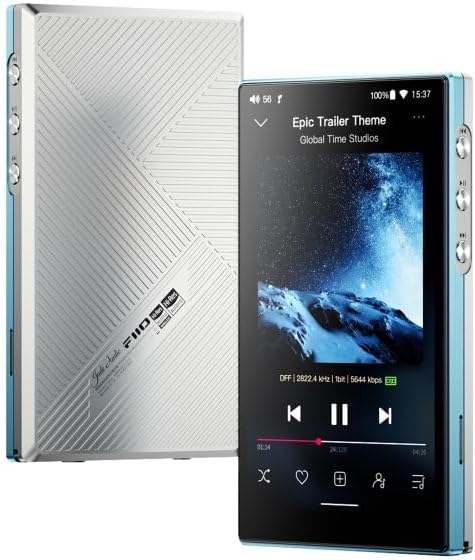
The sky-blue JadeAudio/FiiO JM21 3+32GB is functionally aligned with the black listing and carries the same 4.0 rating. It offers a polished, pocketable Android music player built around dual CS43198 DACs, a Snapdragon 680 processor, and a fully balanced output stage capable of reaching 700mW per channel.
We may earn a commission when you buy through this link, at no additional cost to you.
Its customized Android 13 operating system supports familiar streaming applications, including Spotify and Apple Music, so the device can serve as a central listening hub rather than an isolated file player. DAPS purification, dual femtosecond oscillators, and the fifth-generation FPGA focus on preserving signal integrity, including when the JM21 feeds an external USB DAC.
As with the black model, 32GB of internal storage is the most obvious constraint for owners of large DSD or high-resolution PCM libraries. Its 156g weight and 13mm thickness also make it one of the more convenient choices here, while the stated 12.5-hour playback figure supports use as an all-day portable source when paired with appropriate output settings.
The sky-blue JM21 is best for listeners who prioritize balanced power, portability, and app flexibility over maximum internal storage. Buyers should choose the color based on preference rather than expecting a meaningful acoustic difference, because the supplied specifications describe the same underlying audio architecture.
At 13mm thick and 156g, the JM21 is designed for one-handed use and easy portability. Its size is particularly helpful for listeners who want dedicated audio hardware without carrying a much larger touchscreen device.
The open Android environment allows familiar streaming applications to be installed as needed. This makes the player practical for listeners who alternate between subscription services, downloaded tracks, and external digital sources.
We may earn a commission when you buy through this link, at no additional cost to you.
The HiBy R4 has a 4.1 rating and is one of the most technically complete Android DAPs in this roundup. It combines an SD665 octa-core processor, Android 12, four DAC chips, an integrated Class A headphone amplifier, a 4.7-inch high-definition LCD, and both single-ended and balanced headphone outputs.
We may earn a commission when you buy through this link, at no additional cost to you.
Its audio specifications support up to native DSD256, PCM768kHz/32-bit, and MQA 16X unfolding. Separate PCM and DSD circuitry allows the DACs, low-pass filters, and power supplies to operate independently, while two low-phase-noise crystals and 28 high-precision tantalum capacitors support signal integrity. System-wide SRC bypass is another useful feature for listeners concerned about unnecessary resampling.
Wireless support is unusually comprehensive, including Bluetooth 5.0, UAT, LDAC, aptX, aptX HD, AAC, and SBC. Dual-band WiFi, DLNA, AirPlay, WiFi song transfer, and support for Spotify, Pandora, and Tidal make it broader than a local-only music player. The trade-off is size: the 4.7-inch display and 4500mAh battery create a larger device than the JM21 or F20 Pro.
The R4 is an excellent recommendation for listeners who want extensive format support, flexible wireless codecs, and a large screen without giving up expandable storage. It is a particularly good match for users of balanced headphones and hi-res libraries, provided they are comfortable carrying a more substantial Android DAP.
Independent PCM and DSD pathways are among the R4's most distinctive technical features. The dedicated filters and power supplies are designed to optimize each format rather than forcing both through an identical conversion and amplification path.
Support for LDAC, aptX, aptX HD, AAC, SBC, and UAT gives the R4 broad compatibility with wireless headphones. Dual-band WiFi and AirPlay add further flexibility for home listening and app downloads.
We may earn a commission when you buy through this link, at no additional cost to you.
The HiBy R6III 2025 is the most premium-oriented player in the list, combining four flagship Cirrus Logic CS43198 DACs with eight-channel monoblock output. Its 4.0 rating is supported by a specification set aimed at listeners who care about high-resolution local files, robust headphone amplification, and flexible digital connectivity.
We may earn a commission when you buy through this link, at no additional cost to you.
Class A and Class AB headphone amplifiers provide dedicated power suitable for large headphones and high-impedance in-ear monitors. The player supports native DSD512, PCM up to 768kHz, and MQA 16X playback. Internally, a Snapdragon 665 processor, 4GB of RAM, 64GB of storage, and expandable memory up to 2TB provide a capable platform for Android apps and local libraries.
Its connectivity is the standout practical feature. Separate 3.5mm and 4.4mm headphone outputs, line outputs, USB digital input and output, and coaxial digital output create options that go beyond a basic Android player. Bluetooth 5.0 includes LDAC, aptX, aptX HD, SBC, and AAC, while dual-band WiFi supports faster network activity.
This is the choice for buyers who want an expansive premium audio platform and are willing to carry a more substantial device. Android 12 is not the newest version in the group, but the stronger DAC, amplifier, and output specification makes the R6III 2025 especially compelling for high-end portable listening and desktop use.
Combining Class A and Class AB stages allows the R6III to address different output demands and headphone impedances. This is valuable for listeners who switch between sensitive in-ear monitors and large over-ear models.
USB digital input and output, coaxial output, line outputs, and dual headphone connections make the device useful in more than one role. It can function as a portable source, a desktop companion, or a central component in a larger listening setup.
We may earn a commission when you buy through this link, at no additional cost to you.
This second HiBy R4 listing retains the same 4.1 rating and core architecture as the primary R4 entry. It is worth including because it uses a separate product image and ASIN, allowing shoppers to compare the available listings while evaluating the same Android 12 hi-fi player.
We may earn a commission when you buy through this link, at no additional cost to you.
Its SD665 octa-core processor, four DAC chips, dual low-phase-noise crystals, 28 tantalum capacitors, and Class A headphone amplifier create a feature-rich signal chain. Support reaches native DSD256, PCM768kHz/32-bit, and MQA 16X unfolding, with system-wide SRC bypass designed to preserve source quality.
The 4.7-inch display improves navigation through large local libraries and streaming applications. Physical FN keys provide direct access to functions such as key lock and screen rotation, while the 3.5mm and 4.4mm outputs support both single-ended and balanced headphone connections. Bluetooth and dual-band WiFi broaden the device beyond local playback.
Because the supplied information describes the same R4 model, this listing is best viewed as an alternative storefront entry rather than a separate hardware category. Buyers should check which listing offers the desired configuration and should treat the larger screen and expanded storage as the main reasons to favor this model over more compact alternatives.
Dedicated FN keys reduce the need to navigate menus for tasks such as locking controls or rotating the screen. These conveniences are especially useful during commutes or listening sessions away from a desk.
Thirty-two gigabytes of internal storage is joined by support for expansion up to 2TB. That makes the R4 practical for listeners who want many lossless albums, DSD files, and downloaded streaming content on one device.
We may earn a commission when you buy through this link, at no additional cost to you.
The Sony NW-A306 Walkman has a 3.6 rating, making it the least highly rated product in this comparison, but it remains a distinctive option for listeners who value compact construction, Sony branding, and a more traditional Walkman experience with Android support.
We may earn a commission when you buy through this link, at no additional cost to you.
Its rigid aluminum frame and precisely engineered chassis are intended to improve sound quality, while the NW-A300 series PCM conversion supports the player's hi-res focus. It handles DSD formats up to 11.2MHz and offers 360 Reality Audio, alongside PC access for organizing a personal music collection.
The strongest practical specifications concern endurance and portability. Sony claims up to 36 hours of 44.1kHz FLAC playback, and the device is described as lightweight and designed for pockets. Its 32GB capacity may be enough for a curated collection, although no expandable-storage figure is supplied.
The NW-A306 is worth considering for buyers who prefer the Walkman form and Sony's established portable-audio approach. Compared with the more technically detailed HiBy, FiiO, and Surfans models, its listed specifications reveal less about amplifier power, wireless codecs, and balanced output, so it works best for listeners who prioritize portability and endurance over extensive connectivity.
The lightweight aluminum body is designed around portable use rather than a large-media-first form. Its more modest screen footprint can also make on-the-go operation less distracting than on larger Android DAPs.
The stated 36-hour FLAC playback figure is among the strongest endurance claims in this roundup. Actual results will vary with volume, output settings, wireless functions, and battery condition.
We may earn a commission when you buy through this link, at no additional cost to you.
The FiiO M21 Blue-Black earns a 4.0 rating and targets listeners who want a portable Android player with unusually high output power. Its Snapdragon 680, Android 13, 4GB of RAM, and 64GB of storage form a modern platform, while four CS43198 DACs provide a more elaborate conversion architecture than the JM21.
We may earn a commission when you buy through this link, at no additional cost to you.
Its patented Desktop Mode is the defining feature. When enabled, the player runs on external power while the internal battery neither charges nor discharges, and the output specification reaches 950mW. That approach is aimed at stationary use with demanding headphones rather than maximizing battery life in transit.
The fully balanced four-channel, eight-path design uses two-stage amplification, with voltage amplification followed by current boosting. Connections include dual 3.5mm and 4.4mm headphone or line outputs, SPDIF, and USB Audio. Independent line circuits and the stated 70% jitter reduction give the M21 credibility as both a portable and desktop-oriented source.
The Blue-Black M21 is ideal for someone who alternates between streaming on Android and high-resolution local files, especially when driving large headphones. It may be excessive for sensitive in-ear monitors or light travel use, but its strong drive and broad port selection make it a versatile premium-performance choice.
Desktop Mode allows the M21 to prioritize output capability while connected to external power. It is a practical solution for listeners who want more drive than they would normally seek from a battery-powered portable player.
SPDIF and USB Audio complement the 3.5mm and 4.4mm outputs. This makes the M21 easy to integrate with external DACs, powered speakers, or desktop headphone setups without relying on Bluetooth alone.
We may earn a commission when you buy through this link, at no additional cost to you.
The Surfans F20 Pro combines a 4.1 rating with a specification set that is difficult to overlook: dual ESS9018K2M DACs, dual OPA1612 operational amplifiers, DSD512 support, balanced output rated at 500mW, and Android 12 streaming. It is our best-budget recommendation because it delivers many premium-style features without the highest-tier component complexity.
We may earn a commission when you buy through this link, at no additional cost to you.
Audio support extends to 192kHz/24-bit PCM, while the 3.5mm single-ended output is rated at 125mW into 32 ohms and the 4.4mm balanced output at 500mW. Low-phase-noise oscillators are included, and the listed distortion figure of 0.0008% suggests that the manufacturer is targeting a clean signal path as well as adequate power.
Streaming applications such as Spotify, Apple Music, Tidal, and YouTube are supported on an eight-core Android 12 platform with 3GB of RAM and 32GB of internal storage. Bluetooth 5.0 with LDAC and dual-band WiFi provide useful wireless functions, while the included memory card and microSD expansion up to 1TB improve library flexibility.
The F20 Pro suits first-time Android DAP buyers who want balanced output and streaming support in a tactile, compact design. Its 2.7-inch touchscreen and 32GB base storage are less generous than larger rivals, but the CNC metal body, ALPS volume wheel, and strong output make it a particularly compelling entry point.
The 500mW balanced rating gives the F20 Pro enough stated capability for demanding over-ear headphones, while the 125mW single-ended path remains useful with easier-to-drive models and portable earbuds.
A tactile ALPS volume wheel provides straightforward adjustment, while the 2.7-inch touchscreen handles navigation and app use. That combination makes the player approachable without abandoning physical feedback.
We may earn a commission when you buy through this link, at no additional cost to you.
The JadeAudio/FiiO JM21 4+64GB in sky blue holds the highest rating in this group at 4.3. It keeps the core strengths of the smaller-capacity JM21 listings while offering 64GB of internal storage, making it the most balanced recommendation for listeners who want both app flexibility and room for local music.
We may earn a commission when you buy through this link, at no additional cost to you.
A Snapdragon 680 built on a 6nm process provides the performance foundation, and the deeply customized Android 13 system supports installation of streaming apps such as Spotify and Apple Music. Two CS43198 DACs, SGM8262 operational amplifiers, and a fully balanced circuit deliver the stated 700mW plus 700mW output capability.
The DAPS digital audio purification system, fifth-generation FPGA, and custom dual femtosecond crystal oscillators are designed to preserve original sampling rates for local playback, third-party apps, and output to an external USB DAC. At 156g and 13mm thick, the player remains easy to carry despite its higher storage configuration.
The 4+64GB JM21 is our editor's choice because it solves the main weakness of the base configuration without changing the core listening proposition. It is a strong match for balanced-headphone users who alternate between streaming and local files, and its 4.3 rating gives it the strongest user-feedback result in the supplied data.
Doubling the base storage to 64GB makes the JM21 more practical for listeners who keep downloaded albums, podcasts, or high-resolution files on the device. Streaming remains available, so local capacity and app flexibility do not have to be mutually exclusive.
DAPS purification and the fifth-generation FPGA are intended to maintain sampling-rate integrity across app playback and USB DAC output. These details are relevant for listeners who compare local and streamed sources closely.
We may earn a commission when you buy through this link, at no additional cost to you.
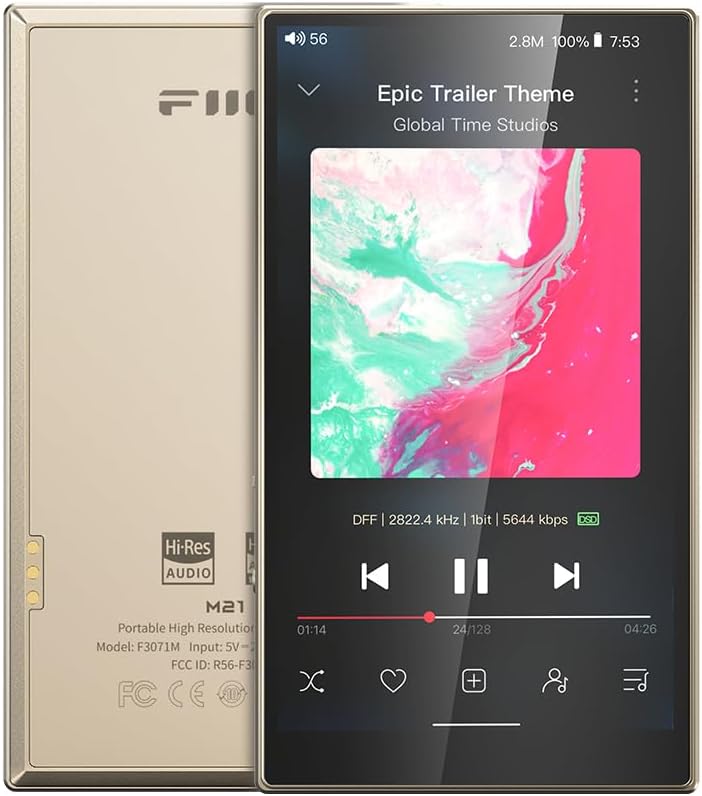
The Titanium Gold FiiO M21 shares the same 4.0 rating and core hardware as the Blue-Black M21 listing. Its defining attraction is the combination of four CS43198 DACs, Snapdragon 680 performance, Android 13, and up to 950mW output in Desktop Mode.
We may earn a commission when you buy through this link, at no additional cost to you.
The quad-DAC matrix uses a four-channel, eight-path fully differential design and a two-stage headphone amplifier. The first stage handles voltage amplification while the second increases current, an arrangement intended to provide dynamic range, noise immunity, and authority across demanding headphones.
Patented Desktop Mode lets the player operate entirely on external power while leaving the internal battery neither charging nor discharging. This protects battery life during stationary use and separates sustained maximum-output listening from ordinary portable operation. The M21 also provides dual 3.5mm and 4.4mm outputs, SPDIF, and USB Audio.
The Titanium Gold M21 is best for audiophiles who want a powerful portable Android source and may also use it with a desktop setup. Compared with the JM21 4+64GB, it offers a more elaborate DAC matrix and higher stated desktop output, while the JM21 retains the advantage of a stronger supplied user rating and greater portability emphasis.
The 950mW Desktop Mode specification and current-focused second amplification stage distinguish the M21 from lower-power portable players. It is particularly relevant to owners of large, high-impedance headphones.
Keeping the battery from charging or discharging in Desktop Mode reduces unnecessary cycling during external-power use. The result is a stationary listening mode designed to complement rather than replace portable operation.
We may earn a commission when you buy through this link, at no additional cost to you.
Choosing an Android DAP means balancing audio hardware, Android flexibility, output power, wireless support, storage, and portability. The most important factors depend on whether your priority is streaming, local hi-res files, sensitive earphones, large over-ear headphones, or a device that can serve both mobile and desktop systems.
Headphone output power is one of the most consequential specifications because it determines whether a player can control volume cleanly with your chosen headphones. The FiiO JM21 lists balanced output up to 700mW plus 700mW, while the M21 reaches 950mW in Desktop Mode and the Surfans F20 Pro lists 500mW balanced output into 32 ohms. These figures are not perfectly comparable because test conditions and architecture differ, but they provide a useful indication of intended drive capability.
Choose sufficient power for your headphones. Sensitive in-ear monitors usually need less, while large over-ear models and high-impedance headphones benefit from stronger balanced amplification. Also check whether the player offers true balanced output or only a 4.4mm socket, because the two are not interchangeable.
A premium DAP should do more than decode familiar files. The HiBy R4 uses four DAC chips with separate PCM and DSD circuitry, the R6III 2025 uses four CS43198 DACs with monoblock output, and the FiiO models use dual or quad CS43198 configurations. The listed format ceilings range from DSD256 and PCM768kHz/32-bit on the R4 to native DSD512 on the R6III and Surfans F20 Pro.
Prioritize the formats in your actual library and avoid paying attention to headline figures you will never use. Dual architecture, low-phase-noise crystals, FPGA-based processing, and SRC bypass can be meaningful for dedicated listeners, but practical usability, drive, and battery life should remain central.
Android capability turns a DAP into a flexible music platform, but the degree of app support varies by manufacturer. The FiiO JM21 and M21 use customized Android 13 systems, while the HiBy R4, R6III 2025, and Surfans F20 Pro use Android 12. The supplied information states that streaming applications such as Spotify, Apple Music, Tidal, Pandora, YouTube, and others can be installed on relevant models.
Check whether your preferred service is explicitly supported and whether the manufacturer permits installation of third-party apps. A newer Android version may improve app compatibility, but the audio hardware, input controls, and connection options ultimately determine much of the daily experience.
Storage is especially important if you own hi-res files, download streaming content for offline use, or want to carry a large library. Internal capacities range from 32GB on the Sony NW-A306 and several Android DAPs to 64GB on the HiBy R6III 2025, FiiO M21, and FiiO JM21 4+64GB. The HiBy models support expansion up to 2TB, while the Surfans F20 Pro supports up to 1TB and includes a memory card.
Choose capacity based on your collection rather than the largest available figure. If you mainly stream and use WiFi, 32GB may be enough. If you routinely store DSD, FLAC, and MQA files, favor 64GB or a model with clearly documented microSD expansion.
Wireless performance depends on both the transmitter and the receiving headphones. The HiBy R4 lists UAT, LDAC, aptX, aptX HD, AAC, and SBC over Bluetooth 5.0, while the FiiO M21 listing specifically mentions LDAC and the Surfans F20 Pro combines Bluetooth 5.0 with LDAC. Dual-band WiFi is also common and assists app downloads and wireless transfer functions.
Match the codec support to your headphones; a player advertising a codec cannot improve the result if the receiver does not support it. For listeners who care most about fidelity, wired output remains the simplest route, while Bluetooth is best viewed as a convenience feature rather than a replacement for a full wired chain.
Battery life can determine whether a player works for an entire day of listening. The FiiO JM21 lists up to 12.5 hours of playback, the Surfans F20 Pro includes a 4500mAh battery, and the Sony NW-A306 claims up to 36 hours of 44.1kHz FLAC playback. Results vary with display brightness, wireless radios, volume, output mode, and battery condition, so these figures should be treated as manufacturer claims rather than guarantees.
Look for power features that match your habits. The FiiO M21's Desktop Mode uses external power and prevents battery cycling during stationary listening. Frequent travelers should prioritize endurance, while desktop-oriented users may value maximum output more than unplugged runtime.
An Android DAP must still be comfortable to operate while walking, commuting, or using it at a desk. The HiBy R4 uses a 4.7-inch high-definition LCD and physical FN keys, the Surfans F20 Pro uses a 2.7-inch touchscreen and tactile ALPS volume wheel, and the FiiO JM21 prioritizes a compact 13mm-thick, 156g body. Each approach suits different preferences.
Choose a large screen if you navigate long libraries or watch video, and a compact screen if pocketability matters more. Physical volume control is convenient for portable use, while desktop users may appreciate a larger display. Check the entire control layout rather than assuming every Android DAP behaves like a phone.
Modern DAPs can function as more than isolated portable players. The FiiO JM21 supports USB DAC output, the M21 adds SPDIF and USB Audio with separate line amplification circuits, and the HiBy R6III 2025 includes USB digital input and output plus coaxial digital output. These connections can improve flexibility with external equipment and desktop headphone systems.
Map your listening setup before buying. A balanced headphone output is useful for portable listening, but USB or coaxial digital connections may be more valuable if you plan to use the player as a desktop source. Ensure the supported direction and format of each digital connection match your equipment.
Begin by charging the player fully, installing only the streaming and utility apps you need, and checking the firmware and audio settings. If the model includes a memory card or supports microSD expansion, format it according to the manufacturer's instructions before copying files. Use the provided or current manufacturer-approved file manager and transfer standards for the formats you intend to play.
Choose the correct output for your headphones. A 3.5mm connection suits conventional single-ended headphones, while a 4.4mm balanced connection should be used only with compatible balanced cables and headphones. Keep gain requirements in mind, start at a moderate volume, and avoid repeatedly changing output modes while a file is playing. For digital connections, confirm that the software recognizes the DAP as an audio device before changing sample-rate settings.
Protect the player by keeping the headphone jack and ports clear, using a case during travel, and avoiding moisture, direct heat, and prolonged exposure to strong sunlight. Update software periodically, keep some free storage available, and back up important local music files. For long-term storage, maintain the battery at a moderate charge level and check it periodically rather than leaving the device unused for extended periods.
An Android DAP is a portable digital audio player that uses an Android operating system while adding dedicated headphone circuitry, storage, controls, and battery life. Unlike a smartphone, it is designed primarily for listening to local files or streaming services through improved portable audio hardware. It can therefore combine app flexibility with a more focused hi-fi listening experience.
It depends on the listener and the device. A well-equipped Android DAP may provide stronger headphone drive, balanced outputs, more storage options, dedicated digital outputs, and longer endurance than a phone. A smartphone remains more convenient for communication and general apps. Your choice should reflect how much you prioritize audiophile hardware, portability, and app-based flexibility.
A balanced output is worthwhile if your headphones support it and you listen at higher volumes or use larger, harder-to-drive models. It can provide additional output capability and a different noise environment compared with single-ended use. If your headphones are single-ended, a 4.4mm jack alone will not create balanced performance, so ordinary 3.5mm equipment remains the sensible choice.
The supplied information explicitly lists support for Spotify, Apple Music, Tidal, Pandora, and YouTube across relevant models. Exact app availability and behavior can vary by operating-system version and manufacturer customization. Confirm support for your required services before purchasing and keep the software current after setup.
A 32GB model works well for streaming, podcasts, and a curated collection, while 64GB offers more freedom for lossless music. Hi-res files and DSD albums can consume substantial space, so listeners with large libraries should prioritize models with microSD expansion. The HiBy R4 and R6III 2025 support expansion up to 2TB, while the Surfans F20 Pro supports up to 1TB.
A wired connection generally offers the most direct route and is preferable when chasing maximum fidelity or consistent performance. Bluetooth has improved substantially, and LDAC, aptX HD, and other high-quality codecs can provide good results. The final experience also depends on the receiving headphones, environmental interference, and the implementation in both devices.
The FiiO JM21 is explicitly described as 13mm thick and 156g, making it one of the most compact options here. The Surfans F20 Pro is also relatively small, with a 2.7-inch touchscreen, while the HiBy R4's 4.7-inch display makes it the larger of the group. Pocketability depends on both dimensions and your comfort with touchscreen or physical controls.
They matter if your library includes those formats and your playback chain can reveal meaningful differences. The models in this guide support high ceilings, including native DSD256 or DSD512 and PCM rates up to 768kHz. Format capability alone does not guarantee superior results, so headphone quality, implementation, file quality, and personal preference remain equally important.
The Surfans F20 Pro is the best-budget starting point, pairing dual ESS9018K2M DACs with 500mW balanced output, Android 12, LDAC, and expandable storage. The JadeAudio/FiiO JM21 4+64GB is the editor's choice for its stronger user rating, generous storage, compact construction, and 700mW balanced output. The HiBy R6III 2025 stands as the premium option, with four CS43198 DACs, Class A and AB amplification, extensive digital connections, and native DSD512 support.
Prioritize the feature that affects your daily use most: adequate output power for your headphones, enough storage for your files, dependable streaming support, or a control layout that feels natural. Small-bodied listeners may favor the JM21, screen-focused buyers may prefer the HiBy R4, and those with large headphones or desktop ambitions should examine the M21 or R6III 2025.
Specifications can change between models, revisions, and marketplace listings, so confirm the processor, DAC count, wireless codecs, storage support, ports, battery configuration, and included accessories before buying. Checking current prices and availability is also important because Android DAPs are specialized hardware with limited release cycles and varying package configurations.