
Neoteck 10kHz LCR Meter Tweezers
4.7Editor score
Automatic component identification
Six-in-one test functions
Rotatable color display
Open, load, and short calibration
Discover the best Lcr Meter Tweezer options by comparing accuracy, ranges, frequencies, displays, accessories, and repair applications for hobbyists.
LCR meter tweezers combine a component meter with a precision handheld probe, making them especially useful for identifying and testing tiny surface-mount parts. A capable model should measure resistance, capacitance, inductance, and diodes while offering clear readings, practical test frequencies, and dependable contact on densely populated circuit boards.
We compared all ten models by examining their stated measurement ranges, accuracy, frequency options, secondary parameters, display designs, power systems, calibration features, and included accessories. The list covers portable FNIRSI, AUTOOL, Neoteck, ALIENTEK, and mini models as well as higher-end Smart Tweezers and Pro1 instruments for different repair and laboratory needs.
Each pick highlights the features that distinguish it within the category and explains where it may be the most sensible choice. Ratings, specifications, and availability can change over time, as can pricing and promotional availability, so readers should confirm the latest listing details before making a purchase.
4.7Editor score
4.3Editor score

4.7Editor score
The table below compares all ten LCR meter tweezers by core measurement capabilities, display characteristics, access modes, and practical extras. It is designed to make it easier to distinguish everyday repair tools from higher-frequency, laboratory-oriented, or feature-rich models.




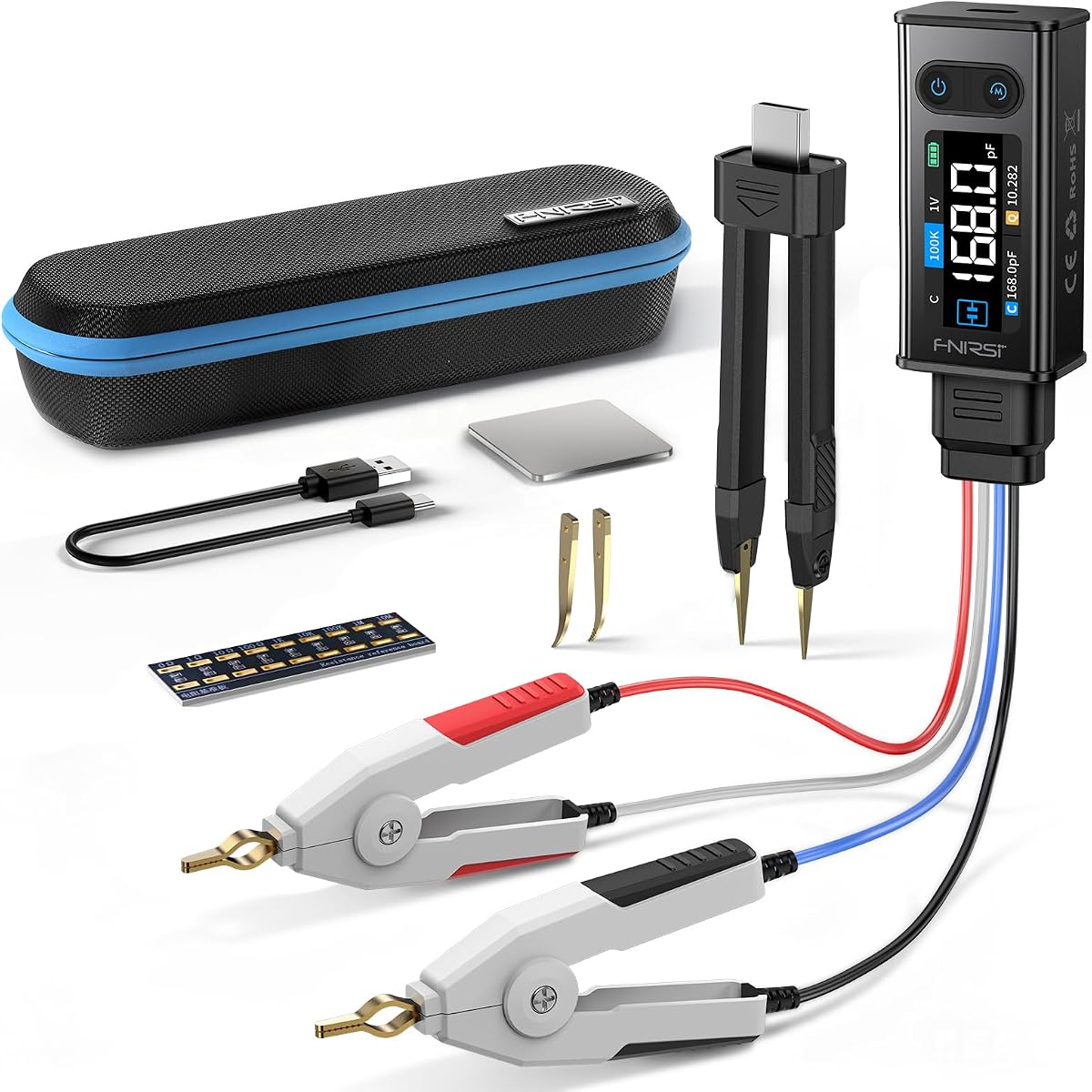
The FNIRSI LCR-ST2 is a strong all-round choice for electronics technicians who want one instrument to handle SMD parts, through-hole components, and broader diagnostic checks. Its 4.3 rating reflects a capable feature set, while the combination of 100 kHz testing, voltage measurement, continuity checks, and automatic component sorting makes it more versatile than a basic resistance-capacitance tester.
We may earn a commission when you buy through this link, at no additional cost to you.
Its most useful features include four selectable RMS test levels and both series and parallel modes. The ability to display primary values such as resistance, capacitance, inductance, and impedance alongside secondary values including reactance, dissipation factor, quality factor, and phase angle gives users more context than a single-number reading. Kelvin clips, gold-plated tweezer tips, and hooks broaden the contact options for tiny components and larger leads.
There are trade-offs. The display is fixed rather than rotating, so users working from different angles may need to reposition themselves or the board. The extensive menu can also feel complex for a first-time LCR user. Despite that, the measurement range, frequency selection, interchangeable tips, and rechargeable 300 mAh battery make these inconveniences manageable for a serious repair bench.
Buy the LCR-ST2 if you want one instrument for mixed electronic repair, board-level troubleshooting, and component inspection. It is particularly attractive to users who value 100 kHz capability, accessory versatility, and the option to examine secondary component parameters without moving to a separate bench meter.
The frequency options extend from 100 Hz through 100 kHz, making the meter useful for larger electrolytic capacitors and smaller RF-oriented components. Select a frequency appropriate to the component and application rather than assuming one setting suits every test.
Kelvin clips, gold-plated tips, and hooks allow the same meter to move from microscopic SMD components to larger through-hole parts. The plug-and-swap design also makes it easier to keep a suitable contact method ready for each repair.
We may earn a commission when you buy through this link, at no additional cost to you.
The Smart Tweezers ST5S stands out as a precision-focused option for users who care more about measurement confidence than extensive record keeping or signal generation. It carries a 4.7 rating and advertises 0.1% accuracy, automated component identification, and both automatic and manual operating modes for capacitance, resistance, inductance, impedance, and ESR.
We may earn a commission when you buy through this link, at no additional cost to you.
The ClearValue OLED display and Swiss-made 24K gold-plated test leads reinforce the instrument's professional positioning. A calibration certificate is included, which can be useful when documenting instrument condition or performing controlled work. Spare test leads reduce downtime, while portable and clam-shell cases make the set easier to organize and transport between a bench, field service call, and classroom.
The main limitation is that the ST5S prioritizes core measurement quality rather than modern workflow extras. It does not list the broad data export, rotating display, or advanced signal features found on some newer competitors. Its higher-end positioning also means it may not be the most economical choice for occasional hobby use.
This is a strong recommendation for repair professionals, calibration-minded users, and anyone working with small components where contact consistency and accuracy justify a premium instrument. For basic household component checks, a lower-cost model will usually provide enough capability, but the ST5S is better suited to repeatable professional measurements.
The stated 0.1% accuracy, calibration certificate, and gold-plated leads make the ST5S attractive for users who need confidence in small-component readings. Regular calibration and careful probe contact remain important regardless of the instrument's published specification.
Included cases, spare leads, and a pocket-style format suit technicians who work across multiple locations. The kit is more travel-friendly than a conventional bench meter with separate probes and leads.
We may earn a commission when you buy through this link, at no additional cost to you.
The Pro1 LCR Meter is the strongest choice in this list for buyers who prioritize stated accuracy and a broad range of component values. Its 5.0 rating, 100 kHz maximum frequency, and tight accuracy specifications distinguish it from many compact tweezer-style alternatives, while the smart SMD tweezer configuration keeps it practical for component-level work.
We may earn a commission when you buy through this link, at no additional cost to you.
The meter offers five frequencies at 100 Hz, 120 Hz, 1 kHz, 10 kHz, and 100 kHz, along with three RMS test voltages. Its stated basic accuracy is 0.1% for resistance, 0.2% for inductance, and 0.2% for capacitance. Measurement limits extend from 20 mΩ to 10 MΩ, 0.1 pF to 10 mF, and 10 nH to 1 H.
Its limitations relate primarily to convenience rather than core functionality. The feature list is shorter than that of several newer models, with no mention of automatic data export, rotating screens, signal generation, or rechargeable operation. Users who need a portable instrument for field repairs may prefer one of the compact units, although the tweezer format still supports direct component contact.
Choose the Pro1 when accurate SMD identification and a wide measurement envelope matter more than wireless data workflows or modern touchscreen-style displays. It is especially compelling for advanced electronics users, repair specialists, and laboratories that routinely need 100 kHz measurements and low-value component detection.
A minimum resistance of 20 mΩ, capacitance of 0.1 pF, and inductance of 10 nH extends usefulness to extremely small parts. These low limits help when identifying components that are difficult to measure with entry-level handheld multimeters.
Multiple frequencies and RMS test levels let users tailor measurements to different component families. Selecting the correct condition can make comparative results more meaningful than relying on a single automatic setting.
We may earn a commission when you buy through this link, at no additional cost to you.
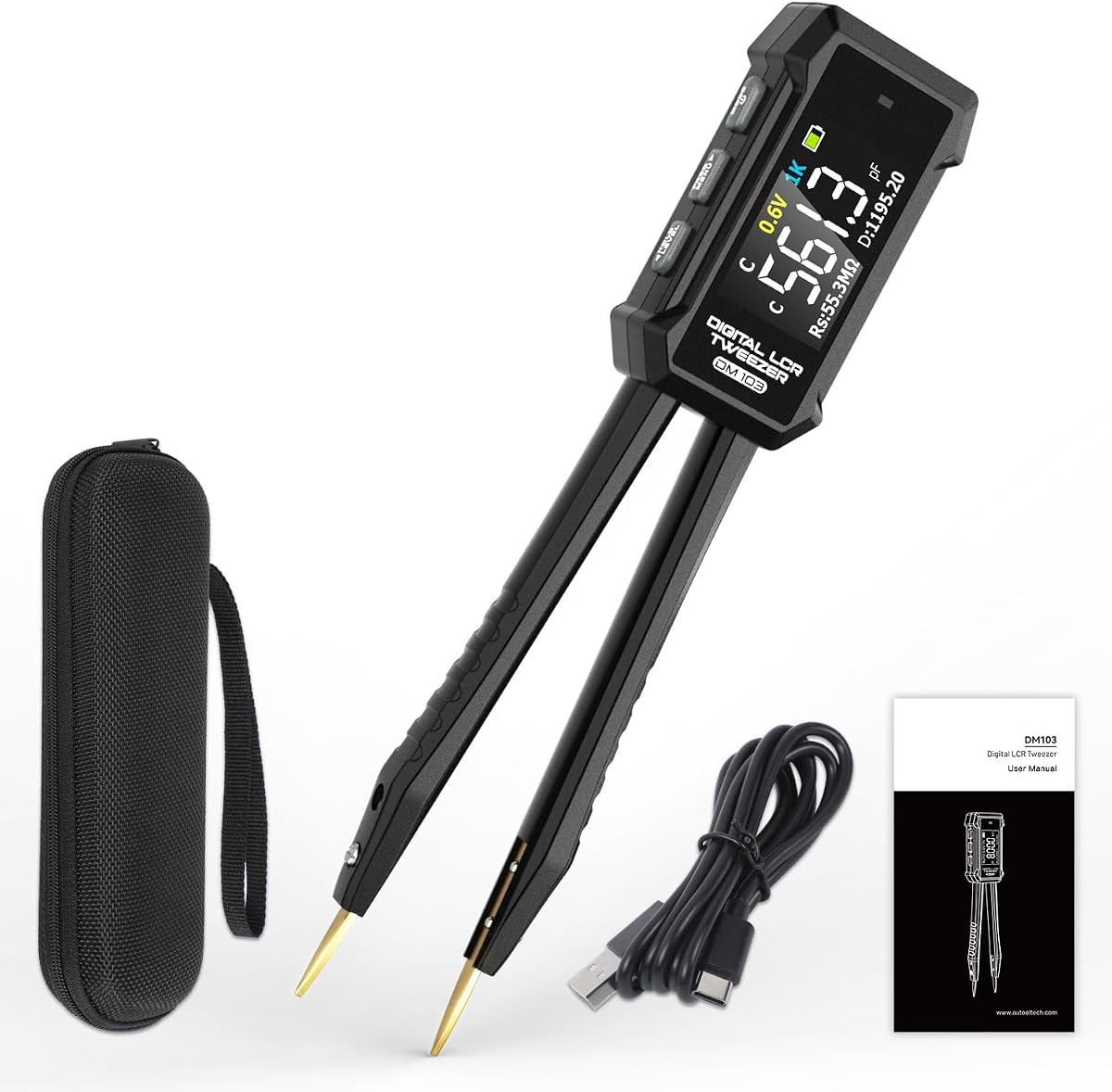
The DM103 LCR Meter Tweezer is a feature-rich option for electronics enthusiasts who want calibration control and a broad inductance range. Its 4.2 rating does not make it the highest-rated product here, but the stated 0.5% accuracy, adjustable frequencies, user-defined calibration, and detachable gold-plated tips create a compelling package for hands-on users.
We may earn a commission when you buy through this link, at no additional cost to you.
Automatic identification covers resistors, capacitors, and inductors, while the meter also supports diode and continuity testing. Primary and secondary values appear together, reducing the need to switch modes repeatedly. The 10 mΩ to 10 MΩ resistance range, 1 pF to 20 mF capacitance range, and 1 μH to 60 H inductance range cover many common service components.
The tradeoff is that the maximum 10 kHz frequency may not satisfy users working with RF components or applications where 100 kHz behavior matters. Calibration is another consideration: the user-defined process can help control long-term drift, but it requires suitable reference resistors and a methodical procedure rather than a casual one-touch adjustment.
This model is a good match for DIY builders, students, and repair technicians who value screen orientation, bilingual support, and calibration flexibility. It is less compelling for specialized RF work than the 100 kHz alternatives, but it offers unusually broad everyday component coverage.
The user-defined calibration function lets users check the meter against standard resistors across selectable ranges. This can help compensate for long-term drift and establish greater confidence in repeat measurements.
The tweezer form keeps both measurement tips in one hand, while the flip OLED display can be oriented for the user's position. Detachable tips also support replacement and allow the contact geometry to suit different SMD packages.
We may earn a commission when you buy through this link, at no additional cost to you.
The Neoteck 10kHz LCR Meter Tweezers deliver one of the strongest feature sets for an accessible entry into component testing. Its 4.7 rating is among the best in the group, and the meter supports resistance, capacitance, inductance, diode, continuity, and automatic component identification in one compact instrument.
We may earn a commission when you buy through this link, at no additional cost to you.
The display can show D, Q, Z, X, and ESR values in addition to the main measurement. Three selectable frequencies and two test levels provide useful control, while open, load, and short calibration address different sources of error. Data hold, internal storage, and USB transfer to Excel make the tool more useful for inspection work than a minimal tester.
The main limitation is its 10 kHz ceiling, which places it below the 100 kHz FNIRSI, Pro1, and ZT-MD2 options for RF-focused testing. Users who do not understand dissipation factor, quality factor, and reactance may also find the secondary displays more technical than necessary, even though they add value for deeper analysis.
The Neoteck is a compelling recommendation for makers, repair learners, and bench technicians who want many functions without moving to a premium instrument. The included charging cable, spare tip, test board, and manual make it especially attractive as a ready-to-use electronics toolkit.
Open, load, and short procedures target different measurement errors. Running the appropriate calibration after changing tips or probe configuration can improve consistency, especially when working with very small parts.
Stored readings can be transferred through USB and exported in Excel format. This is useful for production inspection, board repair logs, and comparisons between known-good and suspect components.
We may earn a commission when you buy through this link, at no additional cost to you.
The ALIENTEK LT1 is the top-rated compact model in this comparison, earning a 4.8 rating and distinguishing itself through a broad collection of test functions. It measures resistance, capacitance, inductance, diodes, and frequency while also offering voltage measurement, continuity-style work, and automatic component recognition.
We may earn a commission when you buy through this link, at no additional cost to you.
Its square-wave, sine-wave, triangle-wave, and step-wave signal generator adds a dimension rarely included with pocket LCR tweezers. Frequency sweeps can show how component characteristics change across a selected range. Four RMS test levels, automatic left- and right-hand recognition, rotating display, and Excel export further support bench and inspection workflows.
Its 25 H inductance maximum and 25 mF capacitance maximum extend beyond several similarly compact products, although the 10 kHz frequency ceiling still limits RF use. The tweezer-only design is also less forgiving than a standard multimeter when checking a loose component or tracing a larger circuit path.
Choose the LT1 for technicians who want component analysis and signal functions in a portable format. It is particularly useful for education, prototypes, and board repair where experimenting with frequency response is more important than carrying a full bench instrument.
The built-in generator can provide several waveform shapes for circuit experiments and component characterization. Sweep functionality makes it easier to observe how capacitance, inductance, impedance, or related parameters vary across frequencies.
Left- and right-hand recognition rotates the screen to keep readings readable. Automatic record saving and PC transfer reduce the need to manually transcribe readings during repetitive testing.
We may earn a commission when you buy through this link, at no additional cost to you.
The AUTOOL DM103 is designed for users who want a particularly legible meter and straightforward automatic identification. Its 4.5 rating reflects a balanced feature set, with resistance, capacitance, inductance, diode, and continuity testing supported through a compact pair of tweezers.
We may earn a commission when you buy through this link, at no additional cost to you.
The self-luminous HD IPS color display is the model's defining feature. It should remain clear in bright workshops and low-light repair environments while presenting the main reading without unnecessary visual clutter. Automatic recognition removes the need to select R, C, or L manually, and simultaneous primary and secondary displays include RS, D, Q, Z, and X.
Accuracy is stated at ±0.5%, with 100 Hz, 1 kHz, and 10 kHz frequencies and 0.3 V or 0.6 Vrms excitation levels. Gold-plated precision probes support stable contact on tiny SMD components. The tradeoff is that this model does not list a battery capacity, and its 10 kHz maximum is less capable than several 100 kHz alternatives for specialized RF work.
The AUTOOL DM103 is a good fit for professional repair, lab diagnostics, and SMD inspection where screen readability matters. It is also useful for users who want compact tweezer ergonomics without giving up detailed secondary parameters.
The IPS panel offers strong contrast and fast response, helping readings remain visible on crowded workbenches. Automatic component identification further reduces time spent navigating menus in the middle of a repair.
Showing R, C, or L alongside RS, D, Q, Z, and X gives users a more complete view than a basic tester. These secondary values can help reveal losses, poor quality factors, and unexpected phase behavior.
We may earn a commission when you buy through this link, at no additional cost to you.
The Global Specialties LCR-58 is a dedicated tweezer LCR meter for users who value straightforward operation over an expansive software and display feature set. Its 4.5 rating indicates solid customer reception, while DCR measurements and parallel or series modes cover the central needs of component identification and comparison.
We may earn a commission when you buy through this link, at no additional cost to you.
Useful protection and convenience features include overload protection, a low-battery indicator, automatic power-off, and data hold. These are practical additions for a portable instrument because they help protect the meter and make it easier to preserve a reading while adjusting component position or inspecting the result.
The LCR-58 publishes fewer detailed specifications than the newer models, so buyers cannot compare specific frequencies, range limits, or accuracy claims from the supplied information. It also lacks the explicit secondary-parameter displays, data export, rotating screens, and signal generation offered by several competitors. That reduced feature set is only a disadvantage for users who need deeper analysis.
Choose the LCR-58 when ease of use, basic protection, and a focused tweezer format are priorities. It may suit quick service checks and users who already understand the basic LCR measurement process, but buyers wanting precise published limits and modern workflow tools should examine the specification list closely.
The ability to switch measurement modes supports different circuit interpretations and component comparisons. Choosing the correct mode is essential when evaluating how a part behaves within a particular circuit arrangement.
Overload protection, a battery warning, and automatic shutdown reduce avoidable instrument stress. Data hold keeps a measurement visible while the user repositions the probes or checks the board.
We may earn a commission when you buy through this link, at no additional cost to you.
The ZT-MD2 Mini Smart Tweezer is a compact model that combines a perfect 5.0 customer rating with a broad set of measurement and analysis functions. It handles capacitors, resistors, inductors, diodes, continuity, and buzzer testing while providing a CNC metal housing for a more substantial feel than many lightweight plastic tools.
We may earn a commission when you buy through this link, at no additional cost to you.
Its parameter list is extensive, covering Rs, Rp, Cs, Cp, Ls, Lp, P, D, Q, X, and Z. Test levels range from 0.1 V to 0.6 V, while automatic component recognition and simultaneous primary and secondary displays reduce setup time. Voltage measurement, adjustable frequency, frequency scanning, and five frequency choices extend the instrument beyond a basic component identifier.
The main uncertainty comes from limited information about accessories, display size, power, and calibration in the supplied listing. That makes it harder to compare ergonomics and long-term ownership details with models that publish a fuller kit description. Its 100 kHz ceiling is nevertheless a significant advantage over 10 kHz compact competitors.
The ZT-MD2 is best suited to users who want a small, metal-bodied instrument with impressive ratings and extensive measurements. It should appeal to repair technicians and advanced hobbyists who value frequency scanning and multiple parameter modes more than detailed data export or explicitly documented calibration features.
Supporting series and parallel equivalents alongside phase, dissipation, quality, reactance, and impedance values gives the tool considerable analytical depth. Users can inspect more than a nominal resistance, capacitance, or inductance value.
The 100 kHz maximum and adjustable frequency support make the ZT-MD2 more versatile for small capacitors and RF-adjacent components. Sweeping frequency can reveal behavior that a single fixed test frequency misses.
We may earn a commission when you buy through this link, at no additional cost to you.
The FNIRSI LCR-ST1 is a portable SMD testing tool aimed at users who want core LCR measurements, automatic recognition, and data export in a compact package. Its 4.3 rating is solid, and the supported resistance, capacitance, and inductance ranges cover many common components encountered during board-level repair.
We may earn a commission when you buy through this link, at no additional cost to you.
Three frequencies are available at 100 Hz, 1 kHz, and 10 kHz, together with two RMS test voltages. The meter displays primary and secondary parameters and supports D, Z, Q, R, and ESR readings. Records can be saved and transferred to a PC through Excel export, making it practical for users who need to document repetitive inspections.
Two head styles—pointed and hook—help the user handle different component shapes, while the storage bag and data-cable charging support portable use. The fixed 1.14-inch color screen cannot flip or rotate, which may be inconvenient for some working positions. Compared with the LCR-ST2, this model does not list voltage measurement or 100 kHz testing.
Choose the LCR-ST1 for mobile repair work involving small SMD components when portability and record keeping matter. It is a sensible companion tool for a technician, while the LCR-ST2 is the better choice when voltage testing, higher frequencies, and interchangeable clips are priorities.
Automatic recognition helps shorten the sequence used to inspect unidentified board components. Presenting both primary and secondary readings gives users a useful cross-check rather than relying on one isolated value.
Automatic record storage and Excel export support inspection notes, repair logs, and component comparisons. The included pouch makes the meter easier to carry between jobs without leaving tips or accessories behind.
We may earn a commission when you buy through this link, at no additional cost to you.
The best LCR meter tweezer depends on the components you test, the precision you need, and how you record results. Compare measurement range, frequency support, contact methods, display usability, calibration, and power requirements before choosing a model.
Accuracy determines how closely the displayed value reflects the component under test. The Pro1 lists 0.1% basic accuracy, while the Smart Tweezers ST5S advertises 0.1% accuracy; several compact DM103 models state 0.5%. These figures apply under their specified test conditions and should not be treated as a guarantee of identical performance across every range. A higher stated figure is useful for comparing nominal parts, detecting subtle changes, and performing quality-control work.
Accuracy also depends on correct probe placement, clean contacts, suitable frequency, and appropriate test voltage. Treat the published specification as one part of the measurement system rather than a substitute for careful technique.
Test frequency affects how capacitors, inductors, resistors, and ESR readings are interpreted. Models limited to 10 kHz cover many routine repair tasks, while the FNIRSI LCR-ST2, Pro1, and ZT-MD2 reach 100 kHz for broader suitability with smaller or RF-oriented parts. Four RMS levels on the FNIRSI LCR-ST2 and ALIENTEK LT1 also give more control than basic models with only one or two levels.
Choose frequencies based on the component and application, not simply the largest number. Higher frequencies can be valuable for RF and capacitor work but may not represent a component's behavior in a low-frequency circuit.
The measurement range determines which component values the meter can identify. Most products cover 10 mΩ to 10 MΩ for resistance and begin near 1 pF for capacitance, but inductance limits vary. The DM103 extends to 60 H, the ALIENTEK LT1 to 25 H, and several others to 10 H. The Pro1 goes further at the low end with 20 mΩ resistance, 0.1 pF capacitance, and 10 nH inductance.
Match the limits to the component values in your work. A wide range is advantageous for general repair, but a low minimum is especially important when testing very small SMD resistors or capacitors.
Primary R, C, or L values tell you what a component is, but secondary parameters can reveal its condition. Quality factor can indicate how sharply an inductor or capacitor resonates, dissipation factor describes energy loss, ESR reveals equivalent series resistance in a capacitor, and impedance or reactance can reveal unexpected behavior. Models such as the AUTOOL DM103 and ZT-MD2 display a wide collection of these values.
These readings are most useful when comparing a suspect part with a known-good one or examining a component at multiple frequencies. They require some interpretation, so beginners can begin with the primary value and use secondary readings to support diagnosis.
Tweezer contact is most effective on small SMD parts, but different geometries suit different packages. Pointed tips can reach tightly packed components, hooks may make contact on larger leads easier, and Kelvin clips can provide a more controlled connection to through-hole or board-mounted parts. The FNIRSI LCR-ST2 includes clips, gold-plated tips, and hooks, while the Neoteck kit includes a spare tip and test board.
Look for detachable or interchangeable contacts as well as gold plating or other contact materials. Replaceable tips are valuable because contamination, wear, or a bent tip can undermine otherwise good readings.
A clear display is essential when the meter is held close to a circuit board. The AUTOOL DM103 uses a self-luminous IPS panel, the DM103 offers a flip OLED screen, the Neoteck and ALIENTEK models support rotation, and the ZT-MD2 lists simultaneous primary and secondary parameters. The FNIRSI LCR-ST1 and LCR-ST2 use fixed screens, so users may need to orient the board or their body around the instrument.
Consider brightness, color contrast, how many parameters appear at once, and whether the display can rotate. A large screen is helpful for initial identification, while compact displays can make a tool easier to balance over tiny components.
Calibration helps remove systematic errors introduced by probe contact, stray capacitance, residual resistance, and long-term component drift. The Neoteck supports open, load, and short calibration, while the DM103 offers user-defined calibration using standard resistors across selectable ranges. Models with a calibration certificate, such as the Smart Tweezers ST5S, may appeal to users who require more controlled documentation.
Calibration is especially important when comparing small values or performing repeated inspections. Follow the procedure consistently, use suitable standards, and recalibrate when tips are changed or after significant environmental shifts.
Data storage turns a component tester into a more useful inspection tool. The FNIRSI LCR-ST1, Neoteck, and ALIENTEK LT1 can save records and transfer them to a PC through Excel-compatible export. This helps document repairs, build inspection logs, and compare multiple readings without manually copying every result.
Export is less important for occasional hobby testing than for production, quality assurance, or repeated board diagnosis. Confirm that the supplied connection method and file format suit your computer and record-keeping process before purchasing.
Rechargeable Type-C power makes a tweezer meter convenient for mobile repair. The FNIRSI LCR-ST2 has a stated 300 mAh battery, the DM103 uses a 400 mAh rechargeable cell, and the ALIENTEK LT1 also lists a 400 mAh battery. The Neoteck supports Type-C charging and automatic power-off, although its supplied information does not state a battery capacity. The Global Specialties LCR-58 lists a low-battery indicator and automatic shutdown.
For bench use, charging convenience matters less than uninterrupted power. For field work, battery capacity, charging cable inclusion, auto power-off, and a storage pouch can influence which instrument is more practical.
Start by inspecting the tweezer tips and confirming that the meter is charged or connected to its intended power source. Turn the instrument on, select the required test frequency and voltage, and complete the appropriate open, short, or load calibration if the model supports it and the task requires consistent readings. For a first check, measure a known-good component with a verified value.
Identify the component, remove it from the circuit when necessary, and place the tips across its two terminals with light, even pressure. Too little pressure can produce an open contact, while excessive force can damage tiny SMD parts or shift the component. Read the primary value and use secondary parameters for additional evaluation, especially when comparing a suspect part with a known-good reference.
Keep the tips clean and dry, avoid scraping them against solder joints, and return the instrument to its case or pouch after use. Periodically check calibration against suitable references, update firmware when supported, and replace worn or contaminated tips. Do not measure energized circuits unless the instrument and application explicitly support that operation.
An LCR meter tweezer identifies and measures resistance, capacitance, inductance, and sometimes diodes or continuity. Its pointed contact tips make it especially useful for surface-mount components on densely populated circuit boards. It can also help locate failed parts, compare known-good and suspect components, and support board-level troubleshooting.
Yes. The tweezer form is particularly well suited to small SMD resistors, capacitors, and inductors. Contact quality still matters, so the tips should meet both terminals cleanly without forcing the component. Very low-value parts may require an open, short, or load calibration to produce dependable readings.
A 10 kHz maximum is sufficient for many common repair tasks, while 100 kHz support offers more flexibility for small capacitors and RF-adjacent work. The better choice depends on the components involved. Match the meter to the circuit and component characteristics rather than treating the higher frequency as automatically superior.
ESR is equivalent series resistance, D is dissipation factor, Q is quality factor, Z is impedance, and X is reactance. These values help describe component losses and behavior beyond a basic capacitance or inductance reading. They are especially useful for spotting aged capacitors, poor inductors, and components that differ from known-good examples.
For the most reliable isolated measurement, removing the component from the circuit is advisable. In-circuit readings can be influenced by parallel paths, surrounding circuitry, and board leakage. Some in-circuit troubleshooting is still useful for comparison, but it should not be treated as the same as an isolated component measurement.
Calibration frequency depends on use, environmental conditions, tip condition, and the required precision. Checking against known standards before important comparisons or after replacing tips is sensible. Users who rely on calibration certificates or formal inspection processes should follow the manufacturer's recommended interval and procedure.
Do not test energized circuits unless both the instrument and the specific measurement method are explicitly designed for that use. Applying power across a component or through the tweezer tips can produce incorrect results and may damage the meter. Remove power, discharge relevant capacitors, and verify a safe test point before probing.
Data export is valuable for repeated inspections, repair documentation, and comparisons across many components. It is less essential for occasional identification of a single part. If your work involves quality control, board refurbishment, or test records, Excel-compatible export can save significant time and reduce transcription errors.
The FNIRSI LCR-ST2 is the most balanced overall recommendation because it combines 100 kHz testing, voltage measurement, series and parallel modes, secondary parameters, interchangeable tips, and a rechargeable design. The Neoteck 10kHz model is an excellent value choice with strong ratings, calibration options, data export, and a rotating display, while the Smart Tweezers ST5S serves users who prioritize premium accuracy and included certification.
For specialized requirements, the Pro1 offers the strongest stated accuracy and low-end limits, the ALIENTEK LT1 stands out for signal generation and frequency sweeps, and the ZT-MD2 combines a perfect rating with 100 kHz support in a metal-bodied package. For everyday SMD work, the FNIRSI LCR-ST1 and AUTOOL DM103 provide practical auto-identification in portable formats.
Before buying, compare the exact component ranges, supported frequencies, contact accessories, calibration process, and power arrangement against your work. Verify the latest listing details, included items, specifications, customer feedback, and current pricing before ordering, since availability and seller information can change.