
ROVSUN 9000 BTU Mini Split AC/Heating System with Inverter
4.4Editor score
115V single-phase electrical service
Cools rooms up to 400 square feet
Quiet operation down to 28 dBa
Explore the best Mini Split for Tiny Houses with this expert comparison of efficiency, capacity, features, installation needs, and smart control options.
A mini split can give a tiny house the kind of precise, ductless temperature control that is difficult to achieve with a window unit. The right system should match the home's size, electrical service, climate, and available wall space while fitting the owner's budget and long-term comfort priorities.
The systems in this guide were compared by cooling capacity, heating performance, SEER2 efficiency, electrical requirements, low-temperature operation, noise, controls, installation requirements, and room coverage. The list includes 115V and 230V heat pumps, compact 9,000 BTU models, 12,000 BTU systems, and a higher-capacity option for larger tiny-house plans.
Each review shows what makes the product distinctive, from 115V convenience and inverter control to smart-home compatibility, ultra-quiet operation, and cold-weather heating. Ratings reflect the supplied customer feedback, while specifications and features come from the listed product information. Prices and availability can change, so confirm current listings before buying.
4.4Editor score

4.5Editor score

4.2Editor score
This side-by-side comparison highlights the major differences among the 10 systems, including nominal capacity, efficiency, voltage, room coverage, smart controls, and important installation considerations for a tiny house.


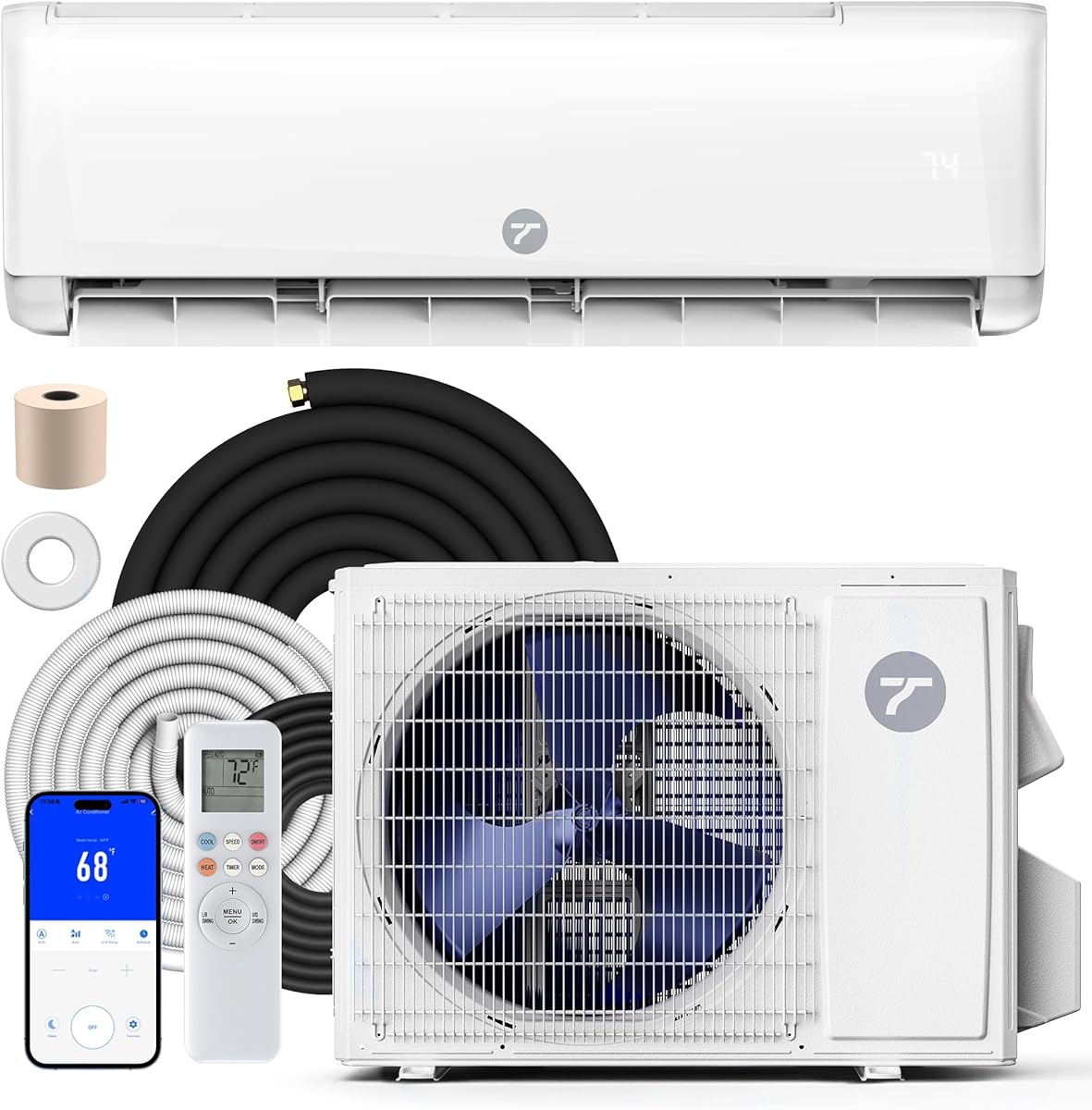


The ROVSUN 9000 BTU is a practical starting point for owners of compact homes who want both cooling and heating without adding ductwork. Its 4.4 rating reflects generally favorable customer feedback, while the supplied specifications distinguish it through 20 SEER2 efficiency and a 115V supply. The listed cooling capacity is intended for rooms of approximately 400 square feet, making it most relevant to a studio or one-room tiny house.
We may earn a commission when you buy through this link, at no additional cost to you.
Inverter technology is one of the system's main selling points. Instead of relying only on full-speed operation and repeated cycling, an inverter compressor can vary its output to match demand. The remote also provides fan speed, sleep, 24-hour timer, eco, turbo, and mute controls. This gives a resident several practical ways to balance rapid comfort, energy-conscious operation, and lower-noise sleep settings without needing a complicated wall controller.
The system's advertised operating sound level of 28-42 dBa and four-way swing function make it appealing where bedrooms, offices, or work areas need even air distribution. Heating is a meaningful benefit for a tiny house that may otherwise depend on a small portable heater. The trade-off is that professional installation is required, and the condenser should remain upright for 24 hours before use. It also provides less room coverage than 12,000 BTU systems.
This is a strong recommendation for a tiny house with a straightforward layout, 115V electrical service, and a need for a compact one-room climate system. Buyers should avoid it when the interior exceeds its stated coverage, when a larger open-plan house needs more capacity, or when 230V service is readily available and a higher-efficiency system is the priority. For the stated use, it balances capability, efficiency, and value effectively.
A 20 SEER2 rating is notable for a 9,000 BTU model, and the inverter compressor can tailor output to changing demand. That makes this option appealing when lowering operating energy is important but the tiny house lacks a dedicated 230V circuit.
Sleep, eco, turbo, mute, fan-speed, and timer settings give the resident useful control over everyday comfort. Four-way swing helps distribute air more evenly across a compact room, which is particularly helpful in an open studio.
We may earn a commission when you buy through this link, at no additional cost to you.
This Tehanld 12000 BTU system combines a heat-pump air conditioner with a 17 SEER2 efficiency rating and 115V operation. It has a 4.4 rating and is listed for spaces up to 750 square feet. That makes it a potentially strong fit for a larger tiny house, a loft, or a small dwelling divided into a main living area and sleeping area, provided the home's electrical and structural arrangements support it.
We may earn a commission when you buy through this link, at no additional cost to you.
The operating choices are extensive. Cool, heat, auto, fan, and dry modes cover the primary seasonal needs, while four fan speeds allow more precise control. Sleep, quiet, turbo, and eco functions refine the experience further. The system's intelligent-defrost feature is designed to protect internal components, and the supplied information states that the outdoor unit can operate down to -4°F, an important consideration in cold climates.
This model uses R32 refrigerant, which the product information describes as an eco-friendly option with a lower global-warming potential than traditional refrigerants. It also supports 115V household power, avoiding the need for a 230V circuit in some installations. The included kit contains the indoor and outdoor units, remote, and a 9.8-foot copper piping line set. A licensed HVAC professional must complete installation.
Choose this system when a tiny house needs more cooling capacity than a 9,000 BTU model and has reliable 115V service. It is less compelling for a very small studio where 12,000 BTU would be oversized. The lower 17 SEER2 rating should also be weighed against higher-efficiency alternatives, and buyers should account for professional installation and the possibility that the two shipped packages arrive at different times.
The stated 12,000 BTU output and coverage of up to 750 square feet create more headroom than compact 9,000 BTU options. This can suit homes with higher ceilings, sunny windows, kitchens, or a separate sleeping zone.
The listed low-temperature operation down to -4°F makes this model more relevant to cold regions. Intelligent defrost and R32 refrigerant support year-round use, although local climate and professional load calculations remain essential.
We may earn a commission when you buy through this link, at no additional cost to you.
The DELLA Vario Series pairs a 12,000 BTU heat-pump system with a 23 SEER2 rating, the highest efficiency figure in this comparison. It carries a 4.4 rating and is designed to cool and heat spaces up to 550 square feet. For a tiny house with 230V electrical service, that efficiency makes it an attractive choice for long-term operating considerations.
We may earn a commission when you buy through this link, at no additional cost to you.
Smart control is a major feature. The system works with Alexa and includes a smart sensor that reads room temperature at the remote rather than relying only on the indoor unit. Auto defrost, self-diagnosis, cleaning, I Feel mode, dehumidification, a 24-hour timer, sleep mode, eco mode, multiple fan speeds, and compressor preheating form a broad control package.
The stated 28 dBa operating level is appropriate for a bedroom or workspace. Heating is rated down to -4°F, and the 9.5 HSPF specification helps place its seasonal performance in context. A pre-charged refrigerant system and 16.4-foot installation kit simplify preparation, but the information explicitly states that line-set vacuuming is required and modifying line-set length means refrigerant levels must be adjusted.
This model is best suited to a tiny house that can support 208-230V power and whose owner prioritizes efficiency and smart-home integration. It may be excessive for a very small studio, and the professional installation requirement is non-negotiable. For a suitable 500-square-foot-class home, however, its efficiency, cold-weather operation, and sensor-based comfort controls make it a serious contender.
At 23 SEER2, this system leads the group in listed efficiency and pairs that figure with 9.5 HSPF heating performance. The specification is particularly attractive for owners who will use both heating and cooling throughout the year.
The remote's temperature reading allows control decisions to reflect the occupied location rather than only the indoor unit's position. That can improve comfort in a tiny house where the resident may sit or sleep away from the wall-mounted head.
We may earn a commission when you buy through this link, at no additional cost to you.
The Garvee 12000 BTU offers the most balanced feature set for many tiny houses, combining a 4.5 rating with 18.5 SEER2 efficiency, heating and cooling, and extensive connected controls. Its stated coverage reaches 750 square feet, giving it enough capacity for a larger tiny-house layout without moving into the oversized 24,000 BTU category.
We may earn a commission when you buy through this link, at no additional cost to you.
Built-in WiFi allows operation through a mobile app, while Alexa compatibility adds hands-free control over temperature, fan speed, modes, and timers. A physical remote remains part of the package for convenient local operation. The custom sleep mode adjusts temperature and airflow through the night, while noise-reduction technology is intended to avoid interrupting work, study, or rest.
Maintenance is another differentiator. The automatic self-cleaning cycle is designed to flush dust and residual grime from the indoor unit, and the washable filter can be removed and cleaned. The installation package includes the outdoor condenser, wall-mounted indoor head, connection piping, drain hose, communication wire, remote, and manual. Safe and code-compliant installation is explicitly reserved for professionals.
The Garvee is a strong all-around recommendation for a tiny house with 208-230V service, reliable WiFi, and a resident who values low-effort maintenance. It may not suit the smallest studio because 12,000 BTU can be more capacity than necessary, nor a home limited to 115V. Subject to those conditions, its smart controls, self-cleaning function, and balanced specifications make it an especially complete package.
WiFi app access and Alexa support make it possible to adjust the system before returning home or while away. The included remote provides a straightforward local alternative, which is useful when connectivity is unavailable.
Automatic self-cleaning and a reusable washable filter reduce routine care. While periodic filter cleaning remains necessary, these features are particularly helpful in a compact home where easy access to the indoor unit may be awkward.
We may earn a commission when you buy through this link, at no additional cost to you.
This 12,000 BTU Temprium system stands out by combining 115V operation with a 22 SEER2 efficiency rating, a 4.4 customer rating, and extensive smart controls. It is listed for rooms up to 750 square feet, making it well suited to a compact home that needs substantial cooling capacity but does not have access to a 230V circuit.
We may earn a commission when you buy through this link, at no additional cost to you.
The inverter compressor provides 12,000 BTU of cooling and 12,300 BTU of heating. The supplied information states that the system can cool in outdoor temperatures up to 122°F and heat down to 5°F. Its minimum listed noise level of 23 dB is especially appropriate for sleeping, nursery, or library use. Sleep mode adjusts the temperature and dims the display to reduce distractions.
WiFi app support, Alexa and Google Assistant compatibility, seven operating modes, seven fan speeds, 4D auto swing, turbo, and Follow-Me controls create extensive flexibility. The self-cleaning function operates at a high temperature to help keep the indoor coil clean and dry, while a washable filter captures dust and airborne particles. ETL and AHRI certification are also listed.
This is a compelling choice for a larger tiny house constrained to 115V service, especially one where quiet operation and smart controls are priorities. The trade-off is its large stated room coverage: a very small studio may not need 12,000 BTU, and professional installation remains necessary. For a medium-size tiny house, however, the combination of efficiency, low sound, and connected operation is unusually well rounded.
The 22 SEER2 figure makes this one of the strongest efficiency options in the guide, while 115V compatibility widens its practical appeal. It can be a better fit than similarly capable 230V systems when the electrical panel cannot support a dedicated high-voltage circuit.
A listed minimum of 23 dB makes the low-speed setting attractive for a sleeping area. Sleep mode also dims the display and manages temperature automatically, reducing the visual and audible interruptions associated with a conventional system.
We may earn a commission when you buy through this link, at no additional cost to you.
The upgraded Tehanld 12000 BTU combines a 4.5 rating with 19 SEER2 efficiency, 115V electrical service, and a one-ton heat pump. It is designed for spaces up to 750 square feet. That combination makes it an appealing middle-ground option for a tiny house that needs 12,000 BTU capacity but is better served by a lower-voltage supply.
We may earn a commission when you buy through this link, at no additional cost to you.
The compressor and inverter technology allow output to vary with heating and cooling demand, while R32 refrigerant is used to support the system's lower-global-warming-potential positioning. Five primary modes—cool, heat, auto, fan, and dry—cover everyday seasonal use. Four fan speeds, a 24-hour timer, sleep mode, eco mode, and rapid cooling or heating add further control.
The listing indicates that the system ships in two separate packages, which may arrive on different dates. This is a practical planning consideration because a tiny-house build may have a narrow installation window. The filter should be removed and cleaned regularly, and professional installation is required. The supplied information does not describe an advanced app-based smart-control system, so buyers prioritizing voice and remote access should compare carefully.
This Tehanld model is a strong recommendation for a medium or larger tiny house with 115V service and a preference for straightforward remote-controlled operation. Its 4.5 rating is among the strongest listed, and 19 SEER2 gives it an efficient profile. It is less suitable for owners who need app control, a compact studio that would be overserved by 12,000 BTU, or a schedule that cannot accommodate two possible delivery dates.
A 19 SEER2 rating offers a useful middle ground between lower-efficiency 115V units and the group's highest-efficiency models. It can be an efficient choice for households prioritizing straightforward heat-pump operation without complex connected features.
The 24-hour timer makes it easy to align operation with waking and sleeping schedules. Sleep and eco modes refine the system further, while four fan speeds give residents control over airflow intensity.
We may earn a commission when you buy through this link, at no additional cost to you.
The DELLA Serena Series is a compact 9,000 BTU system with a 22 SEER2 rating, Energy Star certification, 230V operation, and extensive connected features. Its 4.2 rating is the lowest among the products listed, but the underlying specifications position it as a premium compact option for a tiny house where efficiency, smart control, and design-conscious equipment matter.
We may earn a commission when you buy through this link, at no additional cost to you.
The system works with Alexa, Google Home, and the DELLA app through WiFi. Its geolocation function can adjust temperature based on whether the resident is away, while a physical remote is included for local control. PureClean technology is designed to reduce dust buildup and support defrosting, and an outdoor bottom heating element helps prevent ice accumulation during winter operation.
At 24 dBa in mute mode, the Serena is among the quietest systems here. Heating performance down to 5°F, a 16.4-foot pre-charged line set, four-way airflow, I Feel mode, a 24-hour timer, sleep mode, eco mode, turbo, dry mode, and multiple fan speeds make it well equipped. The listing states that it is a 2025 Red Dot Design Award winner and offers 24/7 live chat and a lifetime warranty.
This is the premium choice for a compact 400-square-foot-class home with 230V service and a resident who values smart-home automation. It is less suitable for a larger tiny house because 9,000 BTU may be inadequate, and its 230V requirement can complicate electrical planning. It also requires professional installation and careful refrigerant handling if the line-set length changes.
Geolocation can make connected control more useful by adjusting the system when the resident's location changes. This reduces the need to manually manage the mini split during short errands while preserving the option of local remote control.
A 5°F low-temperature heating rating and an outdoor heating element support winter operation. Combined with 22 SEER2 efficiency and Energy Star certification, these features make the Serena especially relevant in climates that need dependable heating.
We may earn a commission when you buy through this link, at no additional cost to you.
The Temprium 24000 BTU is the highest-capacity system in this guide, with stated coverage up to 1,500 square feet. It carries a 4.4 rating and a 19 SEER2 efficiency rating. While most tiny houses need less, it is worth considering for unusually large, open, poorly insulated, or heavily sunlit homes that exceed the practical limits of compact systems.
We may earn a commission when you buy through this link, at no additional cost to you.
The inverter compressor provides 24,000 BTU of cooling and 24,000 BTU of heating. The listing states that it can cool in outdoor temperatures up to 119°F and heat down to 5°F. A minimum sound level of 30 dB, sleep mode, dimmable display, WiFi app access, Alexa and Google Assistant support, seven fan speeds, and 4D swing provide a broad comfort-control package.
The system also offers seven operating modes, turbo, Follow-Me temperature sensing, high-temperature self-cleaning, and a washable filter. It is described as ETL and AHRI certified. Installation requirements for this capacity are more substantial than for 9,000 or 12,000 BTU models, so a homeowner should allow a professional HVAC contractor to evaluate the electrical panel, line paths, outdoor location, and structural support.
The best use case is a tiny house with a genuinely large conditioned area, high cooling loads, or a plan that may expand. It would be a poor match for a normal studio because oversizing can create short cycling, uneven comfort, and unnecessary installation complexity. For a sufficiently large dwelling, though, this product offers strong capacity, efficient inverter operation, and advanced controls.
A 24,000 BTU system makes sense when the conditioned area, window exposure, insulation level, and internal heat sources create demands beyond a compact model. It should be selected from a professional load calculation rather than simply by comparing the stated square-foot figure.
WiFi, app access, voice-assistant support, seven modes, and multiple fan speeds are useful for maintaining comfort across a large open interior. Follow-Me sensing and 4D swing help keep the remote occupant's preferred temperature central to operation.
We may earn a commission when you buy through this link, at no additional cost to you.
This 12,000 BTU wall-mounted heat pump is designed for tiny houses that need both cooling and heating on a 115V supply. Its 4.3 rating is solid, and the stated 17 SEER2 efficiency, 26 dB low-noise mode, and coverage of up to 750 square feet make it a practical middle-capacity option. The installation kit includes a 9.8-foot copper piping line set and other accessories.
We may earn a commission when you buy through this link, at no additional cost to you.
Advanced inverter technology adjusts compressor speed rather than relying entirely on constant cycling, and the listing states that power consumption can be reduced by up to 35% compared with conventional units. Cooling and heating are available for rooms up to 450 square feet in the product's comfort description, while the headline capacity and coverage specifications indicate broader suitability. Professional sizing should settle the appropriate area for the home's conditions.
Sleep and mute modes support quiet rest, and the remote lets the resident operate the system from a bed or sofa. The high-temperature self-cleaning cycle operates at 135°F or higher to dry the indoor unit and inhibit mold, while the washable filter traps dust. The outdoor unit includes auto-defrost for cold-weather heating performance.
This system is a good fit for a 115V tiny house seeking an all-season system without moving to 230V. It is less attractive when the highest possible efficiency is the goal, since several 115V alternatives carry higher SEER2 ratings. It is also important to remember that the product ships in two boxes that may arrive on different dates and that professional installation is recommended for safe, optimal performance.
The 12,000 BTU capacity provides more headroom than compact 9,000 BTU models while retaining 115V convenience. It can suit a tiny house with separate sleeping and living areas, provided professional sizing confirms adequate capacity.
The 26 dB low-noise figure supports sleep-mode use, while high-temperature self-cleaning and a washable filter help maintain airflow. These maintenance features can be especially valuable in a small house where the indoor unit is installed in a tight utility or living area.
We may earn a commission when you buy through this link, at no additional cost to you.
The DELLA Umbra 9100 BTU is a compact 0.76-ton heat pump intended for rooms of approximately 400 square feet. It has a 4.3 rating, 19 SEER2 efficiency, 230V operation, and smart control through Alexa and WiFi. Its nearly 9,000 BTU capacity makes it appropriately scaled for a studio or one-room tiny house rather than a large open dwelling.
We may earn a commission when you buy through this link, at no additional cost to you.
The system provides a 25 dBa operating level, 4D airflow, I Feel mode, a 24-hour timer, sleep mode, eco mode, multiple fan speeds, turbo, and heating, cooling, and dry modes. The remote acts as a temperature sensor during cooling, allowing airflow and temperature to respond to the occupied position. The supplied information also lists a maximum fuse size of 10A and heating operation down to 5°F.
R-32 refrigerant is used, and the outdoor condenser includes a bottom heating element for cold-weather performance. The pre-charged installation kit includes a 16.4-foot copper line set and a 6.56-foot drain pipe. As with other pre-charged systems, changing the line-set length may require additional refrigerant, so buyers should confirm local R-32 availability before installation.
The Umbra is a good recommendation for a compact tiny house with 230V service and a resident who wants smart-home control without moving to a larger system. It may not suit a home limited to 115V, and its 400-square-foot target leaves little margin for extreme heat or heavy solar gain. Within that properly sized use, it combines quiet operation, heating, efficiency, and connected control effectively.
A 9100 BTU output is scaled appropriately for a studio or compact one-room dwelling. Alexa and WiFi add convenience without pushing the system into the larger capacity category reserved for substantially more square footage.
The listed 5°F minimum operating temperature and bottom heating element make cold-weather use more viable. A professional installer should still evaluate local conditions, drainage, and outdoor placement before relying on year-round heating performance.
We may earn a commission when you buy through this link, at no additional cost to you.
A tiny-house air conditioner should be selected as part of the building's electrical, structural, and climate plan. Capacity, efficiency, voltage, cold-weather performance, controls, noise, and installation logistics matter more than any single specification.
Nominal cooling capacity should reflect the tiny house's conditioned area, ceiling height, window exposure, insulation, and internal heat loads. The products here range from 9,000 BTU for approximately 400-square-foot coverage to 24,000 BTU for spaces listed up to 1,500 square feet. A larger home may need a professional load calculation, while a small studio is usually better served by a compact 9,000 or 9,100 BTU system. Undersized equipment can struggle during hot weather, while an oversized system may cycle inefficiently.
A tiny house may have 115V service, an upgraded 230V panel, or no dedicated circuit for a mini split. Six products in this list use 115V, while the others specify 208-230V or 230V. A 115V model can simplify electrical planning, but a 230V system may provide greater capacity or efficiency. Confirm the panel capacity, circuit rating, grounding, outlet location, and local electrical code before ordering, and allow a licensed electrician to evaluate the service.
SEER2 is a seasonal cooling-efficiency measure, and higher numbers generally indicate less energy use for a given cooling output under standardized conditions. The guide includes systems from 17 to 23 SEER2. Efficiency matters most for a residence that runs the mini split frequently, although actual consumption also depends on climate, insulation, thermostat behavior, maintenance, and duct design. Compare the complete system rating rather than looking only at compressor specifications.
Every listed unit is described as a heat-pump system, but their low-temperature capabilities differ. Several models specify operation down to 5°F, while the DELLA Vario Series and 12000 BTU Tehanld list -4°F. Cold-weather ratings are most meaningful in regions with prolonged freezing conditions. A backup heat source may still be sensible in extreme climates, and the outdoor unit needs proper clearance, drainage, and protection from snow and ice.
Mini splits generally require professional installation, and several systems include a pre-charged line set or copper piping kit. The included length must be sufficient between the indoor head and condenser without unnecessarily lengthening the run. Altering a pre-charged line can require vacuuming and refrigerant adjustment, which adds cost and complexity. Review included line-set length, drainage requirements, fuse size, electrical service, and the outdoor unit's accessible placement before purchase.
Low sound levels can make a huge difference in a tiny house, where the indoor unit may be close to the bed, desk, or seating area. Listed minimum sound levels range from 23 to 30 dBa, with mute and sleep modes available on many systems. Compare the lowest operating level, not just a general quiet-operation claim, and consider what the compressor sounds like through a small wall assembly. A bedroom installation should prioritize low noise and stable temperature control.
A physical remote remains the most dependable way to adjust temperature, fan speed, and timers. WiFi and voice-assistant support add convenience for pre-cooling a home or checking the system remotely, but they depend on network access and compatible services. Models with I Feel or Follow-Me sensing also use the remote's location to refine comfort. Decide whether smart features justify the added complexity, and confirm which app and voice platforms are supported.
Washable filters need regular cleaning, and models with automatic self-cleaning or PureClean functions can simplify indoor-unit care. A compact home benefits from easy-access filters and reminders for seasonal cleaning. The self-cleaning cycles described here use elevated temperatures to dry internal components, but they do not eliminate the need for filter care. Consider the physical access around the indoor head and the availability of replacement parts before installation.
Begin by allowing the installer to complete the required electrical, refrigerant, drainage, and line-set work before operating the system. Read the included manual, identify the indoor controls, test every mode, and set the thermostat to a comfortable starting temperature. During the first cooling period, check that airflow is moving consistently and that no condensate is leaking near the indoor head or outdoor unit.
Use the thermostat and scheduled timer to avoid conditioning an empty tiny house unnecessarily. Sleep, eco, and mute modes are useful overnight, while turbo can provide faster initial comfort. If the system is connected to an app or voice assistant, confirm that remote access and location-based features work as expected. Avoid repeatedly changing the setpoint by only a degree or two, because stable settings can support more consistent comfort and energy use.
Clean the reusable filters regularly according to the manual and remove accumulated dust from accessible areas. Use the automatic self-cleaning cycle when the model provides it, but continue inspecting the indoor unit for dirt, odor, or moisture. Keep the outdoor unit unobstructed, clear leaves and debris from its surroundings, and confirm that condensate drainage remains open. Schedule professional maintenance for unusual noise, leaks, weak airflow, error codes, or any refrigerant-related concern.
Most compact tiny houses are best served by a 9,000 or 9,100 BTU system, while larger layouts may suit 12,000 BTU. Capacity should also reflect ceiling height, insulation, window exposure, and internal heat sources. A professional load calculation is more reliable than relying only on a stated square-foot range.
Yes, several systems in this guide specify 115V operation. Others require 208-230V or 230V service, which may require a new circuit and panel evaluation. Check the exact product voltage, the tiny house's existing service, and local code before buying.
A ductless system can be efficient because it avoids losses associated with long duct runs and provides zoned control. Actual performance depends on the unit's SEER2 rating, insulation, climate, thermostat settings, and maintenance. Selecting a correctly sized inverter system and using schedules can improve energy results.
The listings include installation kits, piping, remotes, and other components, but they also state that professional installation is required or recommended. Kit contents do not normally include every site-specific part, and a licensed HVAC professional may need to supply electrical upgrades, line-set changes, condensate work, or refrigerant service.
Yes, because every product listed combines cooling with heat-pump heating. Low-temperature capability varies, with several models specifying operation down to 5°F and others down to -4°F. Local climate, exposure, and outdoor-unit placement determine real-world heating performance, so check the stated limits carefully.
They can be appropriate for tiny homes, studios, and well-insulated spaces of roughly 400 square feet according to the listed specifications. They may struggle in a very open, sunny, poorly insulated, or hot-climate home. A load calculation helps identify whether a larger 12,000 BTU system is necessary.
The indoor head requires a clear wall area for airflow, service access, and drainage, while the outdoor condenser needs approved clearance and stable support. Exact dimensions are not provided in the product data, so measure the intended locations and ask the installer to verify clearances before purchase.
Smart controls are convenient for changing temperature remotely, preparing the home before arrival, and integrating the system with other devices. They are not essential for basic comfort because these systems also include remotes. Consider connectivity reliability, app support, voice-platform compatibility, and whether the added convenience is worth the higher equipment cost.
The ROVSUN 9000 BTU stands out as the best value option for a compact 115V home, offering 20 SEER2 efficiency, heating, and a stated 400-square-foot coverage. The Garvee 12000 BTU is the most balanced overall selection because it combines a 4.5 rating, 18.5 SEER2 efficiency, smart controls, self-cleaning, and ample coverage. For premium compact comfort, the DELLA Serena Series adds 22 SEER2 efficiency, Energy Star certification, app and voice support, and cold-weather heating.
The right choice ultimately depends on the house rather than on a universal size. Confirm voltage, professional electrical capacity, outdoor placement, room dimensions, and local climate first. Then prioritize adequate capacity, appropriate efficiency, a tolerable noise level, and the controls that will actually be used. Avoid installing the largest system simply because it can cool more area, and do not assume every heat pump performs equally during extreme cold.
Ratings, features, and product availability can change, and current prices should be checked before making a purchase. Compare the live listing with the specifications used in this guide, ask the HVAC contractor about electrical and line-set requirements, and verify the warranty and local installation rules. Those final checks can prevent an otherwise suitable mini split from becoming an expensive or difficult retrofit.

