10 Best Hygrometer for Reptiles (November 2026) Expert Guide
Written by admin · Updated November 2026
A hygrometer for reptiles helps owners track the temperature and humidity inside a terrarium, where small environmental changes can affect comfort, hydration, and health. The most useful device is not necessarily the most elaborate one; it should provide readable readings, suit the enclosure, and deliver specifications appropriate for the species and setup.
This guide compares ten digital, analog, adhesive, wired, and multi-pack options based on the supplied measurement ranges, stated accuracy, display features, power arrangements, mounting methods, and intended applications. It covers standalone meters for checking a habitat as well as multipack products that can monitor several enclosures, rooms, or containers at once.
The recommendations show why a long probe, illuminated screen, high-low records, or no-battery analog movement may be useful for different keepers. Product prices and availability can change, so readers should verify current listings, confirm battery requirements, and compare the specifications with the needs of their particular reptile before buying.
Top 3 Picks for Best Hygrometer for Reptiles
Best Budget
JEDEW 2 Pack Hygrometer Thermometer Digital Humidity Meter Indoor/Outdoor Humidity Monitor Reptile Thermo-Hygrometer for Greenhouse Humidors Terrarium Jars, Fahrenheit (℉) /Celsius(℃) (2)
REPTI ZOO Thermometer Hygrometer, LED Digital Thermo Hygrometer for Reptile Terrarium Pet Rearing Box, Reptile Tank Thermometer with 55.2" Cable USB Power Supply
As an Amazon Associate we earn from qualifying purchases.
Top 10 Best Hygrometer for Reptiles in 2026 Compared
The table below places all ten options side by side, emphasizing power source, display type, stated accuracy, and monitoring flexibility. These distinctions help separate basic indoor meters from purpose-built reptile devices, analog gauges, and multi-unit monitoring kits.
The JEDEW 2 Pack Hygrometer combines a digital temperature and humidity display in a compact package designed for terrariums, jars, aquariums, hermit crab habitats, greenhouses, and other monitored spaces. Its 4.5 rating reflects a generally positive reception, while the stated accuracy of ±1°F and ±3% RH makes it a credible budget-oriented option for routine environmental checks.
Pros
Two included monitoring units
Accurate stated humidity readings
Flexible temperature unit selection
Broad reptile application
Cons
Small standard LCD screen
Battery cells require replacement
We may earn a commission when you buy through this link, at no additional cost to you.
The most useful feature is the inclusion of two meters. One unit can remain in the main habitat while the second provides a comparison reading elsewhere, such as a nearby quarantine enclosure, plant-growing area, or secondary container. Both show temperature and humidity on an LCD screen, refresh their values every 10 seconds, and allow switching between Fahrenheit and Celsius.
Its operating range covers temperatures from 32°F to 158°F and relative humidity from 10% to 99% RH, making the stated specifications suitable for many common reptile enclosures. The device uses one main LR44 button cell and includes a backup cell, with each battery described as lasting up to 10 months. The screen is compact, however, and may take a little more attention to read than an illuminated display.
This is a strong choice for keepers who want two basic monitoring points without moving beyond a simple indoor thermo-hygrometer. It is less suitable for someone who needs a remote probe, alarms, historical graphs, or a screen that is easy to read at night. For straightforward, regularly checked habitats, however, the pair offers practical versatility and strong stated accuracy.
Two Locations at Once
Using one meter in the primary enclosure and another in a secondary habitat can reveal differences caused by heating, ventilation, substrate, or misting. That comparison is particularly useful when one area appears warmer or more humid than expected.
Readings Suitable for Routine Checks
The ±1°F temperature accuracy and ±3% RH humidity accuracy are suitably tight for many general-purpose monitoring tasks. The ten-second refresh interval also helps users notice changes without repeatedly handling the device.
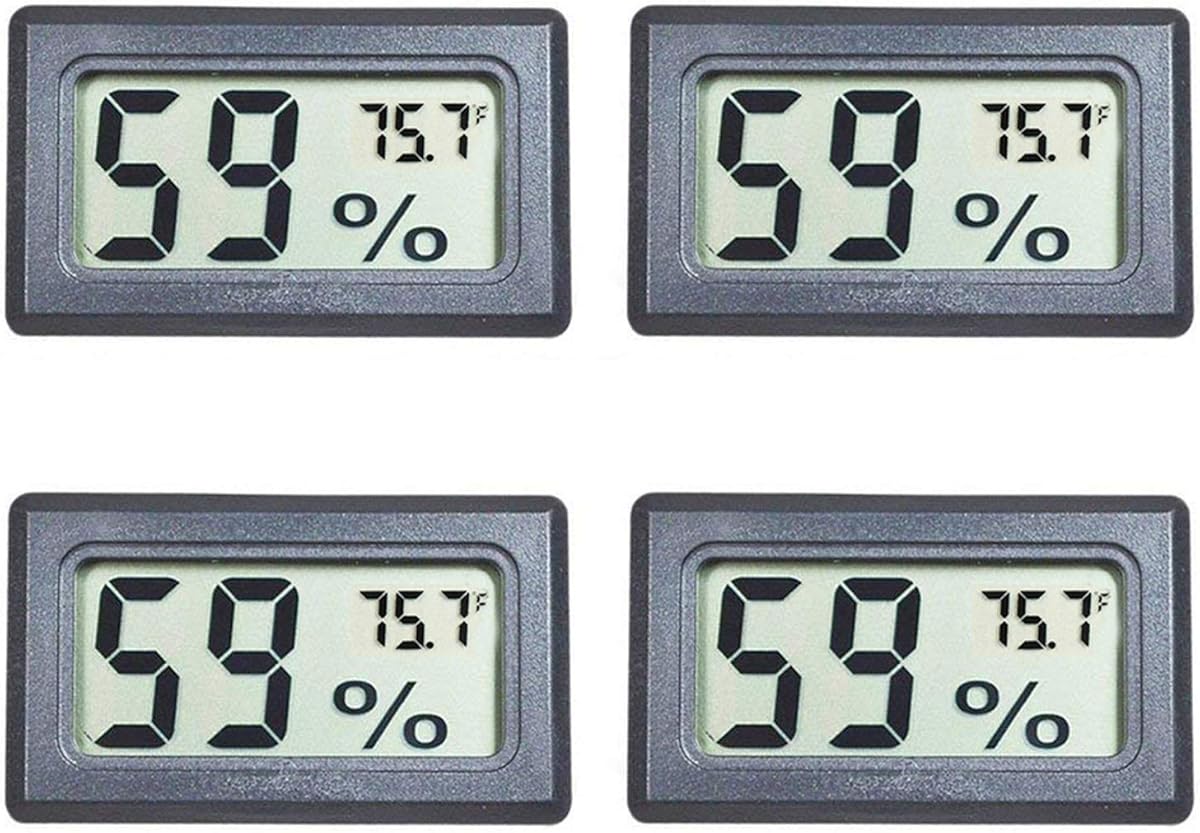
The 4-Pack Mini Indoor Temperature Humidity Meters Digital Gauge is built for small environments where space is limited and multiple readings are needed. Its 4.4 rating reflects a solid practical feature set, and the listed uses—including reptile tanks, incubators, brooders, jars, guitar cases, offices, and greenhouses—show its versatility beyond a single habitat.
Pros
Four compact monitoring units
Useful built-in sensor probe
Wide temperature measurement range
Extra backup batteries included
Cons
Fahrenheit-only temperature display
No illuminated screen
We may earn a commission when you buy through this link, at no additional cost to you.
Each meter measures 1.89 by 1.13 by 0.6 inches and includes a built-in probe. It displays temperature in Fahrenheit, checks conditions every 10 seconds, and covers a temperature range of -58°F to 158°F. The stated accuracy is ±2°F for temperature and ±5% RH for humidity, which is useful for routine tracking but less tight than several other selections.
Four units offer the most obvious advantage: a keeper can place a meter in every enclosure, compare zones within a large habitat, or retain devices for quarantine and nursery spaces. Two LR44 batteries power each meter, and the package includes four additional backup batteries. The compact construction makes placement in jars and smaller terrariums easier than with a larger desktop unit.
The main limitation is its Fahrenheit-only display, which will inconvenience owners who regularly work in Celsius. It also lacks a backlight and does not offer long-probe positioning, high-low records, or an audible alert. It is best suited to owners who prioritize low-profile placement and several monitoring locations over advanced data features.
Small-Size Advantage
The compact dimensions allow these meters to fit into smaller jars, reptile containers, incubators, and other constrained spaces. Their small footprint also makes it practical to position several units around a larger setup instead of concentrating on one reading.
Useful Temperature Breadth
The -58°F to 158°F range covers conditions beyond ordinary room temperature. This makes the meters adaptable to reptile rooms, brooders, and other indoor environments where temperatures may fluctuate substantially.
The Serundo Auto Digital Hygrometer Thermometer Indoor/Outdoor Hygrometer 2PC is a compact two-unit solution for owners who need to monitor temperature and humidity in more than one place. It carries a 4.5 rating and combines straightforward digital readings with a stated temperature accuracy of ±1°F and humidity accuracy of ±3% RH.
Pros
Two included digital meters
Accurate stated temperature readings
Celsius and Fahrenheit switching
Designed for varied habitats
Cons
Standard LCD visibility
Button cells need eventual replacement
We may earn a commission when you buy through this link, at no additional cost to you.
Readings refresh every 10 seconds, covering a stated range of 32°F to 158°F and 10% to 99% RH. The meters support Fahrenheit and Celsius conversion, which is helpful for keepers accustomed to either scale. They are specifically listed for reptile terrariums, aquariums, hermit crab habitats, crawl pet enclosures, greenhouses, laboratories, and other spaces.
Each unit is powered by one LR44 button cell with a backup cell also included, and the stated working time is up to nine months per cell. As with other small digital meters, readability depends on viewing angle and ambient light. The product does not provide a remote probe, alarms, recorded highs and lows, or a backlit display.
The pair is a good fit for a main terrarium and a secondary habitat, or for comparing different ends of a long enclosure. It is particularly attractive to owners who want Celsius flexibility and tight stated tolerances without a more complex device. Those who need night visibility or continuously powered monitoring should consider the larger LED model instead.
Unit Flexibility for Keepers
The Celsius and Fahrenheit controls prevent the need to convert readings manually. That convenience can make day-to-day checks quicker and reduce the chance of confusing a target humidity range with a displayed value.
Built for Quick Checks
The ten-second refresh rate gives a more current picture than a meter that updates only once per minute. The built-in sensitive sensor and compact screen keep the device simple for regular visual monitoring.
The 6-Pack Mini Hygrometer Indoor Humidity Meter Digital Thermometer is the broadest monitoring kit in this guide by unit count. It is aimed at owners who maintain several reptile environments, incubators, brooders, or other enclosed spaces and need a dedicated meter in each location.
Pros
Six included monitoring units
Clear compact digital display
Broad temperature measurement range
Wide variety of applications
Cons
Humidity accuracy is less precise
No backlight or memory
We may earn a commission when you buy through this link, at no additional cost to you.
Each compact device combines a digital thermometer and hygrometer with a built-in probe. The stated ranges are -58°F to 158°F for temperature and 10% to 99% RH for humidity, while accuracy is listed at ±2°F and ±5% RH. Readings update automatically every 10 seconds, providing enough responsiveness for routine observation.
The display is designed for quick reading, and the compact housing can be placed discreetly in jars, reptile tanks, greenhouses, incubators, offices, and guitar cases. The product listing does not specify a unit-switching control, illuminated display, or recording function, so owners should verify the interface if Fahrenheit versus Celsius display is important.
The six-unit quantity is a meaningful advantage for a multi-animal collection. It also permits comparison of different enclosures without repeatedly moving a meter, which can provide more reliable observations. The trade-off is that ±5% RH is less precise than the ±3% RH figures associated with several digital alternatives, and six devices also represent more batteries to maintain.
Dedicated Monitoring Points
A dedicated meter in each habitat gives a more representative picture than checking one enclosure and assuming the others are similar. Different heating systems, ventilation, misting schedules, and substrate depths can produce noticeable local variations.
Rapid Automatic Updates
The ten-second refresh interval makes the meters convenient for checking whether a recent misting or heating adjustment has affected conditions. It also allows keepers to compare devices at roughly the same moment.
The Reptile Thermometer and Humidity Gauge 2PCS is designed specifically around reptile enclosure monitoring. The 4.3 rating indicates a generally favorable response, and its adhesive installation, LED screen, and two-unit format make it easy to compare conditions in multiple zones or containers.
Pros
Purpose-built reptile positioning
Simple adhesive installation
LED screen remains visible
Two units enable area comparison
Cons
No stated humidity tolerance
No remote sensor cable
We may earn a commission when you buy through this link, at no additional cost to you.
The product uses a high-precision measurement chip with stated temperature accuracy of 0.9°F. Its LED display is designed to remain readable day or night, including in dim reptile rooms, and a quick-switching control changes between Fahrenheit and Celsius. The absence of a long cable means readings come from the unit's installed location rather than a remote probe.
Double-sided adhesive allows the meters to be fixed in preferred positions without tools, while the cordless design keeps the enclosure interior uncluttered. Two units can reveal whether one side of a habitat is warmer or more humid, or the same devices can be used in separate enclosures. The product uses replaceable button-cell power, reducing waste compared with disposable-only devices.
This option appeals to beginners and experienced keepers who want an unobtrusive, reptile-focused monitor without a complicated installation. One notable limitation is that the supplied data emphasizes the 0.9°F temperature accuracy but does not state a humidity accuracy tolerance. Buyers who require a specific humidity precision should verify that detail before relying on the display for close control.
Visibility in Dim Rooms
The LED screen is a meaningful advantage for nocturnal reptiles and evening checks. A keeper can glance at the display without turning on a bright room light or shining a flashlight into the habitat.
No-Cable Placement
Cordless adhesive mounting keeps the enclosure clean and makes the meters easy to reposition when zones or equipment layouts change. It also avoids cable clutter around branches, hides, and other habitat furnishings.
The TempPro TP50 Digital Hygrometer Indoor Thermometer Room Thermometer is the most versatile general-purpose choice in this roundup. It has a 4.6 rating, the highest listed among the ten products, and combines accurate readings with features that are especially helpful when interpreting conditions in a reptile room.
Pros
Highest listed rating
Records temperature and humidity highs
Convenient tabletop or magnetic placement
Clear humidity comfort indicator
Cons
No remote probe cable
Not designed for outdoor exposure
We may earn a commission when you buy through this link, at no additional cost to you.
Its stated temperature accuracy is ±1°F, while humidity accuracy is listed at ±2 to 3% RH. Readings refresh every 10 seconds, and a DRY, COMFORT, or WET indicator summarizes humidity conditions at a glance. High and low records preserve the strongest and weakest temperature and humidity values observed since the unit was reset.
Installation is flexible because the unit includes a tabletop stand and a magnetic back. It can stand on a shelf, attach to a metal surface, and serve as a room or reptile-room monitor. A Fahrenheit/Celsius selector broadens its appeal, and one AAA battery powers the device. The listing also identifies uses including reptile, soil, refrigerator, freezer, humidor, and greenhouse monitoring.
The main limitation is that it is an indoor device without a remote probe, making it less suitable when a keeper needs to measure a precise location deep inside a tall or densely decorated enclosure. It also has no listed backlight, alarm, or USB power. Even so, its recording function, comfort indicator, accurate stated specifications, and flexible placement make it the strongest all-around option for general reptile monitoring.
Useful High and Low Memory
The high and low records reveal how far conditions move beyond a keeper's target range. This is particularly helpful for identifying brief nighttime changes or periods when heating equipment and ventilation operate at different levels.
At-a-Glance Humidity Indicator
The DRY, COMFORT, and WET icon provides a quick interpretation of relative humidity. It does not replace knowing the species-specific target, but it can make deviations from a normal condition easier to recognize during a routine visit.
The REPTI ZOO LED Digital Thermo-Hygrometer is the feature-forward selection for keepers who want the reading unit outside the habitat and the sensor positioned inside. It has a 4.5 rating, a three-inch backlit display, and a 55.2-inch cable that provides much greater placement flexibility than a compact built-in-sensor meter.
Pros
Remote sensor reaches enclosure zones
Large backlit LED screen
Continuous USB-powered operation
Multiple mounting accessories included
Cons
Requires a nearby USB connection
Cable must be routed carefully
We may earn a commission when you buy through this link, at no additional cost to you.
The device monitors temperature from 32°F to 140°F and humidity from 10% to 99% RH, with switchable Celsius and Fahrenheit modes. Its built-in precision chip and sensors are designed to track subtle environmental changes in real time. The large LED display remains easy to read at night, an important consideration for nocturnal species and dimly lit reptile rooms.
The long cable allows the sensor to be placed near a basking area, humid hide, upper canopy, or cooler section while the screen remains outside the front glass. It is powered by USB through the included charging cable and includes an on/off button. Double-sided tape and hook-and-loop material provide flexible mounting options without requiring permanent modifications.
The tradeoff is that the unit needs a reachable USB power source and a cable long enough to reach the intended sensor location. Owners must prevent pets from chewing or moving the cable, and condensation near vents may affect placement. For a carefully planned enclosure, though, the remote sensor and backlit display make this the most purpose-driven premium option.
Place the Sensor Precisely
A remote probe can sit in the warm zone, cool zone, humid hide, or elevated area that matters most for the species. The display can then remain outside the enclosure, where it is easier to view without repeatedly opening the habitat.
Nighttime Reading Convenience
The three-inch backlit LED screen reduces eye strain during evening or nocturnal checks. It is a substantial readability improvement over compact LCDs that depend on room lighting and direct viewing angle.
The 6 Pack Mini Hygrometer Indoor Humidity Meter, Digital Thermometer Monitor is another broad multi-unit option, combining six compact digital meters with a high-precision sensor. Its 4.4 rating indicates a well-received general-purpose product, and its listed applications include reptile tanks, greenhouses, incubators, offices, cellars, and mason jars.
Pros
Six compact meter units
Simple digital readouts
Broad indoor temperature range
Long stated battery life
Cons
Less precise humidity accuracy
No memory or illuminated display
We may earn a commission when you buy through this link, at no additional cost to you.
The stated measurement ranges extend from -58°F to 158°F for temperature and 10% to 99% RH for humidity. Readings update automatically every 10 seconds. Accuracy is listed at ±2°F and ±5% RH, making it best suited to general awareness and comparative monitoring rather than exceptionally precise laboratory work.
Its small housing and clear digital screen are designed for unobtrusive placement in almost any indoor setting. Six units can be distributed among a collection, positioned in different zones, or kept as backups. The package includes two LR44 button cells per meter, with the product information describing up to eight months of operation per set.
The obvious strength is the number of units in a simple, consistent format. The trade-offs are the looser ±5% RH humidity tolerance and the absence of listed high-low memory, a backlight, Celsius conversion, or a long probe. It is a practical choice for owners who want broad coverage and a small footprint rather than advanced data management.
Broad Collection Coverage
Six matching meters make it easy to give each habitat a dedicated unit. The compact dimensions also allow placement in smaller containers where a desktop display would occupy too much usable space.
Low-Maintenance Power
The included button cells are intended to run for up to eight months per set. Replacing them on a regular schedule helps prevent inaccurate readings caused by depleted batteries.
The REPTI ZOO Reptile Terrarium Thermometer Hygrometer Dual Gauges offers a deliberately simple alternative to digital meters. With a 4.4 rating and no battery requirement, it is appealing to owners who want immediate temperature and humidity indications without managing button cells or USB power.
Pros
No batteries to replace
Simple mechanical operation
Easy adhesive installation
Clear color-coded scale
Cons
No digital precision specifications
No high and low memory
We may earn a commission when you buy through this link, at no additional cost to you.
The unit uses two analog movements to display temperature and humidity in separate color-coded sections. This can make broad conditions easy to interpret at a glance. It is listed for vivariums, hatchers, brooders, and propagators, all environments where a compact gauge attached near the observation area can provide a quick reference.
A sticky pad on the reverse allows installation on most suitable surfaces. Because the gauges are mechanical, there is no battery to weaken over time, no charging cable to route, and no digital clock to reset. That simplicity is also the main limitation: the product information does not state numerical accuracy, and the device cannot record highs, lows, or historical changes.
This gauge works best as a supplementary visual tool or for keepers who value reliability and low maintenance over precise data. A digital meter may be more useful when conditions must be tracked against narrow targets, while this analog model provides an immediate indication that something appears unusually dry, wet, hot, or cool. It should not be assumed to provide the same level of quantification as a digital sensor.
Zero Battery Maintenance
The battery-free design removes charging or replacement from the maintenance routine. It can be especially convenient for owners who dislike small cells or want a simple backup indicator inside a habitat.
Immediate Visual Interpretation
Color-coded gauge segments allow a keeper to recognize normal and unusual zones without navigating a menu or waiting for an electronic update. The analog format also provides a constant visual presence inside the enclosure.
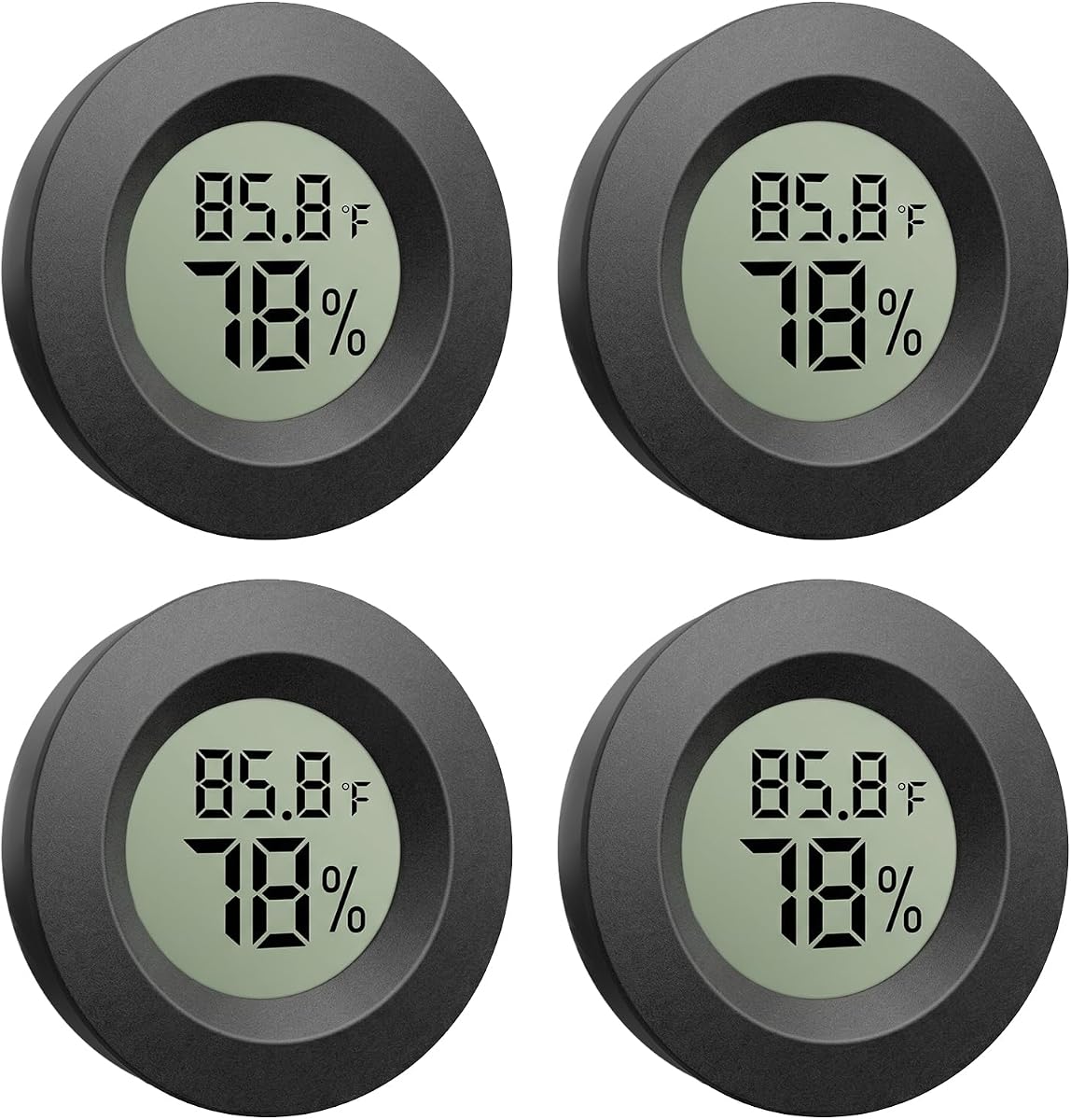
The 4-Pack Mini Hygrometer Thermometer, Indoor Temperature Humidity Monitor combines four compact digital meters with flexible installation options. Its 4.3 rating reflects a generally positive response, and the ability to embed a meter or attach it with double-sided tape distinguishes it from products designed only for placement on a shelf.
Pros
Four matching compact meters
Embedded or adhesive installation
Celsius and Fahrenheit switching
Wide reptile application range
Cons
Humidity range begins at 20%
Compact screen lacks backlight
We may earn a commission when you buy through this link, at no additional cost to you.
Each device is approximately 1.78 inches square and 0.6 inches deep, with an opening of about 1.65 inches for embedded installation. The temperature range is -4°F to 140°F, while humidity covers 20% to 99% RH. The stated accuracies are ±1.8°F for temperature and ±5% RH for humidity, with readings updated every 10 seconds.
The product is listed for reptile tanks, leopard gecko accessories, jumping spider enclosures, incubators, brooders, laboratories, fridges, greenhouses, and other containers. A multifunction button supports power controls and Fahrenheit/Celsius switching. One LR44 cell powers each meter, and a backup cell is included, with each described as lasting up to eight months.
The main consideration is the 20% lower humidity limit, which is less broad than the 10% floor offered by several digital choices. Its small screen also lacks a stated backlight. Even so, the embedded installation option is useful for creating a permanent-looking monitoring station, while four units make it easy to check several small habitats.
Permanent-Looking Installation
Embedding a meter behind a panel or within a suitable enclosure fixture can create a cleaner appearance than leaving a standalone unit loose on top of the habitat. The included tape also provides a simpler alternative for renters or temporary arrangements.
Convenient Multi-Enclosure Set
Four units support a collection with several habitats or separate nursery and quarantine areas. The common dimensions and display format also make it easier to compare readings without learning multiple controls.
We may earn a commission when you buy through this link, at no additional cost to you.
Buying Guide – How to Choose the Best Hygrometer for Reptiles
The right hygrometer should match the enclosure layout, the keeper's monitoring habits, and the environmental range required by the reptile. Accuracy, display quality, mounting, sensor position, and power requirements deserve attention before comparing individual models.
Measurement Accuracy
Accuracy determines how closely a displayed value reflects the actual environment. Among the digital products in this guide, stated temperature tolerances range from ±0.9°F to ±2°F, while humidity tolerances range from ±2 to 3% RH up to ±5% RH. These figures describe the manufacturers' stated performance, not independently verified results, but they still provide a useful basis for comparison. A tighter tolerance can be helpful when a species has a narrow acceptable range or when the meter will be used to make fine adjustments.
Choose a meter with accuracy specifications that comfortably support the decisions you need to make. A general room monitor with ±5% RH may be sufficient for broad awareness, while keepers managing a narrow target may prefer a tighter figure and may also want to confirm behavior against a trusted reference device.
Sensor Placement
A meter is only useful if it measures the part of the habitat that matters. Compact built-in-sensor units should be placed at reptile level, away from direct mist, heating elements, vents, glass corners, and other surfaces that can distort the reading. A long external probe offers more control because the sensing end can be positioned near a basking area, humid hide, canopy, or cool zone while the display stays outside.
Decide whether you need a room-level overview or a targeted habitat reading. A room meter is useful for broad monitoring, while a precise probe is better for identifying gradients and confirming conditions in a specific microclimate.
Display Readability
A readable screen makes it more likely that owners will check conditions consistently. Standard LCD meters are compact and may be read quickly in a well-lit room, while the REPTI ZOO LED model offers a much larger backlit screen for dim spaces. Consider display size, backlighting, viewing angle, unit labels, and whether an icon gives a quick humidity interpretation. A visible high and low record can also help identify recent excursions without requiring separate monitoring equipment.
For frequent evening checks, prioritize a backlit or large display. For occasional daytime readings, a compact screen with clear temperature and humidity values may be sufficient and can conserve enclosure space.
Power Source
The available power options include LR44 button cells, a single AAA battery, USB power, and a fully mechanical analog gauge. Battery-powered devices are portable and easy to deploy, but they require occasional replacement and can lose reliability when cells weaken. USB power supports continuous operation and is convenient when a port is close to the enclosure, although the cable must be protected from chewing. The analog gauge removes battery maintenance entirely but offers fewer detailed functions.
Choose power according to placement and maintenance preferences. Continuous USB power is advantageous for a fixed installation, while button cells are better for portable kits. A battery-free gauge can serve as an easy secondary indicator when another meter provides more precise data.
Mounting and Size
The best mounting method is one that places the reading device where it can be seen without interfering with the reptile. Adhesive-backed meters can be attached to the outside of a terrarium, while embedded units can sit behind a panel opening of the stated size. Long-cable models can keep the display outside and the probe inside. Compact button-cell meters are useful for jars, small containers, and multiple enclosures, but a small footprint may come with a smaller screen.
Check the enclosure material, available surface area, and whether the pet could reach or disturb the device. Do not cover vents, block seals, or place an adhesive unit where condensation or direct heat will compromise its readings.
Multi-Enclosure Value
Four-, six-, and two-unit packs provide an immediate advantage for collections, quarantine areas, and environmental comparisons. Multiple meters can reveal differences between enclosures or between the warm and cool sections of one habitat. The value depends on whether the owner has enough locations to use them meaningfully and can maintain several sets of batteries. A single wired meter with a remote probe may be more practical when one highly visible screen is the priority.
Choose a multi-pack for parallel monitoring and keep a single premium display for a primary habitat. Comparing devices also helps reveal whether one location is unusually warm, dry, or exposed to sensor error.
Humidity Measurement Range
Humidity range matters because some reptile habitats need to be monitored in very dry conditions while others require consistently saturated zones. The digital products here generally cover 10% to 99% RH or 20% to 99% RH, while the TempPro offers a stated ±2 to 3% RH accuracy and the REPTI ZOO LED model uses a 10% to 99% RH range. Owners should compare both range and tolerance rather than assuming a broad range implies high precision.
Select a model whose lower humidity limit remains comfortably below the intended target. For very dry species, a 10% minimum provides more margin than a 20% minimum and makes the meter more versatile across seasons.
Species-Specific Targets
A hygrometer does not determine the correct environment by itself. The keeper must know the target temperature and humidity range for the species, life stage, and enclosure design. A dry-adapted species and a tropical rainforest species may live in rooms with identical room-level readings but require very different local conditions. Use the meter to confirm husbandry targets, not to replace research into the animal's requirements.
Prioritize a device that helps you verify the appropriate range for the particular reptile. Room readings, probe readings, and observations of animal behavior should be considered together rather than treating one display value as the sole answer.
How to Use and Care for Your Hygrometer for Reptiles
Begin by identifying the target temperature and humidity range for the reptile, life stage, and enclosure. Place the sensor at the animal's likely level or in the specific zone you need to monitor, such as beside a basking area or within a humid hide. Avoid positions exposed to direct heater output, mist, condensation drips, ventilation jets, or unusually cold glass surfaces.
Allow the meter to stabilize after installation and compare its readings with the enclosure's other equipment. Check the display at consistent times, including after heating cycles, nighttime cooling, and misting. If the device records highs and lows, reset those records when a new observation cycle begins so that temporary excursions are easier to interpret and document.
For battery-powered models, replace cells on a regular schedule and keep spare batteries on hand. Clean the exterior and vents gently without pushing moisture into the openings. USB-powered units need a secure cable route, while adhesive mounts should be checked for looseness. Periodically confirm that the display remains responsive, that the readings change as expected, and that the mounting position has not shifted.
Frequently Asked Questions
Where should a hygrometer be placed in a reptile terrarium?
Place it at reptile level in the zone you most need to monitor, or position a remote probe near a basking area, humid hide, or cool side. Keep the sensor away from direct heater output, mist spray, condensation, and ventilation openings. For enclosures with strong gradients, use more than one meter to compare conditions across separate zones.
Is a digital or analog hygrometer better for reptiles?
Digital meters generally provide more precise numerical readings, automatic updates, and useful options such as unit conversion or high-low records. Analog gauges are simpler, require no batteries, and can be read at a glance, but they usually provide less detailed data. A digital model is often the primary monitor, while an analog gauge can serve as a convenient secondary indicator.
How accurate should a reptile hygrometer be?
The meter should be accurate enough to support the species-specific target range. Products in this guide state temperature tolerances between ±0.9°F and ±2°F and humidity tolerances of approximately ±2 to 3% RH or ±5% RH. Tighter specifications are generally more useful for narrow ranges, but correct placement and fresh batteries are equally important in real-world performance.
Can one hygrometer monitor several reptile enclosures?
Only if it has a remote probe and the cable is long enough, or if you use a multi-pack. Multi-unit sets allow a dedicated meter in each habitat and make comparison easier, while a long-probe display keeps one screen outside the enclosure. For many enclosures, several compact meters may be more practical than routing several long cables.
Do reptile hygrometers need to be calibrated?
The supplied product information does not include calibration procedures for these models, and users should follow the manufacturer's directions. Start by placing the meter beside a trusted reference if a discrepancy is suspected, then confirm placement, battery condition, and sensor exposure before assuming calibration is necessary. Consistent comparison is especially useful for digital meters used in important habitats.
How often should I check the humidity in a reptile enclosure?
Check often enough to notice changes caused by heating, ventilation, misting, or seasonal shifts. Daily visual checks are a useful baseline, while high-gradient habitats or sensitive species may justify more frequent monitoring around key environmental cycles. Continuous devices with remote probes make it easier to confirm conditions without repeatedly opening the enclosure.
What humidity range should a reptile hygrometer cover?
Choose a range that extends below the lowest humidity level you expect, not merely above the target. Most digital choices here cover 10% to 99% RH or 20% to 99% RH, with the 10% models offering greater flexibility for dry habitats. Always compare the measurement range with the established requirements of the particular species.
Should a reptile hygrometer be mounted inside or outside the enclosure?
A built-in-sensor meter should usually be inside or at the enclosure wall to measure local conditions accurately, while its display may still need to be visible. A remote-probe model allows the probe inside and the display outside, which is convenient for viewing. Regardless of placement, protect wiring, avoid obstructing ventilation, and keep the sensor away from direct moisture and heat.
Final Thoughts on Choosing the Best Hygrometer for Reptiles
The TempPro TP50 stands out as the strongest overall option because it combines a 4.6 rating, tight stated accuracy, high and low records, a humidity comfort indicator, and flexible tabletop or magnetic placement. The JEDEW 2 Pack is a compelling budget choice for owners who want two accurate, simple meters, while the REPTI ZOO LED model is the premium pick for a long remote cable, large backlit display, and continuous USB power.
The remaining products serve distinct needs. Multi-packs are valuable for collections, the purpose-built adhesive pair is convenient for reptile-focused installations, and the analog dual gauge provides dependable visual information without batteries. Prioritize the temperature and humidity range your species requires, then choose based on sensor placement, display visibility, accuracy, and maintenance rather than on extra features you will not use.
Before ordering, confirm the current product listing, included accessories, battery requirements, and enclosure dimensions. Prices and availability can change, and installation details may affect compatibility. A well-positioned meter with realistic expectations is more useful than an elaborate device displayed in the wrong location.