
Talking Products Voice Pad
4.1Editor score
Forty-second recording capacity
Large tactile recording controls
Clear removable picture cover
Speaker and built-in microphone
Explore the 10 best tape recorder for kids options, comparing cassette players, voice recorders, microphones, recording capacity, portability, and learning
A tape recorder for kids can support creative play, speech practice, storytelling, music discovery, and sensory learning. The most useful model depends on the child’s age and interests: some children enjoy the mechanics of cassette tapes, while younger learners may benefit from a simplified voice pad designed for short, repeatable recordings.
This guide compares ten products across cassette and digital formats, with attention to recording controls, playback options, microphones, speakers, headphone support, portability, and educational usefulness. It includes compact personal cassette players, child-focused music devices, sensory communication tools, and feature-rich recorders for classrooms, interviews, and family activities.
Each pick demonstrates a different way to create and replay audio, from hands-on cassette play to extended digital recording. Ratings reflect the supplied customer feedback, while practical suitability depends on supervision, battery needs, audio format, and intended use. Product availability and prices can change, so check current listings before purchasing.
4.1Editor score

4.7Editor score

4.0Editor score
The table below compares all ten selections by format, recording capacity, playback features, portability, and connectivity, making it easier to identify a recorder suited to a child’s age, interests, and planned activities.



The TOMASHI Portable Cassette Player is a compact traditional tape recorder for children who want to explore the physical mechanics of cassette music. It has a 3.9 customer rating and combines a cassette transport, built-in speaker, built-in microphone, and headphone jack in a small 4.57 by 3.54 by 1.38-inch format. That combination makes it a practical choice for children who want to record a message, listen back to a story, or play a favorite tape without connecting the device to another system.
We may earn a commission when you buy through this link, at no additional cost to you.
The transport controls cover rewind, fast-forward, stop, play, and record, so the basic operation of a cassette deck is easy to explain. Children can use the built-in speaker for shared listening or switch to the headphone jack for quieter, more personal listening. The built-in microphone supports recording, and the supplied description particularly highlights music listening and language learning as possible uses. The automatic stop system also releases the play button when a tape ends, helping reduce unnecessary contact with the pinch roller.
The main trade-off is that neither the two AA batteries nor a USB power supply are included. Families therefore need to account for batteries and compatible tapes before the device can be used. Its relatively modest rating also suggests that buyers should consider the complete feature set rather than expect the specifications of a larger classroom recorder. Even so, the compact dimensions and focused control layout provide meaningful advantages for small hands and portable use.
This is a good option for a child who enjoys tangible music technology, wants a straightforward record-and-play device, or needs a personal recorder that is easier to carry than a full-size shoebox model. It is less suitable for families seeking a large built-in display, extensive digital storage, or connectivity beyond headphones. For uncomplicated cassette creativity in a portable format, it remains a practical choice.
The compact body and clearly separated transport functions make this model approachable for children who are learning how recorded media works. It can move easily between a bedroom, classroom, or playroom without requiring the larger footprint of a traditional home deck.
A built-in microphone and speaker make the recorder useful for stories, sing-along recordings, language practice, and simple interviews. Headphone support provides a useful alternative when background noise or personal listening matters.
We may earn a commission when you buy through this link, at no additional cost to you.
The LeapFrog Let’s Record! Music Player is the most child-focused selection in this guide, earning a 4.7 customer rating. It allows children to record their voices or unusual sounds on three separate buttons, with up to three minutes stored on each and 30 minutes in total. Its combination of creative recording, familiar music, and age-appropriate learning content makes it especially well suited to toddlers and younger children.
We may earn a commission when you buy through this link, at no additional cost to you.
Built-in content gives children options beyond their own recordings. They can move among ten active songs, ten lullabies, ten classical selections, ten favorite children's songs, and ten learning songs covering subjects such as letters, counting, animals, and the weather. Bluetooth adds another layer by allowing a compatible device to stream music, soundscapes, and other audio. The result is a flexible device that can be used for quiet solo play, movement, or learning sessions.
The product is intended for ages 18 months and older and requires four AA batteries. Batteries are included for demonstration purposes only, and the manufacturer recommends new batteries for regular use. This requirement should be considered when planning uninterrupted use. It also lacks the tangible cassette mechanism that some children may specifically want, and its three-minute allocation per button is better for short ideas than long recordings.
For families seeking an approachable audio toy that encourages singing, movement, sound exploration, and early learning, this is the strongest all-around pick. It is particularly effective for younger children because content and recording limits are tailored to short attention spans and simple button-based operation. For children who specifically want to record onto cassette tape, one of the dedicated cassette recorders would be a closer match.
Three dedicated buttons keep the recording process simple while allowing separate voices, sounds, and ideas. Thirty minutes of total storage gives children room for songs, stories, noises, and repeated performances without turning the activity into a complicated technical task.
The built-in library balances energetic music with calming selections and educational songs. Parents and educators can use the variety for movement breaks, listening practice, alphabet or counting activities, and introducing different musical styles.
We may earn a commission when you buy through this link, at no additional cost to you.
The Talking Products Voice Pad is a compact recording and playback tool designed around a single 40-second message. It has a 4.1 customer rating and offers a more focused educational purpose than many general-purpose recorders. A child can record speech, music, or sound effects, listen back, and re-record as often as needed, making it useful for phonics, speaking, and listening activities.
We may earn a commission when you buy through this link, at no additional cost to you.
Large tactile buttons help children understand and operate the device, while the built-in microphone and speaker support a simple record-and-replay routine. A removable clear cover adds a creative dimension: families can place photographs or pictures inside it to connect the visible prompt with the recorded message. That makes the Voice Pad useful for vocabulary cards, family reminders, classroom prompts, or personalized communication supports.
Its 40-second limit is the clearest constraint. Longer stories, songs, or interviews will need to be divided into short segments, but the restriction can also help young children focus on concise messages. Wall-mounting holes, built-in magnets, and a rear kickstand allow several placement options. Replaceable batteries keep the device straightforward to maintain, although fresh batteries are needed for regular use.
This is an excellent choice for families seeking a simple sensory-learning or early communication tool without the complexity of a full tape deck. It also works well for short phonics exercises and photo-linked prompts. Buyers wanting longer recordings, multiple speakers, or music storage should look elsewhere, but for brief repeatable messages and accessible controls, it delivers a clear, useful purpose.
The removable cover lets adults place meaningful pictures inside the device beside the message children create. That visual connection can support vocabulary, memory, and communication exercises without requiring a complex screen or app.
Wall holes, magnets, and a kickstand make the Voice Pad useful across classrooms, therapy spaces, kitchens, and activity tables. Its small footprint also makes it easy to keep close to the child during a supervised activity.
We may earn a commission when you buy through this link, at no additional cost to you.
The JENSEN Portable Cassette Player and Tape Recorder is the most connection-focused traditional cassette option here, carrying a 4.0 customer rating. It combines familiar tape playback and recording with one-touch recording, a built-in condenser microphone, automatic level control, an auxiliary input, a headphone jack, and an external microphone connection. The feature set suits children who want to record more polished audio than a very compact personal recorder may offer.
We may earn a commission when you buy through this link, at no additional cost to you.
Automatic level control is particularly useful because it adjusts recording volume as needed, reducing the need for manual balancing. Children can record from the built-in microphone, capture a connected source through the auxiliary input, or use an external microphone. The supplied description positions the device for lectures, music, personal notes, classroom use, outdoor recording, and interviews. A retractable handle adds nostalgic character while making the larger shoebox design easier to carry.
The trade-offs come from its size and its reliance on physical media. Adults may need to manage cassette insertion, rewinding, storage, and occasional tape maintenance. The headphone connection is useful for private listening, while the external microphone jack allows a more directed recording setup. Buyers should also account for needing suitable blank tapes and appropriate power for the unit.
Among the cassette choices, this model is best suited to a child who wants to move beyond simple voice memos and experiment with interviews, music, or connected sources. It is less convenient for spontaneous travel than the small TOMASHI players, but its recording flexibility and one-touch operation justify the additional bulk. It is our premium choice for a more capable home or classroom tape deck.
One-touch recording lowers the barrier between having an idea and capturing it. Automatic level control then helps maintain a consistent result, which is useful for children who may not understand microphones or technical recording settings.
Auxiliary input, external microphone support, and headphone output broaden the device beyond one-person recordings. A parent can help a child capture a story, a small musical performance, or a conversation while keeping the final playback private through headphones.
We may earn a commission when you buy through this link, at no additional cost to you.
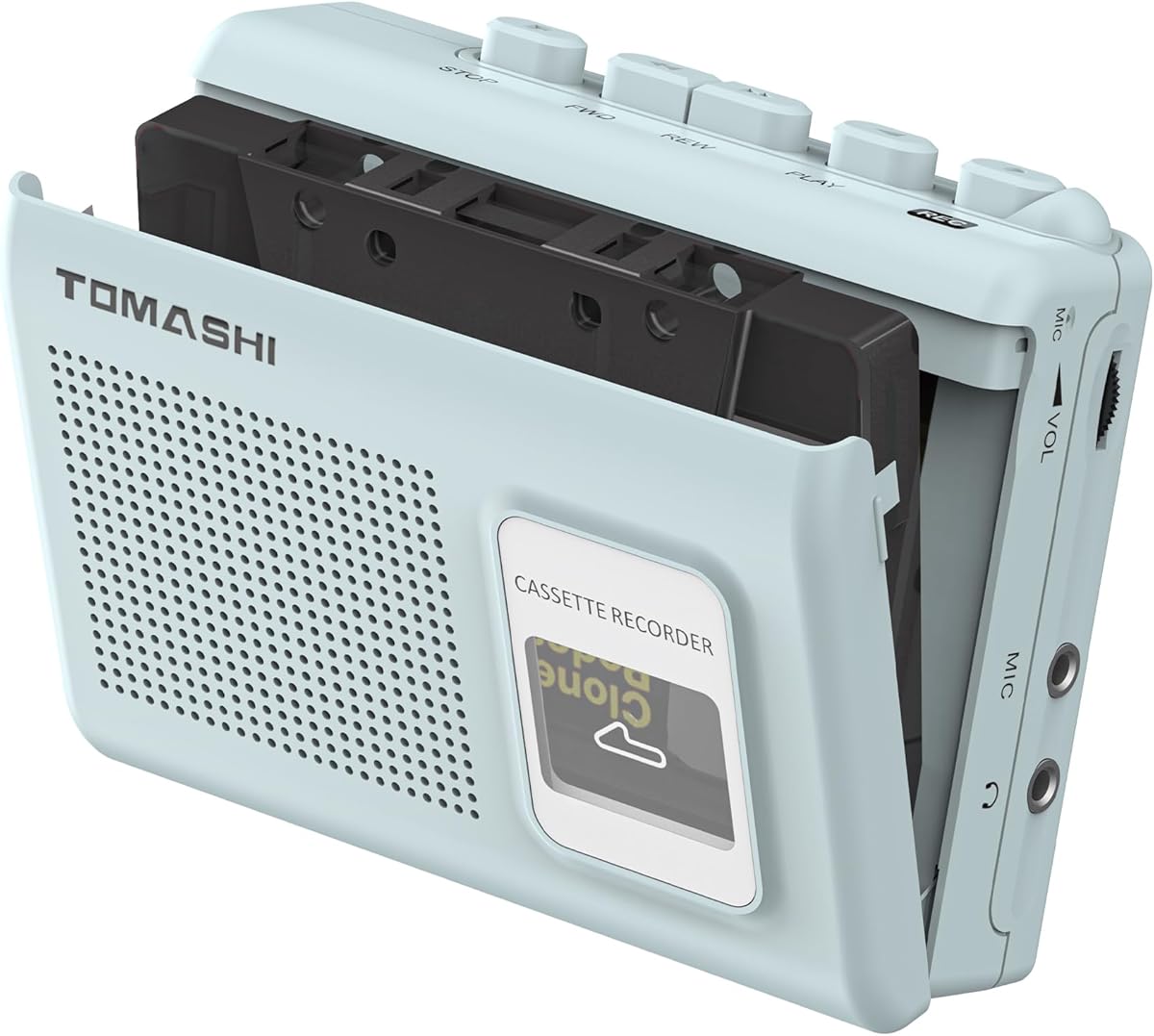
The blue TOMASHI Portable Cassette Player offers the same core combination as the first-ranked model in a distinct color option. It has a 3.9 customer rating and combines cassette playback and recording with a built-in speaker, microphone, and headphone jack. Its compact 4.57 by 3.54 by 1.38-inch body makes it suitable for children who want a personal recorder that is easy to carry.
We may earn a commission when you buy through this link, at no additional cost to you.
The controls include rewind, fast-forward, stop, play, and record, giving young users direct access to the essential cassette functions. A child can listen through the speaker, use headphones for a quieter experience, or record through the built-in microphone. The supplied use cases include listening to music and learning a language, while the automatic stop mechanism helps protect the tape and pinch roller when a recording or playback side ends.
The device shares a major practical limitation with other compact cassette players: two AA batteries and a USB power supply are not included. The recommendation to remove batteries when using USB power also requires attention. There is no digital storage, Bluetooth, or USB audio transfer, so the format is deliberately old-fashioned and best for children who understand and enjoy physical tapes.
This model is a solid alternative for families who prefer the first-ranked TOMASHI's compact design but want a blue version. It can serve as a story recorder, language-practice tool, or personal music player under adult supervision. It is less suitable for long recordings or cross-device content, yet its straightforward controls and automatic stop function make it approachable for hands-on cassette discovery.
Unlike a digital recorder with an abstract file list, this player lets children see, insert, rewind, and physically handle a tape. That tangible interaction can make recording feel more like a creative activity rather than an invisible software process.
Automatic stopping reduces needless wear at the end of a tape, while the headphone jack gives children control over when audio is shared. Together, these details balance durability with personal listening.
We may earn a commission when you buy through this link, at no additional cost to you.
The TOMASHI Portable Stereo Cassette Tape Player is a stylish, lightweight personal player with a 4.6 customer rating. Its two-tone pink and green design gives it an eye-catching appearance, while the stereo playback head supports left-right channel separation when stereo-recorded tapes are played through earphones. The device is intended for convenient everyday listening rather than shared playback.
We may earn a commission when you buy through this link, at no additional cost to you.
A built-in microphone allows the player to record voices, ideas, and ambient sounds directly onto a blank cassette. A dedicated 3.5mm microphone jack provides a path to an external microphone for improved recording, although one is not included. The package includes the player, a pair of earbuds, and a user manual. Power can come from two AA batteries or a Type-C connection, though neither the batteries nor a Type-C cable are included.
Its most important limitation is the absence of a built-in speaker. Children cannot simply place it on a table and listen audibly unless they connect separate speakers or another compatible output. That makes headphones or earbuds essential rather than optional. The product is also marketed for basic everyday use, so buyers seeking advanced recording levels or studio-quality results should look elsewhere.
This is a compelling choice for a school-age child who likes music, fashion accessories, and the look of a personal cassette player. The strong rating and distinctive design add appeal, while stereo playback improves the experience with properly recorded tapes. It is less suitable for group activities and family storytelling because of the lack of a speaker, but excellent for a child who wants private, portable listening and occasional recording.
The stereo playback head is meaningful for children listening to albums recorded with separated left and right channels. Earbuds help children experience that separation without requiring the device to duplicate the larger footprint and power demands of a speaker-equipped deck.
The pink-and-green finish and pocket-sized form give the recorder a personal accessory feel. That may make it more appealing for children who are more motivated to use a device that looks distinctive and fits comfortably in a backpack or pocket.
We may earn a commission when you buy through this link, at no additional cost to you.
The PROSCAN Cassette Player and Recorder is built around flexible recording in a traditional portable deck. It has a 3.9 customer rating and includes a free-standing microphone, an external microphone jack, automatic level control, one-touch recording, a headphone jack, and auxiliary input. Fast-forward and rewind functions round out a conventional tape transport.
We may earn a commission when you buy through this link, at no additional cost to you.
The included microphone is notable because it allows a child to record a conversation or performance without holding a small microphone directly. That can make interviews, class presentations, family stories, and group activities easier to manage. One-touch recording reduces operational complexity, while automatic level control is intended to support consistent audio. The auxiliary input also allows compatible smartphones, tablets, and other sources to contribute to the recording setup.
At 1.8 pounds with a carry handle, this model is portable but bulkier than the TOMASHI personal players. It also shares the usual limitations of cassette equipment: tapes must be inserted, rewound, stored carefully, and replaced when worn. The supplied rating is modest, so buyers should not expect a premium interface or advanced digital conveniences. It remains a functional choice built around familiar controls.
This recorder is best for a child who wants to record other people, conduct an interview, or collect family and classroom performances on tape. The free-standing microphone and auxiliary connection are more useful in those situations than an ultra-compact personal device. For a child who mainly wants private music playback and inexpensive short recordings, one of the smaller personal cassette players may be easier to manage.
A free-standing microphone gives children room to speak, sing, or perform without crowding the recorder. This is a practical advantage for family storytelling, classroom demonstrations, and simple podcast-style activities.
One-touch recording, fast-forward, rewind, automatic level control, and auxiliary input cover the core needs of a home tape deck. The combination gives beginners a direct path from pressing record to reviewing the result.
We may earn a commission when you buy through this link, at no additional cost to you.
The QFX RETRO-39BT is the most technically expansive product in the guide, combining a cassette player and recorder with USB, Bluetooth, FM radio, MP3 playback, and analog connections. Its 3.8 customer rating is the lowest in this group, but its capabilities distinguish it from the simpler tape players. It is especially relevant for children interested in how older and newer audio formats interact.
We may earn a commission when you buy through this link, at no additional cost to you.
USB-to-cassette recording allows digital audio from a USB drive to be placed directly onto a tape. The system can also record from cassette, Bluetooth, FM radio, microphone, or line-in to USB. A built-in 3.5-inch speaker, line input and output, external microphone support, swivel handle, included AC cord, and four-C-battery option make it function more like a portable media hub than a basic recorder.
This versatility adds complexity. A child may need an adult to help manage files on a USB drive, connect sources correctly, choose recording directions, and handle the different controls. Four C batteries are not included, and cassette recording still requires appropriate tapes and careful media management. The lower rating may reflect the learning curve or variability in the overall experience, but the stated functionality remains extensive.
For an older child, teen, teacher, or family that wants to connect computer-based audio with physical cassettes, this model is the most capable option. It can support digital-to-analog projects, radio-inspired listening activities, interviews, and shared playback. A younger child focused only on speaking, singing, and uncomplicated recording would probably benefit more from the LeapFrog or Voice Pad products.
The ability to move audio from USB or other sources onto cassette tape makes this more than a nostalgia device. It offers a tangible way for children to compare file-based playback with the mechanical process of winding and replaying physical tape.
Bluetooth, FM radio, MP3 files, cassette playback, line connections, and a built-in speaker create a varied listening platform. An adult can use those options to build supervised activities around music discovery, communication, and audio conversion.
We may earn a commission when you buy through this link, at no additional cost to you.
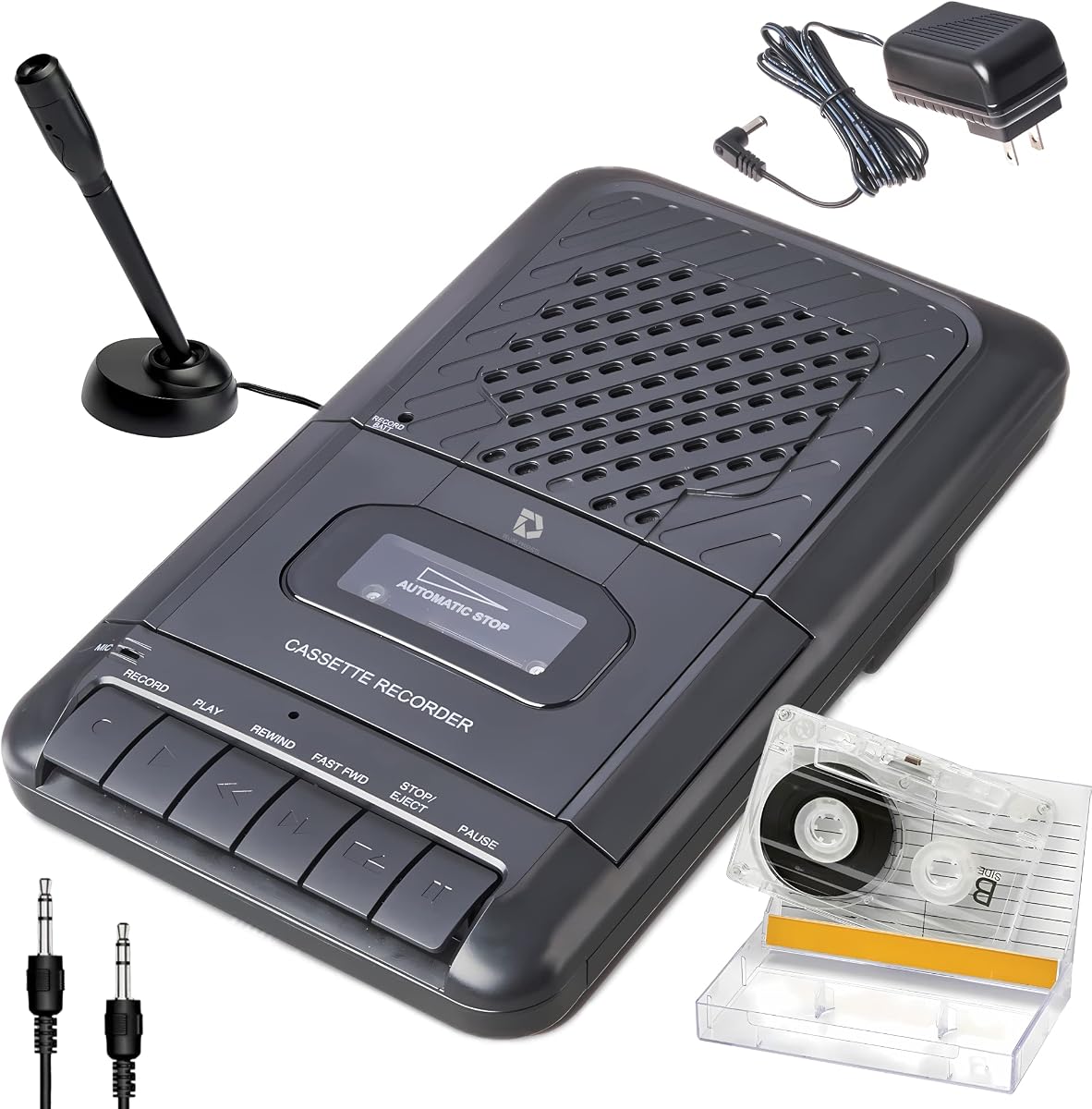
The Deluxe Products Portable Cassette Player Tape Recorder is a complete analog recording package for children and families. It has a 3.9 customer rating and includes an external microphone, auxiliary input cable, and AC adapter. The deck also has a built-in condenser microphone, built-in speaker, large transport buttons, and a carrying handle, giving it useful features without requiring a separate collection of accessories.
We may earn a commission when you buy through this link, at no additional cost to you.
Children can record their voice with the included external microphone, capture sound with the built-in condenser microphone, or record audio from a smartphone, laptop, or tablet through the auxiliary cable. The connected-device method requires a device with a headphone output. Once recorded, tapes can be reviewed through the built-in speaker or private headphone output. Large, easy-to-press buttons help make the transport functions approachable.
The supplied description emphasizes replaying old tapes and presents the unit as a gift for music and nostalgia enthusiasts, but it can also serve family storytelling, oral history, and creative audio projects. The included AC adapter is convenient for home use, while the carry handle supports movement around a room. Four C batteries are not included, so cordless operation requires an extra purchase. Physical tapes and careful rewinding remain part of the experience.
This model is well suited to families that want to record onto cassette while listening back immediately. The included microphone and cable make it particularly useful for interviewing family members, recording performances, or transferring approved audio from a connected device. It is less suitable for a child who wants a tiny, battery-only personal player, but as a complete home recorder kit it provides a balanced and approachable package.
Providing the external microphone, auxiliary cable, and AC adapter reduces the number of extra items a family needs for common recording tasks. Children can begin with voice recording and gradually explore connected-source recording with adult help.
The built-in speaker allows a child to hear a recording without connecting headphones. That makes it convenient for checking stories, performances, and messages during a family activity, while the headphone output supports quieter review.
We may earn a commission when you buy through this link, at no additional cost to you.
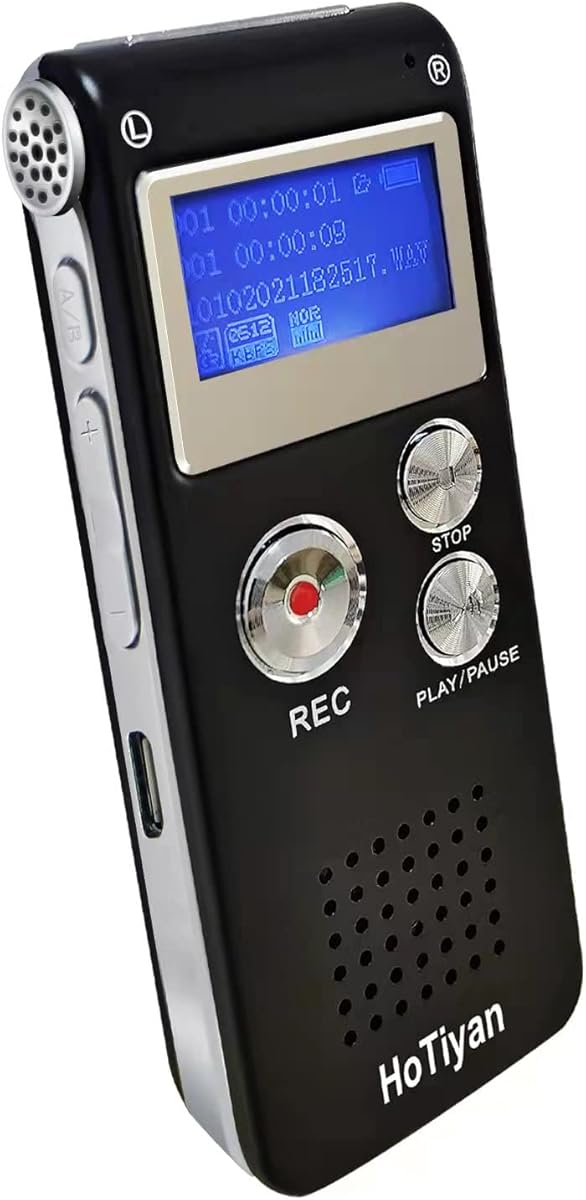
The Digital Voice Recorders 8GB Audio Recorder is the most storage-oriented selection, with a 4.1 customer rating and built-in 8GB capacity. It records in MP3 or WAV formats, supports a sensitive microphone and noise-reduction function, and can transfer files to a computer through the supplied Micro USB cable. It offers a long recording menu, variable playback speed, timestamps, password protection, and MP3 playback.
We may earn a commission when you buy through this link, at no additional cost to you.
Voice activation is useful when an adult cannot continuously press the record control. Once a sound threshold is set, the recorder begins capturing audio above the chosen level and stops when sound falls below it. The stated recording estimates range from 128 hours at 192 kbps to 560 hours at 32 kbps, with support for up to 199 files. These options make the device more suitable for extended sessions than the 40-second Voice Pad.
The built-in rechargeable 3.6-volt 300mAh lithium battery is listed as supporting 20 hours of continuous recording and eight hours of headphone playback. The A-B repeat function is valuable for learning because it lets a child replay a chosen section repeatedly. On the other hand, file menus, playback speed, threshold settings, timestamps, and computer transfer are less intuitive than pressing a physical tape button. An adult should introduce file management and charging routines.
This recorder is best for an older child, student, or family member who wants longer recordings, repeated study playback, interviews, lectures, or organized audio files. It is less compelling for a toddler seeking immediate button-driven play or for someone specifically wanting the mechanics of a cassette. Even so, it is a capable digital option for building listening and study habits.
Eight gigabytes of internal storage provides substantially more room than a short voice pad or fixed cassette recording. A child can preserve family stories, class notes, language practice, or a sequence of creative recordings in separate files.
A-B repeat, variable playback speed, and timestamped filenames are particularly useful for reviewing difficult language, sounds, or important passages. These features support independent practice while still allowing an adult to explain how the device works.
We may earn a commission when you buy through this link, at no additional cost to you.
The right choice depends on age, sound-management skills, and the type of recording activity. Consider format, controls, capacity, connections, power, and supervision before choosing a recorder.
A cassette recorder offers a tactile, visible process that can make recording feel more concrete to a child. It also introduces the mechanical ideas of tape winding, rewinding, playback, and physical media storage. A digital recorder is better when storage capacity, file transfer, repeated playback, or longer sessions matter. The most important distinction is not simply old versus new, but whether the format supports the activity without frustrating the child or adult.
Choose cassette for music discovery, hands-on storytelling, and family nostalgia. Choose digital for lectures, interviews, classroom learning, and an audio library that can grow over time.
Younger children benefit from fewer decisions, large tactile buttons, immediate feedback, and short recording limits. A three-button voice pad or a child-specific music player can feel manageable, while a complex menu system may require more adult assistance. Older children may appreciate variable playback, timestamps, USB transfer, and direct recording controls. Always compare the stated age guidance with the child's developmental level rather than relying on age alone.
The ideal device should let the child begin an activity with minimal setup. Simple controls are useful, but they should still leave room for creativity rather than restricting every recording to the same short duration.
Capacity should match the length and purpose of the intended recording. A 40-second voice pad works well for short reminders, phonics exercises, and single-message activities. Thirty minutes across several buttons is more appropriate for songs, repeated sounds, and varied creative projects. Digital devices may support many hours, while cassette recorders are limited by the length of individual tapes. Consider whether a child benefits from short limits or becomes frustrated when a message is cut off.
Short limits can improve focus, while long capacities support complete stories and interviews. Match the recording window to the child's attention span and the activity's natural length.
A built-in microphone makes personal recording convenient, but an external microphone can capture other people more effectively. A free-standing microphone is particularly useful for interviews, family performances, and classroom demonstrations. Built-in speakers enable shared listening, while headphone jacks support private playback and reduce distraction. Some personal players omit speakers entirely, so confirm that shared listening is important before choosing one.
For a child recording their own voice, a built-in microphone may be sufficient. For group activities or interviews, include an external microphone and consider placement in a quiet room.
Connectivity determines how easily a child can bring in existing music or move recordings elsewhere. Auxiliary input can connect suitable devices, Bluetooth supports convenient wireless playback, and USB transfer allows digital files to be organized or saved. These features are helpful for older children and supervised educational activities, but they also add complexity. A simple parent should understand the connections before handing them to a child.
Choose added connectivity for larger projects and older users. Choose a simpler model when independent operation, durability, and immediate recording controls matter more than file access.
Power requirements should be checked before purchase. Some compact cassette players require AA batteries and a USB supply, neither of which may be included. Larger models may use C batteries, while the digital recorder uses a rechargeable lithium battery and includes a USB cable. Adapters and batteries affect readiness, portability, and ongoing operating convenience. Also note which headphones, microphones, cables, and cassettes are included.
List every required accessory before buying. A recorder that arrives complete is more convenient than one that needs batteries, blank tapes, or a cable before the first use.
Personal cassette players are small enough for backpacks, pockets, and small hands, while shoebox-style recorders offer a built-in handle and more connection options. The weight and dimensions matter if a child carries the device to school, activities, or outdoors. A sturdy carry handle and clearly separated controls can help a family use a larger model safely, but a more compact unit may be easier for a younger child to manage independently.
Choose a compact model for personal listening and simple messages. Choose a handled deck when recording performances, group activities, or connected sources is the main goal.
The most educational recorders support active listening, speaking practice, phonics, storytelling, music exploration, or repeated review. A removable picture cover can turn recordings into communication prompts, while built-in learning songs and movement tracks can add structure to daily use. Digital A-B repeat and playback-speed functions support study. The key is to choose features that encourage repeated, meaningful interaction rather than adding complexity for its own sake.
Look for educational features that fit the child's current interests and developmental needs. A focused tool used consistently is usually more valuable than a feature-rich device that is too complicated to enjoy.
Begin by explaining the basic recording cycle in terms the child can understand: create a message, stop the recording, play it back, and then decide whether to keep or replace it. For a cassette model, show how to insert the tape correctly and identify rewind, play, stop, fast-forward, and record. For a digital model, demonstrate charging, saving a file, selecting playback speed, and transferring recordings to a computer when appropriate. Keep the first session short and focused.
Choose a quiet location and hold or position the microphone at a suitable distance. A child should never speak directly into a microphone at an excessive volume, and adults should supervise equipment with cords, small parts, or removable covers. Use headphones when private listening is appropriate, but keep volume at a comfortable level. With cassette recorders, avoid repeatedly leaving a tape in fast-forward or play after it has ended, and use the automatic stop feature where available.
For long-term care, remove batteries from battery-operated devices that will sit unused for extended periods, unless the manufacturer provides different guidance. Keep magnetic tape players away from magnets, moisture, dust, and excessive heat, and store tapes in their cases. Charge the digital recorder according to its instructions, clean its microphone surface gently, and keep transferred files organized. For child-focused devices, check the removable cover, buttons, battery compartment, and microphone openings regularly so that damage or loose parts do not go unnoticed.
Young children usually benefit from a child-focused device with large tactile buttons, immediate playback, and short recording limits. The LeapFrog Let's Record! Music Player offers guided music and sound activities, while the Talking Products Voice Pad provides a simpler single-message format. Adult supervision remains appropriate, particularly with removable covers, cords, batteries, or small accessories.
Neither format is automatically more educational. Cassette players can teach children about physical media, winding, recording, and playback in a visible way, while digital recorders support larger libraries, file transfer, timestamps, and repeated study functions. The better choice depends on the child's interests and the learning activity, such as music exploration, phonics, storytelling, or lecture review.
Yes, provided the recorder supports an external microphone and the child has a quiet, suitable recording environment. The JENSEN and PROSCAN models include connections or microphones designed for more directed recording. A free-standing external microphone can make it easier for another person to speak without holding the recorder close to their mouth.
Short activities may need only a few seconds or a 40-second message, while songs, stories, and interviews benefit from several minutes. The LeapFrog player stores up to three minutes on each of three buttons, while the digital recorder provides extensive storage across many files. Choose a limit that matches the activity and the child's concentration rather than simply choosing the largest capacity.
No. The TOMASHI Portable Stereo Cassette Player includes earbuds, but the product data for the other models does not consistently identify headphones as included. Several support headphone output, which is different from providing compatible headphones. Check the package contents and plan to purchase suitable earbuds or headphones when necessary.
No. The LeapFrog player includes batteries for demonstration purposes only, while several cassette models require AA or C batteries that are not included. The digital recorder uses a rechargeable lithium battery, and some larger cassette devices include an AC adapter. Confirm the required power source before purchase so the product is ready for use.
Some models support auxiliary input, which can accept audio from a phone, tablet, or laptop with a headphone output and the appropriate cable. The Deluxe Products model includes an auxiliary cable, and the JENSEN and PROSCAN recorders also provide auxiliary connections. Compatibility, cable requirements, and recording rights should be checked before transferring audio.
Adults should explain the record, stop, and playback controls, choose a quiet space, and demonstrate comfortable listening volume. Small parts, removable covers, cords, loose batteries, and microphones require supervision. Parents should also check that any connected device is permitted by the recorder's instructions and help organize digital files so the child can retrieve recordings without deleting them accidentally.
The LeapFrog Let's Record! Music Player stands out as the most complete pick for younger children because it combines an easy recording interface with movement, music, learning content, and Bluetooth. The Talking Products Voice Pad is the leading budget option for short speech, phonics, listening, and photo-linked communication activities. The JENSEN Portable Cassette Player and Tape Recorder earns the premium designation for one-touch recording, automatic level control, a condenser microphone, and flexible connections.
Prioritize the format that matches the intended activity rather than choosing only by appearance or feature count. Very young children benefit from large controls, short limits, and immediate playback, while older children may appreciate long recording windows, file transfer, auxiliary connections, and repeated playback functions. Adults should also consider whether the device is primarily for private listening, shared stories, interviews, music, or school practice because no single feature set serves every situation equally well.
Before purchasing, verify the current product listing, package contents, power requirements, compatible accessories, and availability of suitable tapes or storage media. Customer ratings can change over time, and individual experiences may vary. Checking the latest listing and current cost helps ensure that the selected tape recorder for kids remains suitable for the child's age, interests, and intended creative or learning activities.