
Amzboy 15.6-Inch Laptop
4.8Editor score
15.6-inch Full HD display
Silent fanless solid-state design
45-watt USB-C charging
An entry level laptop should make everyday computing straightforward without overwhelming a buyer with specifications that add little to the experience. The right model balances a legible display, capable processor, dependable battery life, practical ports, and enough memory for browsing, documents, video calls, and streaming.
The ten laptops in this guide cover Chromebooks and Windows models for students, home users, travelers, and budget-conscious professionals. We compared the supplied specifications, focusing on processor capability, memory, storage, screen quality, connectivity, portability, battery claims, and features that matter during a normal workday.
Each review explains where a particular laptop stands out and where its limitations may affect the buyer. Ratings reflect the information available for the listed products rather than a hands-on testing claim, and specifications, availability, and prices can change, so readers should confirm the current listing before buying.
4.8Editor score

4.5Editor score

4.3Editor score
As an Amazon Associate we earn from qualifying purchases.
This side-by-side comparison highlights the major differences among ten entry level laptops, including their operating systems, processors, memory, displays, connectivity, and portability.




The Lenovo Flagship Chromebook is an attractive entry level option for buyers who want a capable display and a highly portable design. Its 14-inch Full HD touchscreen offers 1920 by 1080 resolution, IPS wide viewing angles, and an LED backlight. The listed user rating of 4.2 reflects a generally positive reception, although the modest memory configuration places it firmly in the affordable category.
We may earn a commission when you buy through this link, at no additional cost to you.
Its MediaTek Kompanio 520 processor uses an eight-core arrangement and is designed for efficient everyday Chrome OS workloads. Four gigabytes of RAM can handle ordinary browsing, multiple browser-based applications, and standard school or office tasks, while 64GB of eMMC provides local storage for files and applications. The included microSD reader helps address the limited internal capacity without requiring a connection to the internet.
Portability is a major strength. At 2.86 pounds and 0.73 inches thick, the Lenovo is lighter and slimmer than several full-size Windows alternatives in this roundup. It also includes one USB-A port, one USB-C port, a 3.5mm headset connection, Wi-Fi 6, and Bluetooth 5.1. That balance makes it suitable for commuting, campus use, or working from different rooms.
The compromises are the 4GB of RAM and 64GB of eMMC, which offer little room for demanding software or a large local media library. Chrome OS is well suited to web-centered work, and the touchscreen enhances browsing, media viewing, and navigation. For a student, family member, or traveler who favors a light, polished Chromebook experience, this Lenovo remains a strong recommendation.
The Full HD IPS touchscreen is the Lenovo's most visible advantage. Its 1920 by 1080 resolution provides more usable detail than the HD panels found on several competing models, while touch input offers another way to navigate Chrome OS.
Weighing 2.86 pounds, the chassis is particularly easy to carry for extended periods. Its slim profile complements the large screen, making the device a practical choice for students and commuters who value low weight.
We may earn a commission when you buy through this link, at no additional cost to you.
The HP 14-Inch N150 Laptop combines Windows 11, 8GB of memory, and a one-year Microsoft 365 subscription in a conventional notebook format. Its listed rating of 4.4 makes it one of the stronger-rated models here. The Intel Processor N150 is a four-core chip capable of reaching 3.6GHz, making it appropriate for office applications, research, online classes, and communication.
We may earn a commission when you buy through this link, at no additional cost to you.
The 8GB RAM is the key specification for buyers who frequently switch between documents, browser tabs, and video calls. Storage is more modest at 128GB UFS, but this configuration can still hold the operating system, essential applications, and a working collection of cloud-based documents. USB-C and HDMI 1.4 allow the laptop to connect to an external monitor or other accessories.
At 3.24 pounds, the laptop is light enough for commuting and classes. The specification sheet claims up to 11 hours of battery life, Wi-Fi 6 support, a 720p camera, and a full-size keyboard. These features create a well-rounded package for students and office workers who need conventional Windows applications rather than a browser-centered operating system.
It is important to set realistic expectations for the N150. It is intended for efficient everyday tasks, not intensive content creation or demanding modern games, despite the broad use cases stated in the listing. The 128GB drive may fill quickly with large files. Even so, the combination of 8GB RAM, Microsoft 365, and a portable body makes this a well-balanced entry-level Windows choice.
Unlike a Chromebook, this model supports the broader application catalog associated with Windows 11. The included Microsoft 365 period provides immediate access to Word, Excel, PowerPoint, and cloud storage for school or office tasks.
The four-core N150 and 8GB memory combination is appropriate for multitasking among office applications, web browsing, and communication tools. It remains an entry-level platform, but it offers more local-software flexibility than the Chrome OS alternatives.
We may earn a commission when you buy through this link, at no additional cost to you.
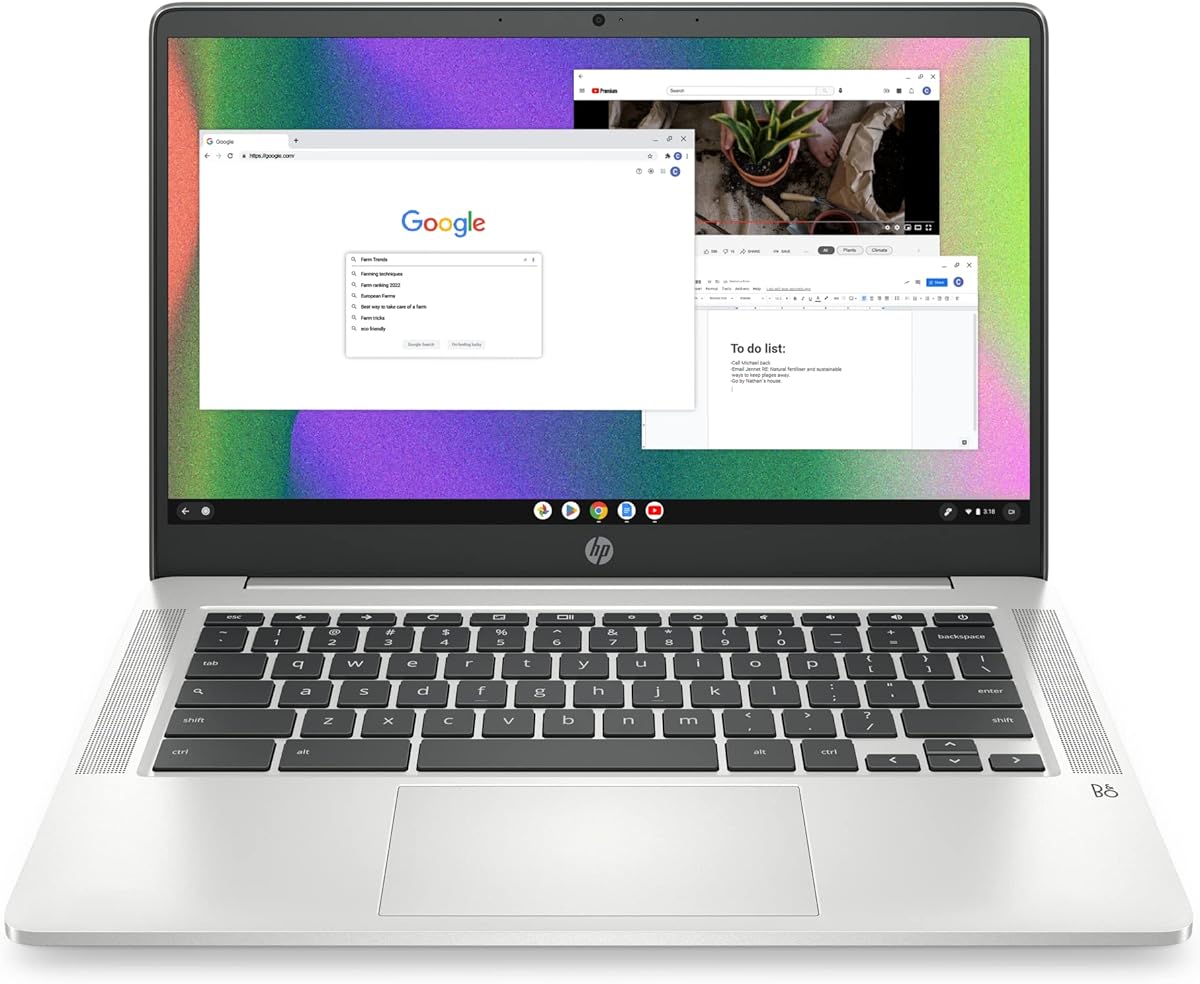
The HP Chromebook 14 is designed around the fundamentals of a budget Chromebook: an efficient processor, a portable 14-inch form factor, and long claimed battery life. It holds a 4.3 rating in the supplied data. The quad-core Intel Celeron N4120 and 4GB of RAM target web browsing, assignments, streaming, and standard Chrome OS applications.
We may earn a commission when you buy through this link, at no additional cost to you.
Its 14-inch HD display uses an anti-glare finish, which can be useful under bright indoor lighting or for users who spend long periods reading. Intel UHD Graphics 600 supports smooth 4K content according to the product information. The larger benefit is endurance: HP advertises up to 14 hours of battery life and Fast Charge that can move the battery from zero to 50 percent in approximately 45 minutes.
The device also includes a multi-touch touchpad, stereo speakers, 802.11ac Wi-Fi, Bluetooth, and a one-year limited hardware warranty. Its 64GB eMMC is less generous than the storage found in several Windows laptops in this guide, while 4GB of memory is adequate for Chrome OS but not ideal for heavy multitasking.
This Chromebook is most compelling for students, travelers, and households seeking a dedicated browsing and document machine with minimal maintenance. Its limitations are the 1366 by 768 resolution and modest memory. If long battery life, an anti-glare screen, and fast charging matter more than a high-resolution panel, it is a sensible entry-level recommendation.
The advertised runtime of up to 14 hours gives this Chromebook an advantage for school days, airport travel, and locations where charging access is uncertain. Fast Charge also reduces the amount of time spent waiting when a top-up is necessary.
The anti-glare surface is useful for classrooms and shared workspaces. Its HD resolution is less detailed than the Full HD and IPS panels in the roundup, but the focus is placed on readability and endurance rather than media editing.
We may earn a commission when you buy through this link, at no additional cost to you.
The HP Essential 14-Inch Laptop is an exceptionally balanced entry-level Windows machine. It has a 4.5 rating in the supplied information, a compact 14-inch form factor, Wi-Fi 6, and a useful collection of ports. The Intel N150 processor, 4GB LPDDR5 memory, and 128GB UFS drive are aimed at browsing, streaming, document editing, and ordinary multitasking.
We may earn a commission when you buy through this link, at no additional cost to you.
Connectivity is one of its strongest areas. It includes a 10Gbps USB-C port with DisplayPort 1.2, two USB-A ports, HDMI 1.4b, a headset connection, and a multi-format SD card reader. Bluetooth 5.4 and Wi-Fi 6 provide current wireless standards, while the included Microsoft 365 Personal subscription covers Word, Excel, PowerPoint, and cloud storage during its introductory period.
The 14-inch anti-glare HD display has 250-nit brightness, 62.5 percent sRGB coverage, and a 79 percent screen-to-body ratio. It lacks the resolution and color richness of a Full HD IPS panel, but the compact dimensions help maintain portability. At 3.24 pounds and 0.71 inches thick, it should fit comfortably in a daily backpack.
The main weakness is 4GB of RAM, which can become restrictive when many browser tabs and applications are open simultaneously. Some users may also prefer a larger or sharper display. Even so, the device balances battery claims, full-size keyboard, modern connectivity, portability, and Windows software support, making it the strongest general-purpose recommendation in this guide.
USB-C with DisplayPort, HDMI, two USB-A ports, and an SD reader cover most accessory needs without requiring a permanent dongle. The inclusion of both modern and legacy connections is particularly helpful for students and office users.
The 3.24-pound body, long claimed battery life, and full-size keyboard support mobile work. A dedicated Copilot key provides quick access to Microsoft 365's AI features, while noise reduction helps improve clarity during calls.
We may earn a commission when you buy through this link, at no additional cost to you.
The Dell 15.6-Inch Core 3 Laptop stands apart from the most basic systems in this guide through its Intel Core 3 100U processor, 8GB of RAM, and 256GB solid-state storage. It carries a 4.3 rating and offers Windows 11 Home. For buyers who can move up slightly from the entry tier, this configuration provides greater headroom for multitasking.
We may earn a commission when you buy through this link, at no additional cost to you.
The 15.6-inch Full HD display is well suited to coursework, spreadsheets, presentations, and media consumption. Dell ComfortView software is included to help reduce potentially uncomfortable blue-light exposure during extended viewing. The roomy keyboard has a separate numeric keypad, which is particularly useful for data entry, accounting, and spreadsheet work.
Its Core 3 platform is better aligned with sustained productivity than the lower-power N-series, Celeron, and Kompanio chips represented here. The 8GB memory makes switching among browser tabs and productivity applications easier, while the 256GB drive provides roomier local storage than 64GB or 128GB configurations. Express Charge and energy-efficient batteries support the productivity focus.
The main trade-off is portability. A 15.6-inch notebook generally occupies more space than a 14-inch model, although the benefits of a larger screen, numeric keypad, stronger processor tier, and roomier storage may justify that extra footprint. Dell's one-year onsite service adds reassurance for buyers who value support. This is the top premium-oriented pick for users who want a step above basic entry hardware.
Eight gigabytes of RAM and a Core 3 processor create a more comfortable environment for numerous browser tabs, documents, and communication tools. The 256GB SSD also reduces the need to keep every working file in cloud storage.
The Full HD panel provides a useful balance of detail and screen area. A separate numeric keypad further distinguishes this model from ultraportable laptops, making it especially practical for finance students and administrative work.
We may earn a commission when you buy through this link, at no additional cost to you.
The Acer Aspire 3 combines a 15.6-inch Full HD IPS display with an AMD Ryzen 3 7320U processor, 8GB of LPDDR5 memory, and a 128GB NVMe solid-state drive. Its 4.2 rating reflects a broadly capable budget configuration. The quad-core Ryzen processor and Radeon graphics create a useful foundation for productivity, browsing, and casual media use.
We may earn a commission when you buy through this link, at no additional cost to you.
The Full HD IPS display is one of the strongest in this roundup, offering 1920 by 1080 resolution, crisp colors, and a 16:9 aspect ratio. Narrow bezels help keep the visual design modern despite the larger screen. Acer's front-facing HD camera uses temporal noise reduction for improved low-light imagery, while PurifiedVoice and AI noise reduction target clearer online communication.
The 8GB of onboard LPDDR5 memory gives the system enough capacity for everyday multitasking, and the NVMe drive provides faster response than the eMMC storage found in many Chromebooks. Wi-Fi 6 supports faster modern wireless connections. The slim, light design also makes the Aspire 3 easier to carry than a typical 15.6-inch notebook.
Buyers will need to manage the 128GB storage limit, and the product information does not provide a specific battery-runtime claim. Nevertheless, the combination of a Ryzen 3 processor, 8GB RAM, NVMe storage, and Full HD IPS display creates one of the most attractive specification packages here. It is a strong recommendation for students and home users who want Windows without a premium price.
The 15.6-inch Full HD IPS panel offers more detail and viewing-angle flexibility than the HD anti-glare displays in several competitors. It is a good fit for streaming, coursework, and regular document work.
The Ryzen 3 7320U, 8GB LPDDR5, and NVMe drive create a responsive foundation for normal productivity. These specifications are more accommodating than the 4GB memory and eMMC storage combinations common among the cheapest devices.
We may earn a commission when you buy through this link, at no additional cost to you.
The HP Essential 15.6-Inch Laptop pairs 8GB of RAM with a 256GB PCIe NVMe solid-state drive, giving it more balanced storage and memory than most Chromebook-class configurations in this guide. It has a 4.2 rating and runs Windows 11. The Intel N100 is a four-core processor aimed at browsing, video conferencing, education, streaming, and document editing.
We may earn a commission when you buy through this link, at no additional cost to you.
The 15.6-inch Full HD anti-glare display has 1920 by 1080 resolution and narrow bezels. It is larger than the panels in the 14-inch alternatives and offers enough room for side-by-side research, presentation editing, or relaxed media viewing. Intel UHD Graphics supports everyday visual workloads, while the listed storage provides room for substantial local files.
The laptop includes Wi-Fi 6, Bluetooth 5.3, USB-C, two USB-A ports, HDMI, and a headphone connection. Its full-size keyboard includes a numeric keypad, improving efficiency for data entry. At 3.64 pounds, it remains portable enough for school or work, and the listed eight-plus-hour battery estimate supports an all-day use pattern.
The N100 will not satisfy intensive editing, advanced engineering software, or high-end gaming, but that limitation is consistent with the entry-level category. Its strengths are the roomier SSD, 8GB memory, large Full HD screen, and practical connectivity. This model is especially attractive to buyers who want the HP 15-inch format and a larger local storage allowance without moving into a higher processor tier.
The 256GB NVMe drive provides a much more generous local workspace than the 64GB eMMC options in this guide. Faster storage also supports quicker system response and application launches compared with many budget flash configurations.
A full-size keyboard with a numeric keypad makes this laptop useful for spreadsheet-heavy school and office work. The 15.6-inch Full HD screen adds enough room for presenting, reading, and viewing without the cramped feel of a compact notebook.
We may earn a commission when you buy through this link, at no additional cost to you.
The HP Essential 14-Inch Celeron is a lightweight device designed around basic learning, browsing, streaming, and communication. It carries a 4.2 rating and includes a dual-core Intel Celeron N4500 processor, 4GB of LPDDR4x memory, and 64GB of eMMC storage. Its compact chassis weighs 3.35 pounds, making it one of the lighter full-size options reviewed.
We may earn a commission when you buy through this link, at no additional cost to you.
The 14-inch anti-glare HD display provides 1366 by 768 resolution, 250-nit brightness, and 62.5 percent sRGB coverage. Its 80 percent screen-to-body ratio creates a modern appearance, although the resolution is less detailed than the Full HD models in the roundup. A 47Wh battery, Wi-Fi 6, and Bluetooth 5.3 support mobile use and wireless accessories.
Port selection is a relative strength. The laptop includes a 10Gbps USB-C port with power delivery and DisplayPort 1.4, two USB-A ports, HDMI 1.4b, and a headset connection. An HP True Vision 720p camera and dual-array microphones are included for online learning and meetings, while an H1 secure microcontroller supports device security.
The listing contains a noteworthy inconsistency: the product title refers to Windows, while the supplied description discusses Chrome OS. Buyers should verify the operating system and included applications on the current listing. With only 4GB of RAM and 64GB of storage, the laptop is best for lightweight web-based study rather than heavy applications. Its low weight and good connectivity nevertheless make it convenient for daily school use.
USB-C with DisplayPort, HDMI, and two USB-A ports give the device more flexibility than several minimalist Chromebook designs. A user can connect to an external monitor or use existing peripherals with fewer adapters.
The 3.35-pound weight and 14-inch dimensions make the laptop convenient to move between classes or work locations. Its anti-glare panel and 47Wh battery support extended reading and study sessions away from a wall outlet.
We may earn a commission when you buy through this link, at no additional cost to you.
The Amzboy 15.6-Inch Laptop combines a Full HD display, Windows 11, and a 3.3-pound chassis at one of the most affordable points in this roundup. Its listed rating of 4.8 is the highest among the ten products. An Intel N4020 processor, 4GB of RAM, and 128GB of eMMC storage position it as a basic machine for everyday computing.
We may earn a commission when you buy through this link, at no additional cost to you.
The 15.6-inch 1920 by 1080 anti-glare display offers more resolution than most entry-level competitors. Its fanless solid-state design provides silent operation and reduces the possibility of dust entering through cooling fans. The laptop is intended to handle Zoom classes, browsing, and documents, which covers the needs of many students and casual home users.
Its 45-watt USB-C power delivery adapter is smaller than a conventional barrel-plug charger, making travel easier. The port selection includes dual USB-C and USB 3.2 connections, while an external slot supports TF card expansion up to 1TB. Windows 11 is preinstalled for users who want a traditional desktop environment rather than Chrome OS.
The 4GB of memory is the clearest limitation, particularly when several demanding applications are open at once. The lesser-known brand may also mean a less extensive support network than buyers receive from established manufacturers. Even with those caveats, the Full HD screen, low weight, silent cooling, expandable storage, and strong listed rating make it the budget recommendation in this guide.
The 1920 by 1080 panel is unusually useful in a budget-oriented laptop. It provides more detail for reading, web browsing, and video than the HD screens found on many similarly positioned systems.
The fanless solid-state design operates without fan noise, which can be helpful during classes, meetings, and shared workspaces. A lightweight body and compact 45-watt USB-C adapter simplify carrying the computer between locations.
We may earn a commission when you buy through this link, at no additional cost to you.
The Acer Chromebook 315 is a large-screen Chromebook for streaming, web-based work, and Android applications. It has a 4.4 rating and pairs a dual-core Intel Celeron N4500 processor with 4GB of LPDDR4x memory and 64GB of eMMC storage. Chrome OS provides a straightforward, automatically updated environment centered on web applications and Google services.
We may earn a commission when you buy through this link, at no additional cost to you.
Its 15.6-inch Full HD IPS display is a major advantage over the HD Chromebook alternatives. The 1920 by 1080 resolution and IPS technology support detailed viewing and wider viewing angles, making it suitable for entertainment and group study. DTS Audio and two built-in stereo speakers add value for video and music.
Connectivity is generous for a Chromebook. It has two USB-C ports with USB 3.2 Gen 2 support, DisplayPort, charging, and power input, plus two USB-A ports. Dual-band Wi-Fi 6, Bluetooth 5.1, an OceanGlass touchpad, and a claimed battery life of up to 10 hours make it convenient for school or travel. An additional 100GB of Google Drive space supports cloud storage.
As with most Chromebooks in this category, 4GB of RAM and 64GB of local storage are limited. It is best suited to users whose work and entertainment primarily happen online rather than those who need to install conventional desktop software. Within that category, the sharp IPS screen, strong port selection, and audio equipment make the Acer Chromebook 315 an especially attractive model.
The Full HD IPS panel delivers more detail and viewing-angle flexibility than standard HD Chromebook screens. Paired with DTS Audio and stereo speakers, it creates a capable entertainment setup for a budget notebook.
Chrome OS updates automatically, starts quickly, and integrates tightly with Google applications. The additional cloud storage makes it convenient for users who prefer to keep documents online and access them from multiple devices.
We may earn a commission when you buy through this link, at no additional cost to you.
Choosing an entry level laptop starts with the tasks you expect it to perform. A balanced comparison of operating system, processor, memory, storage, screen, battery, and connectivity is more useful than focusing on one headline specification.
Chrome OS is built around browser-based workflows, Google applications, Android apps, and automatic cloud-focused updates. It is easy to administer and generally well suited to writing, research, school portals, video calls, and streaming. However, buyers should confirm that the specific educational, workplace, or creative software they need is available through the Chrome ecosystem.
Windows 11 provides broader compatibility with established desktop applications and is the safer choice when a course or employer requires specialized software. The Windows models in this guide vary from Intel N-series processors to an Intel Core 3, so operating-system choice does not determine performance by itself. Compare applications first, then choose the hardware that can run them comfortably.
MediaTek Kompanio 520, Intel Celeron, and Intel N4020 models are designed for web browsing, documents, communication, and streaming. Intel N100 and N150 processors add useful capacity for Windows multitasking, while the Ryzen 3 7320U and Intel Core 3 100U offer more headroom for sustained productivity. No entry-level processor is intended to replace a specialized workstation.
Choose a Core 3 or Ryzen 3 configuration if you regularly keep many applications open, work with larger files, or want a laptop that should remain comfortable for several years. An N-series or Celeron chip is more appropriate for light tasks and controlled budgets. Clock speed alone does not tell the entire story, so consider memory and storage alongside the processor.
Memory determines how many applications and browser tabs a laptop can keep active without slowing down. The 4GB configurations found in several models are sufficient for light browsing and basic documents, but 8GB is the more comfortable minimum for a Windows system. Users who split their time among video calls, web research, email, and productivity software should favor the 8GB options.
Check whether the RAM is onboard or upgradeable when the listing provides that distinction. The Dell, HP N150, Acer Aspire 3, and HP Essential 15.6-Inch offer 8GB, giving them an advantage for heavier multitasking. A 4GB machine can still work well as a dedicated browser or school Chromebook, particularly when fewer tasks are running simultaneously.
eMMC storage is inexpensive and well suited to cloud-centered Chromebook use, but 64GB can fill quickly once applications and offline files are added. UFS and NVMe solid-state drives generally provide a more responsive experience and make local files easier to manage. The 128GB models offer more room than 64GB devices, while 256GB configurations provide the most comfortable local workspace in this group.
Consider both type and capacity. A 256GB NVMe drive is usually a better productivity investment than a 64GB eMMC drive because it leaves room for applications, media, and offline documents. Buyers with limited storage should also look for microSD, TF-card, or USB expansion, but should not treat removable media as a complete replacement for internal storage.
A 14-inch screen is easier to carry and works well for travel, while 15.6 inches provides more room for documents, presentations, and media. Resolution is another major factor: Full HD 1920 by 1080 panels display more detail and make split-screen work more practical than HD 1366 by 768 screens. IPS technology can also provide more comfortable viewing angles.
Anti-glare finishes are useful for bright rooms, prolonged reading, and shared workspaces. Glossy screens may look more vibrant but can reflect surrounding lights. Consider the balance between panel size and portability, and verify brightness and color coverage when the listing provides them. High-resolution media work may justify a larger display, while basic productivity can be handled comfortably on a 14-inch HD panel.
Battery claims range from 8-plus hours to 14 hours across the list, but actual runtime depends on screen brightness, network activity, video playback, and workload. A model advertised for long battery life is useful for students, commuters, and travelers who spend significant time away from an outlet. Fast charging can be especially valuable when only a short break is available.
Charging portability also matters. The Amzboy includes a compact 45-watt USB-C adapter, while several other models provide USB-C connectivity. Confirm the charger included with the chosen configuration, especially when relying on a single travel cable. A large claimed runtime is less valuable if the supplied charger is bulky or difficult to replace.
USB-C, HDMI, USB-A, a headset jack, and a memory-card reader can reduce the need for adapters. USB-C with DisplayPort is particularly useful for connecting an external monitor, while multiple USB-A ports simplify use of existing peripherals. The Acer Chromebook 315 and HP Essential 14-Inch Celeron offer an especially broad selection for their categories.
Wi-Fi 6 is now common in this roundup and can improve performance on compatible networks and routers. Bluetooth 5.1 through 5.4 supports accessories such as mice, keyboards, headphones, and phones. Look for the specific ports you use rather than relying on a general connectivity claim, and remember that the number of USB ports alone does not indicate whether one supports charging, data transfer, or video output.
Laptop weight becomes tangible during a full day of classes, meetings, or travel. The Lenovo Chromebook is the lightest listed model at 2.86 pounds, while the 14-inch HP laptops weigh approximately 3.24 to 3.35 pounds. The 15.6-inch options generally occupy more space, though their larger screens and numeric keypads can compensate for the extra footprint.
Slim designs often look attractive and are convenient to carry, but keyboard comfort, screen visibility, and structural feel cannot be confirmed from specifications alone. Read buyer feedback when possible and consider the included warranty or support. A laptop that is easy to carry and comfortable to use is more valuable than one that merely appears thin.
Begin by signing in with the appropriate account, completing operating-system updates, and checking that the date, time, and security settings are correct. Install only the applications required for your work, and keep default passwords or a passcode on the device. For a new Windows computer, review the included Microsoft 365 access and confirm whether it is a trial or a longer-term subscription before relying on cloud features.
Create separate working folders and use cloud storage for documents that must remain available across devices. Chromebook users should keep important files synchronized and understand which applications work offline. Windows users should save active work regularly, avoid filling the drive to capacity, and maintain free space for updates. Use an external drive or approved cloud service when storage begins to run low.
Care for the battery by avoiding prolonged heat, using the provided or compatible charger, and enabling power-saving or battery-care modes when available. Clean the screen with a soft microfiber cloth and avoid placing food or drinks near the keyboard. Periodic restarts, updated software, and occasional review of storage and startup programs will help the system remain responsive.
A 4GB laptop is suitable for browsing, email, documents, streaming, and video calls when applications are used one at a time or in moderation. Chrome OS may handle browser-based work particularly efficiently. Windows users who keep many tabs or several office applications open will benefit more from 8GB, which provides better headroom for multitasking.
Chrome OS is a strong choice for students and casual users whose work happens mainly in web applications. Windows 11 is generally more appropriate when required software includes traditional desktop programs or specialized tools. Check application compatibility first, then compare processor, memory, and storage rather than treating the operating system as a guarantee of performance.
eMMC is common in affordable Chromebooks and offers limited capacity at a lower cost. UFS and NVMe solid-state storage generally provide faster response and better practical usability for local files and applications. Capacity matters too, so 128GB or 256GB of faster storage can be a better productivity investment than a very small eMMC drive.
A Core 3 processor generally offers a higher performance tier, making it preferable for sustained productivity, heavier multitasking, and more demanding applications. An Intel N-series chip is well suited to browsing, documents, streaming, and communication. The gap may not matter for light use, but it becomes more noticeable as workload and usage time increase.
Full HD is useful because it provides more visible detail for text, websites, documents, and video. It can also make a 14-inch screen more practical for split-screen work. HD resolution remains acceptable for basic tasks, especially on inexpensive Chromebooks, but users who spend long periods reading or viewing media may prefer the sharper panel.
A 64GB device works best for light use with most files stored online, while 128GB offers more freedom for applications and offline documents. A 256GB drive is preferable for larger media libraries, courses with software, or local project work. Expansion through USB or a memory card can help, but it is not as convenient as ample internal storage.
Weight and battery life are related but separate concerns. Several 14-inch models weigh about three pounds and offer battery claims ranging from roughly 10 to 14 hours. Actual runtime varies with brightness, workload, video, and wireless activity, so buyers should consider charger portability as well as the stated runtime.
A high rating can indicate broad buyer satisfaction, but it should not replace a feature-by-feature comparison. The best choice depends on the operating system, display size, memory, storage, ports, and weight that suit your needs. Check current customer feedback, warranty details, and specifications at the time of purchase because listings can change.
The Amzboy 15.6-Inch Laptop stands out as the budget selection because it combines a Full HD anti-glare display, a light 3.3-pound body, silent fanless operation, and expandable storage. The HP Essential 14-Inch Laptop is the most balanced recommendation for buyers who want Windows 11, modern wireless connectivity, useful ports, Microsoft 365, and strong portability.
For shoppers willing to spend more, the Dell 15.6-Inch Core 3 provides a higher-performance processor, 8GB of memory, 256GB of storage, and a spacious Full HD display with a numeric keypad. Other strong alternatives include the Acer Aspire 3 for a Ryzen-based Full HD IPS configuration and the Acer Chromebook 315 for large-screen streaming and cloud-centered use.
Prioritize the specifications that match your everyday tasks, including processor class, memory, storage type, display resolution, connectivity, and portability. Review the latest listing before checkout because configurations and prices can change. Availability, included software, warranty terms, and technical details may also vary, so confirming the current product page is an essential final step.