
Yiman Remote Control Robot Dog
4.4Editor score
Remote and voice activation
Programmable dance and stunts
Two-hour playtime per charge
Explore the best pet robot dogs for kids and seniors, with side-by-side feature, control, programming, safety, battery, and companion comparisons for families.
Pet robot dogs combine the appeal of a responsive animal companion with programmable movement, voice interaction, music, lights, and imaginative missions. A satisfying model should respond reliably, feel safe around children, offer engaging ways to play, and fit the household’s preferred level of control. It should also provide enough variety to remain interesting beyond the first demonstration.
This guide compares ten robot dogs based on the supplied product information, including control methods, action libraries, programming features, construction, charging, range, age guidance, and intended use. It covers energetic stunt models, app-connected STEM toys, plush companions for seniors, remote-controlled puppies, and programmable robot animals designed for children.
Each pick highlights the product that best fits a particular need while noting trade-offs in runtime, setup, control, or play value. Ratings reflect the listed customer feedback, and no products are represented as personally tested. Prices and availability can change, so confirm current listings and product details before buying.
4.4Editor score

4.1Editor score

4.5Editor score
The table below compares all ten robot dogs by their strongest advertised control methods, creative features, construction, and practical specifications. It highlights important differences between stunt-focused toys, app-enabled STEM models, programmable companions, and plush sensory robots.




The Smart Robot Dog is an app-connected robotic puppy designed for children age six and older, combining physical remote access, English voice commands, and touchscreen controls through a free iOS or Android app. Its 4.1 rating reflects a generally positive but not uniformly perfect customer reception. Its standout appeal comes from the breadth of interactions: more than 30 actions include handshakes, kung fu movements, somersaults, and playful pranks.
We may earn a commission when you buy through this link, at no additional cost to you.
Programmability gives this model more depth than a basic remote-controlled stunt toy. Children can build custom action sequences that develop sequencing, logic, and cause-and-effect reasoning without turning play into a formal lesson. The parent-friendly app adds useful controls, including volume adjustment, language switching between Chinese and English, and the ability to lock specific controls. Free updates advertised for new actions can also help extend the toy’s repertoire over time.
Battery specifications are particularly attractive for extended family play. A 600mAh battery and USB-C charging system are described as reaching a full charge in about 1.5 hours while supporting a six-hour runtime. The smooth, non-toxic ABS construction and automatic motor shutdown during collisions add reassuring safety attributes, although the claimed runtime and charging time should be treated as manufacturer specifications rather than guaranteed results.
This is a strong choice for a child who wants more than remote movement and who is ready to explore simple coding. It may be less attractive to families that want completely wireless, download-free operation, since app compatibility introduces another element of setup. Even so, the combination of voice control, direct driving, custom sequences, and a substantial action list makes this one of the most versatile pet robot dogs in the guide.
Coding mode lets children arrange custom sequences and watch the dog carry them out. That active process is more educational than simply pressing a motion button, while the app makes program management and control more flexible.
Volume limits and control locking offer useful ways to tailor play. The range of inputs also allows different children to alternate between remote driving, voice commands, and touchscreen interaction.
We may earn a commission when you buy through this link, at no additional cost to you.
The Police Robot Dog is a download-free STEM toy that combines remote and voice control with more than 30 movements. Its 4.2 rating places it among the stronger-reviewed models in this collection. The dog can walk, shake hands, perform handstands and push-ups, patrol, sleep, and act cute, with sound effects adding personality to each demonstration.
We may earn a commission when you buy through this link, at no additional cost to you.
Its defining feature is the police-themed soft-blast target function. Children can knock down lightweight dummies or preset targets from a distance, turning the robot into the centerpiece of a safe rescue mission. A remote range of more than 25 meters supports both structured games and straightforward driving across a larger room, yard, or open play area.
Programming is unusually flexible for a remote-first model. Pressing the P button begins recording a sequence, and pressing it again ends it, allowing children to chain as many as 100 unique combinations. This makes the toy a practical gateway to sequencing and logic. The reinforced, non-toxic ABS body, impact-resistant joints, smooth edges, and auto-shutoff protection are also reassuring for active use.
Battery life is the main compromise. Although the USB-C system charges in about an hour, the listed runtime is only around 30-plus minutes, which may be shorter than families want for long play sessions. The remote also needs three AAA batteries, which are not included. Even with those limitations, this is a compelling pick for children who want rescue play, dependable remote control, and meaningful programming without an app.
The target system gives children a clear objective that goes beyond free-form movement. It supports active, cooperative games involving setup, aiming, teamwork, and storytelling.
Record-and-play programming works directly on the toy. That makes the feature approachable for families who want basic coding practice without account setup, downloads, or Wi-Fi dependence.
We may earn a commission when you buy through this link, at no additional cost to you.
The HBUDS Robot Puppy is a programmable robotic pet with a 4.4 rating and an unusually broad set of interaction methods. It can be driven by remote, operated by touch or gestures, or directed with voice commands. Children can move it forward and backward, turn, sit, perform a handstand, do yoga or push-ups, act cute, show anger, and run stunt or demonstration routines.
We may earn a commission when you buy through this link, at no additional cost to you.
Its educational and entertainment centerpiece is the imitation show. The dog can reproduce sounds and movements associated with ten animals, including an elephant, cat, duck, pig, gorilla, tiger, sheep, cow, horse, and chicken. That makes it useful for animal-recognition conversations as well as straightforward play. Four routines can dance to music, while the built-in story function offers bedtime content for a quieter end to the day.
The toy also supports basic programming, allowing a child to create an action sequence and see the robotic puppy perform it. This provides an accessible introduction to sequencing without requiring advanced technical knowledge. Its 3.7V rechargeable battery lasts for up to 90 minutes following a 60-minute USB charge, and an automatic sleep function activates after 240 seconds of inactivity to conserve power.
This robot is a strong fit for children who enjoy variety and animal-themed play. It may be less ideal for anyone prioritizing a long remote range or all-day battery life, since neither is specified. Nevertheless, the combination of touch response, gesture control, voice interaction, animal sounds, stories, dancing, and programming makes it one of the most feature-rich conventional robotic puppies in the roundup.
Ten imitation modes create noticeably more variety than a standard bark-and-walk toy. Children can build games around identifying animals, matching movements, or acting out familiar environments.
Built-in stories offer a gentler alternative to active demonstrations. This broadens the product’s appeal for quieter play, particularly near bedtime.
We may earn a commission when you buy through this link, at no additional cost to you.
The second HBUDS listing offers another version of the same feature-rich robot puppy concept, carrying a 4.4 rating and supporting remote, touch, gesture, and voice operation. It performs a broad movement library that includes forward and backward travel, turning, demonstrations, stunt dancing, stories, sitting, handstands, yoga, push-ups, cute behavior, anger, and an imitation show.
We may earn a commission when you buy through this link, at no additional cost to you.
Gesture control is the most distinctive element for active children. Hand movements can direct the dog, while touching its chin triggers sounds and cute responses. Remote control remains available for conventional driving, and voice commands provide a more natural interaction style. This variety can keep a single toy feeling fresh when several children share it or when play preferences change.
Like the related HBUDS model, it can imitate ten animals and perform four dance routines to music. Children can also program custom sequences, introducing early logic and responsibility concepts through a format that still feels like play. The rechargeable 3.7V battery provides up to 90 minutes of use after approximately 60 minutes of charging, and the sleep mode activates after 240 seconds without activity.
Because this model shares much of its advertised feature set with the preceding HBUDS listing, shoppers should compare the current product pages closely for differences in dimensions, accessories, control behavior, and warranty support. It is an attractive option for children who prioritize gestures and touch responses. Its strongest advantages are interaction variety, animal sounds, stories, and accessible programming rather than extreme range or stunt mobility.
Gesture and touch responses let children interact more directly with the dog. That can make play feel less like operating a vehicle and more like caring for a responsive pet.
The automatic sleep function helps conserve power during short breaks. Restarting the toy restores play without requiring the child to manage a separate power-saving setting.
We may earn a commission when you buy through this link, at no additional cost to you.
The Interactive Robot Puppy is designed for children ages three through 12 and emphasizes touch reactions, following, music, and programmable movement. Its 4.3 rating indicates generally favorable customer feedback. The dog can sit, bow, execute handstands and push-ups, wag its tail, dance, spin, and perform flips, giving it a more animated appearance than a simple remote drive-on toy.
We may earn a commission when you buy through this link, at no additional cost to you.
Follow technology is the central attraction. Instead of requiring constant steering, the robot can move after a child, turning ordinary walking around the home into a lightweight chase or exploration game. Touch reactions add another layer: patting its head produces sounds and movement responses, making the puppy feel more like an interactive companion than a conventional vehicle.
Custom movement sequences introduce a simple STEM component. Children can decide in what order the robot should perform selected movements and then watch the routine unfold. This encourages planning, creativity, and early logical thinking while keeping the experience playful. Colorful illuminated eyes and music-driven dances make the model visually engaging for parties and demonstrations.
The product is a good match for younger children who may benefit from follow and touch interaction but do not need a complex app. The absence of stated charging, runtime, and remote-range specifications means buyers should verify those details on the current listing. Overall, the model’s strongest combination is easy physical interaction, follow behavior, and approachable programming.
A moving puppy that follows a child adds momentum to play. It can support simple chase games, household adventures, and movement-based storytelling without requiring a complex controller.
The movement programming uses a straightforward sequence model. Children can create short routines that demonstrate cause and effect while preserving the feeling of a toy rather than a computer exercise.
We may earn a commission when you buy through this link, at no additional cost to you.
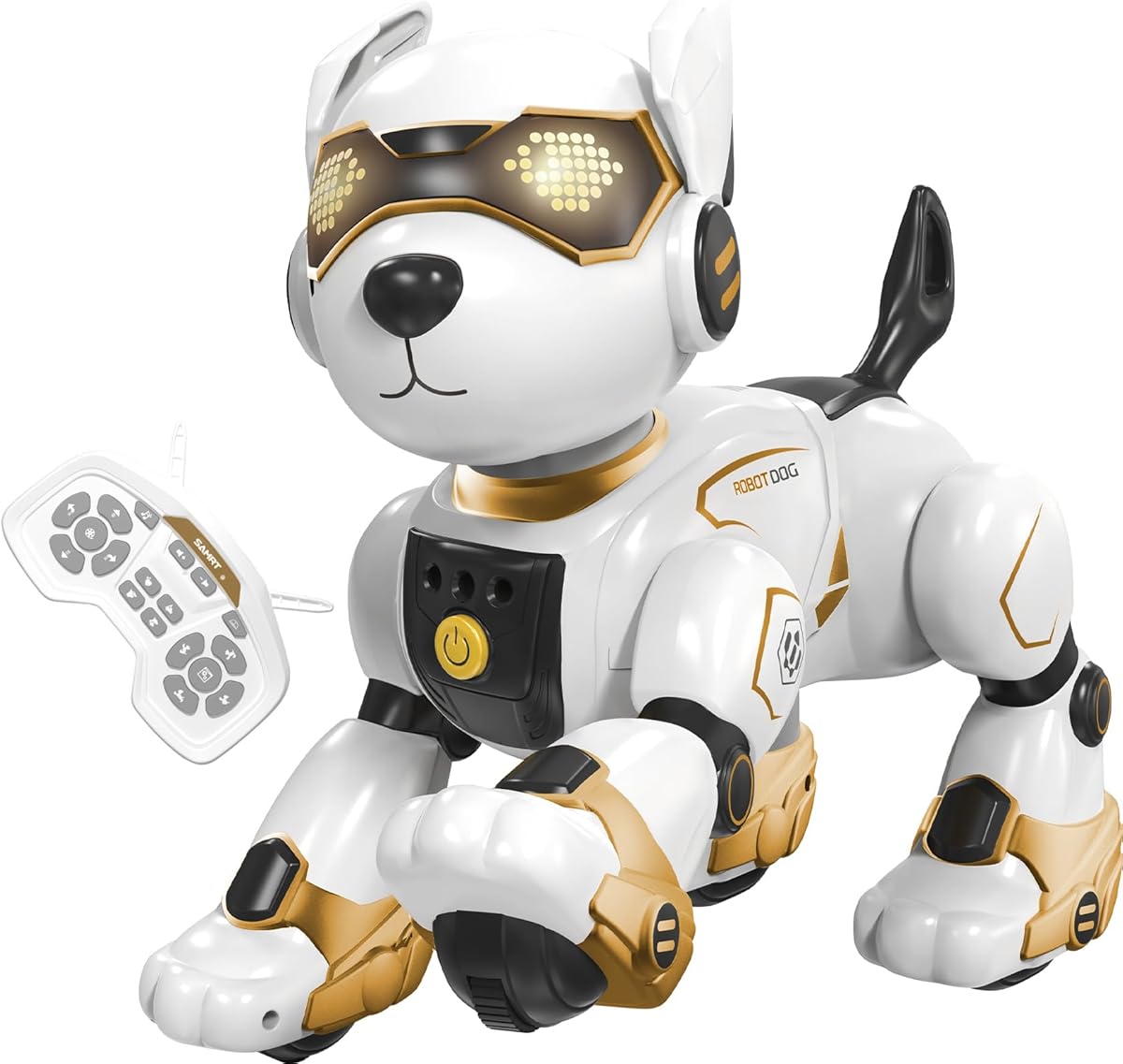
The Yiman Remote Control Robot Dog is an approachable electronic puppy for children ages three through 10. Its 4.4 rating is among the strongest in this roundup, and the toy offers direct infrared remote control plus voice activation by applauding twice. That makes it one of the more straightforward options for children who do not need a smartphone or app.
We may earn a commission when you buy through this link, at no additional cost to you.
Programmable actions include leaning forward, dancing, handstands, push-ups, sitting, barking, and an automatic demonstration. Once programmed, the robot can perform the sequence on its own. Bright LED eyes, smooth movement, adjustable volume, and three musical dance modes give it enough visual and audible character for birthday parties, family rooms, or casual solo play.
Its built-in 3.7V 500mAh battery is advertised as providing up to two hours of play after a two-hour USB charge. The toy enters sleep mode after 90 seconds of inactivity, which reduces wasted power and makes it easy to resume later. The stated 33-foot infrared range provides a useful balance between indoor mobility and manageable control.
The main limitation is the voice method: users activate it by applauding twice rather than speaking a natural-language command. That is easy to demonstrate and fun for younger children, but it offers less flexibility than true speech recognition. Even so, the Yiman model provides a strong combination of programming, remote control, music, stunts, and long advertised runtime without app complexity.
The remote-first design avoids account creation and touchscreen learning. Children can begin driving and demonstrating after charging, while the physical controls remain easy to understand.
Automatic sequences let the dog entertain without continuous steering. This is useful for parties, display moments, or when an adult wants to start a demonstration while other children watch.
We may earn a commission when you buy through this link, at no additional cost to you.
The 3-in-1 Battle Robot Dog combines three configurations in one toy: a standard robot dog, a battle bot with a cannon, and a rover with a functional claw. Its 4.2 rating reflects solid interest in a versatile action format. The removable accessories change the play proposition considerably, giving children more ways to engage than a fixed-design robotic pet.
We may earn a commission when you buy through this link, at no additional cost to you.
Control options are varied. Voice commands provide hands-free interaction, a 2.4GHz remote delivers direct movement, and coding mode lets children create and execute custom sequences. More than 30 pre-programmed bionic actions include crawling, handshaking, and dancing. The combination is especially useful for children who enjoy both imaginative missions and introductory programming.
Mobility is another major strength. A four-wheel Mecanum drive system enables forward, backward, and sideways movement along with 360-degree spins. The listed versatility extends to carpet, tile, and grass. Durable ABS construction, robust wheels, and blue LED effects support both indoor and outdoor play while giving the toy a futuristic appearance.
The advertised battery runtime of up to 50 minutes is the clearest drawback. Caregivers may want to keep the charging cable available during long sessions, particularly if children are using the action attachments outdoors. The transforming design also deserves supervision to ensure that younger children handle the claw and cannon appropriately. For action-oriented children age six and up, however, the three-mode format creates unusually broad replay value.
The dog, battle bot, and rover configurations support completely different styles of play. Children can alternate between pet interaction, target-focused missions, and practical object manipulation.
The Mecanum wheel system enables sideways travel and spins in addition to conventional forward and backward movement. That range of motion adds excitement to demonstrations and obstacle courses.
We may earn a commission when you buy through this link, at no additional cost to you.
The Shoot Robot Dog is an app-enabled STEM pet for children age six and older. It shares the broad control and programming approach of the leading Smart Robot Dog but adds a shooting movement to its roster of more than 30 actions. Its 4.1 rating indicates positive reception, with the app experience and voice behavior likely accounting for some variation in satisfaction.
We may earn a commission when you buy through this link, at no additional cost to you.
English voice commands, touchscreen controls, and a physical remote give players several ways to interact. Custom programming lets children design action sequences, while the app includes volume adjustment, Chinese and English language options, and control locking. Free action updates may expand the robot’s repertoire, which is valuable for a child who might otherwise exhaust the basic routine.
The 600mAh battery is advertised as offering a six-hour runtime after a 1.5-hour USB-C charge. That makes it appealing for lengthy household play or regular demonstrations. Smooth, non-toxic ABS surfaces and automatic motor shutdown during collisions provide additional reassurance, particularly when the robot is operated by younger children.
This model is best suited to families that want action play with an educational structure and are comfortable with app-based operation. The shooting action should be directed responsibly and used only in an appropriate play environment. Compared with a purely plush or story-driven companion, it emphasizes movement, routines, and stunt variety, making it an excellent pick for children who want a small robot-show performer.
Adding a shooting routine gives children another story element beyond dancing and basic pet behavior. The broader action library can support obstacle courses, rescue scenarios, and staged demonstrations.
New actions advertised through free app updates may reduce the chance that children tire of the initial routine. Families should still confirm update availability and device compatibility before purchase.
We may earn a commission when you buy through this link, at no additional cost to you.
The Chongker Percy Dog is a plush robotic companion rather than a mobile stunt toy, and it holds the highest listed rating in this guide at 4.5. Designed with the elderly in mind while remaining suitable for children or anyone seeking comforting presence, it emphasizes touch, realistic sounds, purring, and emotional warmth rather than wheels, ranges, or active stunt programming.
We may earn a commission when you buy through this link, at no additional cost to you.
Five sensor areas are placed around the head, back, neck, tail, and leg. Touching different areas triggers authentic dog sounds and purrs, giving the toy a more nuanced response than a single chin sensor. Long-pressing the back sensor activates a heartbeat simulation. These details create a sensory interaction model that feels closer to a comforting plush pet than a conventional electronic puppy.
Construction uses soft, high-quality plush with carefully placed stitching and sensor points. The stated goal is both durability and a pleasant tactile feel, important for a companion intended for repeated handling. Customizable voice interaction and a customizable name add a personal dimension, while sleep-mode purring is designed to provide a consistent, soothing response.
The built-in rechargeable battery charges through a discreet Type-C port on the belly. A red LED indicates charging and green signals a full charge, making the status easy to understand without opening the toy. This is the best choice for a senior, an adult seeking emotional support, or a child who prefers cuddly companionship to active robot entertainment.
Sensors spread across five areas allow different responses to different touches. The placement makes ordinary petting actions feel meaningful and helps the toy respond in a more lifelike manner.
Soft plush, heartbeat simulation, purring, and sleep-mode sounds prioritize a soothing experience. These qualities are especially relevant for older adults who may want a responsive companion without the complexity of an active RC device.
We may earn a commission when you buy through this link, at no additional cost to you.
The Smart Robot Dog Stunt Toy combines remote and voice control with more than 30 actions, programming, music, and an advertised 100-foot range. Its 4.4 rating makes it one of the strongest-reviewed choices in the collection. The action library includes forward and backward rolls, frog jumps, handshakes, somersault flips, and a playful prank routine.
We may earn a commission when you buy through this link, at no additional cost to you.
An auto-demo button launches a synchronized dance with built-in music, making the toy useful for parties and family gatherings. At the same time, the 2.4GHz remote provides conventional steering and a maximum range of 100 feet. That range gives it an advantage over models intended strictly for tabletop or indoor-floor play.
Programming mode allows children to create personalized action sequences that can run continuously. This is a useful beginner-friendly introduction to coding, logic, and robotics for children roughly age five and up. The package includes the robot, controller, screwdriver, USB charging cable, two rechargeable batteries, and a manual, although the remote requires AA batteries that are not included.
Its 3.7V 1200mAh rechargeable lithium-ion battery is stated to charge in 1.5 hours and provide up to two hours of play. That battery specification, combined with the long remote range, makes this a strong choice for children who want extensive active play. Voice recognition and exact real-world range can vary with surroundings, but the product offers an unusually complete combination of movement, programming, and stunt entertainment.
A maximum range of 100 feet allows the dog to move through a yard, living room, or open indoor area. This supports races, obstacle courses, and follow-style games that shorter-range products handle less easily.
The stated 1200mAh capacity and two-hour runtime provide useful room for extended play. Families should allow the advertised 1.5-hour charging time before planning a long demonstration or gathering.
We may earn a commission when you buy through this link, at no additional cost to you.
The right robot dog depends on whether the priority is active movement, programming, sensory companionship, or simple entertainment. Age, control preferences, available space, charging habits, and the types of activities the child enjoys should guide the decision.
Begin by separating movement toys from companion devices. Remote-controlled stunt dogs emphasize driving, dancing, obstacle courses, and programmed routines, while plush robotic pets focus on touch, sounds, purring, and comforting presence. Families seeking a lively puppy that crosses a room should concentrate on specifications such as wheels, range, stunts, and control response. Those wanting a responsive object for an older adult should look first at tactile materials, sensory locations, heartbeat simulation, and simple charging indicators.
Some products bridge both categories by adding touch and voice responses to an active body, while others add shooting or battle functions to a conventional puppy. Decide which activity should dominate rather than choosing solely by the number of advertised features.
Remote control is the most dependable option for precise movement, particularly in houses with siblings, pets, or breakable objects. Voice control feels more natural and supports hands-free play, but recognition quality can depend on accent, background noise, and the exact phrases supported. Touch and gesture controls add immediate physical interaction and can be especially appealing to younger children. App-based control provides the deepest configuration options, although it introduces phone compatibility, downloads, and possible software-update considerations.
Check whether the included remote uses replaceable or rechargeable batteries and whether those batteries are included. Voice-only features should not be assumed to accept arbitrary conversational commands; examples such as clapping twice may be less flexible than natural speech recognition.
Programmable actions turn a remote-controlled toy into a small introduction to STEM. The useful distinction is between simple prerecorded demonstrations and genuine sequence creation. A model that records, orders, and repeats a child’s chosen actions offers clearer cause-and-effect learning than a single demo button. Larger sequence limits and app-based editing can extend the experience, but they are not automatically better for very young children.
The best activity is one that matches the child’s age and attention span. Short routines with obvious results are often more rewarding than complex tools that require adult assistance. Voice, touch, and remote inputs should remain available so children can switch between free play and structured programming.
Runtime claims should be compared with the length and intensity of typical play. A toy used for brief demonstrations may not need the longest battery, while a model used for parties or outdoor roaming benefits from a larger stated capacity. Check both charging duration and expected play duration, and note whether the battery is removable or fixed.
USB-C is convenient for households that already use that cable, while a remote requiring AA batteries should be included in the ongoing accessory budget. Energy-saving sleep modes are valuable because they reduce the need to recharge after brief interruptions. Actual performance can vary with movement intensity, sound volume, age, and battery condition.
Look for smooth, non-toxic ABS construction, reinforced joints, and motor protection against collisions. These characteristics are especially relevant for active children because stunt movements can cause falls or contact with furniture. Check the stated age guidance carefully and confirm whether small accessories, removable batteries, targets, or projectile-style functions are included.
The transforming model needs particular supervision because its claw and cannon change the toy from a simple pet into an action accessory. Remote-controlled robots should also be used away from stairs, fragile objects, and animals that may not understand the movement. Supervision matters even when the marketing material describes a product as child-safe.
Remote range matters most when the robot will operate across a yard, large playroom, or open floor. Thirty-three-foot infrared control suits a smaller space, while a 25-meter or 100-foot specification supports more active roaming. Indoor homes should also consider furniture, narrow passages, and the risk of the dog moving under sofas or into corners.
A follow function can reduce the need to steer, but it may also encourage movement into unintended spaces. Establish boundaries before beginning. For tabletop or compact areas, a plush companion or shorter-range stunt model may be more convenient than an agile rover with a long control distance.
Age ranges are useful but not absolute. Younger children generally benefit from immediate physical responses, simple remote controls, and clear cause-and-effect demonstrations. Older children can manage app menus, custom sequences, and more complicated mission scenarios. Models advertised for ages three and above may include only simple actions, while six-and-up products often add deeper programming.
Some options work without downloads, while others require a compatible iOS or Android device. Check battery installation, charging, remote pairing, and any required app permissions before giving the toy as a gift. The best choice should offer an engaging first session without requiring a parent to troubleshoot a complicated setup.
More sounds, lights, movements, sensors, and accessories can make a robot dog engaging, but they also create more ways for play to end in a battery warning or a cleaning task. Plush products collect dust and may need gentle surface care, while active robots need battery charging and occasional joint inspection. Removable accessories should be stored securely so small parts do not become lost.
Look for adjustable volume, inactivity sleep, and automatic motor protection. These features improve day-to-day convenience. A model that can remain interesting through several activity modes may ultimately be more satisfying than one with a long feature list but limited functionality or difficult maintenance.
Begin by fully charging the robot according to its instructions and installing any required batteries in the controller. Place it on a clear, level surface away from stairs, fragile furniture, small objects, and pets. Run a short demonstration first so the child can learn how movement begins, how voice commands are recognized, and how the remote should be oriented. Testing the automatic stop and programmed sequence before handing over the controls helps prevent avoidable bumps.
Introduce one activity at a time. Direct driving can teach basic cause and effect, touch or voice responses can make the dog feel responsive, and programming can be introduced as a simple sequence builder. Set limits on difficult floors, outdoor debris, water, and excessive sunlight. For models with targets, a cannon, or a claw, establish a clear play zone and supervise accessory use. Keep the volume comfortable and use the app’s locking features where available.
Care begins with following the model’s charging and cleaning instructions. Remove dust from wheels and joints gently, keep charging ports dry, and inspect moving parts for trapped hair or debris. Do not immerse the electronic unit, even if the exterior feels soft. Store removable batteries and accessories with the toy or in a designated place, and replace damaged cables or batteries rather than working around them. Regular gentle cleaning and correct storage help preserve responsiveness and extend the toy’s useful life.
They can be, but the specific model matters. Products listed for ages three and up usually emphasize touch reactions, simple remote control, lights, music, and easy demonstrations, while models for ages five through 12 often add voice commands and programming. Always follow the stated age guidance, supervise young children, and check whether any accessories, targets, or small parts are included.
The app-connected Smart Robot Dog and Shoot Robot Dog support a combination of English voice commands, touchscreen app controls, and a physical remote. The HBUDS models also provide four interaction styles through remote, touch, gesture, and voice control. The best choice depends on whether your family values app flexibility, natural interaction, or simple operation without a smartphone.
A stunt robot dog emphasizes movement, driving, dancing, programmable sequences, and remote range. A companion robot emphasizes touch responses, comforting sounds, heartbeat simulation, purring, and a soft plush feel. The former is better for active missions and performances, while the latter is designed more for reassuring interaction and cuddly use.
Some do, while others are designed to work entirely with their physical remote, voice recognition, touch sensors, or onboard programming. The Police Robot Dog and Yiman RC Robot Dog emphasize no-download operation, whereas the app-connected models offer deeper configuration and action updates. Check the current product listing and device compatibility before purchasing.
Many models support basic action sequencing. Children can press a programming control, record movements such as walking, dancing, sitting, or performing a handstand, and then play the sequence back. App-based models may provide greater editing flexibility, while onboard systems are usually simpler and more approachable for younger children.
The Chongker Percy Dog is designed specifically around companion use for the elderly. Its soft plush construction, touch sensors around five body areas, purring, heartbeat simulation, sleep mode, and simple Type-C charging make it more suitable for comforting interaction than a mobile stunt robot. Families should still consider the recipient’s hearing, dexterity, and mobility.
The listed specifications range from around 30-plus minutes to as much as six hours, depending on the model. Actual runtime varies with movement intensity, audio use, battery condition, and age. Short-range stunt toys often prioritize quick charging, while premium app-connected and larger-battery models are designed for longer sessions.
A robotic dog does not produce the dander or shed fur associated with many living pets, which can be helpful for allergy-sensitive children. It is still important to consider sound sensitivity, toy safety, and the recipient’s individual allergies. Regular cleaning of the toy also helps reduce the buildup of dust and other particles around the home.
The strongest all-around choice is the app-connected Smart Robot Dog because it combines remote driving, voice commands, more than 30 actions, custom programming, control settings, and a long advertised runtime. The Yiman Remote Control Robot Dog stands out as the best value-oriented option for straightforward stunt play, while the Chongker Percy Dog offers a different kind of value through soft sensory companionship designed for older adults.
Before choosing, prioritize the activity your child or recipient will actually use. Active children may prefer programmable stunts, animal sounds, follow behavior, or a transforming battle format. A senior may benefit more from touch responses, heartbeat simulation, and purring. Remote reliability, age suitability, charging convenience, room size, and safe supervision should matter more than the longest advertised feature list.
Finally, check the current listing for availability, included accessories, battery requirements, app compatibility, warranty details, and the latest specifications. Prices, ratings, and configurations can change, so confirm the live product page before making a final purchase. The right pet robot dog should be fun to operate, easy to charge, secure around its intended user, and engaging beyond a single demonstration.