
Solar Ultrasonic Animal Repellent, Deer & Raccoon Deterrent Outdoor, 2 Pack
5.0Editor score
Motion-activated ultrasonic deterrent
IP65 weather-resistant housing
Dual-area two-pack coverage
This Possum Repellent Deterrent guide compares 10 solar, ultrasonic, scent-based, and predator-light options for yards, gardens, farms, and outdoor spaces.
Possums can quickly turn a quiet yard into a problem area, especially when they find garbage, pet food, fallen fruit, shelter, or a convenient route toward the house. The right possum repellent deterrent should discourage visits without relying on harmful poison, and it should suit the animal behavior, property layout, and weather conditions you face.
This guide compares ten possum repellents using the supplied product information, focusing on deterrent method, targeted species, outdoor weather resistance, installation, coverage, and ease of use. The list includes ultrasonic and motion-activated devices, solar predator lights, and botanical scent pouches designed for raccoons, skunks, opossums, and other nuisance animals.
Each pick highlights a different practical approach rather than presenting every option as suitable for every property. The top recommendations show which products stand out for value, broad deterrent capability, and garden-focused outdoor coverage. Product availability, features, and prices can change, so shoppers should verify current listing details before buying.
5.0Editor score

5.0Editor score

4.4Editor score
The comparison below places scent-based repellents beside solar ultrasonic stakes, motion-activated units, and predator-light devices. Key differences include power source, weather rating, detection method, installation style, and the range of nuisance animals addressed.




This natural raccoon and skunk repellent earns its place as the leading botanical scent option because it directly addresses possums and other food-seeking scavengers without electricity or chemical spraying. It carries a 3.4 rating, and its main appeal lies in eight ready-to-use 25-gram pouches containing garlic and peppermint oils. The breathable fabric design is intended to release the scent gradually while keeping the product contained and relatively tidy.
We may earn a commission when you buy through this link, at no additional cost to you.
The pouches are particularly versatile around trash cans, garbage bins, bird feeders, gardens, attics, sheds, fences, and food-producing plants. The manufacturer states that each pouch can provide up to six weeks of scent protection, making the pack useful for households that want to establish several scent barriers without installing powered devices. Placement near entry points and along routes where animals have appeared can help mask attractive food odors and make those areas less inviting.
The main limitation is that this is a passive environmental deterrent rather than a sensor-driven system. You will need to monitor activity and reposition pouches as wind, rain, and other outdoor conditions affect scent release. The product also does not physically block entry, and the listed 3.4 rating suggests that experiences may vary. For best results, the description also recommends sealing garbage, removing fallen fruit, cleaning food scraps, and closing access gaps.
This is a sensible choice for homeowners who prefer scent-based protection, need a non-electronic option, or want to cover several separate locations around the property. Buy it as a supplementary deterrent rather than the only line of defense. When used alongside good sanitation and secure trash storage, its natural oils and no-mess placement make it a practical option for discouraging possums and related wildlife.
Each pouch is described as providing up to six weeks of scent protection, allowing the eight-pack to cover multiple problem areas. Actual longevity will vary with sun, wind, rain, and placement, so checking the pouches periodically is important.
Because the pouches require no power, batteries, or wiring, they can be moved as possum routes change. Place them close to known entry points without creating access for pets or children.
We may earn a commission when you buy through this link, at no additional cost to you.
This four-pack of solar ultrasonic stakes is designed for properties where one deterrent location is not enough. The 3.8-rated product targets a broad collection of animals, explicitly including possums, raccoons, skunks, snakes, moles, gophers, voles, rabbits, groundhogs, and other burrowing or outdoor pests. Its combination of ultrasonic pulses, intermittent vibration, and solar power offers a broader garden-defense format than a single motion-activated unit.
We may earn a commission when you buy through this link, at no additional cost to you.
The listing describes a coverage radius of up to 50 feet and says the device uses ultrasonic frequencies between 400 and 1,000 hertz. It also mentions dynamic frequency modulation intended to reduce the chance that pests adapt to the output. The IP65 housing is designed for outdoor conditions, while the stake format allows each unit to be pushed into the ground and positioned around lawns, gardens, orchards, or other vulnerable areas.
These performance and coverage claims should be treated as product specifications rather than guaranteed results. Ultrasonic deterrents are most effective when the target animal can detect the frequency and when the unit is placed in a frequently traveled area. A 3.8 rating reflects generally favorable but not exceptional customer feedback. Solar charging also needs direct exposure, and areas under dense shade or heavy canopy may receive less reliable operation.
Choose this option if you want multiple deterrent points, want to address possums along with several common garden pests, and prefer a hands-off solar format. The four units are especially useful for surrounding separate food sources or marking likely approaches. For properties with many acres, carefully space the stakes rather than expecting one compact cluster to protect the entire area.
Possum control often shares a property with raccoon, skunk, rabbit, or burrowing-pest problems. This device's long target list allows one installation format to address several nuisance animals without changing deterrent types.
The ultrasonic and vibration combination is designed to discourage animals without the persistent noise of a conventional rodent deterrent. It also avoids digging or trapping associated with some ground-pest controls.
We may earn a commission when you buy through this link, at no additional cost to you.
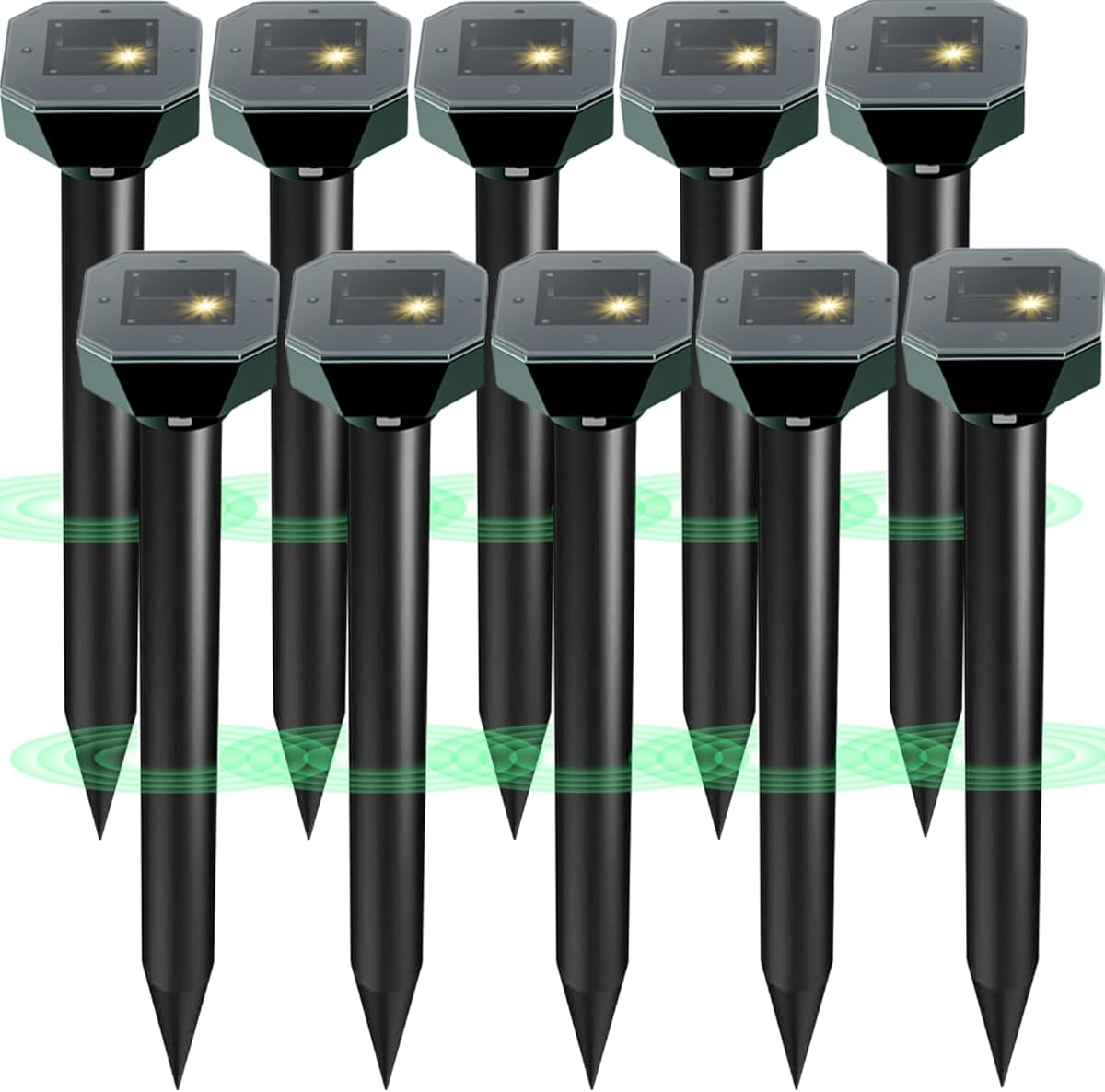
This ten-pack is the most comprehensive option in the list and stands out for properties with multiple gardens, lawn sections, animal paths, or food sources. It has a 4.4 rating, the highest among the larger multi-pest packs, and combines solar power, ultrasonic pulses, intermittent vibration, and variable-frequency operation. Possums are among the many animals included in its stated target list, alongside raccoons, skunks, moles, gophers, voles, rabbits, and other creatures.
We may earn a commission when you buy through this link, at no additional cost to you.
Each stake is described as offering up to a 50-foot radius, although the practical result depends on placement, terrain, animal habits, and the presence of obstructions. The IP65 construction is intended for year-round outdoor use, and the device avoids poisons and painful trapping methods. Solar panels power the stakes, making them convenient for locations where wiring would be inconvenient or where several independent defense points are desired.
The ten-unit format also creates a significant planning requirement. Poorly distributed stakes can leave gaps, while excessive clustering may not provide meaningful additional protection. The listing's claims about animal evacuation and effectiveness are manufacturer claims and should not be interpreted as guaranteed outcomes. As with other electronic deterrents, direct sunlight and correct orientation can materially affect charging and performance.
This premium pick is best for a homeowner, farm operator, or grounds manager who wants extensive coverage and expects to position devices across a broad outdoor area. Its higher rating, large pack, and no-chemical approach distinguish it from smaller single-zone products. Pair it with trash management, animal-proof fencing, and entry-gap repairs for the most complete possum-control strategy.
A ten-pack can mark numerous travel routes, food-gathering zones, and perimeter openings. Place units where possums are actually observed rather than distributing them evenly without understanding the property's activity pattern.
The product uses sound, vibration, and solar power rather than poison or trapping. That makes it suitable for gardeners seeking a non-chemical option for protecting plants, roots, and soil.
We may earn a commission when you buy through this link, at no additional cost to you.
The Broox device is a flexible motion-activated option for yards, gardens, and farms, with a 3.8 rating. It combines a PIR motion sensor, ultrasonic sound, an alarm, and flashing LED light to discourage a broad range of animals. The target list includes raccoons, skunks, deer, squirrels, cats, dogs, rabbits, and rodents, making it a reasonable general-purpose choice when the property has several nuisance-animal concerns.
We may earn a commission when you buy through this link, at no additional cost to you.
Five selectable frequency modes allow the user to vary the deterrent, and the device can be inserted into the ground or mounted on a wall. Its 110-degree infrared sensor has a stated detection range of 20 to 25 feet, depending on animal size. Solar charging provides regular outdoor power, while the included USB cable offers a backup charging method. The product is also described as IP65-rated, UV-protected, and suitable for rain, snow, and sun exposure.
An important limitation is that the product does not work on snakes because they cannot detect ultrasonic sound. Its effectiveness also depends on the target animal being capable of hearing the selected frequency. A single unit covering one approach point is less suitable for a large property, and the sensor can be affected by its direction, nearby movement, and environmental conditions. The 3.8 rating suggests solid general utility rather than universally dramatic results.
This device is a good match for someone who wants one adjustable unit that can be moved between a garden, patio, orchard, or livestock area. It works best near a repeatedly used possum path and when the flashing light is visible. For complete coverage, buying more than one unit and rotating them can be more effective than relying on one sensor in a broad yard.
The selectable modes can make it easier to respond to different animals or changing behavior. If visits continue, changing the mode, height, or approach angle may produce a more useful deterrent pattern.
The ability to stake the unit in soil or mount it on a wall is useful for properties with different entry routes. Ground placement is often useful near lawn edges, while elevated mounting may suit routes passing close to walls or structures.
We may earn a commission when you buy through this link, at no additional cost to you.
This predator-light four-pack offers a distinctive alternative to ultrasonic repellents. Its 3.1 rating is the lowest among the ten products, but the approach is specifically designed around nocturnal nuisance animals, including opossums, raccoons, skunks, deer, foxes, and coyotes. The devices imitate flickering flames and predator eyes to make frequently visited areas feel less safe after dark.
We may earn a commission when you buy through this link, at no additional cost to you.
A built-in light sensor automatically activates the lights at dusk and switches them off at dawn. This focused nighttime operation avoids unnecessary daytime activation and is well suited to properties where possums are most active around garbage, pet food, or sheltered edges. Installation height is an important feature: the product instructions recommend 12 inches for skunks, raccoons, and opossums, 24 inches for foxes and coyotes, four feet for deer, and eight feet for owls and hawks.
The main drawback is that predator lights are primarily a visual deterrent. Animals that are accustomed to the visual pattern, property owners who need a broader multi-pest strategy, or sites with bright ambient lighting may see less benefit. The IP44 waterproof rating is also lower than the IP65 or IP66 ratings offered by several electronic competitors, so sheltered placement may be prudent during severe weather. The 3.1 rating supports a cautious recommendation.
This four-pack is best for homeowners whose main concern is nighttime opossum activity and who prefer a low-complexity deterrent with no audible frequency output. It can also protect chicken coops, farms, gardens, and yards. Use it as one layer in a broader plan that includes secure trash lids, motion-sensitive lights, and physical exclusion of possum entry points.
The automatic light sensor makes this device especially relevant for possums that emerge after dark. It focuses its deterrent effect during the hours when nighttime scavenging is most likely.
The product provides animal-specific mounting heights, including a recommended 12-inch position for opossums and raccoons. Correct height helps ensure the simulated predator effect is visible along the animal's travel route.
We may earn a commission when you buy through this link, at no additional cost to you.
This ten-pack of solar ultrasonic stakes closely resembles the premium multi-pest option while carrying a 3.8 rating. It is designed for large gardens, farms, lawns, and orchards where several independent deterrent locations are needed. Possums appear in its stated list of more than 20 targeted animals, which also includes raccoons, skunks, moles, gophers, voles, rabbits, groundhogs, lizards, squirrels, deer, and various burrowing rodents.
We may earn a commission when you buy through this link, at no additional cost to you.
The devices combine ultrasonic pulses between 400 and 1,000 hertz with vibrations every 20 seconds. Solar panels provide continuous outdoor operation, and the IP65 housing is intended to withstand demanding weather. Each stake is pushed into soil and positioned according to the property's vulnerable areas. The product description states coverage of up to one acre, making it an ambitious option for a ten-device system when properly distributed.
The broad pest target and coverage figures are manufacturer claims, not independently verified results. A ten-pack can be overkill for a small suburban yard, and crowded placement may waste both charging potential and deterrent effectiveness. The 3.8 rating indicates that some customers are satisfied, but the product's effectiveness may still depend heavily on animal hearing, local behavior, and the number of active approaches. Solar exposure should be checked regularly.
Buyers seeking a large quantity without moving between separate products may prefer this set. It is especially attractive to property owners who want to deter multiple animal types at once or create a ring of units around a garden, orchard, or farm area. Confirm that the coverage and placement can cover the zones where possums actually travel before deploying the full pack.
A ten-unit arrangement can be distributed around a substantial garden or farm. For the stated coverage, spacing and placement should be planned around entry routes rather than based on a simple perimeter count.
The product avoids traps, toxic chemicals, and soil excavation. Its sonic and vibration action is designed to protect flower beds, roots, and lawns while discouraging burrowing and visiting animals.
We may earn a commission when you buy through this link, at no additional cost to you.
This 24-pack of natural scent pouches provides an inexpensive, non-powered approach to discouraging skunks, raccoons, and other nuisance animals. It has a 3.5 rating and is formulated with plant-based ingredients, including mint and citrus oils. The product is positioned for households with children and pets, offering an alternative to poison, traps, and sprayed fumes while remaining easy to deploy.
We may earn a commission when you buy through this link, at no additional cost to you.
Each pouch is designed to release scent for up to 30 days, depending on environmental conditions. The pouches can be placed or hung near entryways, patios, decks, walkways, garbage areas, garages, sheds, and RVs. This flexibility makes them useful for sealing gaps in a defense strategy or covering a broad collection of small problem locations. Their no-spray design also avoids application residue and mixing.
The central limitation is that passive scent repellents depend on local conditions and animal behavior. Sun, wind, and light rain can shorten useful scent life, while heavy exposure may require more frequent replacement. Possums that are strongly conditioned to a food source may continue entering despite the odor. The 3.5 rating indicates reasonable but not outstanding customer satisfaction, so expectations should remain realistic.
This pack is best for inexpensive, low-maintenance supplementation around garbage, pet-food areas, and known entries. The large quantity allows frequent relocation as possum habits shift. Use it with secure waste containers, prompt cleanup of fallen fruit, and physical barriers, especially if animals are already accustomed to the scents found around your property.
Because the product requires no spraying, mixing, or cleanup, it can be handled without leaving liquid residue on decks, floors, or garden surfaces. Placement and removal remain under the user's control.
The pouches are suitable for yards, porches, garages, sheds, RVs, and other indoor or outdoor areas. That versatility lets homeowners use the same deterrent approach in several types of possum entry locations.
We may earn a commission when you buy through this link, at no additional cost to you.
This two-pack combines a perfect 5.0 listed rating with a focused motion-activated design, making it the editor's choice for properties with two distinct problem areas. Each unit uses a 110-degree PIR sensor to detect approaching movement from up to 30 feet under suitable conditions. When triggered, it combines 13.5 to 45.5 kilohertz ultrasonic output with a bright flashing light to discourage deer, raccoons, squirrels, rabbits, skunks, and other visitors.
We may earn a commission when you buy through this link, at no additional cost to you.
Solar panels recharge the built-in system, while the IP65 housing and durable ABS construction are designed for year-round outdoor use. The two-pack can cover separate zones instead of requiring the user to move one device between a vegetable garden and a fence opening. Suitable placements include garden beds, fruit trees, lawn edges, trash areas, patios, driveways, and common animal paths.
The product's own guidance emphasizes consistent use for two to three weeks and repositioning if animals start entering from a different direction. Its sensor must have a clear view of the approach route, and the solar panel should receive good sunlight. Like other ultrasonic devices, it depends on the target animal being able to perceive ultrasonic frequencies. A perfect rating is encouraging but does not guarantee identical results in every environment.
This is an excellent pick for a homeowner who wants a balance of value, compactness, and two-zone flexibility. It is easier to deploy than a ten-pack and more responsive than a continuously operating scent barrier. Use the two units to monitor the areas most attractive to possums, then add sanitation, trash security, and gap closure to address the reasons they visit.
The PIR sensor activates the deterrent only when movement enters the detection zone. This targeted approach can preserve stored solar power and focus the sound and light response around actual approaches.
A garden and a trash area may receive visits through completely different routes. Two independently placed units solve that problem more effectively than repeatedly moving a single device between them.
We may earn a commission when you buy through this link, at no additional cost to you.
This solar animal repeller earns a 4.0 rating and stands out for its five operating modes, adjustable volume, and higher IP66 weather-protection rating. It uses variable ultrasonic frequencies from 13.5 to 45.5 kilohertz, an alarm sound, and flashing lights to deter animals including raccoons, skunks, foxes, rabbits, owls, squirrels, deer, cats, and dogs. Its humane, non-chemical design is intended for yards, farms, terraces, and similar properties.
We may earn a commission when you buy through this link, at no additional cost to you.
The advanced PIR sensor covers a 110-degree angle and a range of up to 33 feet. The device can be inserted into the soil or hung on a wall, while solar power and an included USB cable provide two charging methods. The listing says users may begin seeing fewer visits after 10 to 15 days of consistent use, which illustrates that deterrence is not necessarily instantaneous.
Adjustable volume can help manage use around neighbors, although the description says changing volume does not alter the ultrasonic frequency. Mode selection may also reduce the chance of animals becoming accustomed to one fixed sound pattern. The IP66 construction provides stronger water protection than the IP44 predator-light product and the IP65 units in this list. Nevertheless, results still depend on placement, sunlight, and the target animal's hearing.
This is a strong choice for a single high-value zone, such as a vegetable patch, orchard, or garbage enclosure, where the homeowner wants adjustable behavior. It is less convenient than a two-pack for covering separated zones, but the broad detection range can make one unit useful when aimed along a principal travel corridor. Pair it with secure bins for a stronger possum-control plan.
Five modes allow the owner to vary the deterrent response, while three volume settings offer some control over disturbance. These adjustments can be useful when neighboring conditions or animal behavior change.
The IP66 housing and ABS construction are designed to support operation in harsh outdoor weather. The rechargeable lithium battery and USB option add flexibility when sunlight is limited.
We may earn a commission when you buy through this link, at no additional cost to you.
This two-pack of solar ultrasonic repellents is the budget pick for homeowners who need a practical deterrent in two locations. It has a perfect 5.0 listed rating and uses a 110-degree PIR sensor with a stated range of up to 30 feet. When an animal enters the sensing zone, the device activates variable 13.5 to 45.5 kilohertz ultrasonic output and a white flashing light.
We may earn a commission when you buy through this link, at no additional cost to you.
The dual-action response is designed for deer, rabbits, raccoons, skunks, squirrels, cats, and other visiting animals. Solar operation eliminates outdoor wiring and reduces the need for disposable batteries. The two units can cover separate high-activity areas, such as a vegetable garden and fruit trees, or a flower bed and a fence opening. The IP65 housing is intended to handle changing outdoor conditions.
The most important installation detail is orientation. The sensor should face the path animals use to approach, the solar panel should remain exposed to direct sunlight, and leaves or shade should not cover the panel. If visits continue, the listing recommends adjusting the location or angle. The system is not appropriate for animals unable to hear ultrasonic frequencies, and its reaction is limited to detected movement.
This is a good entry-level choice for a yard with one or two well-defined possum routes. Its two-pack configuration, simple installation, and strong listed rating make it easier to deploy than a large stake system. For best results, keep garbage secured, remove fallen food, and close holes beneath fences or decks, since electronic deterrents work best when attractive attractants are also controlled.
Solar charging keeps the device operating without outdoor wiring or frequent battery replacement. Direct sunlight remains important for consistent performance and can require occasional adjustment if vegetation shades the panel.
Variable ultrasonic sound paired with a flashing white light creates two simultaneous deterrents. This can make the product more adaptable than a unit that relies on only one type of sensory response.
We may earn a commission when you buy through this link, at no additional cost to you.
The best possum repellent deterrent is not simply the device with the longest feature list. It should match how possums enter your property, which other animals frequent the area, and whether you need active detection, continuous scent release, or a visual nighttime deterrent.
Choose the method that matches your target and environment rather than combining several products without a plan. Active devices suit monitored travel routes, scent products suit frequent placement, and predator lights suit areas where nocturnal visual deterrence is acceptable.
Map the most active routes first, then position devices or pouches at those points. Adjust placement when behavior changes and pair deterrence with blocked access points.
Prioritize direct sun for solar units and verify that the stated charging alternatives are sufficient for your location. Choose a no-power scent option when reliable charging is difficult.
Compare the actual IP ratings and construction rather than treating every outdoor label as equivalent. For frequently exposed equipment, favor stronger water protection and maintain the unit.
Estimate the number of high-activity zones before choosing a pack size. Spread units across observed routes and confirm the stated range matches the area you expect to protect.
Choose a broad multi-pest model when the yard has several problems. Select a targeted scent or predator-light option when you only need to discourage specific nocturnal or food-seeking animals.
Choose a design that matches your willingness to maintain it. Check sensors, solar panels, scent release, and mounting height at regular intervals.
Treat the repellent as one layer in a complete plan. Cleaning up attractants and closing entry gaps can outperform any single device.
Begin by identifying where possums are entering and what attracts them. Secure trash containers, bring pet food indoors, remove fallen fruit, and close entry gaps before installing a deterrent. For electronic units, place the solar panel in direct sunlight and aim the motion sensor along the animal's approach path rather than directly at the open yard. For scent pouches, place them near the attractant or entry point without creating access for children or pets.
Use the selected deterrent consistently and give it time to establish the area as less attractive. Motion-activated devices should be tested by walking through their sensing zone from the expected direction. Scent pouches should be checked for weakened aroma, visible damage, or exposure to heavy rain. Predator lights should be installed at the height recommended for possums and raccoons, with a clear view of the route.
Inspect devices and placements regularly. Clean solar panels, clear leaves and vegetation from sensors, confirm stakes remain secure, and reposition units if you notice a new path. If possum activity continues, do not simply add more output; identify the new attractant or access route and adjust the plan. Combining a suitable deterrent with sanitation and physical exclusion provides the most dependable approach.
The most effective approach combines an appropriate deterrent with removal of attractants and blocked entry points. Possums are strongly motivated by garbage, pet food, fallen fruit, and sheltered spaces, so securing those resources can matter as much as the device itself. A motion-activated unit near an observed route or scent pouches near food-related entry points can reinforce that cleanup work.
Possums can hear ultrasonic frequencies, so ultrasonic devices may discourage them when the output reaches their travel route. Results depend on frequency, distance, placement, animal habituation, and whether the unit activates at the right time. A motion sensor and flashing light can provide a stronger combined response than sound alone, but no device should be expected to guarantee permanent results.
Many solar repellents include weather-resistant housings, with ratings such as IP44, IP65, or IP66 appearing in this comparison. Those ratings support outdoor use but do not mean every unit is completely waterproof under all conditions. Direct sunlight remains important for recharging, so panels should be kept clean and positioned where weather and foliage will not obstruct them.
Many multi-pest electronic products also target raccoons, skunks, rabbits, deer, squirrels, moles, gophers, and other animals. Botanical raccoon and skunk pouches can help with shared nuisance routes, while broader ultrasonic stakes may suit gardens with several active pests. Check every stated target species because not every product is equally suited to every animal.
Place it along a confirmed travel route, close to garbage, pet-food areas, garden beds, bird feeders, or an opening beneath a fence or deck. Electronic sensors should face the direction from which possums approach, and solar panels need direct sunlight. If activity continues, observe the new path and move or redirect the unit rather than leaving it aimed at an inactive area.
The scent products in this guide are described as plant-based and suitable for use around family spaces when directed as instructed. Nevertheless, every household should keep all pest-control products inaccessible to children and animals. Follow the product label, avoid direct contact, and confirm that placement will not create chewing or access risks.
There is no universal response time because the products use different mechanisms. Motion-activated devices work immediately when an animal enters the sensor zone, while animals may need repeated encounters before avoiding a scent area. One listing recommends consistent use for two to three weeks, and another suggests looking for reduced activity after 10 to 15 days. Environmental conditions and the strength of existing food attractions can also change the timeline.
Yes. Garbage is a strong attractant, and leaving it accessible can overpower the intended deterrent effect. Use secure lids, remove food scraps, bring pet food indoors, and clean fallen fruit regularly. A device works best when possums encounter an unpleasant or changing environment rather than a reliable food reward.
The best budget-oriented choice is the two-pack of solar ultrasonic deer and raccoon repellents, which combines a perfect listed rating with motion activation, weather resistance, and two-zone flexibility. The two-pack motion sensor solar repeller is the editor's choice for its 30-foot detection range, combined sound and light response, and simple placement. For broad, multi-zone coverage, the ten-pack 2026 solar deterrent earns the premium recommendation with its 4.4 rating and 50-foot stated range.
Your priority should be the behavior and geography of the problem. Choose a two-pack or motion-activated device for a small number of observed routes, a larger solar stake set for extensive properties, and scent pouches when you need a non-electronic option near garbage or sheltered entries. Predator lights can be useful for nocturnal visits, but correct height and an unobstructed view are essential. Whatever device you select, pair it with sanitation and physical exclusion.
Finally, verify the current product listing, technical specifications, customer feedback, and price before purchasing because availability and product details can change. Compare the unit's power source, weather rating, detection method, and coverage against the exact areas where possums enter your property, then monitor and adjust the setup as their behavior changes.