
XbotGo Chameleon AI Auto Sports Action Camera
3.9Editor score
AI player tracking
4K sixty-frame recording
No subscription fee
Live RTMP streaming
A dependable Court Recording System for Pickleball should capture the ball, the athletes, and the surrounding play without requiring someone to follow every rally with a phone. Camera tracking, wide-angle coverage, clear wireless audio, and a stable playing area all influence the final result, especially during fast exchanges near the kitchen.
This guide compares ten relevant systems across AI sports cameras, professional wireless audio equipment, portable or permanent nets, and temporary court-marking products. The evaluation considers the stated recording capabilities, court dimensions, setup requirements, portability, and practical use for practices, tournaments, coaching reviews, and family footage.
Each pick reveals how the product fits into a complete recording setup rather than treating every item as a standalone camera. Some choices handle automated visual tracking, some capture broadcast-style sound, and others create a stable court for filming. Product details and availability can change, so readers should confirm current specifications before purchasing.
3.9Editor score

4.5Editor score

3.9Editor score
As an Amazon Associate we earn from qualifying purchases.
The comparison below separates the three camera-focused products from the audio and court-infrastructure options, showing how each contributes to a complete pickleball recording setup.




The RØDE Wireless PRO earns a place as the strongest all-around audio component for a pickleball recording setup, carrying a 4.5 rating based on the supplied listing information. It is not designed to record the court visually, but it addresses a common weakness in sports footage: audio that becomes inconsistent when athletes move, call shots, or compete in a busy environment. Two transmitters, one receiver, a charging case, and included lavalier microphones provide a flexible foundation for interviews, coaching commentary, player reactions, and multi-camera productions.
We may earn a commission when you buy through this link, at no additional cost to you.
The most valuable feature is 32-bit float onboard recording, which preserves a safety copy of each transmitter session and allows clipped audio to be recovered. That resilience is useful during a competitive pickleball match because unexpected voices, wind, or close-range movement can challenge conventional recordings. Built-in timecode can also synchronize picture and sound across a multi-camera shoot, while the stated 260-meter line-of-sight range gives a court or nearby field enough room to operate without crowding the transmitters together.
There is an important limitation: this product does not replace a camera. A buyer still needs a visual system, such as one of the AI sports cameras in this guide, or an existing phone and camera arrangement. The package also appears oriented toward creators and production-minded users rather than buyers wanting a single all-in-one court recorder. Users who only need a basic camera and do not care about isolated wireless audio may find the setup unnecessary.
Even so, the RØDE Wireless PRO is the most flexible option here for a serious recording arrangement. It is well suited to a club event with two commentators, a coach filming practice and talking between points, or a production combining several camera angles. For those buyers, the redundancy, synchronization, and inclusive accessory set outweigh the need for separate visual equipment.
Onboard 32-bit float recording gives each transmitter an internal safety copy, so the system does not depend entirely on the receiver signal. That is particularly useful during long practice sessions or competitive exchanges where missed peaks would otherwise be difficult to repair.
The built-in timecode function provides a more organized way to align separate recordings. It is especially valuable when a pickleball event is filmed from more than one angle and the finished video will combine commentary, player interviews, and court action.
We may earn a commission when you buy through this link, at no additional cost to you.
The XbotGo Chameleon AI Auto Sports Action Camera carries a 3.9 rating and offers the most approachable dedicated sports-recording approach in this roundup. Although its product description focuses on soccer and basketball, its core features—hands-free AI tracking, a wide-angle lens, 4K 60FPS recording, and live streaming—translate well to a pickleball court where the ball and athletes move quickly through a defined area.
We may earn a commission when you buy through this link, at no additional cost to you.
FollowMe Mode can automatically track a key player, which is useful for parents recording a child, coaches reviewing an athlete, or club operators producing player-focused content. The 120-degree wide-angle lens gives the camera a broad view of the court, while the stated 4K 60FPS recording should support smooth replay of quick exchanges. The included app also provides a live scoreboard, one-tap highlight creation, Bluetooth remote or Apple Watch control, and 20GB of cloud storage without a subscription fee.
The most important caveat is that this is a general team-sports camera rather than a purpose-built pickleball system. AI tracking behavior may require adjustment for smaller courts, doubles formations, and players crossing close to one another. The listing also states up to eight hours of uninterrupted recording, so buyers organizing tournaments should plan charging, file management, and post-event backups rather than assuming a single all-day session is guaranteed.
For families, recreational leagues, and coaches seeking a hands-free way to capture practices without a dedicated camera operator, the Chameleon remains a strong pick. Its no-subscription model and live-sharing features make it especially convenient for regular use. Users wanting tournament-grade manual control or a specifically optimized pickleball workflow should examine that limitation before committing.
AI tracking and FollowMe Mode reduce the need to reposition a camera whenever a featured player changes direction. This makes the system attractive for solo family filmmakers and coaches who would otherwise spend more time following the action than observing it.
RTMP-compatible streaming can send a game to supported platforms, while the app creates highlight reels and provides 20GB of cloud storage. Those features make captured footage easier to share with players, teammates, and remote spectators.
We may earn a commission when you buy through this link, at no additional cost to you.
The XbotGo Falcon All-in-One AI Action Camera is the premium option in this guide, combining AI tracking, 4K dual-lens recording, and live streaming in a system intended for hands-free sports capture. Its 3.9 rating is modest, but the listed processing capabilities and focus on game analysis indicate a more ambitious platform for coaches, competitive players, and clubs that want structured footage rather than isolated clips.
We may earn a commission when you buy through this link, at no additional cost to you.
Its AI system is advertised at 6 TOPS of performance with an eight-core processor, allowing the camera to recognize action and keep the main subject centered. The dedicated recording lens and AI-assisted lens divide the job between high-quality imagery and tracking performance. Built-in Wi-Fi supports live sharing, while standard 1/4-inch tripod mounting gives the camera flexibility for a sideline, elevated corner, or other practical position.
The principal trade-off is that this capability comes with a substantially higher acquisition cost than the entry-oriented camera options. The supplied data also does not mention pickleball-specific modes, manual exposure controls, removable batteries, or weather-resistance ratings, so buyers should not assume those features simply because it is positioned as a premium sports camera. A lower user rating than the RØDE Wireless PRO adds another reason to verify expectations before purchasing.
Despite those caveats, the Falcon offers the most complete visual package among the products presented. It is a logical fit for a club filming multiple practices, a coach building player-development material, or a competitive player who wants automated tracking and shareable live video. Those users can place it at the premium end of a Court Recording System for Pickleball, while families and casual filmmakers may prefer the simpler Chameleon.
The stated 6-TOPS processing and eight-core architecture support automatic recognition and tracking of the main action. Those capabilities support the product's stated use in game reviews, coaching analysis, player development, and recruitment video.
The dual-lens design separates visual capture from AI-assisted tracking, while microSD and cloud storage provide different paths for organizing footage. The standard tripod interface also makes the camera easier to reposition as players, spectators, or court layouts change.
We may earn a commission when you buy through this link, at no additional cost to you.
This Pro Pickleball Net with Wheels is one of the most useful infrastructure products for a filming setup because a stable, regulation-size court makes automated tracking more consistent. It holds a 4.1 rating, reaches the stated 22-foot regulation length, and measures 34 inches at the center and 36 inches at the sides. Those dimensions provide a clearly defined playing area for players and cameras alike.
We may earn a commission when you buy through this link, at no additional cost to you.
The built-in hand winch and reinforced tension rope are particularly relevant to recording sessions. Net sag can affect how players perceive the court and may lead to inconsistent returns or interruptions, while a taut net allows the match to proceed without frequent adjustments. Locking three-inch wheels make it possible to move the full system, secure it before play, and store it when it is not needed.
Assembly is designed to be straightforward, with pre-attached quick-tie points that eliminate rope threading and metal buckle clips for the base. A carry bag supports transport to different courts, gyms, or outdoor areas. The trade-off is that portability introduces a setup step and a need to position the system accurately on each site. Users should also plan how they will move the long frame safely, particularly in parking areas or narrow corridors.
This net suits a club that records practices at multiple venues, a family that wants a consistent backyard court, or a coach who travels to tournaments. It is not a camera, but it helps remove court variability from the recording process. For buyers building a full Court Recording System for Pickleball, pairing it with one of the AI cameras can create a more repeatable filming environment.
The hand-crank system lets the operator tighten the reinforced rope without complicated tools. Consistent tension supports a predictable court line and reduces mid-game distractions that can interrupt a recording.
Smooth-rolling lockable wheels let a club or traveling team reposition the net between locations. Once locked in place, the frame can remain stable during rallies and serve as a consistent base for the camera's view.
We may earn a commission when you buy through this link, at no additional cost to you.
The Chemimoso Temporary Magnetic Pickleball Court Lines System carries a 3.6 rating and offers a different kind of court setup: it establishes visible boundaries without installing posts or permanently altering the playing surface. Its twelve accessories use magnetic cable connections, with double magnetic snap modules at corners and single modules between line sections.
We may earn a commission when you buy through this link, at no additional cost to you.
A claimed one-and-a-half-minute setup makes the system appealing for filming practice in a driveway, gym floor, or multipurpose space. Bright coloring makes court limits easier for players and camera operators to see, while the textured bottom particles are designed to increase friction and help the lines remain in place. The package rolls down to roughly shoebox size for convenient transport and storage.
These lines do not create a complete netted court, so they cannot replace the net products in this guide. Their outdoor performance also depends on surface conditions and the degree to which the weighted or textured sections resist movement or wind. The listing's claim of use in any weather should be understood as a product feature rather than a guarantee that every line will remain undisturbed in severe conditions.
For families, coaches, and community organizers who film on a shared surface, the Chemimoso system offers a quick way to improve court definition. It can help players understand the intended boundaries and make filmed practices look more organized. It works best as a supporting element paired with a proper net and a secure camera position.
Magnetic connections eliminate much of the measuring and attachment work associated with temporary boundaries. A short setup allows a filming session to begin sooner, which is useful when court time is limited.
The lines can be cleaned after use and reused indoors or outdoors. Compact rolled storage also makes them easier to carry than a full net assembly for facilities that alternate between game areas.
We may earn a commission when you buy through this link, at no additional cost to you.
The ONCOURT OFFCOURT PickleNet Deluxe has the highest listed rating in the group at 4.6, making it the most well-regarded product by customer feedback among the supplied options. It is a heavier-duty portable net built around a hybrid powder-coated steel and aluminum structure, with official 22-foot length and 34-inch height.
We may earn a commission when you buy through this link, at no additional cost to you.
One-and-a-half-by-three-inch oval tubing and four-inch locking wheels distinguish the Deluxe version from lighter portable designs. The center-strap configuration helps maintain a consistent height, while the elastic bottom net band speeds setup, preserves tension, and reduces stress on the net. Those features are helpful during a recording session because the court remains visually and functionally consistent.
Its principal trade-off is bulk. The heavy-duty frame, wheels, and large duffel are less convenient to transport than a temporary line system or a compact hand-crank net. It is also not intended to be permanently embedded, so facilities seeking a truly fixed court would need to consider the Seliyoo system instead.
Despite those limits, the PickleNet Deluxe is a strong foundation for clubs, traveling teams, and training organizations. A reliable net gives players familiar reference points and gives a tracking camera a stable view of the court. Buyers should pair this product with a suitable camera mount and confirm that the shooting position provides an unobstructed angle.
Oval tubing and the steel-and-aluminum construction provide a stable base for frequent use. The larger wheels and locking mechanism are intended to simplify transport while limiting unwanted movement between sessions.
The center strap and elastic bottom band work together to support consistent net tension. A repeatable playing height improves the quality of practice footage and reduces the likelihood of players disputing a line or stoppage.
We may earn a commission when you buy through this link, at no additional cost to you.
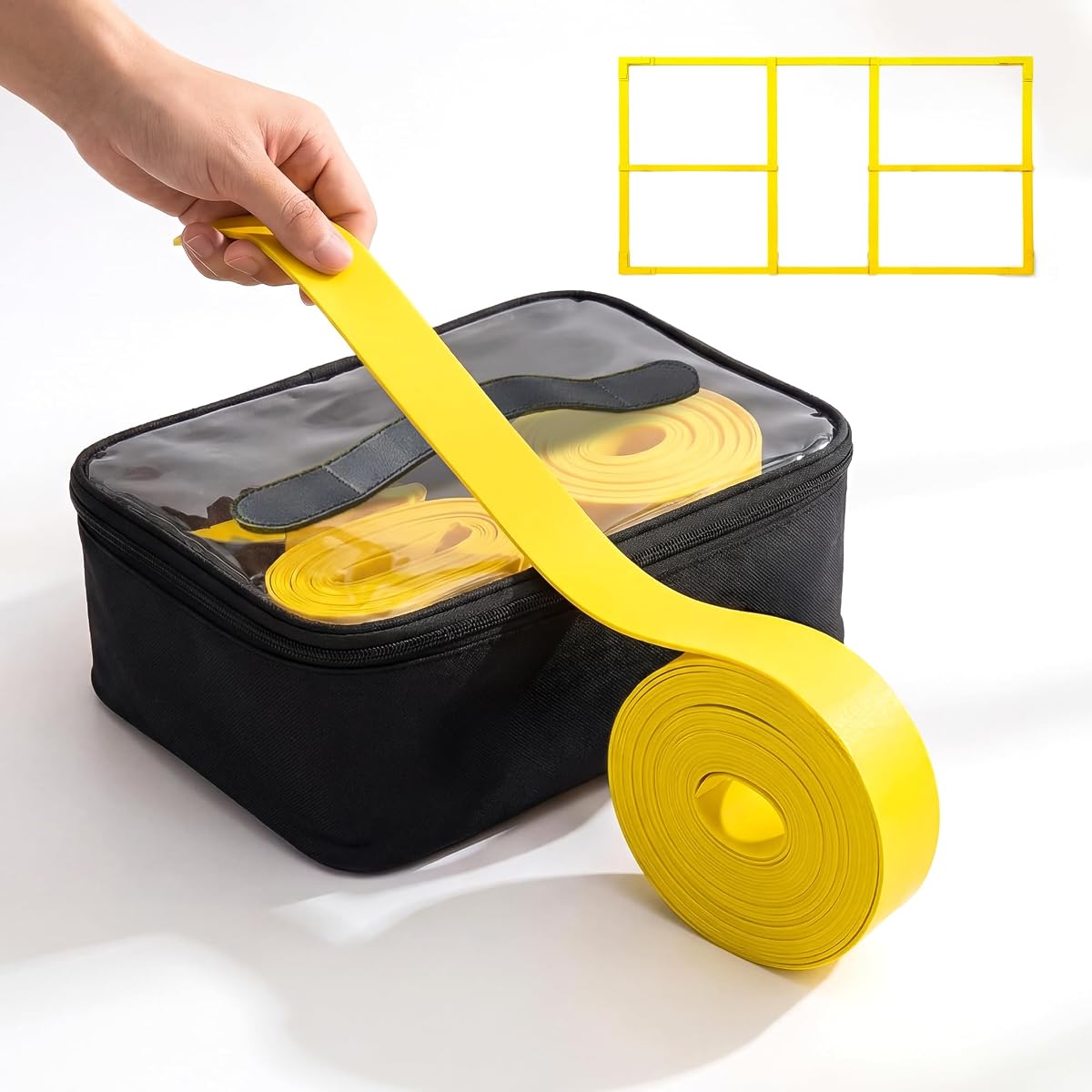
The Magnetic Temporary Portable Pickle Court Marking Lines System has a 2.3 rating, the lowest listed result, and should be considered with that customer-feedback context. It includes twelve accessories with magnetic cable connections, dual corner buckle modules, and bright yellow lines intended to make court boundaries easy to identify.
We may earn a commission when you buy through this link, at no additional cost to you.
The main strength is portability. The system rolls into compact packaging, can be installed in minutes according to the listing, and can be cleaned and reused indoors or outdoors. Textured particles on the underside are intended to increase ground friction, giving the lines more resistance to shifting. Optional weight blocks are available separately for greater resistance to wind uplift.
The separate weight blocks are a meaningful drawback for outdoor filming because the base package may not include everything needed in breezy conditions. The low rating may also reflect concerns that buyers should investigate through current customer feedback. In addition, a marked surface is not equivalent to a playable netted court and cannot provide the stopping plane required for actual pickleball play.
Despite the low score, the system serves a specific need: creating a recognizable filming area in a shared indoor space, parking lot, driveway, or practice room. It is most useful for drills, ball-control exercises, introductions, and short demonstrations where a full net assembly would be inconvenient.
The magnetic system creates a recognizable playing area without drilling or permanently painting a surface. That flexibility makes it useful for community events, coaching demonstrations, and filming in rented indoor spaces.
Textured undersides help grip the ground, but the listing notes that weight blocks are a separate purchase. Outdoor users should plan for those accessories or choose another method when conditions are likely to be windy.
We may earn a commission when you buy through this link, at no additional cost to you.
The Pro 22ft Pickleball Net with Hand Crank carries a 4.4 rating and presents a practical balance of regulation length, tension control, and transportability. Its stated 22-foot size is designed for competitive matches and casual games, making it a useful central component for filming practices and organized events.
We may earn a commission when you buy through this link, at no additional cost to you.
The built-in hand winch allows the operator to fine-tune the reinforced tension rope as the net is positioned. Pre-attached quick-tie points remove the need to thread rope manually, while metal buckle clips support rapid base assembly. Locking smooth-rolling wheels make the system easier to move between a backyard, gym, and tournament venue without disassembling the entire frame.
A 600D carry bag provides a more substantial storage solution than a lightweight pouch, though the complete package will still occupy meaningful space. The product listing does not state the center height as prominently as some competing systems do, so buyers seeking exact regulatory verification should check the current dimensions and official net specifications before use in sanctioned competition.
This net is well suited to clubs that need to establish a court quickly before recording begins. Its combination of hand-crank tension, easy assembly, and locking wheels reduces downtime, while the familiar 22-foot shape makes it approachable for players. A camera positioned safely beyond the baseline can then capture a consistent view of the full court.
The integrated hand crank and reinforced rope let operators tune net tightness directly at the frame. Pre-tied connections further reduce setup time compared with systems that require separate rope installation.
Locking wheels allow the assembled net to roll and then remain fixed during play. The carry bag keeps the remaining components organized for transport to practices, leagues, and tournament sites.
We may earn a commission when you buy through this link, at no additional cost to you.
The Seliyoo In-Ground Pickleball Net System has the highest listed rating in the roundup at 4.7. It is designed for facilities that need a permanent court rather than a portable net, using 75-millimeter square carbon-steel posts with 3-millimeter walls and a black UV-resistant powder coat.
We may earn a commission when you buy through this link, at no additional cost to you.
Unlike portable systems that can drift and require repeated locking, the Seliyoo posts are intended to be embedded in poured concrete using galvanized sleeves. Its winder, crank, and top pulley use cast brass, while the included 22-foot net has a steel cable core and adjustable center strap. The stated heights are 36 inches at the sidelines and 34 inches at the center, matching the regulation dimensions described in the listing.
The trade-off is installation. Concrete work, accurate post alignment, and proper sleeve depth are required before the system can be used. Because it is not portable, buyers must be certain that the location will support a permanent court. Maintenance is minimal according to the product data, but the initial installation demands planning and appropriate construction expertise.
For a club, academy, residential development, or municipality that regularly records games on the same court, permanence is a major advantage. A fixed net eliminates frame movement and repeated tension checks, creating a stable environment for both players and automated cameras. It is the strongest infrastructure choice here for a long-term Court Recording System for Pickleball.
A permanently anchored net does not move between sessions or require repeated wheel locking. That consistency helps the playing area remain unchanged, which is valuable when cameras are positioned according to a repeatable court layout.
The thick carbon-steel posts, brass hardware, and galvanized embedded sleeves are intended to resist rust and wear. The product also emphasizes reduced maintenance and re-leveling over years of regular use.
We may earn a commission when you buy through this link, at no additional cost to you.
The MOXOW Semi-Permanent Pickleball Net System carries a 4.2 rating and offers a middle path between a fully portable net and a permanently embedded installation. Its regulation dimensions are listed as 22 feet by 36 inches, with an adjustable center strap supporting a 34-inch center height for training, tournament play, and everyday matches.
We may earn a commission when you buy through this link, at no additional cost to you.
Integrated lockable wheels allow the system to be repositioned and then secured in place. A steel cable and hand crank provide smooth tension adjustment, while a rust-resistant aluminum frame and reinforced net are designed for outdoor use in varying weather conditions. The product description recommends covering the system when it is not in play to extend its service life.
The nested slide-in frame supports quick, tool-free assembly, and the included backpack makes storage and transport simpler than a bulky wheeled system. That makes the MOXOW suitable for facilities that need a dependable court without committing to concrete installation. Its semi-permanent nature still demands attention to placement, though, and the wheels do not make it as convenient to move as a smaller temporary net.
For a tournament facility, training academy, or multi-use club, this system offers a practical combination of stability, regulation dimensions, and repositioning. Paired with a tripod-mounted AI camera, it can support consistent event footage while allowing the court to be cleared when other activities require the space.
Integrated wheels allow the net to move between positions, while the locking mechanism keeps it fixed during play. This flexibility is useful for facilities that alternate between competition, instruction, and general court use.
The steel cable and hand crank allow smooth, precise tension changes. An adjustable center strap helps preserve the intended center height, supporting consistent play and a clear camera view.
We may earn a commission when you buy through this link, at no additional cost to you.
Choosing a Court Recording System for Pickleball means matching tracking, audio, court stability, and setup needs to the type of footage you want. The right combination depends on whether the priority is family highlights, coaching analysis, live sharing, or a permanent club production.
Automatic tracking is most useful when a camera can recognize the featured player and keep that person central during a rally. The Chameleon provides AI-powered tracking, FollowMe Mode, and a 120-degree wide-angle lens, while the Falcon uses a dual-lens arrangement, 6 TOPS of AI performance, and an eight-core processor. These specifications make both viable for pickup games, although neither is expressly documented as having a pickleball-specific tracking profile. Buyers should consider court size, doubles play, crossing patterns, and how often players change direction. A wide field of view is valuable for doubles, but tracking accuracy is equally important because a camera that repeatedly loses the subject can create less useful footage than a fixed view.
Prioritize tracking that is understandable and easy to correct. A hands-free system is convenient, but manual repositioning should remain possible when a player leaves the frame.
Pickleball rallies can involve rapid ball exchanges, sudden direction changes, and players crossing close to the net. The Chameleon records at 4K 60FPS, and the Falcon also advertises 4K recording through a dual-lens system. High frame rates can make the footage easier to review frame by frame during coaching, while 4K provides detail for cropping, analysis, and social sharing. Resolution alone does not guarantee a useful result: camera placement, lens coverage, lighting, stabilization, and network conditions still affect the finished recording. Buyers should also consider whether the output format works with their editing software and whether continuous recording duration fits the planned session.
Choose 4K and 60FPS when motion analysis is important. For general highlights, prioritize reliable tracking, simple sharing, and adequate coverage over extra resolution.
Court-side commentary, interviews, and player reactions can carry as much value as the action itself. The RØDE Wireless PRO includes two transmitters, one receiver, lavalier microphones, onboard 32-bit float recording, and built-in timecode. That combination gives operators a backup copy of each session and helps align multiple cameras. Since the RØDE product records sound rather than video, it should be treated as a complement to a visual system. Players should also test wind protection and confirm how the receiver connects to the chosen camera or computer.
Prioritize isolated wireless capture, onboard backup recording, and timecode when commentary or multi-camera editing matters.
A camera cannot create a professional-looking court from an unstable or poorly defined playing area. The Seliyoo, MOXOW, ONCOURT OFFCOURT, and hand-crank portable nets all state 22-foot lengths, with regulation center-height information appearing in the product descriptions. A hand crank or winder allows tension to be adjusted, while a center strap can support consistent height. The portable products are more convenient for clubs that use different spaces, whereas the Seliyoo is intended for concrete installation. A visibly level net and clear sidelines also help an AI camera maintain consistent spatial references.
Match the net to the venue. Choose portability for changing locations and permanent anchoring for a dedicated facility.
Temporary court lines can be useful for ball-control drills, exhibitions, filming in multipurpose spaces, or establishing boundaries where a complete net cannot be installed. Both magnetic line systems in this guide use modular accessories, bright colors, textured undersides, and compact storage. They are not substitutes for a regulation net because they do not create a proper stopping plane for the ball. Wind exposure is also a consideration, and one listing specifically identifies weight blocks as a separate accessory. For indoor spaces or brief demonstrations, the simplicity may outweigh the limitation.
Use temporary lines for accessible practice areas, not as a substitute for regulation gameplay equipment.
A system that is difficult to assemble can consume court time and discourage regular filming. The hand-crank nets emphasize quick-tie points, buckle clips, wheel-assisted movement, and included carry bags. The Chameleon supports hands-free tracking, which reduces the need for a camera operator, while the Falcon's standard tripod mounting makes positioning relatively straightforward. The RØDE system requires separate audio connection and a charging workflow, so its setup planning is different from that of a standalone action camera. Consider who will carry the equipment, how long it takes to install, and whether a single person can manage the components safely.
Favor fast setup and organized transport when recording time is limited or different people handle the equipment.
Recorded footage is only useful if it can be stored, moved, and shared. The Chameleon includes 20GB of cloud storage, highlight creation, a live scoreboard, and RTMP-compatible streaming without a subscription fee. The Falcon supports both microSD and cloud storage options and includes Wi-Fi live streaming. The RØDE Wireless PRO records onboard but does not provide a complete video-management workflow. Clubs should determine whether they prefer local removable media, cloud access, direct streaming, or all three, and should account for file management after full-length practice or tournament sessions.
Choose storage and sharing features that match the audience. Local media suits editors, while cloud and streaming help families and teams share promptly.
Outdoor courts expose equipment to sun, moisture, dust, and wind, while indoor facilities can involve tighter spaces and frequent transport. The Falcon's product data does not specify a weather-resistance rating, so it should not be assumed to tolerate rain or prolonged exposure without protection. The portable nets are described for indoor and outdoor use, and the MOXOW recommends covering its system when not in play. Permanent installations use embedded sleeves and corrosion-resistant hardware, while temporary lines are easier to remove and dry. Buyers should always review the latest product instructions rather than infer environmental limits from the category alone.
Match protection and storage practices to the environment, and keep portable equipment covered between sessions.
Begin by choosing the camera position before players arrive. Mount an AI camera beyond the baseline or in a raised corner where it can see the full court without being struck by a ball. Keep the lens unobstructed, confirm that the chosen tracking subject is visible from the starting position, and test both a near-side rally and a far-side exchange before recording official play.
For audio, connect the RØDE receiver to the camera, phone, or computer using the appropriate supplied cable, then assign the transmitters to the intended speakers. Check the input level, enable any required monitoring, and record a short test with conversation, paddle contact, and movement near the court. Onboard 32-bit float recording provides a useful backup, but it should not replace a proper connection check.
After the session, lock portable net wheels, loosen or secure components according to their instructions, and clean the court lines before rolling them for storage. Review the footage for framing and audio errors, organize files promptly, and back up important recordings. Cover outdoor equipment when it is not in use, dry the lines and frame if they have been exposed to moisture, and inspect tension, connections, wheels, and fasteners before the next session.
The XbotGo Chameleon and Falcon are the products designed around hands-free AI tracking. The Chameleon emphasizes affordability, live sharing, and no subscription fee, while the Falcon offers more advanced processing, dual lenses, and broader analysis features. Both should be tested on the actual court because their tracking profiles are described primarily for team sports rather than pickleball specifically.
A regulation-size net is not required merely to create video, but it improves the quality and consistency of practice or game footage. Portable, semi-permanent, and in-ground options each work, with permanent systems best for dedicated facilities and wheeled systems better for changing venues. Temporary court lines are useful for drills but do not replace a net for full gameplay.
The Chameleon supports RTMP-compatible live streaming, and the Falcon includes Wi-Fi live streaming. Organizers should still test the network connection, confirm platform support, verify streaming limits, and keep a local recording running whenever possible. A stable wired or cellular connection and sufficient storage can reduce the risk of interruptions.
Place the camera high and behind a baseline or in a rear corner so all four players and most of the court remain visible. Avoid low positions where players can block the ball or accidentally strike the camera. Test the tracking mode with both teams serving, with a player near the kitchen, and during side-by-side movement across the court.
Wireless microphones are not essential for every recording, but they can materially improve commentary, interviews, and footage captured at a distance. The RØDE Wireless PRO provides two transmitters, onboard backups, and timecode. If the camera is close to the action and built-in audio is sufficient, a simpler setup may meet your needs.
A wheeled, regulation-size portable net offers the best balance for a club moving between locations. The ONCOURT OFFCOURT PickleNet Deluxe, MOXOW, and hand-crank options all include wheeled designs, while the Seliyoo system is intended for permanent concrete installation. Clubs should account for storage, transport, and setup time when selecting among them.
They can be useful for outdoor drills and marked practice areas, but wind and surface conditions affect stability. The textured undersides improve grip, and one listed system offers optional weight blocks for added wind resistance. They should not be treated as regulation court equipment, and users should inspect connections before each session.
Storage needs depend on resolution, frame rate, duration, and the camera's compression method, which the supplied data does not specify for every product. The Chameleon and Falcon include or support cloud or removable storage options, but users should confirm available capacity and maintain a local backup. Recording a short sample before a full session is the simplest way to estimate file consumption.
The best complete setup depends on the recording goal. The RØDE Wireless PRO is the strongest choice for reliable, timecode-enabled audio, while the XbotGo Chameleon offers an accessible hands-free camera with live sharing and no subscription fee. The XbotGo Falcon serves buyers who want a more advanced visual platform and deeper game-analysis features.
The net and court products determine the physical foundation of those recordings. Portable hand-crank systems suit changing venues, the ONCOURT OFFCOURT PickleNet Deluxe emphasizes stability and customer satisfaction, the MOXOW balances mobility with tournament dimensions, and the Seliyoo system is the strongest option for a permanently installed court. Prioritize the factors that directly affect your footage: reliable tracking, full-court visibility, clear isolated audio, consistent net tension, and suitable storage.
Before purchasing, verify the current specifications, included accessories, compatibility, and availability of the exact model. Product features and market conditions can change, so a fresh check is especially important for a system assembled from multiple cameras, audio equipment, and court hardware rather than a single all-in-one device.
