
PREXISO 30Ft Small Laser Leveler
4.9Editor score
LED-illuminated bubble vials
Thirty-foot projected range
Magnetic V-groove base
Discover the best laser levels for crafting and compare accuracy, beam visibility, mounting options, range, and features for detailed creative projects.
Laser levels bring dependable horizontal and vertical references into crafting, helping you align shelves, wall art, cabinet hardware, tiles, trim, and decorative installations with greater confidence. A useful model should project a clear line, mount conveniently, and fit naturally into the scale and rhythm of your workspace.
We compared all ten options by examining their stated accuracy, working range, beam color, leveling behavior, mounting methods, included accessories, and suitability for common indoor and light-construction projects. The list covers compact pocket tools, adhesive wall levels, magnetic cross-line lasers, and more capable self-leveling systems.
Each review identifies the work the tool is best suited for, along with practical limitations to consider before buying. Ratings reflect the supplied customer feedback, while specifications and features come from the listed product information. Product availability and pricing can change, so confirm current details before purchasing.
4.9Editor score

4.2Editor score

4.4Editor score
This side-by-side comparison highlights the range of crafting laser levels, from compact torpedo-style tools to self-leveling cross-line systems with tripods and long-range green beams.




The Johnson Level & Tool 9250 Laser Mouse is a distinctive interior-focused level with a 4.4 rating and a projected range of up to 30 feet. Rather than requiring a tripod or conventional bracket, it uses an adhesive back that adheres directly to a wall or other suitable surface, freeing both hands for the project in front of it.
We may earn a commission when you buy through this link, at no additional cost to you.
Its most valuable feature for crafting is the combination of a laser reference and integrated horizontal and vertical vials. The laser helps establish a straight line across a larger area, while the spirit levels provide additional ways to confirm orientation. The reusable SuperStick adhesive system is designed to remove without leaving holes or marks, making it practical for temporary installation layout.
The trade-offs are inherent in the mouse-style format. It is intended for indoor work rather than exposed outdoor environments, and adhesion is less flexible than a tripod or adjustable magnetic base. It also uses two AA batteries, although the listed 40-hour continuous runtime reduces the likelihood of frequent interruptions during a detailed project.
This is an especially useful pick for hanging aligned artwork, installing shelves and cabinets, marking flooring or tile positions, and completing one-person interior jobs. If your workflow repeatedly changes the reference height or angle, a rotating cross-line model may be more versatile, but for hands-free interior layout the 9250 has a clear advantage.
The adhesive back changes the working method because the tool can remain fixed while you mark, measure, drill, or install. That is particularly helpful when both hands are needed to position a bracket, hold a frame, or transfer a level reference across multiple points.
The integrated horizontal and vertical vials provide a familiar physical leveling check alongside the projected beam. This combination can be reassuring when transferring a layout or confirming that a fixture is correctly oriented.
We may earn a commission when you buy through this link, at no additional cost to you.
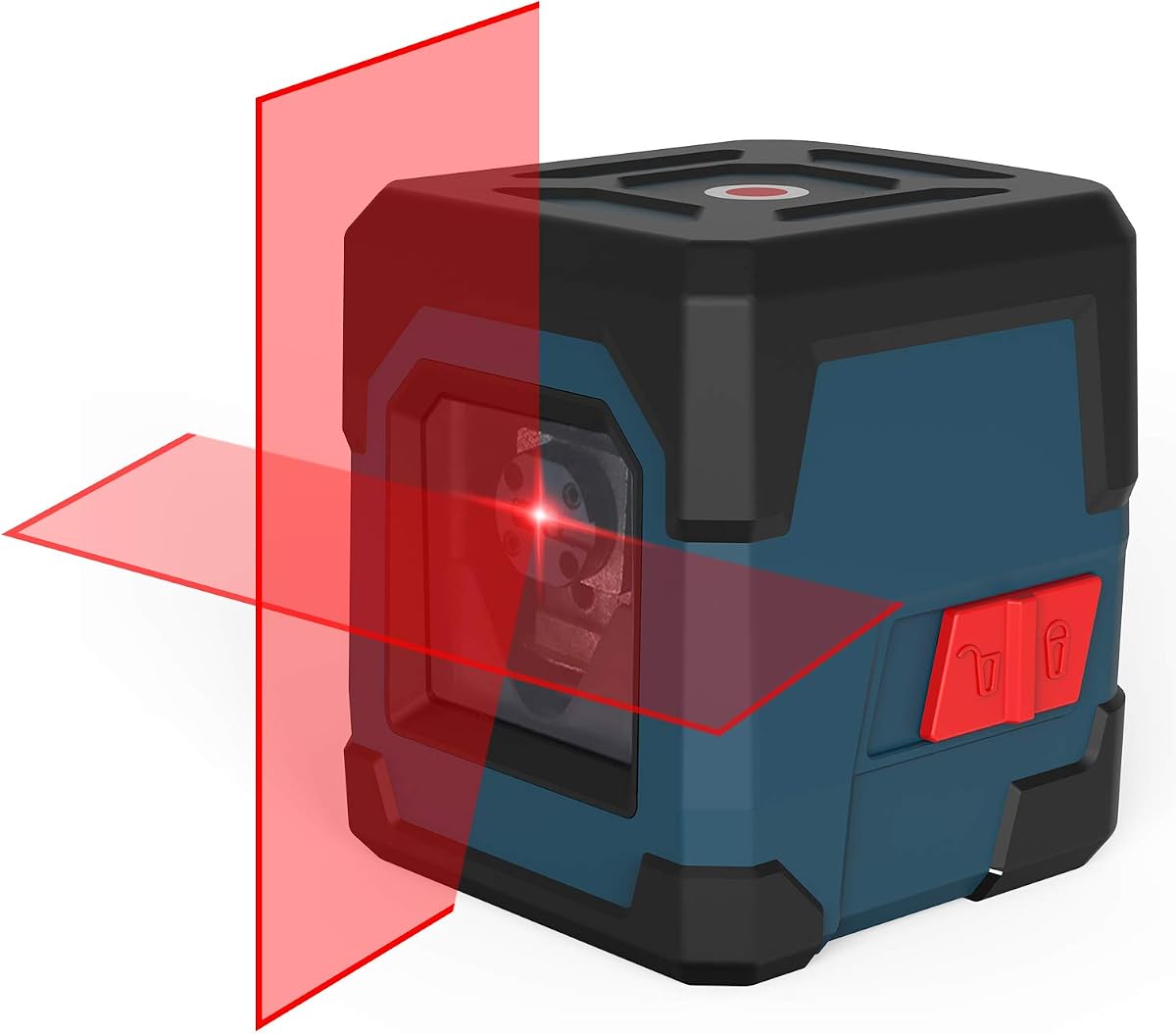
The Utoolmart LV09 earns a 4.0 rating and offers a straightforward way to create straight, cross, and corner references indoors. It is designed for checking whether a plane is uneven and for tasks such as hanging artwork, with a 90-degree horizontal bead that helps assess horizontal level.
We may earn a commission when you buy through this link, at no additional cost to you.
Its selectable line patterns make it adaptable without requiring a complicated control layout. The straight line supports basic alignment, the cross line helps establish perpendicular references, and the vertical or corner line can assist with layouts that need a 90-degree relationship. A wall-mounted fixture adds value for repeated marking and repair work around the home.
The specification list states an accuracy of 0.01 and a wavelength of 650nm to 680nm, but it does not provide the measurement distance associated with that accuracy. It also does not list a maximum working range. Those omissions make it more important to evaluate the tool for your actual surfaces and to confirm the manufacturer’s documentation before relying on it for precision work.
The LV09 is best for budget-conscious crafters who need a simple indoor reference for pictures, shelves, and general home repair. It is less compelling for large furniture installations, detailed joinery, or outdoor layouts, where range, visibility, and mounting flexibility matter more. For straightforward interior alignment, the core functions are useful.
Straight, cross, and corner projections let one compact tool handle horizontal, vertical, and perpendicular references. That versatility is useful when decorating several surfaces or repeating the same alignment pattern in more than one room.
The included wall-mounted fixture can make it easier to establish a recurring reference point. It is particularly useful for home repair projects involving repeated measurements or multiple marks along one wall.
We may earn a commission when you buy through this link, at no additional cost to you.
The PREXISO 30Ft Small Laser Leveler Tool combines a 4.9 rating with a remarkably compact 3-3/4-inch profile. It is built for quick decoration, home improvement, and light construction tasks, including hanging pictures, installing shelves, aligning décor, and spacing hooks.
We may earn a commission when you buy through this link, at no additional cost to you.
Two built-in bubble vials are illuminated by an LED, improving visibility in low-light work areas. The red button controls the illumination, while fixed 180-degree horizontal and 90-degree vertical vials provide physical references for orientation. Its magnetic base includes a V-groove so it can attach to suitable metal surfaces without requiring a separate tripod.
The laser projects a horizontal line up to 30 feet, which is ample for most rooms and many craft installations. Its simpler projection pattern means it will not create a full cross line as quickly as a dedicated cross-line laser, and the lack of an included tripod may matter for projects requiring a precise elevated reference.
Despite its small size, this is one of the most balanced selections for everyday crafting. It is particularly appealing for users who want the reassurance of a bubble level, a projected line, illuminated readings, and magnetic hands-free positioning in a pocketable format. It is our best budget choice for general decorative and home-project work.
The LED-lit bubble windows make the center line easier to locate in cupboards, closets, evening rooms, and other low-light settings. The light can be toggled as needed, helping conserve battery use when illumination is not required.
The magnetic V-groove base gives the compact level a practical hands-free option on metal surfaces. It can sit securely while you mark or install, yet remains small enough to carry from a workbench to different project areas.
We may earn a commission when you buy through this link, at no additional cost to you.
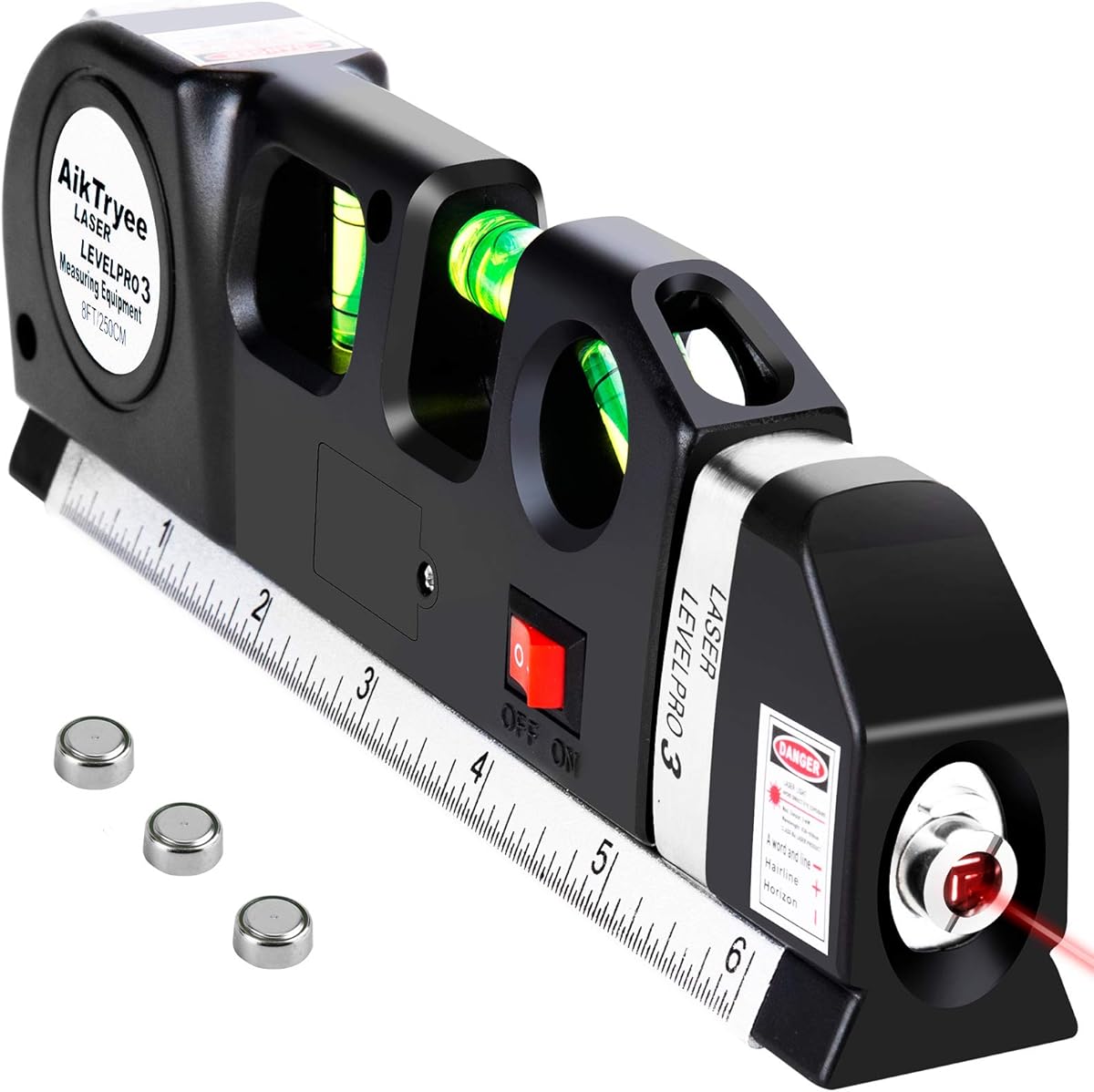
The AikTryee Cross-Line Laser Kit has a 4.3 rating and combines a laser level with a three-pronged bubble tool and an eight-foot measuring tape. It is aimed at indoor jobs requiring a straight line or accurate measurement, including shelves, cabinets, tile, and picture frames.
We may earn a commission when you buy through this link, at no additional cost to you.
A front slider controls the vertical, horizontal, and cross-line modes, making the operating concept approachable even for first-time laser-level users. The three-pronged layout provides level, plumb, and 45-degree bubble references. These physical checks complement the projected lines and can help establish common construction angles.
The included tape is a notable differentiator, measuring eight feet, or 2.5 meters, and offering both imperial and metric graduations down to 1/32 inch and 1 millimeter. That makes the kit more useful when a craft project combines layout and distance transfer. However, no beam range is stated, and the product information does not mention an automatic leveling system.
This is a good choice for beginning crafters, renters, and anyone who wants a laser and measuring ruler in one compact kit. It handles basic decorative alignment better than specialized precision work, so demanding woodworking or large-room installations would favor a self-leveling cross-line laser with a clearly stated working range.
The eight-foot dual-scale tape lets you measure away from the laser reference and then return to the projected line. That convenience is valuable for spacing multiple hooks, transferring dimensions, or laying out a run of decorative elements.
The zero-degree, 90-degree, and 45-degree vials cover horizontal, vertical, and diagonal references. These familiar angles are especially useful for framing, cabinetry, square layouts, and general decorative geometry.
We may earn a commission when you buy through this link, at no additional cost to you.
The Motovera Self Leveling Laser Level is a well-equipped cross-line model with a 4.2 rating, a green beam, and a stated indoor range of up to 100 feet. Its stated accuracy is plus or minus 1/9 inch at 33 feet, equivalent to plus or minus 3 millimeters at 10 meters, and the projection angle is 110 degrees.
We may earn a commission when you buy through this link, at no additional cost to you.
Four brightness modes and a pulse function offer several ways to adapt the beam to indoor conditions. The pendulum unlocks for self-leveling within plus or minus four degrees and flashes continuously when tilted beyond that range. Manual mode locks the lines at a chosen angle for staircases, patterns, and other creative layouts.
The package includes an adjustable tripod, two AA batteries, a manual, and a carry bag. An IP54 rating adds dust and water resistance, while the stated drop resistance extends to 30 inches. One minor qualification is that the protective acrylic window may create tiny gaps in the laser lines, which the manufacturer describes as normal and not an accuracy issue.
For crafters who install wall systems, tile, shelving, cabinetry, or large arrangements, this is a strong all-purpose recommendation. The included tripod removes the need for another support, and the green beam is especially useful in bright indoor spaces. It is less suited to direct outdoor use without a receiver because green light can be difficult to see in intense sunlight.
The green beam is described as four times brighter than a standard red laser under the same light source, while four brightness settings let you adapt to the room. High visibility can reduce frustration when marking long lines across a wall, floor, or work surface.
Locking the pendulum allows the cross line to remain fixed at a selected angle. That makes the tool useful beyond perfectly horizontal work, including sloped staircases, repeated wall patterns, and custom decorative alignments.
The adjustable tripod, carrying bag, batteries, and manual make the package convenient for immediate setup. This is a meaningful advantage for beginners or users who do not already own compatible mounting equipment.
We may earn a commission when you buy through this link, at no additional cost to you.
The RockSeed Cross Line Laser has a 4.2 rating and provides horizontal, vertical, and cross-line projections across a stated 110-degree angle. It is suited to tile, photos, doors, windows, furniture carpentry, wallpaper, and many general leveling tasks around the home.
We may earn a commission when you buy through this link, at no additional cost to you.
Its slide switch changes between self-leveling and manual modes. In self-leveling mode, the unit compensates within a stated range of 4 degrees plus or minus 1 degree and flashes when out of level. Manual mode disables that function and locks the cross at a chosen angle. Stated accuracy is plus or minus 1/8 inch at 30 feet.
The IP54 enclosure is designed for resistance to dust, water, shock, wear, impact, and temperature extremes, with a stated four-foot collision-protection claim. It can mount to a tripod, while a magnetic bracket is available separately. The package includes the tool, a canvas carry case, two AA batteries, and an instruction manual.
This is a sensible pick for decorators and installers who need a conventional red cross-line laser with selectable self-leveling behavior. It is less convenient out of the box than models with a tripod or magnetic bracket included, and the red beam may be harder to see in brightly lit rooms than a green beam.
The self-leveling mode removes the need to manually set the instrument perfectly level within its compensation range. It is a useful feature for common horizontal and vertical installations where speed and repeatable reference lines matter.
The protective enclosure and IP54 rating make this cross line more appropriate for workshops and light job sites than a bare, non-rated decorative tool. Its compact housing remains manageable to carry between tasks.
We may earn a commission when you buy through this link, at no additional cost to you.
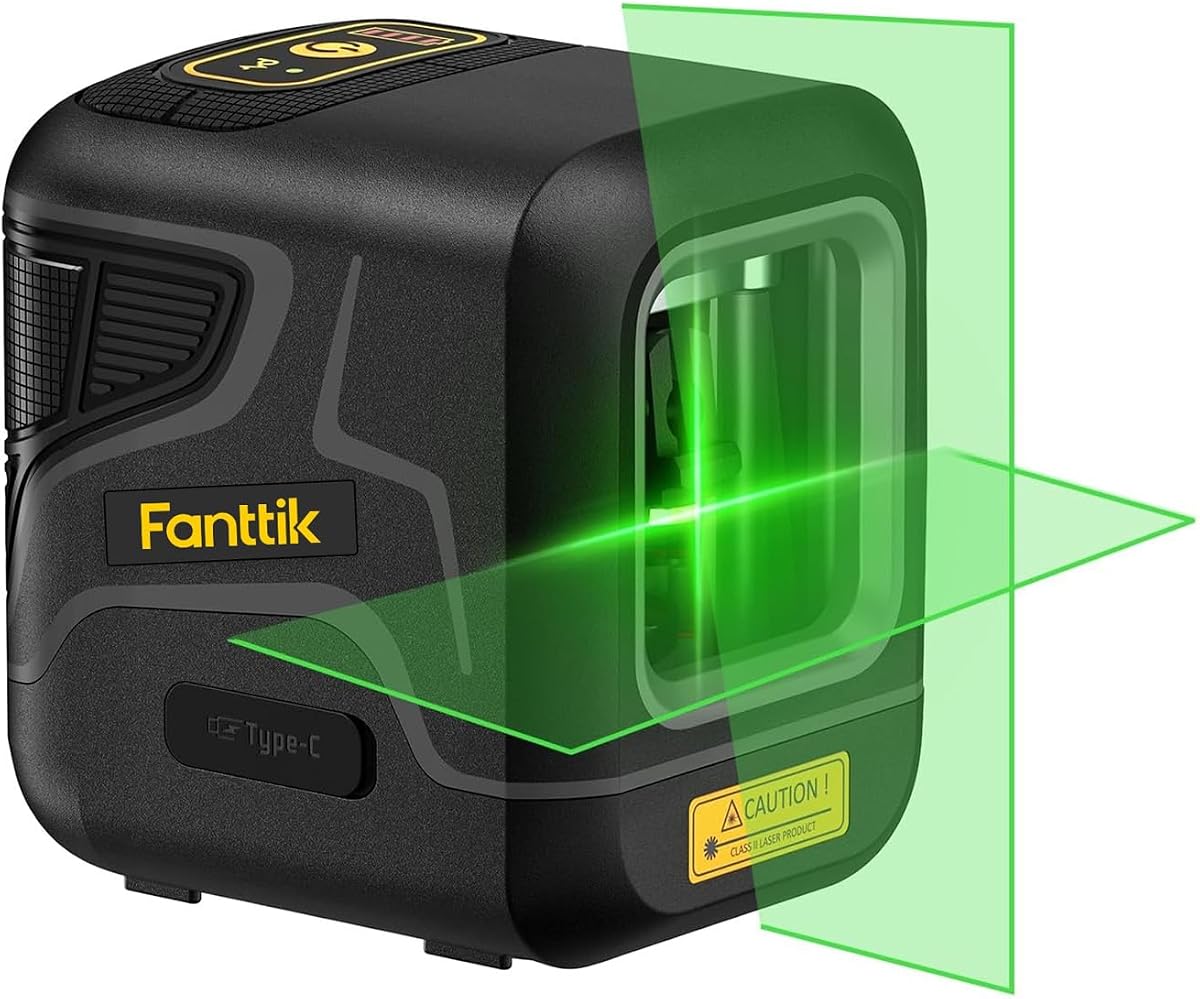
The Fanttik D2 combines a pocket-friendly design with a 4.5 rating and a rechargeable power system. Its integrated 2200mAh battery provides up to 10 hours of continuous use and is stated to be rechargeable more than 500 times, making it convenient for regular decorating and home-improvement work.
We may earn a commission when you buy through this link, at no additional cost to you.
The green laser is designed for strong visibility and is described as four times brighter than red under the same illumination. Stated accuracy is within 1/8 inch at 30 feet. The body weighs 0.56 pounds, while a TPE rubber cover adds drop resistance. Its included magnetic bracket supports 360-degree positioning on metallic surfaces.
The pendulum provides self-leveling when unlocked and flashes every 0.5 seconds if tilted beyond four degrees. Locking it creates manual mode for angled work, with a flash every four seconds. Pulse mode can reach a stated 164 feet when used with a receiver, but the receiver is not supplied, so outdoor performance should be considered with that limitation in mind.
The package includes the D2, magnetic bracket, USB-C cable, user manual, and drawstring pocket. This is a strong choice for mobile crafters who want a bright green line, rechargeable convenience, and a compact body. If the work regularly takes place in direct sunlight at long distances, budget for the compatible receiver.
The integrated rechargeable battery removes the need to keep spare cells on hand. USB-C charging also makes it easy to top up between projects, while the stated 10-hour runtime supports extended decorating sessions.
Green light offers strong contrast in many indoor environments, helping a line remain visible while a room is occupied or brightly lit. That visibility can be especially helpful when aligning several pieces of wall décor.
The compact, rubber-covered tool and drawstring pocket make the D2 easy to carry. The magnetic bracket allows it to turn through 360 degrees, supporting vertical, horizontal, and angled references without a separate large base.
We may earn a commission when you buy through this link, at no additional cost to you.
The ZANIS Multi Surface Laser Level has a 4.0 rating and focuses on flexible installation across different wall types. Its 360-degree dual-dial system offers manual adjustment for horizontal, vertical, and angled alignment in one-degree increments, while a built-in bubble level provides a familiar reference.
We may earn a commission when you buy through this link, at no additional cost to you.
The mounting system is the distinguishing feature. Four wall pins suit drywall, softwood paneling, and plywood. A built-in screw slot supports hard or rigid walls such as hardwood, masonry, tile, and plaster, as well as walls with an existing screw. Fourteen reusable adhesive pads provide a no-drill option for smooth, nonporous surfaces such as ceramic tile, glass, metal, and smooth wood.
The clean indoor line extends up to 30 feet, and the tool is described as a Class II product with output below 1mW. The package includes the laser, MountBase, adhesive pads, wall pins, screwdriver, handle, two AAA batteries, and a QR code linking to support and setup information.
This model is a good answer for renters and decorators who need to move between different surfaces. It is also well suited to picture hanging, shelves, tiles, and cabinetry. The important caveat is that pads should not be used on painted drywall, plaster, wallpaper, or textured walls, so surface type must be checked before mounting.
The three mounting methods let you match the tool to the surface instead of relying on one universal solution. Pins suit softer substrates, the screw slot handles rigid walls, and pads avoid drilling on smooth nonporous surfaces.
The dual dials permit precise manual adjustment in one-degree increments. This makes the tool suitable for repeating decorative angles and for projects that need a line at a chosen orientation rather than only true horizontal or vertical.
We may earn a commission when you buy through this link, at no additional cost to you.
The Klein Tools 93MCLPG is a compact, self-leveling cross-line laser with a 4.4 rating. It projects vibrant green horizontal and vertical lines, along with a plumb spot, across a stated working range of up to 75 feet. The output is listed as less than 1mW for a Class 2 product.
We may earn a commission when you buy through this link, at no additional cost to you.
Its base cutout is a useful feature for crafters and finish installers who work around framing. The tool can align directly on 2-by-4s and metal tracks without a tripod, allowing it to sit close to the work surface. A soft carrying case is included, and the compact housing is designed for tight spaces.
The auto out-of-level detection flashes the laser when it is no longer level, helping prevent a false reference from being used during a project. Green lines offer strong visibility in busy indoor work areas, and the 75-foot range is ample for most rooms and many small installation projects.
This is a premium option for users who want a trusted compact cross-line system, especially when working around exposed framing or metal tracks. It does not list a tripod in the supplied information, so buyers who require a full elevated setup should verify their support equipment. Its feature set and build make it a strong choice for advanced craft and installation work.
The cutout in the base allows the laser to sit directly against common 2-by-4 framing and metal tracks. That means you can establish a reference without a separate raised support in some common installation situations.
Vibrant green lines and a plumb spot make horizontal, vertical, and overhead reference points easier to distinguish. The result is especially useful when cabinets, trim, wall art, or framing must align across several points.
The flashing warning gives clear feedback when the instrument has moved beyond its leveling condition. That helps distinguish a trustworthy reference from a line projected while the tool is improperly positioned.
We may earn a commission when you buy through this link, at no additional cost to you.
The Klein Tools 93PTL is a magnetic pocket laser level with a 4.3 rating that projects one bright red line up to 30 feet indoors. It is designed for leveling and alignment around the house, with the supplied information specifically calling out picture hanging and use around existing structures.
We may earn a commission when you buy through this link, at no additional cost to you.
Three bubble vials illuminate for better visibility from different angles, and horizontal and vertical fine-adjustment knobs permit small corrections without moving the entire tool. The body rotates through 360 degrees, allowing the line to be projected in different directions while the tool remains supported.
Mounting options include powerful magnets, a tripod mount, hang holes, and a kickstand. The tool includes two AAA batteries and provides a stated runtime of more than 12 hours, along with a low-battery warning. Its laser output is less than or equal to 1mW at 630 to 640nm, and it is listed as a Class 2 product.
This is an excellent compact choice when a single adjustable reference line is enough. It works well for picture placement, trim alignment, hooks, shelves, and general indoor layout. It is less versatile than a cross-line model when two perpendicular lines are required at once, but its illuminated vials, fine controls, and multiple mounting methods make it a practical precision companion.
The three-axis illuminated vials make the physical level easier to read in dim areas and from less convenient positions. They also provide an alternative to interpreting the laser line when the physical bubble center is the clearer reference.
Dedicated horizontal and vertical knobs permit small changes to the line while the tool remains mounted. This is useful when the target reference is already close and repeated repositioning would be inefficient.
Magnets, a kickstand, hang holes, and a tripod mount allow the tool to adapt to metal, flat surfaces, vertical points, and elevated setups. That flexibility makes it easier to keep working without one particular accessory.
We may earn a commission when you buy through this link, at no additional cost to you.
The most useful laser level is the one that matches your surfaces, project scale, and need for portability or hands-free positioning. Compare projection patterns, range, accuracy, mounting methods, and beam visibility before choosing.
A single horizontal or vertical line is sufficient for aligning one edge or transferring a level reference. A cross-line projects both directions at once and is more efficient for cabinets, square layouts, tile grids, and perpendicular wall art. A corner or dual-line pattern is useful when a true 90-degree relationship is needed without relying entirely on a bubble vial.
Match the stated range to the largest space where the laser will be used. A 30-foot range handles many rooms and craft walls, while 75- or 100-foot models provide more room to position the tool. Outdoor work also depends on beam color and receiver support, so indoor range alone does not tell the whole story.
Compare accuracy at a stated distance rather than looking only at a single number. Self-leveling tools compensate automatically within a specified range, while manual and mechanical models require careful adjustment. For hanging décor, general shelving, and light construction, modest precision is usually sufficient; fine furniture or cabinet work benefits from a tighter published specification.
Red beams are conventional and often easier to find in lower-cost tools, while green beams are generally easier to see in bright indoor environments. Brightness settings can help manage the line in different conditions. If the tool will be used outdoors in direct sun, a compatible receiver may be more important than beam color alone.
Consider how the tool will remain stable while you work. Magnetic bases suit metal surfaces, tripods provide adjustable height, adhesive mounts reduce drilling, and wall fixtures help repeat layouts. Fine-adjustment knobs are valuable when a line is close but still needs a small correction without moving the entire unit.
Compact tools are easier to carry between a craft table, wall, and workbench. AA or AAA models are familiar and easy to power, while a rechargeable system can reduce ongoing battery replacement. Compare stated runtime, included batteries, charging cables, carry cases, and the physical size of the housing.
An IP54 rating offers stronger protection for workshops, garages, and light job sites than an unprotected indoor model. Laser class and maximum output should also be checked. For delicate indoor décor, a compact Class 2 tool may be sufficient, while active work areas benefit from a more rugged enclosure.
Accessories can determine how quickly a tool becomes useful. A bundled tripod, magnetic bracket, carrying case, batteries, wall fixture, or measuring tape can reduce extra purchases. Conversely, note when a bracket, receiver, or other essential accessory is sold separately so the final setup remains realistic.
Begin by identifying the exact reference needed, then choose a surface where the laser can be mounted securely and positioned far enough away to cover the full project. Confirm the tool is level or properly calibrated, switch to the appropriate line or self-leveling mode, and allow the beam to stabilize before transferring measurements.
Use the line as a guide rather than as a substitute for a full measurement. Mark several points, verify the distance between them, and use both the projected reference and a physical bubble vial when available. For angled work, lock or adjust the tool according to its instructions, and never assume a manual position is automatically level.
Remove the tool before cleaning or working around the mount. Wipe the housing gently, keep the laser window free of dust and adhesive residue, and replace batteries before a project if the warning appears. Store the unit in its case, protect it from drops and moisture, and consult the manual if the beam stops flashing, leveling behavior changes, or the mounting surface could be damaged.
Yes, a properly positioned laser level is well suited to hanging pictures, shelves, hooks, and similar decorative projects. The important steps are mounting the tool securely, allowing it to level, and checking the reference from more than one point. Use a bubble vial as a secondary check when the surface or mounting angle is uncertain.
A single-line level projects one horizontal or vertical reference, depending on orientation. A cross-line level projects horizontal and vertical lines at the same time, which speeds up cabinet, tile, and square-layout work. If you only need to align one edge, a single line is simpler; if you repeatedly need perpendicular references, a cross line is more efficient.
Green beams are often easier to see in bright or occupied indoor rooms, which can make precise marking faster. Red beams remain suitable for many ordinary indoor tasks and may be available in smaller, less expensive tools. Outside in direct sunlight, beam visibility can be limited for either color, so a compatible receiver is the more important consideration.
It depends on the mounting method. Magnetic tools require a magnetic surface, and adhesive tools may damage paint or fail to hold properly. The ZANIS Multi Surface specifically states that its pads are not for painted drywall, plaster, wallpaper, or textured walls. Use a suitable screw or pin method when a no-mark adhesive mount is unsuitable.
A tripod is helpful when the laser must project from a specific elevated height, especially across tile grids, cabinetry, or long wall runs. It is less essential for a small room or a single picture when a magnetic, adhesive, or wall-mounted base can hold the tool securely. Some models include a tripod, while others require one to be purchased separately.
Self-leveling means the internal pendulum automatically adjusts the projected line when the tool is within the manufacturer’s specified leveling range. If the tool is tilted too far, it normally flashes to warn that the line is not a reliable level reference. Manual mode locks the beam so it can be used at a deliberate angle.
Position the tool far enough away to illuminate the entire working area, but not so far that the line becomes difficult to see. The manufacturer’s stated range provides the upper limit, while room brightness and beam color affect practical visibility. Moving the tool closer can improve line clarity when precision marking matters more than full-room coverage.
Yes, most models in this guide are useful for both decorative projects and practical home repair. A compact, illuminated, single-line tool suits pictures and hooks, while a self-leveling cross line with a tripod or robust mount is better for cabinets, tiles, shelves, and wider renovations. Choose based on the most demanding project you expect to complete.
The PREXISO Pocket Level stands out as the best budget option for general crafting because it combines a compact body, illuminated bubble vials, a magnetic base, and a 30-foot projected line. The Motovera Green Cross Line is the most versatile all-round package, offering a bright beam, multiple modes, a tripod, and a long stated range, while the Klein Tools 93MCLPG provides a premium professional choice with green lines and compact framing-friendly positioning.
Prioritize the features your actual projects demand. Choose a single line for one-dimensional alignment, a cross line for cabinets and tile, a green beam for bright rooms, and a tripod or magnetic base for hands-free work. Also account for surface type, portability, power, and whether the required accessories are included.
Ratings, product configurations, availability, and pricing can change, so check the current listing and manufacturer information before making a final purchase. Most importantly, mount the tool securely, confirm it is level, and verify the reference from multiple points for a clean and accurate finished project.