
Power Wheel Adapter for Ryobi 18V Battery
4.8Editor score
Broad Ryobi model support
Integrated switch protection
Maximum 20A current
Compare the best battery adapter for Power Wheels converter kits by battery fit, voltage control, protection, wiring, and ease of installation.
Battery adapters let ride-on vehicles use compatible cordless-tool batteries instead of their original power source. A worthwhile converter should match your battery platform, provide the correct voltage and current, include effective protection, and connect cleanly enough for repeatable installation and maintenance.
This guide compares ten battery adapter for Power Wheels converter kits across DeWalt, Milwaukee, and Ryobi platforms. We evaluated compatibility, output capabilities, switching, fusing, low-voltage handling, wiring quality, included components, installation considerations, and suitability for vehicles, robotics, lighting, and other DIY projects.
The list includes direct battery adapters, adjustable low-voltage protection systems, and a step-down converter for projects requiring 12-volt power. Each pick reveals its strongest use and main limitations, while current product details and pricing should be confirmed before purchase.
4.8Editor score

4.7Editor score

4.3Editor score
The table below compares all ten kits by battery platform, output type, electrical protection, and major use case, helping readers distinguish simple power adapters from adjustable protection systems and dedicated step-down converters.

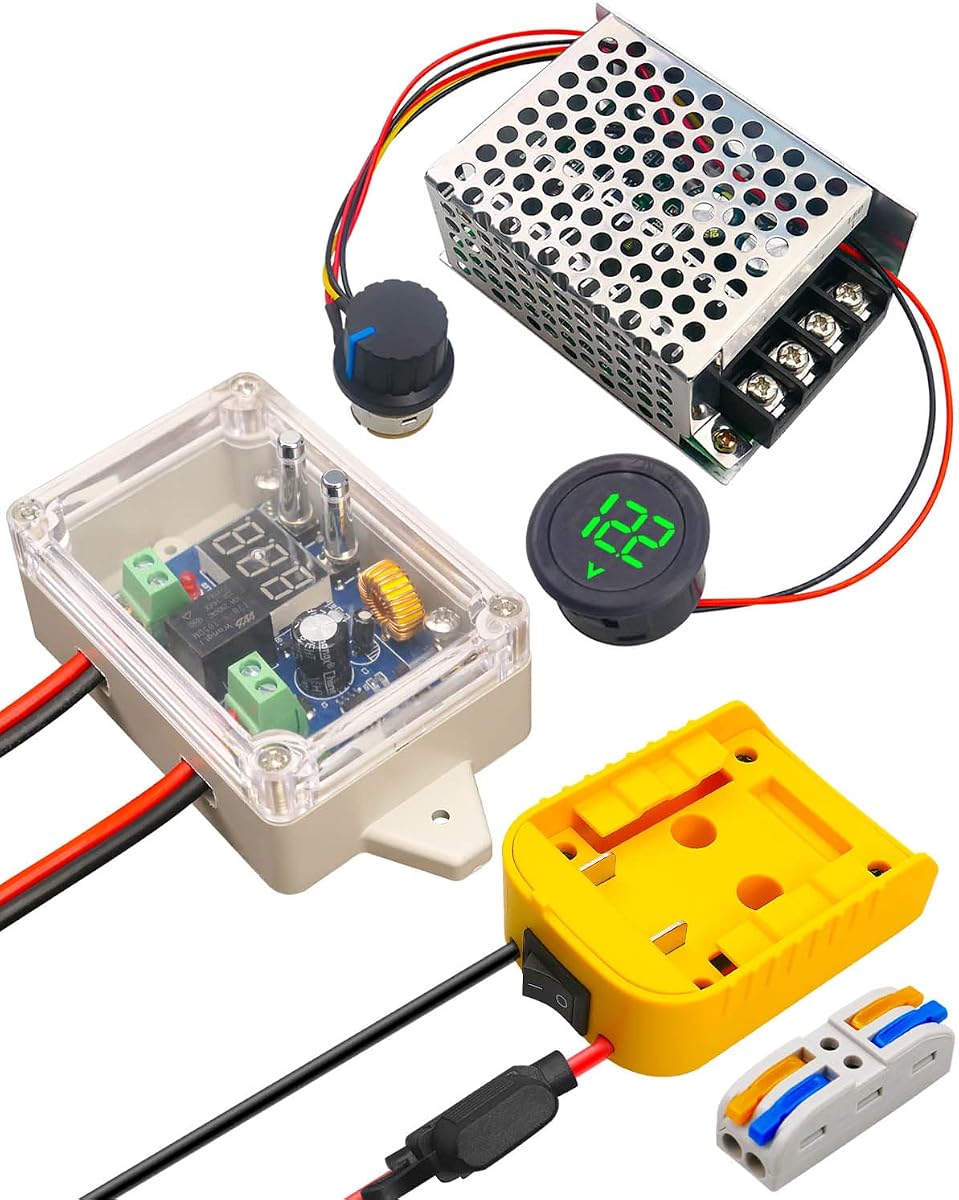


This Low Voltage Protection Power Wheels Battery Adapter is a feature-rich option for DeWalt-battery projects, combining an adjustable electronic switch, an LED voltage indicator, low-voltage protection, and two detachable terminal outputs. Its 4.3 rating reflects a capable design, although users still need to match the converter to the voltage and current requirements of the connected equipment.
We may earn a commission when you buy through this link, at no additional cost to you.
The standout advantage is real-time monitoring. Seeing the battery voltage at the adapter makes it easier to judge remaining capacity and notice unexpected changes without relying entirely on the battery's own indicator. The adjustable low-voltage function can power down the circuit at a selected threshold, helping reduce over-discharge. Detachable outputs also provide more configuration options than a single hardwired terminal.
The trade-off is that this is not a simple plug-in battery lead. It offers more control and flexibility, but correct configuration is essential. Its stated compatibility covers DeWalt 20V batteries and a 12V to 30V range, so the battery, output voltage, and device should all be checked before use. The presence of multiple outputs also means the installer should follow the wiring guidance rather than improvising connections.
This adapter is best for builders who want monitoring and adjustable protection rather than the smallest possible conversion kit. It is a particularly strong choice for a Power Wheels upgrade, robot, remote-controlled vehicle, or work-light project where visibility into system voltage is useful. For those willing to configure it carefully, it offers the most sophisticated control set in this roundup.
The LED voltage display gives users a quick way to confirm output during installation and operation. That visibility can help distinguish a depleted battery from a wiring, switch, or load-related problem without dismantling the entire project.
An adjustable cutoff helps guard against excessive battery discharge, while two detachable terminals can simplify series or parallel arrangements. Both features are valuable for DIY builders, provided the complete circuit is designed around the adapter's electrical limits.
We may earn a commission when you buy through this link, at no additional cost to you.
This Milwaukee M18 adapter kit combines a battery adapter, adjustable low-voltage protection, a DC PWM motor controller, a voltage display, a 30A fuse, and wiring terminals. It is aimed at builders creating more than a basic battery feed. The 3.7 rating makes it worth examining carefully because the included components are extensive, but the module's stated current limit is an important constraint.
We may earn a commission when you buy through this link, at no additional cost to you.
The PWM controller is the most useful component for an RC truck, robot, or powered car project because it can regulate speed and provide a central switching function. A real-time voltage display and adjustable low-voltage protector add monitoring and battery care. The junction box around the circuit board also adds a layer of physical protection, while the external fuse helps limit excessive current.
The significant drawback appears in the warm reminder: the board uses a micro-relay and thin wiring traces, so operating current should not exceed 8A, or 10A only under the specified below-12V condition. That is a more restrictive ceiling than the 20A maximum stated by several simpler direct adapters. Users must also ensure that every device in the circuit supports 18V input.
This kit is a sensible option when you need motor-speed control and low-voltage management in one package and can keep the load below the stated limit. It is less attractive for a high-current ride-on modification or for someone who wants the shortest possible installation. For compatible RC and robotics builds, the bundled components can reduce the number of separate parts needed.
The included PWM controller makes this kit more practical for moving projects than a basic adapter. Builders can adjust speed through the controller rather than relying entirely on the vehicle's original input electronics.
The micro-relay and thin board traces are the decisive limitation. Staying below the stated operating ceiling, confirming 18V compatibility across the circuit, and checking the wiring before energizing it are essential.
We may earn a commission when you buy through this link, at no additional cost to you.
This DeWalt 18V and 20V ride-on car battery adapter kit is a comprehensive conversion package with a battery adapter, an adjustable low-voltage protection unit, a voltage display, a DC PWM motor controller, a 30A fuse, and a fast terminal. Its 3.9 rating reflects a useful feature set, but the included electronics should be installed with attention to voltage and current.
We may earn a commission when you buy through this link, at no additional cost to you.
The kit is well matched to DIY ride-on trucks, jeeps, robots, and RC-style cars that need more than raw power. The PWM motor controller allows speed adjustment, the display provides output-voltage feedback, and the low-voltage protector can shut the system down at a selected minimum voltage. A protective enclosure helps shield the low-voltage controller from water, debris, and dust, which is particularly useful in vehicle environments.
As with the Milwaukee full kit, the module design introduces a current limitation because of the miniature relay and thin circuit-board traces. The product information is not as explicit about a single maximum operating figure as it is for the direct adapters, so users should not assume it can carry the same load. Every attached device should support the input voltage, and wiring should be checked carefully before the first test.
The kit makes sense for builders who want a coordinated set of motor-control and protection components without sourcing each one separately. It is less suitable for a simple power connection or a vehicle whose motors already have suitable control electronics. Confirm the motor requirements and circuit design first; if they align, this is a versatile all-in-one conversion solution.
Battery adapter, motor controller, voltage display, fuse, and low-voltage protection are supplied as a group. That organization helps builders plan a ride-on vehicle conversion around compatible parts rather than mixing unrelated modules.
The listed applications include cars, trucks, jeeps, RC toys, and robots. Such broad utility makes the package appealing to hobby builders, provided each connected motor and control component can safely handle the selected battery voltage.
We may earn a commission when you buy through this link, at no additional cost to you.
This direct DeWalt battery adapter combines broad battery compatibility with a straightforward installation and a 4.7 rating, the strongest among the DeWalt-focused direct adapters in the list. It accepts 18V and 20V DCB-series batteries and is intended for ride-on trucks, RC toys, robotics, work lights, and other DIY equipment.
We may earn a commission when you buy through this link, at no additional cost to you.
The kit's strongest qualities are practical rather than elaborate. A locking battery connector helps resist accidental disconnection, 12AWG heat-resistant silicone copper wire is suitable for higher-power use, and the stated maximum permissible current is 20A. An integrated switch provides basic on/off control, while a 30A fuse holder and spare fuses help protect the battery and connected devices from overcurrent conditions.
The main limitation is that this converter is not a charger or voltage regulator. It passes the battery's power directly to the attached circuit, so the vehicle, motor controller, lights, or other devices must be designed for 18V or 20V as appropriate. Users must match red to positive and black to negative, and the product should be removed from the battery during long storage periods.
This is the strongest general recommendation for a conventional Power Wheels conversion using a DeWalt pack. It combines a high rating, useful included hardware, a manageable installation, and a stated current capacity without requiring a more elaborate control module. It is especially appropriate when the existing project already expects tool-battery voltage and needs dependable, protected direct power.
The switch gives the installer a clear way to interrupt power, while the 30A fuse system adds overcurrent protection. These features make the direct adapter more practical than an unwired battery lead, even though it still lacks voltage regulation.
The listed DCB205, DCB206, DCB204, DCB203, DCB200, and DCB201 support gives owners of common DeWalt packs a good chance of finding a compatible connection. Users should still verify the physical battery model and project voltage before installation.
We may earn a commission when you buy through this link, at no additional cost to you.
This Milwaukee M18 direct adapter is a well-reviewed option for converting ride-on vehicles, RC toys, and robotics projects that can operate from an 18V M18 battery. Its 4.6 rating and support for numerous listed battery models make it a credible choice for owners who already use the Milwaukee platform.
We may earn a commission when you buy through this link, at no additional cost to you.
The design includes a locking connector, heat-resistant ABS housing, 12AWG silicone copper wire, an integrated switch, a covered blade-fuse holder, extra 30A fuses, a wire terminal, and mounting fasteners. The stated 20A maximum permissible current gives it useful capacity for moderate-power DIY equipment. Two screw holes also allow the adapter to be secured inside a vehicle or to another project surface.
The same limitation applies to most direct adapters: it is not a charger and it does not lower the battery voltage. Connected electronics must tolerate the M18 pack's output. The adapter is also only a one-pack product, which is adequate for a single vehicle or project but may require another unit for a second installation. Correct polarity remains essential.
For an M18-based build, this is a strong, uncomplicated solution with useful protection and mounting hardware. It is best for users who want direct battery power, have a compatible vehicle electronics system, and prefer a straightforward installation without a separate display or controller module. It is a particularly practical fit for hobby robotics and custom RC projects.
The compatibility list includes the 48-11-1815, 48-11-1820, 48-11-1828, 48-11-1840, 48-11-1850, and 48-11-1860 families. This broad coverage is valuable for builders who may already own several qualifying packs.
The switch, covered fuse holder, 12AWG wire, and fixed mounting points help create a more stable installation inside a ride-on vehicle. These details are especially relevant in projects exposed to vibration, impacts, or changing movement.
We may earn a commission when you buy through this link, at no additional cost to you.
This two-pack of direct DeWalt adapters is a practical choice for builders converting more than one ride-on vehicle, robot, or powered accessory. It carries a 4.6 rating and provides the same core construction as other well-regarded direct adapters: a locking battery connector, heat-resistant ABS body, 12AWG wiring, and a covered 30A fuse holder.
We may earn a commission when you buy through this link, at no additional cost to you.
The package contains two adapters, six 30A fuses, and two wire terminals. Each adapter has two fixing holes, so the units can be mounted securely within separate projects. The stated maximum permissible current is 20A, and the connector supports the common 18V and 20V DCB battery families, including several DCB200-series packs.
Because this is a direct-output design, it does not regulate voltage or provide a low-voltage display. A vehicle designed for a lower voltage will not automatically become safe to use with an 18V or 20V pack. Each installation also requires correct red-to-positive and black-to-negative wiring. The bundled wire terminals should be installed securely to reduce accidental contact or disconnection.
The two-pack is best for makers who want spare capacity, a second vehicle, or several DIY projects using the same battery platform. Even if only one unit is needed immediately, having a second adapter can be useful for maintenance or parallel project planning. For a single straightforward conversion, the one-adapter alternative is more focused, but this bundle offers stronger overall flexibility.
A second unit is useful for another ride-on vehicle, a stationary lighting setup, or keeping a spare converter available. It also allows a builder to standardize the connection method across several compatible projects.
Heat-resistant 12AWG wire and a rubber-covered fuse holder support dependable connections, while six fuses provide replacements. Correct installation and adherence to the 20A limit remain necessary for safe operation.
We may earn a commission when you buy through this link, at no additional cost to you.
This DeWalt two-pack focuses on the practical needs of ride-on cars and other DIY power projects. Its 4.6 rating indicates strong customer reception, while two complete adapters, mounting hardware, wire terminals, and spare fuses make it convenient for multiple installations.
We may earn a commission when you buy through this link, at no additional cost to you.
Each adapter uses a close-fitting connector designed for 18V and 20V DCB batteries, including the DCB200 through DCB206 families listed by the manufacturer. A switch, 30A fuse, rubber-covered fuse holder, and 12AWG heat-resistant wire support controlled installation. The package also contains four screws and four drywall anchors, which are useful when fixing an adapter to a wall, panel, or project chassis.
The adapter does not convert the battery to a different voltage, so the receiving equipment must be compatible with the direct output. Although the product description references 12V and 18V applications, users should distinguish between devices with their own appropriate power conversion and those that directly accept the DeWalt battery output. The battery should be removed during extended non-use.
This bundle is a good match for someone building two projects or a single project that benefits from a ready-made mounting option. The included anchors may be especially helpful for stationary work-light or tool-related builds, while the switch and fuse support safer control. It is less appropriate for users specifically seeking adjustable low-voltage cutoff or regulated 12-volt output.
Two adapters, separate terminals, multiple fuses, and four fasteners allow parallel planning across two projects. The additional drywall anchors also support permanent mounting where appropriate.
The connector is designed to sit closely within the battery slot and lock in place. That snug approach helps limit loosening during use, making the adapter suitable for moving ride-on vehicles and other vibration-prone installations.
We may earn a commission when you buy through this link, at no additional cost to you.
This Ryobi 18V direct adapter earns the highest rating in the roundup at 4.8 and offers a clear, well-protected route to powering a custom vehicle or robot from a compatible 18V battery. Its simple architecture makes it approachable for first-time builders while retaining the useful electrical details experienced hobbyists look for.
We may earn a commission when you buy through this link, at no additional cost to you.
Compatibility is a major strength. The listed models include the P102 through P109, several PBP packs, P189 through P195, P197, and BPL-1815, BPL-18152, and BPL-1820G families. The kit adds a locking connector, heat-resistant ABS housing, 12AWG silicone copper wire, an integrated switch, a covered 30A fuse holder, extra fuses, and a wire terminal. Its stated maximum permissible current is 20A.
The adapter is not a charger and does not regulate the 18V output. The connected device must therefore be able to tolerate that voltage, and polarity must be matched correctly. Because the package contains one adapter, buyers with multiple Ryobi-powered projects will need additional units. Two fixing holes on the housing allow it to be secured inside a vehicle or onto another project structure.
This is the best value-oriented recommendation for someone already invested in Ryobi 18V batteries. It combines an excellent rating, broad model support, and the protection and wiring features expected from a solid direct adapter. It is especially appropriate for RC cars, robotics, work lights, and ride-on toy conversions designed around 18-volt power.
The 4.8 rating and extensive supported-model list make this adapter particularly attractive to Ryobi owners. Checking the exact battery model and connector before purchase remains essential, but the stated coverage is notably broad.
A switch, protected 30A fuse, and 12AWG wiring deliver the core safeguards needed for many direct-power projects. This straightforward approach avoids the additional setup associated with PWM controllers or adjustable low-voltage modules.
We may earn a commission when you buy through this link, at no additional cost to you.
This DeWalt adjustable voltage kit combines a battery adapter, low-voltage protector, 30A fuse, real-time voltage display, and DC motor controller. It offers the controls needed for controlled RC and robotics projects, but its 3.5 rating and 8A operating limit make careful compatibility checking essential.
We may earn a commission when you buy through this link, at no additional cost to you.
The protected low-voltage controller is designed to resist water and dust, which is useful in a ride-on vehicle or outdoor work-light installation. Its threshold can be adjusted so the circuit powers off at a chosen minimum voltage. A display shows the output, while the motor controller offers speed and switch adjustments. The battery side supports common 18V and 20V DeWalt DCB packs.
The major issue is the miniature relay and thin-board design, which limits operating current to 8A. A 30A fuse is included, but that does not mean the module should be operated at 30A; the stated relay and circuit limitation remains controlling. The product description also advises disconnecting power after the set threshold is reached and checking all connected devices.
This kit is best for low-current controlled projects that benefit from visible voltage and automatic cutoff, not for demanding high-power drive systems. It may suit a lightly loaded robot, an RC project with modest motor demand, or a lighting setup. Users who need greater output should choose a direct 20A-rated adapter or another solution designed around their actual load.
Automatic cutoff can help prevent an attached device from continuing to draw from a depleted battery. The enclosed controller adds environmental protection and makes the system suitable for projects where dust or occasional moisture is a concern.
The PWM speed control and voltage display add useful visibility to compatible RC and robot projects. The 8A ceiling means motor selection and startup behavior must be checked carefully before installation.
We may earn a commission when you buy through this link, at no additional cost to you.
This dedicated step-down converter changes compatible DeWalt 18V or 20V battery power into a stable 12V DC output. Its 4.3 rating and clearly defined 20A, 240W output make it the most specialized option in the guide, particularly useful when the target ride-on vehicle or accessory requires 12 volts.
We may earn a commission when you buy through this link, at no additional cost to you.
The converter's smart chip provides low-voltage, over-voltage, over-current, short-circuit, overload, and overheating protection. A 30A fuse adds another layer against current spikes, while the automatic shutdown at 15.2V helps prevent excessive battery discharge. These features create a more comprehensive safety package than a simple direct adapter.
Because it is a regulated step-down design, it is limited to equipment designed for 12V. The maximum output is 20A and 240W, so the combined load must remain within both limits. Users must also follow the stated polarity convention: yellow is positive and black is negative. The battery itself is not included, and the product should be disconnected during long storage periods.
This converter is the right choice for a ride-on toy with a 12V motor system, an LED lighting project, a small fan, or another device that should not receive raw 20V power. It is less useful for a vehicle designed to run directly from 18V or 20V, because the extra conversion stage is then unnecessary. For a stable, protected 12V supply, however, it is the most purpose-built option here.
The regulated 12V output is the defining benefit. It allows compatible low-voltage devices to use a DeWalt tool battery without exposing them to the battery's higher nominal voltage.
Electronic safeguards, a 30A fuse, and a 15.2V automatic cutoff address several different failure conditions. Users should still observe the 20A and 240W limits and disconnect the battery whenever the system is unattended or stored.
We may earn a commission when you buy through this link, at no additional cost to you.
The right converter depends first on battery platform, but voltage, current, protection, and project demands are equally important. Use the following factors to narrow the field before installing any adapter in a ride-on vehicle or other powered project.
Match the connector and model list before considering other features. A 20V DeWalt adapter will not fit a Milwaukee pack, and an 18V Ryobi connector cannot be used with a DeWalt battery simply because both are labeled 18V.
Choose direct output for an 18V or 20V-native project and step-down output for a 12V project. Never assume that a labeled converter can safely power a device merely because the connectors appear to fit.
Match the adapter's current ceiling to the worst-case load, not just average consumption. For heavier motors or multiple accessories, favor a 20A-rated direct design or a properly engineered higher-capacity system.
Look for both a fuse and automatic cutoff when possible, but treat both as part of a complete safe design. Verify the voltage threshold, current rating, wire size, and protection behavior before connecting valuable equipment.
Choose a PWM controller when speed control is required and a display when troubleshooting or battery monitoring matters. A direct switch is sufficient for simpler fixed-speed equipment.
Prioritize locking connectors, properly sized wire, a protected fuse holder, and solid mounting points. These physical details often determine whether a conversion remains reliable after repeated use.
Inspect the complete vehicle circuit rather than focusing only on the motor. Choose an adapter and any controller as one matched system tailored to that vehicle.
Choose environmental protection for exposed installations and keep simpler direct adapters in controlled spaces. Disconnecting the battery during extended storage helps prevent unwanted drain.
Before installation, identify the adapter's supported battery platform and confirm that the vehicle's control electronics and accessories can tolerate the output voltage. If the project needs 12V from an 18V or 20V battery, use a proper step-down converter rather than a direct adapter. Read the included instructions, identify every connection point, and arrange the tools needed to secure the adapter and terminals before removing the vehicle's original power wiring.
Install the adapter with the battery disconnected. Mount the housing firmly, connect the output wiring with correct polarity, and fit the fuse in its holder before attaching the battery. Keep red with positive and black with negative for conventional direct adapters; for the dedicated step-down converter, follow its yellow-positive and black-negative designation. Check the seating and locking of the battery connector, inspect exposed connections, and verify that the switch, fuse, controller, and voltage display are correctly configured before conducting a brief low-load test.
Operate the vehicle or device within the adapter's current and voltage limits, and stop testing immediately if wiring becomes unusually warm, the fuse blows repeatedly, the connector shifts, or the motor behaves erratically. For adjustable low-voltage kits, set the cutoff appropriate to the battery system and disconnect power after a protective shutdown. Remove the battery during long periods of non-use, inspect the connector and wires periodically, and replace damaged or discolored components rather than relying on protection circuits to compensate for poor installation.
Only if the vehicle's motors, controller, wiring, and accessories are designed for the voltage supplied by that battery. A DeWalt direct adapter passes the battery's power through rather than reducing it to 12V. If the original system expects 12V, choose a compatible step-down converter and confirm its current and power ratings.
No. The adapters in this guide are power-conversion or connection devices, not battery chargers. They either pass the source battery's voltage directly to the project or, in the case of the dedicated step-down model, regulate that power to 12V. The compatible tool battery should be charged with its own intended charger.
No. Voltage alone does not guarantee compatibility. The physical connector, mounting groove, dimensions, terminal arrangement, and battery model must all match what the adapter supports. This is especially important when comparing DeWalt, Milwaukee, and Ryobi systems, since their 18V or 20V packs use different connections.
A direct adapter supplies the source battery's native voltage to the project, making it simple and capable of higher current in several of the products reviewed. A step-down converter changes 18V or 20V battery power into a regulated 12V supply for equipment designed for 12 volts. The step-down unit is necessary when the receiving system cannot safely handle the higher battery voltage.
The adapters use different internal components. Direct adapters with 12AWG wiring list a 20A maximum permissible current, while kits using miniature relays and thin circuit-board traces list an 8A operating limit. Those figures should not be treated as interchangeable. Check the specific adapter's documentation and keep the load below its stated ceiling.
An adjustable low-voltage cutoff monitors the battery's voltage and disconnects power when it reaches the selected minimum threshold. This can help prevent over-discharge and protect the source battery or connected device. The threshold should be selected carefully for the battery chemistry and load, and power should be disconnected after a protective shutdown.
Not necessarily. A direct adapter with a switch can be sufficient when the vehicle already has suitable motor-control electronics or the device does not need adjustable speed. A PWM motor controller becomes valuable for DIY RC cars, robots, and other projects where speed regulation is required. Check what control system the original vehicle uses before adding another controller.
Check the connector, wire insulation, terminals, fuse holder, and mounting points periodically, especially after rough use. Keep the fuse installed and replace it with the specified type if it fails. Remove the battery during extended storage, and stop using the adapter if wires discolor, connections loosen, or components become excessively hot.
The DeWalt 20V direct adapter is the strongest all-around choice for compatible ride-on conversions, combining a 4.7 rating with useful switching, 30A fuse protection, 12AWG wiring, and a stated 20A capacity. The Ryobi 18V adapter stands out for its 4.8 rating and broad model support, while the feature-rich low-voltage protection adapter offers the most advanced monitoring and output configuration.
Prioritize exact battery fit first, then match the converter's voltage and current limits to the complete vehicle circuit. Simple direct adapters work well for native-voltage projects, adjustable low-voltage kits suit controlled builds that need monitoring, and the dedicated step-down converter is the right choice when a 12V system must use a DeWalt pack. Correct polarity, secure mounting, suitable wire, and a properly installed fuse are essential in every case.
Ratings, product specifications, included accessories, and prices can change over time, so buyers should confirm the current listing and detailed instructions before purchasing. Comparing the actual vehicle requirements with the latest battery compatibility list will help prevent an otherwise capable adapter from being used in an unsuitable circuit.