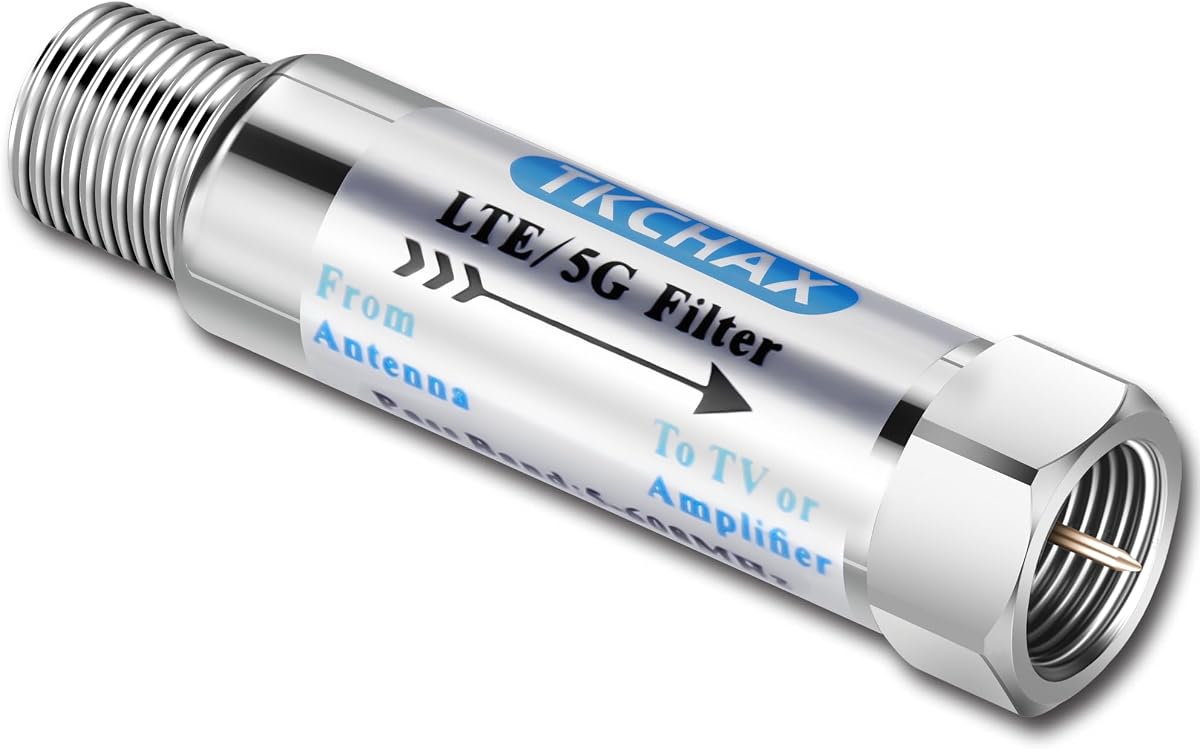
Channel Master LTE/5G Filter
4.0Editor score
Supports current US TV standards
Attenuates 618 MHz and above
Features low insertion loss
Includes built-in weather seal
Our LTE Filter for TV Antenna guide compares 10 options for reducing 4G and 5G interference, with installation, compatibility, and weather resistance levels.
An LTE filter for a TV antenna is a small coaxial accessory designed to reduce interference caused by nearby cellular transmitters. It can help stabilize over-the-air reception, particularly on UHF channels close to the 600 MHz cellular band. A good filter preserves desired television frequencies, fits standard F-type connections, and suits the indoor or outdoor location where your antenna system is installed.
We compared the ten available options by their stated frequency range, installation method, compatibility, environmental protection, and approach to blocking LTE interference. The list includes single filters, multipacks, and kits with quick-connect adapters. It also separates products with built-in sealing from those designed for exposed outdoor use, giving attention to practical details beyond the basic filtering claim.
Each review explains where the filter is most likely to help, what technical features set it apart, and where its limitations may matter. The top picks highlight the strongest combinations of filtering, construction, and installation convenience, while the remaining entries explain who may prefer each alternative. Product details and availability can change, so confirm the specifications before ordering.
4.0Editor score

4.0Editor score

3.9Editor score
This side-by-side comparison reviews all ten filters by frequency handling, connector compatibility, weather protection, package contents, and installation considerations.


The Philips LTE Filter for TV Antenna combines a clearly defined 5–608 MHz passband with TruAmp filtering intended to block unwanted 4G and 5G cellular frequencies. Its 4.0 rating reflects a generally favorable customer reception, while the product’s strongest selling point is the straightforward explanation of how it fits into a conventional antenna system. It is particularly relevant for viewers struggling with intermittent channel loss, pixelation, or reception disruption in metropolitan and suburban areas.
We may earn a commission when you buy through this link, at no additional cost to you.
Installation is uncomplicated because the filter uses an F-type coax jack and port for inline connection. It does not require tools, an external power supply, or changes to the antenna itself. Philips describes compatibility with televisions, amplified antennas, coax cables, and coax splitters, which makes the accessory flexible across indoor and outdoor arrangements. Its weatherproof design is another useful characteristic, particularly when the device must sit close to an outdoor antenna or rooftop installation.
The tradeoff is that the product information does not identify a built-in O-ring or other specific sealing mechanism. That does not negate its stated environmental protection, but it means installers should still protect the connection from standing water and make sure coax fittings are securely tightened. Also, the filter is designed to address cellular interference rather than weak signals, faulty splitters, poor cable connections, obstructed antenna placement, or other causes of reception problems.
This is an excellent general choice for anyone who wants a straightforward, well-described filter for a standard coax setup. It offers broad compatibility, a clearly stated passband, simple installation, and suitability for indoor or outdoor use without introducing a powered component into the signal path. For most TV antenna systems affected by suspected 4G or 5G interference, it is a practical place to start.
The filter allows desired frequencies from 5 to 608 MHz to pass while attenuating the cellular frequencies associated with 4G and 5G transmission. That makes it most relevant to UHF channel issues, especially when a stable antenna setup suddenly develops pixelation or dropouts near active cellular infrastructure.
Its inline F-type connection requires no power supply or extra hardware, while Philips includes U.S.-based technical support and a limited-lifetime replacement pledge. Those support provisions add confidence for buyers who may need help with placement or connection.
We may earn a commission when you buy through this link, at no additional cost to you.
The Channel Master LTE/5G Filter is the most technically detailed option in this guide. It has a 4.0 rating and is designed to pass signals through 608 MHz while attenuating 618 MHz and above, directly addressing the lower portion of the 600 MHz cellular band. Unlike a generic noise blocker, the product is explicitly framed around U.S. television standards, including Digital HDTV, NextGen TV, ATSC 1.0, and ATSC 3.0.
We may earn a commission when you buy through this link, at no additional cost to you.
Its class A RFI shielding and low insertion loss are meaningful differentiators for viewers who want to preserve signal quality while reducing interference. The built-in O-ring is especially useful for outdoor installations because it adds a specific weather-protection feature rather than relying only on a general claim of ruggedness. The filter can be used with TV antennas indoors or outdoors, making it a strong candidate for rooftop, attic, and exterior mast arrangements.
Its most important limitation is also clearly stated by the manufacturer: most television signal problems are not caused by LTE interference. Adding this filter will not correct weak station coverage, damaged coax, inadequate antenna placement, amplifier overload, or other technical faults. The product may also be more specialized than a shopper needs, making its standards-focused construction most compelling for modern ATSC systems and UHF reception problems.
For a technically informed buyer who wants explicit frequency attenuation, television-standard support, low insertion loss, and a built-in environmental seal, the Channel Master filter stands out. It is the premium choice of the group and a particularly sensible choice when the filter will be exposed to weather or installed in a system that should support future U.S. broadcast standards.
Rather than describing all cellular frequencies generically, the filter identifies a passband through 608 MHz and attenuation beginning at 618 MHz. That specificity is valuable for TV antenna buyers who understand that unwanted 600 MHz cellular energy can overlap with upper UHF television channels.
The integrated O-ring provides a visible design advantage over filters that offer only general weather resistance. It can help preserve the integrity of an outdoor connection, although the remaining coax fittings still need to be properly seated and protected.
We may earn a commission when you buy through this link, at no additional cost to you.
The Saillong 2 Pack 4G 5G LTE Filter provides two complete filters and carries a 3.9 rating. Its core specification is easy to understand: it blocks unwanted 4G and 5G cellular signals while allowing lower frequencies from 5 to 608 MHz to pass. The two-pack format is useful for a household with multiple antenna locations, a spare kept on hand, or a multi-connector setup.
We may earn a commission when you buy through this link, at no additional cost to you.
Each filter works with a TV, amplified antenna, coax cable, or coax splitter. Installation takes place inline in the existing antenna path, and no hardware or power supply is required. The stated weather-resistant construction makes the filters appropriate for indoor or outdoor antenna arrangements, although buyers planning a fully exposed installation should ensure their cable and connector joints are also protected.
The main drawback is that its product information is less technically detailed than the Channel Master and SiliconDust descriptions. It does not provide a specific cutoff figure, insertion-loss specification, or built-in sealing detail in the supplied details. The 3.9 rating also sits slightly below the strongest-rated alternatives, so customers should be comfortable with the broader category rather than expecting a highly specialized premium component.
The Saillong two-pack is a sensible budget-oriented option for shoppers who need one or two filters, want a simple installation, and have confirmed that cellular interference is affecting their television signal. It combines a clearly stated passband with weather resistance and universal-style compatibility, making it a straightforward addition to many modern antenna systems.
Including two filters adds practical flexibility that a single-filter package cannot match. The second unit can serve another coax line, replace a unit installed in a harsh location, or remain available for troubleshooting without interrupting the primary system.
Compatibility with common antennas, splitters, cables, and televisions allows the filters to fit into an existing system rather than requiring specialized equipment. Their F-type inline format also keeps installation centered on familiar coax fittings.
We may earn a commission when you buy through this link, at no additional cost to you.
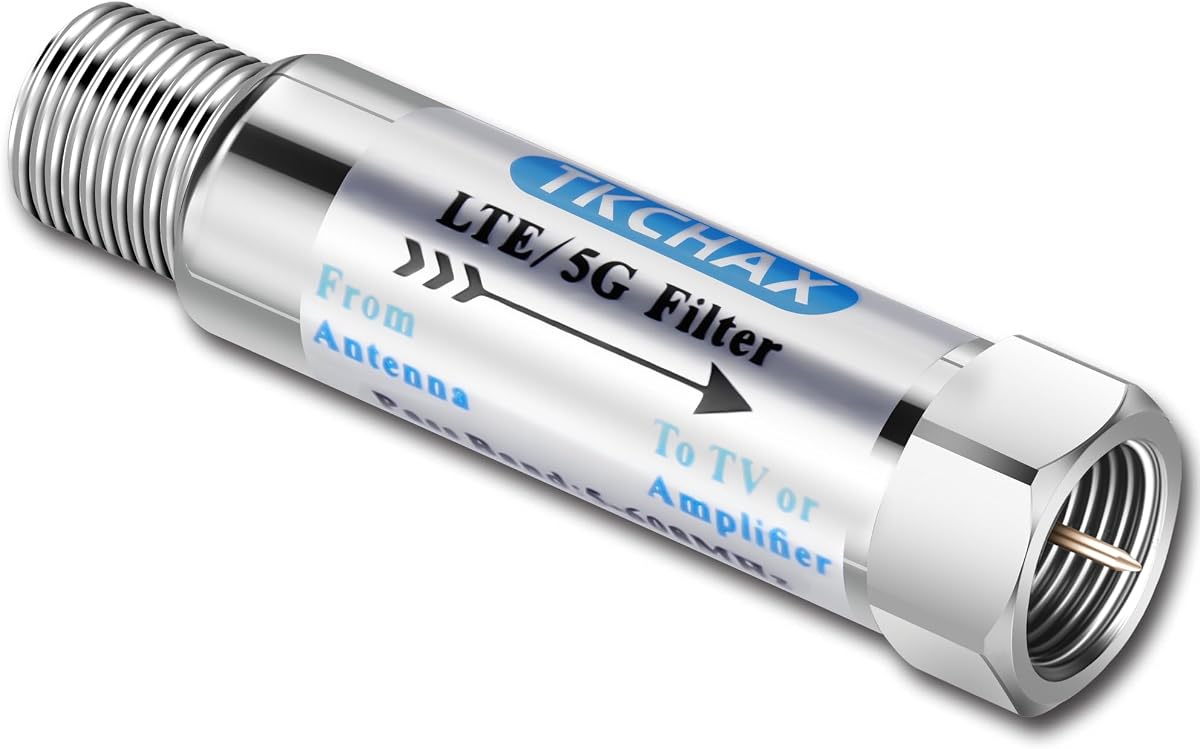
The TKCHAX LTE Filter for UHF TV Antennas is built around a specific concern: interference affecting channels 14–36, which occupy the upper UHF range from 470 to 608 MHz. Its 4.0 rating and stated 5–608 MHz passband place it squarely among filters intended to separate desired television frequencies from adjacent 600 MHz cellular energy. It is most relevant when only particular UHF channels display snow, pixelation, ghosting, or sudden dropouts.
We may earn a commission when you buy through this link, at no additional cost to you.
The product provides unusually clear guidance about when an LTE filter may help. It points to interference near cellular towers, dense urban mobile networks, and signal changes that coincide with nearby cell activity. That practical symptom-based approach helps prevent buyers from expecting the filter to solve every kind of television reception issue. Its all-metal brass and nickel construction is also positioned for compact indoor or outdoor deployment.
The primary limitation is its UHF emphasis. Although the stated passband extends down to 5 MHz, the marketed use case concentrates on channels 14–36 and upper-frequency interference. The product information also lacks a detailed insertion-loss figure or a specific built-in O-ring, so those aspects are not established by the available details. Like the other filters here, it cannot repair a weak signal, split or loose cable, poor antenna placement, or a faulty television.
This filter is most appropriate for viewers with a functioning antenna whose problem is concentrated on high-numbered UHF stations. Its detailed symptom list, metal housing, and standard F-type connections make it a focused troubleshooting tool rather than a universal antenna upgrade. It should be considered when interference patterns align with nearby cellular activity or the 600 MHz band.
A filter is more likely to be useful when the problem follows a clear pattern. The product specifically highlights pixelation on certain channels, dropouts associated with cell activity, and ghosting or duplicate images, helping shoppers distinguish cellular interference from general signal weakness.
The brass and nickel body offers a compact, weather-resistant option for both protected and exposed antenna locations. Metal construction also makes the filter easier to handle during installation than a small component with exposed plastic fittings.
We may earn a commission when you buy through this link, at no additional cost to you.
The SiliconDust LPF-608M has a 4.1 rating, making it the highest-rated product in this comparison. Its defining feature is a clearly defined operating approach: it passes television signals through 608 MHz and attenuates 618 MHz and above to block the 600 MHz LTE band introduced in 2020. That frequency-specific design makes it especially relevant to U.S. TV antenna systems experiencing interference in the upper UHF range.
We may earn a commission when you buy through this link, at no additional cost to you.
The filter is focused rather than general-purpose, which can be an advantage for informed buyers. Instead of promising broad interference reduction without technical boundaries, its product information identifies the intended cellular band and the television passband. It is designed for U.S. television reception, so buyers in regions using different broadcast systems should verify compatibility before installation.
Compared with filters that provide extensive descriptions of connectors, weather sealing, and installation, the SiliconDust listing is concise. The supplied information does not state a specific connector type, environmental rating, insertion-loss value, or included accessories. Consequently, prospective buyers should inspect the product page and existing coax arrangement to confirm that the physical fittings and installation conditions are appropriate.
This is a strong choice for users who understand the 600/608/618 MHz issue and want a focused, well-rated filter for U.S. television channels. It is especially attractive when the antenna and coax are known to work, but some upper UHF stations become unstable in the presence of cellular transmitters. Those seeking a more extensively documented, weather-sealed design may prefer the Channel Master filter instead.
The stated 608 MHz passband and 618 MHz attenuation point are the product’s strongest distinctions. This clarity helps buyers connect the filter to the specific overlap between upper UHF broadcasting and the 600 MHz cellular allocation.
The LPF-608M is most convincing as a targeted addition to an otherwise sound antenna system. It makes sense when basic station coverage is satisfactory but interference or instability occurs in a particular frequency range.
We may earn a commission when you buy through this link, at no additional cost to you.
The Saillong 1 Pack 4G 5G LTE Filter is the simplest package option in the guide. It has a 3.9 rating and uses the same core filtering approach as the company’s multipacks: unwanted 4G and 5G cellular frequencies are blocked while desired signals from 5 to 608 MHz are allowed to pass. It is a direct response to intermittent channel loss, pixelation, and reception disruption.
We may earn a commission when you buy through this link, at no additional cost to you.
The filter is compatible with televisions, amplified antennas, coax cables, and splitters. Because it installs inline and does not need an external power supply, it can be added without introducing another electrical component into the antenna system. The stated weather-resistant construction supports both indoor and outdoor use, making it suitable for an attic, exterior wall, or sheltered position near an antenna.
Its most obvious limitation is that only one filter is included. That is entirely adequate for a single TV or antenna line, but it offers less flexibility for a multi-antenna household, a replacement, or a second installation location. The supplied description also does not provide a specific environmental seal or a detailed insertion-loss specification, leaving those points to verify in current product information.
This single-pack option is best for a straightforward installation where one coax route needs filtering. It prioritizes familiar F-type connectivity, broad device compatibility, and tool-free setup without adding unnecessary parts. Buyers who want the same stated filtering characteristics but need multiple units can select the two- or three-pack versions from the same range.
A single filter is useful when the goal is to address one television or antenna feed without altering the rest of the system. Its inline format makes it straightforward to place directly between the antenna lead and the appropriate coax connection.
The stated resistance to outdoor conditions allows the same model to serve an exterior antenna arrangement or a protected indoor installation. Placement should still follow the connector and weather-protection requirements of the surrounding coax system.
We may earn a commission when you buy through this link, at no additional cost to you.
The Saillong 3 Pack 4G 5G LTE Filter offers three units with a 3.9 rating. Each filter blocks unwanted 4G and 5G LTE frequencies while passing desired signals from 5 to 608 MHz, allowing the same interference-control approach to be applied across several television or antenna connections. It is the largest of the three Saillong pack configurations shown in this guide.
We may earn a commission when you buy through this link, at no additional cost to you.
All three units use the familiar inline installation method and work with TVs, amplified antennas, coax cables, and splitters. No power supply or additional hardware is required, so a household can add the filters to separate coax runs without changing the fundamental design of its antenna system. Their stated weather resistance also permits indoor or outdoor placement, provided the connectors are properly secured.
Three units will be unnecessary for a basic installation serving one television, and the package is better suited to users with multiple antenna feeds, a distributed system, or a desire to keep replacement units available. As with the smaller Saillong packs, the supplied information does not describe a particular O-ring, connector finish, or quantified insertion loss. Its advantage is quantity and consistency rather than an advanced environmental feature.
This multipack makes the most sense for installers or households that know they will need filters in more than one place. Rather than buying identical units separately, users can install all three in a coordinated system. It retains the straightforward compatibility and no-power operation that make the range attractive, while offering the most flexibility of Saillong’s one-, two-, and three-filter packages.
Three filters can serve separate televisions, multiple antennas, or a combination of active and spare locations. This is useful for households with a more complex distribution system or for anyone who prefers to keep replacement components on hand.
Using the same filter model at several points can make system behavior more consistent. Each unit provides the stated 5–608 MHz passband and can be placed inline according to the particular coax route that experiences interference.
We may earn a commission when you buy through this link, at no additional cost to you.
The Saillong 2 Pcs LTE Filter with Coaxial Cable Quick Connector has a 4.2 rating, the highest among the ten products. Its distinctive package combines two LTE filters with two F-type male-to-female push-on coax adapters. The filters block unwanted 4G and 5G LTE frequencies while allowing desired signals from 5 to 608 MHz through, and the adapters are intended to simplify connection to the existing antenna system.
We may earn a commission when you buy through this link, at no additional cost to you.
The installation proposition is unusually convenient. Instead of relying exclusively on conventional threaded F fittings, the included adapters allow a quick push-on connection without additional tools. The product listing says users do not need to twist or screw the connectors, which can make the filter easier to add around tight spaces, in an RV, or in a temporary arrangement. Compatibility is also broad, covering televisions, amplified antennas, coax splitters, satellite receivers, modems, and RV setups.
The tradeoff is that the kit contains more parts than a standard single-filter package. Buyers must confirm that push-on fittings suit their equipment and ensure each connector is fully engaged, because an inadequately seated connection can cause its own reception problems. Although the components are described as weather resistant and corrosion resistant, an exposed installation still depends on careful sealing and strain relief.
This is the strongest option for a viewer who values installation speed and convenience. The included adapters remove much of the uncertainty associated with joining different coax fitting styles, while the two filters provide enough units for a small system or a spare. It combines a strong rating with broad compatibility and is particularly compelling for RV, trailer, and flexible indoor or outdoor antenna arrangements.
The included male-to-female adapters give users an alternative to conventional threaded connections. Their push-on design is intended to speed installation and avoid tools, especially where access is limited or the antenna must be assembled in a confined area.
RV and trailer users often value connectors that are easy to assemble and disassemble. The kit’s stated compatibility with RV systems, satellites, modems, antennas, and splitters makes it a broader coax accessory than a television-only filter.
We may earn a commission when you buy through this link, at no additional cost to you.
The 2Pcs LTE 5G Filter for TV Antennas provides two compact filters and holds a 4.0 rating. It is designed to reduce 4G and 5G interference that can disrupt over-the-air digital television reception. Unlike products that list a precise upper passband, its supplied description emphasizes modern 5G filtering without detailing the exact attenuation point or an insertion-loss measurement.
We may earn a commission when you buy through this link, at no additional cost to you.
Construction is a central selling point. The shell is described as all metal with nickel plating, and the filter chip is built into the housing. That design is presented as durable and less susceptible to damage than a purely plastic component. The filters work with televisions, amplified antennas, coax cables, and splitters, making them suitable for common residential antenna systems in urban and suburban locations with active cellular networks.
The filter installs inline through F-type coax connections and requires no power supply or hardware. Its stated weather-resistant design supports indoor and outdoor use, although the lack of a more specific seal description means exposed installations should be checked carefully. The two-pack format is also less flexible than the three-pack alternative, though it is still useful for two routes or a spare unit.
This product is a good match for buyers who prioritize metal construction and need two filters but do not require quick-connect adapters. It is best suited to a conventional F-type coax system where simple inline placement and no external power are the main installation priorities. Viewers wanting exact cutoff figures may prefer a filter with more detailed frequency specifications.
The nickel-plated metal shell is a meaningful construction feature for antenna hardware. It is intended to provide a durable enclosure for the built-in filter chip and can suit both protected indoor and exterior installations.
The two included filters can be assigned to different televisions, antennas, or coax runs. One can also remain as a replacement, which is useful because outdoor components are more exposed to handling and environmental wear.
We may earn a commission when you buy through this link, at no additional cost to you.
The 1Pcs LTE 5G Filter for TV Antennas is the most straightforward single-filter product in the final group. Its 4.0 rating indicates generally positive customer reception, while its stated purpose is to reduce 4G and 5G interference and support clearer digital television channels. The filter is compact, uses an all-metal nickel-plated shell, and contains a built-in filter chip designed for continued use.
We may earn a commission when you buy through this link, at no additional cost to you.
It works with a TV, amplified antenna, coax cable, or coax splitter, so it can be incorporated into a residential system without specialized signal equipment. Installation is inline through the F-type coax connection, and neither an external power supply nor additional hardware is required. The product also describes itself as weather resistant for both indoor and outdoor antenna installations.
Its main limitation is the limited technical detail in the supplied product information. No specific passband endpoint, attenuation threshold, insertion-loss figure, or built-in environmental seal is stated. That makes it difficult to compare its raw filtering precision with the SiliconDust, Channel Master, and TKCHAX options. As a single-filter package, it also offers no spare for multi-route systems.
This is a practical choice for a basic TV antenna setup that has one coax connection to address. Its compact metal body, familiar connectors, and no-power operation cover the essential requirements of an LTE filter without adding adapters or extra components. It is best suited to straightforward residential use where the primary goal is to test whether cellular interference is contributing to unstable reception.
The nickel-plated metal shell gives the filter a straightforward, durable appearance. Its compact form is convenient for placing close to a television, inside an antenna housing, or within a protected outdoor connection.
With one filter and standard F-type connections, the product minimizes the number of parts in the signal path. That can be attractive for users who want a basic inline accessory rather than a full adapter kit.
We may earn a commission when you buy through this link, at no additional cost to you.
The right LTE filter depends on the television channels affected, the type of interference, the connectors in your system, and whether the unit will be exposed to weather. These factors help separate a useful targeted fix from an accessory that will have little effect on other reception problems.
Before choosing a filter, observe which channels fail and when the problem occurs. Pixelation, snow, ghosting, duplicated images, and sudden dropouts confined to upper UHF channels may point toward cellular interference, especially near towers or in dense urban and suburban areas. Problems affecting every channel, weak station coverage, or consistent failure regardless of location are more likely to involve antenna placement, cable faults, splitters, amplifiers, or television settings. A filter is most valuable when the symptom pattern aligns with 4G or 5G transmission activity.
In the United States, the upper television frequencies require attention because the 600 MHz cellular band can overlap with upper UHF broadcasting. A filter that passes signals through 608 MHz and attenuates 618 MHz and above is specifically aligned with the upper edge of the U.S. TV spectrum. Products described only as 4G or 5G filters offer less detail, so buyers should confirm that the unit is designed for U.S. broadcast channels and the 600 MHz cellular band rather than another regional allocation.
Most TV antennas use F-type coax connections, but adapters, splitters, and older installations can create mismatches. Confirm that the filter has the correct male or female connector orientation for the planned position. A filter with quick-connect adapters may be easier to install in a tight space, while conventional threaded fittings can provide a familiar, secure connection. Incorrectly seated push-on fittings or poorly tightened threaded fittings can create their own signal problems, so connector quality and engagement deserve attention.
An outdoor filter must tolerate moisture, temperature changes, and prolonged exposure. A weather-resistant housing is helpful, while a built-in O-ring offers a more specific indication that the manufacturer addressed the connection itself. Weather protection does not remove the need to protect the entire joint: use suitable coax sealant, keep connectors properly seated, and avoid leaving the filter where pooled water can collect. Indoor attic or wall installations generally have less demanding environmental requirements.
A good filter should remove unwanted cellular energy without needlessly degrading the television channels you want to receive. Low insertion loss, shielding, and explicit support for ATSC 1.0, ATSC 3.0, Digital HDTV, and NextGen TV are useful indicators of a more considered design. The supplied information does not provide comparable loss measurements for every option, so it is prudent to review current specifications and avoid selecting a filter solely on its ability to block signals.
A single filter is usually enough for one television feed, while multipacks make sense for multiple antennas, distributed coax runs, or keeping a replacement on hand. Kits with quick-connect adapters are useful for RV installations, temporary arrangements, and users who do not want to work with conventional threaded fittings. Before choosing a multipack, count the actual antenna lines that need filtering and avoid installing unnecessary components in the signal path.
The strongest selection is one that can be placed inline without modifying the rest of the antenna system. All ten products described here use an F-type inline approach and require no external power supply, which simplifies setup and avoids adding another electrical connection. A filter is normally installed near the antenna or at a suitable point before the signal splits. The television and antenna should be powered down during installation, and every connector should be firmly attached before signal testing.
An LTE filter addresses one category of interference. It cannot create coverage where no station signal exists, repair a damaged conductor, solve an overloaded amplifier, or correct a defective television tuner. It also may not change reception if the problem is caused by electrical noise, adjacent-channel interference, or a poorly aimed antenna. If symptoms remain unchanged after the filter is installed, further system troubleshooting is more useful than repeatedly adding filters.
Begin by identifying the coax route that serves the affected television and temporarily disconnect the television or receiver. Decide where the filter will sit in line, keeping enough space around the connectors to attach them by hand. If the antenna uses a mast, roof mount, or outdoor junction box, select a position that will not place the filter where cables are repeatedly flexed or where water collects.
Connect the appropriate side of the filter to the antenna-side coax and the opposite side to the television-side cable. For conventional F-type fittings, thread the connector carefully by hand and tighten only as needed for a secure seal. For push-on adapters, make sure the connector is fully pushed into place and that no conductor is visible or pinched. Keep the filter aligned with the cable rather than bending the coax sharply at the connector.
After reconnecting the television, complete a channel scan and compare reception with the previous behavior. Observe both the previously affected UHF channels and the channels that were already working well. If the filter does not resolve the issue, check the antenna position, cable integrity, splitter connections, amplifier settings, and television signal information before concluding that the filter is faulty. Outdoor filters should be inspected periodically for looseness, corrosion, water intrusion, and damaged sealant.
No. An LTE filter only reduces interference caused by 4G, 5G, or 600 MHz cellular transmissions. It cannot correct weak station coverage, obstructed antenna placement, damaged coax, faulty splitters, amplifier overload, or a television tuner problem. It is most useful when particular channels are unstable and the rest of the antenna system is functioning normally.
Not necessarily. If your television reception is stable and you do not live near cellular transmitters or high-density mobile infrastructure, a filter may not be necessary. Adding one is more compelling when upper UHF channels show pixelation, snow, ghosting, or dropouts that coincide with nearby cell activity or appear after cellular network changes.
Install it inline between the antenna and the television or receiver, usually close to the antenna or at the point where the affected coax run enters the building. Avoid placing it where the cable will be sharply bent, pulled, or exposed to pooling water. Each filter should be installed on the particular signal path that experiences interference.
None of the ten filters in this guide requires an external power supply or batteries. They are passive coaxial components that filter signals as they pass through. This makes them relatively simple to install, although the television, antenna amplifier, and connected equipment still require their normal power.
Most products in this guide are described as weather resistant or weatherproof for indoor and outdoor use. The Channel Master model specifically includes a built-in O-ring, while the others emphasize resistant metal or compact construction. For any exterior installation, properly seat the connectors and use appropriate weather protection around the entire joint.
A 5–608 MHz passband allows the desired television frequencies used by the filter to continue through, while signals at 618 MHz and above are attenuated. That boundary is designed to address interference from the lower edge of the 600 MHz cellular band. Products with more exact specifications make it easier to verify that the filter is designed for your region and broadcast system.
The appropriate position depends on the system design, but a common approach is to place the filter close to the antenna or antenna-side of the amplifier to remove cellular energy before it enters the distribution system. If the amplifier is already experiencing overload or the signal chain is complex, review the amplifier documentation because improper ordering can affect the result.
Run a fresh channel scan after installation and compare the affected stations with their previous condition. Improvement may appear as fewer frozen frames, less pixelation, clearer pictures, or more stable reception on upper UHF channels. If nothing changes, the original problem may not be LTE-related, so continue checking the antenna, cable connections, amplifier, splitter, and television settings.
The Philips LTE Filter is the strongest all-around choice for its clear 5–608 MHz filtering specification, broad compatibility, passive installation, and stated suitability for indoor and outdoor use. The Channel Master LTE/5G Filter stands out for detailed U.S. television-standard support, low insertion loss, precise 618 MHz attenuation, and a built-in O-ring. The Saillong two-pack is a compelling practical choice when a viewer needs multiple filters or wants a straightforward, weather-resistant model.
Prioritize a problem that actually resembles cellular interference before choosing any model. Pay close attention to the U.S. 600/608/618 MHz frequency details, F-type connector compatibility, outdoor weather protection, and the amount of signal loss associated with the filter. The Saillong Quick Connect Kit is worth considering for RV users or anyone who wants fast push-on connections, while the SiliconDust LPF-608M appeals to buyers who prefer a focused filter with explicit cutoff frequencies.
Finally, confirm the current specifications, included components, compatibility, and product details before purchasing, as manufacturer information and availability can change. Most importantly, remember that a filter is an interference-control accessory rather than a substitute for a properly positioned antenna and sound coax system. A measured approach can prevent unnecessary purchases and make troubleshooting much more effective.