
WisaKey Electric Lunch Box
4.5Editor score
Four voltage settings
Leak-resistant seal
Dishwasher-safe container
Our guide compares the best Office or Jobsite Microwave options for offices, trucks, crews, and break rooms, covering power, capacity, portability, and
Heating lunch at work is easy when the right appliance matches your location, power access, and schedule. An office may have a reliable kitchenette, while truck drivers and jobsite crews often need cordless or vehicle-powered alternatives. This guide compares conventional countertop microwaves with portable heated lunch boxes designed for commutes, remote work, and demanding schedules.
The products were evaluated using the supplied specifications, including capacity, output power, heating methods, power-source options, safety controls, dimensions, and portability features. The list covers full-size and compact countertop models as well as conduction-based lunch warmers. It also distinguishes true microwave ovens from devices that heat food without microwave radiation, helping readers choose the appropriate appliance for a workplace.
Each review highlights the product's most useful strengths, practical limitations, and ideal buyer. The top three recommendations cover a flexible budget lunch warmer, a polished daily-use model, and a premium cordless option. Product features and availability can change over time, and prices fluctuate, so readers should confirm current listings, dimensions, and workplace power requirements before purchasing.
4.5Editor score

4.7Editor score

4.3Editor score
The comparison below places countertop microwaves, compact models, and portable lunch warmers side by side. Pay close attention to whether you need microwave cooking, continuous food warming, vehicle power, or complete cordless operation.




The WisaKey Electric Lunch Box is a portable conduction-style food warmer rated 4.5 stars by customers. It is built for people who want one heated-lunch solution that can follow them between an office, vehicle, job site, home, or travel setting. Its most unusual strength is the four-setting voltage support: 12V, 24V, 110V, and 220V cover many common work and travel environments.
We may earn a commission when you buy through this link, at no additional cost to you.
The removable 304 stainless steel container holds 1.5 liters, enough for a substantial adult meal, while the food-grade PP exterior is designed to resist staining and absorbing odors. A folding handle makes the lid easier to carry, and the installed seal gasket helps limit spills when the lunch box is bumped. The included lunch bag adds a practical layer of portability and storage, while the dishwasher-safe insert simplifies cleanup after soups, pasta, rice, or other lunches.
This is not a microwave, and its warming behavior should not be described as microwave reheating. It is better understood as an electric food warmer that works with a range of power sources. Heat-up time can vary with food temperature, portion size, and power input, so it is not ideal when someone needs a meal instantly. Cleaning also requires care: the inner container and lid can go in the dishwasher, but the external body should not be washed directly, and water should never be added to the heating base.
The WisaKey is an excellent value-oriented choice for budget-conscious workers who regularly eat away from a kitchenette. It is especially suitable for truck drivers, office employees, construction workers, and commuters who can access one of the supported voltage inputs. Choose it over a countertop microwave when portability and power flexibility matter more than rapid reheating or the ability to cook from frozen.
The four voltage settings are the defining advantage for a mobile lunch routine. Instead of being tied to one wall outlet or vehicle socket, the lunch box can accommodate common 12V and 24V vehicle systems as well as 110V and 220V wall power. That makes it a more adaptable tool for people whose location changes from one workday to the next.
A removable 304 stainless steel container provides a practical interior surface and lifts away for serving. The specified container and tight-seal lid are dishwasher safe on the top rack, which helps busy users maintain a cleaner lunch routine without hand-washing the entire appliance.
We may earn a commission when you buy through this link, at no additional cost to you.
The MEGAWISE Electric Lunch Box holds a 4.7 rating, the highest customer rating in this group. It combines an 80-watt heating system, a removable 1.5-liter stainless steel tray, and a thoughtfully assembled accessory set. The result is a strong all-around choice for an employee or traveler who wants warm leftovers, rice, or pasta without relying on a shared break-room microwave.
We may earn a commission when you buy through this link, at no additional cost to you.
Its power flexibility is straightforward. A 110V wall cord supports use at home, in an office, or at a powered jobsite, while the 12V/24V cord serves compatible cars and trucks. The removable 304 stainless steel tray holds an adult portion and lifts from the base for serving and cleaning. The package also includes a carry bag, utensils, and a small side container, reducing the need to pack separate items for every meal.
Transport details are thoughtfully addressed with side clips, a fitted lid, and a handle. The manufacturer recommends keeping the box upright to reduce accidental spills, so users should avoid laying it on its side during the commute. The 80-watt system will not heat as rapidly as a 700-watt or 1,000-watt microwave, and it does not provide the cooking functions of a countertop oven.
This is the most balanced recommendation in the guide for someone who wants a dedicated work-lunch device rather than another appliance for a kitchenette. It suits office workers, drivers, and field employees who regularly carry a meal and can plug in at their destination. Its accessory set, high rating, useful capacity, and flexible cords make it an especially easy recommendation for a daily routine.
The carry bag, utensils, and small side container make the MEGAWISE more useful than a basic warmer alone. A user can pack a main dish and a smaller accompaniment in one coordinated setup, which is convenient for commuters who do not want to carry a separate knife, fork, and dish every day.
For employees with an unpredictable lunch window, keeping a meal in the office and heating it later can be more reliable than waiting in line. The removable tray and dedicated heating base provide a practical way to warm a prepared lunch at a desk or in a private work area where permitted.
We may earn a commission when you buy through this link, at no additional cost to you.
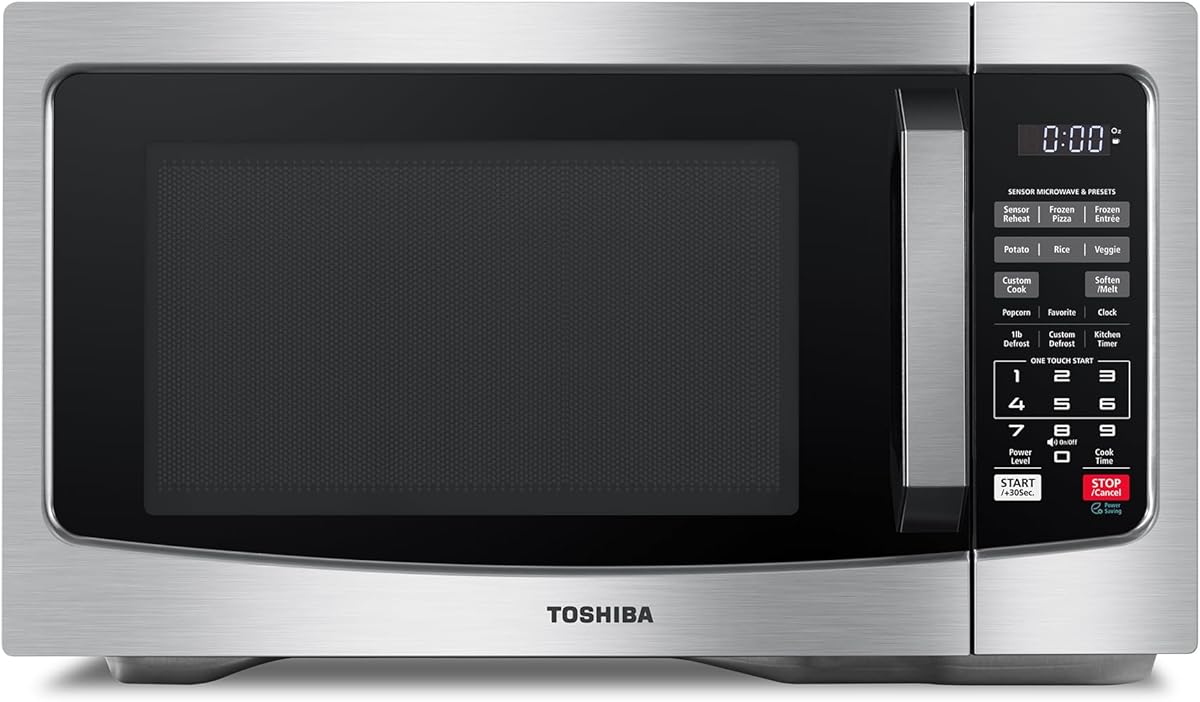
The stainless-steel TOSHIBA countertop microwave earns a 4.4 rating and brings genuine microwave performance to an office or break room. Its 1.2-cubic-foot cavity and 1,000-watt output distinguish it from the small reheating-only units in this list. It is a sensible option for a shared kitchen, apartment break area, or stationary onsite office where quick, flexible reheating is the priority.
We may earn a commission when you buy through this link, at no additional cost to you.
Smart Sensor Technology automatically adjusts time and power according to food humidity, reducing the need to guess how long leftovers or vegetables require. Six preset menus cover common preparations such as pizza, vegetables, and sensor reheating. Ten power levels offer finer control for tasks ranging from gentle warming to full-power reheating, while the clock, kitchen timer, defrost-by-weight, defrost-by-time, and one-touch start functions add useful flexibility.
The physical footprint is substantial. Its external dimensions are 20.6 by 14.6 by 11.8 inches, and the glass turntable measures 12.4 inches. It therefore needs more counter space than the compact 0.7-cubic-foot models, and it cannot be carried to a remote worksite. It also needs a grounded countertop location rather than a vehicle outlet or battery pack.
This TOSHIBA is best for buyers who want a conventional microwave with more capacity and power than a mini model. It can handle larger plates and provide dependable sensor-assisted reheating, making it suitable for an office break room where a microwave is used throughout the day. It is not the right tool for a truck driver without access to a wall outlet, but it is a strong fixed-location choice.
Automatic adjustment based on humidity is particularly helpful for everyday leftovers, which can vary significantly in moisture. The feature reduces guesswork, although users should still stir denser foods midway and verify the center temperature when appropriate.
A 1.2-cubic-foot interior and 12.4-inch turntable provide more room than compact office microwaves. That makes the appliance better suited to larger dinner plates or meal containers, provided the counter and ventilation area can accommodate its 20.6-inch width.
We may earn a commission when you buy through this link, at no additional cost to you.
The BLACK+DECKER 1.1-cubic-foot microwave combines a 1,000-watt output with familiar, accessible controls, making it a practical fixed-location option for an office kitchen. Its 4.2 rating is solid, though it trails the higher-rated portable warmers and the comparable Toshiba models. The appliance focuses on straightforward reheating and everyday cooking rather than portability.
We may earn a commission when you buy through this link, at no additional cost to you.
Pre-programmed buttons cover popcorn, potatoes, pizza, frozen vegetables, beverages, and dinner plates. Ten power settings, a clock, a kitchen timer, and 30-second express cooking give users both shortcut and manual control. The large LED digital display should be easy to read in a busy break room, while the interior light, removable 12.4-inch glass turntable, and push-button door release support everyday operation.
Its 20.6 by 14.8 by 11.8-inch dimensions require more counter space than a 0.7-cubic-foot unit. The stainless-steel door frame and black enclosure create a conventional appliance look that can blend into a practical break-room setup. As with any countertop microwave, installation near wall edges should allow for ventilation, and the unit should remain connected to a suitable outlet during use.
This model is a good match for a break room, home office kitchenette, or other stationary area that needs a little more power than a compact 700-watt microwave. It may suit a workplace that values familiar direct-access buttons and a clear display. It is less suitable for mobile work, where carrying and powering the appliance would be inconvenient.
Six dedicated food programs reduce the need to memorize timing for common items. The one-touch buttons are especially helpful for office users who want quick reheating without navigating a long menu before a short lunch break.
The interior light makes it easier to monitor food, while the child safety lock provides an added layer of protection in a shared family or workplace environment. A push-button release also makes the door mechanism straightforward to operate.
We may earn a commission when you buy through this link, at no additional cost to you.
The TaskStar Heated Lunch Box is the most advanced mobile option in the guide, with a 4.3 rating and a 100-watt cordless heating system. Its 12,000mAh rechargeable battery is designed to support two full heating cycles per charge, a useful specification for long shifts, extended drives, and worksites where finding an outlet at mealtime can be difficult.
We may earn a commission when you buy through this link, at no additional cost to you.
Scheduling is the standout feature. Users can set heating in advance so a meal is ready around a planned break rather than requiring attention at the moment it is needed. Heat, Warm, Scheduled, Hot Food, and Cold Food modes broaden the use cases beyond simply reheating leftovers, including keeping prepared food warm and accommodating different meal types. The manufacturer specifically emphasizes low-noise operation, which is useful in offices, break rooms, and libraries.
The sealed 1.2-liter container is designed to prevent spills inside a backpack or vehicle. A removable 304 stainless steel tray, divider, cable, and insulated bag are included, and the tray is dishwasher safe. The battery does add weight and requires periodic charging, while the 100-watt system will take longer than a full-size microwave. It also cannot cook frozen food in the way a microwave with defrost and sensor programs can.
TaskStar is best for people who need a genuinely cordless routine: truck drivers, commuters, field technicians, and construction workers moving between locations. It is also useful for an employee who wants to schedule lunch heating before a meeting. Its premium feature set justifies consideration when freedom from outlets and advance timing are more important than the lowest purchase cost.
Programmed heating is particularly valuable when a worker cannot stop the moment food is ready. Setting the cycle in advance creates a more predictable lunch break, particularly for drivers whose schedules are controlled by delivery windows or jobsite tasks.
The large rechargeable battery removes the need to remain near a wall or vehicle outlet. The stated two-heating-cycle capacity and included original adapter make the product more practical for extended shifts, though actual runtime can vary according to the selected mode and operating conditions.
We may earn a commission when you buy through this link, at no additional cost to you.
The COMFEE 0.7-cubic-foot microwave is a compact 700-watt option for an office kitchenette, dorm, or other space with limited counter room. Its 4.4 rating reflects a broadly positive customer reception, while the mute function and ECO mode distinguish it from basic compact models. It is designed primarily for reheating and simple meals rather than high-volume cooking.
We may earn a commission when you buy through this link, at no additional cost to you.
One-touch express cooking offers direct starts at one through six minutes, and a +30-second control makes small adjustments convenient. Automatic programs cover popcorn, potatoes, pizza, frozen vegetables, beverages, and reheating. Defrosting can be performed by weight or time, giving users two approaches for frozen ingredients. The two-step child lock adds a more involved release procedure intended to reduce accidental activation.
The 700-watt output is adequate for ordinary leftovers, drinks, and prepared meals, but it is lower than the 1,000-watt output of the Toshiba and BLACK+DECKER 1.1- or 1.2-cubic-foot models. The smaller cavity may also limit the size of the plate or container. The supplied information does not list external dimensions, so buyers should check the current product page and measure available counter space before ordering.
COMFEE is best for buyers who value a small footprint, quiet operation, and dedicated shortcuts over maximum cooking power. It works particularly well in a compact office pantry where users primarily need to reheat lunches or prepare quick drinks. Those expecting large plates or frequent frozen-food cooking would receive more capability from a higher-capacity microwave.
The mute control turns off audible beeps, which is valuable in an open office, library, or shared kitchen where an alert could be disruptive. It can make routine reheating feel more considerate without changing the cooking time or power level.
ECO mode is designed to minimize standby power by 50 percent. For an appliance that may remain plugged in throughout the workday, that feature can be helpful, although users should always follow the manual for placement and standby instructions.
We may earn a commission when you buy through this link, at no additional cost to you.
The Aotto Portable Oven carries a 4.6 rating and provides one of the simplest ways to warm meals without a conventional microwave. It uses conduction rather than microwave energy, making it suitable for anyone who wants to bring food in a compatible container rather than use a proprietary lunch box. Its ability to work from 12V, 24V, or 110V power is a major advantage for mobile users.
We may earn a commission when you buy through this link, at no additional cost to you.
The automatic PTC heating system provides consistent warming without buttons, timers, or stirring. The manufacturer states that the food should remain warm whether the user returns after one hour or several, although exact results depend on food type, volume, starting temperature, and the available power source. Refrigerated food requires additional heating time, and 12V operation is slower than a stronger source.
Users can use flat-bottomed glass, ceramic, metal, stainless-steel, or foil containers. Heat-resistant plastic may also be used if rated to 257°F. Containers must fit within 9.76 by 7.01 by 3.94 inches, and the containers shown in product imagery are not included. Because the appliance is a conduction warmer rather than a microwave, it is best for prepared meals, sides, and reheating—not full microwave cooking.
Aotto is a strong choice for commuters, drivers, travelers, and office workers who already own suitable food containers. The collapsible shape, sturdy handle, and shoulder strap make it easy to pack. It also works at home, although a traditional microwave remains faster for some tasks. Buyers who value reusable containers and flexible power will appreciate this design.
Supporting several common container materials makes the Aotto more flexible than lunch boxes with a fixed stainless-steel insert. Users can choose a container that matches their meal and storage needs, as long as it has a flat bottom, is heat compatible, and falls within the stated size limit.
The PTC conduction plate is controlled automatically, eliminating timer-setting and stirring prompts. It is best suited to keeping prepared food warm or reheating a meal gradually, and it should not be confused with the more powerful, rapid heating of a 700-watt or 1,000-watt microwave.
We may earn a commission when you buy through this link, at no additional cost to you.
The Chefman 0.7-cubic-foot microwave combines 700 watts of power with a dense set of everyday controls. Its 4.3 rating makes it a credible compact option for a small office, apartment, dorm, or break area. Unlike many basic mini microwaves, it provides six one-touch presets, ten power levels, a child safety lock, ECO mode, and a mute button.
We may earn a commission when you buy through this link, at no additional cost to you.
Number-key express cooking allows users to set a one-minute interval quickly, while +30 seconds adds time without restarting the cycle. Presets cover popcorn, pizza, beverages, vegetables, potatoes, and leftovers. The child safety lock is integrated into the handle release, and the audio control silences beeps for quieter operation. These details make the unit practical in shared or family spaces where convenience and access control matter.
At 0.7 cubic feet, the internal capacity is smaller than the full-size models in the list, and 700 watts is modest compared with 1,000-watt alternatives. It is therefore more appropriate for reheating individual meals than preparing larger dishes. The black exterior wipes clean with a damp cloth, and the glass turntable is top-rack dishwasher safe, helping simplify maintenance after daily use.
Chefman is best for a user who wants more than a bare-bones mini microwave but has limited counter space. It suits small break rooms and residential work areas where one person primarily needs quick lunches. Its one-year assurance and cETL approval add reassurance, but buyers should still follow all operating and ventilation instructions.
The six presets cover many workday staples, while direct number-key entry makes a simple reheat even faster. This combination offers a good balance between one-touch convenience and manual control for unusual portions.
The mute button and handle-mounted child safety lock address two different shared-space concerns. Muting prevents distracting alerts, while the safety lock reduces the chance that the appliance will be started unintentionally by someone who cannot operate the release.
We may earn a commission when you buy through this link, at no additional cost to you.
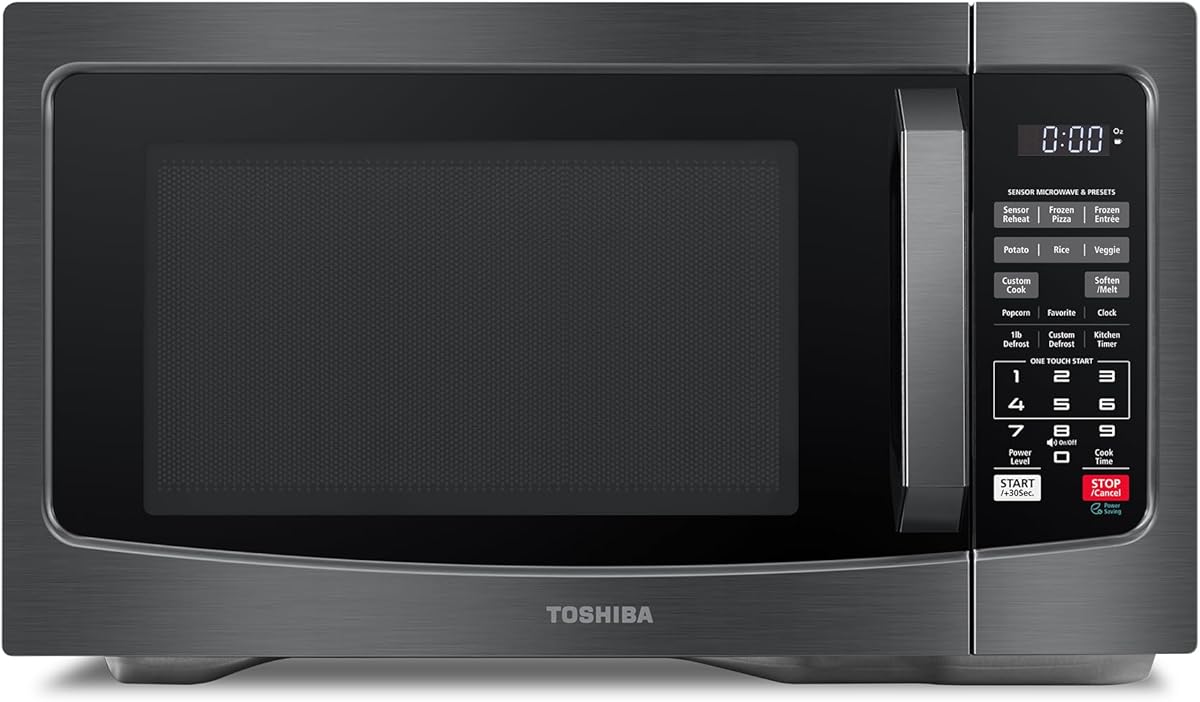
The black TOSHIBA 1.2-cubic-foot microwave offers the same strong core performance as the stainless-steel version, including 1,000 watts of output and smart sensor cooking. It earns a 4.4 rating and is a good fit for an office or break room that prefers a dark appliance finish. The 1.2-cubic-foot cavity gives it more room than most compact models.
We may earn a commission when you buy through this link, at no additional cost to you.
Sensor cooking adjusts time and power according to food humidity, while six preset menus cover popular foods such as pizza, vegetables, and reheating. Ten power levels allow careful control over less intense tasks. The clock and kitchen timer, defrost by weight, defrost by time, and one-touch starts from one to six minutes make the unit versatile for both reheating and basic preparation.
The appliance measures 20.6 by 14.6 by 11.8 inches and includes a 12.4-inch glass turntable. Its size is an important consideration for a compact kitchenette, though the larger cavity can accommodate more substantial dishes than the 0.7-cubic-foot models. It remains a stationary appliance and cannot be powered from a vehicle or used as a portable lunch warmer.
This black TOSHIBA is a strong option for a fixed office kitchen where capacity and power matter more than portability. It is especially attractive to buyers who want sensor-assisted reheating and multiple power levels without moving up to a very large oven. A buyer with very little counter space should instead consider one of the 0.7-cubic-foot models.
Humidity-based sensor cooking is valuable in a shared microwave because users cannot always rely on someone else's timing judgment. It can help produce more consistent results across leftovers, vegetables, and other foods with different moisture levels.
The 1.2-cubic-foot interior is relatively generous for a microwave, while the listed dimensions remain manageable for most countertops. It offers a useful middle ground between a very small office unit and a large residential oven.
We may earn a commission when you buy through this link, at no additional cost to you.
The BLACK+DECKER 0.7-cubic-foot microwave is designed for offices, apartments, dorms, and other locations where counter space is more constrained than cooking capacity. It has a 4.4 rating and measures only 17.1 by 12.3 by 9.5 inches, making it one of the more compact conventional options in the comparison.
We may earn a commission when you buy through this link, at no additional cost to you.
One-touch presets cover popcorn, potatoes, pizza, frozen vegetables, beverages, and dinner-plate reheating. A 700-watt output and ten power levels support routine meal preparation, while express cooking provides shortcut access. Multi-stage cooking lets the appliance move sequentially between stages, such as defrosting and reheating, without requiring the user to manage each stage manually.
Despite its compact exterior, the product is described as able to accommodate standard dinner plates, although users with unusually large dishes should verify fit before purchase. The 0.7-cubic-foot cavity and 700-watt motor are less capable than full-size 1,000-watt models. The fingerprint-resistant black finish is a practical choice for a frequently touched public appliance because it should show fewer distracting marks.
This microwave is best for a small kitchenette where employees mainly reheat lunches, beverages, and individual portions. Its multi-stage programming adds useful flexibility for frozen meals, while the short footprint helps preserve counter space. Buyers seeking large-batch reheating, larger plates, or faster cooking should consider a higher-capacity model instead.
The 17.1-inch length is one of the most useful features for a constrained office pantry. It leaves more room for a coffee maker, toaster, or supplies nearby, while still providing an actual turntable-style microwave rather than a very small specialized reheater.
Multi-stage cooking removes the need to remember which steps a frozen meal requires. It can move from a defrost stage to a reheat stage automatically, which is useful for users preparing packaged meals during a limited lunch break.
We may earn a commission when you buy through this link, at no additional cost to you.
The best appliance depends first on where it will be used and how food will be transported. Power availability, capacity, cooking method, cleanup, safety, and noise are the most important factors to evaluate before choosing.
A true microwave uses electromagnetic energy to heat food and provides rapid reheating, cooking presets, defrosting, and adjustable power. A conduction lunch warmer transfers heat from a plate to a food container, which works well for keeping prepared meals warm but generally takes longer and does not provide equivalent cooking or defrosting functions. Choose a microwave for a fixed break room or kitchenette. Choose a conduction warmer for mobile meals, especially when the goal is carrying a hot lunch to work or a jobsite.
In short, pick a microwave for speed and versatility, and pick a food warmer for portability and gradual reheating.
A countertop microwave normally requires a standard wall outlet, while portable lunch warmers may support 12V vehicle power, 110V wall power, or a rechargeable battery. Verify whether the jobsite has reliable electrical service and whether vehicle sockets match the included cord. Cordless operation offers maximum freedom, but it introduces battery charging and may provide lower heating power than a wall-connected model.
Match the power system to the actual work environment rather than simply choosing the largest advertised wattage.
Countertop capacity ranges from 0.7 cubic feet in the most compact models to 1.2 cubic feet in the larger units. A 0.7-cubic-foot cavity is generally appropriate for individual lunches and standard dinner plates, while 1.1 or 1.2 cubic feet offers more room for larger containers. Portable lunch boxes usually specify capacity in liters rather than cubic feet, so compare portion needs carefully and check the physical dimensions before ordering.
Choose enough space for your normal meal container, but avoid purchasing a large oven for a very small counter.
Microwave output power strongly influences reheating speed. The 1,000-watt models provide the most power in this group, while the 700-watt units are still suitable for ordinary leftovers and drinks. Portable warmers operate at lower wattages and are better for maintaining warmth over time. Consider how long your break lasts, how densely packed your food is, and whether the food comes directly from a refrigerator or was already close to serving temperature.
Higher microwave wattage favors quick reheating, while a warmer's gradual approach favors scheduled, unattended warming.
Anyone carrying food across a worksite or in a vehicle should consider handle design, closure security, and container shape. Side clips, fitted lids, folding handles, and sealed gaskets can reduce accidental movement and liquid leakage. Portable convection or conduction systems should generally remain upright for best results. Look for an insulated carry bag if the lunch must remain warm during a long commute or between shifts.
Favor a secure upright design over the smallest possible package when your route includes stairs, uneven ground, or frequent vehicle movement.
One-touch presets, express controls, defrost modes, and power-level settings make a microwave easier to use during a short break. Sensor cooking can improve consistency by adjusting for humidity. Portable lunch boxes may instead emphasize scheduled heating, automatic temperature control, and keep-warm modes. The best interface is the one that matches the user's routine: fast manual entry is useful for varied leftovers, while scheduling is valuable for a predictable lunch hour.
Choose simple controls for diverse users, and programmable timing for workers who need lunch ready at a specific time.
Removable stainless-steel trays and dishwasher-safe lids are particularly useful for daily meals. Countertop microwaves should have a wipe-clean exterior, a readable display, an interior light, and a child safety lock. In offices or homes where quiet operation matters, a mute function can prevent disruptive beeps. Review the cleaning instructions carefully: some lunch warmers allow the container in a dishwasher but prohibit washing the external heating base.
Prioritize safe, low-maintenance components that are easy to clean without disassembling the appliance.
Before using a countertop microwave, place it on a stable, level surface with the required clearance around the ventilation openings. Remove packaging and protective materials, clean the interior and turntable, and confirm that the door closes normally. Choose a microwave-safe container and avoid sealed containers or metal unless the appliance manual specifically permits them.
For a portable lunch warmer, place food in the specified stainless-steel tray or a compatible flat-bottom container, close the lid, and keep the appliance upright. Connect the correct wall or vehicle cord, or charge the battery fully before a shift. If scheduling is available, set the heating time around the intended meal time. Food type, quantity, starting temperature, and power source all affect warming speed, so begin with conservative settings and allow extra time for refrigerated meals.
After eating, unplug portable appliances and allow the heating surface to cool before cleaning. Remove the tray or insert and wash it according to the manual; do not immerse the external body or heating base unless the instructions explicitly allow it. Wipe countertop microwave surfaces with a damp cloth, remove crumbs, and wash the turntable as directed. Inspect cords, plugs, seals, and battery indicators periodically, and stop using the appliance if damage or a safety concern appears.
The best choice depends on the size of the break room and how often it is used. A 1.1- or 1.2-cubic-foot, 1,000-watt model offers faster reheating and more room for standard plates, while a 0.7-cubic-foot model is better when counter space is limited. Also consider one-touch presets, an interior light, a mute function, and whether users need easy cleaning.
Only when the site provides a suitable, grounded power outlet and the appliance can be placed safely on a stable surface. Outdoor conditions, dust, moisture, crowded work areas, and unstable surfaces can make a conventional microwave impractical. In those environments, a lunch warmer designed for vehicle or battery power may be a better fit.
No. The lunch boxes in this guide generally use conduction heating to warm food from a heated plate or base. They can keep prepared meals warm and reheat many leftovers, but they do not provide microwave cooking, rapid sensor reheating, or the same defrosting capability. Check the product description carefully because the terms heated lunch box and portable microwave are sometimes used loosely.
Vehicle power and cordless scheduling are the most important criteria. The MEGAWISE includes 12V and 24V cords, the TaskStar offers a rechargeable battery with scheduled heating, and the Aotto supports 12V, 24V, and 110V power. A secure lid, spill-resistant container, carry bag, and sufficient meal capacity should also influence the decision.
The compact BLACK+DECKER and Chefman models are each listed at 0.7 cubic feet and are likely to suit constrained counters, although the Chefman listing does not specify external dimensions. The BLACK+DECKER measures 17.1 by 12.3 by 9.5 inches. The 1.1- and 1.2-cubic-foot models require more space, with listed lengths around 20.6 inches.
Some models are specifically designed with sealed containers or gasket systems. The WisaKey includes a leak-proof seal gasket, while the TaskStar uses a sealed 1.2-liter container. Even with these features, keeping the box upright and tightening the lid carefully reduces spill risk. Avoid assuming that every portable warmer is equally leak-resistant.
A 1,000-watt microwave generally heats food faster and offers more margin for dense portions, while a 700-watt microwave is usually sufficient for drinks, leftovers, and standard prepared meals. The difference is most noticeable when reheating large or very cold portions. Actual results also depend on food quantity, container shape, starting temperature, and the microwave's sensor programs.
It depends on traffic and available space. A full-size microwave can serve several people in rotation when it has straightforward controls and enough capacity. A personal lunch warmer is more useful for employees with irregular breaks, mobile roles, or limited access to a shared kitchen. Consider queue length, cleaning responsibilities, and electrical access before choosing.
The MEGAWISE Electric Lunch Box is the most versatile daily-use pick, combining an 80-watt heating system, a removable 1.5-liter stainless steel tray, and both wall and vehicle power. The WisaKey is the budget leader, offering four voltage settings and a roomy food container, while the TaskStar stands out for rechargeable cordless operation and scheduled heating for long or unpredictable shifts.
For a stationary office or break room, a true microwave provides the fastest and most flexible option. The full-size Toshiba and BLACK+DECKER models deliver 1,000 watts of output, sensor or preset cooking, and more capacity, while compact 0.7-cubic-foot models suit smaller kitchens. Prioritize the power source, meal-container fit, available counter space, cleanup, and safety features that match your actual workday.
Finally, confirm the current product listing, dimensions, included accessories, and electrical requirements before buying. Product designs, availability, and prices can change, so current details should guide the final purchase. For mobile workers, a complete lunch set and reliable leak protection may deliver more value than the highest countertop wattage.