
Odatay 1000X Digital Kids Microscope Kit
4.6Editor score
100X–1000X magnification range
1080P camera and IPS screen
Twelve prepared slides included
A digital microscope can turn leaves, coins, fabrics, insects, and prepared slides into large, vivid images that children can explore on a screen. The best models pair useful magnification with simple controls, dependable lighting, clear displays, and enough storage or connectivity to preserve discoveries without making the experience feel like advanced laboratory equipment.
The ten microscopes in this guide were compared using the supplied specifications, including magnification range, camera resolution, display size, lighting, power, storage, portability, included accessories, and intended age range. The list highlights options for different priorities, from compact everyday explorers to complete science kits with prepared specimens, larger screens, and expanded storage.
Each review explains the product's strongest features, practical limitations, and ideal buyer so parents can choose confidently. Magnification and performance claims reflect the listed product information, while availability, promotions, and prices can change, so readers should confirm the current listing and included accessories before making a purchase.
4.6Editor score
4.6Editor score

4.3Editor score
As an Amazon Associate we earn from qualifying purchases.
This side-by-side overview highlights the main differences in magnification, imaging, display size, storage, lighting, and kit contents, making it easier to identify the microscope that best matches a child's age, interests, and exploration habits.




This handheld microscope has a 4.5 rating and combines 1000X magnification, a 2MP camera, and a 2.0-inch IPS screen in a compact body. Its most appealing quality is the balance between useful technical features and child-friendly handling, particularly the oversized focus dials, rubber casing, and simple three-position lighting control.
We may earn a commission when you buy through this link, at no additional cost to you.
The microscope is designed for examining plant material, insect anatomy, fabric fibers, coins, and other small subjects. Eight LEDs with three brightness settings help illuminate specimens, while the stated 600mAh battery supports about two hours of use and can be recharged through USB. Photo and video capture adds educational value because children can document a specimen rather than simply look at it and move on.
The main limitation is its 32MB of internal storage, advertised as sufficient for more than 200 high-resolution photos or AVI videos. That can be restrictive for an enthusiastic explorer, although USB transfer to Windows or Mac systems helps manage files. The small 2.0-inch display is also less immersive than the 4.0-inch screens found on some competing models, and the kit does not include prepared slides.
This is a strong choice for a child who wants an approachable introduction to digital microscopy, especially for backyard, classroom, or travel use. It offers enough magnification and documentation features to support repeated exploration without requiring advanced setup. Buyers wanting a larger display, more sample material, or greater internal capacity should consider one of the more complete kits in this guide.
The textured focus controls are sized for small fingers, while the shock-absorbent casing and wrist lanyard make the unit easier to manage during active exploration. The listed safety certifications and stated suitability for children over three also make it a practical first microscope.
Photo and video functions let children create a visual record of specimens for nature journals, reports, or presentations. The ability to transfer files to a computer also makes the microscope a bridge between hands-on discovery and simple digital documentation.
We may earn a commission when you buy through this link, at no additional cost to you.
With a 4.4 rating, this microscope science kit stands out for its unusually complete collection of learning materials. It combines a handheld viewer, 32GB memory card, five real glass slides, a fitted EVA case, charging cable, neck strap, and manual, providing a ready-to-use experience without requiring parents to assemble a collection of accessories.
We may earn a commission when you buy through this link, at no additional cost to you.
Five adjustable magnification levels from 200X to 1000X support investigations involving insects, leaves, coins, fabrics, plants, rocks, and household objects. The widened 3mm slot is designed to position glass slides more smoothly, a meaningful improvement for children who may struggle with narrow holders. The 32GB card provides ample room for pictures and video, and the case makes the kit easier to store or travel.
Its 0.34-pound weight and pocket-size body improve portability, while the wide neck strap offers a practical way to carry the microscope during a field trip. The battery is stated to last approximately 2.5 hours and recharge through the included Type-C cable. The chief drawback is that the listing does not state the display size or camera resolution, so buyers who prioritize a large screen may have less certainty.
This kit is best for families seeking a self-contained science gift with real prepared slides and substantial storage. It suits children roughly ages four through twelve and works well for structured lessons, outdoor observation, and display-quality biology activities. Compared with simpler handheld models, it offers more ready-made material for experimentation.
The fitted EVA case keeps the microscope, slides, cable, strap, and accessories together, reducing the chance that pieces will become scattered. This makes the set especially convenient for birthdays, holidays, classroom storage, or travel.
Five lab-grade glass specimens give children a more realistic introduction to biology than printed plastic imitations. The improved viewing slot supports smoother positioning and may make slide-based observation less frustrating for younger users.
We may earn a commission when you buy through this link, at no additional cost to you.
This Odatay model carries a 4.5 rating and offers an unusually broad feature set for a child-oriented microscope. It combines a 4K HD camera, 2.4-inch screen, 200X–1000X magnification, a 32GB TF card, twelve prepared slides, eight LED lights, and compatibility with a tripod.
We may earn a commission when you buy through this link, at no additional cost to you.
Four magnification levels cover both long-distance viewing and close examination. That flexibility lets children begin with broader views before zooming toward fine details on insects, plants, coins, or fabric. The screen supports photo capture, video recording, playback, and deletion, while the included card provides substantial space for saving an ongoing collection of observations.
At 0.5 pounds, the microscope is light enough for a pocket or activity bag. A lanyard supports hands-free carrying, a tripod hole can steady the view during close work, and PC connectivity allows file transfer or extended viewing. The product information does not state battery duration, so buyers who expect all-day outdoor use should check the manual and current listing.
This is a good match for children who want both ready-made slides and live outdoor exploration. The 4K camera and included storage are especially appealing for creating a digital discovery collection, while the 2.4-inch display offers more viewing space than many compact alternatives. It is a versatile middle ground between a basic microscope and a larger-screen model.
The lowest magnification level supports longer-distance viewing, which can be useful for insects or moving subjects that would be difficult to approach closely. Higher levels reveal finer surface details, giving children a useful way to compare broad context with close-up structure.
The included TF card, twelve slides, data cable, lanyard, viewing cover, and protective screen case create a relatively complete portable setup. The tripod option also improves stability when a child needs to examine a stationary object.
We may earn a commission when you buy through this link, at no additional cost to you.
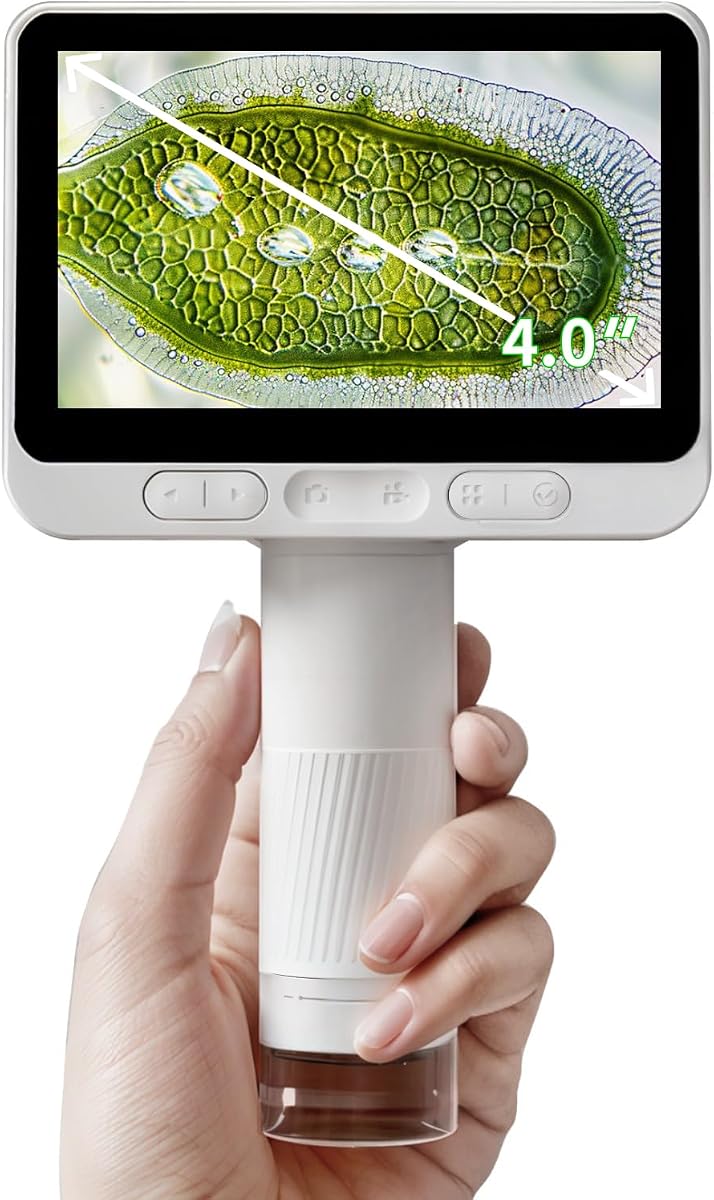
The BEAVERLAB Finder has a 4.6 rating and distinguishes itself with a large 4.0-inch IPS display, 1080P imaging, and a 100X–1600X magnification range. For children who want to examine fine structures in greater visual detail, the screen size is one of the most important features in this roundup.
We may earn a commission when you buy through this link, at no additional cost to you.
A 2MP CMOS sensor records full HD video and still photos, allowing young scientists to compare living specimens with prepared materials or everyday objects. Eight adjustable lights help control illumination, and the built-in hotspot provides a way to upload findings to a phone for sharing with family. Its compact body also makes it practical to carry between home, classroom, and outdoor locations.
The product information does not mention prepared slides or a large internal storage capacity, so the complete nature of the package is less explicit than with some competitors. The 1600X maximum is a listed magnification range rather than a guarantee that every object will remain sharp at full power, since focus and working distance still matter. Children may also need help connecting to the hotspot and selecting files.
This is our top large-screen choice for older children who are serious about visual exploration. It is particularly attractive for observing plant veins, bee wings, fabric fibers, ladybirds, and coin patterns. Parents prioritizing screen size, video quality, and flexible magnification should place it near the top of their shortlist.
The 4.0-inch IPS display gives fine structures more room to fill the frame than a compact 2.0-inch screen. That makes the Finder attractive for detailed observation sessions and for children who naturally move closer to a display when studying images.
The built-in hotspot offers a convenient way to transfer or upload observations to a mobile phone. This can make a backyard discovery feel social, allowing children to explain what they found and share a memorable image with relatives.
We may earn a commission when you buy through this link, at no additional cost to you.
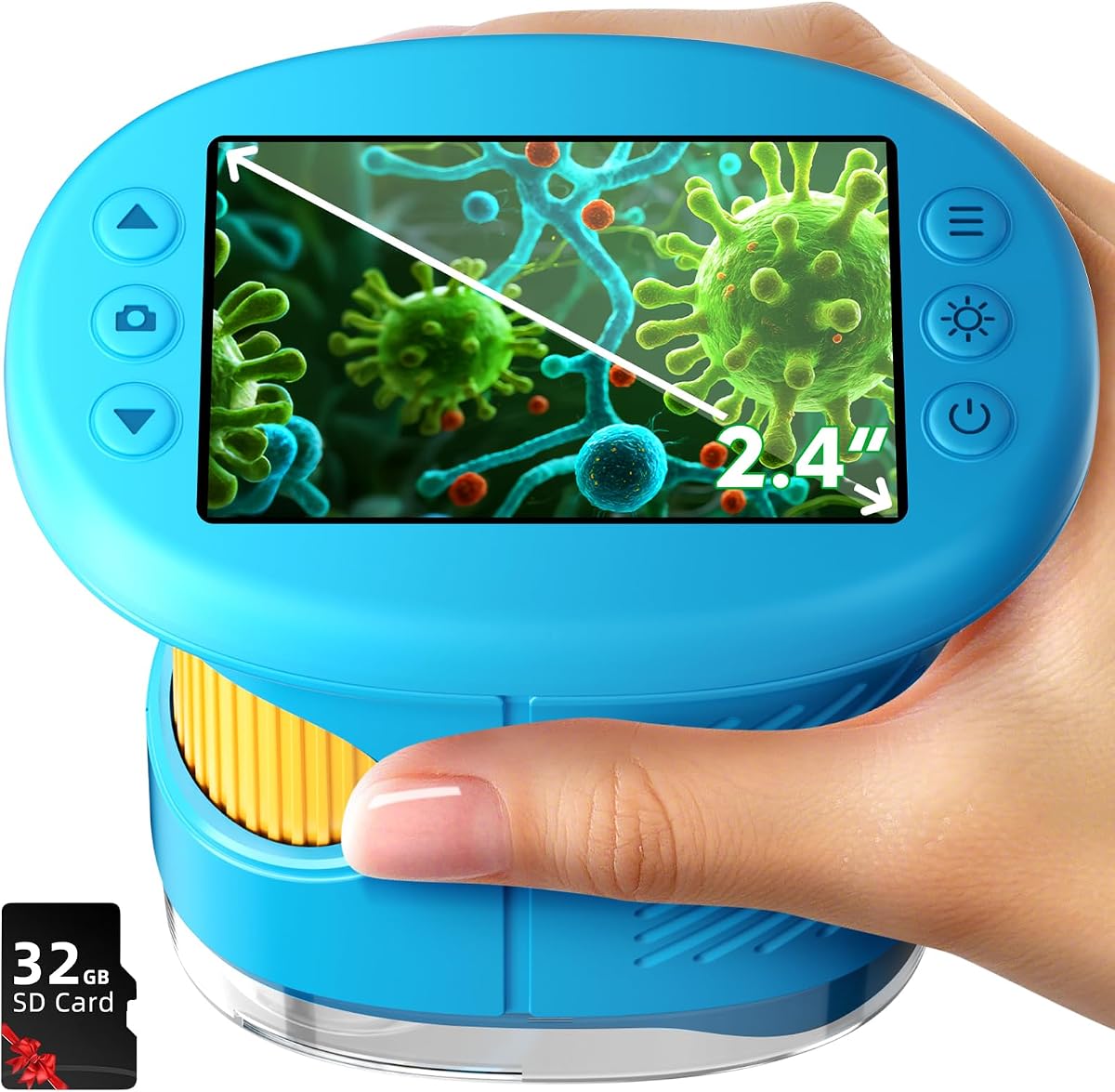
This microscope has a 4.5 rating and focuses on making digital exploration feel friendly and approachable. Its custom cat-shaped housing, textured oversized focus wheel, 2.4-inch IPS display, and listed safety certifications give it a child-oriented design without omitting useful magnification or recording functions.
We may earn a commission when you buy through this link, at no additional cost to you.
It reaches up to 1000X magnification and provides photo and video recording across three viewing modes. Computer observation mode allows the screen to be replaced with a larger computer display, memory-card mode supports viewing and transferring files, and device mode allows use while charging. The 600mAh battery is stated to provide up to three hours of exploration.
A significant limitation is the file-transfer process. Internal memory can hold about 200 photos, but those files cannot be moved directly to another device; a memory card is needed for export, and the card itself is not included. Buyers who expect effortless transfer from the first day should add suitable storage to their purchase plan.
This model is best for younger explorers who value an approachable appearance, simple controls, and a comfortable screen size. Its stated suitability for ages three through twelve and low adult-assistance design make it a versatile choice for home use. It is less convenient than models whose kits include both a memory card and a larger storage capacity.
The oversized textured focus wheel is the central usability feature, helping children adjust the image without navigating a complicated menu. The cat-shaped housing also gives the device a friendly identity that may make children more willing to begin exploring on their own.
Computer observation mode can provide a much larger real-time image for close study, presentation, or shared exploration. Memory-card recording adds capacity when children want to save extensive collections, although the required card is not part of the stated kit.
We may earn a commission when you buy through this link, at no additional cost to you.
The Odatay 1000X Digital Kids Microscope Kit has a 4.6 rating and offers an accessible combination of magnification, imaging, prepared slides, and portability. It supports 100X–1000X magnification, uses a 1080P camera, and displays the image on a 2.0-inch IPS screen.
We may earn a commission when you buy through this link, at no additional cost to you.
Twelve plastic prepared slides cover plants, vegetables, insects, and animals, giving children immediate activities beyond backyard searching. Built-in storage holds up to 500 photos, while a microSD card can add capacity when more space is needed. PC connectivity supports real-time viewing on a larger screen, which is useful for study, presentation, and sharing.
The small 2.0-inch display is the clearest trade-off, particularly when compared with the 4.0-inch screens in this guide. The microSD card is also not included, so the stated expandable-storage feature requires an additional purchase. As with other digital microscopes, maximum magnification can produce less clarity when focus, lighting, or working distance is not well controlled.
This is a strong value choice for a child who wants twelve ready-made specimens and a capable camera without a large-screen premium. It works for ages three through twelve according to the listing and should especially appeal to families looking for a portable, rechargeable microscope with immediate educational content.
The prepared slides span four broad categories and provide a ready-made curriculum of visual comparisons. This is particularly helpful for children who may not have safe or available natural specimens available at the moment they want to explore.
Top-mounted buttons allow children to observe and control the microscope at the same time, while the lanyard supports neck or backpack carrying. A rechargeable battery and computer connection make the unit flexible for home, classroom, and outdoor use.
We may earn a commission when you buy through this link, at no additional cost to you.
This 4.3-rated microscope is a flexible premium option with a large 4.0-inch IPS screen, 1080P camera, and adjustable 100X–1600X magnification. Its detachable 3-in-1 design can function as a desktop microscope, handheld viewer, or portable unit, allowing children to change setups as their specimens change.
We may earn a commission when you buy through this link, at no additional cost to you.
Six LED fill lights offer three brightness levels for controlling illumination in dim environments. The high-capacity rechargeable battery is stated to last up to four hours, the longest listed figure in this roundup, and PC connectivity enables real-time viewing on a larger screen. These features make it suitable for prolonged sessions, school displays, and shared family exploration.
Its 4.3 rating is lower than those of the other highly rated products, although the supplied information does not provide enough detail to attribute that result to a specific feature. The listing also does not mention prepared slides or substantial internal file storage, and the detachable design may be more complex for the youngest children than a straightforward handheld model.
This microscope is best for children who want to alternate between stable desk viewing and portable fieldwork. The large display, flexible configuration, and stated battery life make it a premium pick for older explorers. Younger users may benefit from an adult helping them understand the detachable configuration and operating modes.
Desktop mode provides stability for prepared slides and carefully arranged objects, while handheld and portable modes suit insects, leaves, and travel. This flexibility helps a single microscope serve both structured science activities and spontaneous exploration.
The stated four-hour battery life reduces interruptions during nature walks, classroom investigations, or multi-session projects. Six LEDs with adjustable brightness help maintain visibility as lighting conditions change.
We may earn a commission when you buy through this link, at no additional cost to you.
This compact microscope has a 4.2 rating and offers a 4K HD camera, 200X–1000X magnification, and a 2.0-inch screen. It is designed for children ages three through twelve and combines photo capture, video recording, playback, file management, and adjustable lighting in a portable package.
We may earn a commission when you buy through this link, at no additional cost to you.
Four magnification levels range from broad observation to close detail, and eight LEDs with three brightness levels support use around the home or outdoors. The body weighs 0.5 pounds and fits into a pocket or bag, while the included neck strap supports hands-free transport. PC connectivity provides file transfer and extended viewing options.
The 2.0-inch display is modest compared with the larger screens available in this category, and the 4.2 rating is the lowest among the ten listed products. The product information does not specify battery capacity, internal storage capacity, or whether a memory card is included, so buyers may need to review the current package details carefully.
This model is best for families who want 4K capture in a small, inexpensive-looking handheld format without a long accessory list. It suits casual backyard exploration, classroom demonstrations, and travel. Those wanting a larger display, prepared slides, or extensive storage should look toward the complete kits or premium large-screen options.
The 4K camera gives children a way to record crisp-looking images and videos of small details, while playback and file management let them review their observations. That makes the microscope useful for creating a simple digital catalog of discoveries.
Its light weight and pocket-friendly dimensions make spontaneous observation more likely. A child can carry the microscope outside, inspect a leaf, and return to the same instrument for a school project without packing a larger desktop setup.
We may earn a commission when you buy through this link, at no additional cost to you.
This handheld microscope earns a 4.4 rating and emphasizes outdoor discovery, straightforward operation, and recording of natural specimens. It offers 100X–1000X magnification, a 2MP camera, a 2-inch color display, and built-in storage for more than 200 photos and AVI videos.
We may earn a commission when you buy through this link, at no additional cost to you.
The enhanced stabilization design helps maintain a clear view when a child is moving, while a large textured focus wheel is intended to make focusing more manageable. Eight LEDs provide four lighting levels, including off, soft, medium, and high, and an anti-glare diffuser improves comfort. The 600mAh battery is stated to last up to three hours and recharge through USB-C.
Built-in storage is adequate for a collection of discoveries, but the listed capacity is modest compared with models that include a 32GB card. The product information does not mention an included memory card or expandable storage. Its 2-inch screen is also smaller than the premium 4.0-inch options, although the listed color display is still practical for basic observation.
This is a strong recommendation for children who frequently explore outdoors and want to document what they find. Its stability, simple focus control, and multiple lighting levels suit active use, while the 200-gram BPA-free ABS body is easy to carry. It is less suitable for families prioritizing expandable file storage or a very large viewing area.
The stabilization design and textured focus wheel address two common difficulties in child-operated microscopes: keeping a subject visible and bringing it into focus. The stated child-testing results also suggest that the controls may be approachable, though actual ease of use will vary by child.
Photo and AVI video capture can support nature journals, science projects, and a personal record of repeated backyard observations. USB-C transfer to Windows or Mac computers makes those files easier to organize or share.
We may earn a commission when you buy through this link, at no additional cost to you.
The WINWEND Kids Microscope has a 4.6 rating and presents a straightforward combination of 100X–1000X magnification, a 2-inch digital display, photo and video support, and 400-photo internal storage. It is positioned as a pocket microscope for children aged three to ten and for adults who want a simple personal tool.
We may earn a commission when you buy through this link, at no additional cost to you.
Fine and coarse focusing controls help bring specimens into view more quickly, while eight LEDs offer six brightness levels for illumination. Children can observe plants, insects, coins, jewelry, stamps, and other small objects. USB connectivity supports a broader computer view, which can make the image easier for a child or adult to study together.
The product weighs less than 300 grams and includes a wrist band to reduce the chance of dropping it. Video recording requires inserting a personal storage card, which is not included, and there is no mention of prepared slides or a larger display. Younger children may still need guidance when selecting a subject, adjusting distance, or transferring files.
This is a good straightforward choice for a child who wants a pocket-sized microscope with a high rating and a useful internal photo capacity. It works well for casual home observation, nature collecting, and introductory STEM activities. Buyers wanting ready-made slides or computer-based storage management may prefer one of the fuller kits.
Separate fine and coarse focusing gives children two stages of control as they learn to work with a microscope. The broad brightness range also helps them adapt to specimens that look better under stronger or softer illumination.
USB connectivity allows the image to be viewed on a broader computer screen, supporting joint exploration between children and adults. This can be especially useful when children are learning to describe patterns, textures, and differences between specimens.
We may earn a commission when you buy through this link, at no additional cost to you.
The right digital microscope depends less on the largest printed magnification number and more on the complete viewing experience. Consider the child's age, display size, lighting, controls, storage, power, included samples, and the kinds of specimens the family expects to examine.
Most products in this roundup reach 1000X, while two offer a listed maximum of 1600X. Higher magnification can reveal smaller structures, but the clarity of the final image depends on camera resolution, focus, lighting, working distance, and the physical specimen. A lower setting that remains sharp is more useful for children than a maximum setting that produces a blurred or unstable image.
Choose a broad adjustable range for general exploration, and pay more attention to focus controls and illumination than the headline number. A microscope should make it easy to move from a broad view to a close detail without losing the subject.
A 2.0-inch screen keeps the device compact and lightweight, while a 4.0-inch display gives fine structures more room to fill the frame. The BEAVERLAB Finder and 1600X Kids Microscope are the leading choices for a larger visual experience. Camera specifications range from 2MP and 1080P to listings that describe 4K HD capture, which can improve recorded detail.
Prioritize a clear screen with accurate color and stable focus. A larger display is especially helpful for shared viewing, presentations, and children who need a more obvious image while learning to describe what they see.
Built-in LEDs are essential when examining opaque objects, fabric, coins, or specimens in a dim location. Brightness levels help control glare and reveal depth, while a diffuser can make viewing more comfortable. Focus controls should be large, textured, and easy for small fingers to move gradually without suddenly changing the working distance.
Look for a simple focus wheel or fine-and-coarse adjustment rather than a complicated menu. Good lighting and manageable focusing are often more valuable to a child than the highest magnification setting.
Storage needs vary according to whether a child will take a few photographs or record an ongoing nature collection. The Odatay STEM Kit and 4K 1000X model include a 32GB card, while the Odatay 1000X kit stores up to 500 photos internally. Other models rely on limited built-in storage, and some require a separately purchased card for easy exporting.
Check whether the listing includes a memory card, how videos are saved, and whether files can transfer directly to a computer. For children creating science projects or digital journals, removable storage is generally more convenient than repeatedly deleting small amounts of built-in memory.
Prepared slides provide immediate, repeatable subjects that do not depend on the weather or finding an interesting insect. The Odatay 1000X kit includes twelve plastic slides, while the Odatay STEM Kit includes five real glass slides in a fitted case. Glass slides can provide a more authentic biology experience, while plastic slides are generally easier for younger children to handle.
A complete case, neck strap, cable, and viewing cover can make the microscope feel ready to use. The right bundle helps a child begin investigating rather than immediately needing a trip to find supplies.
Rechargeable batteries and USB charging make portable use more practical than disposable batteries. Stated runtimes range from about two hours to as much as four hours, though actual performance can depend on screen brightness, lighting, and recording. Light weight, a wrist strap, and a neck strap all improve portability for children.
PC connectivity can enable real-time viewing on a larger screen or help transfer images. A tripod socket, as offered by the Odatay 4K model, can also improve stability when children examine stationary prepared slides.
The listed age ranges vary from children aged three and older to older tweens, so parents should choose according to both the manufacturer's guidance and the child's attention span. Oversized focus controls, simple top-mounted buttons, smooth housings, and secure wrist straps can make independent use easier. Several products also list CE, CPC, FCC, UKCA, or related safety certifications.
For younger children, adult participation can turn initial setup into a learning activity rather than a frustration. As skills develop, independent operation becomes more practical and supports confidence through repeated observation.
Start with a simple prepared slide or a familiar object such as a leaf, coin, stamp, or piece of fabric. Let the child place the subject on a clean, flat surface, turn on the microscope, and begin at a low magnification level. Move the scope slowly toward the specimen, adjust the focus wheel in small movements, and use the lighting controls to reduce glare or reveal detail in shadowed areas.
For outdoor observations, choose a dry specimen and avoid placing the microscope where moisture, dirt, or insects could enter the body. Keep the lens away from sticky leaves and residue, and do not aim it directly at the sun or other intense light sources. Because small parts and cables can be choking hazards or trip hazards, supervise younger children and keep the product out of reach when it is not being used.
After use, switch the microscope off and gently wipe the lens with a soft, dry microfiber cloth. Keep the device away from water, extreme heat, and direct sunlight, and use the stated charging cable and compatible software recommended in the manual. Protect the screen and slides from scratches, remove or transfer stored files as needed, and store the unit in its case or in a clean, padded place to prevent drops.
A range that reaches approximately 1000X is versatile enough for many leaves, coins, fabrics, insects, and prepared slides. The top magnification setting should not be the only consideration, because focus, lighting, and working distance determine whether the image is useful. Models with several magnification levels are generally more satisfying because children can compare broad and close views.
The listed 1000X and 1600X figures describe maximum magnification capabilities, not a guarantee of laboratory-grade clarity. Real cellular detail depends on the specimen, camera, optics, focus, and lighting. Prepared slides provide a reliable starting point, while a child's claim of seeing individual cells should be discussed as an observation to test with additional evidence.
A larger screen can make details easier to see and is useful for shared exploration, but it also makes the microscope bulkier. Children aged three and above may benefit from the approachable 2.4-inch options, while older children studying fine details may prefer a 4.0-inch display. Control simplicity and portability may matter more than screen size for younger users.
It depends on the model. Several products include a 32GB card, while others use built-in storage or require a card for video recording and file export. If a child plans to save many images or videos, purchasing a compatible card can prevent frequent deletion. Buyers should check the current package contents because included accessories can vary.
Many of these products are specifically designed for portable outdoor exploration, with lightweight bodies, neck straps, wrist bands, rechargeable batteries, and built-in LEDs. The microscope should still be protected from moisture, dirt, drops, and direct sunlight. A small carrying case can also make outdoor activities easier and protect accessories.
Prepared slides are not necessary because natural objects and everyday items provide excellent introductory specimens. They are valuable when a family wants repeatable samples, structured biology activities, or a way to begin immediately. The Odatay models include twelve plastic slides, while the Kids Digital Microscope STEM Kit includes five real glass slides.
Transfer methods depend on the model. Some include a removable card that can be read through a computer, while others provide USB cable transfer or PC viewing mode. A few products require compatible software for certain functions, so the manual should be consulted before connecting the microscope or attempting to transfer internal files.
Look for a lightweight body, a large textured focus wheel, simple buttons, automatic LED illumination, and a rechargeable battery. The 2.4-inch cat-themed model is explicitly designed for young children, while the Odatay 1000X kit offers top-mounted controls and twelve prepared slides. Even the simplest model benefits from an adult demonstrating the first observation.
The Odatay 1000X Digital Kids Microscope Kit is the best-value choice for immediate exploration, offering 100X–1000X magnification, twelve prepared slides, a 1080P camera, and expandable storage. The BEAVERLAB Finder takes the large-screen lead with its 4.0-inch IPS display, 1080P imaging, and 100X–1600X range, while the 1600X Kids Microscope stands out for its flexible 3-in-1 construction and stated four-hour battery life.
Prioritize the experience that fits the child rather than the highest magnification alone. Younger explorers benefit from simple focus controls, small bodies, friendly design, and prepared slides, while older children may value a 4.0-inch display, expandable storage, PC connectivity, and more advanced recording options. A microscope that is easy to carry and genuinely fun to use is more likely to become a learning tool than one packed with features the child rarely reaches.
Before purchasing, confirm the current magnification range, display size, battery expectations, storage method, included accessories, and computer requirements against the latest product listing. Promotions, bundle contents, and prices can change, so checking the current offer helps ensure that the selected digital microscope for kids remains suitable for the child's age, interests, and planned activities.