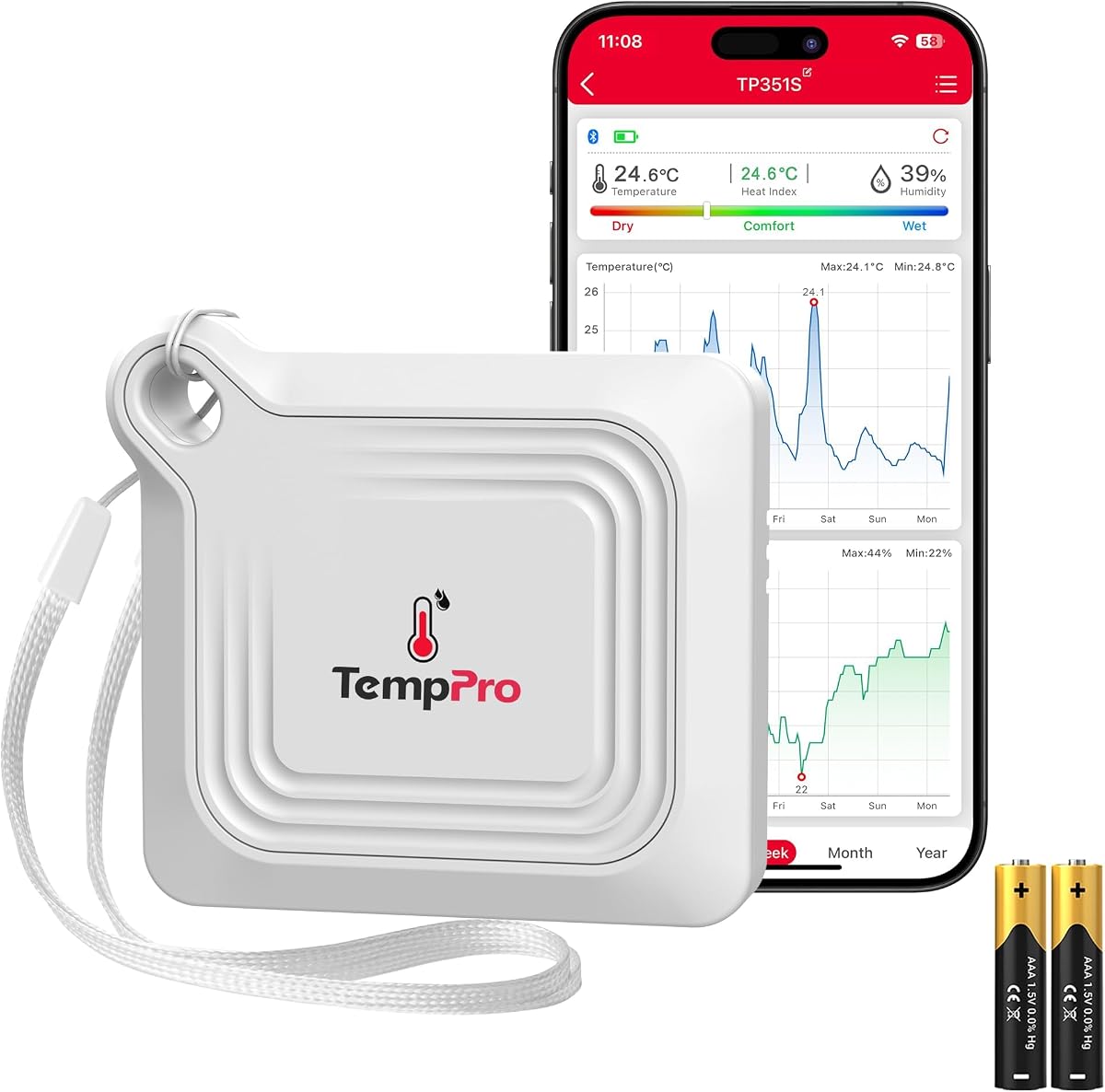
TempPro TempAir Bluetooth Thermometer Hygrometer
4.3Editor score
Bluetooth remote monitoring
Two-year data logging
Temperature and humidity alerts
Compact portable construction
Compare 10 greenhouse thermometer options for accuracy, humidity tracking, remote monitoring, durability, and placement to help you choose the right model.
A greenhouse thermometer is more than a convenient readout: it helps growers understand temperature swings, identify humidity problems, and respond before conditions stress plants. A useful model should combine dependable readings with an easy-to-read display, durable placement, and the measurement features that match how you monitor your growing space.
We compared these 10 options by examining their stated temperature and humidity specifications, refresh rates, displays, mounting methods, environmental resistance, data logging, connectivity, and greenhouse-specific functions. The guide includes digital, analog, maximum-minimum, multi-sensor, and Bluetooth models for growers who need a quick glance, a historical record, or remote monitoring.
Each review explains where a thermometer performs best and where its design introduces trade-offs. The selections also highlight the best choices for different priorities, including humidity readings, high-humidity resistance, remote app access, and multi-location monitoring. Product availability and prices can change, so check the current listing before purchasing.
4.3Editor score

4.5Editor score

4.6Editor score
The following comparison highlights each thermometer's display style, measurement capabilities, placement options, and monitoring features to help you identify the right model for your greenhouse routine.


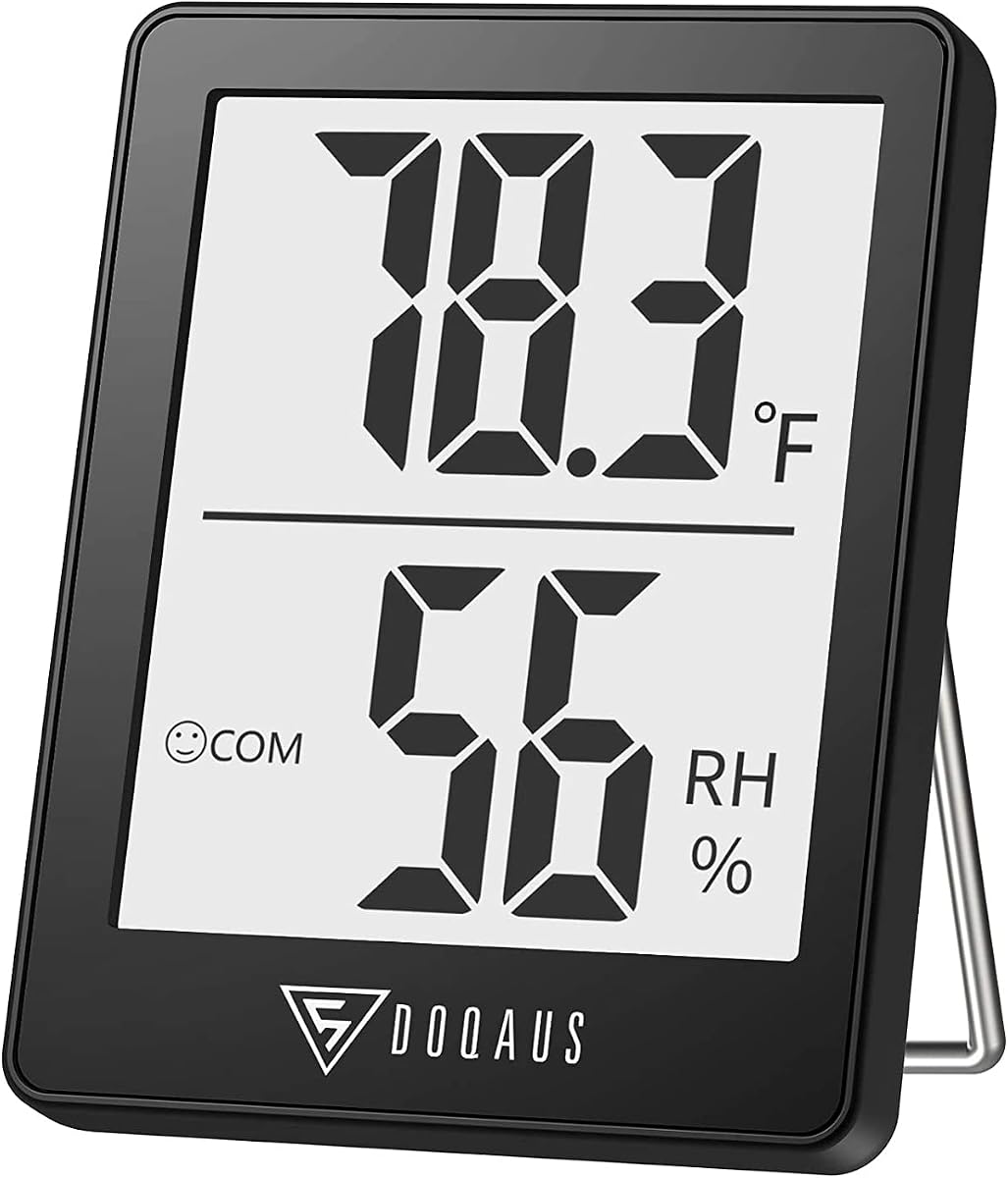


The TempPro TempAir Digital Hygrometer Indoor Thermometer with IPX5 Waterproof earns a 4.5 rating and stands out as the most complete general-purpose choice in this guide. It reports both temperature and humidity, with stated accuracy of plus or minus 1 degree Fahrenheit and plus or minus 2% relative humidity. Its IPX5 design makes it particularly appropriate for greenhouses, grow tents, and other spaces where condensation or elevated humidity is a concern.
We may earn a commission when you buy through this link, at no additional cost to you.
Real-time monitoring is straightforward because the display refreshes every 10 seconds. The unit automatically retains the highest and lowest temperature and humidity values from the preceding 24 hours, giving you a useful picture of recent environmental movement without requiring a separate data logger. Large bold digits improve readability, while dry, comfort, and wet face icons provide a quick visual indication of the current humidity condition.
The principal trade-off is its local-only operation. It does not offer Bluetooth monitoring, phone alerts, or long-term data export, so growers who need remote access and multi-year records will need a more connected model. Its 24-hour history is also more limited than the two-year storage offered by some app-enabled alternatives. Even so, the accurate humidity sensing, water-resistant construction, and flexible placement make it a balanced option for routine greenhouse use.
Choose this model if you want one device that provides dependable temperature and humidity readings, quick visual guidance, and recent high-low records without managing an app. It is especially well suited to growers who want straightforward monitoring and need a meter that can tolerate a humid growing environment. For remote access or long-term trend analysis, consider one of the Bluetooth thermometers instead.
The stated IPX5 waterproof design is the defining feature for greenhouse use. Combined with plus or minus 2% RH humidity accuracy, it gives growers useful information in spaces where moisture frequently accumulates around plants, vents, and irrigation areas.
Automatic 24-hour maximum and minimum records help you identify hot afternoons, cool nights, and sudden humidity changes. The information is easy to consult at the unit itself, making it more convenient than estimating conditions from a temporary display reading.
We may earn a commission when you buy through this link, at no additional cost to you.
This TempPro TempAir Bluetooth Hygrometer Thermometer for Greenhouse Up to 260ft receives a 4.3 rating and focuses on remote oversight. It connects to the TempPro app from up to 260 feet away when there are no obstructions, allowing temperature and humidity to be checked without walking into the growing space. The app does not require user registration, which may appeal to growers who prefer not to create an account.
We may earn a commission when you buy through this link, at no additional cost to you.
The combination of an NTC temperature and humidity sensor, plus or minus 0.9-degree Fahrenheit accuracy, plus or minus 2% RH accuracy, and a 10-second refresh rate makes this a credible option for routine greenhouse monitoring. A large backlit display remains useful when you are near the device, while a face icon summarizes the comfort condition. Most importantly, the app can retain data for two years and export that history for later inspection.
Its biggest limitation is dependence on the connection path. The advertised 260-foot range applies without obstructions, so metal greenhouse panels, dense walls, and other barriers may reduce practical connectivity. The device also cannot provide the same hands-on simplicity as a standalone digital meter: checking conditions requires a phone and app rather than simply looking at a nearby screen.
This thermometer is best for growers who want alerts, trends, and remote access without staying beside the greenhouse. The two-year data history is especially valuable for comparing seasons or understanding how ventilation and irrigation affect the space. If direct visual access and simple placement matter more, the first TempPro model offers a more immediate alternative.
Two years of stored information gives you a much longer record than a basic max-min display. Reviewing and exporting that history can help you identify recurring temperature and humidity patterns before changing your growing routine.
The backlit screen and large display make the unit practical during early mornings and evening checks. A face icon provides a fast summary of whether conditions read as dry, comfortable, or wet.
We may earn a commission when you buy through this link, at no additional cost to you.
The Digital Max Min Greenhouse Thermometer is a focused option for growers who primarily need to see the current, highest, and lowest temperature. It carries a 4.3 rating and uses a straightforward digital display rather than a more complicated interface. That makes it suitable for a greenhouse, garden, or home where temperature fluctuation is the main concern.
We may earn a commission when you buy through this link, at no additional cost to you.
Its max-min function reveals how conditions move across the day, which can help a gardener notice unusually warm afternoons or cool periods. The unit works indoors and outdoors, is easy to wall mount, and lets the user switch between Celsius and Fahrenheit. An AA battery is included, so the core setup does not depend on finding a separate power source.
The key limitation is that this is a thermometer rather than a combined thermometer and hygrometer. It does not measure relative humidity, and there is no app, refresh-rate information, or exportable historical record in the supplied specifications. Growers concerned about condensation, fungal pressure, or irrigation-driven moisture changes would need a separate humidity meter.
It remains a sensible choice for tracking temperature only, especially when the goal is to identify daily highs and lows without a smartphone. Its uncomplicated display and wall-mountable format also work well in a fixed location. For complete environmental control, however, select a digital hygrometer that includes humidity readings and comfort indicators.
Keeping the current reading alongside the maximum and minimum values makes changes easier to spot at a glance. This is especially useful in greenhouses where a brief temperature swing can remain hidden by a single instantaneous number.
Wall mounting keeps the display visible in a stable position, while indoor and outdoor versatility allows the same device to move between the greenhouse and another space as needed.
We may earn a commission when you buy through this link, at no additional cost to you.
The TempPro TempAir Digital Hygrometer Indoor Thermometer holds a 4.6 rating, the highest customer rating among the products listed, and combines useful greenhouse features with a compact footprint. It measures temperature with stated accuracy of plus or minus 1 degree Fahrenheit or Celsius and humidity with plus or minus 2% to 3% RH. That makes it a capable choice for monitoring the two variables that most directly affect a greenhouse's immediate environment.
We may earn a commission when you buy through this link, at no additional cost to you.
Readings refresh every 10 seconds, and the large bold LCD digits are designed to remain visible from different angles and distances. A face icon labels conditions as dry, comfort, or wet, helping you make a quick assessment without interpreting every number. Placement is unusually flexible: the mini unit includes a tabletop stand, magnetic back, and hanging mount, so it can be used on a shelf, wall, or other suitable surface.
The trade-offs are the same limitations associated with simple local monitoring. There is no smartphone connection, alert system, or long-term data export. It also does not specify an automatic high-low memory, so you may need to check the display during critical parts of the day if you want to record the day's extremes yourself.
This is our best budget recommendation for growers who want a dependable digital temperature and humidity meter without app setup. The accurate specifications, fast refresh rate, readable display, and three mounting options make it particularly versatile around a greenhouse, grow tent, brooder, or workbench. Choose a connected model if remote access and historical data are essential to your operation.
A ten-second refresh rate keeps the display responsive while you adjust vents, doors, irrigation, or heating. It is fast enough for routine observations without creating the impression that every tiny sensor fluctuation represents a meaningful environmental change.
Three mounting methods let you optimize the viewing position. Use the stand on a shelf, the magnetic back on compatible metal, or the hanging mount where a suspended position is more practical.
We may earn a commission when you buy through this link, at no additional cost to you.
The Indoor Outdoor Thermometer Hygrometer with its large dial is a 4.2-rated choice for growers who prefer a mechanical instrument with no batteries to maintain. It combines an analog temperature display with a humidity gauge, and the face is designed for clear visual interpretation rather than dense numerical analysis. Its mechanical operation avoids batteries and liquids.
We may earn a commission when you buy through this link, at no additional cost to you.
The listed temperature range extends from -20 to 140 degrees Fahrenheit, equivalent to -30 to 60 degrees Celsius, while humidity covers 0% to 99% RH. A stainless steel humidity sensor adds a durable, cleanable element, and the unit is intended for both indoor and outdoor environments. A hook hole and detachable bracket make it straightforward to mount vertically or position it wherever needed.
The important trade-off is response speed. The product guidance specifically notes that an analog thermometer may take time to stabilize and recommends checking at different times of day. It also lacks programmable alerts, recorded data, and app-based analysis. If you require rapid updates or a precise digital reading from a distance, a digital model may be more suitable.
This thermometer is a good option for a simple, durable monitoring station where low maintenance matters. It can be used in greenhouses, reptile breeding boxes, moisture chambers, cellars, or incubators without battery replacement concerns. Choose it for a traditional gauge-style setup; choose a digital or Bluetooth model when rapid feedback, records, or remote notifications are priorities.
Because the instrument is mechanically operated and requires neither batteries nor liquids, it offers a low-maintenance way to monitor a greenhouse. The stainless steel humidity sensor is also described as durable and easy to clean.
The broad dial and zone-oriented temperature scale are designed to be understood at a glance. This visual format can be helpful in a busy growing space where users need to check conditions quickly.
We may earn a commission when you buy through this link, at no additional cost to you.
The DOQAUS Digital Hygrometer Indoor Thermometer Humidity Meter, Black earns a 4.4 rating and stands out for its fast refresh rate. It updates every five seconds, giving the screen a more immediate feel than many standard digital thermometers. The stated temperature accuracy is plus or minus 1 degree Fahrenheit, while humidity accuracy is plus or minus 5% RH.
We may earn a commission when you buy through this link, at no additional cost to you.
Its 2.3-inch LCD uses large bold numbers that are easy to read from different angles. A dry, comfort, or wet face icon provides a quick environmental summary. The unit is lightweight and compact, and its three mounting options—hanging hole, tabletop stand, and magnet—make it suitable for greenhouses, reptile terrariums, cellars, incubators, kitchens, bedrooms, and other areas.
Compared with the leading TempPro models, the primary weakness is the broader stated humidity tolerance. Plus or minus 5% RH is less precise than the plus or minus 2% figure offered by several competitors, which may matter for close tracking of moisture-sensitive crops. There is also no Bluetooth connectivity, historical graph, or export function.
Despite those limitations, the DOQAUS is a practical choice for growers who prioritize fast updates, a large display, and flexible placement at an approachable cost. It is particularly useful when you need a quick local reading in multiple areas. For high-precision humidity work or long-term analysis, a model with tighter specifications and data logging may be a better fit.
The five-second refresh interval makes this one of the quickest-reading digital models in the guide. It is useful when you want to see the display react during routine checks without interpreting a slowly changing analog needle.
The small housing and multiple mounting methods support portable use. A grower can move the unit between a greenhouse, nursery, or terrarium and position it on a shelf, wall, or metal surface.
We may earn a commission when you buy through this link, at no additional cost to you.
The TempPro TempAir Bluetooth Thermometer Hygrometer, 260 ft Temperature Sensor is the feature-rich option in this roundup. It receives a 4.3 rating and offers remote monitoring, long-term records, customizable alerts, and detailed app-based charts. It is designed for growers who want more than a display showing the present conditions.
We may earn a commission when you buy through this link, at no additional cost to you.
Its advanced NTC humidity sensor is stated to provide temperature accuracy of plus or minus 0.5 degree Fahrenheit, humidity accuracy of plus or minus 2% RH, and 10-second refreshes. The included batteries and straightforward pairing process simplify initial setup. Once connected, the app can display temperature and humidity, provide alerts, show a one-year chart, indicate battery status, and export stored data.
A major advantage is the two-year logging capability, which provides a much more useful record for long-term analysis than a simple maximum-minimum display. The app is especially relevant for growers comparing conditions over days or months. The device also supports remote readings from up to 260 feet away, although the stated range assumes an unobstructed path.
The trade-off is dependence on the phone and app ecosystem, and the product is not described as a Wi-Fi device. If remote data is your priority, this is a compelling model. If you only need an immediate, always-visible reading and prefer fewer digital connections, choose one of the standalone digital thermometers instead.
Preset temperature and humidity ranges can send notifications when conditions move outside the range you select. This makes the device useful for growers who cannot continuously visit the greenhouse or need prompt warnings about changing conditions.
Two years of logging and one-year online chart tracking create a substantial history for identifying trends. Exported information also allows you to examine readings outside the app, making the monitor more versatile for ongoing records.
We may earn a commission when you buy through this link, at no additional cost to you.
The TempPro TP49 3 Pack Digital Hygrometer Indoor Thermometer is built for growers who need to watch more than one part of a growing environment. Its 4.6 rating reflects a well-regarded set of features, and the pack includes three digital monitors for separate temperature and humidity readings.
We may earn a commission when you buy through this link, at no additional cost to you.
Each unit refreshes every 10 seconds and offers stated temperature accuracy of plus or minus 1 degree Fahrenheit or Celsius and humidity accuracy of plus or minus 2% to 3% RH. The compact LCD screens have large digits, and face icons indicate dry, comfort, or wet conditions. Every monitor includes a tabletop stand, magnetic back, and hanging mount, so each can be positioned in a different zone.
The limitation is that the pack does not provide a centralized app view, remote notifications, or shared data export. You must physically check each display. That is still useful for comparing zones such as a high shelf, a low bench, and a ventilated wall, but it is less convenient than a connected system that combines every reading in one dashboard.
This three-pack is an excellent choice for mapping temperature and humidity variation across a greenhouse, grow room, or collection of smaller spaces. It offers a practical way to locate warm, cool, dry, or humid corners without investing in several unrelated instruments. Choose it for local multi-point monitoring; choose the Bluetooth model for remote alerts and consolidated history.
Three separate units can reveal significant differences that a single reading may miss. Place them at different heights or distances from doors, vents, and heat sources to build a more useful picture of the greenhouse's conditions.
Each monitor uses the same display, sensing, and placement design. This consistency makes it easier to compare readings and gives every area the same fast refresh rate and comfort indicator.
We may earn a commission when you buy through this link, at no additional cost to you.
The Digital Greenhouse Thermometer – Max Min Thermometer for Greenhouse or Garden is a 4.3-rated traditional monitoring option with a useful protective feature. It displays the current temperature along with the maximum and minimum readings, allowing gardeners to see the range of conditions recorded by the unit.
We may earn a commission when you buy through this link, at no additional cost to you.
Unlike many compact digital meters, it has a flip-out attached roof intended to provide extra protection from the elements. That design makes it more appropriate for an outdoor garden wall or exposed greenhouse position than a small tabletop unit. It can be used indoors or outdoors and is designed for straightforward wall mounting.
Its main limitation is that it measures temperature only. There is no relative humidity display, refresh-rate specification, comfort indicator, wireless connection, or exportable data. Growers who need to manage moisture alongside temperature will need to pair it with a hygrometer or choose a combined model.
This thermometer is a good match for gardeners who want a recognizable max-min display in a fixed, semi-exposed location. The protected design and indoor-outdoor versatility offer a practical balance for garden and greenhouse use. For a connected or humidity-focused setup, however, one of the digital hygrometers provides greater scope.
The flip-out roof adds a physical barrier around the instrument when it is mounted. That makes the design more suitable for outdoor placement where incidental weather exposure is a concern.
The dedicated maximum and minimum display provides a quick summary of temperature movement. It is a useful choice for spotting unusually warm or cool periods without relying on a phone or separate logbook.
We may earn a commission when you buy through this link, at no additional cost to you.
The Govee Smart Bluetooth Thermometer Hygrometer H5074 is a 4.3-rated smart sensor designed for growers who value immediate readings and remote notifications. It monitors temperature and humidity through the Govee Home app, and the built-in Swiss-made sensor is stated to provide temperature accuracy of plus or minus 0.54 degree Fahrenheit and humidity accuracy of plus or minus 3% RH.
We may earn a commission when you buy through this link, at no additional cost to you.
Its standout specification is the two-second refresh rate, the fastest in this guide. Readings appear on the app in real time, and the stated connection distance reaches 262 feet without obstacles. You can set preset temperature and humidity ranges, then receive an instant notification when conditions leave those ranges. A hanging hole and compact body make placement straightforward.
The data system is more complicated than the simple onboard description first suggests. It stores 20 days of recent records on the device and displays them through a curve graph, while the app can export the last two years of data as CSV. The product is Bluetooth rather than Wi-Fi, so remote access still depends on the phone's connection and the stated unobstructed range.
Choose the H5074 when rapid updates, high precision, and threshold alerts are more important than a purely local display. It is particularly helpful for unattended growing spaces where a grower wants notification of an unexpected heat, cold, or humidity change. If direct screen viewing is a priority, a standalone digital hygrometer may be easier to use.
Preset ranges let the device watch conditions for you. When temperature or humidity moves outside the selected boundary, the app provides a prompt notification that can support faster greenhouse interventions.
Curve graphs simplify recent on-device history, while CSV export provides a way to analyze up to two years of data. This makes the monitor useful for growers who want to connect environmental patterns with seasonal or operational changes.
We may earn a commission when you buy through this link, at no additional cost to you.
The right greenhouse thermometer depends on the conditions you need to monitor, how quickly you need to know about changes, and how much control you want over placement and records. Consider the following factors before choosing a model.
Look for a clearly stated temperature tolerance, because it provides a more useful basis for comparison than a vague claim that a sensor is accurate. The products in this guide range from plus or minus 0.5 degree Fahrenheit to plus or minus 5 degrees Fahrenheit. Models with tighter tolerances are attractive when you need to track small changes, while less precise readings may still be sufficient for a basic overview. Accuracy matters most around temperature thresholds that influence plant comfort, ventilation decisions, and frost risk.
Humidity can be as important as temperature in a greenhouse, particularly where condensation, mold, or plant moisture is a concern. A combined hygrometer saves you from handling separate instruments. The listed humidity tolerances range from plus or minus 2% RH to plus or minus 5% RH, with the plus or minus 2% models offering the strongest stated precision. If your operation depends on a narrow humidity range, prioritize a tighter specification and a display that reports both values clearly.
Refresh rate determines how quickly the display or app reflects a change. The five-second DOQAUS model and two-second Govee H5074 are the fastest, while many other digital thermometers update every 10 seconds. A quick refresh is useful during active adjustments, but it does not automatically make a sensor more accurate. Match the speed to your routine: remote alerts and chart tracking matter more than extremely rapid updates in most steady greenhouse conditions.
Decide how often you will physically visit the greenhouse. A local display is immediate, reliable, and simple, while Bluetooth models allow phone-based readings, alerts, charts, and data export from a stated unobstructed range of roughly 260 feet. Remote monitoring is valuable for growers who cannot inspect conditions frequently, but it introduces dependence on a compatible device, app, and connection. A local unit can also serve as a useful backup when you are working directly among the plants.
Historical information can reveal temperature patterns and help you connect environmental changes with ventilation, irrigation, or seasonal shifts. Basic max-min thermometers retain only the highest and lowest temperatures, while the TempPro Bluetooth models support two-year storage and export, and the Govee offers on-device records plus longer CSV export. Consider how much history you actually need, because graphing and export tools add value for analysis but are unnecessary for a simple daily check.
A greenhouse display should be readable in variable light and from a practical distance. Digital models use large bold digits, while the Govee H5074 refreshes every two seconds and the Govee H5075 offers a backlit display for low-light conditions. The analog model uses a large dial and zone indication instead. Think about whether you prefer exact numbers, quick visual categories such as dry or comfort, or a familiar needle-based scale.
The best reading is the one taken from a location that represents the area you want to manage. Look for a tabletop stand, magnet, hanging hole, hook, bracket, or wall mount to suit the greenhouse. The IPX5 model is specifically designed for high-humidity environments, while the analog unit uses a stainless steel humidity sensor and needs no batteries. Also consider whether you want one fixed device or several units to compare different heights, shelves, and zones.
Alerts are useful when you need to know about a problem without being present, and the Govee H5074 plus the feature-rich TempPro Bluetooth model both support threshold notifications. For a different need, the TempPro three-pack lets you monitor three locations with separate displays, though it does not combine readings in a shared dashboard. Decide whether you value early warning from one location or a broad map of conditions across the entire growing space.
Place the thermometer where it can represent the conditions you intend to manage, away from direct heater output, cooling equipment, open doors, wet irrigation lines, and other sources of localized interference. For a multi-zone greenhouse, use separate units or compare readings from different heights and corners rather than assuming one location represents the entire structure. Allow analog and digital sensors to stabilize before making decisions, especially after moving them between noticeably different environments.
For digital models, review both temperature and humidity rather than focusing on a single number. Set alerts or manually inspect maximum and minimum readings during important daily periods. If you are using a Bluetooth model, connect the unit to its app, select the relevant conditions, and position the phone where it can maintain the stated unobstructed communication range. For analog instruments, compare the dial reading with nearby conditions at different times of day as the manufacturer advises.
Keep the display and vents free from dust, condensation, and plant debris. Clean removable surfaces gently and dry the unit before returning it to service. Store electronic devices in a dry, moderate environment when they are not in use, remove batteries from long-term storage if the model allows it, and replace batteries according to the display or app battery indicator. Check wall attachments, hanging loops, magnets, and brackets regularly so the sensor remains securely positioned and accurately reflects the intended area.
A combined thermometer and hygrometer is usually more useful than a temperature-only model. Temperature explains heat and cold conditions, while relative humidity helps you recognize moisture conditions that may affect condensation, plant comfort, or ventilation decisions. Choose a combined unit unless you already have a reliable hygrometer in place.
Place the sensor at plant height in the area whose conditions you want to monitor, away from heaters, vents, direct sunlight, and wet surfaces. If different parts of the greenhouse behave differently, use multiple monitors. This can reveal warm upper zones, cool lower zones, and humidity changes near doors or irrigation equipment.
Bluetooth is better when you want remote readings, threshold alerts, charts, and exported history. A local digital display is better when you value simplicity, immediate visibility, and operation without an app. Some growers use both, relying on a connected sensor for oversight and a local meter for hands-on checks.
Check more frequently when conditions can change quickly, during extreme weather, or while adjusting ventilation and heating. A device with automatic high-low records, rapid refresh, or alerts can make this easier. The appropriate frequency ultimately depends on the plants, greenhouse construction, and the environmental changes your setup can produce.
A tighter tolerance gives more confidence when monitoring small changes or operating near important temperature thresholds. The models listed here offer stated temperature tolerances ranging from plus or minus 0.5 degree Fahrenheit to plus or minus 5 degrees. For routine monitoring, a wider tolerance may be adequate, but highly precise readings are preferable for detailed control or research-style tracking.
Resistance to humidity and water is useful in a greenhouse because condensation, watering, and plant foliage can expose the instrument to moisture. The TempPro IPX5 model is specifically designed for high-humidity environments. Regardless of the stated rating, keep the display and ventilation openings clean and follow the manufacturer's placement and care guidance.
Several models in this guide are explicitly suitable for both indoor and outdoor use. Their ability to move between locations makes them useful for comparing a greenhouse with a garden or outdoor area, but the protective hood or water resistance should be considered when choosing an exposed position.
A max-min thermometer provides a basic record of recent extremes, while a Bluetooth model with charts and export can support longer-term analysis. Recording is helpful when you want to connect environmental patterns with ventilation, heating, irrigation, or seasonal changes. Choose based on how much history you need and whether you want to review it in an app or directly on the device.
The TempPro TempAir Digital Hygrometer with IPX5 Waterproof is the strongest all-around pick for accurate local temperature and humidity monitoring, recent high-low records, and humid-environment durability. The feature-rich TempPro TempAir Bluetooth Thermometer Hygrometer is the premier connected option for two-year logging, alerts, and remote analysis, while the standard TempPro Digital Hygrometer offers the best budget balance of precision, readability, and flexible mounting.
Prioritize the measurement that matters most to your operation. Choose a tight humidity specification when moisture control is essential, a max-min thermometer for simple temperature extremes, and a Bluetooth model when alerts or long-term trends are important. Multiple monitors are valuable for comparing separate greenhouse zones, while a mechanical analog gauge may be ideal where low-maintenance, battery-free operation matters most.
Before purchasing, verify the current listing for specifications, included accessories, compatibility, and availability. Prices and product configurations can change over time, so the current product page remains the best source for current purchasing details. Use the review as a practical shortlist and choose the model that matches your monitoring routine rather than simply selecting the most feature-heavy device.