
LG 27GX704A-B UltraGear OLED
4.6Editor score
QHD OLED at 240Hz
0.03ms response time
Dual HDMI 2.1
A gaming monitor with HDMI 2.1 for consoles can unlock smoother frame rates, higher resolutions, and more flexible display options, but only when its ports, bandwidth, and supported modes align with your console. The right model should also suit your desk, viewing preferences, and the types of games you play.
This guide compares ten monitors using their stated resolution, refresh rate, response time, panel technology, color performance, adaptive-sync support, and HDMI connectivity. It covers 4K, QHD, and ultrawide models for players who want everything from competitive PC gaming to cinematic console experiences.
Each review explains the strongest reasons to consider a particular display, along with practical trade-offs such as glossy finishes, maximum brightness, port limitations, or lower-resolution console output. Rankings reflect the supplied product information, while prices and availability can change at any time.
4.6Editor score

4.2Editor score

4.4Editor score
As an Amazon Associate we earn from qualifying purchases.
The comparison below places every display by resolution, maximum refresh rate, response time, and key connectivity features, making it easier to identify the model that matches a PlayStation, Xbox, Switch, or mixed PC-and-console setup.




The ASUS TUF Gaming VG27UQ1A stands out as the most balanced option in this guide, combining a 27-inch 4K panel with a 160Hz refresh rate and support for 4K 120Hz over HDMI 2.1 without chroma subsampling. Its 4.2 rating reflects a well-rounded display capable of serving modern consoles and a high-performance PC without requiring separate equipment for each.
We may earn a commission when you buy through this link, at no additional cost to you.
The strongest attraction is its combination of resolution and refresh rate. A 4K image gives console games more visible detail, while 160Hz is valuable for fast PC play and competitive titles. The supplied specifications also list a 1ms Fast IPS response time, NVIDIA G-SYNC compatibility, AMD FreeSync Premium, variable overdrive, and ELMB Sync for reducing ghosting and tearing.
Color performance adds another layer of value. HDR support and a stated 95% DCI-P3 gamut make the display more suitable for vivid games and mixed entertainment than a basic office panel. The trade-off is that the information does not specify a particularly high brightness figure, and buyers who need several wired devices or additional USB connectivity may find the port selection less expansive than some alternatives.
This is the strongest recommendation for a gamer who wants one capable display for PlayStation, Xbox, and PC. Its 27-inch size also makes 4K practical on a normal desk, while the 160Hz ceiling offers a useful PC upgrade path. Choose it if 4K image quality and 120Hz console support matter more than having multiple HDMI ports.
HDMI 2.1 support for 4K 120Hz without chroma subsampling is the key console benefit, while the 160Hz maximum refresh rate gives PC games additional headroom. Fast IPS technology and broad adaptive-sync support help keep motion clear and consistent.
HDR and 95% DCI-P3 color support make this a more versatile screen for games, video, and everyday creative work. The supplied package includes a DisplayPort cable, power cord, quick-start guide, screwdriver, and warranty card.
We may earn a commission when you buy through this link, at no additional cost to you.
The LG 27GX704A-B is the premium pick for gamers who prioritize speed, contrast, and visual impact. It combines a 27-inch glossy QHD OLED panel with a 240Hz refresh rate, a 0.03ms response time, and a 4.6 rating, placing it near the top of this roundup for performance-focused use.
We may earn a commission when you buy through this link, at no additional cost to you.
Its OLED technology delivers the deep blacks and high contrast associated with the format, while the listed 1.5M:1 contrast ratio and VESA DisplayHDR True Black 400 certification reinforce that positioning. Standard brightness is stated at 275 nits, with peaks up to 1300 nits, and the color gamut reaches up to 98.5% DCI-P3 for saturated, high-impact imagery.
Connectivity is especially relevant to console players. Dual HDMI 2.1 ports, DisplayPort 1.4, USB 3.2 upstream, and two USB 3.2 downstream ports provide room for a console, PC, and peripherals. The trade-off is the glossy surface, which may reflect room lighting, and the QHD panel does not offer the same native detail as a 4K display. OLED image-retention management is also an ongoing consideration.
This monitor suits a player who wants fast motion, rich contrast, and polished PC performance in one 27-inch package. It is especially compelling for competitive PC gaming and console players who value speed and color more than 4K pixel density. The display also includes height, tilt, swivel, pivot adjustment, and a headphone jack.
A 240Hz refresh rate and 0.03ms GtG response make this an excellent choice for fast action and competitive PC games. G-SYNC compatibility and FreeSync Premium Pro provide additional synchronization options when the connected hardware supports them.
The glossy OLED panel combines high contrast, up to 1300-nit peak brightness, and wide DCI-P3 coverage for vivid scenes. Anti-glare, flicker-free, and low-blue-light certifications add comfort-oriented features for extended sessions.
We may earn a commission when you buy through this link, at no additional cost to you.
The MSI MAG 274QP delivers an unusually strong specification set for a value-oriented gaming monitor. Its Quantum Dot OLED panel, 240Hz refresh rate, and 0.03ms response time give it a 4.6 rating and place it alongside the LG as one of the fastest QD-OLED options considered here.
We may earn a commission when you buy through this link, at no additional cost to you.
Color accuracy is a major strength. The panel supports 10-bit color with 1.07 billion colors, 99% DCI-P3 coverage, a stated Delta E of two or lower, and a native 1,500,000:1 contrast ratio. Peak brightness reaches 400 nits, providing a solid HDR foundation without reaching the extreme figures of the premium LG.
Its HDMI 2.1 CEC ports, DisplayPort 1.4a, 240Hz PC capability, and console modes make it a versatile mixed-device display. A fanless graphene heatsink supports panel durability, while MSI Gaming Intelligence includes OLED Care 2.0, an AI crosshair, game-assistance tools, and a four-way adjustable stand. The main limitation is resolution: console games may look impressive and smooth, but they will not benefit from native 4K detail.
This is an excellent choice for gamers who want OLED speed and accuracy without moving to a 4K panel. It suits fast PC shooters, competitive multiplayer, and console players who value contrast and response more than pixel density. For buyers balancing performance features and value, it is a particularly compelling recommendation.
The 240Hz QD-OLED panel, 0.03ms GtG response, and VESA ClearMR 13000 rating target fast competitive play. Ten-bit color and Delta E of two or lower also make the display useful beyond gaming.
OLED Care 2.0 is included to help reduce burn-in risk, while the fanless graphene heatsink avoids a cooling fan. Console modes, game-assistance features, and a four-way adjustable stand improve everyday usability.
We may earn a commission when you buy through this link, at no additional cost to you.
The SANSUI 34 Inch Curved Monitor offers a large, immersive alternative to conventional 16:9 gaming displays. Its 3440×1440 UWQHD panel, 240Hz refresh rate, and 1ms-rated Fast VA response make it particularly attractive to PC gamers who want extra side-to-side space.
We may earn a commission when you buy through this link, at no additional cost to you.
The curved 21:9 format can improve immersion in racing, open-world, and strategy games while also allowing multiple windows side by side. Adaptive sync is supported, and the specification lists VRR for Xbox, PlayStation, and Switch when connected through HDMI 2.1. Two HDMI 2.1 ports and two DisplayPort 1.4 connections support high-refresh PC output.
Its gaming tools include AI crosshair, AI picture enhancement, AI blue-light filtering, a sniper scope, and a game mode. A PIP/PBP function, 100x100mm VESA compatibility, and tilt adjustment add practical flexibility. The trade-offs are meaningful: it has no speakers, and 3440×1440 does not provide native 4K detail for console gaming.
Choose the SANSUI if your priority is a wide, fast PC display at a value-oriented tier. It is less compelling as a dedicated 4K console screen, but it can still serve consoles well for 1440p-class output. The 4.4 rating and broad feature set make it a confident inclusion in this roundup.
The 3440×1440 21:9 canvas provides more horizontal space than a 16:9 display without requiring a multi-monitor arrangement. Its curve and wide field of view suit simulation, racing, and strategy games.
Two HDMI 2.1 ports can carry up to 2K at 240Hz, while dual DisplayPort 1.4 connections offer the same stated high-refresh capability. PIP/PBP, a headphone output, and VESA support broaden the display's practical uses.
We may earn a commission when you buy through this link, at no additional cost to you.
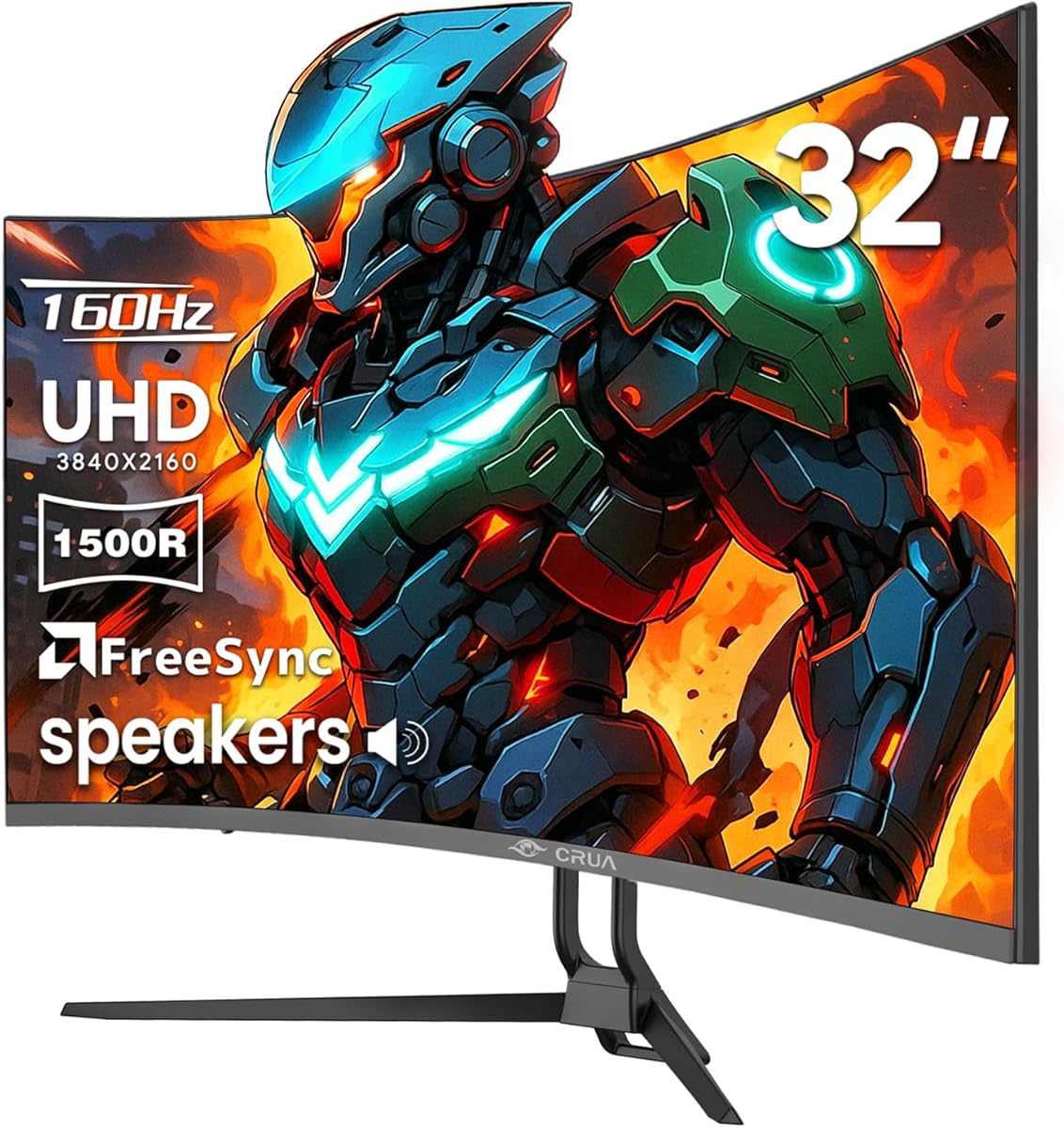
The CRUA 32 Inch 4K combines a 4K UHD curved display with a 160Hz refresh rate, giving console players high resolution and PC users a fast competitive ceiling. Its 32-inch size and 1500R curve create an expansive image that should appeal to open-world, racing, and simulation enthusiasts.
We may earn a commission when you buy through this link, at no additional cost to you.
AMD FreeSync is included for synchronized PC play, and HDMI 2.1 plus DisplayPort 1.4 connectivity supports next-generation devices. The stated color coverage of 120% sRGB, 320 cd/m2 brightness, and 3000:1 contrast ratio should provide vivid everyday visuals, while built-in speakers reduce the need for separate desktop audio.
There are some limitations compared with the top 4K choice. G-SYNC compatibility is not stated, and 320 nits is modest for premium HDR. The curved 1500R panel may also introduce geometric considerations for users who prefer flat displays, although it remains less extreme than many heavily curved gaming monitors.
This display is well suited to console owners who prioritize resolution and size while also playing high-refresh PC games. It can serve media consumption, streaming, and light content creation as well. At 4.3, its rating reflects a broad and versatile feature set rather than class-leading imaging specifications.
Native 3840×2160 resolution gives console games a sharp canvas, while HDMI 2.1 provides the appropriate modern connection for compatible hardware. The large screen and gentle 1500R curve create a more immersive presentation.
Built-in speakers, 120% sRGB color, and FreeSync make this practical for entertainment and mixed productivity. VESA 75x75mm mounting support adds flexibility for dedicated gaming-room installations.
We may earn a commission when you buy through this link, at no additional cost to you.
The Hikers 27 Inch Curved Monitor is a practical 1440p choice for console and PC gamers who want modern connectivity without moving to a 4K or premium OLED model. It supports up to 170Hz, uses a fast VA panel, and carries a 4.2 rating.
We may earn a commission when you buy through this link, at no additional cost to you.
Two HDMI 2.1 ports and one DisplayPort 1.4 connection are listed as supporting up to 170Hz. The supplied compatibility information covers PS5, Xbox, PC, laptops, and Switch, with G-SYNC compatibility over HDMI 2.1 and one HDMI 2.1 cable included. This makes the monitor a flexible middle ground for mixed-device setups.
Color specifications include 135% sRGB, 99% DCI-P3, 350 nits of brightness, and a 4000:1 contrast ratio. AI crosshair, night vision, a timer, dynamic blue-light filtering, and picture-quality tools are designed to improve visibility and focus. The compromises include the absence of speakers, a tilt-only ergonomic adjustment, and the fact that console output is constrained by 1440p rather than native 4K.
Choose this model if you want a reasonably priced 1440p display with multiple modern ports and useful gaming assists. It works well for competitive PC play, everyday console gaming, and users who value connectivity and color coverage more than a high-end panel or 4K detail.
Two HDMI 2.1 ports provide useful flexibility for a console and PC, while DisplayPort 1.4 serves high-refresh desktop workflows. The included HDMI 2.1 cable helps simplify initial setup.
AI crosshair, night vision, a timer, and picture-quality controls target common competitive needs. The 170Hz ceiling and 4000:1 listed contrast also make the display more engaging than a basic 60Hz screen.
We may earn a commission when you buy through this link, at no additional cost to you.
The Amzfast 32 Inch 4K is explicitly positioned for PS5 and Xbox gaming, and its core specifications support that focus. It combines 3840×2160 resolution, 120Hz refresh, dual HDMI 2.1 FRL ports, adaptive sync, and VRR, giving it a straightforward high-resolution console package with a 4.5 rating.
We may earn a commission when you buy through this link, at no additional cost to you.
Its 1500R curve creates a more enveloping picture, while 131% sRGB coverage, a 3000:1 contrast ratio, HDR, and 300-nit brightness support colorful gaming and general media use. PIP and PBP can be valuable for placing a console feed alongside a PC window or reference material. DisplayPort 1.4 provides another high-bandwidth input for desktop use.
Additional features include AI picture quality, AI crosshair, low-blue-light protection, anti-flicker, and anti-glare. Three-watt speakers and an audio jack provide convenient basic audio, while 75x75mm VESA support allows wall or arm mounting. The main limitation is modest brightness, which may make HDR highlights less forceful in a bright room.
This is a strong recommendation for console-first buyers who want 4K and 120Hz without moving to a higher-end OLED. It also functions well as a general entertainment display. Buyers prioritizing peak brightness, extremely deep blacks, or native 4K refresh rates beyond 120Hz should look to the ASUS or Acer alternatives.
Dual HDMI 2.1 FRL ports support up to 4K 120Hz output, matching the capabilities of current high-end console generations. Adaptive sync and VRR help maintain fluid presentation when the source and display can synchronize.
PIP and PBP support makes multitasking easy, while built-in speakers reduce desktop clutter. Anti-glare, anti-flicker, and low-blue-light features are useful additions for longer viewing sessions.
We may earn a commission when you buy through this link, at no additional cost to you.
The Acer Nitro VG270K V4 is unusual because it supports both 160Hz at 4K and an astonishing 320Hz at 1080p through Dynamic Frequency and Resolution. This dual-mode design gives competitive PC gamers exceptional speed while preserving a sharp 4K mode for consoles and less competitive titles.
We may earn a commission when you buy through this link, at no additional cost to you.
The 27-inch IPS panel has up to a 0.5ms GtG response in the listed specifications, with an overall rating of 4.2. Two HDMI 2.1 ports, DisplayPort 1.4, and an included HDMI cable provide modern connectivity. AMD FreeSync Premium, HDR 10, and 90% DCI-P3 color coverage round out a gaming-oriented feature set.
Its main conceptual trade-off is that the 320Hz figure requires dropping to 1920×1080. That is attractive for shooters and esports but sacrifices detail. The ZeroFrame design also helps create a nearly uninterrupted multi-monitor view. Adjustability is more limited than on many premium models, with tilt listed but height, swivel, and pivot not stated in the supplied data.
Choose this Acer if you alternate between console gaming and extremely fast PC matches and want one screen to handle both. It is particularly compelling for owners who can accept a lower-resolution competitive mode. At the same time, the ASUS offers a steadier 160Hz 4K-focused proposition, while the CRUA provides a larger curved canvas.
Dynamic Frequency and Resolution allows the display to run at 320Hz when 1920×1080 is selected. The up-to-0.5ms GtG response and FreeSync Premium make this mode well suited to competitive shooters.
At 3840×2160, the monitor reaches 160Hz and supports modern console workflows through two HDMI 2.1 ports. The near-bezel-free design also makes multi-monitor arrangements look cleaner.
We may earn a commission when you buy through this link, at no additional cost to you.
The AOC Q27GAZDV is a 27-inch QD-OLED monitor that combines a 240Hz refresh rate with a 0.03ms response time. Its 4.5 rating reflects a strong balance of speed, color coverage, and practical adjustment options, making it a notable option for gamers who want OLED performance and broad PC compatibility.
We may earn a commission when you buy through this link, at no additional cost to you.
The panel's stated color coverage reaches 147% sRGB and 110% DCI-P3, offering vivid imagery and high-impact highlights. HDMI 2.1 and DisplayPort 1.4 provide the connections needed for high-refresh PC play and compatible current consoles. NVIDIA G-SYNC compatibility supports smooth frame delivery on systems with suitable NVIDIA graphics hardware.
Ergonomics are a particular strength. The stand supports height, tilt, swivel, and pivot adjustment, while VESA compatibility broadens mounting options. A USB 3.2 hub and flicker-free technology add everyday convenience. The trade-off is the same one shared by most 27-inch high-end OLEDs: 1440p resolution does not provide native 4K detail, and long-term image retention requires sensible usage and care.
Choose the AOC for competitive PC gaming, rich color, and a flexible premium-style setup. It is less suitable for buyers whose main objective is maximum console detail, but it delivers the responsiveness and rich presentation sought by many fast-paced games. Among the OLED entries, its particularly strong stand adjustment and USB hub help distinguish it.
The 240Hz QD-OLED panel and 0.03ms response provide clear advantages in fast competitive games. G-SYNC compatibility helps reduce tearing when used with compatible NVIDIA systems.
Color coverage of 110% DCI-P3 and 147% sRGB supports rich visuals, while full ergonomic adjustment helps optimize posture. The USB 3.2 hub and VESA support make it easy to integrate into a permanent desk setup.
We may earn a commission when you buy through this link, at no additional cost to you.
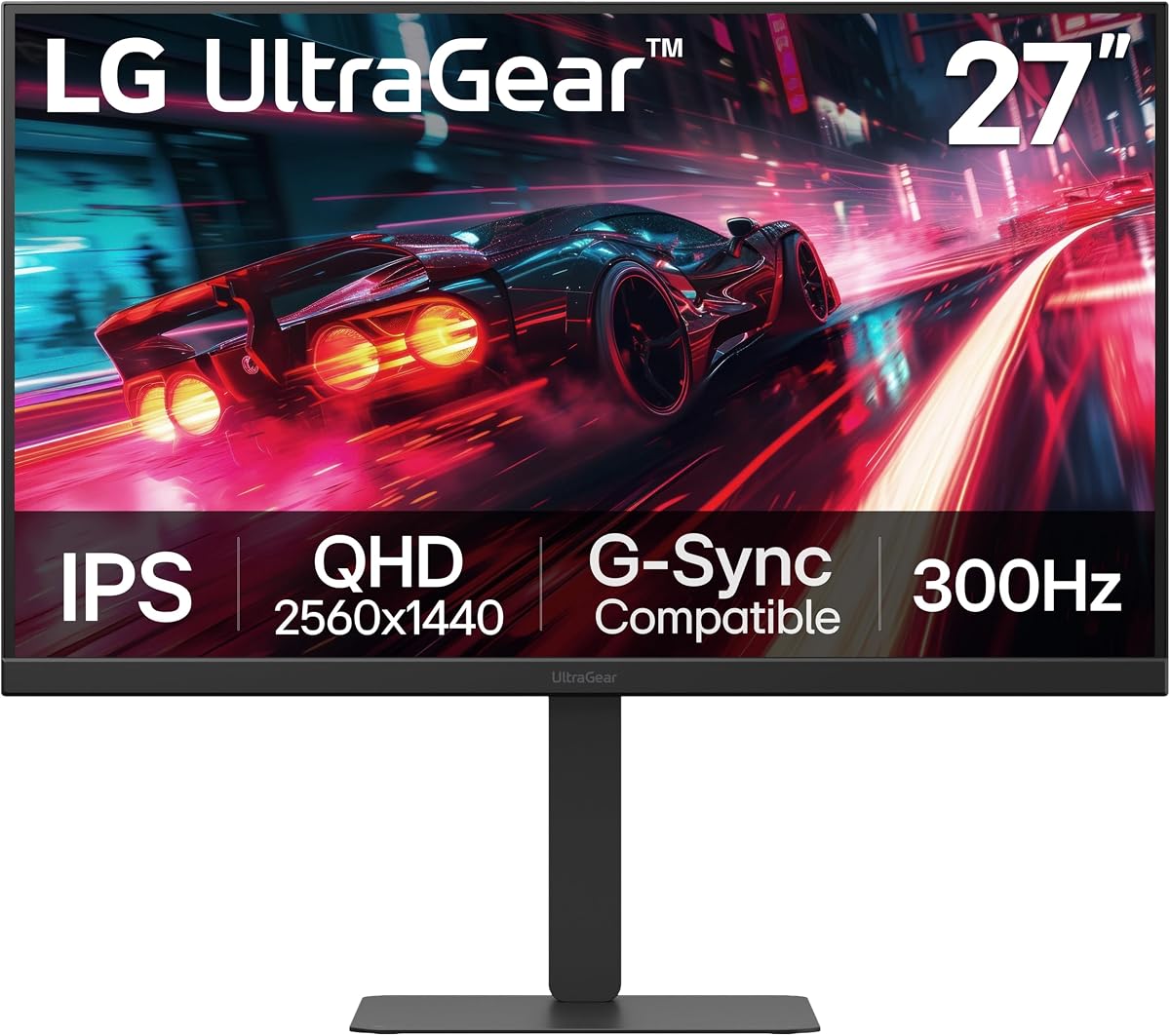
The LG 27G640A-B stands out for its 300Hz refresh rate, making it one of the fastest IPS gaming monitors in this roundup. It pairs that ceiling with a 1ms GtG response, QHD resolution, and a 4.4 rating for players who prioritize competitive PC performance while still wanting modern console connectivity.
We may earn a commission when you buy through this link, at no additional cost to you.
Its 2560×1440 IPS panel provides wide viewing angles, up to 95% DCI-P3 color coverage, and VESA DisplayHDR 400 support. Dual HDMI 2.1 ports, DisplayPort 1.4, and USB Type-C with 15W power delivery create a versatile connection set. G-SYNC compatibility, AMD FreeSync Premium, Dynamic Action Sync, Black Stabilizer, an FPS counter, and a crosshair cover the essentials.
The main limitation is that 300Hz is principally a PC advantage. Modern consoles cannot drive this display at that refresh rate, and its native QHD resolution is below the 4K standard sought by some console players. Even so, HDMI 2.1 allows the screen to serve as a capable secondary console display, especially for 1440p output and fast-paced games.
This LG is a compelling choice for competitive PC gamers who want extreme refresh capability without moving to OLED. Height, tilt, swivel, and pivot adjustments make long sessions more comfortable. It ranks below the ASUS as the broad console-and-PC recommendation because it offers no native 4K, but it remains a specialized speed option.
The 300Hz ceiling and 1ms GtG response are designed for fast competitive play. G-SYNC compatibility, FreeSync Premium, and Dynamic Action Sync provide tools for smooth, low-latency presentation.
Dual HDMI 2.1 and DisplayPort 1.4 handle high-refresh sources, while USB Type-C provides 15W power delivery. The fully adjustable stand supports better positioning for long gaming sessions.
We may earn a commission when you buy through this link, at no additional cost to you.
The right console gaming monitor depends on your hardware, screen size, and preferred genres. Resolution, refresh rate, panel behavior, HDR, and usable connectivity should be considered together rather than as isolated specifications.
Start with the resolution your console can actually deliver and the detail you want on screen. A 4K monitor such as the ASUS TUF VG27UQ1A, CRUA, Amzfast, or Acer Nitro can show console games at 3840×2160 and commonly support 120Hz modes through HDMI 2.1. QHD OLED models provide a sharper competitive PC experience, but many consoles render their games at a lower pixel density even when connected to a 1440p display.
Choose 4K when console image detail, desktop use, and future readiness matter most. Choose 1440p when you play primarily on PC, prefer a smaller 27-inch screen, or want to spend more on refresh rate, contrast, and response time.
Refresh rate determines how many frames the display can present each second, while response time influences how quickly pixels change between colors. Console users will commonly prioritize smooth 120Hz output, while competitive PC gamers may value 240Hz or 300Hz modes. The listed response times also vary: OLED models reach 0.03ms, while fast IPS and VA panels are generally specified around 0.5ms to 1ms.
Do not choose solely by the largest headline number. Confirm that the highest mode uses the intended resolution, and consider whether adaptive synchronization is supported. The LG 27G640A-B illustrates this distinction with 300Hz at QHD, whereas the Acer reaches 320Hz only at 1080p.
HDMI 2.1 is most useful when the display can actually carry the desired console mode, particularly 4K at 120Hz. Full-bandwidth or FRL implementations are especially relevant for higher resolutions and refresh rates, while the number of HDMI ports determines how easily a console, PC, and other source can be connected. Dual-port models offer convenient switching and leave room for a capture device or streaming accessory.
Check the full input list rather than looking only at the HDMI version. DisplayPort 1.4 is useful for PC gaming, USB hubs simplify peripheral connections, and USB Type-C may support cleaner desk arrangements. Also verify the included cables because not every monitor ships with an HDMI 2.1 cable.
Panel technology affects contrast, color, viewing experience, and response characteristics. QD-OLED models deliver very fast response and deep blacks, making them excellent for competitive play and cinematic console games. IPS provides wide viewing angles and consistent color, though it generally does not match OLED contrast. Fast VA can provide strong contrast on a larger ultrawide display, but its handling of dark scenes and viewing angles should be considered.
The best panel is the one that matches your priorities. Choose OLED for speed, punch, and contrast; choose IPS for a balanced, potentially brighter-looking desktop experience; and consider VA when an immersive ultrawide format matters more than the very fastest pixel response.
HDR support only delivers a convincing result when the display can maintain useful brightness, control highlights, and render dark scenes with detail. The LG 27GX704A-B lists 275 nits standard brightness and peaks of 1300 nits, while the QD-OLED displays reach stated peaks of 400 nits. The Amzfast and CRUA are listed at 300 and 320 nits respectively, which is adequate for many rooms but less dramatic in bright surroundings.
If vivid highlights, deep blacks, and cinematic contrast are central to your experience, an OLED model deserves priority. For a bright office or controlled gaming room, IPS can be a sensible alternative. Always consider the stated brightness alongside room lighting rather than treating HDR support alone as proof of superior HDR performance.
A 27-inch 4K monitor offers a high pixel density in a relatively compact footprint, making it a strong default for 4K consoles and PC. A 32-inch 4K model creates a larger, more cinematic image, while a 34-inch 21:9 ultrawide is better suited to competitive PC games, racing, and multitasking. Curvature can add immersion, but the effect depends on seating distance and personal preference.
Consider desk depth, viewing distance, and whether the monitor includes a suitable stand. The SANSUI provides a metal stand, the MSI and AOC offer broad adjustments, and the Acer has more limited listed ergonomics. Check desk clearance before choosing a wide or deeply curved display.
AMD FreeSync and NVIDIA G-SYNC compatibility can reduce tearing and stutter when the graphics source and display synchronize correctly. Console VRR is valuable when the particular monitor supports it. Crosshairs, night-vision modes, timers, and picture-enhancement tools can make competitive games easier to parse, but they are secondary to a suitable resolution, refresh rate, and low response time.
Prioritize standards-based synchronization and broad source support over a long list of minor features. OLED users should also look for burn-in-prevention tools and automatic pixel-care functions, while all users may benefit from blue-light filtering, flicker reduction, and adjustable picture modes.
Begin by selecting the correct input on the monitor and using an HDMI 2.1-certified cable when the console and display support 4K at high refresh rates. Update the console's display preferences and the monitor's operating system, then select a matching resolution and refresh rate from the on-screen controls. Avoid forcing a mode that the graphics source does not support, as this can produce blank screens, unstable output, or unintended downscaling.
Fine-tune the picture after installation. Choose the intended display mode, set brightness to a comfortable level for the room, and review console-specific options such as HDR, variable refresh, or enhanced picture processing. Competitive players can use crosshair and timer tools, while OLED users should use the available pixel-care or burn-in-prevention functions and avoid leaving static content onscreen unnecessarily.
Care for the panel according to its technology and the manufacturer's guidance. Keep vents unobstructed, clean with a soft microfiber cloth, and avoid liquids near the display. For OLED models, moderate static content and use screen savers or the automatic maintenance cycle. For IPS and VA displays, periodically checking cables, firmware, and adaptive-sync settings can maintain stable performance.
HDMI 2.1 is highly useful when you want 4K output at refresh rates such as 120Hz. It provides the bandwidth required for those combined modes, while older HDMI 2.0 connections are more often limited to lower refresh rates at 4K. A monitor labeled HDMI 2.1 should also be checked for its supported resolution and refresh-rate combinations.
Yes, but the console may render games at a lower internal resolution and then upscale them to the monitor's 2560×1440 panel. The result can still look sharp and smooth, but it will not provide native 4K detail. A 4K monitor is preferable when console image fidelity is the priority.
For current high-end console gaming, 120Hz is the key target. PC-focused monitors may offer 170Hz, 240Hz, 300Hz, or even 320Hz, but those higher rates generally require a powerful gaming PC. Confirm the maximum refresh rate at your desired resolution rather than relying on a single headline specification.
No. HDMI 2.1 provides the connection bandwidth, but synchronization features such as VRR, G-SYNC-compatible FreeSync, or AMD FreeSync Premium must also be supported and enabled. Source and display capabilities both matter, and variable refresh works within the compatible refresh-rate range.
Yes, and they can be excellent for cinematic console games because of their deep blacks, high contrast, wide color coverage, and fast response. Their main concerns are the price, glossy reflections, brightness consistency, and possible image retention. Regular use of pixel-care features and avoiding prolonged static imagery can reduce maintenance concerns.
A 4K 120Hz monitor is usually better if console gaming, sharp desktop text, and a conventional 16:9 layout are your priorities. A 21:9 ultrawide gives PC players more horizontal space and can feel more immersive in certain genres, but it usually does not deliver native 4K and can be more demanding to position correctly.
Two ports are convenient because they allow a console and PC to remain connected simultaneously, making switching easier. One port may be sufficient if you use only one source, while additional USB ports, DisplayPort connections, and headphone outputs can further improve desk integration.
For 4K at 120Hz, a cable certified for the required HDMI 2.1 bandwidth is generally necessary. Older or incorrectly rated cables may cap the available resolution or refresh rate. Check whether the monitor includes a suitable cable, because some models ship with a DisplayPort cable or a cable that does not support every advertised mode.
The ASUS TUF VG27UQ1A is the most versatile all-around recommendation, pairing 4K, 160Hz PC performance, 4K 120Hz HDMI 2.1 support, fast IPS response, and broad synchronization features. The LG 27GX704A-B leads the premium group for OLED speed, contrast, brightness, and connectivity, while the MSI MAG 274QP delivers a particularly compelling high-end feature set for value-focused buyers.
Prioritize resolution and refresh rate together. Console-first players should seek 4K 120Hz output, while competitive PC gamers may gain more from QHD at 240Hz or faster. Panel type, brightness, ergonomics, adaptive sync, and port count then determine which display best fits your room and habits. For an expansive PC-first experience, the SANSUI ultrawide remains an appealing alternative.
Before purchasing, verify the current supported display modes, included cables, console compatibility, and warranty details. Prices, promotions, and availability can change, so compare the final listing rather than relying on a previously seen amount. The right monitor should deliver the modes you actually use without unnecessary cost, complexity, or desk space.


