
Panasonic Pro 16X9 Anamorphic Lens Adaptor
5.0Editor score
16:9 anamorphic design
Compact adaptor format
Traditional cinema conversion
Five-star customer rating
Explore the best anamorphic lens adapter options, comparing squeeze factors, lens compatibility, focus methods, mounts, construction, and image effects.
An anamorphic lens adapter adds a cylindrical optical element to a conventional camera lens, creating a wider cinematic image, horizontal flare streaks, oval bokeh, and a stronger sense of depth. A worthwhile adapter should match the lens, camera, and desired squeeze factor while remaining stable, practical to focus, and compatible with the equipment you already own.
This guide compares ten adapters and adapter bundles using the specifications and product information available for each listing. It covers front-mounted 1.25x designs, rear adapters, purpose-built 1.7x systems, supported lens families, mounting structures, focus methods, maximum apertures, and the distinctive image characteristics associated with each option.
The top selections show why the best anamorphic lens adapter depends on the base lens: a flexible entry-level front adapter, a purpose-built 1.7x unit, and a compact rear adapter serve very different shooting needs. Product ratings, availability, bundle contents, and prices can change, so confirm the current listing before purchasing.
5.0Editor score

3.9Editor score
4.0Editor score
The comparison covers front and rear conversion methods, squeeze factors, focus arrangements, lens support, optical specifications, and workflow features, helping you identify the adapter that best fits your camera, base lens, and preferred cinematic look.


The SIRUI 1.25x T2.9 adapter combines a front-mounted cylindrical design with an 82mm rear thread and three step-down rings. Its 3.9 rating reflects a mixed customer response, but the published specifications make it the most comprehensively documented general option in this guide. It is designed to add a 1.25x squeeze to compatible spherical or anamorphic lenses.
We may earn a commission when you buy through this link, at no additional cost to you.
The adapter is especially interesting for owners of SIRUI Venus lenses because the listing explains how adding it in front of a 1.6x full-frame anamorphic lens increases the total squeeze to 2x. That can produce more conspicuous horizontal flare, waterfall-style bokeh, and a stronger cinematic character. Included 67mm, 72mm, 77mm, and 92mm rings broaden the available lens combinations.
Its front single focus method is the defining practical feature. Rather than requiring repeated fine adjustments between the base lens and adapter, the suggested procedure sets the base lens to infinity and focuses through the adapter alone. The tradeoff is that this arrangement is less convenient with lenses whose infinity scale or mechanics are inconsistent, and the adapter remains specifically tied to the stated thread and focus approach.
This is the most balanced choice for someone already invested in the SIRUI ecosystem and seeking a noticeable 2x conversion without assembling an entirely new lens system. Check your front thread, confirm that your base lens can be set to infinity, and verify the required rear step-ring before buying. For those conditions, the detailed specifications and included hardware make it the strongest all-around option here.
The 1.25x factor can transform the appearance of a spherical lens or increase the total squeeze of a 1.6x anamorphic lens to 2x. The result is a wider, more stylized frame with characteristics that often become easier to notice in reflections, highlights, and out-of-focus light.
Setting the base lens to infinity and focusing with the adapter simplifies a process that can otherwise involve two coupled focus systems. This is particularly useful when the adapter provides a suitable focus ring and the base lens remains locked at its infinity setting.
We may earn a commission when you buy through this link, at no additional cost to you.
This SIRUI T2.9 1.25X adapter is closely related to the first-ranked model, sharing the same 1.25x squeeze, 82mm rear thread, T2.9 maximum aperture, and front single focus arrangement. Its 3.5 rating is the lowest numerical score among the rated products in the list, so buyers should examine the current customer feedback and listing details carefully.
We may earn a commission when you buy through this link, at no additional cost to you.
The product is explicitly presented for the SIRUI Venus series, including the possibility of combining it with a full-frame anamorphic lens to move from a 1.6x to a 2x squeeze. Its included 67mm, 72mm, and 77mm step-down rings plus a 92mm step-up ring give owners several mounting paths, while the 46.5mm to 58.5mm adjustable length offers some positioning flexibility.
The principal limitation is compatibility. The title emphasizes that the adapter is only for SIRUI Venus series lenses, which narrows its appeal compared with a general threaded adapter. Its 0.8m minimum focus distance, 650g weight, 85mm front diameter, and 89.6mm maximum diameter are clearly stated, but the customer rating indicates that fit, finish, or actual performance may not satisfy every user.
Choose this option if you already own a compatible Venus lens and specifically want to add a stronger 1.25x front element. It is less compelling as a first anamorphic purchase because the included rings do not make an incompatible lens automatically suitable. Confirm the camera mount, lens front diameter, and the adapter's infinity-focus procedure before ordering.
An adjustable length of 46.5mm to 58.5mm can help a filmmaker find the best balance between the adapter and the front of the base lens. The correct orientation and spacing are essential because a front anamorphic element must sit in the proper optical position.
The adapter is built around the SIRUI Venus family, which reduces ambiguity about its intended optical and mechanical relationship. This makes it more suitable for a focused kit than for someone expecting one accessory to work across many unrelated lens brands.
We may earn a commission when you buy through this link, at no additional cost to you.
The Samyang SYCAF V-AF 1.7X is a purpose-built anamorphic conversion system for Sony FE cameras. Unlike a simple screw-on front adapter, it uses a linear rail and bayonet mount, and it lists a fast T1.9 maximum aperture. Its 1.7x squeeze can create a distinctly widescreen image with oval bokeh, horizontal flare, and a cinematic perspective.
We may earn a commission when you buy through this link, at no additional cost to you.
Compatibility is defined around the Samyang V-AF range. The listing specifically names 24mm APS-C, 35mm, 45mm, 75mm, and 100mm lenses. That broader focal-length coverage lets a filmmaker move from a wide establishing lens to a longer portrait option while retaining one consistent anamorphic system, rather than combining unrelated adapters with different image characteristics.
The integrated tally lamp is a thoughtful production feature, particularly for solo shooters who need an unobtrusive way to monitor recording status. The rail-and-bayonet structure is also described as stable for gimbals and smooth manual focusing. However, the product has no published numerical customer rating in the supplied data, making its real-world reception harder to judge from the listing alone.
This is the premium choice for a filmmaker who already owns supported Samyang V-AF lenses and works with Sony FE. Its focused compatibility, T1.9 aperture, and production-oriented mounting system offer more integration than a generic adapter. Confirm your exact lens and camera, check clearance around the mounted system, and review current customer feedback before making a final decision.
Supporting five named focal lengths is a major workflow advantage. A single squeeze and adapter architecture can create a more consistent visual language than assembling different anamorphic solutions from unrelated manufacturers.
The linear rail, secure bayonet, compact construction, and tally lamp are all oriented toward mirrorless production work. These details matter when an adapter must remain stable on a gimbal or function without a second operator monitoring every recording detail.
We may earn a commission when you buy through this link, at no additional cost to you.
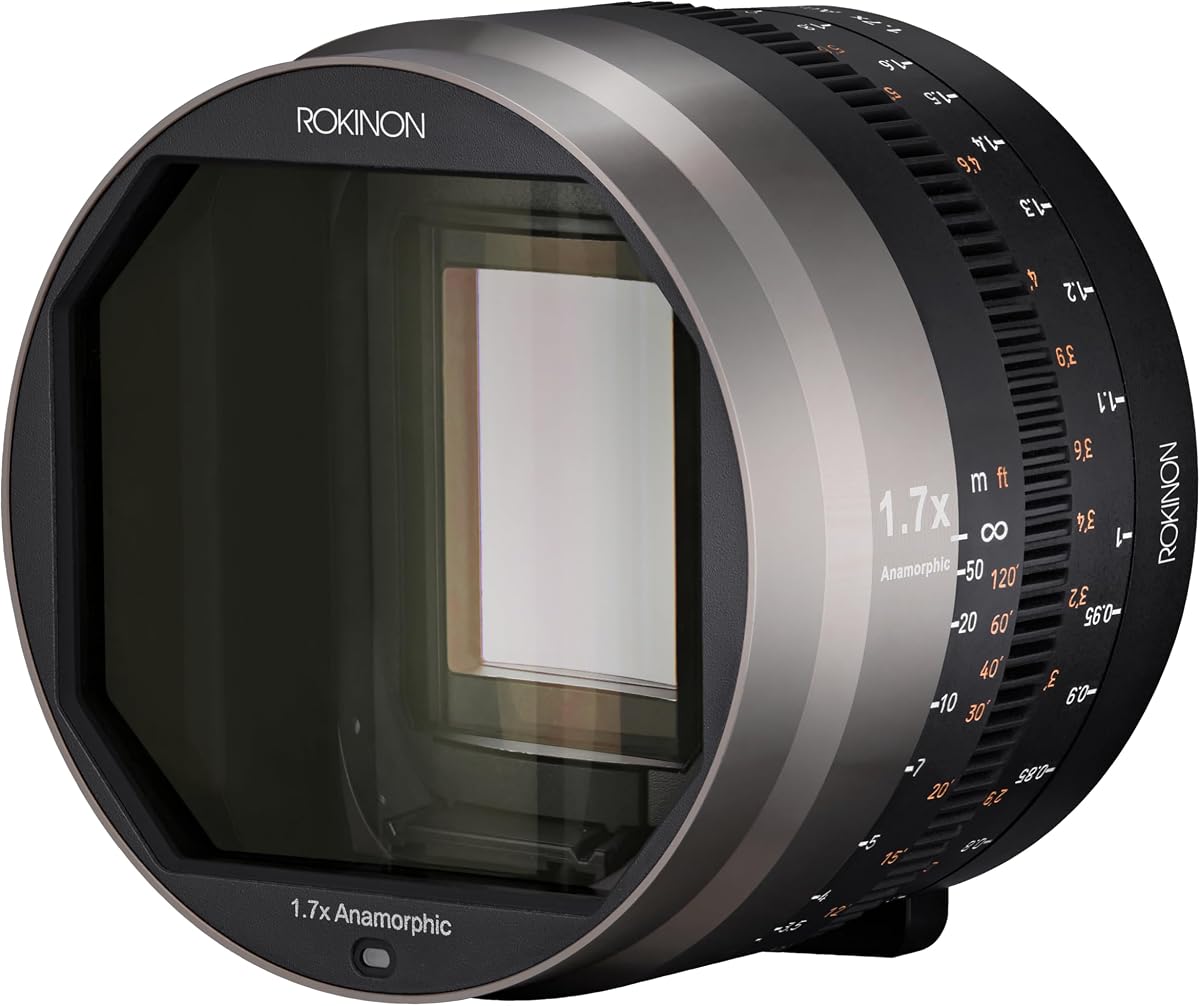
The Rokinon Cine AF 1.7X adapter is designed specifically for Rokinon Cine AF lenses and has a 4.0 customer rating. Its 1.7x squeeze is suitable for cinema-scope-style framing, while the T1.9 maximum aperture is presented as a bright conversion option for working in demanding lighting.
We may earn a commission when you buy through this link, at no additional cost to you.
The supported lenses include the 24mm APS-C, 35mm, 45mm, 75mm, and 100mm Rokinon Cine AF models. A linear rail and bayonet mount provide a more structured connection than a lightweight screw-in ring, and the built-in tally lamp adds practical awareness during solo production. These features position the adapter as a production tool rather than a novelty filter.
Its limitation is the same one that gives it value: it is not a universal solution. The MF designation indicates a manual-focus workflow, and the listed compatibility is confined to a particular lens family. While a linear rail may support stable positioning, users should confirm the intended camera mount, lens length, and mechanical clearance from the supplied product information before building a complete camera package around it.
For owners of the specified Rokinon Cine AF lenses, this is a well-focused premium system with useful brightness and workflow features. Its 4.0 rating gives it a stronger established customer signal than several other specialized units. Choose it when its lens support matches your kit and you value a consistent 1.7x look across several focal lengths.
A T1.9 maximum aperture provides a practical foundation for low-light work and shallow depth of field. The listed specification is a notable advantage for an anamorphic conversion because the cylindrical optics can otherwise make the system less forgiving.
The linear rail and bayonet mount are intended to hold the conversion system securely. A rigid arrangement can be valuable on moving rigs, where a loosely threaded adapter may shift or produce inconsistent framing.
We may earn a commission when you buy through this link, at no additional cost to you.
The Panasonic Pro 16X9 Anamorphic Lens Adaptor is the straightforward budget-oriented choice in this guide. It carries a 5.0 customer rating, the highest numeric score among the products for which a rating is supplied. Its main stated feature is a 16:9 anamorphic format, positioning it as a dedicated conversion accessory rather than a broad multi-lens system.
We may earn a commission when you buy through this link, at no additional cost to you.
For a filmmaker who understands the target camera and lens combination, this adapter can provide a more widescreen presentation without replacing an entire lens. Its appeal lies in simplicity: there are no complicated claimed workflows or multiple squeeze configurations to evaluate. The compact format also suggests a straightforward addition to a suitably configured setup.
The major tradeoff is the limited information. The supplied listing description does not state a squeeze ratio, thread size, supported lens models, maximum aperture, or focus method. Those omissions make it difficult to compare the unit confidently with the thoroughly specified 1.25x, 1.33x, and 1.7x options. Compatibility with a particular lens must therefore be confirmed from the listing and manufacturer information rather than assumed.
This adaptor makes sense for a buyer seeking a dedicated 16:9 anamorphic solution at a modest entry point. Its perfect customer rating is encouraging, but the sparse specifications limit how broadly it can be recommended. Verify mount, thread, optical orientation, and the intended base lens before buying, and avoid selecting it solely on its rating.
The adapter's dedicated 16:9 format indicates a focused conversion design. That makes it potentially useful for a filmmaker who already knows the exact lens and camera pairing needed for a widescreen image.
A 5.0 rating is notable, although a small number of reviews can carry more weight than the number suggests. Reading current feedback, photographs, and detailed compatibility notes can provide more context than the headline score alone.
We may earn a commission when you buy through this link, at no additional cost to you.
The Samyang V-AF Series Anamorphic Adapter combines a 1.7x squeeze with a T1.9 maximum aperture and a 5.0 customer rating. Its description emphasizes a 2.55:1 film ratio when used in full frame, giving it one of the most distinctly cinematic specifications among the options covered.
We may earn a commission when you buy through this link, at no additional cost to you.
Compatibility covers the V-AF 24mm in APS-C format, as well as 35mm, 45mm, 75mm, and 100mm versions. This breadth makes the adapter useful to someone building a compact focal-length set. The claimed image characteristics include creamy background blur, visible distortion, yellow flare, and oval bokeh, all of which should be considered stylistic tools rather than universal improvements.
A tally lamp supports solo content creators, while the T1.9 aperture is intended to provide good light intensity even in difficult conditions. The description does not mention a rail, bayonet, or specific camera mount in the same level of detail as the dedicated SYCAF and Rokinon listings. As a result, mechanical integration and exact fit should be confirmed for the particular camera and lens combination.
This is an attractive choice for a V-AF owner who values a pronounced widescreen frame and recognizable anamorphic artifacts. Its 5.0 rating and detailed optical description make it one of the strongest customer-rated entries, although the generic title calls for extra care when comparing it with other Samyang adapters. Confirm the current package contents and mount before ordering.
The listed yellow flare, distortion, creamy blur, and oval bokeh show that the adapter is meant to shape the image, not merely extend the frame. These effects are useful when the goal is a recognizable cinematic style.
The tally lamp provides visible recording feedback without requiring a second operator. It is a small feature, but one that can improve efficiency during solo video production.
We may earn a commission when you buy through this link, at no additional cost to you.
The 1.25x Multi-Ring Adapter is notable for offering 67mm, 72mm, 77mm, 82mm, and 92mm connections. That broader ring selection makes it one of the most adaptable options for a mixed kit of DSLR and mirrorless lenses. Its listing also states that the adapter can be expanded to a 2x effect when paired appropriately.
We may earn a commission when you buy through this link, at no additional cost to you.
Construction is described as sturdy solid material with fine workmanship intended to prevent loosening and shaking. Installation is presented as straightforward, requiring no complex adjustment or debugging. These are meaningful benefits because even a small amount of movement at the front of a lens can affect framing, focus, or the consistency of the anamorphic effect.
The supplied information does not state a maximum aperture, minimum focus distance, dimensions, focus method, or numerical customer rating. That makes it harder to predict light-gathering performance and compare it with the well-documented SIRUI options. The phrase that it can be expanded to 2x also requires careful interpretation, because the base lens and adapter arrangement will affect the final result.
This adapter is best suited to a filmmaker who values the included ring variety and simple installation over a tightly controlled lens ecosystem. Confirm the exact thread of your base lens, the optical spacing requirements, and how the 2x configuration is achieved. If those details align with your equipment, it can provide a convenient way to add anamorphic character without changing the entire lens kit.
The included 67mm, 72mm, 77mm, 82mm, and 92mm rings cover several common front-thread sizes. This variety can simplify a mixed-lens setup and reduces the need to source separate adapters for each base lens.
A secure fit is essential when adding a substantial optical element to the front of a lens. The listing emphasizes stable installation without loosening, which is particularly relevant for handheld, gimbal, and rig-based shooting.
We may earn a commission when you buy through this link, at no additional cost to you.
The 1.25x 82mm Squeeze Adapter is designed around a clear mechanical target: lenses with an 82mm thread and a maximum front diameter of 85mm. That specificity is useful for buyers who can confirm their lens matches, although it offers less flexibility than the multi-ring option with five listed sizes.
We may earn a commission when you buy through this link, at no additional cost to you.
Its 1.25x squeeze adds anamorphic characteristics to a compatible spherical or cinema lens, while the sturdy construction and firm connection are intended to prevent movement during shooting. The product is described as operational without complicated adjustment, with a plug-and-play installation that makes swapping between compatible lenses more convenient.
What the supplied information does not provide is just as important. There is no numerical rating, maximum aperture, minimum focus distance, focus mechanism, or exact camera-mount information. The adapter's performance with different lens designs may therefore vary, and the phrase supporting lenses up to an 85mm front diameter should not be interpreted as universal compatibility.
Choose this adapter if your lens has an 82mm thread, its front diameter falls within the stated limit, and you want a simple 1.25x conversion without a complex multi-element system. Verify the required physical spacing and whether your base lens can be focused comfortably once the adapter is installed. It is best viewed as a focused, straightforward option rather than a complete cinematic lens platform.
The 82mm thread and 85mm front-diameter limit give buyers two concrete checks. A lens meeting both requirements is mechanically closer to a known fit, although camera-side clearance and optical spacing still need confirmation.
The stated plug-and-play design can reduce setup time when moving between compatible lenses. A secure connection also helps maintain consistent orientation, which is essential for obtaining a repeatable anamorphic image.
We may earn a commission when you buy through this link, at no additional cost to you.
The Laowa Venus 1.33x Rear Anamorphic Adapter is a specialized PL-to-PL solution for the OOOM 25-100mm T2.9 cine lens. Rather than attaching a cylindrical element in front, it uses a rear-mounted arrangement to expand the filming canvas to a 2.35:1 ratio within a 16:9 sensor while retaining the available image resolution.
We may earn a commission when you buy through this link, at no additional cost to you.
That approach is tailored to a particular cinema-lens workflow. It is intended for filmmakers who want the broader frame and special bokeh and flare associated with anamorphic rendering while continuing to use the specified spherical OOOM lens. A rear adapter can also preserve the front of the lens for a matte box, filter, or lens-changing system, depending on the camera configuration.
The trade-off is exceptionally narrow compatibility. This is not a general adapter for PL lenses, and the title specifically identifies the OOOM 25-100mm T2.9 model. The supplied data does not include a numerical customer rating, dimensions, focus method, or additional camera requirements, so the full setup should be verified before purchase.
For a filmmaker who already uses the specified OOOM lens and PL-mounted cinema camera, the adapter is a focused route to a 2.35:1 anamorphic look. It is less suitable for general-purpose use, but the precise support and rear-mounted design make it compelling within its intended system. Confirm camera orientation, lens position, and current manufacturer guidance before ordering.
The 1.33x rear squeeze is described as retaining resolution while enabling a 2.35:1 cinematic canvas. This is useful for a rig already designed around a 16:9 PL cinema camera.
The adapter is intended to add distinctive bokeh and flares to an ordinary spherical lens. It can therefore extend the visual language of an existing cine-lens set without requiring every lens to be anamorphic.
We may earn a commission when you buy through this link, at no additional cost to you.
The SIRUI 35mm T2.9 bundle combines a full-frame 1.6x anamorphic lens with a 1.25x front adapter. That makes it different from the adapter-only entries: the buyer receives a complete 35mm anamorphic setup and can use the included adapter to increase the combined squeeze to 2x for stronger flare and bokeh effects.
We may earn a commission when you buy through this link, at no additional cost to you.
The 35mm focal length is highly versatile for narrative work, interviews, environmental shots, and many conventional cinematic compositions. Its native 1.6x squeeze already provides a strong anamorphic starting point, while the additional front element gives the user a path toward a more exaggerated 2x look without purchasing a separate lens.
The bundle remains less flexible than buying a standalone adapter for several lenses. A 35mm lens cannot cover every situation requiring a wider or longer perspective, and the supplied information does not provide a numerical customer rating or full mounting details for the included bundle. Camera compatibility, front thread, and mechanical clearance therefore need to be confirmed.
This is the most convenient all-in-one option for someone ready to shoot with one anamorphic focal length. Choose it if 35mm suits your planned work and you value the option to move from 1.6x to 2x. It is less attractive for a kit requiring multiple focal lengths, where a dedicated adapter system may offer better consistency across lenses.
The native 1.6x configuration provides a conventional anamorphic look, while the included 1.25x front adapter can create a stronger 2x combination. That gives a new kit some room to explore different amounts of horizontal flare and bokeh.
At 35mm, the lens can support a broad range of cinematic framing. It is particularly practical for dialogue, moving shots, and locations where a normal-to-wide perspective is needed.
We may earn a commission when you buy through this link, at no additional cost to you.
The right anamorphic lens adapter depends on optical placement, squeeze factor, lens support, focus behavior, image goals, and the stability of your camera system. Use the following factors to narrow the field before making a purchase.
A front-mounted adapter sits ahead of the base lens and uses a thread or adapter ring to establish the optical spacing. It is often easier to add to a collection of existing lenses, but the base lens must meet the adapter's diameter, thread, and infinity-focus requirements. A rear-mounted adapter works behind or within a compatible lens and camera mount, usually offering a more integrated result but requiring a narrowly defined system. The Laowa Venus option, for example, uses a PL-to-PL arrangement for a specified OOOM cine lens. Do not assume that a PL thread or a similar diameter makes one rear adapter interchangeable with another.
The squeeze factor describes how strongly the anamorphic optics compress the image. A 1.25x front adapter can add a moderate cinematic effect, while 1.33x rear adapters and 1.7x dedicated systems create increasingly pronounced horizontal flare, oval bokeh, and widescreen proportions. A bundled 1.6x lens with a 1.25x adapter may produce a combined 2x look. Squeeze is not the same as the final aspect ratio, and the sensor, camera crop, and delivery framing all affect what the viewer sees. Choose a factor based on how obvious you want the effect to be rather than assuming the largest number is always preferable.
Compatibility should be checked at three levels: the front thread, the maximum front diameter, and the focus behavior of the base lens. A ring that physically screws onto a lens is not necessarily optically correct. Some adapters specify that the base lens should be set to infinity, which can be difficult with lenses that lack a clear infinity mark or require breathing during focusing. Dedicated systems such as the Samyang V-AF and Rokinon Cine AF adapters limit the supported lenses but can provide more predictable mechanical and optical integration. Always check the complete model name rather than relying on a brand or focal length alone.
The maximum aperture indicates how much light the converted setup can gather and helps determine practical performance in dim environments. The purpose-built Samyang and Rokinon 1.7x adapters list a T1.9 maximum aperture, while the SIRUI Venus adapters list T2.9. A lower T-number generally means a brighter system, but real exposure also depends on the base lens, transmission losses, camera sensor, and chosen shutter speed. Do not treat the adapter's maximum aperture as a promise of identical performance with every supported lens. Confirm the T-stop and ensure that your camera and workflow can accommodate it.
Some front adapters use a single-focus method: the base lens is locked at infinity and the adapter's focus ring controls the subject distance. This can make focusing more intuitive because only one ring needs attention. Other arrangements may preserve conventional focusing but demand more precise optical spacing. The adapter must sit in the correct position relative to the lens entrance pupil; an adapter that can be threaded on is not automatically positioned correctly. The SIRUI listing provides a 46.5mm to 58.5mm length range, giving some adjustment, while the other listings do not provide equivalent measurements. Follow the stated installation procedure and avoid forcing a lens into a focus range it was not designed to use.
An adapter adds length, weight, and a projecting optical element to the front of a camera. That can affect balance on a gimbal, collide with a matte box, or create unwanted movement if the connection is loose. Dedicated systems using a linear rail and bayonet mount are designed for more stable positioning. Threaded adapters can still work, but the fit should be checked for wobble, and any loose thread should not be forced or used as a substitute for a proper step ring. Consider the complete camera profile, lens support, filter clearance, and top or bottom cage attachments rather than evaluating the adapter in isolation.
Anamorphic adapters are aesthetic tools. The listed results include horizontal blue flares, waterfall-style bokeh, yellow flare, visible distortion, creamy blur, and a wider cinematic frame. Different squeeze factors and lens designs will not produce identical artifacts, and the strongest effects often appear when a bright point source crosses the frame. If you need subtle correction and consistent sharpness above all else, a spherical setup may be more appropriate. If you want recognizable widescreen imagery and expressive highlights, an anamorphic adapter is a better fit. Consider whether the base lens is suitable for the wide, edge-sensitive optics commonly associated with anamorphic shooting.
Tally lamps, bayonet mounts, linear rails, and included step rings can materially improve a shooting workflow, particularly for solo creators or gimbals. These features do not replace core optical compatibility, but they can make repeated setup faster and more dependable. Customer ratings are also useful, especially when recent feedback discusses fit, flare consistency, or focus behavior. The Panasonic adaptor has a 5.0 rating but little technical information, while several newer systems have detailed specifications but no published rating. Use both kinds of evidence: read the specifications for fit and function, then examine recent reviews for practical observations.
Begin by confirming that the camera, base lens, and adapter belong to a supported combination. Check the thread, maximum lens diameter, required rear ring, and whether the base lens must be set to infinity. With the camera off, attach the correct ring or bayonet component, thread the adapter onto the lens if applicable, and ensure that the cylindrical element is oriented correctly. Do not force a connection or use threads that appear to cross or bind.
Before adding the adapter to a completed rig, perform a stationary focus and framing check. Lock the base lens at its specified starting position, focus at a known subject distance, and confirm that the image remains sharp and that the adapter does not rotate or shift. Check full-frame, APS-C, or other crop modes because the available image area and focal behavior may change. On a moving rig, add support and rebalance the camera after the adapter's weight and length have altered the center of gravity.
Clean only the surfaces recommended by the manufacturer, using a lens-safe method and avoiding fluid near unconfirmed coatings. Keep the adapter caps on when it is not in use, inspect threads and bayonet contacts for dirt, and protect the projecting glass from impact. Store the unit in a padded, dry environment and avoid leaving it attached to a lens in a hot vehicle. If exposure, flare, focus, or mechanical behavior changes, stop using the setup and recheck spacing, cleanliness, and compatibility.
An anamorphic lens adapter adds cylindrical optics that squeeze a wide image horizontally, allowing the camera to create a widescreen frame and characteristic effects such as horizontal flare and oval bokeh. The adapter does not simply crop the image; it changes the optical rendering. Results vary according to squeeze factor, base lens, camera sensor, and framing settings.
No. You need to match the adapter's front or rear connection, thread size, optical spacing, maximum lens diameter, focus method, and sometimes the exact lens family. Products such as the Samyang and Rokinon 1.7x adapters support named V-AF and Cine AF lenses, while the Laowa adapter is designed around a specific OOOM cine lens and PL-to-PL connection.
A 1.7x adapter generally creates a more pronounced anamorphic appearance, with stronger horizontal flare, wider proportions, and more noticeable bokeh shaping. A 1.25x adapter can be more versatile and may produce a subtler effect. The better choice depends on your base lens, preferred framing, and whether the extra optical character suits the footage.
A front single-focus design may divide focusing between the base lens and adapter, but requiring the base lens to remain at infinity simplifies that process. In this arrangement, the adapter's focus ring controls subject distance while the base lens supplies the correct image distance. If your lens has an inaccurate infinity scale or cannot be locked reliably, a conventional-focus adapter may be easier to use.
They can affect sharpness, distortion, vignetting, flare behavior, and exposure compared with using the base lens alone. The result depends heavily on correct optical spacing, sensor size, crop mode, and lens compatibility. A listed maximum aperture provides only part of the story because transmission losses and the base lens also influence the final brightness.
A front adapter mounts in front of the lens and is commonly attached with a thread or step ring. A rear adapter sits behind the lens and connects within a defined camera and lens-mount system. Front options can support several existing lenses, while rear adapters are usually narrower but may integrate more directly with a cinema camera setup.
You need a step ring when the adapter's attachment thread does not match the base lens's front thread. Step-down rings connect a smaller lens thread to a larger adapter thread, while step-up rings connect a larger lens thread to a smaller adapter thread. The correct ring must match both diameters and must be securely seated.
Yes, because the optical conversion works in a still camera as well as a video camera. You may need to frame the widescreen image manually or crop it in post. The effect can be especially visible in reflections, city lights, and other bright highlights, although the final composition should be planned around the adapter's projected image circle and sensor coverage.
The SIRUI 1.25x Venus adapter stands out as the most fully documented all-around option, offering a T2.9 maximum aperture, multiple rings, front single focus, and a path from 1.6x to 2x squeeze. The Panasonic Pro 16X9 adaptor serves as a budget-oriented dedicated solution with a strong customer rating, while the Rokinon Cine AF 1.7X offers the premium combination of a 1.7x squeeze, T1.9 aperture, stable rail mount, and tally lamp.
Your priorities should begin with exact lens and camera compatibility, followed by the type of anamorphic effect you want to create. Choose a dedicated 1.7x system for a stronger, more consistent look; consider a 1.25x front adapter for flexibility; and investigate a 1.33x rear adapter only if your PL-based cinema setup supports it. Focus method, aperture, mechanical stability, and rig clearance are just as important as the headline squeeze factor.
Finally, revisit current product listings before purchasing because prices, ratings, bundle contents, and availability can change. Check the included rings, mount type, focus instructions, and stated lens support, and read recent customer feedback for fit and image-quality observations. The right anamorphic lens adapter is the one that matches your existing equipment and reliably supports the cinematic result you want to create.