
HONGUAN 40W 2000 CFM Solar Attic Fan
5.0Editor score
40W monocrystalline solar panel
Hybrid solar and AC power
Adjustable thermostat controls
Solar roof vent exhaust fans help remove trapped heat, moisture, and stale air from attics, garages, sheds, warehouses, and other enclosed spaces without conventional electrical wiring. A strong model should combine useful airflow with durable outdoor construction, dependable solar operation, and an installation method appropriate for the building and roof type.
This guide compares ten solar-powered vent fans using the information supplied for each product. The comparison covers airflow, solar-panel and motor specifications, thermostat controls, hybrid-power options, housing materials, installation considerations, and suitable applications. Solar-only, hybrid, smart, and container-specific designs are included so buyers can compare different operating approaches.
The top picks show why high output alone is not the only consideration: dependable controls, outdoor durability, and the right fit for the installation can matter just as much. Products are listed in their supplied rank order, with practical guidance throughout. Prices and availability can change, so readers should confirm current details before purchasing.
5.0Editor score

4.5Editor score

4.8Editor score
As an Amazon Associate we earn from qualifying purchases.
The comparison below highlights the major differences among these ten solar roof vent fans, including power capacity, airflow, controls, construction, and the environments each model is designed to ventilate.
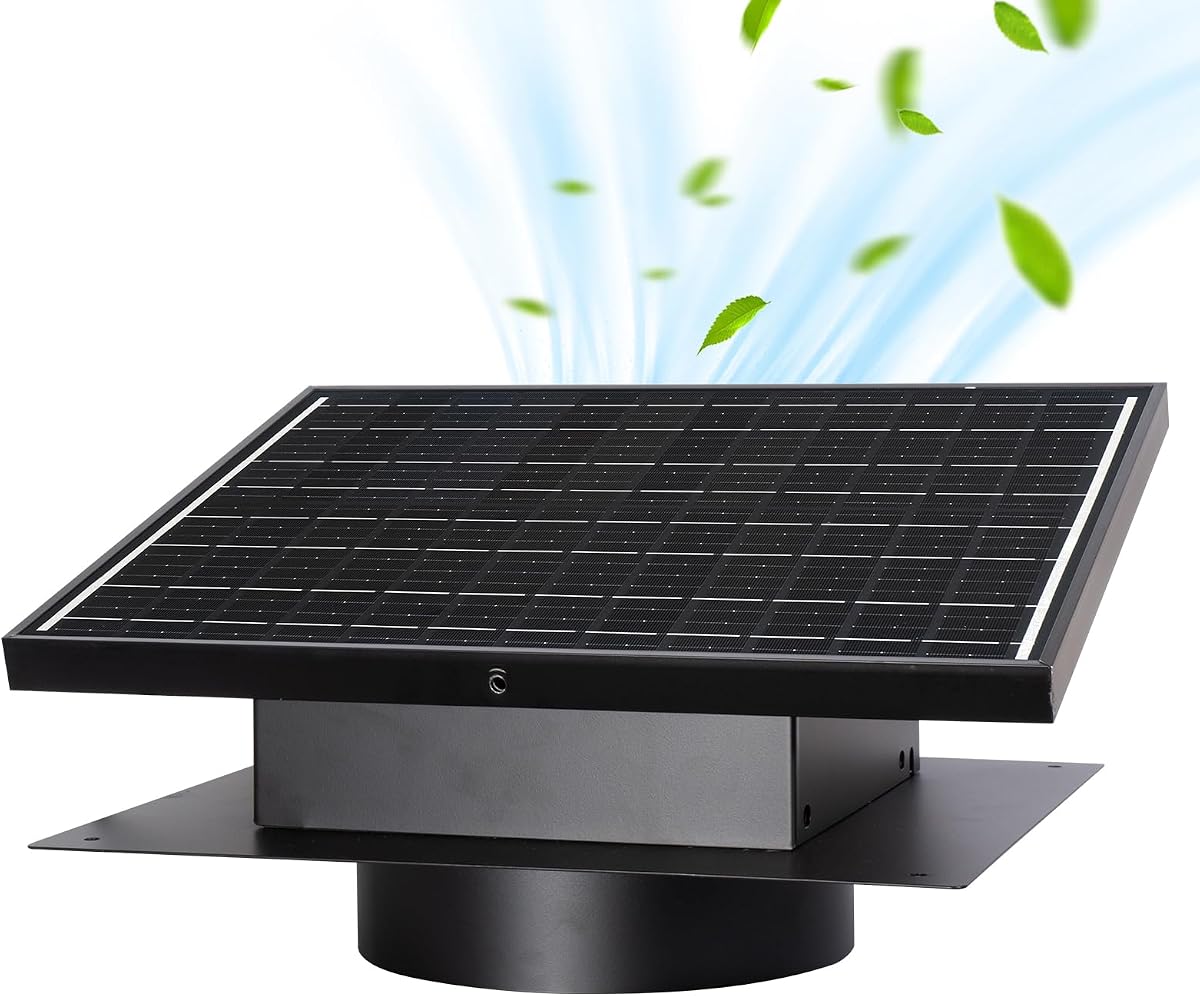


This 40W solar attic fan combines a large 12-inch blade with a stated maximum airflow of 2000 CFM, placing it among the highest-output models in this guide. Its 4.5 rating reflects a balance of substantial ventilation performance, simple operation, and robust outdoor construction. The controller-free design is especially appealing for buyers who want automatic ventilation without configuring a thermostat or managing multiple operating modes.
We may earn a commission when you buy through this link, at no additional cost to you.
The fan is built around a pure copper motor described as heavy-duty and IP65 weather resistant. Its metal housing is designed to resist hail and general outdoor exposure, while 12-inch metal blades support the high-airflow positioning. The solar panel and fan arrive pre-connected, which reduces the amount of electrical work and makes the unit appealing for a straightforward DIY roof installation.
Its principal limitation is that operation depends on sunlight, so nighttime and heavy-cloud ventilation will not be available unless another system is used. It also lacks the temperature control, AC fallback, remote access, and adjustable fan speeds found on several hybrid competitors. Those omissions make it less flexible for users who need constant airflow or precise automatic cutoffs, but they also explain its uncomplicated operating approach.
This is a strong recommendation for homeowners, garage owners, and workshop operators seeking high airflow with minimal controls. Buyers should confirm that the roof opening and structural area can accommodate a 12-inch installation and place the panel where it receives unobstructed sun. For simple daytime exhaust without wiring, its output and construction make it the most versatile choice in the list.
The combination of 40W solar input and 12-inch blades makes this model suitable for larger attics and enclosed outbuildings where substantial air exchange is the priority. Its automatic sunrise operation and shutdown at dusk provide consistent daytime ventilation without thermostat programming.
A metal housing, hail-resistant construction, and an IP65 copper motor support outdoor durability. The pre-connected panel and fan also reduce installation complexity, although buyers should still carefully seal the roof penetration and follow the supplied setup guidance.
We may earn a commission when you buy through this link, at no additional cost to you.
This compact 25W model is built around an 8-inch removable roof vent and an IP68 brushless DC motor. Its stated maximum airflow of 240 CFM makes it more appropriate for compact attics, workshops, shops, warehouses, and similar spaces than for large areas needing aggressive whole-home exhaust. The supplied 4.0 rating reflects useful construction features paired with output limitations inherent to its smaller format.
We may earn a commission when you buy through this link, at no additional cost to you.
The galvanized steel cover and polyester powder coating are designed to resist corrosion, while the aluminum mesh helps keep birds and other small animals from entering through the vent. A 25W single-crystal panel supplies energy, and the tempered glass surface and aluminum frame are intended to improve solar capture. A pipe extension beneath the flange adds flexibility during installation.
Because the unit stores no electricity, it depends entirely on current sunlight. The product information explicitly warns that cloud cover or shadows can reduce output, cause low-speed operation, or stop the fan altogether. It therefore offers less consistent ventilation than hybrid models, and the modest 240 CFM rating may not satisfy users with larger attics or very high heat loads.
This fan is best for a small roof opening, a compact garage, a shop, or an auxiliary ventilation point where a full-size 12-inch unit would be unnecessary. Buyers should prioritize unobstructed panel placement and ensure the removable vent can be connected to a flexible pipe if required. For those needs, its compact design, mesh protection, and corrosion-resistant cover are persuasive features.
The 8-inch removable vent is easier to accommodate in compact roofs and secondary structures than larger 12-inch assemblies. Rated up to 240 CFM in sunny conditions, it works best where the required heat and moisture removal is moderate.
The fan has no battery storage, and shadows can significantly reduce its speed or stop it. Positioning the panel away from obstructions is therefore one of the most important installation considerations for consistent performance.
We may earn a commission when you buy through this link, at no additional cost to you.
The iLIVING HYBRID Ready fan combines a 40W solar panel, a 14-inch nylon-fiber-aluminum blade, and an included smart thermostat. It produces 1150 CFM and is described as capable of cooling areas up to 2900 square feet. Its 4.4 rating makes it a credible option for buyers who want intelligent controls and a large blade in a hybrid-ready design.
We may earn a commission when you buy through this link, at no additional cost to you.
The thermostat can be adjusted from 50°F to 122°F and includes an enable and disable function. That broad range allows operation in either heating or cooling situations rather than restricting the fan to hot-weather ventilation. The solar panel can be angled at 0, 15, 30, or 45 degrees, helping installers orient it toward available sunlight. An IP68 brushless motor is also specified.
The important qualification is that the non-stop day-and-night AC/DC adapter kit is sold separately under model ILG8SF304. As supplied, the product is not a complete continuous-power solution unless the compatible kit is added. Buyers who need ventilation around the clock should account for that extra component, while those focused on solar daytime operation can still benefit from the thermostat and adjustable panel.
This model suits large attics and users who want temperature-based automation or plan to expand it with continuous power. The broad thermostat range, 14-inch blade, and panel-angle choices make it versatile, but potential buyers should confirm the optional kit and verify roof dimensions before ordering. It is a strong smart-control alternative to simpler controller-free fans.
A 50°F to 122°F thermostat range makes the fan useful in a wider set of conditions than temperature controls limited to hot-weather operation. Users can enable or disable automatic responses as seasonal needs change.
The fan is hybrid ready, but the listed non-stop AC/DC adapter kit is not included. Homeowners who require uninterrupted nighttime or cloudy-day ventilation should verify the correct ILG8SF304 kit before installation.
We may earn a commission when you buy through this link, at no additional cost to you.
The Hon&Guan 25W fan is a compact hybrid option that combines solar and AC power with a temperature probe and adjustable speed control. It delivers up to 320 CFM and is marketed for spaces up to 1300 square feet. Its 4.8 rating is among the strongest in this guide, making it especially attractive for buyers seeking capable controls at a relatively accessible price point.
We may earn a commission when you buy through this link, at no additional cost to you.
Two operating modes provide flexibility. Eco Mode primarily uses solar power while the AC adapter supplies enough energy to maintain minimum speed, and available solar energy can increase output. Performance Mode uses the adapter and offers four adjustable speed levels. The included 25W waterproof panel measures 17 by 13 inches, and its freely adjustable angle helps improve exposure to available sunlight.
The temperature probe automatically activates the fan when the attic reaches the chosen value and switches it off after the temperature falls below that setting. The adjustable range is 68°F to 113°F. Compared with controller-free products, this provides more precise operation; compared with larger 2000 CFM models, it has less capacity and a smaller likely use area.
This is an excellent choice for small and medium attics, garages, and sheds where continuous operation and simple automation are priorities without the space demands of a 12-inch system. Buyers should ensure the included adapter can reach a suitable outlet and that the panel has clear sun. It is especially well suited to users who want more control than a basic solar-only fan.
The included AC adapter allows the fan to continue operating at night or during cloudy weather. This removes the common solar-only limitation and makes temperature control more dependable across changing conditions.
A temperature probe, adjustable 68°F to 113°F range, and four speed levels allow more precise management than basic on-and-off solar models. Eco and Performance modes further separate energy-conscious use from maximum adapter-assisted operation.
We may earn a commission when you buy through this link, at no additional cost to you.
This 12W fan is specifically designed for 3.5-inch ribbed roofs and shipping containers. Its brushless fan produces 630 CFM, which is meaningful for a unit using only 12 watts. The product carries a perfect 5.0 rating, making it the highest-rated option in the supplied data, though its specialized application makes that rating most relevant to a compatible installation.
We may earn a commission when you buy through this link, at no additional cost to you.
The container-specific format should simplify fitting compared with adapting a general attic fan to corrugated metal. A mounting kit and manual are included, and the solar-powered design needs no grid connection or electrical wiring. It can be used to release heat and excess moisture from workshops, equipment storage, container offices, and dry-storage spaces where summer heat becomes problematic.
The tradeoff is clear specialization. Buyers with a different roof profile may find that the fit is unsuitable, while users wanting round-the-clock ventilation will have no AC fallback because the product is solar-only. It also does not offer thermostat control, adjustable fan speeds, or remote operation. The lack of controls is acceptable for a straightforward ventilation device, but less suitable for automated whole-attribute management.
This is the best choice among the list for a container, conex container, or other structure with the specified 3.5-inch ribs. Measure the roof profile before ordering, as the product information explicitly recommends. For the right structure, its compact, wiring-free design and 630 CFM airflow provide a focused solution without the size or complexity of a larger attic fan.
The container-specific mounting approach is a major advantage over forcing a general-purpose roof vent onto corrugated metal. Buyers should still verify the stated 3.5-inch rib measurement and inspect the surrounding roof for obstructions.
A 12W panel and 630 CFM brushless fan provide meaningful ventilation with a relatively compact power requirement. The direct solar design is especially useful in remote workshops, offices, and storage containers without electrical service.
We may earn a commission when you buy through this link, at no additional cost to you.
This 40W system combines 2000 CFM maximum airflow with a thermostat, MPPT controller, four speed levels, and hybrid power. It is designed to ventilate areas up to 2500 square feet and carries a 4.4 rating. Compared with simpler solar fans, it offers one of the most comprehensive control packages in this guide while retaining high airflow capacity.
We may earn a commission when you buy through this link, at no additional cost to you.
The solar panel adjusts from 0 to 70 degrees both horizontally and vertically, which gives installers considerable freedom in directing it toward the sun. Energy Saving Mode varies output with available sunlight, while the AC/DC adapter supplements solar power. Performance Mode provides four speed settings, with level four delivering the maximum output. The thermostat can start or stop the fan at a selected temperature from 68°F to 113°F in either mode.
With the adapter connected, the system prioritizes solar power on sunny days and uses household electricity when solar production is weak or unavailable. The product information clearly states that there is no battery backup and that the AC/DC adapter is required for Performance Mode. Its wiring is extensive, including separate panel, fan, and adapter cables with stated lengths and connector types.
This model is well suited to larger attics, workshops, and garages where high airflow, automatic temperature control, and nighttime ventilation are all priorities. Installation requires more care than a plug-and-play solar unit, and roof penetrations must be properly flashed and sealed. Buyers who want advanced control and strong output will find one of the most versatile systems here.
The MPPT controller and adjustable panel help capture usable solar output, while Energy Saving Mode automatically responds to available sunlight. The hybrid arrangement provides continuity without relying on a battery system.
Four speed levels and a broad thermostat range make it possible to balance airflow against energy use. Performance Mode requires the included AC/DC adapter, and the extensive wiring should be planned before installation.
We may earn a commission when you buy through this link, at no additional cost to you.
The 55W hybrid fan combines a relatively large solar panel, 1300 CFM airflow, temperature control, and wireless remote access. It carries a 4.7 rating and is designed for attics, garages, sheds, greenhouses, and other roof-mounted ventilation applications. The remote and hybrid design distinguish it from more basic models that operate only in direct sunlight.
We may earn a commission when you buy through this link, at no additional cost to you.
Its thermostat starts the fan at a configurable 77°F and shuts it off at 68°F, allowing the unit to respond to heat without continuous manual intervention. The 65-foot wireless remote lets users adjust speed, change temperature settings, or manually switch the fan on and off without climbing onto the roof. A 55W monocrystalline panel and automatic AC fallback support operation during cloudy periods and at night.
Construction details include a waterproof, UV-protected, rust-resistant aluminum housing and a brushless DC motor. The included waterproof flashing and plug-and-play design are intended to simplify roof installation, while low noise is another stated benefit. The claimed 15°F to 20°F attic temperature reduction should be understood as a product claim whose real result depends on attic conditions, insulation, airflow paths, and weather.
This is a strong option for owners who want remote convenience, temperature automation, and consistent ventilation without climbing onto the roof. It is less suitable for buyers seeking the simplest possible installation or absolute all-solar independence, because hybrid operation depends on access to AC power. Subject to proper flashing and sealing, it offers an unusually convenient control experience.
The 65-foot wireless remote is a meaningful convenience for roof-mounted equipment. Users can change speed, temperature, or power state without direct roof access, making the fan easier to manage day to day.
The aluminum housing is described as waterproof, UV-protected, and rust resistant, while the included flashing helps manage the roof penetration. A brushless motor supports smooth, low-noise operation.
We may earn a commission when you buy through this link, at no additional cost to you.
The Bghdas 25W is a straightforward 8-inch solar roof vent with 240 CFM airflow and a 12V brushless motor. Its 3.6 rating is the lowest among the selected products, so buyers should assess its basic specification set carefully. The model remains relevant for small structures where a simple, direct-solar fan is sufficient.
We may earn a commission when you buy through this link, at no additional cost to you.
Galvanized steel construction and an aluminum mesh guard are designed for outdoor use and to discourage birds, insects, and small animals from entering. The fan and solar panel use a plug-and-play connection, and the package includes pre-drilled holes and screws. It can be used in attics, garages, sheds, sunrooms, chicken coops, and other small or medium spaces needing regular air exchange.
Like other battery-free solar products, it depends on direct sunlight for peak operation. It may slow or stop in low light, and the stated 240 CFM figure is well below the capacity of the larger 12-inch models. There is no hybrid fallback, thermostat, speed control, or remote access. Consequently, it cannot provide the consistent overnight ventilation or automated response offered by more advanced competitors.
This model makes the most sense for a straightforward secondary installation or a small enclosed space where minimal controls are acceptable. Its galvanized body, mesh protection, and easy mounting provisions help compensate for limited output and features. Buyers should position the panel in full sun and choose it only when moderate daytime ventilation is enough for the application.
The battery-free design avoids battery replacement and routine battery maintenance. The tradeoff is that output depends on sunlight, so cloudy conditions and nighttime can reduce or stop airflow.
The 8-inch galvanized steel housing, mesh guard, pre-drilled holes, and plug-and-play connection make this an approachable installation. Its 240 CFM rating is best matched to compact areas and moderate ventilation needs.
We may earn a commission when you buy through this link, at no additional cost to you.
The HONGUAN 40W model combines 2000 CFM airflow, a 40W monocrystalline panel, MPPT control, hybrid power, and an independent thermostat. It is described as suitable for areas up to 2500 square feet and carries a perfect 5.0 rating. Its feature set and strong customer feedback place it among the most complete options in the guide.
We may earn a commission when you buy through this link, at no additional cost to you.
Energy Saving Mode adjusts airflow according to available sunlight, with the AC/DC adapter available as supplemental power. Performance Mode uses the adapter and provides four speed levels through the controller knob. The thermostat operates from 68°F to 113°F, starting the fan when the selected temperature is reached, and it can be disabled for continuous solar ventilation.
The panel adjusts from 0 to 70 degrees horizontally and vertically to improve exposure throughout the day. The IP65-rated fan, controller, AC/DC adapter, mounting template, brackets, screws, manual, and service card provide a broad installation package. The trade-off is complexity: Performance Mode needs the adapter, and the controller and temperature probe add installation requirements compared with a basic solar fan.
This is an excellent match for larger attics, workshops, garages, greenhouses, and other spaces needing high airflow with automated operation. Buyers who want solar independence with no electrical connection should choose Eco Mode without continuous adapter support. For everyone else, the combination of output, MPPT management, thermostat control, and installation accessories offers a particularly complete package.
The MPPT controller and two operating modes separate solar-responsive ventilation from adapter-assisted performance. Users can prioritize energy savings or select one of four stronger speed levels when consistent airflow matters more.
A 40W monocrystalline panel and 2000 CFM capacity support larger enclosed spaces, while the adjustable panel angles improve solar capture. The included roof hardware and documentation make this a well-equipped installation.
We may earn a commission when you buy through this link, at no additional cost to you.
This 10W roof vent uses a 12V solar system and a 9.8-by-9.8-inch panel to support lightweight daytime ventilation. Its 4.8 rating indicates strong customer satisfaction, while the aluminum alloy housing distinguishes it from many galvanized-steel competitors. It is positioned for attics, garages, warehouses, greenhouses, barns, and other enclosed areas.
We may earn a commission when you buy through this link, at no additional cost to you.
The square panel is designed to maximize solar absorption and should face direct sunlight for effective energy conversion. The product requires no complex wiring or electrical connection, and its pre-drilled mounting holes and included hardware streamline installation. Aluminum alloy offers a rust-proof, lightweight structure that may appeal to installers concerned about weight or long-term surface corrosion.
The product information does not provide a CFM airflow figure, making direct output comparison difficult. Its 10W panel is also the smallest listed capacity, so users should not assume performance comparable to 40W or 55W systems. There is no hybrid power, thermostat, remote, or adjustable speed control, and nighttime ventilation is not expected.
This fan is best for a modest ventilation need in a small or medium structure where simple daylight operation is sufficient. Buyers should seek clarity on the expected airflow for their particular opening, then ensure the 9.8-inch panel can be positioned without shade. For a straightforward aluminum unit with an easy mounting process, it remains a compelling compact option.
The aluminum alloy housing is described as sturdy, rust proof, and suitable for long-term outdoor exposure. Its relatively light construction can simplify handling during installation, subject to proper roof anchoring.
With a 10W panel and 12V system, the fan is best matched to smaller ventilation demands. No airflow rating is supplied, so prospective buyers should compare the opening size and expected heat load carefully.
We may earn a commission when you buy through this link, at no additional cost to you.
The right solar roof vent exhaust fan depends on the size of the space, available sunlight, roof construction, desired operating schedule, and the amount of control you need. Reviewing these factors before ordering can prevent an installation that is undersized, incompatible, or unable to operate consistently.
Airflow is the clearest way to compare the output of larger solar attic fans, but the figures must still be interpreted in relation to the space. Products range from compact units specified at 240 or 320 CFM to 12-inch systems claiming 1300, 1150, or as much as 2000 CFM. The 630 CFM container model occupies a useful middle position, while one compact 10W product does not publish a CFM rating. A higher number generally indicates greater potential air movement, but actual attic cooling also depends on the space, insulation, intake paths, and outdoor conditions.
Match the fan to the volume and heat load rather than relying on a stated coverage number alone. Larger systems may suit broader attics and workshops, while smaller fans can be appropriate for shops, sheds, and targeted ventilation points.
A solar-only fan operates without wiring but naturally depends on sunlight. Several products in this list explicitly warn that clouds, shadows, or nighttime can reduce output or stop the fan. That behavior can be acceptable for a daytime exhaust device, especially in a remote building, but it may be undesirable where heat accumulates overnight or ventilation must remain steady. Hybrid products include an AC adapter to support operation in Eco Mode, provide continuous runtime, or enable a separate Performance Mode.
Choose solar-only operation for simplicity and no electrical connection. Choose hybrid power when uptime, automated control, or nighttime ventilation is important and an outlet can be reached safely.
Solar panel wattage, surface type, and mounting position influence how much energy the fan receives. Listed capacities range from 10W to 55W, with adjustable-angle panels available on several of the higher-output products. A larger monocrystalline panel can be valuable where available sunlight varies, while a compact 25W or 10W model may be sufficient for a smaller opening. Every solar-only design needs direct, unobstructed exposure, and even hybrid systems benefit from a strong solar contribution.
Prioritize a panel that can face the sun through the useful part of the day. Check the proposed orientation, nearby obstructions, roof pitch, and cable route before installation.
Thermostat control can prevent unnecessary ventilation and make a fan adapt to changing attic temperatures. The iLIVING model has the broadest stated range at 50°F to 122°F, while the HONGUAN, Hon&Guan, 40W smart, and 55W hybrid products use ranges of 68°F to 113°F or closely related cutoffs. Fans with several speed levels give users more control than basic solar-only units that accelerate and slow according to available sunlight. Wireless remote access is offered by the 55W model.
Decide whether automatic temperature cutoffs are worth the extra setup. Simple controller-free operation is easier, while thermostat and speed controls are more useful for changing spaces and seasonal conditions.
Not every fan suits every roof. The 12W container model targets a specific 3.5-inch ribbed profile, while the 8-inch products are better suited to smaller openings. Larger 12- and 14-inch units need adequate space around the fan and a structurally sound mounting area. Kits, templates, pre-drilled holes, brackets, screws, flashing, and removable vents differ considerably across the products. Some solar panels and fans arrive pre-connected, while others require several specified cable connections.
Measure the roof opening and ribs before ordering, and check the complete hardware list. Proper flashing and sealing are as important as the fan itself for preventing leaks and air bypass.
Roof-mounted equipment faces sun, rain, wind, dust, insects, and temperature extremes. Options include galvanized steel with powder coating, heavy-duty metal housing, aluminum alloy, and nylon-fiber-aluminum blades. Motor protection ranges from an IP68 brushless design in several products to an IP65 pure copper motor in the 2000 CFM controller-free model. A brushless motor generally reduces mechanical wear, while the housing material influences weight and corrosion resistance.
Look for a stated outdoor protection rating and durable housing rather than assuming all units are equally weather resistant. Confirm that the roof location provides clearance and that the installation does not obstruct critical roof components.
The listed use cases range from large attics and homes to workshops, garages, sheds, warehouses, greenhouses, barns, sunrooms, chicken coops, and shipping containers. Some products are general-purpose, while the container fan has a deliberately specialized fit. A compact 8-inch model may be ideal for a small shop or secondary roof opening, but a greenhouse, workshop, or large attic with substantial moisture and heat will benefit from more airflow and stronger hybrid controls.
Choose the product category that matches the structure and ventilation goal. A specialized fit can be more useful than a nominally stronger fan that cannot be mounted correctly.
Solar panels lose performance when dirt, leaves, dust, or shading interfere with sunlight. Most units need only periodic panel cleaning, but users should also inspect the housing, mesh guard, roof flashing, wiring connections, and mounting hardware. The iLIVING model includes a 15-year warranty, the Hon&Guan product lists a three-month warranty with a 24-hour response commitment, and the leading 40W controller-free model includes 12 months of dedicated product support. Warranty terms should be checked in the current listing.
Budget for simple upkeep rather than batteries: these designs generally avoid routine battery replacement. Plan a periodic cleaning and inspection schedule, especially during seasons with leaves or construction dust.
Begin by identifying the fan's installation area, checking the opening size, roof material, and required clearance. For a hybrid model, place the included AC/DC adapter where it can reach a suitable outlet without creating a trip hazard or exposed electrical connection. Install the solar panel in the position specified by the product instructions and orient it toward direct sun, avoiding shadows from trees, chimneys, or nearby structures.
Mount the fan securely, connect any required panel, controller, and temperature-probe cables, and ensure the supplied template, brackets, screws, flashing, and seals are used as intended. The roof penetration should be weatherproofed according to the product instructions. Before enabling the fan, verify that the blade has clearance, the panel is firmly attached, and any thermostat or remote is configured with the desired starting temperature and operating mode.
For routine care, periodically wipe the solar panel clean and inspect it for leaves, dust, bird droppings, or accidental shade. Check the mounting hardware, roof flashing, housing, mesh screen, and visible wiring, particularly after severe weather. Keep the fan opening clear of debris and avoid placing objects where they could contact the blades. Hybrid adapters should be connected only with dry, intact connectors, and any unusual noise, vibration, or loss of control should prompt inspection before continued operation.
Solar-only models generally do not operate after sunset because they store no electrical energy in the models listed here. Fans with an included AC adapter can continue operating at night, either as a backup or as the primary source in Performance Mode. A hybrid model is therefore the better choice when overnight ventilation is required.
No electrical wiring is generally required for solar-only products, and several units arrive with the fan and panel pre-connected. Hybrid models include longer panel, fan, and adapter cables that must be routed between components. Even with a plug-and-play connection, a roof penetration still needs secure mounting and proper weather sealing.
The correct airflow depends on the attic or structure size, insulation, heat gain, moisture level, and available intake pathways. Compact 8-inch models are generally oriented toward smaller spaces, while 12-inch products with 1300 to 2000 CFM claims target larger ventilation demands. Air changes should be evaluated alongside roof compatibility rather than by fan diameter alone.
Cloud cover reduces solar energy and may cause a direct-solar fan to run more slowly or stop. Models with an AC adapter can maintain operation or supplement output in weak sunlight. Even hybrid systems produce more solar power in clear conditions, so the panel should still be placed where it receives the best available exposure.
It depends on the control range and local conditions. The iLIVING thermostat supports settings from 50°F to 122°F, while several other models focus on a 68°F to 113°F range. Operating a fan in cold weather can help control moisture, but users should consider condensation, freezing conditions, snow cover, and whether ventilation could chill the living space below.
A solar fan can remove heat from an attic, potentially reducing the burden on household cooling equipment in suitable conditions. Actual savings depend on insulation, climate, airflow paths, and the fan's output, so no specific savings should be assumed. Solar-only units also use no grid electricity during operation, although a hybrid fan may consume some grid power when solar energy is unavailable.
Place the panel where it receives direct sunlight for as much of the day as possible and avoid shade from trees, walls, roof structures, or accumulated debris. Adjustable models allow the installer to optimize the angle, but even an adjustable panel cannot compensate for a completely obstructed location. Keeping the surface clean also helps maintain output.
Yes, the 12W solar container fan is specifically designed for a 3.5-inch ribbed roof. General-purpose models may also fit depending on the opening, roof material, and available clearance. Measure the roof profile and spacing between ribs before ordering, and follow the supplied mounting instructions to obtain a secure, leak-resistant installation.
The top selections cover three different priorities. The 40W 12-Inch 2000 CFM model leads with high output, durable copper-motor construction, and uncomplicated automatic operation. The HONGUAN 40W model adds a more comprehensive premium package with MPPT control, hybrid power, four speed levels, a thermostat, and a 5.0 rating. The Hon&Guan 25W model is the value-oriented smart option, with dual modes, an AC adapter, temperature sensing, and 4.8 customer feedback.
Prioritize roof compatibility, available sunlight, and the ventilation schedule before comparing airflow numbers. Large attics and workshops often benefit from 12-inch high-output or hybrid systems, while small sheds, shops, and secondary openings may be better served by compact 8-inch fans. Specialized container installations should start with the purpose-built 12W model, and users who need nighttime operation should favor a fan with an included AC adapter.
Before buying, confirm the installation dimensions, included hardware, weather protection, control method, and warranty terms against the current listing. Prices, availability, and product configurations can change, so checking the latest product page and seller information is an important final step.