
No Monthly Fee Solar Security Cameras Wireless Outdoor
4.9Editor score
500GB hard drive included
4MP full-color night vision
Expandable to ten cameras
Four-watt solar charging
Sound and light deterrence
A standalone solar security system with DVR combines self-sufficient outdoor cameras, a local recorder, and dependable local viewing in one package. The best options reduce cable clutter, simplify off-grid installations, and keep recordings under your control instead of relying entirely on a cloud subscription.
The products in this guide were compared by examining camera quantity, solar charging, local storage, recording hardware, resolution, night imaging, detection features, connectivity, remote controls, and whether a system can operate independently. The list includes complete NVR kits, home-hub systems, and closely related solar camera systems that fit the category.
Each review highlights the most useful feature, practical trade-offs, and the type of property for which the system makes sense. Rankings reflect the supplied product information, including ratings and specifications, rather than personal testing. Product configurations and prices can change, so confirm the current package details before ordering.
4.9Editor score

4.6Editor score
4.5Editor score
As an Amazon Associate we earn from qualifying purchases.
The table below compares the ten systems by their most important design choices, including bundled local storage, camera count, imaging resolution, solar charging, and connectivity. Because some listings use NVR terminology while others describe a local home hub or app-based recording, the table highlights what each package actually includes rather than relying on the title alone.



The Solar Dual-Lens 4-Pack Wireless Outdoor Security Camera System is a strong overall match for anyone who wants a conventional DVR-style setup built around solar cameras. Its 4.6 rating reflects a favorable balance of features, and the package is especially complete: four outdoor cameras, an expandable 4K 10-channel NVR, a preinstalled 500GB hard drive, and a built-in WiFi 6 router. That combination means the system can support local recording while reducing dependence on a separate network and recurring cloud fees.
We may earn a commission when you buy through this link, at no additional cost to you.
The cameras combine a wide-angle lens with a remotely controllable PTZ lens. Human and vehicle tracking is available, while dual-PIR thermal detection is intended to reduce false alerts. Full-color night vision, two-way audio, a remote siren, and real-time app alerts make the system useful for more than basic video storage. Its flexible power cord and integrated solar panel make mounting away from outlets more practical, and the IP66 weatherproof rating suits exposed outdoor positions.
The main trade-off is complexity. A four-camera, multichannel NVR with two lenses per camera offers substantial coverage but requires planning, mounting, and initial network setup. The NVR supports up to eight live feeds and is expandable, so buyers should not assume every additional channel needs to be populated immediately. It is also less convenient for renters or anyone wanting a single compact camera rather than a property-wide installation.
This is the most convincing choice for a homeowner who wants independent local recording, multiple outdoor viewpoints, and solar operation in one package. Choose it over a smaller camera-only system when recording retention, centralized playback, and broad property coverage are the main priorities. The included drive, expandable NVR, dual-band WiFi 6, and tracking features justify the additional setup involved.
The built-in WiFi 6 router allows the NVR to operate independently, while the preinstalled 500GB hard drive keeps recordings local and avoids a mandatory monthly fee. This is a major advantage for users who want continuous recording without depending on a cloud service.
Each camera combines a wide-angle view with a PTZ lens, reducing the need to install separate units for close detail and broad scene coverage. Automatic human and vehicle tracking adds another layer of usefulness when monitoring driveways, yards, or other active areas.
We may earn a commission when you buy through this link, at no additional cost to you.
The No Monthly Fee Solar Security Cameras Wireless Outdoor system earns the highest rating in the supplied lineup at 4.9. It is designed for buyers who want a self-contained security hub, flexible local recording, and solar-powered outdoor monitoring without a required subscription. A 500GB hard drive is included, and a TF card slot offers an additional storage route. The camera can also be expanded to a ten-camera network, making the platform more flexible than many small kits.
We may earn a commission when you buy through this link, at no additional cost to you.
Its standout strengths are the 4MP CMOS sensor, full-color night vision reaching a stated viewing distance of up to 65 feet, and 355-degree horizontal rotation with 90-degree vertical tilt. Dual-band 2.4GHz and 5GHz WiFi is intended to maintain a stable connection across longer distances or around obstacles. AI-assisted human detection, adjustable sensitivity, two-way audio, a six-LED light, and a fixed detection zone make it useful for active deterrence rather than passive recording alone.
Solar charging is handled by a four-watt panel and an 8,000mAh battery. The stated claim of two hours of sunshine for one day of recording is appealing, but actual performance will depend on panel placement, shade, weather, season, and camera activity. It is also important to distinguish the included free functions from premium AI detection options, because human, pet, vehicle, and package recognition may require an in-app purchase.
This is the best pick for users who prioritize local ownership of recordings, a generous included drive, expandable capacity, and strong low-light viewing. It works particularly well for a larger home or rural property where a single central storage location and a wide selection of camera zones are valuable. Review the free-versus-premium app features before purchase, but overall it offers the most ambitious standalone specification set in this guide.
The included 500GB drive provides a practical base for continuous local recording, while the TF card slot and expansion to ten cameras create additional options. Keeping footage on-site can improve privacy and make remote playback less dependent on a recurring cloud plan.
A four-watt solar panel and 8,000mAh battery are paired with 4MP full-color night vision. These features work together to support continuous outdoor monitoring, although camera placement must provide the solar panel with meaningful direct sunlight.
We may earn a commission when you buy through this link, at no additional cost to you.
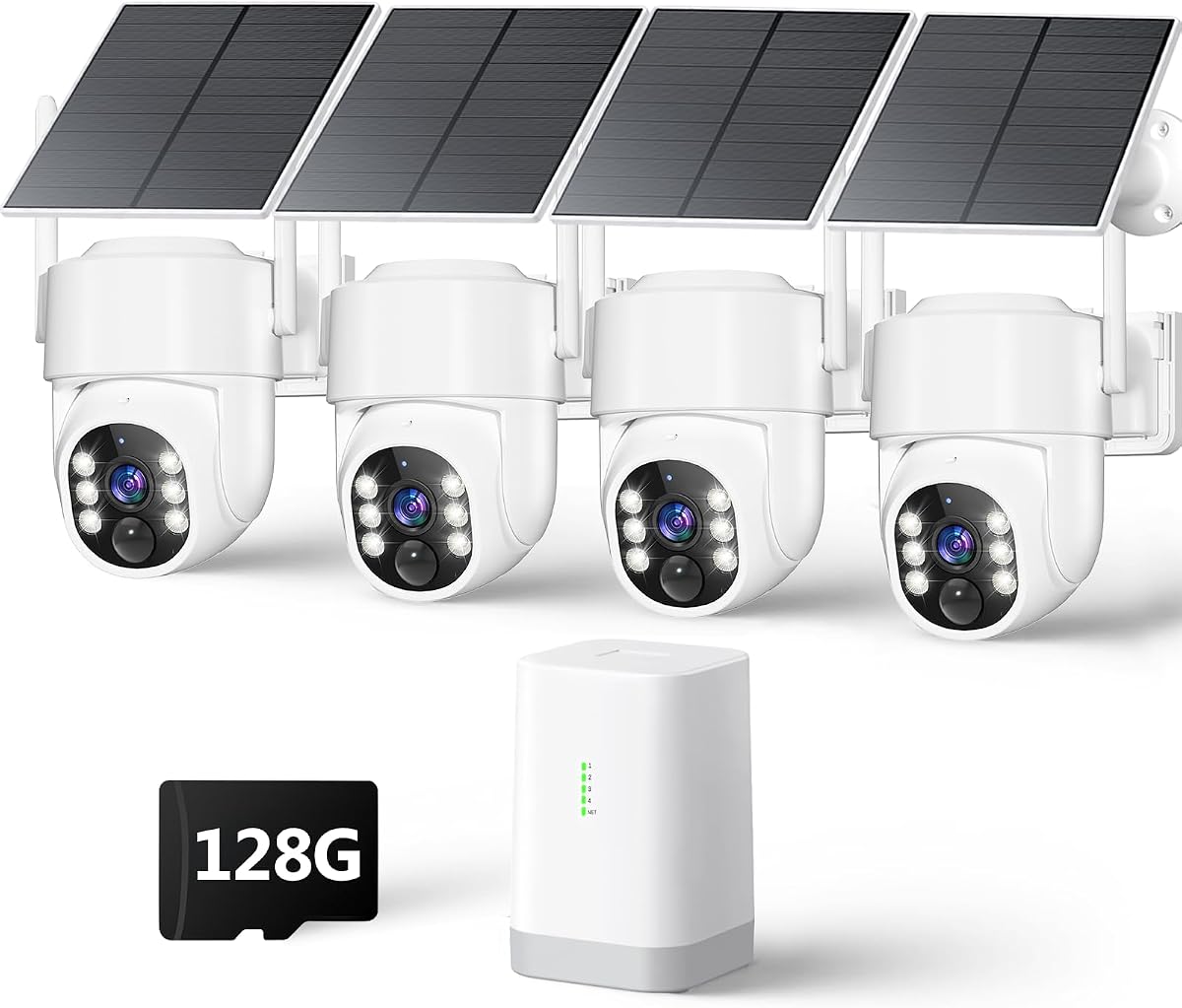
The 4MP Security Cameras Wireless Outdoor 4Cam-Kit is a balanced budget-minded way to establish local surveillance. Its 4.5 rating is among the strongest in the group, and the package includes four cameras, a home hub with 128GB of memory, solar panels, and a 4MP color night-vision system. The hub provides encrypted local recording without mandatory cloud or subscription fees, a meaningful advantage for buyers who want routine monitoring without an ongoing service charge.
We may earn a commission when you buy through this link, at no additional cost to you.
The cameras support 2.4GHz and 5GHz WiFi 6, 360-degree pan and tilt, AI-assisted human detection, two-way audio, instant app notifications, and activity-zone controls. The stated local capacity can support up to three months of loop recording for the X4 system, depending on recording behavior and storage conditions. Cross-camera event tracking is also available to organize clips involving the same event, making review across several viewpoints more efficient.
The primary limitation is that automatic tracking is turned off by default and must be enabled in the app. Users also need a dependable location for the powered hub, even though the cameras can operate without a nearby outlet thanks to their wire-free solar design. Battery and panel performance depend on sunlight, and the stated three-hour charging target should be treated as a product claim that can vary with weather and orientation.
Choose this kit when four exterior viewpoints, 4MP color footage, and local encrypted storage matter more than having a conventional multi-channel NVR. It offers an approachable path to standalone local recording while avoiding subscription fees. The hub-centered design is particularly appropriate for a family that wants a straightforward centralized system but does not need to manage a more complex recorder setup.
The home hub stores recordings locally in encrypted memory, and the supplied 128GB is intended to provide up to three months of loop recording. Footage remains accessible even if an outdoor camera is damaged or removed.
Four PTZ cameras, human detection, and cross-camera event organization make the kit suitable for covering several exterior zones. Remote rotation and two-way audio add live interaction without requiring a traditional monitor.
We may earn a commission when you buy through this link, at no additional cost to you.
The Solar-Powered Wireless Security Camera System with 10-inch HD Monitor is distinctive because it includes a physical 10-inch Full HD IPS display rather than relying only on a phone or tablet. Its 3.8 rating places it below the leading systems, but the bundle still offers a clear convenience advantage for households that want an always-available local viewing station. The monitor provides 1280×800 resolution and supports plug-and-play monitoring according to the product information.
We may earn a commission when you buy through this link, at no additional cost to you.
Solar charging, a built-in battery, an adjustable panel, and a fully wireless camera design eliminate the need to run power cables to each unit. Each camera uses a fixed bullet lens alongside a remotely adjustable PTZ dome lens, delivering 4MP combined resolution. A 350-degree horizontal and 90-degree vertical PTZ range, infrared night vision, and a full-color white-light mode provide day-and-night options. Two-way audio allows communication through the built-in speaker and microphone.
The important distinction is that this product includes a monitor and an app-based system rather than a clearly identified NVR with bundled hard drive. Its local recording arrangements should therefore be verified before purchase, especially for a buyer whose main requirement is a conventional DVR. The included display also requires power and a suitable indoor location, while the cameras need good solar exposure.
This system suits users who value a dedicated screen and a simple all-in-one solar setup more than large expandable storage. It is also appropriate as a secondary interface when a household already prefers app-based monitoring. Verify the exact storage workflow and compatibility details, but the monitor helps make the system approachable for family members who do not want to manage a smartphone app.
The 10-inch Full HD IPS monitor gives household members an easy way to check the property without opening an app. That makes the package more approachable for shared spaces, offices, or areas where a permanently visible screen is useful.
Adjustable solar panels and built-in batteries remove the need for a power outlet at every camera location. Dual lenses provide broad and adjustable views, while white-light and infrared modes support different nighttime conditions.
We may earn a commission when you buy through this link, at no additional cost to you.
The 2K Security Camera System with four solar wireless cameras is a flexible middle-ground option for buyers who want strong outdoor features without committing to a conventional NVR. Its 4.3 rating reflects a well-rounded specification list, including 2K video, a smart spotlight, AI human detection, two-way talk, IP65 weather protection, and support for both 2.4GHz and 5GHz WiFi.
We may earn a commission when you buy through this link, at no additional cost to you.
Each camera has a detachable solar panel and backup battery. According to the product information, two hours of daily sunlight can maintain continuous operation, while the battery offers support during cloudy periods. Remote pan, tilt, and zoom cover broad areas, and the spotlight activates with motion to create full-color night footage. Storage can be handled with a microSD card or optional cloud service without a mandatory subscription, although the memory card is not included.
This package differs from a true DVR kit because the listing does not identify an included recorder or hard drive. Local continuity therefore depends on the supported microSD configuration and the number of cameras being recorded. That makes it most appropriate for a smaller installation or a buyer who values optional cloud access and individual camera control. Installation remains wire-free, but a microSD card and careful solar positioning add setup steps.
Choose this four-pack for flexible storage, dependable 2K clarity, and modern detection features at a moderate tier. It is a good match for users who want to begin with a manageable number of cameras and avoid locking themselves into a subscription. If uninterrupted multi-camera recording through a central DVR is nonnegotiable, select one of the systems that explicitly includes a hard drive or home hub.
The ability to use local microSD recording or optional cloud storage gives buyers control over ongoing costs. Because the card is sold separately, the complete cost and retained recording capacity should be considered before installation.
Dual-band WiFi, an IP65 housing, and a detachable solar panel support a flexible wire-free installation. The combination is especially useful where running cables is inconvenient but dependable wireless coverage remains available.
We may earn a commission when you buy through this link, at no additional cost to you.
The 4K Solar Wireless Security Camera System is best understood as a specialized expansion camera rather than a complete standalone solar security system with DVR. Its 3.5 rating is the lowest among the listed products, and the most important limitation is explicit: it requires an NVR, which is not included, and cannot work on its own. It is therefore only appropriate for a buyer who already owns a compatible recorder.
We may earn a commission when you buy through this link, at no additional cost to you.
For those who do, the camera offers a strong set of outdoor features. It records in 4K Ultra HD, uses a 130-degree wide-angle lens with a 2.8mm F1.6 aperture, and supports digital wide dynamic range for backlit scenes. The stated CYVIO long-range WiFi can maintain transmission up to 700 meters in open areas, while the product title references a 2,300-foot range. IP66 weatherproofing supports exposure to rain, wind, sand, ice, and snow.
Advanced PIR detection, AI human and vehicle recognition, a spotlight, and a siren alarm provide monitoring and deterrence. Full-duplex two-way audio allows natural real-time conversation. Remote control and phone alerts require the app to be linked to the NVR, adding another setup dependency. Long-range wireless also performs differently in buildings, dense vegetation, and other obstructed environments compared with open space.
Do not buy this as the centerpiece of a first standalone installation. Consider it when an existing compatible NVR needs another 4K, solar, long-range outdoor camera. Its high resolution, weather protection, and intelligent detection are compelling, but the missing recorder, required app pairing, and lower rating make the product less suitable for the keyword's core standalone use case.
Long-range wireless can reduce the need to place cameras close to the NVR or main router. The camera is particularly attractive for large yards, driveways, and other open areas, subject to real-world interference and obstructions.
4K recording, AI human and vehicle detection, a spotlight, and a siren give the camera a useful combination of evidence capture and active deterrence. These features make it a strong add-on when compatible NVR infrastructure already exists.
We may earn a commission when you buy through this link, at no additional cost to you.
The Wireless Outdoor Security Camera System, Solar Powered WiFi Cameras Systems is a straightforward single-camera solution with a 4.0 rating. It is not presented as a four-camera NVR bundle, so it fits the standalone solar category more loosely. Its appeal lies in simplicity: a rechargeable lithium battery, direct-charging support, an included solar panel, PIR motion detection, infrared night vision, and two-way communication through the HonestView app.
We may earn a commission when you buy through this link, at no additional cost to you.
Because there is no complicated hub or multi-channel recorder described, installation should be relatively approachable. The camera can be mounted away from outlets, and the app provides live viewing, motion alerts, and remote control from a phone or tablet. PIR detection is designed to wake the system and begin recording when movement occurs, while infrared LEDs provide low-light monitoring without a visible white-light spotlight.
Its limitations are straightforward. A single camera provides less coverage than a multi-camera DVR kit, and the lower rating suggests less confidence in the overall package. The listing also does not specify how much local recording capacity is available or whether it supports continuous recording without a memory card, separate storage service, or other accessory. Those details should be confirmed for anyone whose main goal is standalone local DVR-style recording.
This system makes sense for monitoring a gate, side yard, shed, driveway, or other single high-priority location without running a power cable. It also works well as a simple starting point before expanding to a larger system. For whole-property coverage and retained local footage across several viewpoints, however, one of the four-camera or home-hub kits will offer a more convincing fit.
The combination of a rechargeable battery, direct charging, and an included solar panel provides multiple ways to keep the camera running. This makes it practical for isolated locations where an outlet or wired camera would be inconvenient.
PIR activation, infrared night vision, and two-way talk cover the core needs of an outdoor camera. The HonestView app adds remote viewing and alerts, although local DVR storage is not a stated centerpiece of this listing.
We may earn a commission when you buy through this link, at no additional cost to you.
The 4MP Security Cameras Wireless Outdoor 4Cam-Kit repeats the core strengths of the budget-leading system: a four-camera package, a local home hub, and solar outdoor monitoring without mandatory subscription fees. With a 4.5 rating, it is one of the most well-regarded products here. The hub includes 128GB of memory and stores encrypted recordings, with a stated loop-recording capacity of up to three months for the X4 setup.
We may earn a commission when you buy through this link, at no additional cost to you.
Each camera provides 4MP imagery, full-color night vision reaching a stated 65 feet, six LED lights, PTZ coverage, and two-way audio. The 2.4GHz and 5GHz WiFi 6 connection supports flexible router placement, while the five-watt panel and 8,000mAh battery aim to keep cameras operating without regular charging. PIR and AI human detection help reduce irrelevant alerts, and customizable zones focus notifications on meaningful activity.
Automatic tracking is not active out of the box and must be enabled in the app. It also cannot be manually activated, which may frustrate users who want continuous tracking. The powered home hub must be placed where it can connect reliably to the cameras and router. Solar charging results will vary with shade, weather, orientation, and the amount of video recorded each day.
For a buyer who values a complete four-camera setup, local storage, and high-resolution night footage without subscription fees, this remains a compelling option. It is especially useful where camera loss or damage is a concern because the hub retains the recordings. It may not satisfy someone seeking a traditional multi-channel NVR, but it delivers the same broad goal: centralized, independently accessible outdoor surveillance.
Encrypted hub storage protects the privacy of recordings and keeps them available even if an exterior camera is damaged or lost. The included 128GB offers a generous starting point for a four-camera loop-recording setup.
Human detection, adjustable activity zones, instant notifications, and cross-camera event organization improve the way important activity is surfaced. Six LEDs and 4MP sensors create clear full-color images after dark.
We may earn a commission when you buy through this link, at no additional cost to you.
The second Wireless Outdoor Security Camera System, Solar Powered WiFi Cameras Systems shares a simple feature set with another camera-only option in the list. Its 3.4 rating is the lowest among the ten products, which makes it difficult to recommend above larger systems with explicit storage, weather ratings, or multi-camera support. The core proposition remains clean: rechargeable battery power, an included solar panel, PIR activation, infrared night vision, and two-way talk through the HonestView app.
We may earn a commission when you buy through this link, at no additional cost to you.
The system does not require outlets or messy camera cables, and the ability to use direct charging as well as solar power provides useful installation flexibility. Live video, instant motion alerts, and remote camera controls are managed from a phone or tablet. Infrared LEDs switch on in low-light conditions, offering conventional monochrome night footage for entrances and exterior areas.
A buyer should not mistake the term system for a complete DVR package. No multi-channel NVR, hard drive, home hub, or camera count is identified in the supplied information. It is therefore better treated as a capable standalone outdoor camera that happens to be sold under a system title. Storage capacity, continuous recording behavior, and the number of cameras supported by one hub should be checked before purchase.
This listing makes sense for a single location or as an entry-level way to add solar outdoor monitoring. It avoids the complexity of hard-drive management and can be a good choice when simplicity matters more than centralized multi-camera review. However, the low rating, less detailed specification set, and lack of explicit DVR hardware make it a less complete answer to the keyword than the NVR and home-hub kits.
A rechargeable lithium battery can be charged directly or replenished through the included solar panel. That gives installers more freedom than a fixed power-cord system while retaining basic PIR and night monitoring functions.
The HonestView app supports live viewing, motion notifications, and remote control. This keeps the system easy to manage, although buyers needing extended local DVR retention should choose a bundle that clearly includes storage.
We may earn a commission when you buy through this link, at no additional cost to you.
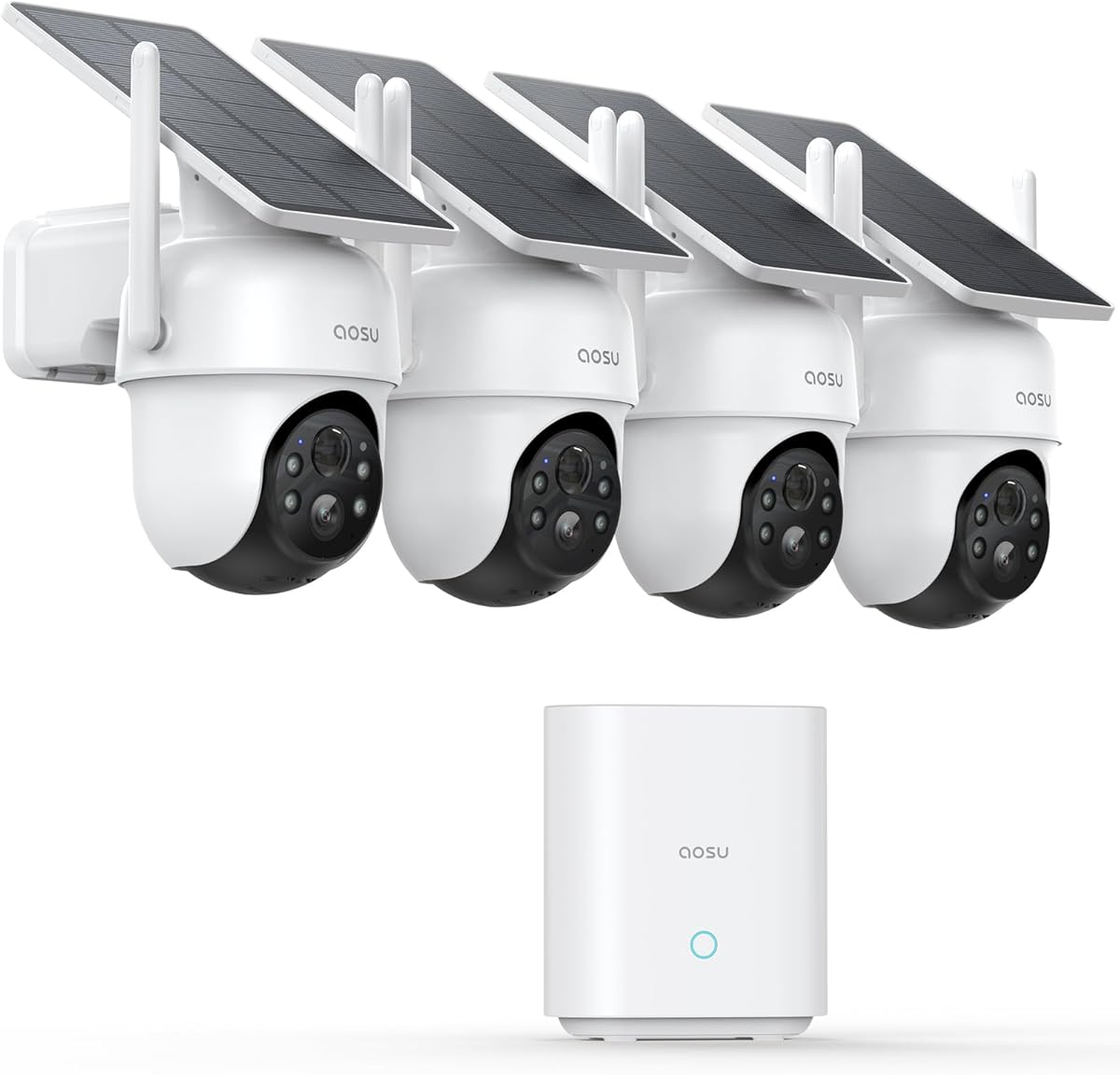
The aosu D1 Classic 4-Cam Kit is a well-rounded solar camera system with a 4.3 rating. It bundles four outdoor cameras with the aosuBase platform, which provides encrypted local recording, stable live streaming, and instant notifications without requiring a subscription. The included 32GB of local storage can support up to four months of video loop recording, making this a strong choice for buyers who value a managed whole-system experience.
We may earn a commission when you buy through this link, at no additional cost to you.
AosuBase adds several features that help the four cameras work as a coordinated system. Users can watch four live areas at once, relate events occurring at the same time across cameras, and control multiple camera statuses from one interface. The cameras support 360-degree pan-and-tilt coverage and automatic motion tracking. Four LEDs improve illumination for color night vision, while the stated day-and-night capture resolution is listed as 3MP in the product information.
There is a wording inconsistency in the listing, which refers to the product as 2K in its title but also states 3MP resolution. Buyers should verify the exact sensor output before judging it against 4MP alternatives. The 32GB starting capacity is also smaller than the 128GB and 500GB options in other kits, which may matter for continuous multi-camera recording. Solar performance depends on direct sunlight and regular panel exposure.
This kit is well suited to a household that wants four cameras, easy central management, and local recording without managing a traditional NVR channel by channel. Its simultaneous views and cross-camera organization make it particularly useful for monitoring several parts of a property at once. For users with lighter recording needs, it delivers a coherent, privacy-friendly solar system at a competitive specification level.
Four simultaneous views, one-click camera controls, and cross-camera event relationships make aosuBase more than a set of independent cameras. This is useful for users reviewing activity across a yard, garage, driveway, and entrance.
Encrypted aosuBase storage keeps footage in the home and provides a stated four months of loop-recording capacity with the included 32GB. A local-first design gives owners useful control without a mandatory cloud plan.
We may earn a commission when you buy through this link, at no additional cost to you.
The most important choice is whether a listing provides a genuinely independent recording system, not merely a solar camera with app access. Buyers should then compare camera quantity, storage, power, connectivity, image quality, detection, and installation demands to find a package that fits the property.
A standalone system should be able to store recordings locally without requiring a recurring cloud plan. Look for an NVR with an included hard drive, a home hub with built-in memory, or a clearly documented local storage option. Product titles can be misleading, so distinguish between a camera that uses an SD card, a camera controlled through an app, and a full DVR capable of managing multiple feeds. The Solar Dual-Lens 4-Pack includes an NVR and 500GB drive, while the 4MP Solar Four-Camera Kit and aosu D1 Classic use local hubs with built-in storage.
A four-camera kit can cover common exterior priorities such as a front entrance, driveway, backyard, and garage, but placement matters more than the raw count. PTZ models offer remote movement and can cover a wider area, while fixed dual-lens cameras can simultaneously provide a broad view and a closer perspective. Very small properties may be adequately served by one or two cameras, while larger grounds may benefit from six cameras or expansion capacity. Check how many channels the recorder supports and whether additional cameras require separate purchases.
Solar cameras still depend on sunlight, panel orientation, shade, season, and recording activity. Systems range from two-watt panels to larger five-watt options, while battery capacities also differ. A panel may be mounted separately from the camera, giving installers more flexibility, but it must have a clear view of the sun. Ask whether direct charging is supported, how the batteries behave in prolonged bad weather, and whether the stated charging time refers to direct sun rather than overcast conditions. The best solar design minimizes manual recharging without pretending weather never affects output.
Resolution determines the amount of visual detail available, but lens quality, infrared illumination, and ambient light also affect useful identification. Options in this guide range from 2K and 3MP classifications to 4MP and 4K. Full-color night systems with visible LEDs can be easier to interpret, while infrared systems often provide a more discreet monochrome image. Compare the stated night-viewing distance against the actual size of the monitored area, and consider whether a 130-degree wide lens or adjustable PTZ view better fits the scene.
Dual-band 2.4GHz and 5GHz WiFi is common among the stronger options. The 2.4GHz band generally offers better reach through walls, while 5GHz can provide faster throughput where the signal path is clear. WiFi 6, long-range claims, and built-in routers may improve a large installation, but real performance depends on distance, walls, vegetation, antenna placement, and the router's position. Confirm whether cameras connect directly to the NVR or hub, whether the included equipment acts as a router, and how remote access works when the internet is unavailable.
PIR motion detection is the basic trigger in most of these systems, while AI human detection helps distinguish people from leaves, animals, or moving shadows. Vehicle, pet, and package detection may be available as premium app features, so confirm what is included at no cost. Auto tracking can be valuable, but some systems require it to be enabled manually. Adjustable sensitivity, detection zones, and cross-camera event grouping are particularly helpful in busy properties where a basic motion alert would otherwise generate constant interruptions.
Local storage is the main attraction of many DVR-style solar systems, but capacity and retention vary substantially. The featured options include 500GB drives, 128GB hub memory, 32GB aosuBase storage, and microSD-based alternatives. More cameras recording continuously require more capacity, and loop recording overwrites older footage. A TF card slot can be useful for redundancy, while encrypted local storage can improve privacy. Consider whether recordings remain accessible if a camera is stolen or damaged and whether backup or export functions are included.
Solar cameras remove many power cables, but they still require mounting, WiFi configuration, app setup, and periodic panel cleaning. Weatherproof ratings such as IP65 and IP66 indicate resistance to dust and water, yet cable-free equipment can still be vulnerable to physical tampering. Choose locations that balance visibility, sunlight, and protection. Make sure the hub or NVR has a stable power source, keep the app updated, inspect seals and brackets periodically, and verify that the manufacturer's stated recording access works from a phone when away from home.
Begin by mapping every desired camera location and identifying the central NVR or home hub. Install the hub near a reliable network connection and stable power outlet, then connect it to the router using the manufacturer's instructions. Download the relevant app, create the account, and complete the pairing process before mounting cameras permanently. Confirm that each camera can deliver live video and that recordings are actually being stored on the included drive or local memory.
Install cameras where they can see the intended area without pointing directly into nearby windows or neighboring property. Position each solar panel for maximum direct sun, keeping the panel clean and free of branches, leaves, and accumulated dirt. Follow the required drilling and mounting steps, tighten fasteners, and verify the weatherproof seals. Aim the cameras, define motion zones, adjust detection sensitivity, and enable any tracking or AI features that are relevant to each location.
For ongoing care, check the app regularly for disconnected cameras, failed recordings, storage warnings, and firmware updates. Clean solar panels periodically, especially after dusty or stormy weather. Inspect mounts for movement, confirm that camera microphones and speakers remain unobstructed, and review local storage capacity before it reaches capacity. Test remote access and two-way audio after network changes. If the property has an existing alarm or automation platform, test integrations and make sure the DVR's local behavior continues to work during an internet outage.
A local NVR or home-hub system can generally continue recording without cloud access, although remote viewing and mobile alerts require an internet connection. The Solar Dual-Lens 4-Pack includes a router in its NVR, which supports a more independent setup. Check the specific manual because camera pairing, firmware updates, and time synchronization may still use an internet connection.
Solar cameras include rechargeable batteries, so they can operate without a constant power connection. A charged battery may continue recording through short cloudy periods or outages, but extended poor weather can reduce the available runtime. Actual performance depends on panel exposure, battery capacity, temperature, and how often the camera records. Keep the panels unobstructed and choose a location that receives meaningful direct sunlight.
An NVR is a network video recorder that connects to cameras and manages channels, recording, and playback. A home hub performs a similar central role but may be branded around a particular app and use integrated memory or expandable card storage. Both can provide local recording without a mandatory subscription, but the NVR tends to offer more explicit channel and hard-drive controls.
Local storage offers privacy, predictable ongoing costs, and uninterrupted recording when the internet is unavailable. Cloud storage can make remote access and sharing more convenient, but it may require a recurring plan. The best value is often a system with strong local storage plus optional cloud or app features, allowing the owner to choose when extra services are useful.
Required storage depends on camera count, resolution, motion frequency, and recording schedule. Continuous high-resolution recording uses substantially more space than event-based recording, and loop recording eventually overwrites older files. Compare the included capacity with the number of cameras, but also consider whether the system records continuously or only when motion is detected.
The supplied systems can be mounted on walls, trees, garages, rooftops, and similar outdoor locations when the hardware and instructions support them. A fixed structure is usually more stable than a tree, whose movement can affect framing and vibration. Ensure the panel has direct sunlight and that the camera view is not repeatedly blocked by branches or foliage.
Local NVR recording can often continue independently of internet service, but setup and remote app access may require WiFi or a wired network connection. Camera-to-NVR or camera-to-hub communication also depends on the system's supported local network architecture. Buyers should verify whether the camera can be commissioned without an online account and whether a separate router or hub is included.
A 4MP camera is a practical balance for many exterior locations because it provides more detail than 2K without requiring the highest bandwidth and storage of 4K. Night performance also depends on lens aperture, infrared range, visible illumination, and camera angle. Full-color night vision with LEDs can help at moderate distances, but a stated maximum range should not be treated as a guarantee in every environment.
The Solar Dual-Lens 4-Pack is the strongest all-around choice for a buyer who wants a recognizable DVR-style setup, four solar cameras, an included 500GB drive, and an expandable NVR. The No Monthly Fee Solar Security System stands out for its 4.9 rating, 4MP full-color night vision, flexible charging design, and expansion to ten cameras, while the 4MP Solar Four-Camera Kit delivers a balanced, subscription-free hub setup for budget-conscious buyers.
Prioritize the parts that match the actual installation. A standalone system needs local recording, reliable hub or NVR placement, enough storage for the number of cameras, and solar panels that receive direct sun. Dual-band WiFi, AI human detection, two-way audio, PTZ coverage, and full-color night vision are useful additions, but they cannot compensate for poor camera placement or undersized storage.
Finally, confirm the exact package contents before ordering because similar listings use the word system for very different configurations. Check whether the NVR or hard drive is included, how many cameras ship in the box, which AI features are free, whether app subscriptions are optional, and whether the stated resolution matches the listing. Product configurations and prices change, so review the current listing and seller details at the time of purchase.