
Ozone Generator 45,000mg/h
4.7Editor score
45,000 mg/h claimed output
Up to 2,500 sq. ft.
Timer-controlled operation
Explore the best ozone machine for water purification and odor control, comparing ten models for output, water mode, coverage, controls, portability, and
Ozone machines use electrically generated ozone to address odors and support water treatment across homes, vehicles, kitchens, and commercial spaces. The right model should match your treatment area, offer a practical water-delivery method, and include controls that make unattended operation easier and safer.
This guide compares ten ozone machines using the supplied specifications, customer ratings, claimed ozone output, room coverage, timer design, portability, water-treatment features, and safety guidance. It covers compact household units, high-output odor eliminators, dual-mode machines, and commercial systems designed for demanding environments.
Each review explains the product's strongest attributes, practical limitations, and most suitable audience, while the comparison table provides a quick side-by-side view. Product configurations and availability can change, so readers should verify current specifications, seller instructions, and pricing before purchasing.
4.7Editor score

3.9Editor score

5.0Editor score
The following table compares all ten machines by their most important listed features, including treatment mode, claimed output, area coverage, control method, and intended use. These differences help distinguish dedicated water ozonators from high-output odor-control systems.


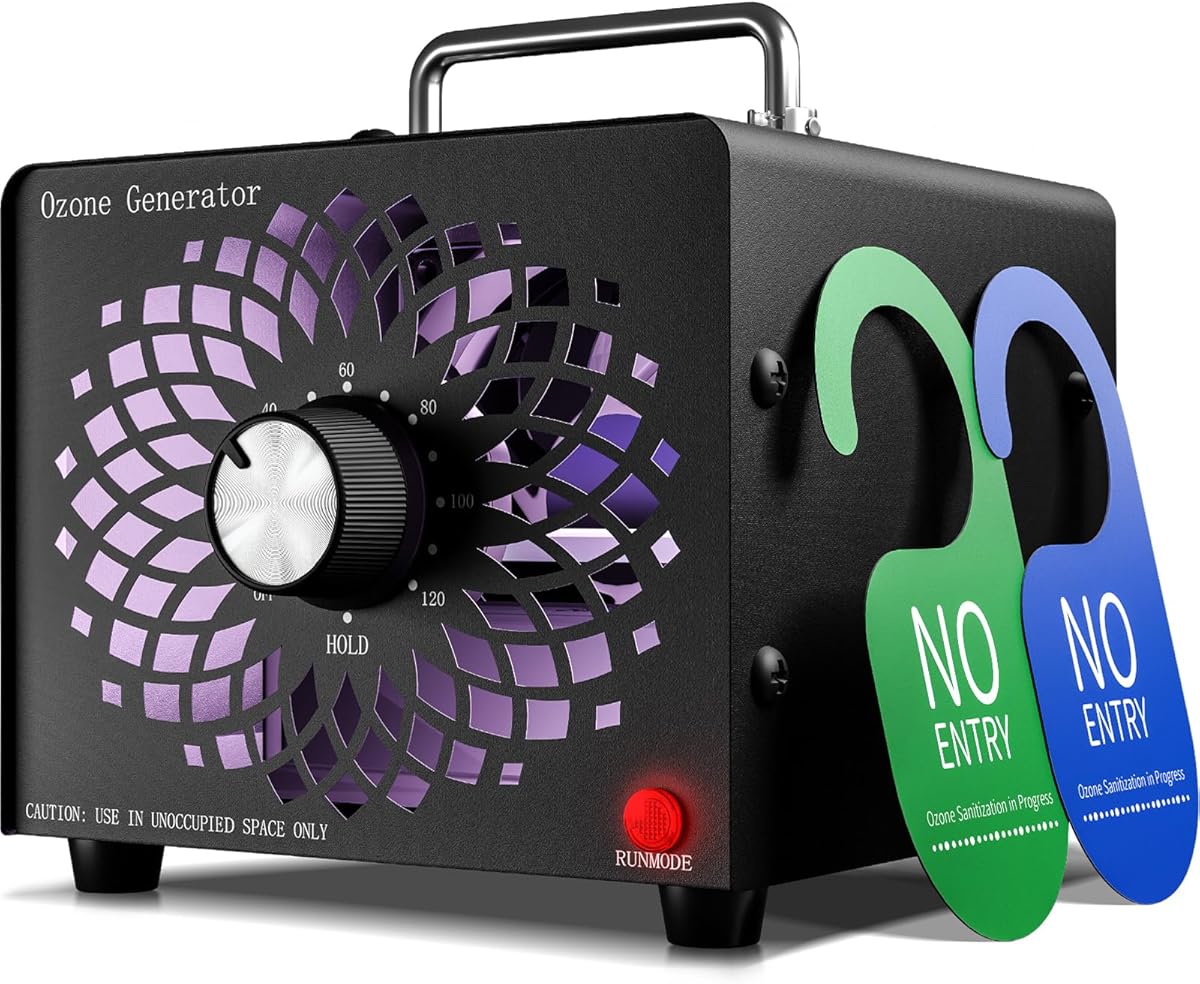


This 45,000 mg/h ozone generator combines a high customer rating of 4.7 with a straightforward design for removing persistent odors from homes, cars, and other enclosed spaces. Its stated coverage of up to 2,500 square feet makes it a capable mid-range option for areas where ordinary wiping and surface cleaning have not been enough.
We may earn a commission when you buy through this link, at no additional cost to you.
The integrated single-layer ozone plate is specified to produce up to 45,000 mg/h of ozone, while the fan helps distribute the treatment through a closed room. The product is listed for kitchens, bathrooms, basements, boats, dumpsters, closets, vehicles, pet areas, and other odor-prone locations, giving it useful flexibility beyond ordinary household spaces.
Its main limitation is that it is presented primarily as an odor eliminator rather than a dedicated water-purification system. The instructions also require treatment in unoccupied spaces, followed by one hour of ventilation so ozone can convert back to oxygen. These conditions make it less convenient for occupied kitchens or continuous water use, despite its attractive output and rating.
This is a strong choice for buyers seeking powerful odor removal without moving to a commercial-scale machine. It suits vehicles, basements, kitchens after cleaning, and other spaces that can remain empty during a treatment cycle. For users who also need a dedicated 1,000 mg/h water mode, the dual-purpose machine in fifth place is the more relevant option.
The claimed 45,000 mg/h output and 2,500-square-foot capacity position this model as a capable residential and light-commercial odor treatment device. Its timer and unattended format are useful when smoke, cooking, pet, or musty odors need time to dissipate.
People, pets, and plants should be removed before treatment, and the room should remain ventilated afterward as instructed. Users who cannot meet those conditions should consider a filtration-oriented alternative rather than forcing an ozone cycle into an occupied environment.
We may earn a commission when you buy through this link, at no additional cost to you.
This combined air-and-water ozone machine receives a 3.9 rating and distinguishes itself with two clearly stated output levels: 60,000 mg/h for air odor treatment and 1,000 mg/h for water applications. That separation makes it one of the more relevant options for readers who need a single device for both odor control and ozone-water tasks.
We may earn a commission when you buy through this link, at no additional cost to you.
In water mode, the included air pump and enlarged air stone increase bubble contact with the liquid. The product is described for use in cold or hot bathtub water, spas, produce cleaning, and general water treatment. In air mode, a high-speed fan and claimed 99% purification efficiency are presented as solutions for smoke, pet odors, cooking smells, tenant odors, and post-renovation smells.
The touchscreen, two-hour timer, room-temperature and humidity display, and automatic start sequence make the controls more informative than a basic mechanical model. The trade-off is the lower 3.9 rating and a described strong ozone smell during operation. The safety notice requires vacant rooms, followed by at least 30 minutes of ventilation before re-entry.
Choose this machine when balanced household functionality matters more than the highest customer rating. It is especially useful for users who want separate water and air functions, a visible operating display, and a portable aluminum housing. Commercial operators wanting still greater output and longer cycle controls may prefer the Powerscale model.
The water mode uses an air pump, enlarged air stone, and 1,000 mg/h output rather than treating water as an incidental use. This design gives it an advantage over many odor-focused machines when a sink, tub, spa, or produce-washing routine is central to the purchase.
A five-second delayed start gives users time to leave the room, while the touchscreen and countdown simplify timed treatment. The display of temperature and humidity can also help users judge conditions in the space being treated.
We may earn a commission when you buy through this link, at no additional cost to you.
The Enerzen 60,000 mg/h industrial ozone generator has a 4.6 rating and emphasizes a straightforward knob-and-timer format. It is designed to react with odors in air, water, fabrics, and walls, allowing it to address sources that are difficult to reach with a conventional air purifier that requires air to pass through a filter.
We may earn a commission when you buy through this link, at no additional cost to you.
The stated use cases are extensive: cars, boats, dumpsters, kitchens, bathrooms, basements, and spaces affected by flood, fire, cooking, smoking, pets, or general mustiness. Its simple controls reduce the learning curve, while the 60,000 mg/h output gives it substantially more claimed production than compact household ozonators.
The trade-off is limited information about dedicated water treatment, no touchscreen, and a product listing that says it is unavailable in California. As with the other ozone-only odor machines in this guide, it must be operated in an unoccupied area after removing people, pets, and plants. The manufacturer calls for an additional 30 minutes of airing out after the cycle ends.
This model is well suited to buyers who value simple operation and broad odor applications over sophisticated displays or a dedicated water diffuser. It is especially relevant for restoration-related spaces, vehicles, basements, and other areas that can be sealed and left empty. Buyers in California should verify availability before ordering.
The product's chemical odor-reduction approach does not require contaminated air to pass through a filter. That can make it useful where odors are present in fabrics, wall materials, or areas with difficult airflow, provided the treatment space is vacant.
A single timer knob and a defined airing-out period keep operation straightforward. Users still need to clean the underlying odor source first, because ozone treatment works best when contaminants and trapped smells have already been addressed.
We may earn a commission when you buy through this link, at no additional cost to you.
This VEVOR ozone generator combines a 3.9 rating with several features designed for flexible treatment, including a 30,000 mg/h claimed output, an LCD touchscreen, area-based operating programs, remote control, and a dual-hose water mode. It is aimed at odor removal and water applications rather than a single-purpose air purifier.
We may earn a commission when you buy through this link, at no additional cost to you.
Its most distinctive feature is the pair of hoses, which allow two sinks, containers, or small treatment areas to be serviced at the same time. The quartz tube system is described as more stable and serviceable than ceramic plates, while an auxiliary light source is included to assist with stubborn smoke odors. The unit can also be operated through a wall by remote control.
A 15-second delayed start allows users to leave before ozone production begins, and selecting the area automatically adjusts runtime. The main compromises are its 3.9 rating and the fact that batteries for the remote are not included. The listing provides no separate water-output figure, so buyers should not assume that its water mode matches the specifically stated 1,000 mg/h offered by dedicated dual-mode competitors.
This model appeals to households or small businesses that need to treat more than one water container or basin and value touchscreen automation. It is a good fit for smoke, car, home, and other odor applications in spaces that can remain unoccupied. Those needing a documented water-output rate should favor a model that states one explicitly.
The dual-hose configuration can divide ozone delivery between two sinks or compact spaces, reducing the need to move and reset the machine. This is a practical advantage for produce cleaning, dishes, toys, or paired household work areas.
Area-based program selection reduces the need to repeatedly consult a manual, and through-wall remote control makes placement more flexible. The 15-second delay creates a useful buffer for leaving the area before active treatment begins.
We may earn a commission when you buy through this link, at no additional cost to you.
This dual-function ozone machine offers the most clearly documented combination of household air and water features in the roundup. Its 3.9 rating is not among the highest, but the stated 60,000 mg/h air output, 1,000 mg/h water output, diffuser system, and two-hour timer make it a versatile functional package.
We may earn a commission when you buy through this link, at no additional cost to you.
Water treatment is supported by a high-power air pump and enlarged air stone intended to increase ozone contact with liquids. The stated applications include bathtubs, spas, and produce cleaning, while the air mode is directed at smoke, pets, cooking, tenant odors, and renovation smells. A 2,800 RPM fan is specified to promote rapid diffusion through the treated area.
The metal ozone plates are claimed to last more than 60,000 hours, and the aluminum housing is positioned as durable and easy to clean. These are useful features for regular use, although the rating of 3.9 suggests some buyers may have found aspects of the product less satisfactory. The strong ozone scent and mandatory ventilation period also require careful scheduling.
Overall, this is the most balanced pick for a reader who wants explicit water output alongside meaningful air-treatment capacity. Choose it for combined household water and odor-control routines, particularly when produce washing, tubs, or spas are priorities. Buyers seeking a simpler odor-only unit can choose a higher-rated model, while larger commercial facilities may need still more output.
The machine's stated air and water rates let buyers match it to a specific task instead of relying on one vague output number. It can cover broad odor treatment while providing a dedicated 1,000 mg/h function for selected liquids and small spaces.
The two-hour countdown, delayed start, and environmental display make the unit practical for planned treatment sessions. A removable timing sticker and replaceable fuse add small maintenance conveniences that support ongoing use.
We may earn a commission when you buy through this link, at no additional cost to you.
This high-capacity ozone generator pairs a 4.5 rating with a claimed 55,000 mg/h output and coverage of up to 6,000 square feet. That coverage is unusually generous relative to its general-purpose positioning, making it relevant to larger rooms, basements, and odor-prone commercial spaces.
We may earn a commission when you buy through this link, at no additional cost to you.
The product uses an intuitive timer knob with a maximum 120-minute setting and a hold option for continuous operation. Its listed noise level is below 30 decibels, which may be useful in equipment rooms, storage areas, or other spaces where audible operation matters. Applications include cars, boats, dumpsters, kitchens, bathrooms, and basements.
The limitations are that no water output is specified and the unit is not available for sale in California. The instructions require an enclosed space during operation, with people, animals, and plants kept away. Ventilation for 30 to 60 minutes is specified after treatment, and users should clean the odor source before starting.
This is a compelling option for buyers who want substantial claimed coverage at a straightforward, accessible price point. It is best suited to odor elimination rather than a formal water-purification workflow. Buyers who need water treatment should choose a model with a dedicated diffuser, air stone, or documented water mode.
The stated 6,000-square-foot capacity is one of the highest figures in this comparison, while the 55,000 mg/h output supports rapid treatment. Buyers should still account for room construction, airflow, odor intensity, and cycle time when judging practical results.
A straightforward knob, 120-minute maximum, and continuous hold option make the machine easy to set. The stated sub-30 dB operation is particularly appealing for longer unattended cycles where a loud fan would be inconvenient.
We may earn a commission when you buy through this link, at no additional cost to you.
This blue 120,000 mg/h machine has a 4.6 rating and combines ozone production with a negative-ion air-purification function. Its four-layer cubic ceramic plates, 3,200 RPM fan, and claimed output distinguish it as a high-output air odor treatment unit rather than a dedicated water ozonator.
We may earn a commission when you buy through this link, at no additional cost to you.
The two-function approach is intended to handle persistent smoke, pet, paint, and similar smells while also absorbing fine dust. A knob timer supports durations up to 120 minutes, and a separate mode switch includes a hold setting. The all-metal body, folding handle, and stated 4.4-pound weight make it relatively easy to move between a home, office, RV, or boat.
Its trade-offs are the absence of a stated water-treatment rate and a coverage figure of up to 2,500 square feet, which is lower than several 120,000 mg/h competitors. It also must run in an unoccupied space, and the instructions require at least 30 minutes of ventilation afterward. Buyers seeking a drain-and-ozone arrangement should look elsewhere.
This is an attractive choice for odor-and-dust-oriented users who value a strong ozone rate, independent ion functionality, and portability. It is especially suitable for cars, basements, smoke-affected rooms, and other vacant spaces. For a documented water mode, the dual-function 60,000 mg/h and 1,000 mg/h machine offers a clearer fit.
Combining ozone with negative ions gives the machine two related air-treatment functions. The ion mode is presented as useful for fine dust, while ozone targets stubborn odors, allowing users to select the approach that best fits the situation.
A folding handle and metal body support movement among rooms and vehicles. The high-speed fan is designed to distribute ozone more evenly, although the room must still remain unoccupied during operation.
We may earn a commission when you buy through this link, at no additional cost to you.
This 120,000 mg/h ozone generator receives a 4.5 rating and offers a useful combination of high claimed output, broad area coverage, and separately controlled ozone and negative-ion modes. It is designed for large rooms, offices, cars, basements, hotels, garbage areas, and post-renovation odor control.
We may earn a commission when you buy through this link, at no additional cost to you.
The four-layer ceramic plate and 3,200 RPM fan are credited with producing 120,000 mg/h and distributing it through spaces up to 6,000 square feet. Separate red and green buttons provide direct mode control, and the modes may run simultaneously. A rotary dial offers up to 120 minutes, while a hold function supports continuous use.
The main compromises are that there is no specified water mode and the safety guidance is demanding. The space must be unoccupied, people and pets must be kept away, and the manufacturer recommends ventilating for more than 60 minutes after a cycle. It is also not available in California. The hold function is intended for vacant spaces above 2,500 square feet and requires cooling after 120 minutes.
This model fits buyers who want a single high-output air machine with independent mode selection and a large stated coverage footprint. It is a strong option for odor-heavy commercial or renovation environments, but not for routine water treatment. A smart socket can assist with remote power control during a hold cycle, though that accessory is not included.
Independent ozone and negative-ion controls make it easy to run one function or both together. This offers more operational flexibility than machines that force every treatment through a single shared mode.
The stated 6,000-square-foot coverage and hold setting suit large vacant areas. Buyers should note the limitation on continuous use, the cooling period, and the extended ventilation recommendation before scheduling treatment.
We may earn a commission when you buy through this link, at no additional cost to you.
The Powerscale OZB4 stands apart with a 5.0 rating, 500,000 mg/h claimed output, and two independent high-voltage cores. It is explicitly designed for commercial and industrial odor removal in restaurants, hotels, warehouses, offices, dealerships, kennels, and boarding facilities.
We may earn a commission when you buy through this link, at no additional cost to you.
The dual-core architecture is presented as reducing strain on any one module while supporting steadier output and longer service life. Coverage is stated at up to 4,000 square feet during a 90-minute cycle, with the time attached to the area figure. A digital LCD timer can program cycles from zero to 300 minutes, and a 10-second delay provides time to leave before ozone production begins.
The removable, washable filter and one-year protection plan support frequent professional use. However, this is an air odor-removal system rather than a water-purification device, and its premium purchase cost may be difficult to justify for a small household. Users also need to follow all ozone safety instructions and account for occupancy restrictions.
This is the premium choice for high-traffic spaces, severe smoke or pet odors, and operators who value repeatable digital timing and sustained commercial output. It is less appropriate for apartments, small vehicles, or water-focused routines. Home buyers seeking dual water functionality should look to the lower-output dual-mode model instead.
Two independent cores are intended to share the workload rather than overdrive a single plate set. The design supports the stated 500,000 mg/h output and is aimed at demanding environments where odor removal cannot depend on a low-output household device.
The digital timer, 10-second delay, and clearly defined 90-minute coverage example help operators plan repeatable jobs. A washable filter and one-year protection add service-oriented features, but the large footprint in the category and premium cost require a clear commercial use case.
We may earn a commission when you buy through this link, at no additional cost to you.
This portable multipurpose ozone generator has a 4.5 rating and prioritizes compactness, simple operation, and broad use over high production figures. It is described for air and water use in homes, rooms, kitchens, offices, vehicles, travel settings, and hunting equipment areas.
We may earn a commission when you buy through this link, at no additional cost to you.
Its stated output is over 500 mg/h, far below the high-output commercial models, but the product is positioned as a convenient personal device. Five timer levels offer 5-, 10-, 15-, 30-, and 60-minute cycles. Applications include washing hands, skin, face, foods, vegetables, fruits, baths, utensils, and feeding bottles as described in the listing.
The lightweight housing makes the unit easy to carry and store, which is its clearest advantage. The trade-offs are its much lower claimed output, a basic timer instead of a digital display, and the lack of detailed area coverage or dedicated air-pump specifications. As an ozone product, it still requires careful separation from people and pets during operation.
This model is best for compact, task-oriented use where portability matters more than treating a large room. It may suit a homeowner seeking a small machine for containers, produce, travel, or limited odor work. Buyers needing powerful whole-room odor removal or professional coverage should select a higher-output unit.
The portable, lightweight format makes this unit easy to move among a kitchen, office, vehicle, or travel setup. It is particularly useful when a full-size high-output machine would be excessive for a small container or localized task.
Users can choose from five clearly defined runtime settings instead of navigating a more complex control system. The simple design supports quick setup, although its low output means it should not be judged against large commercial units.
We may earn a commission when you buy through this link, at no additional cost to you.
The most important decision is whether the machine is primarily an air odor eliminator, a water-treatment device, or a dual-purpose system. Output, area coverage, diffusion hardware, controls, and ventilation requirements should then be matched to the intended room and task.
A dedicated water mode is preferable when ozone must be dissolved into a sink, tub, spa, or container. The strongest examples specify a separate 1,000 mg/h water rate and describe an air pump plus diffuser stone, while odor-focused machines often list only a single high air output. Dual-hose systems can be useful when two sinks or compact containers need treatment simultaneously.
Output figures range from over 500 mg/h for a compact portable model to 500,000 mg/h for a dual-core commercial system. Higher figures can support faster or larger-area odor treatment, but they should be considered alongside room size, airflow, runtime, and safety planning. Compare products on a consistent basis and pay particular attention to whether the number refers to air or water.
Coverage claims range from 2,500 square feet to 6,000 square feet, while the Powerscale model states up to 4,000 square feet during a specific 90-minute cycle. A timed example is more informative than a standalone area figure. Consider the dimensions, airflow, degree of odor contamination, and whether the room can remain closed for the full selected cycle.
Mechanical timer knobs are simple and durable, while touchscreens can provide countdowns, environmental readings, and automatic timing. Delayed-start functions are especially helpful because they give users time to leave before ozone production begins. Look for a maximum runtime suited to the treatment cycle, plus a clear shutoff or hold behavior that matches the space.
Every product described as an ozone generator should be used only according to its instructions, and the listed models require treatment in unoccupied spaces. People, pets, and plants should be removed, and the room ventilated afterward for the stated period, which ranges from 30 minutes to an hour or more. Choose a model whose requirements fit your schedule and whether the room can be sealed during treatment.
Lightweight construction, folding handles, and compact housings make it easier to treat vehicles, basements, bathrooms, or different rooms without moving a permanent installation. Wall mounting and included tubing can save countertop space, while a sturdy metal case and reinforced handle suit transport. Larger commercial machines may offer more output but require a dedicated, vacant area.
Ozone plates, quartz tubes, fuses, and removable filters are the components most relevant to upkeep and longevity. Several listings emphasize long plate life, replaceable fuses, washable filters, or a one-year protection plan. Check which consumable or serviceable parts are included and whether the manufacturer supplies local support before choosing a machine for intensive use.
A small household device may be sufficient for compact containers or localized odors, while a 45,000 to 120,000 mg/h system is better aligned with whole-room smoke, pet, cooking, or mustiness. A 500,000 mg/h dual-core machine is intended for demanding commercial environments. Dedicated water needs should be evaluated separately from air-area claims to avoid buying a powerful but unsuitable unit.
Begin by reading the current manual and identifying the machine's air mode, water mode, and required accessories. Remove people, pets, and plants from the treatment area, then clean the source of the odor or contamination. For water applications, use a clean container, compatible tubing, and the specified diffuser stone or air stone, ensuring the setup is stable and ventilated.
Select a treatment time appropriate to the room size or water task. If the machine has a delayed start, use it to leave the area before ozone generation begins. Do not touch, reposition, or enter the unit while it is operating. In water mode, follow the specified water volume, immersion, and run time; in air mode, close the room only as directed to maintain the intended treatment environment.
After the cycle ends, turn off and unplug the machine as instructed, then ventilate the area for the full stated interval. Wait the listed 30 to 60 minutes or more before people or pets return. Keep the housing dry, wipe the exterior when cool, inspect tubing and diffuser stones, and replace damaged parts. Store the unit in a dry, ventilated location and follow the manual for plate care, fuse replacement, and long-term storage.
An ozone generator actively produces ozone to react with odors, while a conventional air purifier primarily pulls air through filters to capture particles. Some machines combine ozone with negative-ion functions, but they remain different from filter-only devices. Check the product's stated treatment method and intended use before choosing.
The products in this guide specify operation in unoccupied spaces, and users should follow those instructions exactly. Remove people, pets, and plants before a cycle begins, then ventilate for the stated period afterward. Do not assume that a short timer makes treatment safe for occupants to remain in the room.
A model with a dedicated water mode, documented water output, and supplied diffuser or air stone is the most relevant choice. The dual-function 60,000 mg/h and 1,000 mg/h machine lists bathtub and spa use, while the VEVOR option supports two water points through dual hoses. Check the manual for compatible water volumes and operating times.
No. Output should be evaluated alongside room size, odor intensity, airflow, runtime, and whether the claim refers to air or water. A smaller dedicated unit may be more appropriate for a container, while a high-output system is better suited to large vacant rooms or commercial odor removal.
The required period depends on the model, and the listed instructions range from at least 30 minutes to one hour or more. Follow the specific manual and warning label for the chosen unit. If the ozone smell remains strong or the space is not fully ventilated, wait longer before allowing entry.
Yes. Multiple product descriptions recommend cleaning the underlying source first because ozone is intended to address residual odors that ordinary wiping cannot remove. Cleaning also improves airflow and gives the machine a better chance to reach affected surfaces, fabrics, and enclosed areas.
Several dual-purpose models can, but buyers should verify that a water mode and compatible accessories are included rather than assuming an air generator can be adapted safely. Look for specified water output, tubing, diffuser components, and water-volume instructions. The 60,000 mg/h air and 1,000 mg/h water model is the clearest example.
Availability is not uniform. Three listings specifically state that the product is unavailable for sale in California, and local restrictions may also affect use. Consumers should check current seller information, applicable rules, building requirements, and manufacturer guidance before ordering or operating an ozone generator.
The best budget odor-control pick is the 45,000 mg/h ozone generator, which combines a 4.7 rating with substantial claimed output and broad household applications. For combined water and air work, the 60,000 mg/h and 1,000 mg/h dual-mode machine offers the most clearly explained water system, while the Powerscale dual-core system is the premium selection for demanding commercial spaces.
Before buying, decide whether the priority is water treatment, whole-room odor removal, or both. Pay close attention to diffuser hardware, separate output ratings, room coverage tied to runtime, startup delay, portability, and required ventilation. A large output figure cannot compensate for a design that lacks the mode, accessories, or operating conditions needed for the intended task.
Current specifications, availability, seller guidance, and prices can change over time, so check the latest product listing before purchasing. Most importantly, follow the manufacturer's operating instructions, keep the treatment area unoccupied, and allow the full recommended ventilation period before people or pets return.