
Dell OptiPlex 3060
4.0Editor score
32GB DDR4 memory
1TB solid-state storage
Built-in wireless connectivity
Discover the best desktop computers for home use in 2026, with expert comparisons of processors, memory, storage, connectivity, displays, and everyday value.
A home desktop should make everyday computing feel straightforward, whether that means managing schoolwork, connecting with relatives, handling finances, editing photos, or enjoying better monitor performance than a laptop offers. The best models balance a capable processor, enough memory, fast storage, useful ports, and a design that fits comfortably into your space.
We compared the ten systems in this guide using the specifications and feature information available for each listing. The review considers processor capability, memory, storage, wireless connectivity, display support, included accessories, security features, physical design, and practical suitability for common household, student, and home-office tasks.
Each entry reveals the strengths and trade-offs of a particular model, from compact systems to expandable towers. Award labels identify three standout choices, while the comparisons make clear which computers are best for basic duties, demanding multitasking, productivity, or connected workspaces. Product availability and prices can change, so verify the current listing before buying.
4.0Editor score

4.5Editor score

4.4Editor score
The table below compares the key hardware, connectivity, and practical features of all ten systems, making it easier to identify the right balance of performance, expansion, and convenience for your home.


The Dell Slim Desktop earns a 4.5 rating and stands out as the most balanced option in this guide for a household that wants capable everyday computing without an oversized tower. Its Intel Core Ultra 5-225 processor, 512GB SSD, and Windows 11 Home operating system provide a modern foundation for schoolwork, browsing, communication, media, and home-office productivity.
We may earn a commission when you buy through this link, at no additional cost to you.
Display flexibility is one of its most useful qualities. The system supports up to four Full HD monitors through DisplayPort 1.4a and daisy chaining, or two 4K displays using HDMI 2.1 and DisplayPort. That makes it particularly appealing for a desk with multiple screens, a study area shared by family members, or a workspace that separates communication and active documents.
Its slim enclosure is also more approachable than a full-size tower in a living room or home office. The removable side panel and tool-less entry simplify access to internal components, while the built-in TPM chip, lock slot, and padlock loop support device security. The main limitation is that the listing identifies only 512GB of storage, and it does not state the installed memory capacity.
This is our overall recommendation for buyers who want a versatile, modern system that looks at home in almost any room. Choose it for its mix of compact styling, processor capability, monitor support, service, and straightforward expandability rather than for maximum storage or the highest possible core count.
The extensive display support is the Dell Slim Desktop's signature advantage. It can accommodate a four-screen FHD arrangement, giving home workers room to keep documents, messaging, media, and reference material visible at once.
The removable side panel and tool-less entry reduce the friction of routine maintenance or component access. Users who may add storage or memory later can work with a design intended to make internal access less intimidating.
We may earn a commission when you buy through this link, at no additional cost to you.
The Dell Tower Desktop carries a 4.4 rating and is the premium performance choice in this collection. Its Intel Core Ultra 7-265 processor and 32GB RAM give it the strongest stated processing and memory combination, making it a strong fit for intensive multitasking, large project folders, demanding applications, and households that regularly use several productivity tools at once.
We may earn a commission when you buy through this link, at no additional cost to you.
The tower format adds practical flexibility without sacrificing aesthetics. Dell describes a refined design made with recycled materials, while the removable side panel and tool-less entry make internal access straightforward. Display support reaches up to four FHD monitors through DisplayPort and daisy chaining, or two 4K displays through HDMI 2.1 and DisplayPort.
Its principal trade-off is physical size and a high specification level that may be more than a household needs for email, browsing, and school assignments. The supplied details also do not identify the storage device or capacity. For buyers who want a high-tier processor and 32GB of memory, however, the absence of storage information is easier to resolve than a processor limitation.
Recommend the Dell Tower Desktop to power users, remote professionals, content creators, and shared family workstations that need more headroom than a basic PC. It is the best premium option here when performance and future component access matter more than a compact footprint.
The Core Ultra 7 processor and 32GB of RAM create ample capacity for running many applications at once. That combination is particularly useful for users who keep large documents, communication tools, browser tabs, creative software, and remote meeting applications open together.
A one-year onsite service policy adds convenience for a home installation, allowing covered hardware issues to be addressed at the user's chosen location when remote support is insufficient.
We may earn a commission when you buy through this link, at no additional cost to you.
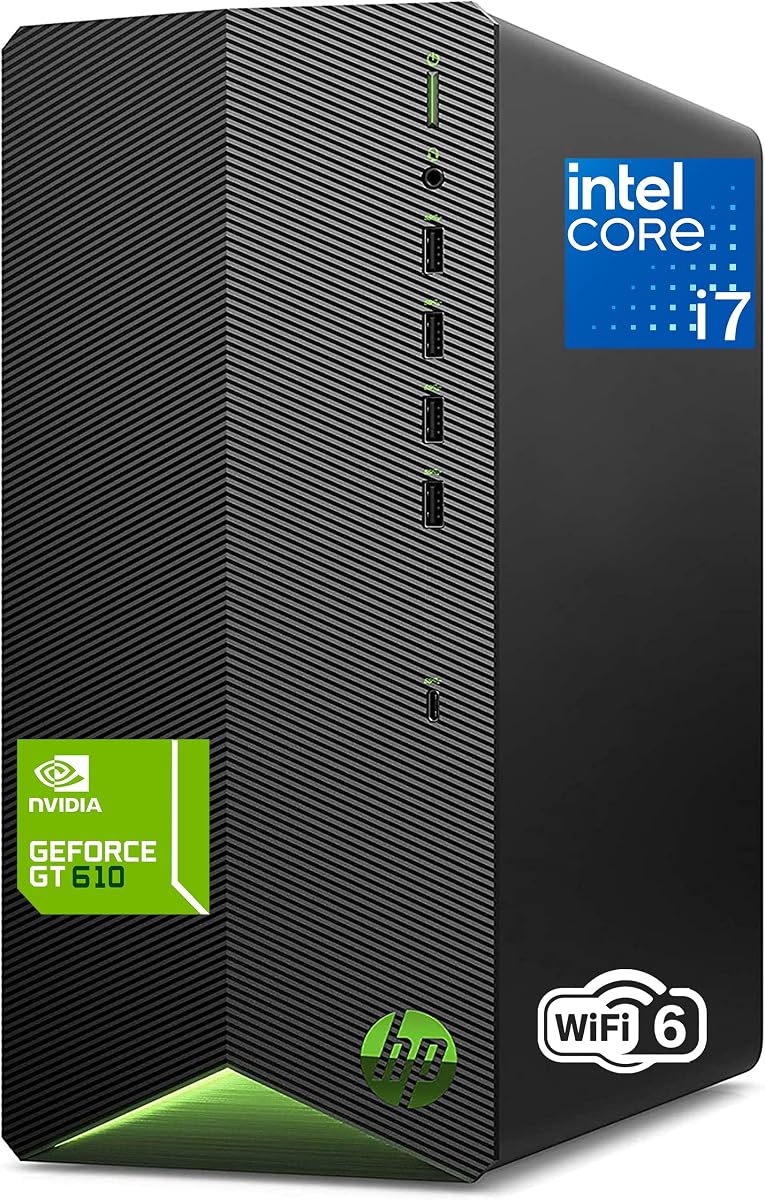
The HP i7 Desktop Tower earns a 4.4 rating and offers a well-balanced configuration for students, remote workers, and families seeking a complete package. Its eight-core Intel i7-11700F processor handles common office, learning, browsing, and conferencing tasks, while 16GB of DDR4 memory provides enough room for substantial multitasking.
We may earn a commission when you buy through this link, at no additional cost to you.
A 1TB PCIe SSD is a major practical strength. It gives users room for assignments, research files, photographs, videos, and installed applications without sacrificing quick boot and file-access performance. The system also includes WiFi 6, Bluetooth, a keyboard, and a mouse, making it a convenient one-box solution for a new desk or student move.
The listed GeForce GT 610 graphics are better suited to casual entertainment and light gaming than modern games or demanding visual work. The processor is also from an earlier generation, although its eight cores remain useful for productivity. Buyers prioritizing high-resolution gaming should look beyond this configuration.
Overall, this tower is a sensible choice for a student, a family member handling everyday work, or a home office that values storage and included peripherals. It is especially attractive when a complete, functional workstation is preferred over a barebones system.
A 1TB PCIe SSD provides useful breathing room for large project folders and media libraries. It also keeps everyday operations responsive, making the system feel more practical for a student handling assignments across several applications.
The included keyboard and mouse remove the need to purchase basic input devices separately. Combined with WiFi 6 and Bluetooth, the package covers the essential needs of a shared home workstation.
We may earn a commission when you buy through this link, at no additional cost to you.
The HP Core i5 Tower has a 4.5 rating and presents a straightforward option for families that need a dependable computer for homework, streaming, communication, casual gaming, and light photo editing. The combination of an Intel Core i5 processor and 16GB of DDR4 RAM supports responsive use across several common applications.
We may earn a commission when you buy through this link, at no additional cost to you.
Its 256GB PCIe NVMe SSD improves boot time and application loading, although capacity is the most obvious constraint. The tower is also designed with modern household connections in mind, including USB Type-C, several high-speed USB ports, Ethernet, an included WiFi adapter, and a headphone jack. HDMI, DVI, and VGA outputs offer display flexibility.
Windows 11 Pro adds security and parental-control features, which can be helpful for a shared family computer. The 11.93-inch-tall microtower is easier to position than a full-size desktop, and the listing describes quiet operation as a benefit in home environments. A buyer with extensive media libraries may need additional storage.
This HP is best for users who value a compact, ready-to-use family system over maximum storage or gaming performance. It is particularly suitable for a child's study area, a shared office, or a second computer used mainly for browsing, schoolwork, and media.
At 11.93 inches tall, the microtower can fit more easily beneath a desk or beside an entertainment center. Its compactness is useful in homes where a full-size tower would occupy valuable floor or surface space.
USB Type-C, multiple USB ports, wired Ethernet, wireless connectivity, and three display outputs give users multiple ways to attach accessories and displays. The variety is useful for older and newer peripherals alike.
We may earn a commission when you buy through this link, at no additional cost to you.
The renewed Dell OptiPlex 3060 receives a 4.0 rating and delivers a notably generous memory and storage package for a value-oriented home computer. Its sixth-generation Intel i5-8500 is not a modern powerhouse, but 32GB of DDR4 RAM and a 1TB SSD create a capable platform for browsing, office applications, media, and extensive multitasking.
We may earn a commission when you buy through this link, at no additional cost to you.
Built-in WiFi and Bluetooth remove the need to rely solely on wired networking. The port selection is also practical, including four USB 3.0 ports, four USB 2.0 ports, DisplayPort, HDMI, an audio combination jack, separate audio output, RJ-45 Ethernet, and internal SATA connections.
The renewed status is the most important consideration. It should appeal to buyers comfortable with refurbished hardware and its variable cosmetic condition. The older processor may also feel less impressive than newer alternatives, particularly in heavily threaded work, while the plentiful RAM helps compensate during ordinary productivity tasks.
For a student, secondary family computer, or home office seeking substantial storage and memory at a value-oriented level, this OptiPlex is compelling. Confirm the refurbisher's condition and warranty terms before purchase, and pair it with an external drive if the internal expansion and storage arrangement need more flexibility.
Thirty-two gigabytes of DDR4 memory exceeds what many home users need for browsing and document work. It provides useful headroom when many browser tabs, office applications, and communication tools remain open simultaneously.
A 1TB SSD supplies both quick access and generous capacity. Built-in wireless connectivity and a broad port selection make the system easier to integrate into an existing home network and peripheral setup.
We may earn a commission when you buy through this link, at no additional cost to you.
The HP ProDesk 400 G9 carries a 4.4 rating and combines a compact small-form-factor enclosure with a generous 32GB memory configuration. Its Intel Celeron G6900 is a dual-core processor, so it is best suited to office productivity, browsing, communication, and applications that do not demand heavy multicore performance.
We may earn a commission when you buy through this link, at no additional cost to you.
The system provides substantial storage with a 1TB PCIe M.2 SSD, while its connectivity list includes USB Type-C, several USB Type-A connections, DisplayPort 1.4, HDMI 1.4, RJ-45 Ethernet, WiFi, and audio connections. Dual 4K display support is valuable for users who want more visual workspace.
Windows 11 Pro, TPM 2.0, and HP Wolf Security make this a security-conscious business desktop, although a home buyer may not use every feature. The processor is the key compromise: plenty of memory cannot fully substitute for higher core count in demanding workloads, but routine office tasks should be comfortable.
Choose the ProDesk 400 G9 for a small, professional-looking computer with large memory, plentiful ports, and dual high-resolution displays. It suits home offices, administrative users, and shared workspaces where a durable business-style design matters more than enthusiast performance.
Windows 11 Pro security tools, TPM 2.0, and HP Wolf Security provide a more business-oriented foundation. These features may be useful for users managing sensitive records or connecting the desktop to an established home-office infrastructure.
Dual 4K support is a meaningful advantage for document comparison, spreadsheet work, communication, and research. The compact dimensions also make it easier to preserve desk space while using two displays.
We may earn a commission when you buy through this link, at no additional cost to you.
The Dell 2026 Edition Tower Desktop earns a 4.4 rating and offers a modern combination of 32GB DDR5 memory, a 1TB PCIe NVMe SSD, and a 14th-generation Intel Core i3-14100 processor. The four-core, eight-thread chip handles office automation, web work, communication, and daily operations with ample responsiveness.
We may earn a commission when you buy through this link, at no additional cost to you.
Dual 4K support through HDMI 2.1 and DisplayPort 1.4a makes the tower useful for extended workspaces. Its connectivity includes MediaTek WiFi 6, Bluetooth, USB 3.2 Gen 1 Type-C, USB-A, Gigabit Ethernet, an SD media reader, and an audio jack, providing a modern and varied peripheral selection.
Windows 11 Pro adds security and management capabilities, but it may not be necessary for a straightforward household. The Core i3 processor is adequate rather than premium, and heavy creative workloads could expose that limit. Against those constraints, 32GB of fast DDR5 memory and rapid NVMe storage make the system very well equipped for ordinary productivity.
This Dell tower is a strong recommendation for home offices, students, and administrative users who want modern memory, fast storage, and multiple high-resolution displays. Choose it over a basic i5 system when memory capacity, connectivity, and monitor flexibility are priorities.
Thirty-two gigabytes of DDR5 RAM gives the system room for many active applications and large working sets. The faster memory generation also complements its contemporary NVMe storage and 14th-generation processor.
Support for two 4K monitors creates a generous canvas for research, spreadsheets, video calls, and creative previews. The included modern display outputs also make it easier to build a flexible desk arrangement.
We may earn a commission when you buy through this link, at no additional cost to you.
The HP 2026 Desktop earns a 4.5 rating and is a well-rounded home-office tower built around the 12th-generation Intel Core i5-12500. Its six cores and 12 threads provide responsive performance for business applications, remote work, online classes, research, and households that keep several applications open throughout the day.
We may earn a commission when you buy through this link, at no additional cost to you.
A 512GB PCIe SSD supports quick startup and file access, while 16GB of DDR4 memory is a practical amount for general productivity. The system arrives with Windows 11 Home, a wired keyboard and mouse, and web-based Office 365 access, making it particularly convenient for users who want a complete setup without sourcing basic accessories separately.
Its eight USB ports, HDMI, VGA, Ethernet, and WiFi 6 connections cover many peripheral needs. Intel UHD Graphics 770 handles everyday visuals, presentations, and general media. It is not a gaming-focused configuration, and the fixed 16GB memory specification may make future upgrades less flexible than a system that supports larger modules.
This HP is a strong all-rounder for home workers, students, and small-business-style household tasks. Its included accessories and balanced specifications make it particularly appealing for setting up a second office or replacing an aging family computer.
The included keyboard and mouse, preinstalled operating system, and web-based Office access make initial setup straightforward. Users can move from unboxing to familiar productivity tasks without immediately shopping for additional basic equipment.
The six-core processor and 16GB of memory provide a comfortable platform for browser research, calls, documents, and lesson platforms used at the same time. Turbo speeds up to 4.6GHz support responsive performance during active work.
We may earn a commission when you buy through this link, at no additional cost to you.
The Lenovo IdeaCentre Tower has a 4.6 rating and pairs a 10-core Intel Core Ultra 5 225 processor with 16GB of DDR5 memory. It is a versatile choice for office work, online learning, browsing, communication, and light creative tasks, with particularly strong processor core count for its general-purpose positioning.
We may earn a commission when you buy through this link, at no additional cost to you.
The processor operates at a 3.3GHz base frequency and can boost as high as 4.9GHz, with 20MB of Intel Smart Cache and 22MB of L2 cache. A 512GB SSD provides fast startup and file access. Expansion is another strength: the listing states support for up to 64GB DDR5 memory and up to 4TB of PCIe M.2 storage.
Connectivity is comprehensive for a home system. Seven USB ports, HDMI, VGA, RJ-45 Ethernet, WiFi 6E, and Bluetooth 5.1 allow flexible peripheral and network arrangements. The wired keyboard and mouse are included, and Windows 11 Home is preinstalled. The main limitation is the more modest 512GB starting storage compared with several rivals.
This Lenovo is an excellent general-purpose home desktop for users who want modern performance, a broad port selection, and room to grow. Choose it when balanced specifications and future capacity matter more than having the largest storage drive from the first day.
The 10-core design provides strong parallel-processing potential for a general-purpose home tower. Users running multiple work, study, and communication applications can benefit from the extra cores during busy periods.
Substantial memory and storage ceilings make the system adaptable over time. Starting at 16GB and 512GB, it can accommodate users whose needs grow without requiring an immediate move to another platform.
We may earn a commission when you buy through this link, at no additional cost to you.
The Dell Pro Tower Desktop has the highest listed rating in the group at 4.9 and combines a 14th-generation Intel Core i3-14100 processor with 16GB of DDR5 memory. The four-core, eight-thread processor supports up to 4.7GHz and 12MB of cache, providing capable performance for communication, presentations, content work, and everyday productivity.
We may earn a commission when you buy through this link, at no additional cost to you.
Its 512GB PCIe SSD enables rapid boot and application access, while the selection of front and rear connections includes USB-C 3.2 Gen 1, several USB 3.2 and USB 2.0 ports, DisplayPort 1.4, HDMI 2.1, a headset jack, a media card reader, and Gigabit Ethernet. MediaTek WiFi 6 and Bluetooth provide modern wireless options.
Windows 11 Pro brings remote desktop capabilities, enhanced security, and professional tools. Intel UHD Graphics 730 supports dual monitors, making the tower useful for a split-screen work area. The 180W Bronze power supply, Kensington lock slot, and padlock loop also suit users who value physical security in a shared home office.
Choose the Dell Pro Tower for a polished, connected business-style system with an excellent listed rating and modern connectivity. Its four-core processor and 512GB storage are modest beside some alternatives, but for typical home-office work, the overall balance is highly attractive.
The wide selection of front and rear USB ports reduces the need for hubs when connecting storage, displays, keyboards, and other accessories. Dual-monitor support further strengthens its suitability for a professional desk.
Windows 11 Pro adds remote access and security capabilities, while the lock slot and padlock loop support physical protection. These features are particularly useful in a shared room or multi-use home office.
We may earn a commission when you buy through this link, at no additional cost to you.
Choosing a home desktop is easiest when you begin with the applications and devices you expect to use, then match those needs to processor power, memory, storage, connectivity, and physical design.
The processor handles the most intensive calculations in a desktop, so its core count, generation, clock speed, and integrated graphics matter. An Intel Core i3 or Celeron is generally sufficient for browsing, school assignments, video calls, and standard office applications, while a Core i5 or Core Ultra 5 provides more headroom for multiple active applications. A Core Ultra 7 is appropriate when performance, content creation, and sustained multitasking justify a higher-tier configuration.
For most households, prioritize a modern processor with at least four cores, then consider clock speed and graphics capability. A faster processor helps but cannot compensate for insufficient memory or storage.
RAM lets several applications and browser tabs remain responsive at the same time. The systems in this guide range from 16GB to 32GB, with 16GB forming a practical baseline for general use and 32GB providing more room for demanding multitasking, larger work files, and creative applications. DDR5 is newer and generally more efficient, while DDR4 remains a valid choice in many established systems.
Choose memory based on how many applications you expect to keep open. For a shared family computer, 32GB may prevent slowdowns during simultaneous schoolwork, browsing, calls, and media use.
A solid-state drive improves startup time, application loading, and file access compared with a traditional hard drive. Capacity still matters because installed applications, photographs, school projects, videos, and backups can consume substantial space. The products here range from 256GB to 1TB, so think about whether you will work primarily online or keep a sizable local media library.
Look for at least 512GB when possible and choose 1TB for heavier files. Check whether the enclosure has additional expansion options if you expect storage needs to grow.
Integrated graphics are adequate for web browsing, office documents, streaming, video calls, and casual entertainment. However, monitor resolution and the number of displays affect the visual workload. Several systems support dual 4K output, while the Dell Slim Desktop is listed for up to four FHD monitors. Dedicated graphics can add value for serious gaming or intensive visual work.
For a productivity desk, prioritize the number and resolution of supported displays. For modern games, check the graphics model and requirements separately from the processor.
A complete home desktop should connect easily to monitors, printers, storage devices, keyboards, mice, headphones, and a network. USB-A remains essential, while USB-C can simplify modern accessory connections. DisplayPort and HDMI provide the most common monitor links, and built-in WiFi and Bluetooth make placement easier when running a cable to the router is inconvenient.
Match the ports to the accessories you already own. A broad selection reduces the need for an extra hub, but check the physical placement and version of each connector before purchasing.
Windows 11 Home is designed for personal computing and familiar home and office applications, while Windows 11 Pro adds management, security, and remote-access capabilities. A business-oriented operating system can be useful for a home office, but it may include features a household never needs. Hardware protections such as TPM, HP Wolf Security, lock slots, and padlock loops can add another layer of device and workspace security.
Choose Home for a straightforward personal setup and Pro when you value centralized management, remote desktop functions, or more advanced security controls. Confirm that your essential applications support the included edition.
Tower desktops generally provide more room for expansion, while slim and small-form-factor systems fit more neatly into living areas and compact offices. The Dell Slim Desktop emphasizes a modest footprint, the HP ProDesk 400 G9 measures just 11.9 by 10.6 by 3.7 inches, and the Lenovo and Dell towers balance larger working areas with clearly stated upgrade paths. Tool-less entry and removable side panels can make maintenance easier.
Measure the intended desk or entertainment-center space before buying. If you may add memory or storage, confirm expansion support and consider a case that offers accessible internal components.
A keyboard and mouse can make a new computer immediately usable, as offered by the HP i7 tower, HP Core i5 tower, HP 2026 desktop, Lenovo IdeaCentre, and HP ProDesk. Some systems also include web-based Office access or wired keyboard and mouse combinations. Service terms can matter too, particularly for a home office, and the Dell Slim Desktop and Dell Tower include a one-year onsite service option.
Account for what is included before comparing only the processor and memory. Also verify warranty coverage, refurbishment status, operating system setup, and the availability of support from the seller.
Start by placing the computer on a stable, ventilated surface with clearance around its vents. Connect the monitor, keyboard, mouse, and network before powering it on, then follow the operating system's initial setup steps. Create separate user accounts for family members if everyone will use the machine, and enable the available security features to protect local files and online accounts.
Keep software current through operating system updates, browser updates, and regular application maintenance. Save important documents in more than one location, use an external drive or a reputable cloud service for backups, and avoid placing confidential files on shared accounts. For a new family computer, establish sensible routines for downloads, file organization, screen time, and automatic locking.
Dust can restrict airflow and increase heat over time, so unplug the system before cleaning removable panels. Use a soft, dry cloth for exterior surfaces, avoid spraying cleaner directly onto ports or openings, and organize cables to improve safety and airflow. Periodically verify that storage remains healthy, backups can be restored, and all connected devices still work as expected.
For browsing, schoolwork, streaming, and standard office use, 16GB is generally a comfortable starting point. It lets users keep several applications and browser tabs open without relying on virtual memory too frequently. A 32GB configuration provides better headroom for demanding multitasking, large files, photo or video editing, and professional applications. Match the amount to your workload rather than paying for memory that will remain unused.
A 512GB SSD can be sufficient when most files are stored online and the household uses the computer primarily for browsing, documents, lessons, and communication. It becomes tighter when storing large video libraries, extensive photo collections, or numerous installed games. Check for storage expansion options or plan to use external storage, which can also provide a convenient backup destination.
A desktop is often preferable when you want a larger monitor, more memory and storage, easier component access, and a stationary setup that remains plugged in at a desk. A laptop offers portability and can operate on battery, making it better for users who work in several locations. Consider a desktop when the computer is mainly used in one room and a fixed workspace is available.
Not for ordinary browsing, documents, schoolwork, video calls, streaming, and casual games. Integrated graphics can handle these tasks and support one or more monitors. Dedicated graphics become more important for modern demanding games, intensive photo or video work, 3D applications, and some high-resolution creative workflows. Check the listed graphics model and game requirements before deciding.
Many are more serviceable than compact laptops because they provide easier access to memory, storage, and expansion areas. Models with removable side panels and tool-less entry can make routine work simpler, although the exact upgrade path depends on the chassis and installed components. Check supported memory types, storage interfaces, and available bays before purchasing parts.
A useful system should include multiple USB-A ports for keyboards, mice, printers, and storage, plus at least one modern USB-C port and both HDMI and DisplayPort for monitor flexibility. Built-in WiFi and Bluetooth reduce cabling requirements, while Ethernet provides a stable wired network option. The most important connections are those required by your own monitors and accessories.
Windows 11 Home is generally sufficient for standard personal use, including schoolwork, entertainment, browsing, and home-office applications. Windows 11 Pro adds features such as remote desktop, advanced device management, and security tools that can benefit professionals or shared family offices. Paying attention to the included edition helps avoid paying for advanced tools the household will never use.
Compare the warranty, return policy, refurbisher, cosmetic-condition description, included accessories, operating system, and available ports alongside the processor, memory, and storage. A renewed system can provide strong value because it may include more memory or storage than new budget models, but its condition and warranty should be understood before purchase. Test essential functions immediately after delivery and keep the return window in mind.
The Dell Slim Desktop is the strongest all-around recommendation because it combines a modern Core Ultra processor, compact styling, extensive monitor support, convenient upgrade access, security features, and onsite service. The Dell OptiPlex 3060 stands out as the value selection with 32GB of memory and a 1TB SSD, while the Dell Tower Desktop represents the premium option for users who want a Core Ultra 7 processor and 32GB of RAM.
Prioritize the parts of the experience you use most often. A household focused on browsing and schoolwork can be well served by an HP i5 tower, while a home office may benefit from the HP 2026 Desktop's included peripherals and broad USB selection. Users building a multi-screen setup should examine display outputs, and buyers expecting large local libraries should prioritize SSD capacity. Expansion support, wireless standards, security, and included accessories complete the decision.
Before purchasing, recheck the current product listing, configuration, seller, warranty, and price. Component configurations and marketplace offerings can change, so confirm that the processor, memory, storage, operating system, ports, and included accessories still match your needs. With those details verified, you can choose the home desktop that offers the most useful balance for your particular space and routines.