
EBL LCD 4-Bay Charger
4.6Editor score
Four individual charging slots
Separate LCD status indicators
Trickle-charge completion mode
Worldwide 100-240V input
NIMH Smart Charger guide compares 10 models for rechargeable batteries, highlighting bay count, displays, discharge features, safety controls, battery
A NIMH smart charger should do more than refill a single AA or AAA cell. It should recognize rechargeable chemistry, charge each cell independently, report status clearly, and stop safely when a battery is full, defective, or inserted incorrectly.
The ten chargers in this guide were compared using the information supplied for each product, focusing on supported battery sizes, charging controls, display capabilities, safety features, included connectors, and practical applications.
Each review shows which user the product suits best, from small household charging needs to large hobby-battery collections, while noting that product availability and pricing can change over time.
4.6Editor score

4.8Editor score

4.7Editor score
This side-by-side overview compares charging capacity, battery compatibility, user controls, safety features, and the most suitable application for each NIMH smart charger in the guide.


The EBL LCD Battery Charger Smart Individual 907 is a focused four-bay option for people who regularly cycle small NiMH and NiCD batteries. Its 4.6 rating reflects a generally favorable balance of clear status reporting, useful safety controls, and straightforward operation. Each of the four bays displays its own charging condition, making it easier to identify a battery that has finished before the rest of the set.
We may earn a commission when you buy through this link, at no additional cost to you.
Its most appealing feature is the separate LCD for every slot. The display identifies the charging state and can flag an error when a battery is installed incorrectly or appears defective. Advanced MCU control, negative-delta-V cutoff, trickle charging, and protection against overheating, overcurrent, and short circuits make this more than a basic four-cell charger. Worldwide 100-240V AC input also makes it practical for travel or use outside the United States.
The main limitation is battery-format support. This charger is designed for AA and AAA rechargeable batteries rather than C, D, 9V, or connected hobby packs. It also lacks a discharge function, detailed capacity readings, and any form of battery analysis. Buyers who only need dependable charging for a few household cells will find those omissions reasonable, while collectors of mixed battery formats will need a more versatile unit.
This is a strong general recommendation for anyone seeking an uncomplicated smart charger without spending money on an oversized hobby-bay system. It is particularly useful for flashlights, remotes, wireless peripherals, toys, and other devices using AA or AAA NiMH cells. Independent displays, worldwide input, and the four-bay capacity make it a practical everyday choice.
A dedicated display for each slot removes much of the guesswork from a shared LED charger. You can see which battery is still charging, which is complete, and which slot has reported an error without removing a cell to inspect it.
Negative-delta-V cutoff, trickle charging, and protections against excessive heat, current, and short circuits provide a more responsible charging cycle. The defective-battery detection is particularly useful when older cells are no longer dependable.
We may earn a commission when you buy through this link, at no additional cost to you.
The BONAI 16-Bay AA AAA Battery Charger is designed for households, classrooms, photographers, or hobby users who need to recharge many small cells at once. Its 4.5 rating and large slot count make it a practical high-volume option. Unlike compact four-bay models, it can handle up to sixteen NiMH batteries without requiring users to split them among several chargers.
We may earn a commission when you buy through this link, at no additional cost to you.
Every bay operates independently, so AA and AAA cells can be mixed without taking neighboring positions. The initial LED cycle confirms that empty ports have power. Once a battery is inserted, the corresponding light turns red while charging and green when complete, while a flashing red signal indicates a defective battery. That arrangement is easier to interpret at a glance than a complicated control panel.
Its protections cover overcharging, overvoltage, overcurrent, overheating, short circuits, and reverse polarity. A regular attached AC cord avoids a separate power brick, and compatibility from 110V to 240V adds flexibility. The trade-offs are its lower charging current of 250-500mA, lack of a detailed display, and inability to charge alkaline or lithium cells. Warmth during operation is normal, so the charger should remain uncovered and well ventilated.
Choose this model if you regularly have eight or more AA or AAA NiMH batteries to manage. It is less appropriate for detailed battery diagnostics or users who also need C, D, 9V, lithium, or hobby-pack support. For straightforward bulk charging, however, the independent bays and clear port lights make it an efficient and approachable solution.
Large collections of AA and AAA cells can be recharged in one session. Independent operation also means you do not have to fill adjacent slots or group batteries by size, which saves time when different devices use different cell formats.
Each occupied port communicates its own state with red, green, or flashing red light. The result is quick monitoring without navigating a menu, making the charger approachable for beginners and convenient for shared workspaces.
We may earn a commission when you buy through this link, at no additional cost to you.
The Tenergy Smart Charger for 8.4V-9.6V NiMH Battery Packs is a specialized solution for airsoft, RC car, and RC airplane users. It carries a 4.7 rating and offers a clearer purpose than a general AA/AAA charger: it recharges connected 7-cell and 8-cell NiMH hobby packs. Its compact design, LED indicators, and supplied connector options make it well suited to a hobby bench.
We may earn a commission when you buy through this link, at no additional cost to you.
The charger supports packs with capacities from 600mAh to 2500mAh and accepts both mini Tamiya and standard Tamiya connections. A mini-to-standard adapter is included, allowing it to work with common RC and airsoft battery configurations. A green LED indicates a fully charged pack, while red shows that charging is underway. Universal 100-240V AC input broadens where it can be used.
This is not a universal NIMH smart charger, and that distinction matters. It cannot recharge loose AA or AAA batteries and must not be used with LiPo packs. Its supported voltage and capacity range is also specific. Those limits are appropriate for the intended hobby applications, but buyers with mixed batteries need a separate household charger or a more flexible multi-bay model.
For someone who owns compatible seven- or eight-cell NiMH packs, this is a strong specialty recommendation. It provides the required connector hardware, straightforward status indication, broad voltage input, and recognized safety standards without the complexity of a full hobby-grade analyzer. The Tenergy 7-8 Cell model is best selected by matching your exact pack voltage and connector.
The charger is designed around the voltage and capacity profile of common seven- and eight-cell NiMH packs. That specialization gives RC and airsoft users a cleaner solution than adapting a general-purpose AA charger.
The included mini Tamiya connector and mini-to-standard adapter cover common hobby configurations. Checking the pack connector and voltage before charging helps prevent an avoidable mismatch.
We may earn a commission when you buy through this link, at no additional cost to you.
The EBL Rechargeable Batteries with Charger bundle is a convenient starting point for someone building a rechargeable battery collection. It combines four 2800mAh AA NiMH cells, four 1100mAh AAA NiMH cells, and an upgraded eight-bay charger. The 4.5 rating reflects a useful all-in-one package for households that want to replace disposable cells with a ready-to-charge set.
We may earn a commission when you buy through this link, at no additional cost to you.
The charger accepts any number of AA and AAA NiMH or NiCD rechargeable batteries across its eight independent bays. A soft LED for each cell indicates charging progress and helps distinguish non-rechargeable batteries. Negative-delta-V cutoff moves a full battery into trickle charging, while heat shedding, short-circuit detection, and input-voltage detection support safer operation.
The main benefit is convenience. You do not have to select and purchase compatible rechargeable batteries separately, and the two capacities suit different device requirements. The drawbacks are that the charger itself handles only AA and AAA formats, while the LEDs provide less detailed information than an LCD or analyzer. It also does not offer a discharge function, so it cannot condition cells through repeated charge and discharge cycles.
This bundle is best for first-time NiMH users, families replacing regular alkaline batteries, or anyone who wants eight matching-capacity cells in two sizes. It is less suitable for C, D, 9V, lithium, or hobby-pack charging. For a simple household ecosystem, the included batteries and eight-bay charger offer a balanced and easy-to-maintain setup.
The included 2800mAh AA and 1100mAh AAA cells provide different capacity levels for high-drain and lighter household devices. Having compatible batteries from the outset removes the common frustration of buying a charger and discovering that the existing cells cannot be used.
The upgraded soft LED indicators are intended to be easier on the eyes during nighttime use. They preserve the useful information buyers need without requiring a bright display that remains visible throughout the charging session.
We may earn a commission when you buy through this link, at no additional cost to you.
The Tenergy Smart Battery Charger for NiMH/NiCd 7.2V-12V 6S-10S Battery Packs is built for serious hobby users with varied pack requirements. Its 4.6 rating reflects a capable specialty charger that supports both NiMH and NiCd packs from 7.2V through 12V. Unlike a small-cell charger, it is intended for RC cars, RC airplanes, airsoft equipment, and other connected battery systems.
We may earn a commission when you buy through this link, at no additional cost to you.
Automatic voltage detection adjusts the charger to the connected pack, reducing the need to make manual voltage selections. Two current options provide useful flexibility: 0.9A is recommended for packs between 900mAh and 1800mAh, while 1.8A is recommended from 1800mAh to 5000mAh. LED indicators use red for active charging and green for completion.
The included standard Tamiya connector, standard-to-mini Tamiya adapter, and standard-Tamiya-to-alligator-clips adapter provide broad connection options. The trade-offs are that this remains a pack charger rather than an AA/AAA device, and its chemistry support excludes lithium batteries. Users must still verify the pack's chemistry, voltage, capacity, and connector before connecting it.
For hobbyists who own several RC or airsoft packs, this charger is a strong recommendation. It accommodates a wider voltage range than the smaller Tenergy 7-8 Cell option and provides useful current selection. Choose it when connected packs are central to your activities, rather than when your main need is recharging household AA and AAA batteries.
The charger identifies the voltage of a connected NiMH or NiCd pack and adjusts accordingly. This makes the unit more convenient when multiple pack configurations are in regular use, provided every battery falls within the supported range.
The 0.9A and 1.8A modes let users match current to the pack's rated capacity. Selecting the appropriate range is an important part of maintaining charging consistency across batteries with different power requirements.
We may earn a commission when you buy through this link, at no additional cost to you.
The EBL Universal Smart Battery Charger with Discharge Function is one of the most format-flexible options in this guide. Its 4.5 rating reflects a feature set aimed at users who collect several rechargeable battery types. It supports one to four AA, AAA, C, or D cells and one to two 9V NiMH or NiCD batteries, with independent slots for mixed charging.
We may earn a commission when you buy through this link, at no additional cost to you.
The LCD provides a central view of charging information, while the blue button activates discharge mode. During discharge, the display reads DISCHG, and the charger returns to charging after the process ends. This cycle is useful for users who want the device to manage both discharge and recharge rather than serve only as a basic replenishment tool.
Charging output totals 2A, with stated full-charge times of up to three hours for AA and AAA cells and up to ten hours for C, D, and 9V batteries. Safety controls stop charging for invalid input voltage, faulty cells, short circuits, and non-rechargeable batteries. Constant-current operation is designed to reduce power fluctuations. The limitations are the two-bay maximum for 9V batteries and the absence of a discharge function for 9V cells.
This model is an excellent fit for a mixed battery collection, including large remote-control batteries, flashlights, radios, and household cells. It combines more supported formats than most competing models while adding a discharge cycle. It is less compelling for hobby-pack charging or for users who need only four AA and AAA batteries.
The ability to combine AA, AAA, C, D, and 9V cells in independent slots reduces the need for separate chargers. This is particularly helpful for users who move between compact devices and equipment that uses larger cylindrical batteries.
The blue-button discharge mode adds a maintenance function beyond basic charging. Once discharge is complete, the unit returns to charging mode, creating a more complete cycle for compatible AA-through-D cells.
We may earn a commission when you buy through this link, at no additional cost to you.
The MIEKLALE 20+2 Bay AA AAA Battery Charger is built for unusually large rechargeable-cell collections. Its 4.6 rating and 22-slot layout make it the capacity leader among the products reviewed. It can charge any combination of AA or AAA NiMH and NiCD batteries across 20 individual bays, plus up to two 9V rechargeable batteries.
We may earn a commission when you buy through this link, at no additional cost to you.
A smart LCD displays charging information for the connected batteries, giving the user a clearer central view than a collection of separate LEDs. Any number of supported cells can be charged simultaneously, and the independent-bay design avoids the need to fill neighboring positions in pairs. That flexibility is valuable for families, schools, camera kits, or hobby workspaces where batteries are constantly rotating.
The charger includes protection against overcharging, overcurrent, overvoltage, overheating, and short circuits. Its limitations are important: it cannot charge 3.7V lithium batteries or 1.5V lithium AA and AAA cells, and no discharge function is available. Its wide chassis also requires more room than a compact household charger, though that footprint is justified for users who genuinely need the capacity.
Choose the MIEKLALE 20+2 when your battery collection includes many AA, AAA, and 9V cells and you want a single central display. It is less appropriate for lithium users, hobby packs, or anyone with only a few cells. For a shared battery station, few alternatives offer as many individual charging positions.
Twenty AA/AAA positions support large rotations of cells without moving batteries between chargers. The two additional 9V positions extend the same centralized setup to rectangular rechargeable batteries used by certain household devices.
A central smart LCD makes a 22-bay unit easier to supervise than a wall of separate indicator lights. It also confirms the product's broader monitoring role, although it does not provide the battery-analysis suite found on dedicated analyzers.
We may earn a commission when you buy through this link, at no additional cost to you.
The ISDT N8 is the most feature-rich and highest-rated charger in this guide, earning a 4.8 rating. It combines eight independently controlled AA and AAA bays with a full-color LCD, touch panel, USB-C power, and battery analysis functions. It is designed for users who want more information than a simple red-and-green charging light can provide.
We may earn a commission when you buy through this link, at no additional cost to you.
The display can report voltage, current, elapsed charging time, operating mode, battery type, internal resistance, and charged capacity. The N8 also supports charging, cycling, activation, and discharge functions, with automatic shutoff at full charge and trickle-charge technology. Its stated maximum output reaches 15A per slot, though the supplied information notes that actual charging times vary with NiMH capacity and operating conditions.
Battery compatibility is broad but still bounded. The charger supports AA and AAA NiMH, NiCd, Li-ion, and LiHV formats, and its 5-12V, 18W input can be supplied through USB Type-C. It is not suitable for 1.5V lithium AA or AAA batteries, and users who are unsure of a cell's chemistry should use auto mode. The interface also requires more attention than a basic LED charger.
For technicians, collectors, serious hobbyists, and users who regularly compare battery performance, the N8 offers the most complete information set here. Its charging, testing, cycling, and discharge capabilities justify the premium positioning. It is less appropriate for someone who only wants the simplest possible charger for four household cells.
Voltage, current, charging time, internal resistance, and capacity readings turn the N8 into more than a charger. This information helps users identify uneven performance among batteries that may otherwise look complete after a basic charging cycle.
Charging, cycling, activation, and discharge modes support different maintenance needs. Automatic shutdown and trickle charging work together to limit unnecessary charging after a cell reaches full capacity.
We may earn a commission when you buy through this link, at no additional cost to you.
The EBL AA AAA 8-Bay Individual Charger is a straightforward choice for users who want multiple independently controlled positions without a complex display. Its 4.5 rating reflects dependable everyday functionality. The charger handles one to eight AA or AAA rechargeable cells, with each bay able to operate on its own rather than requiring paired charging positions.
We may earn a commission when you buy through this link, at no additional cost to you.
A red light indicates charging, green means the battery is fully charged, and a flashing red light identifies a bad or non-rechargeable cell. MCU-based control stops charging when it detects improper input voltage, a defect, a short circuit, or a cell that should not be charged. Negative-delta-V cutoff moves the charger into trickle mode, while constant current helps limit power fluctuation.
The product uses fire-resistant housing material, which is useful for a device that may be left unattended during normal charging. However, it only supports NiMH batteries despite mentioning NiCD in the title, so users should verify the exact battery type before insertion. It also lacks discharge, cycling, capacity measurement, and a detailed display, keeping the operating model deliberately simple.
This EBL model is a good recommendation for people who want a medium-capacity AA and AAA charger with independent lights and basic safeguards. It works well for a family collection of rechargeable cells, lights, toys, and remotes. Buyers seeking numerical analysis or broad chemistry support should instead consider the ISDT N8 or another more advanced model.
Any occupied slot can charge a single battery, and AA and AAA cells can be mixed freely. That flexibility is helpful when only one or two batteries need recharging or when different devices require different sizes.
Flashing red distinguishes an unsuitable or defective battery from the solid red used during normal charging. Solid green provides an equally clear signal when the cell is ready to return to service.
We may earn a commission when you buy through this link, at no additional cost to you.
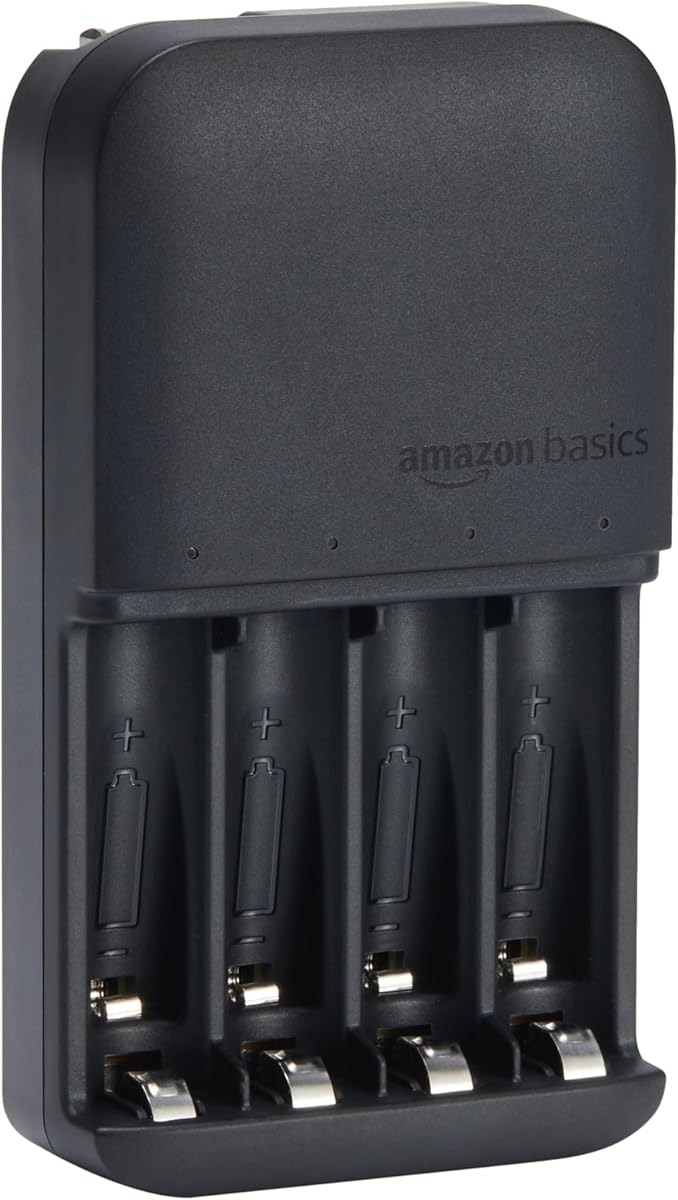
The Amazon Basics 4-Bay Smart Battery Charger offers a compact, uncomplicated way to recharge AA and AAA NiMH batteries. Its 4.2 rating is the lowest in the guide, but that does not reflect a lack of core function. It focuses on independent charging, clear LED feedback, travel convenience, and protection from incorrect polarity and overcharging.
We may earn a commission when you buy through this link, at no additional cost to you.
Each of the four bays charges a cell individually. The product's stated completion times include two AA batteries in 3.5 hours, four AA batteries in seven hours, two AAA batteries in two hours, and four AAA batteries in four hours. Battery detection indicates wrong polarity, while cutoff and trickle-charge functions help prevent overheating and overcharging once a cell reaches full capacity.
Its slim housing and foldable Type A plug make it easier to carry than many larger chargers. Switching power supports 100-240V AC operation, although users in regions with different plug shapes need an appropriate converter. It supports NiMH cells only, and it has no discharge function, cycling mode, or numerical display. Those omissions keep it focused on routine household charging.
This is a sensible recommendation for travelers, office users, or anyone wanting a small four-cell charger that can be packed easily. It is less suitable for large battery collections, lithium cells, hobby packs, or users who want to inspect capacity and internal resistance. Its greatest strengths are portability and uncomplicated independent charging.
The slim body, low weight, and foldable plug make the charger easy to place in luggage or a desk drawer. Its switching power design also supports use across 100-240V when the correct regional plug adapter is available.
Every bay can charge a single AA or AAA cell, allowing a partial set to be refreshed without leaving empty positions beside occupied ones. Individual LEDs make the status of each battery straightforward to check.
We may earn a commission when you buy through this link, at no additional cost to you.
The right smart charger depends on the cell formats, quantity, chemistry, and level of monitoring you need. Compatibility and safety should take priority over speed, while hobby users must match voltage and connectors carefully.
Match the charger to the cells you already own or intend to buy. Do not assume that the words rechargeable, smart, or universal guarantee compatibility with every battery type.
Estimate your typical battery inventory, then select a charger that can handle it in one session without crowding your workspace.
Choose the least complicated display that still provides the information your routine actually requires.
Never charge a damaged, leaking, swollen, or visibly defective battery, even if the charger claims to detect faulty cells.
Never use a hobby charger on a pack with chemistry or voltage outside its stated specifications.
Pay for discharge and analysis only when your battery-maintenance routine makes those functions useful.
Balance charging speed against charger size, available power, and the number of cells you realistically need to refresh.
Confirm whether the box includes cells, cables, adapters, or only the charger before making your final selection.
Before inserting batteries, identify their chemistry, size, voltage, and connector requirements. Make sure the charger supports every cell in the load, inspect the contacts and battery cases, and remove any damaged, swollen, leaking, or corroded batteries. Connect the charger to an appropriate power source, align positive and negative terminals with the marked polarity, and place each cell in a compatible bay.
Allow the charger to complete its normal cycle. Basic models will indicate charging and completion with lights, while LCD models may show progress, voltage, current, elapsed time, or capacity. Do not repeatedly remove and replace cells, interrupt a cycle simply because it is taking longer than expected, or cover a warm charger with fabric. For chargers with discharge or cycling modes, select the appropriate chemistry and settings before starting those functions.
After charging, remove batteries when the manufacturer indicates that they are complete and inspect them for heat, leakage, corrosion, or deformation. Store charged cells in their intended devices or in a dry container away from metal objects and extreme temperatures. Keep the charger itself on a stable, ventilated surface, clean its dry exterior with a lightly damp cloth, and never immerse it. Periodic use helps identify worn contacts or batteries that begin charging incorrectly.
No. Most NiMH smart chargers are designed only for compatible rechargeable cells, and many will detect an alkaline or other non-rechargeable battery as an error. Attempting to recharge an unsuitable chemistry can cause leakage, rupture, or overheating. Check the charger's compatibility list and the markings on each battery before insertion.
A NiMH-compatible charger can usually charge both NiMH and NiCD cells because both use roughly 1.2-volt rechargeable chemistry. A NiCD-only or tightly specified charger may not handle NiMH safely or effectively. Always confirm that the product explicitly supports the chemistry of your batteries rather than relying on the physical AA or AAA size alone.
An error may mean the cell was inserted backward, is not a supported rechargeable chemistry, is damaged, or has a poor connection. Remove the battery, clean the terminals if necessary, confirm the polarity markings, and inspect the cell for swelling or leakage. If a new compatible battery triggers the same warning in the same slot, test another bay and contact the manufacturer.
Mild warmth can occur during charging, particularly with a high current or several batteries charging together. Excessive heat, unusual odor, discoloration, swelling, or a loud error should prompt you to disconnect the charger and stop using the affected cell. Never cover a charger or place it on an insulating surface that prevents ventilation.
Yes, when the model has independent bays that accept both formats. The BONAI 16-Bay, EBL Universal Multi-Bay, MIEKLALE 20+2 Bay, and several eight-bay models allow mixed AA and AAA placement. Always follow the charger's size and chemistry markings, since a physically similar but unsupported cell should not be inserted.
Not for ordinary household use. A standard charger replenishes compatible cells and stops when they are full, while a discharge function adds a controlled discharge and recharge cycle. Discharge and analysis are more useful for battery collectors, technicians, and users who want runtime measurements. The ISDT N8 and EBL Universal Multi-Bay provide these more advanced functions.
No. The Tenergy 7-8 Cell and 6S-10S models are designed for connected NiMH or NiCd hobby packs within specified voltage ranges, not loose AA or AAA cells. Using the wrong charger can damage both the battery and the charger. Choose an AA/AAA multi-bay unit for household cells or a pack charger only for compatible connected batteries.
Replacement depends on condition and performance rather than a fixed date. Remove a battery if it leaks, swells, corrodes, stops charging normally, or shows extreme heat. If a smart charger reports a sharp increase in internal resistance, noticeably reduced capacity, or repeated errors, the cell may be near the end of useful service. Replace it with a compatible rechargeable battery and follow the charger's instructions.
The ISDT N8 is the most capable all-around option, combining eight independent bays, a detailed color display, and charging, discharge, cycling, and analysis functions. The EBL LCD 4-Bay is a practical everyday recommendation for users who value clear per-slot feedback in a compact design, while the Tenergy 7-8 Cell stands out for compatible seven- and eight-cell RC and airsoft packs.
For most buyers, begin with exact battery compatibility, then choose based on capacity and monitoring needs. Large collections may suit the BONAI 16-Bay or MIEKLALE 20+2 Bay, while mixed-size users can consider the EBL Universal Multi-Bay. Hobby owners should match pack voltage, capacity, chemistry, and connectors before considering charging speed or additional controls.
Product specifications, promotions, and prices can change, so confirm the current listing and manufacturer instructions before purchasing. Most importantly, use each charger only with the chemistry, dimensions, and electrical limits it explicitly supports, and retire any battery that appears damaged or behaves abnormally.