
12000W Three-Phase Turbine Generator
5.0Editor score
High-capacity 12000W output
Gearless direct-drive design
Rectifier-equipped wind configuration
This expert guide compares low RPM alternators for wind turbines, evaluating output, voltage, construction, mounting, efficiency, and suitability for DIY
Low RPM alternators for wind turbines make it possible to capture energy from small, slow-turning rotors without relying on a conventional high-speed generator. The right model must match rotor speed, output voltage, load requirements, and the environmental demands of an outdoor installation.
This guide compares ten permanent magnet and brushless alternatives based on stated power ratings, operating speeds, voltage options, construction, mounting features, thermal design, and intended wind or hydro applications. It covers compact 12V charging units as well as larger three-phase systems for more ambitious renewable-energy projects.
The selections show how alternator design changes with project scale, from lightweight single-phase devices to gearless three-phase generators that can be driven directly. Ratings and specifications reflect the supplied listings, while availability, configuration details, and prices can change, so verify the current listing before purchasing.
5.0Editor score

4.3Editor score

5.0Editor score
The table below compares all ten generators by power class, electrical architecture, speed characteristics, and key construction features, helping you identify the most appropriate model for a compact charging project or a larger direct-drive turbine.


The VQP 1200W Permanent Magnet Alternator is the strongest general-purpose choice in this guide for small wind-energy and vehicle-style charging projects. It carries a 4.3 rating and combines a 1200W output rating with a 12V-to-14V AC range. Its built-in voltage stabilizer is particularly useful for keeping connected equipment supplied with a more consistent output.
We may earn a commission when you buy through this link, at no additional cost to you.
The alternator is designed for permanent magnet charging and lighting, with agricultural tricycles and four-wheeled tractors also named as suitable applications. Its aluminum housing helps control weight and withstand impact, while the pure copper winding provides a practical combination of conductivity and mechanical strength. The excitation silicon rectifier arrangement supports power conversion, although the complete electrical system still requires appropriate rectification and battery protection.
The principal trade-off is its stated maximum operating speed of 4500RPM. Although the listing calls it a low RPM alternator and says it is suitable for low-speed applications, that speed may exceed the natural operating range of a small, lightly loaded wind turbine. Buyers must ensure that their rotor, shaft, pulley, or belt ratio can keep the generator within its supported speed without overspeeding it.
This is a practical recommendation for DIY builders who need one generator for both battery charging and lighting, especially in a mobile or agricultural setup. It is less suitable as a plug-and-play alternator for a dedicated three-phase turbine because the listed output arrangement is primarily 12V-to-14V. Verify the selected voltage, rectifier requirements, and speed range before finalizing an installation.
The ability to support both charging and lighting reduces the need for separate power conversion equipment in small systems. Its regulated 12V-to-14V range is especially relevant for projects centered on a conventional lead-acid battery.
The aluminum shell and copper winding produce a relatively practical combination for mobile installations. The design is easier to move than a large, heavily built three-phase turbine generator.
We may earn a commission when you buy through this link, at no additional cost to you.
This 8000W three-phase permanent magnet alternator is aimed at builders of horizontal wind turbines and other low-speed renewable-energy projects. Its listed operating speed of 600RPM makes it more naturally aligned with a slow rotor than many compact 4500RPM units. The product has no supplied customer rating, so its appeal rests on its stated electrical and mechanical specifications.
We may earn a commission when you buy through this link, at no additional cost to you.
Rare earth NdFeB magnets, high-quality copper winding, and a three-phase layout support efficient generation and improved turbine matching. The gearless structure can be driven directly without a gearbox, reducing mechanical complexity and maintenance points. A die-cast aluminum cover is treated for corrosion resistance and described as capable of withstanding demanding wind conditions.
Thermal management is another strength. The rotor and stator arrangement is intended to dissipate heat effectively while maintaining low starting resistance torque. The tradeoff is that three-phase output is not as approachable as a simple 12V battery-charging connection; a proper rectifier, controller, breaker, and system configuration may be required.
Choose this model when the objective is a substantial horizontal turbine and the builder has experience with three-phase electrical equipment. It offers far more potential output than the 400W and 1200W options, but its physical scale and system requirements also make it less suitable for a compact demonstration project.
The stated 600RPM speed gives this model a clearer relationship with a horizontal wind turbine. That makes it more compelling for a dedicated rotor than a generator whose stated maximum speed is several times higher.
Three-phase output can suit more advanced renewable-energy networks and loads that exceed ordinary battery-charging requirements. The associated controls and safety components must be selected to match the chosen voltage.
We may earn a commission when you buy through this link, at no additional cost to you.
This versatile permanent magnet alternator is designed for 500RPM operation and covers a broad stated output range from 1000W to 10000W. That flexibility makes it interesting for builders who may scale a wind or hydro project across several power levels. It supports 12V, 24V, and 48V configurations, although the exact rating depends on the selected listing variant.
We may earn a commission when you buy through this link, at no additional cost to you.
The iron shaft is presented as a durable component for turbine use, while the gearless permanent magnet construction eliminates the maintenance burden associated with a geared generator. Mounting can be customized: the product may be used with its base or installed without one, giving builders freedom to design their own frame and shaft alignment.
Its main limitation is the lack of a customer rating and the need to verify the selected output configuration carefully. A listing that spans many wattages and voltages may contain materially different versions, so the displayed power rating should not be assumed without checking the chosen option. System design also remains the builder's responsibility.
This generator is a good fit for a DIY energy project that benefits from several voltage choices and a slower rated operating speed. It is especially relevant when the same generator architecture might serve either a wind turbine or a water-driven setup. Select the exact voltage and wattage variant based on the intended load rather than ordering solely by the broad product range.
Choosing among 12V, 24V, and 48V configurations can simplify integration with different battery banks and control equipment. Selecting the correct variant is essential because a shared product listing may represent several electrically different options.
The ability to mount without the supplied base gives builders more control over rotor alignment and frame geometry. This flexibility is valuable when the generator must fit a purpose-built nacelle or vertical project structure.
We may earn a commission when you buy through this link, at no additional cost to you.
The 1KW AC Brushless Low RPM Alternator is an approachable compact option with a 5.0 rating. It combines a 1000W power rating with a brushless permanent magnet construction and an integrated voltage regulator. Its double-ended wheel configuration can support power generation, lighting, or the installation of cooling fan blades at one end.
We may earn a commission when you buy through this link, at no additional cost to you.
One of the product's strongest features is its ready-to-use construction. The integrated one-piece assembly reduces setup work, while the smooth surface is easy to clean. Aluminum and copper provide a lightweight but rigid structure, and the immersion-painted finish is described as helping resist abrasion and impact.
The stated rotational speed is 4500RPM, which is an important qualification for anyone searching specifically for a low-speed turbine generator. A small rotor may require a pulley, belt, or gearbox to reach that speed, and overspeeding should be avoided. Its 1000W capacity is also modest compared with the 8000W and 12000W models.
This is a strong choice for a compact demonstration, portable charging setup, or small lighting project where simplicity and a compact form factor matter most. It is best for builders who understand the speed matching requirement and can safely bring the rotor up to the supported operating range.
The largely assembled structure reduces mechanical preparation and makes the alternator approachable for first-time builders. Pre-drilled features and a simple layout can also simplify attachment to a frame.
Its compact, lightweight construction makes the unit easier to transport between field projects. The internal regulator helps maintain a steadier supply to connected equipment.
We may earn a commission when you buy through this link, at no additional cost to you.
This 1200W permanent magnetic generator is designed for low-speed charging, lighting, and mobile power use. It supports AC and DC output, includes a built-in voltage regulator, and is described as compatible with 12V lead-acid battery charging. No customer rating was supplied, so buyers should place greater weight on the documented features.
We may earn a commission when you buy through this link, at no additional cost to you.
Its magnetic-strip rotor and self-rectifying generator design are intended to provide smooth and efficient operation. The aluminum and copper construction supports heat dissipation, electrical conductivity, and corrosion resistance. A double-wheel arrangement makes the unit easier to transport and potentially easier to use with a pulley-driven accessory.
The generator can accept a water-tank cooling fan blade to improve heat dissipation, although that blade is not included. The 4500RPM figure also creates the same speed-matching consideration found in other compact alternators. It may require a ratio increase rather than operating at the speed of a very small wind rotor.
This model suits a builder who wants one alternator to cover both battery charging and lighting in an outdoor or emergency setup. It is less compelling for an advanced three-phase installation, but its dual-output convenience and compact construction make it a practical choice for simpler renewable-energy projects.
Supporting both AC and DC gives the generator broader utility than a model intended only for charging. This is useful when the same unit must serve lighting loads and a battery system.
The compact double-wheel format simplifies transport and offers room for attachment to an auxiliary drive. Builders should still confirm alignment and mechanical support before operating it.
We may earn a commission when you buy through this link, at no additional cost to you.
This 400W gearless permanent magnet alternator is purpose-built for low-speed wind and hydro turbine systems. Its three-phase, gearless construction emphasizes low starting torque and direct rotor coupling, making it a sensible option for small experimental turbines that need to begin generating at modest wind or water speeds.
We may earn a commission when you buy through this link, at no additional cost to you.
The supplied base and single shaft simplify frame construction, while the rotor and stator design is intended to reduce resistance torque and improve matching between the turbine and generator. The human-centered installation approach is helpful for DIY builders because it focuses on straightforward installation, maintenance, and repair.
The ring power output arrangement is designed to address cable-winding limitations associated with traditional generator layouts. With no supplied customer rating and a relatively modest 400W rating, however, this should be viewed as a small-scale generator rather than a solution for substantial household loads.
Choose this alternator for a compact wind or hydro demonstration where low startup torque and direct drive matter more than maximum output. Builders should select the proper 12V or 24V version and add suitable rectification and charge control to create a complete and protected system.
Low startup torque allows a turbine to begin moving under modest conditions, which is especially helpful for small rotors. It also reduces the mechanical stress associated with getting the generator into rotation.
A mounting base and single shaft reduce the need to fabricate those components before the generator can be installed. They still need to be matched to the turbine's exact geometry and load requirements.
We may earn a commission when you buy through this link, at no additional cost to you.
This low-speed permanent magnet alternator covers stated outputs from 8000W through 12000W and is explicitly aimed at horizontal wind turbine builders. Its 600RPM operating speed is well suited to larger slow-turning rotors, while the gearless three-phase architecture can be driven directly to reduce mechanical complexity.
We may earn a commission when you buy through this link, at no additional cost to you.
Rare earth NdFeB material and copper winding are used to support efficiency and better turbine-generator matching. The die-cast aluminum shell receives anti-corrosion treatment for resistance to harsh outdoor conditions. Special rotor and stator design also supports heat dissipation and lowers starting resistance torque.
A standout feature is the stated automatic protection behavior. Under excessive thermal load, external force, or other abnormal conditions, the listing says the rotor's magnetic flux linkage disconnects and the rotor stops, helping protect the equipment from damage. Because this is a broad multi-output listing, the exact selected wattage and voltage must be confirmed before designing the electrical system.
This generator is a strong candidate for a serious horizontal wind project with substantial power ambitions. Its complexity and high output make it less appropriate for a beginner seeking only to charge one small battery. Proper three-phase rectification, switching, protection, grounding, and structural mounting are essential.
The described shutdown behavior offers an additional layer of protection for an exposed turbine generator. It should still be supported by conventional fuses, breakers, and correctly sized rectification equipment.
Multiple output ratings let a builder choose a configuration aligned with rotor diameter and expected wind resource. Larger outputs require a more carefully engineered turbine, foundation, controller, and distribution system.
We may earn a commission when you buy through this link, at no additional cost to you.
The 1200W single-phase permanent magnet alternator is a well-rated compact model, carrying a 4.5 rating. It provides a 12V AC and DC arrangement intended for battery charging and LED lighting, making it relevant to farm, mobile, and small renewable-energy setups.
We may earn a commission when you buy through this link, at no additional cost to you.
Heavy-duty copper windings form the core of the generator, while the aluminum housing resists rust and keeps the unit light. The stated weight of 5.25 pounds supports easier transport between fields or project locations. Pre-drilled mounting holes and ready-to-wire terminals are useful practical details that can shorten installation time.
The listing says the generator begins producing at minimal rotational speeds and can connect to single-wheel drives without complex gearing. At the same time, the listed rated speed is 4500RPM, so actual output depends heavily on how quickly the rotor or accessory drive can turn it. A direct connection does not remove the need to respect the generator's speed limits.
This model is recommended for users who prioritize straightforward charging and lighting over sophisticated three-phase control. The 4.5 rating adds confidence, but prospective buyers should still confirm connector type, voltage, and rectifier configuration before connecting it to a battery or other equipment.
Copper windings support efficient electrical conversion and are central to the generator's farm-oriented design. The housing protects those windings while keeping the overall assembly portable.
Pre-drilled mounting holes and accessible terminals reduce setup time. These features are especially helpful when the generator is intended for repeated mobile use rather than a permanent enclosed nacelle.
We may earn a commission when you buy through this link, at no additional cost to you.
This 400W low-speed alternator is a compact three-phase option for small wind and water turbines. It shares the low-torque, gearless approach of the other 400W model in the guide, but adds more detail about the magnetic steel, winding insulation, and corrosion protection used in its construction.
We may earn a commission when you buy through this link, at no additional cost to you.
The rotor uses 42NSH magnetic steel with NdFeB magnets, while F-class enameled wire is stated to withstand temperatures up to 150 degrees. A special stator and rotor arrangement reduces resistance torque and helps the generator match the operating characteristics of a low-speed turbine.
The dacromet-coated shell and additional anti-corrosion paint layer are intended to resist rust during long-term operation. These features are meaningful in a turbine exposed to moisture, wind, and temperature changes. The trade-offs are the absence of a supplied customer rating and a 400W capacity that is not intended for major household demand.
This generator fits an educational, off-grid, or supplemental project using a small turbine and low-voltage battery system. It is worth considering over the similarly sized option when winding temperature resistance and a detailed corrosion-treatment specification are especially important to the builder.
The same low-speed generator can suit either wind or water-driven rotation, offering flexibility during project development. Mechanical speed and available driving force remain the critical matching considerations.
Layered shell coatings help protect against moisture and oxidation, while F-class wire provides additional thermal tolerance. These details support longer service life when cooling and environmental protection are properly handled.
We may earn a commission when you buy through this link, at no additional cost to you.
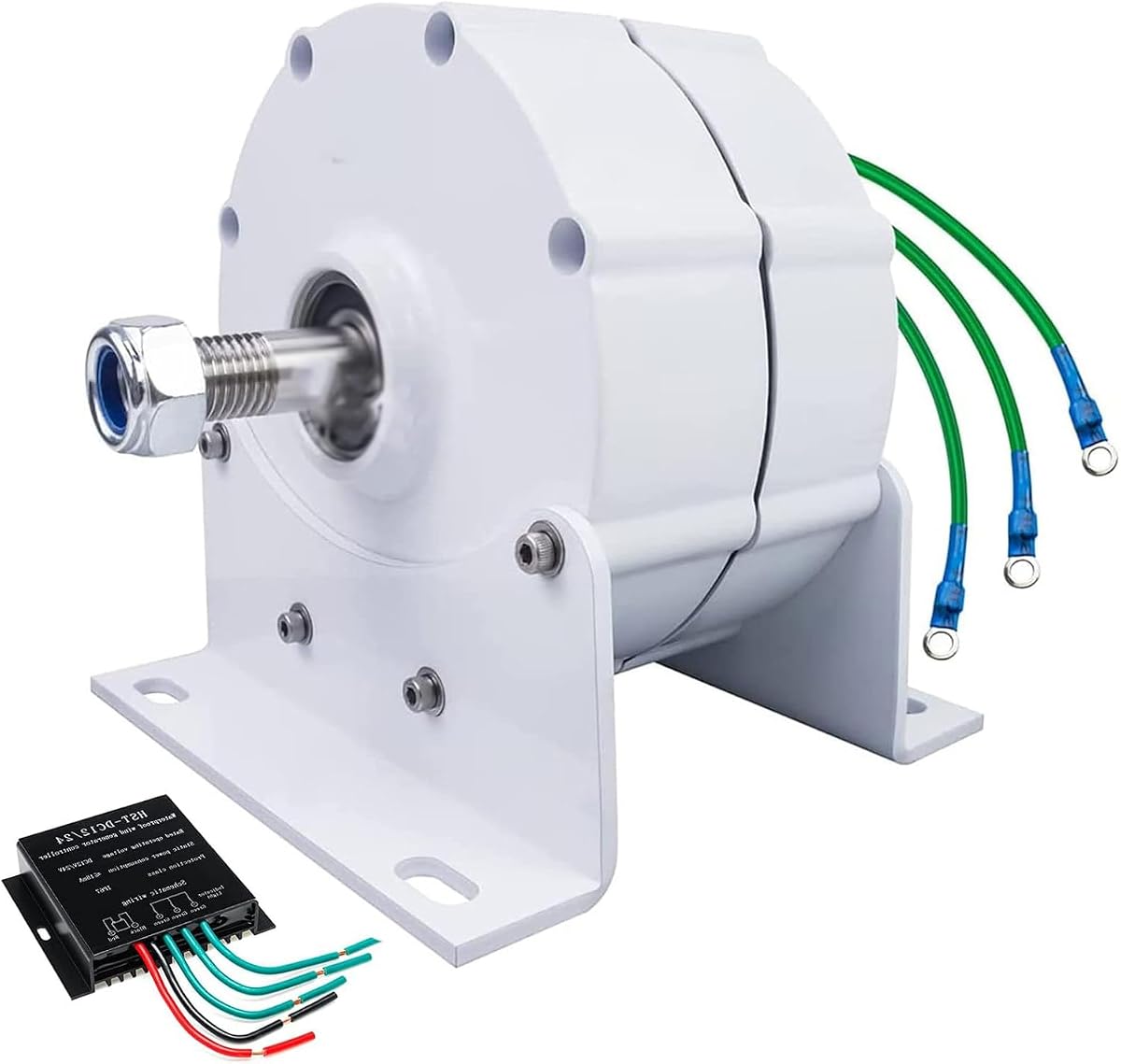
This 12000W three-phase permanent magnet generator is the premium-capacity selection in the guide. It combines a 5.0 rating with a stated 120V output, gearless direct-drive design, and a rectifier configuration intended for wind or water turbine use. It is aimed at builders with a substantial rotor and a suitably engineered electrical system.
We may earn a commission when you buy through this link, at no additional cost to you.
Rare earth NdFeB magnetic material and high-quality copper winding support efficient generation and favorable matching characteristics. The die-cast aluminum shell is designed to withstand strong winds, while corrosion-resistant treatment helps protect it from harsh environments. Its fixed rotor design is also presented as supporting heat dissipation and low starting resistance torque.
The gearless arrangement allows direct coupling without a gearbox, simplifying the drivetrain and reducing maintenance requirements. The included rectifier is a major convenience because it removes the need to source that component separately. Nevertheless, a 120V three-phase system still requires correctly rated switching, grounding, distribution, and potentially a step-down system for ordinary loads.
This generator is recommended for advanced wind or water turbine projects where available energy justifies a large alternator. It is not a sensible first choice for charging a small battery from a modest rooftop rotor, but it offers the strongest combination of stated capacity, specialized configuration, and customer rating among the premium options here.
The 12000W rating makes this generator suitable for projects designed to collect substantially more energy than compact charging systems can. Actual usable output still depends on rotor size, wind conditions, and electrical losses.
Supplying the rectifier within the configuration reduces one procurement step and helps align the generator with downstream conversion equipment. Buyers should still confirm connector, phase, and voltage compatibility before installation.
We may earn a commission when you buy through this link, at no additional cost to you.
Selecting a low-speed alternator requires matching electrical output, rotor speed, voltage, construction, and installation demands. The most important step is defining the turbine and load before choosing a generator, because advertised wattage alone does not guarantee usable energy in real conditions.
Low-speed generators are designed to work with slow-turning rotors, but their listed operating speeds vary substantially across this guide. Some units name 500RPM or 600RPM, while others list a maximum rotational speed of 4500RPM. A generator can produce poorly when it is driven far below its useful range or overspeed when driven beyond its safe limit. Calculate the expected rotor speed under normal wind conditions and compare it with the manufacturer's supported range before choosing a pulley, belt, gearbox, or direct coupling.
In short, match the generator to the actual rotor speed, not just the turbine's power rating.
Wattage indicates the generator's rated electrical capacity, not the energy a turbine will collect throughout the day. A larger rotor moving at a lower speed may still deliver more usable energy than a small rotor operating near its optimum speed. Consider rated voltage, phase configuration, expected duty cycle, and losses in the rectifier, controller, wiring, battery, and inverter. High-power ratings also require a rotor and tower capable of driving them without excessive mechanical strain.
In short, treat rated wattage as one part of a system calculation rather than an isolated performance promise.
Single-phase 12V or 24V arrangements are usually easier to connect to batteries, lights, and small DC loads. Three-phase systems can support larger power levels and more sophisticated renewable-energy controllers, but they demand appropriate rectification, switching, balancing, and often a higher level of electrical knowledge. A rectifier can convert generated AC into a usable DC bus, but it does not remove the need to match voltage, phase, and current ratings.
In short, choose single phase for simpler charging projects and three phase for advanced or higher-capacity systems.
The alternator's output voltage must be compatible with the battery bank, charge controller, inverter, and connected loads. A nominal 12V charging setup commonly uses a regulator or charge controller, while 24V and 48V systems require every major component to support the same voltage. Some listings present several voltage options under one product family, so the selected variant must be verified. Connecting a generator directly to a battery without appropriate rectification and regulation can damage components or create unsafe conditions.
In short, match the complete electrical system to one confirmed output voltage.
The gearless models in this guide can be driven directly, reducing mechanical parts, maintenance, and potential gearbox losses. That advantage is most valuable when the turbine can reliably rotate the generator within its operating window. A geared or belt-driven system can make speed matching easier and may allow a small rotor to reach a generator's higher rated speed. It also introduces friction, alignment requirements, belt maintenance, and another possible failure point. The correct choice depends on rotor speed, starting torque, and available space.
In short, use direct drive when speed and torque naturally align; use a ratio drive when needed to reach the generator's operating range.
Wind and hydro generators are exposed to moisture, wind-driven debris, corrosion, vibration, and changing temperatures. Aluminum housings offer a useful balance of low weight and structural strength, while copper windings provide electrical conductivity and heat transfer. Look for die-cast construction, anti-corrosion treatment, layered coatings, and a design that limits water entry. Mechanical protection is equally important: a sturdy mount, guarded pulley, proper shaft alignment, and access for inspection can prevent failures that an electrical specification alone will not address.
In short, choose corrosion-resistant construction and a protected mounting arrangement suited to outdoor exposure.
Copper windings, aluminum housings, rotor design, and airflow all influence how a generator handles sustained output. Low starting resistance torque helps a turbine begin moving, but heat management becomes increasingly important as output and run time increase. Compact double-wheel models may accept cooling fan blades, though the blade is not always included. Larger three-phase units emphasize stator and rotor design for heat dissipation. Builders should avoid continuous operation at maximum rated output unless the manufacturer explicitly permits it and adequate cooling is available.
In short, match the alternator's duty cycle to expected operating hours and preserve airflow around the housing.
The best generator is one that can be aligned securely and serviced without dismantling the entire turbine. Some models include a base and single shaft, while others allow custom mounting without a base. Consider shaft diameter, shaft length, pulley compatibility, frame dimensions, and whether the generator can be removed for inspection. A permanent magnet alternator generally requires less routine maintenance than a brushed unit, but bearings, connections, wiring, and cooling paths still need periodic checks. The mounting design should also prevent cable bending and keep electrical terminals away from moisture.
In short, verify every mechanical interface before ordering, then preserve access for inspection and maintenance.
Begin with a full mechanical and electrical design rather than attaching the generator directly to an unplanned rotor. Calculate the expected rotational speed, select a pulley or gearbox only when necessary, align the shaft, and install a rigid frame that prevents vibration. Match the confirmed generator voltage and phase arrangement to the rectifier, charge controller, battery bank, inverter, breakers, and grounding system. Before energizing the circuit, test the generator at low speed with the load disconnected and verify its output with appropriate instrumentation.
Operate within the listed speed, voltage, current, and duty-cycle limits. Use a rated rectifier and charge controller rather than connecting AC output directly to a battery. Secure every cable, prevent moving parts from contacting the frame, and keep the generator and electrical enclosure protected from rain where practical. Periodically inspect the shaft, pulley, belt, fasteners, wiring, cooling openings, and corrosion on the housing. If output becomes unstable, vibration increases, or the alternator becomes unusually hot, disconnect the load and investigate before continuing.
For long-term installations, test the system under several wind conditions and record voltage and charging performance rather than relying on one momentary reading. Confirm that the rotor does not overspeed in gusts and that the battery controller handles low-voltage, high-voltage, and reverse-current conditions. Replace damaged wiring promptly, keep terminals clean and dry, and follow local electrical and renewable-energy requirements. Routine inspection and correct load matching will generally contribute more to dependable service than adding unnecessary gearbox complexity.
It means the generator is intended to produce useful output at a slower rotational speed than a conventional high-speed alternator. The exact meaning varies because some models list 500RPM or 600RPM, while others identify a low-speed design with a maximum of 4500RPM. Compare the manufacturer's operating range with the actual speed of your rotor and use a pulley, belt, or gearbox only if the mechanics require it.
It generally requires correctly rated rectification and regulation rather than a direct AC-to-battery connection. A rectifier converts the generated AC into DC, while a charge controller manages battery voltage and current. Confirm the alternator's output voltage, phase arrangement, and speed before selecting these components, and follow the battery manufacturer's charging requirements.
Usually, yes. A gearless design removes the gearbox, reducing the number of moving components that can wear or fail. It may also reduce friction and maintenance demands. Shaft alignment, pulley balance, bearings, cable connections, and the generator's cooling still require attention, so gearless does not mean maintenance-free.
The generator may have a maximum rated output of 1000W, but usable energy depends on rotor diameter, wind speed, generator speed, and system losses. The power rating also does not mean the device will continuously deliver 1000W. For meaningful battery charging, the rotor and controller must be sized together, and storage requirements should be based on actual measured output over time.
Choose the voltage that matches your complete storage and conversion system. A 12V setup is convenient for small batteries and basic loads, while 24V and 48V systems can reduce current for a given power level and suit larger battery banks. Every alternator, rectifier, controller, inverter, cable, and protective device must be rated for the same system voltage.
Several of the listed models explicitly support hydro or water-turbine applications. Their gearless, low-starting-torque designs can be useful with a water wheel or axial-flow turbine. The water-driven rotor must still provide the required speed, torque, shaft alignment, and protection from spray and moisture, and the electrical system must remain fully protected.
No. A higher alternator rating provides more capacity when the rotor can drive it effectively, but actual generation still depends on available wind energy, rotor area, operating speed, losses, and storage controls. An oversized generator on a small or slow rotor may operate below its most efficient range. Match the generator's rated speed and power to the turbine rather than choosing wattage alone.
Periodic maintenance should include checking shaft and bearing condition, pulley or belt alignment, fastener security, cable damage, terminal cleanliness, corrosion, and cooling airflow. Electrical output and operating temperature should also be monitored. Permanent magnet construction removes brushes and their associated wear, but mechanical inspection and correct electrical protection remain essential.
The VQP 1200W PMA is the most versatile compact selection, combining charging, lighting, copper winding, and voltage stabilization. The 12000W three-phase turbine generator represents the premium high-capacity end of the range, while the compact 1KW brushless model is a practical budget-oriented option for smaller systems.
Prioritize rotor speed matching and electrical architecture before considering wattage alone. A 400W gearless generator may be more appropriate for a small experimental turbine than a 12000W model, while a larger three-phase alternator makes sense only when the rotor, controls, wiring, and load can support it. Confirm the exact voltage variant, phase arrangement, included rectifier, shaft dimensions, and mounting hardware before ordering.
Product configurations, availability, and prices can change, so check the current listing and selected variant before making a purchase. Use the supplied specifications as a starting point, compare them with your turbine's real operating conditions, and build the mechanical and electrical safety systems around the generator rather than adding them afterward.
