
4.7' Trail Camera Mount, Solar Panel Holder, Heavy Duty Stake Black
4.5Editor score
34.8-to-57.4-inch adjustment
Dual device compatibility
Rotating locking ball head
Tool-free ground installation
A trail camera stand with a solar panel mount gives outdoor cameras a more stable, adaptable home away from trees. The best models combine strong ground anchors, adjustable height, rotating hardware, and universal 1/4-20 connections, allowing one camera and one panel or two cameras to operate from a single position.
This guide compares ten stands based on construction, stability, mounting compatibility, height range, articulation, installation requirements, and suitability for outdoor monitoring. It covers compact 4.7-foot systems, tall six-foot models, tripod-based designs, single units, and two-packs for users who need more than one deployment location.
The selections show where each option differs: the 56-inch dual-device model leads with broad adjustability, several six-foot stands emphasize rapid setup and stability, and paired configurations suit properties with multiple monitoring sites. Ratings and availability can change, and current prices should always be checked before purchasing.
4.5Editor score

5.0Editor score

4.1Editor score
As an Amazon Associate we earn from qualifying purchases.
The following comparison covers construction, maximum height, device capacity, mounting hardware, and ground support. It highlights the practical differences among single, dual-device, tall, tripod-based, and two-pack configurations without treating any one field condition as universal.
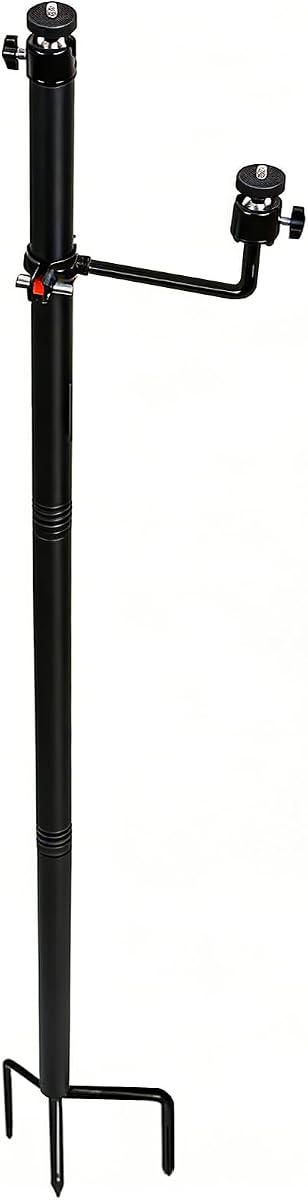


The 56 Inch Trail Camera Stand with Solar Panel Mount is a flexible, dual-device support with a 5.0 rating and a maximum height of 56 inches. Its principal appeal is the combination of a segmented central pole, a separate side arm, and two rotating ball heads, allowing a camera and solar panel—or two cameras—to be positioned independently. The three-prong base also gives it a more grounded appearance than a simple single spike.
We may earn a commission when you buy through this link, at no additional cost to you.
The universal 1/4-20 connections are practical because they are widely used by trail cameras, action cameras, security cameras, and solar panels. Height is changed by adding or removing pole sections, while both attachment points rotate through 360 degrees for changes in pan and tilt. The metal construction and rust-resistant coating suit repeated outdoor deployment, particularly in areas where equipment must remain exposed to rain and changing weather.
The trade-off is that the stand is made from several rod sections, a side arm, a base, and two ball heads, so setup involves more pieces than a one-piece stake. The side arm also extends away from the main pole, meaning soil conditions should be checked before it is loaded with a panel or a second camera. Nevertheless, the available configuration freedom makes the extra assembly step worthwhile for many users.
This is the strongest general recommendation for a user who wants one ground support to handle both monitoring and power equipment. It is particularly useful in treeless fields, along brushy property edges, or anywhere a camera must sit higher than surrounding vegetation. Choose it when adjustable height, standard mounting compatibility, and independent device positioning matter more than minimum assembly time.
The separate side arm can carry a solar panel while the main stake holds a camera, or it can support a second camera for wider coverage. Two ball heads let both devices be aimed without changing the stand's ground position.
The segmented pole adjusts up to 56 inches, allowing the camera to sit above short grass and brush. This is particularly useful in open fields where a low camera would be blocked by vegetation or disturbed by larger animals.
We may earn a commission when you buy through this link, at no additional cost to you.
The 6' Trail Camera Stand Mount with Solar Panel Holder has a 3.8 rating and distinguishes itself with a maximum height of 72 inches. That extra elevation is the most notable feature, making the system relevant for cameras that need to look over brush, low branches, or uneven terrain. The stand holds a trail camera and solar panel through two swivel 1/4-inch by 20 mounts.
We may earn a commission when you buy through this link, at no additional cost to you.
Its steel construction and baked-enamel finish are intended to withstand extended outdoor use, while three triangularly arranged spikes provide support across grass, dirt, and uneven ground. The side arm adjusts vertically, and the threaded pole sections allow the total height to move between 40 and 72 inches. An installation wrench is included, so the user does not need to assemble the stand with separate tools.
Its lower rating compared with the leading choices is the main caution. The product data does not identify a specific defect, but the 3.8 score suggests that some buyers may have found the overall balance of stability, adjustment, or assembly less satisfying than competing models. The triangular spike configuration also requires the user to plant all three legs evenly, which takes more care than driving a single sharp stake.
Despite that qualification, this is a strong choice for a user who specifically needs a six-foot mounting height and values a complete, straightforward kit. It is less compelling for buyers seeking the highest rating or a tool-free process. Check the current product details and customer feedback to confirm whether the included wrench and the chosen mounting arrangement meet your field requirements.
A 72-inch maximum gives the camera more clearance than shorter trail-camera stakes. The additional height can improve views across uneven ground or vegetation, although users should assess line of sight before selecting the tallest setting.
The three steel spikes form a triangular footprint, which helps resist tipping on uneven dirt and grass. Firmly seating each spike is important because the stable shape of the base only helps when the stand is planted consistently.
We may earn a commission when you buy through this link, at no additional cost to you.
The 57-inch Trail Camera Mount combines a 4.1 rating with a tripod-style triangular ground stake and two independently adjustable 1/4-20 ball heads. It is designed to support either two trail cameras or one camera paired with a solar panel, making it a flexible option for users who may change their monitoring arrangement as their needs evolve.
We may earn a commission when you buy through this link, at no additional cost to you.
The main pole is constructed from steel with a corrosion-resistant protective finish, while the side mount slides along the pole and locks into a selected height. Both attachment points offer 360-degree swivel movement for pan and tilt. The described tool-free setup simplifies deployment, a useful benefit for users moving equipment between locations or responding to changing wildlife patterns.
A potential limitation is the 57-inch maximum height, which is shorter than the six-foot options in this comparison. Tool-free assembly also deserves a practical caveat: although the product is described as requiring no tools, users should still confirm that the joints are sufficiently tightened for the weight and wind exposure of their installed camera and panel. Its tripod geometry is designed to reduce the wobble associated with single-stake supports.
This model is well suited to a camera user who values quick setup, broad standard compatibility, and easy height changes over maximum elevation. It is a particularly logical choice for a camera-and-solar-panel pairing in an open or treeless location. Users seeking a taller pole or a more conventional wrench-tightened assembly should compare the six-foot alternatives before deciding.
The tool-free design reduces setup time when a camera must be moved to a new site. The folding or sliding components also make the system easier to carry, disassemble, and store between deployments.
The steel pole is protected by a corrosion-resistant finish intended to endure rain, ultraviolet exposure, and outdoor impacts. Periodic inspection of joints and finish damage is still sensible for equipment left in the field continuously.
We may earn a commission when you buy through this link, at no additional cost to you.
The 2 Pack Heavy Duty Trail Camera Mount is a 4.1-rated two-unit set built around a triangular ground stake, rigid steel pole, and adjustable side mount. Each stand can operate as a single-camera support, a dual-camera system, or a camera-and-solar-panel installation. The two-pack format is the primary reason this option stands apart from otherwise similar single-unit products.
We may earn a commission when you buy through this link, at no additional cost to you.
Each mount uses dual 1/4-20 swivel ball heads, and the side arm slides along the main pole to set an independent mounting height. The tripod-inspired anchor is intended to reduce the movement commonly associated with a single spike. A corrosion-resistant protective finish is specified for outdoor seasons, while the tool-free design helps put each unit into service quickly.
The obvious trade-off is storage and transport volume: two assembled or partially assembled stands take more room than one. Buyers also need to identify two suitable monitoring locations rather than relying on a duplicate unit without a deployment plan. As with any ground stake, the stability depends on proper soil penetration and the absence of rocks or roots directly beneath the anchor points.
This is the premium pick for hunters, property monitors, and wildlife researchers who need two independent camera positions and want each site to support both a camera and a power panel. It reduces the need to buy separate mounting systems, provided the two-pack configuration is convenient for the user's transport and setup routine. For one location, a single stand is the more practical choice.
The package includes two complete mounting systems, making it practical for monitoring separate trails, fields, or property corners. Users can also keep one unit installed and use the second as a portable deployment option.
Each stand accepts two cameras or a camera and a solar panel through standard threaded mounts. This flexibility makes the pair useful for redundancy, wider coverage, or separate camera-and-power configurations.
We may earn a commission when you buy through this link, at no additional cost to you.
The Dual Hunting Camera Mount has a 3.9 rating and offers a height range of 17 to 47 inches. Its most interesting feature is the interchangeable base, which can switch between a kick plate and ground spikes. That makes the stand more adaptable to hard clay, loose mud, and other surfaces where a single anchor style may not perform as consistently.
We may earn a commission when you buy through this link, at no additional cost to you.
The bracket can hold a solar panel for extended monitoring or two cameras to cover different directions. A 360-degree rotating connection and universal 1/4-inch thread allow a broad range of standard scouting devices to be mounted. Its lower profile is also useful for positioning a camera close to a game trail, where excessive height would remove the device from its natural sightline.
The main limitation is its 47-inch maximum, which is shorter than most competitors and may restrict views over taller grass. Its 3.9 rating is also below the strongest products in the list, so buyers should not assume that it matches the adjustment range or customer satisfaction of the leading models. The alternate base system is useful, but it does not eliminate the need to select the right anchor for local soil.
This stand is best for a user who values a low, adaptable mounting position and has variable terrain. The switchable base makes it a practical option where one site has firm clay and another has softer mud. Choose it when close-range trail placement and ground flexibility are more important than a six-foot maximum height.
Switching between spikes and a kick plate allows the user to match the anchor to the ground. The plate can offer a different surface contact than pointed stakes, while the spikes can penetrate and hold in softer terrain.
The 17-inch lower setting places equipment closer to typical trail activity than a tall pole. This can help maintain an unobstructed view across open ground and low vegetation.
We may earn a commission when you buy through this link, at no additional cost to you.
The 6FT Dual Device Trail Camera Mount is a 4.1-rated stand that combines a triangular ground stake with a rigid, adjustable steel pole. Its 72-inch maximum makes it one of the taller options here, while the side mount creates a second attachment point for a camera and solar panel or two cameras. The overall design is aimed at reducing the wobble associated with lightweight single-stake systems.
We may earn a commission when you buy through this link, at no additional cost to you.
Both mounting positions use 1/4-20 swivel ball heads, and the side arm can be moved independently along the main pole. The corrosion-resistant finish is intended to protect the steel from rain, ultraviolet exposure, and impacts. Its tool-free setup is especially attractive for users who expect to reposition equipment or who want to minimize the number of tools carried into the field.
The height is not automatically an advantage. A six-foot pole can be excessive for a low trail, a narrow property boundary, or a location with overhead branches. Its triangular base also needs enough open space to be planted properly. A sound approach is to test the intended location at a lower setting first, then raise the stand only as much as the sightline requires.
This model is a strong fit for open fields, brushy backyards, and wildlife corridors where a camera needs to clear vegetation while a panel sits on an independent side arm. It is also appropriate for users who want quick, tool-free changes to camera direction. Those needing a more compact package should favor a 4.7-foot or 47-inch model.
The side arm slides along the pole, allowing the camera and panel to face different directions and sit at different heights. That separation can improve a camera's exposure and reduce interference between mounted devices.
The triangular stake acts as a broader anchor than one pointed spike. Its vibration-reducing design can help keep footage steadier when wind, nearby animals, or accidental contact affects the ground.
We may earn a commission when you buy through this link, at no additional cost to you.
The second 57-inch two-pack model carries a 4.1 rating and provides another way to deploy two tripod-style trail-camera stands. Each unit includes a ground stake, steel pole, sliding side mount, and dual rotating 1/4-20 ball heads. A pair can cover separate wildlife routes, two sides of a property, or a primary and backup monitoring area.
We may earn a commission when you buy through this link, at no additional cost to you.
The 57-inch maximum provides ample clearance for many open fields and low brush applications while remaining somewhat less imposing than a six-foot stand. The side arm changes height independently, and the tripod-style base is designed to minimize movement. A corrosion-resistant finish supports outdoor durability, while tool-free assembly keeps deployment and relocation straightforward.
The same practical concerns that apply to every two-pack apply here: storage space, transport weight, and the need to find two suitable ground locations. The listed product information is highly similar to the other 57-inch two-pack, so a buyer may want to compare the final listing, included components, warranty information, and current customer feedback before choosing between the two versions. Neither should be assumed to be better without checking those details.
This option is most useful for a user who already knows that two cameras or two camera-and-panel combinations are needed. The paired format makes it easier to build a consistent monitoring network without assembling two unrelated support systems. It is less compelling for a single camera or one site, where the extra unit would remain unused.
Two matching stands make camera and panel positioning more consistent across a property. A user who learns the adjustment range on one unit can apply the same setup method to the other.
The 57-inch height offers more clearance than compact brackets without reaching the full six-foot maximum. It can be a better fit under branches or in narrower outdoor spaces.
We may earn a commission when you buy through this link, at no additional cost to you.
The 4.7' Trail Camera Mount two-pack has a 4.5 rating, tying for the second-highest rating among the listed products. Each stand uses rustproof-coated metal poles and is specified to support more than 20 pounds. The telescopic pole adjusts from 34.8 to 57.4 inches, giving users useful placement range without the footprint of a full six-foot system.
We may earn a commission when you buy through this link, at no additional cost to you.
A swivel ball head with a locking mechanism provides 360-degree camera adjustment, and the standard 1/4-20 connection is intended to hold two devices or power panels. The sharp ground stake and tool-free installation make the system easy to place or move. Receiving two units also gives the user a ready spare, the option to monitor two positions, or enough hardware to support a camera and a panel at each site.
The maximum height of 57.4 inches is the primary limitation, particularly when a camera needs to look across deep grass or over a substantial obstruction. The data's claim of dual-device compatibility should also be treated as a configuration feature rather than automatic simultaneous support for every camera and panel combination; buyers should confirm the dimensions, attachment clearance, and weight of their chosen equipment. The 20-pound support figure is useful but should be treated as a stated specification rather than unlimited capacity.
This is an excellent choice for users who want two 4.7-foot adjustable stakes with a strong rating and straightforward installation. It is particularly appropriate for maintaining consistent equipment heights across two sites. Select it over a six-foot model when moderate elevation, portability, and a two-unit package are more important than maximum clearance.
The pole moves from 34.8 to 57.4 inches, giving meaningful control over the camera's position above the ground. Users can start low, confirm the sightline, and then raise the camera as needed.
The rustproof coating is intended to protect the pole across seasons of exposure. Inspecting the finish and tightening moving parts during routine checks can help maintain long-term reliability.
We may earn a commission when you buy through this link, at no additional cost to you.
The 6FT Dual Device Ground Stake offers a 4.1 rating and shares a practical design with several other tall tripod-style stands. Its steel pole, triangular anchor, adjustable side mount, and dual 1/4-20 ball heads provide a versatile foundation for either two cameras or a camera paired with a solar panel. The maximum height of 72 inches is the defining specification.
We may earn a commission when you buy through this link, at no additional cost to you.
The 360-degree swivel heads allow users to refine pan and tilt after installation, while the side arm moves along the pole for a different height than the primary camera mount. A corrosion-resistant finish is specified for rain, ultraviolet rays, and impacts. The tool-free assembly description suggests a straightforward process for establishing a monitoring post in the field.
Because many products in this category use the same broad design language, prospective buyers should compare the actual dimensions, included pieces, and user feedback rather than relying on the title alone. The stand also needs enough open space for the triangular base and full side arm. A maximum-height setup may place the camera beyond its useful focus range, so elevation should match the lens and detection pattern of the chosen trail camera.
This is a good general option for a tall camera-and-panel arrangement that needs flexible aiming. It is well suited to open fields, property edges, and low wooded areas where a 72-inch pole can clear nearby growth. Choose a shorter 4.7-foot design for a smaller footprint, or select this model when elevation and broad articulation are the main priorities.
Each ball head rotates through 360 degrees, allowing a camera and panel to face the same or different directions. This flexibility makes it easier to correct the angle after observing the actual field of view.
The tool-free setup reduces friction when deploying a camera quickly. It also supports easier relocation, allowing the same equipment to be moved as wildlife activity or monitoring priorities change.
We may earn a commission when you buy through this link, at no additional cost to you.
The 4.7' Trail Camera Mount, Solar Panel Holder, Heavy Duty Stake Black is a single-unit option with a 4.5 rating. It is built from rustproof-coated metal poles, carries a stated support capacity above 20 pounds, and adjusts from 34.8 to 57.4 inches. The result is a compact but versatile support for a camera, a panel, or a two-device arrangement.
We may earn a commission when you buy through this link, at no additional cost to you.
Its swivel ball head uses a locking mechanism to hold the selected 360-degree angle. A standard 1/4-20 thread provides broad compatibility with trail cameras and solar panels, while the sharp stake and tool-free process simplify installation. Because this is the single version of the 4.7-foot design, it is a straightforward choice for one monitoring location and avoids the extra bulk of a two-pack.
The lower end of the height range may be too short for cameras used in very tall grass, while the 57.4-inch ceiling is less than the six-foot alternatives. Users should also confirm the physical clearance between the camera, panel, and ball head when installing two devices, especially if either has a deep housing or sun shield. The stated load figure should not be interpreted as permission to add unlimited accessories.
This is the best budget-oriented single stand for a buyer who wants strong ratings, broad height adjustment, standard compatibility, and quick installation without purchasing a pair. It is a sensible recommendation for a first camera-and-solar-panel setup, a single remote property location, or a user who already owns a second ground support. Those planning multiple sites should examine the two-pack version instead.
The package focuses on one adjustable mount, keeping transport and setup straightforward. It is a practical option when a second location does not yet need dedicated hardware.
The ball head's locking mechanism helps retain the chosen direction after adjustment. This is useful in exposed locations where changing wind or vibration could otherwise alter a loose camera angle.
We may earn a commission when you buy through this link, at no additional cost to you.
The right stand depends on terrain, camera weight, desired height, and whether you need one or two device positions. Compatibility, anchoring, adjustability, and outdoor durability deserve more attention than a long product title.
Choose a dual-device model when power, redundancy, or directional coverage is important. Choose a single-device configuration only when the second attachment point would be unnecessary.
Select enough height to clear expected vegetation, but no more than the camera's useful viewing angle requires. Test the sightline before final tightening.
Use a broader or multi-point anchor where wobble would affect footage, and match the base to the soil. Firmly seat every ground-contact point before attaching equipment.
Look for smooth movement and a lock that holds under the installed load. Test the final angle before leaving the site and recheck it periodically.
Prioritize coated steel and inspect the finish after severe weather. Clean mud from joints and dry the stand before storage to limit corrosion.
Choose tool-free assembly for frequent moves and included tools for confident tightening. Ensure the required tools are available before heading into the field.
Buy one stand for one location and consider a pair for multiple sites. Check vehicle space before choosing a two-pack.
Do not infer unlimited capacity from a heavy-duty label. Confirm published limits and use a wider, firmly seated base when the load is substantial.
Choose a clear site with a stable view of the intended area, then inspect the ground for rocks, roots, and hard obstructions. Assemble the pole and side arm at a comfortable working height before driving the base into the soil. Attach the camera and solar panel with compatible 1/4-20 hardware, tighten the connections evenly, and confirm that the panel is positioned to receive unobstructed sunlight.
Plant the stake firmly at a slight angle if that improves the camera's aim, making sure the base does not rock. Set the camera and panel independently, tighten every locking joint, and take a short test recording before leaving. Cable management should prevent a loose camera cable from catching on the pole or wildlife, while still allowing enough slack to avoid strain at the attachment points.
During use, check the stand after storms, high winds, heavy rain, or visible animal activity. Clean soil from the threads and moving joints, inspect the protective finish, and confirm that the camera remains aimed correctly. Before storage, remove electronics, wipe the metal dry, and disassemble the longest sections if space is limited. A protective cover can reduce dust and moisture exposure during storage.
Yes. The listed dual-device stands use two 1/4-20 attachment points so one mount can hold a camera and a solar panel. The side arm's height is independently adjustable, which can improve camera visibility and panel exposure. Confirm that both devices have compatible threads and enough physical clearance for their housings and brackets.
A single stake is lightweight and easy to drive into the ground, but it can rotate or lean when disturbed. A tripod-style or triangular stand spreads contact across several points and generally resists wobble better. It requires more space and careful installation, yet can provide steadier monitoring in exposed or uneven locations.
The best height depends on vegetation, terrain, and the camera's viewing range. The products here cover ranges from 17 inches to 72 inches, so there is substantial flexibility. Start with a height that clears expected grass and brush without pushing the camera far above the most useful sightline.
The listed products use a universal 1/4-20 threaded connection, which is common for trail cameras, action cameras, security cameras, and many solar panels. Compatibility is not guaranteed for every accessory, so check the camera's mounting specification and look for adapters or unusual mounting hardware before purchase.
It depends on the model. Several designs advertise tool-free assembly, while the 6' Heavy-Duty Stake includes an installation wrench for its threaded sections. Even with a tool-free system, users should ensure joints are secure before attaching a camera and panel, especially in windy or exposed locations.
Choose a base suited to the ground and seat it deeply and evenly. Multi-spike or triangular designs can distribute force, while the Dual Hunting Camera Mount can switch between spikes and a kick plate. If the soil is very soft, test the stand under load and avoid adding equipment until it no longer rocks or settles.
Yes, dual-device stands can hold two cameras instead of one camera and one solar panel. The independently rotating ball heads allow the cameras to face different directions, which is useful for wider coverage. Check the combined weight, thread compatibility, and whether the camera housings will physically overlap.
Inspect it periodically for loosened joints, scratched coatings, rust, and accumulated mud. Clean the threads and moving parts, and dry the metal before storage. If the protective finish is damaged, address the exposed area according to the manufacturer's guidance to reduce further corrosion.
The 56 Inch Trail Camera Stand with Solar Panel Mount is the strongest all-around choice for adjustable height, universal compatibility, and independent positioning of two devices. The 4.7-foot black stake is a focused single-location option with a strong 4.5 rating, while the 57-inch two-pack is the premium choice for maintaining two monitoring sites with matching hardware.
Prioritize the ground design, actual height range, and locking performance that suit your terrain. A dual-device model is essential for camera-and-panel configurations, and a taller pole is most useful when vegetation regularly blocks a low view. Tool-free assembly and a two-pack are convenient features, but they should complement rather than replace good judgment about weight, placement, and stability.
Ratings, product listings, and prices can change over time, and the availability of closely related models also varies. Before ordering, verify the current specifications, included components, thread compatibility, and customer feedback for the exact listing, then check the latest price from the retailer.


