
Dayton Audio SPA100-D
4.3Editor score
100W RMS at four ohms
Class-D efficiency
Manual and automatic switching
Best plate amplifier for subwoofer guide comparing 10 options for power, inputs, crossover control, protection, installation flexibility, and home or PA audio
A plate amplifier for subwoofer gives a passive speaker cabinet the power and control needed to produce strong, clean low frequencies. A capable unit should match the driver, support the intended inputs, provide useful crossover and phase adjustments, and include protection against common installation errors.
This guide compares ten plate amplifiers and amplifier boards by examining output power, load compatibility, signal connections, filtering, protection, thermal design, and intended applications. The list includes home-audio models, PA and DJ units, and compact boards suitable for DIY car or custom subwoofer projects.
Each review shows what the product is best suited to, from room-matched home bass to high-output stage equipment. Ratings reflect the supplied customer feedback, while specifications come from the listed product information. Availability and pricing can change, so confirm current details before purchasing.
4.3Editor score

4.3Editor score

5.0Editor score
The comparison below highlights the main differences in amplifier class, rated power, input flexibility, filtering, and practical features across the ten products.


The WAudio SUA-350 combines 350W RMS of four-ohm Class-D output with a broad collection of setup controls, earning it a 4.3 rating and the position of our most versatile all-around recommendation. It is designed for DIY powered subwoofers, replacement plate-amplifier upgrades, and systems that need more control than a basic fixed-output module.
We may earn a commission when you buy through this link, at no additional cost to you.
Its standout strengths begin with room integration. The crossover is adjustable from 50 to 180 Hz, phase covers 0 to 180 degrees, and EQ and gain modes help blend the subwoofer with main speakers. RCA right and left-mono inputs work with ordinary source components, while balanced input and output support suits compatible professional systems and longer signal runs. A selectable bass boost adds up to 6 dB at 45 Hz for low-end emphasis.
The rear three-way power switch provides always-on, automatic signal-sensing, and off positions, while a front LED communicates operating or standby status. Protection circuitry covers short circuits, over-temperature, and overload, and standby consumption is listed below 0.5W. The trade-off is that the unit supports both 110V and 230V operation through a rear selector, making correct voltage configuration an essential part of installation.
This is the strongest general recommendation for a home subwoofer builder who wants substantial output, flexible source connections, and meaningful tuning controls in one enclosure. It suits anyone willing to check the voltage setting and follow basic grounding and ventilation guidance. For someone needing only a tiny power boost, it may be more amplifier than necessary, but for a serious passive subwoofer it offers an unusually complete feature set.
Adjustable crossover, phase, gain, and EQ controls give the installer meaningful tools for matching the subwoofer to the room and main-speaker system. The separate bass boost is useful when a cabinet needs extra output around 45 Hz, although it should be adjusted carefully to avoid exaggerated boom.
Right and left-mono RCA inputs cover conventional home sources, while balanced connections can simplify professional installations and longer signal paths. Automatic signal-sensing also reduces the need to switch the amplifier manually every time the source is turned off.
We may earn a commission when you buy through this link, at no additional cost to you.
The Dayton Audio SPA100-D delivers 100W RMS at four ohms in an efficient Class-D design, and its 4.3 rating reflects a well-regarded balance of useful features. It is a practical choice for small home subwoofers, desktop bass systems, and builders who want straightforward plate-amplifier performance without a large collection of professional connections.
We may earn a commission when you buy through this link, at no additional cost to you.
The amplifier includes a 6 dB bass boost at 30 Hz, adjustable gain, crossover, and phase controls, and both manual and automatic on/off modes. Those features are more than many basic modules offer because they allow the installer to trim output and align the subwoofer with the main speakers. The Class-D output stage is also appropriate for a compact plate amplifier where efficiency and manageable heat production matter.
A rear switch supports both 120V and 240V mains input, giving the product broader installation flexibility. The trade-off is its comparatively modest power rating: 100W RMS at four ohms is best matched to a smaller passive subwoofer rather than a large stage cabinet or demanding high-spl installation. Its control set is also less expansive than that of the WAudio SUA-350.
For a straightforward home build, this is a sensible recommendation. It is particularly attractive to users who want automatic turn-on behavior, room-adjustment controls, and efficient operation without chasing maximum output. If the passive driver is designed for substantially more power, or if the amplifier must support balanced professional signal paths, a stronger model will be a better fit.
The SPA100-D focuses on the controls most useful in a compact home installation: gain, crossover frequency, phase, and a low-frequency boost. This makes it easier to tune a smaller subwoofer than a simple fixed-gain plate amplifier.
Automatic activation lets the amplifier wake when a signal appears, while manual control can be useful for testing or permanently powered installations. Supporting 120V and 240V inputs also simplifies use in different locations when the selector is set correctly.
We may earn a commission when you buy through this link, at no additional cost to you.
The Sound Town STPAS-G800 is a 700W RMS Class-D plate amplifier intended for PA, DJ, and subwoofer-cabinet applications. Its 4.1 rating and extensive connection panel make it our premium pick for installers who need more power and professional routing options than a basic home plate amplifier provides.
We may earn a commission when you buy through this link, at no additional cost to you.
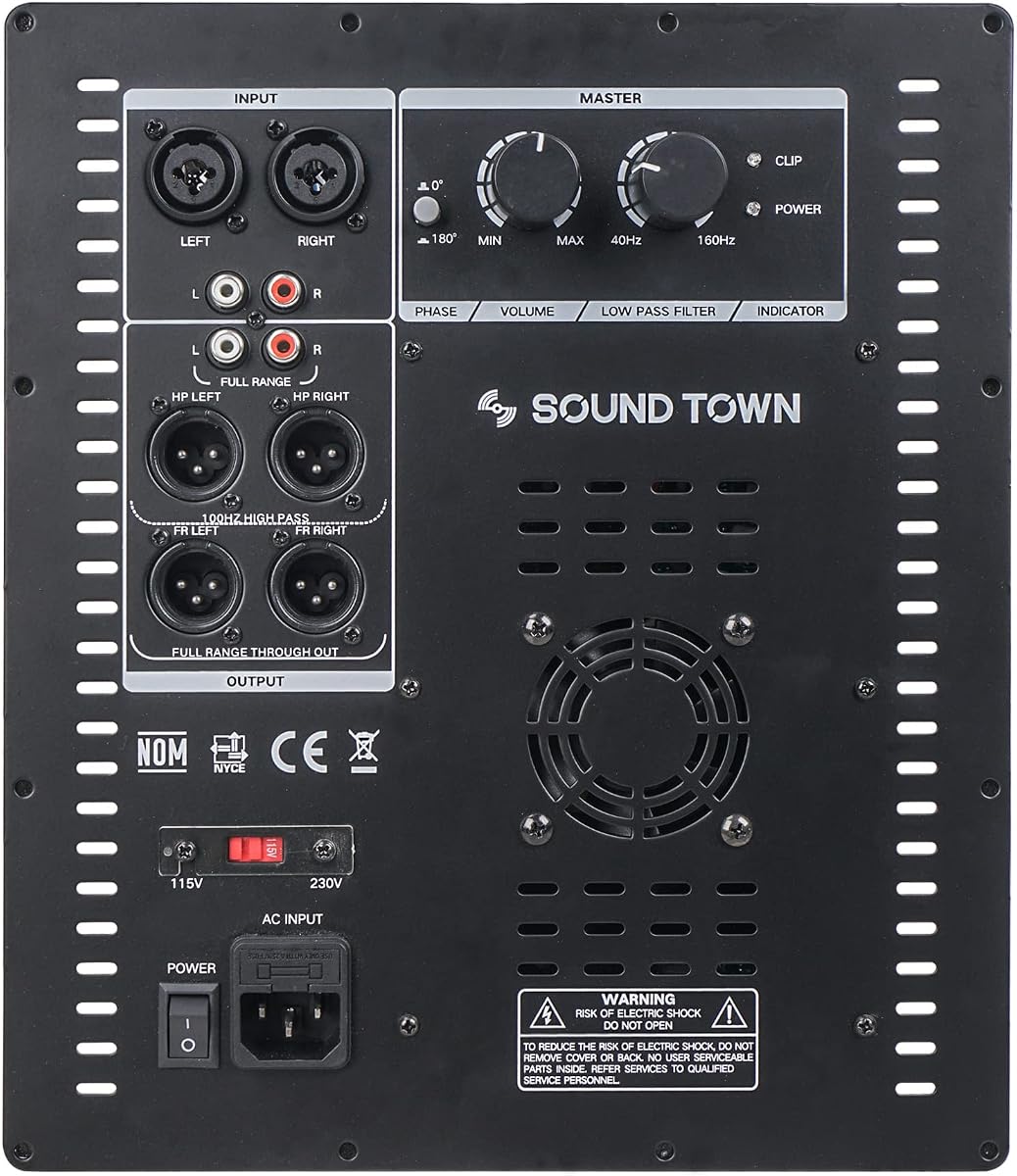
The input section includes two XLR and 1/4-inch combo connectors plus two RCA inputs. Outputs include two XLR connections, one described as a through output and the other providing a 100 Hz high-pass filter, along with RCA outputs. That flexibility supports stage mixers, DJ equipment, line-level sources, and systems that need filtered low-frequency signals sent to other components.
Low-frequency behavior is enhanced by dynamic bass enhancement, an RMS dynamic processor, and a second-order IIR low-pass filter. Protection against overcurrent and short circuits adds confidence during demanding use, while the integrated aluminum heat-sink panel supports thermal management. The primary trade-off is complexity: this is not the simplest choice for a first-time builder who only needs RCA input and a single subwoofer output.
It is a strong recommendation for mobile sound professionals, PA builders, and serious subwoofer projects where power and routing flexibility are priorities. Users should plan the input and output path carefully and provide suitable ventilation around the integrated heat sink. For a compact living-room subwoofer, the WAudio or Dayton Audio alternatives may be easier to integrate.
Combo XLR and 1/4-inch inputs make the amplifier adaptable to stage mixers and other balanced sources, while RCA inputs and outputs broaden the range of compatible equipment. The split XLR output options also provide filtered routing for more involved system designs.
The 700W RMS rating suits more demanding subwoofer cabinets than compact home modules. An integrated aluminum heat-sink panel and protection against overcurrent and short circuits help support stable operation, provided the enclosure receives adequate airflow.
We may earn a commission when you buy through this link, at no additional cost to you.
The Sound Town STPAS-600D provides 350W RMS of Class-D output with a low-pass filter and professional input options. Its 3.9 rating places it below the leading products, but the feature set remains credible for PA, DJ, and subwoofer-cabinet projects that need more than a basic home module.
We may earn a commission when you buy through this link, at no additional cost to you.
Two XLR and 1/4-inch combo inputs and two RCA inputs make it straightforward to connect different source types. Two XLR through outputs permit further signal routing, while the low-pass filter helps shape the subwoofer output. The amplifier also includes overcurrent and short-circuit protection to reduce the consequences of wiring mistakes or excessive demand.
Its main limitation is the absence of more advanced processing in the listed specifications. There is no mention of DSP presets, wireless connectivity, or the richer dynamic bass controls found in the larger Sound Town models. The lower customer rating also suggests buyers should scrutinize the exact implementation and verify compatibility before installation.
This amplifier is best for a builder who wants a straightforward 350W professional plate unit with balanced and unbalanced inputs. It may work particularly well for a moderately sized subwoofer cabinet in a rehearsal room, small venue, DJ setup, or mobile sound system. Those wanting deeper EQ control, screen-based setup, or more advanced output routing should consider a more extensively featured alternative.
The built-in low-pass filter provides the core frequency shaping needed to keep a subwoofer focused on its lowest range. It is a practical starting point for a cabinet designed around a particular driver and crossover point.
Combo XLR and 1/4-inch inputs accommodate balanced and unbalanced professional sources, and RCA inputs broaden compatibility. Through outputs support additional routing without requiring the amplifier to serve as an elaborate system hub.
We may earn a commission when you buy through this link, at no additional cost to you.
The Fosi Audio TP-02 is a compact mono bass amplifier with a maximum output of 220W, a 4.4 rating, and a feature set tailored to home audio. While it is not a conventional built-in plate module, it offers a convenient way to power a passive subwoofer or bass shaker without assembling a larger rack or PA amplifier.
We may earn a commission when you buy through this link, at no additional cost to you.
Its sound specifications include a frequency response of 20 Hz to 250 kHz, total harmonic distortion at or below 0.04 percent, signal-to-noise ratio of at least 98 dB, and input sensitivity of 775 mV. The low-pass filter removes high-frequency content, while the adjustable low-frequency control spans 30 to 260 Hz. A Texas Instruments TDA7498E chip and NE5532 op-amp form the stated signal chain.
The amplifier can work with a powered or passive subwoofer, and built-in speaker protection is listed as a safeguard against output issues. A 24V power adapter and manual are included. The trade-off is that its compact consumer-style design does not offer the XLR routing, DSP, or high-pass output options found in professional plate amplifiers.
This is an appealing recommendation for a small home theater, office, desktop, or living-room bass system where space is limited and straightforward controls are preferable. It also suits someone adding bass to an existing speaker setup. It should not be selected for a large PA cabinet or installation requiring balanced professional signal distribution, and its connection requirements should be checked before purchase.
The stated distortion, signal-to-noise, and frequency-response figures indicate an amplifier designed for clean low-frequency reproduction. Its low-pass filter and adjustable bass range make it easier to keep output focused below the crossover point.
The included 24V adapter reduces the need to source a separate supply, while the compact housing suits a shelf or cabinet. Connecting a passive subwoofer can restore bass to an older or newly assembled speaker system.
We may earn a commission when you buy through this link, at no additional cost to you.
The Dayton Audio SPA1000 combines a 1000W rating with a Class-AB output stage and low-frequency parametric EQ, making it a substantial option for high-output subwoofer projects. Its 4.0 rating reflects a capable unit whose appeal lies more in power and tonal control than compactness or wireless features.
We may earn a commission when you buy through this link, at no additional cost to you.
A patented tracking downconverter power supply and toroidal power transformer support efficiency and clean delivery. The parametric EQ is particularly useful because it allows installers to boost or cut selected low frequencies rather than relying only on a basic tone control. Advanced soft-clip circuitry improves available headroom and helps protect connected woofers when the amplifier approaches its limits.
As a Class-AB design, the amplifier is likely to produce more heat than a compact Class-D module. That makes ventilation and enclosure planning important. The supplied specifications also do not mention balanced inputs, automatic power operation, DSP, or Bluetooth, so users seeking modern connectivity may find the feature list less elaborate than that of newer alternatives.
This model suits a dedicated high-power subwoofer cabinet, a serious home-theater build, or a permanent installation where low-frequency EQ and woofer protection matter. It can also be considered for a PA application if its voltage, load, and connector requirements align with the cabinet. Buyers should not treat the headline wattage as permission to ignore the driver’s power rating or amplifier damping behavior.
Parametric EQ gives the installer more control than a single bass knob or fixed low-pass setting. It can help address a pronounced room peak, compensate for cabinet boundaries, or trim output around a problem frequency without altering the rest of the spectrum as broadly.
Advanced soft-clip circuitry is intended to improve headroom and reduce harsh distortion near the amplifier limit. It also helps protect the connected woofer, making careful gain staging and adherence to the driver’s limits especially important.
We may earn a commission when you buy through this link, at no additional cost to you.
The Hosyond ZK-6001 is a mono amplifier board for custom home, car, and professional subwoofer systems. Rated at 300W into four ohms and capable of up to 600W peak at two ohms with a 48V DC supply, it combines useful output with a broad 18–50V input range and earns a 4.1 rating.
We may earn a commission when you buy through this link, at no additional cost to you.
Frequency and volume adjustments provide basic control, while the large heat sink is designed to support stable operation during prolonged high-power use. Protection includes undervoltage, overheat, overcurrent, and short-circuit mechanisms. These safeguards are valuable in a bare-board product because the installer must manage power, wiring, airflow, and enclosure design directly.
The input uses a stereo XH2.54-3P interface and comes with a matching double-ended shielded cable. Importantly, the product does not include reverse-input protection, so positive and negative leads must never be reversed. It also requires a suitable DC supply capable of at least 10A, with 36–48V recommended, which is a meaningful difference from an AC-powered plate amplifier.
This board is best for an experienced DIY builder creating a compact, high-output custom subwoofer. It can serve home, car, or professional projects when a qualified supply and enclosure are available. It is less suitable for a plug-and-play installation, and its bare-board construction means the user must take responsibility for grounding, cooling, secure mounting, input polarity, and enclosure acoustics.
The board operates from 18 to 50V DC and accepts a recommended 36–48V range, allowing the installer to match output requirements to the available power system. Its 300W four-ohm rating and 600W peak claim at two ohms give it more authority than compact consumer modules.
Overheat, overcurrent, short-circuit, and undervoltage protection help contain abnormal operating conditions. Because the unit lacks reverse-polarity protection, careful terminal identification and sound testing are essential before connecting a speaker or power source.
We may earn a commission when you buy through this link, at no additional cost to you.
The 300W 12V Car Amplifier Board is a compact, exposed board intended for vehicle subwoofer projects. Its 4.2 rating suggests favorable customer reception, while the exposed aluminum cooling panel and slim format make it particularly relevant to installers with limited space under a seat, behind a panel, or inside a custom enclosure.
We may earn a commission when you buy through this link, at no additional cost to you.
The stated 300W figure provides a clear indication of the product’s output class, and the design emphasizes strong low-frequency reproduction and easy integration with a vehicle subwoofer. The thickened pure-aluminum panel acts as both a structural element and a heat-dissipation surface. Its dual-channel designation also provides more channel flexibility than a strictly mono board, depending on the final wiring configuration.
The main limitation is the limited technical detail in the supplied product information. There is no explicit crossover range, signal sensitivity, protection list, terminal configuration, or frequency-response specification to guide fine system tuning. Those details should be verified with the manufacturer before installation, especially if accurate bass integration or system protection is important.
This board is a good candidate for a custom car-audio build where a thin, powerful amplifier is needed and the installer is comfortable wiring exposed electronics. It is less suitable for a beginner who needs a fully enclosed, easy-to-tune unit with comprehensive documentation. The ventilation plan must also account for the fact that its cooling surface is exposed.
The slim board format and exposed construction make it easier to fit into compact vehicle installations. Builders can mount it to a rigid surface where its aluminum panel has access to circulating air.
The amplifier is designed around the needs of vehicle subwoofers, emphasizing powerful low-frequency reproduction over home-theater connectivity. Because published crossover and protection details are limited, installation should prioritize correct load matching and verified wiring.
We may earn a commission when you buy through this link, at no additional cost to you.
The Sound Town STPA11-G900 is the most feature-rich model in this guide and carries a perfect 5.0 rating in the supplied information. It delivers two channels of 600W continuous Class-D output, supports subwoofer and full-range PA applications, and adds DSP, an LCD, Bluetooth TWS, and a Speakon output for flexible professional use.
We may earn a commission when you buy through this link, at no additional cost to you.
Connections include two XLR and 1/4-inch combo inputs, one XLR output, and one Speakon power output. The digital signal processor provides presets and manual EQ and delay settings, while the LCD is intended to make configuration easier to understand in real time. This combination is particularly valuable for installers who want repeatable, detailed control rather than a few basic knobs.
TWS Bluetooth adds a modern option for compatible wireless setups, and the robust construction is supported by an integrated aluminum heat-sink panel. Overload and overcurrent protection help the unit withstand demanding conditions. The trade-off is complexity and a larger feature set than a homeowner may need, along with the importance of ventilation around the heat sink.
This is our top premium recommendation for a PA, DJ, mobile sound, or advanced custom subwoofer system. It also works for home theater when two-channel control, delay, and DSP are valued. A first-time builder with one passive subwoofer and a simple RCA source may find the smaller WAudio or Dayton Audio models easier to operate, but this amplifier offers the most advanced control in the lineup.
Presets and manual EQ and delay controls provide much greater setup flexibility than a conventional analog plate amplifier. The readable LCD helps users access and understand those adjustments during installation.
Two continuous-power channels support subwoofer, full-range, or multi-zone PA configurations. Combo professional inputs, an XLR output, Speakon connection, and Bluetooth TWS allow a wide range of source and speaker arrangements.
We may earn a commission when you buy through this link, at no additional cost to you.
The 1000W Subwoofer Amplifier Board is a compact 12V vehicle amplifier board with a 4.5 rating and one of the highest stated output figures in the lineup. It is aimed at custom installations where a slim, powerful board can be integrated into a subwoofer enclosure rather than installed as a conventional home plate amplifier.
We may earn a commission when you buy through this link, at no additional cost to you.
Its housing uses cooling holes in an aluminum-alloy design to increase contact with surrounding air and accelerate heat dissipation. The stated high-power non-sense resistance is presented as supporting stability at elevated temperature, while the power circuit includes short-circuit rejection intended to improve reliability. Capacitors, transformer components, and the circulating-coil design are also highlighted as contributors to output behavior.
The primary concern is measurement clarity. The product information identifies 1000W as high power but does not provide a clearly defined RMS rating, supported impedance, frequency response, distortion, sensitivity, or crossover range. As a result, the headline figure should not be treated as equivalent to the clearly stated RMS outputs of several complete plate amplifiers. Users should verify those specifications and the wiring diagram before buying.
This board is best for a DIY vehicle builder who values compactness and a high stated output level and is prepared to perform detailed electrical verification. It may suit a custom subwoofer project where an exposed high-current board is acceptable. For a home system or professional installation where transparent specifications and supported controls are priorities, a documented enclosed amplifier is the safer choice.
The board format allows substantial amplifier output to fit into a custom vehicle enclosure. Its stated 1000W capability is attractive for bass-heavy builds, but exact load and continuous-power details should be confirmed before connecting a subwoofer.
Cooling holes in the aluminum housing promote heat transfer, while the stated short-circuit rejection is intended to limit damage from abnormal conditions. Proper mounting, grounding, and unobstructed airflow remain essential to realizing these benefits.
We may earn a commission when you buy through this link, at no additional cost to you.
The right plate amplifier depends on the passive subwoofer, room, source equipment, power supply, and installation method. Compare output ratings and controls with the driver’s requirements rather than focusing on headline wattage alone.
Start with the passive subwoofer manufacturer’s recommended amplifier power and impedance requirements. An amplifier that delivers too little may struggle to control the driver or reproduce low-frequency transients, while excessive output can create distortion if the gain is set aggressively. Compare continuous or RMS capability with the driver recommendation rather than treating peak wattage as the only meaningful figure.
The listed products illustrate why careful comparison matters. The WAudio SUA-350 and Sound Town STPAS-600D each state 350W RMS, the Dayton Audio SPA100-D states 100W RMS at four ohms, and the STPA11-G900 supplies two 600W continuous channels. By contrast, some boards advertise peak or maximum output without an equally clear continuous specification. Treat those differently and verify load ratings before purchase.
The subwoofer’s nominal impedance and the amplifier’s supported load must agree. A four-ohm driver should be connected only to an amplifier rated for four ohms or lower, while parallel or series wiring can reduce the load presented to the amplifier. Never add speakers until the total impedance has been calculated, and follow the driver manufacturer’s recommended wiring diagram.
Power ratings also change with load. The WAudio SUA-350 specifies 350W RMS at four ohms, while the Hosyond ZK-6001 states 300W rated at four ohms and up to 600W peak at two ohms under a specified DC supply. These distinctions help distinguish a usable output figure from a general capability claim and should guide cabinet, wiring, and supply selection.
RCA inputs are common for consumer receivers, mixers, and home subwoofer builds. XLR or XLR-and-quarter-inch combo inputs suit professional equipment and longer balanced signal runs. Outputs should match the cabinet: Speakon is useful for detachable speaker cables, while binding posts or hardwired leads may be more appropriate for a permanent home installation.
The Sound Town models are strongest for professional routing because they offer combo XLR inputs, RCA connections, and XLR outputs. The WAudio SUA-350 includes right and left-mono RCA plus balanced connections, while the Fosi Audio TP-02 emphasizes a simpler home setup. Count the actual source outputs and speaker leads before deciding which connector layout will simplify the build.
A subwoofer amplifier should be able to remove frequencies above the driver’s useful range. Adjustable crossover control gives the installer more freedom to match the cabinet to the main speakers and room, while phase adjustment helps align bass timing. Neither control replaces correct placement, polarity verification, and sensible gain staging.
The WAudio SUA-350 offers crossover adjustment from 50 to 180 Hz and phase from 0 to 180 degrees. The Dayton Audio SPA100-D includes gain, crossover, and phase controls, and the Fosi Audio TP-02 provides an adjustable low-frequency range. For professional systems, the STPAS-G800 adds a 100 Hz high-pass output option. Consider whether a simple low-pass control is enough or whether delay and preset-based DSP would simplify setup.
Digital signal processing can simplify repeatable setup by applying EQ, delay, crossover, and other adjustments through consistent presets. This is especially helpful for mobile PA work, installations that move between venues, or users who want to store and recall configurations. It can also add complexity, so a straightforward analog amplifier may be preferable for one fixed room.
The Sound Town STPA11-G900 stands apart with a DSP, manual EQ and delay settings, presets, and an LCD display. The STPAS-G800 adds dynamic bass enhancement, an RMS dynamic processor, and an IIR low-pass filter for more control than a simple knob. By contrast, the Dayton Audio SPA1000 uses analog parametric low-frequency EQ, which remains useful for room correction without menu-driven operation.
Complete home plate amplifiers generally accept AC mains power, while bare vehicle boards usually require a substantial DC supply. The Dayton Audio SPA100-D supports 120V and 240V input, the WAudio SUA-350 includes a rear voltage selector, and the Hosyond board accepts 18–50V DC with at least 10A current recommended. These requirements must be available at the installation site.
Class-D designs are often compact and generate less heat than Class-AB designs, which can help when space is limited. The Dayton Audio SPA1000 uses a Class-AB output stage and therefore calls for particularly careful ventilation. Consider enclosure dimensions, cooling surfaces, electrical efficiency, and the distance from heat-sensitive furnishings rather than selecting a circuit only by output rating.
Short-circuit, overload, overcurrent, and thermal protection help prevent amplifier damage and reduce risk to the connected subwoofer. A stated protection feature is useful, but it does not excuse improper wiring or an unsuitable speaker load. Correct polarity, secure terminations, adequate current capacity, and regular testing remain essential.
Several options list multiple safeguards, including the WAudio SUA-350, the Sound Town PA models, and the Hosyond ZK-6001. Soft-clip circuitry on the Dayton Audio SPA1000 focuses on headroom and woofer protection. The Hosyond board specifically lacks reverse-polarity protection, so its warning should shape the installation process. Extra caution is also warranted for exposed boards with limited published documentation.
The amplifier must fit the available space without preventing the necessary airflow. Bare boards often fit neatly into custom cabinets but require careful mounting and exposed cooling surfaces. Complete plate amplifiers are easier to install as modules, yet they still need room around vents and heat sinks. A compact design can be valuable in a vehicle, while a fixed home installation may accommodate a larger professional unit.
The Fosi Audio TP-02 is the most obviously compact consumer-style option, while the Hosyond and vehicle boards use exposed heat-dissipation designs. The Sound Town STPA11-G900 includes an integrated aluminum heat-sink panel, and the SPA1000’s Class-AB stage calls for attention to heat. Plan the enclosure before ordering, then confirm cable bend radius, terminal access, and service clearance.
Begin by confirming that the amplifier, passive subwoofer, enclosure, and power source are electrically compatible. Check the driver’s impedance and recommended power range, inspect every terminal, and verify the amplifier’s voltage or DC-supply setting before connecting anything. For an exposed board, install a correctly rated fuse and make sure the power supply can deliver the required current.
Connect the source first, then route the speaker wire with correct polarity, and keep powered speaker leads separated from audio inputs where practical. Begin with gain or volume at a low position and the crossover at a conservative setting. Once the system is powered, increase levels gradually while listening for clean bass, excessive hum, rattling, or signs that the amplifier is clipping.
Give the amplifier adequate ventilation and avoid placing it in a closed, heat-trapping compartment. Periodically check connections, remove accumulated dust, and listen for new noises such as hum, intermittent output, or abnormal heat. Do not change loads while the system is powered, and do not use protection circuits as permission to exceed the subwoofer’s rated power.
A plate amplifier is a compact amplifier module intended to be installed inside or directly associated with a passive subwoofer cabinet. It accepts a line-level audio signal and delivers power to the connected speaker through its output terminals. Some models provide crossover, phase, EQ, and automatic turn-on controls, while others offer professional inputs or DSP.
The correct amount depends on the passive driver’s recommended power range, impedance, enclosure design, and the volume you intend to achieve. Use the manufacturer’s guidance as the foundation and compare it with the amplifier’s continuous or RMS output at the intended load. A larger headline wattage figure is not automatically better if it is peak output under restrictive conditions.
No. The speaker’s nominal impedance must fall within the amplifier’s supported load, and the driver’s power handling must be compatible with the amplifier’s output. For example, a four-ohm subwoofer requires an amplifier that supports four ohms. Calculate the total impedance before wiring multiple drivers and follow the subwoofer manufacturer’s diagram.
A mono amplifier is generally the most straightforward choice for one subwoofer because it concentrates its output into one channel. A two-channel model is useful when you need to power separate subwoofer and full-range speakers, create zones, or combine different cabinet types. The STPA11-G900, for example, supports two continuous-output channels and several professional routing options.
RMS power describes continuous output under a defined test condition, while peak power represents a maximum short-duration output. Continuous power is generally the more useful figure for judging amplifier headroom and matching a subwoofer over normal use. Be cautious with boards that advertise peak or maximum output without clearly stating a continuous rating.
A low-pass filter is highly useful because it removes frequencies above the subwoofer’s operating range and reduces the risk of overdriving the driver with unwanted material. Some plate amplifiers include an adjustable control, while others provide fixed filtering or professional output options. The correct setting depends on the driver, cabinet, and main speakers.
Only models designed for vehicle DC power should be installed in a car. Complete home amplifiers generally require AC mains, while bare boards such as the Hosyond ZK-6001 and the vehicle amplifier boards accept low-voltage DC power. Use an appropriately rated fuse, secure the wiring, ensure effective ventilation, and avoid exceeding the board’s current and load requirements.
Start with proper grounding, secure connections, and correctly seated input cables. Keep power wiring and speaker cables away from sensitive signal paths where possible, and turn the gain down while checking the source. If the noise follows the signal, inspect source cables and grounding; if it remains with the source disconnected, verify the amplifier installation and power arrangement.
The WAudio SUA-350 is the strongest all-around choice because it combines useful four-ohm power with RCA, balanced connections, room-matching controls, automatic operation, and solid protection. The Dayton Audio SPA100-D is the best budget-oriented option for smaller home subwoofers, while the Sound Town STPA11-G900 is the most capable premium model for DSP-rich PA, DJ, and advanced custom systems.
Prioritize compatibility before output claims. Confirm the passive driver’s impedance and power requirements, check the amplifier’s continuous rating at that load, and choose inputs that match the existing source equipment. Crossover and phase controls matter for clean integration, while ventilation, protection, and a secure enclosure are especially important for high-power or exposed-board installations.
Finally, check current pricing, availability, warranty details, and the manufacturer’s documentation before ordering. Plate-amplifier specifications can vary between revisions, and a subwoofer’s needs depend heavily on cabinet volume, room placement, and listening goals. Those final checks can make the difference between a well-matched system and an amplifier that is merely powerful on paper.