
Small Bluetooth Headphones Wrap Around Head Black
4.1Editor score
Compact wraparound construction
Twelve-hour stated battery
Four physical control buttons
Our Behind the Head Bluetooth Headset guide compares comfort, call quality, battery life, durability, and connectivity to help you choose confidently.
Behind the head Bluetooth headsets offer a practical alternative to earbuds and bulky over-ear headphones. Their wraparound shape rests around the neck or behind the head, reducing the need to place speakers inside sensitive ear canals. That makes them especially useful for calls, running, driving, office work, and users who prefer a stable but lightweight alternative.
This guide compares ten behind-the-head Bluetooth headsets using the information available for each model, including fit, microphone design, wireless connection, battery specifications, environmental features, controls, and intended use. The list includes open-ear, bone-conduction, convertible, and compact neckband-style designs, with three standout options highlighted as the top picks.
Each numbered review explains who the headset suits, which strengths matter most, and where compromises may arise. Ratings and product details can change over time, and prices are especially fluid, so readers should confirm the current listing and specifications before purchasing. The ranking reflects practical fit for the category rather than a claim of personal testing.
4.1Editor score

4.4Editor score

4.3Editor score
The comparison below places all ten headsets by design, weight, connectivity, call features, and battery life, making it easier to identify the model that best fits calls, workouts, driving, or extended wear.



This open-ear air-conduction headset combines a very light 29-gram design with features aimed at work, driving, exercise, and everyday communication. Its 4.4 rating is among the strongest in this group, and the key appeal is balance: it offers a microphone, music playback, physical control, and multipoint-style convenience without an earbud tip blocking the canal.
We may earn a commission when you buy through this link, at no additional cost to you.
Dual-device connection is the most useful workplace feature. A user can remain connected to a laptop and smartphone at the same time, then move between a meeting, phone call, music, or a video. The upgraded 16mm drivers are described as producing balanced audio with clear vocals, while the advanced microphone system is designed to pick up speech for meetings, classes, and remote work. One-touch mute adds welcome control during sensitive conversations.
Bluetooth 5.4 and an advertised range of up to 49 feet make the headset suitable for moving around an office, home, or vehicle. The stated battery is up to 10 hours of talk time or playback, which should cover many workdays if the headset is recharged regularly. The trade-off is that open-ear listening deliberately allows environmental sound through, so this is not a noise-isolating option and may not provide the privacy some listeners prefer in crowded spaces.
This is a strong all-around recommendation for someone who wants one headset for calls, music, exercise, and daily wear without the sealed feeling of an earbud. It may be less suitable for long listening sessions in very noisy environments or for users who require passive isolation. Even so, its combination of low weight, multipoint convenience, a mute control, and a 4.4 rating makes it the most balanced model in the roundup.
The air-conduction format keeps the drivers outside the ear, which can appeal to listeners sensitive to earbuds or prone to discomfort after extended insertion. The stated 29-gram weight also makes it easier to wear for commuting, desk work, and exercise without adding much bulk.
Holding two devices at once is valuable for remote work, where a headset may alternate between conferencing software and a smartphone. The dedicated mute control gives users a direct way to manage microphone status without navigating a phone or computer menu.
We may earn a commission when you buy through this link, at no additional cost to you.
The BlueParrott C400-XT is the most conventional professional headset in the roundup, with a convertible frame that can be worn over the head or behind the neck. Its 4.3 rating reflects a proven design centered on calls in demanding environments, particularly for truckers, delivery drivers, mobile workers, and other people who spend substantial time in vehicles or noisy workplaces.
We may earn a commission when you buy through this link, at no additional cost to you.
The headset's standout specification is its claim of blocking 96% of ambient noise. That performance depends on correct positioning and the included ear cushions, but it makes the C400-XT more compelling than many small open-ear alternatives when speech clarity is the priority. Voice control can answer or reject calls, while the BlueParrott Button provides access to mute, speed dial, and other features. The advertised 300-foot range also gives it an advantage for users who move well away from their phone.
Durability is another major strength. An IP54 rating indicates protection against dust and moisture, although the headset should still be treated as electronics rather than exposed to heavy rain. Battery life is listed at up to 24 hours of talk time, and the package includes both leatherette and foam ear cushions, left and right neckband components, a headband, a USB cable, a vehicle charger, and two microphone windscreens.
This headset earns the premium recommendation for buyers who prioritize durability, long range, and stronger environmental-noise control. Its convertible design is less discreet and may feel heavier than a 27-to-29-gram open-ear model, but it is more purpose-built for all-day professional calling. It is a particularly sensible option for mobile workers who want one device that can transition between a neckband, over-head use, and a vehicle-based workday.
Wearing the headset behind the neck can provide a lighter alternative during long drives, while the headband provides a conventional over-ear arrangement for offices. Having both configurations in the box increases flexibility without requiring a separate headset for every setting.
Noise blocking, included windscreens, voice call controls, and a generous 300-foot range target people who work in trucks, vehicles, warehouses, or outdoor environments. The IP54 rating adds reassurance around dust and incidental moisture, though responsible storage remains important.
We may earn a commission when you buy through this link, at no additional cost to you.
This 29-gram open-ear trucker headset places greater emphasis on secure positioning than conventional lightweight neckband models. Its 4.2 rating and feature set make it especially relevant to drivers, outdoor workers, runners, and cyclists who want music and calls without putting speakers into the ears. The rotating hooks are designed to remain stable while accommodating glasses, hats, helmets, and different ear shapes.
We may earn a commission when you buy through this link, at no additional cost to you.
The silicone construction and sweatproof positioning are useful during active use. The headset can rest around the neck when the music stops, while the three-dimensional rotating hooks help keep it from shifting during high-impact activity or wet conditions. This is a practical design for users who have found ordinary earbuds uncomfortable or unstable during exercise.
Call features include an AI microphone system designed to cut through background clutter, a dedicated one-touch mute button, and a microphone that rotates through 270 degrees. Bluetooth 5.3 provides a stated range of up to 49 feet, and true multipoint allows a laptop and phone to remain connected simultaneously. A multifunction button handles tracks, calls, and playback, giving the headset more physical control than many minimalist alternatives.
The main caveat is fit. A hook-style headset may feel more substantial than a simple wraparound band, and users with unusually small or differently shaped ears may need to test the attachment carefully. Open-ear audio also allows traffic and environmental sound to remain audible, which is desirable for outdoor awareness but not ideal for privacy. For active users who value a firm hold and richer controls, this remains a strong option.
The adjustable hook structure is intended to avoid the pressure associated with inserted earbuds while remaining compatible with common accessories. This makes it more relevant than many one-size-fits-all alternatives for drivers and athletes who may wear glasses or protective headgear.
A separate mute button provides immediate microphone control, while the rotating boom can be repositioned toward the mouth. The multifunction button combines track and call commands, reducing the need to reach for a phone while moving.
We may earn a commission when you buy through this link, at no additional cost to you.
This compact wraparound headset is built for people who dislike the feeling of earbuds but still want a small sports-oriented Bluetooth device. Its 4.1 rating reflects a straightforward set of strengths: a light design, a built-in microphone, direct physical controls, a stated 12-hour battery, and a foldable format that can be carried in a purse or pocket.
We may earn a commission when you buy through this link, at no additional cost to you.
Unlike a hook-style model, this headset sits over and around the ears rather than inserting anything into the ear canal. That configuration can be useful during treadmill sessions, gym workouts, walks, and rests on a pillow. The supplied information specifically highlights compatibility with glasses and a more stable experience than earbuds during exercise. The physical control layout includes call, volume, and track-skipping functions, with raised dots intended to help users identify each button by touch.
The headset supports hands-free calling and is described as delivering stereo call audio. Its stated 12-hour battery is longer than the ten-hour active-use figure offered by several open-ear rivals, making it potentially convenient for regular travel or exercise. Foldability, however, is more valuable in terms of packing convenience than confirmed mechanical durability, so users should avoid crushing the hinges or earpieces when placing it in a tight bag.
This is the budget recommendation for a user seeking a small, uncomplicated behind-the-head headset. It lacks many of the advanced workplace features found higher in the list, including a dedicated mute control, rotating boom, or explicit dual-device connection, so it is better suited to casual calls, music, and exercise than intensive conference work. Its portability and approachable design make it a practical first choice.
The folding construction and small footprint are useful for commuters who want more substantial headphones than earbuds without carrying a large headset. It can also be worn under a hat or rested comfortably when the user is not actively listening.
Four clearly separated buttons cover common call, volume, and track functions. Raised identifiers improve usability when the headset is worn behind the head and a user cannot easily see the controls.
We may earn a commission when you buy through this link, at no additional cost to you.
The blue version of the compact wraparound headset offers the same core proposition as the black model: a small, lightweight alternative to earbuds for sports, travel, and casual communication. With a 4.1 rating and a 12-hour stated battery, it delivers a useful combination of portability, endurance, and simple operation, with color being the principal point of distinction.
We may earn a commission when you buy through this link, at no additional cost to you.
The headphones rest around and over the ears, avoiding ear-canal insertion. Their compact form is particularly convenient for runs, gym sessions, and travel, while the four-button layout puts calls, volume, and track navigation directly on the right earpiece. The built-in microphone supports hands-free calling, and the listing describes call audio as stereo rather than presenting the microphone as a specialized noise-cancelling boom.
As with the black counterpart, the appeal lies in simplicity. There is no stated rotating boom, advanced microphone array, dedicated mute, or explicit multipoint capability. The open physical design also lets surrounding sound remain present, which is useful for awareness around roads, paths, and gym equipment but means the headset is not intended to create a private listening environment. The claimed battery can support several hours per day with charging intervals extending between uses.
Choose this version if the blue finish better matches your preferences or helps distinguish the headset from others in your bag. Functionally, it is most compelling for listeners who prioritize a small sports profile and direct controls. Those needing office-grade call features or simultaneous laptop-and-phone connectivity would be better served by one of the open-ear models with a more advanced microphone and wireless feature set.
The blue model shares the same compact wraparound layout, four physical controls, built-in microphone, and stated 12-hour battery as the black version. It is best viewed as a style choice within an otherwise straightforward sports headset.
The stable over-ear positioning can be more appealing than earbuds for treadmill use, walking, or light gym sessions. Keeping the device outside the canal also allows users to remain more aware of nearby people and environmental activity.
We may earn a commission when you buy through this link, at no additional cost to you.
This pink open-ear headset shares the core design strengths of the top-ranked black model while offering a different color option. Its 4.4 rating is tied for the highest in the group, and the combination of a 29-gram air-construction format, dual-device connection, and one-touch mute gives it a clear productivity focus.
We may earn a commission when you buy through this link, at no additional cost to you.
The simultaneous connection feature can keep the headset linked to two devices, such as a smartphone and laptop. That reduces the need to disconnect and reconnect when moving between calls, meetings, music, or video playback. A dedicated microphone mute gives users a quick way to control what the headset transmits, while the lightweight open structure is positioned for office work, driving, workouts, and extended wear.
The open-ear design is the central trade-off. It avoids the sensation of an earbud seated inside the canal, but it also allows more environmental sound to mix with music and speech. The listed 10-hour active-use duration is respectable, although it is shorter than the 12-hour figure of the compact wrap models and the 14-hour talking figure of the itayak neckbands. Users with full work schedules may want to keep a charging option nearby.
This is the right choice for someone who wants the feature profile of a modern open-ear productivity headset and prefers the pink finish. It is not the strongest pick for maximum call-noise reduction, but it provides the most important daily conveniences in a light package. For office users, commuters, and casual athletes who value multipoint switching and fast microphone control, it remains a compelling option.
Keeping a phone and computer connected at once is particularly valuable for hybrid workers. The headset can follow a sequence of calls and media without requiring the user to repeatedly enter pairing mode.
The stated 29-gram weight and open construction reduce the bulk associated with conventional headsets. The pink finish also provides a visible style option for users who want their personal technology to stand apart from standard black office equipment.
We may earn a commission when you buy through this link, at no additional cost to you.
The itayak neckband headset is an affordable, feature-rich option for users who want a conventional behind-the-head form factor without paying for a professional boom-microphone design. Its 3.8 rating is the lowest among the products reviewed, but the listing includes a broad set of practical functions: Bluetooth 5.0, a 33-foot range, a built-in microphone, five controls, a folding construction, a carrying case, and an unusually long stated talk time.
We may earn a commission when you buy through this link, at no additional cost to you.
The neckband can deliver hands-free calls and music from compatible phones and tablets. Five buttons handle power, volume, previous and next tracks, answering, ending or rejecting calls, playback, and voice-assistant activation. The stated battery figures are up to more than 11 hours of music, 14 hours of talking, and 200 hours of standby, making it a potentially useful all-day option for users who primarily stay near their phone.
Its stated 37-gram weight is heavier than several 27-to-29-gram rivals, though the slim, folding profile preserves portability. The sweatproof positioning suits exercise and outdoor entertainment, and the included case makes storage easier. On the other hand, Bluetooth 5.0 and the 33-foot range are more modest than the Bluetooth 5.3 or 5.4 models in the roundup, and no rotating microphone or advanced noise-control system is listed.
This headset makes sense for budget-conscious buyers who value physical controls, battery duration, and a carrying case more than modern multipoint functionality. It may be less attractive for users who routinely move far from a phone or depend on sophisticated microphone performance. Its simple feature set and low weight nonetheless make it a reasonable entry point for travel, casual calls, and workouts.
The slim band rests behind the neck rather than pressing bulky cups over the ears. Its folding design and supplied carrying case make it straightforward to place in a drawer, suitcase, or gym bag between uses.
Five buttons cover power, playback, calls, volume, track navigation, and voice-assistant activation. This broad control layout is practical for users who prefer not to unlock a phone during a call or workout.
We may earn a commission when you buy through this link, at no additional cost to you.
The Golvery open-ear headset is a lightweight productivity model with a particularly flexible titanium-style band and an adjustable boom microphone. Its 4.0 rating places it in the middle of the group, while its 27-gram construction, Bluetooth 5.3 support, two-device pairing, and 270-degree microphone adjustment distinguish it from simpler sports neckbands.
We may earn a commission when you buy through this link, at no additional cost to you.
The headband can bend through 360 degrees and is intended to retain its original form. This flexibility should make it easier to fit comfortably around different head shapes and less likely to feel rigid during extended wear. The ENC noise-canceling boom is designed to isolate the user's voice from surrounding noise, and its wide adjustment range lets the microphone be positioned toward the mouth during calls or conferences.
Bluetooth 5.3 supports a stated transmission distance of up to 33 feet without large obstacles. The headset can pair with two devices, which is useful for moving between a computer and phone. A 165mAh lithium-polymer battery provides up to eight hours of music or calls and up to 200 hours of standby, with a claimed 1.5-hour Type-C charge. That active-use duration is the shortest among several models here and is the main consideration for long workdays.
The Golvery is a good fit for office work, online classes, driving, gaming, and exercise where an open, lightweight format is preferred. It provides more microphone directionality than the basic compact wrap models but remains less purpose-built for extreme noise than the BlueParrott. For buyers who prioritize low weight, flexible positioning, and modern wireless features over maximum endurance, it is a balanced recommendation.
The flexible 360-degree band is useful for adjusting the earpieces to different users and for packing the headset without forcing a permanent bend. It also reduces the feeling of a rigid band pressing against one side of the head.
The boom can rotate up to 270 degrees, allowing it to sit near the mouth rather than relying entirely on a distant built-in microphone. This makes the model more attractive for meetings, online classes, and calls in moderately busy spaces.
We may earn a commission when you buy through this link, at no additional cost to you.
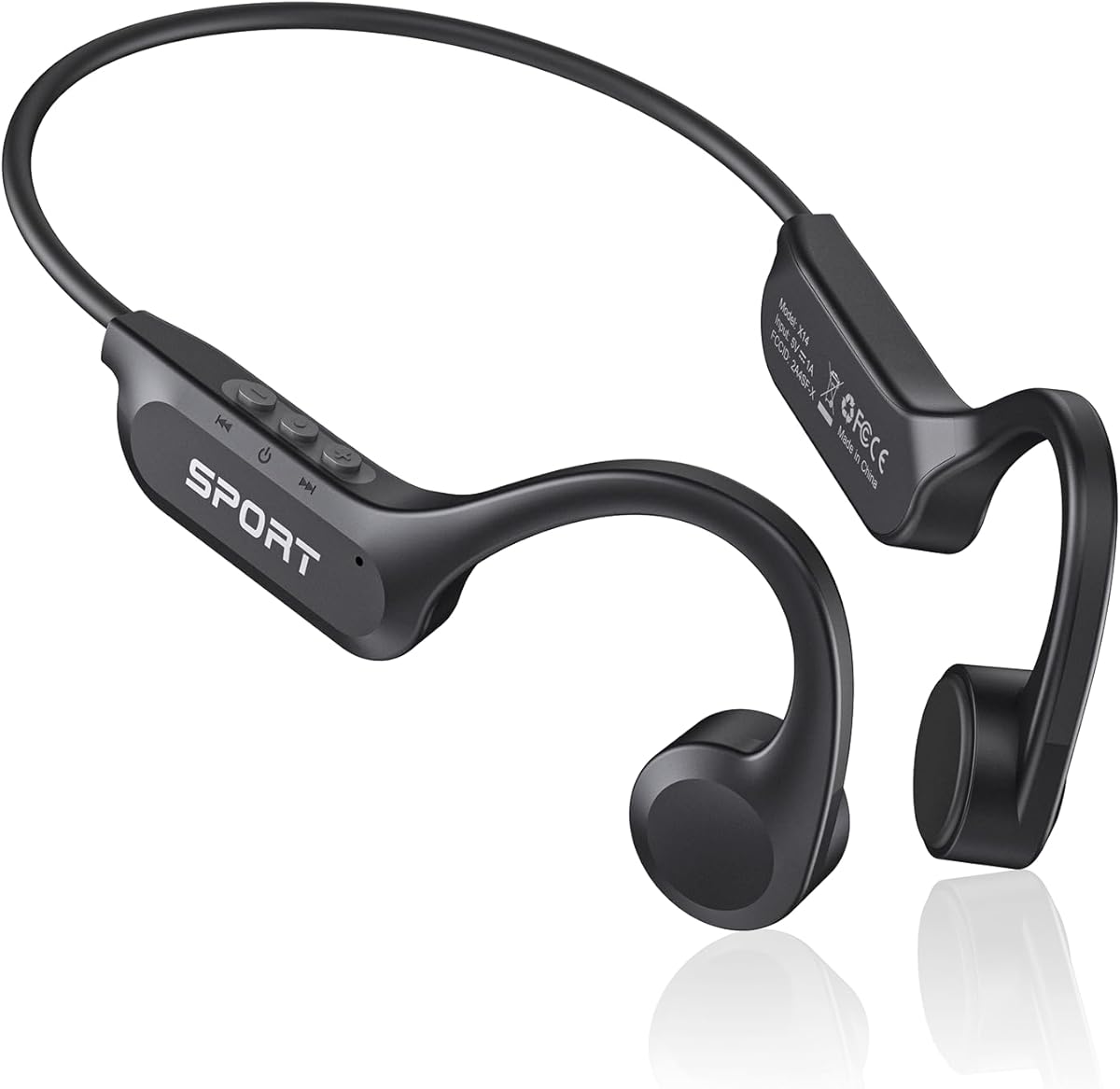
The CXK model uses enclosed-cavity bone-conduction technology to deliver sound while leaving the ears uncovered. Its 3.9 rating reflects a modern and distinctive design that appeals particularly to outdoor users who want situational awareness. At 28 grams, the headset is among the lightest products reviewed, and its wraparound titanium-style frame is described as stable and comfortable.
We may earn a commission when you buy through this link, at no additional cost to you.
Large 15mm bone-conduction drivers are intended to provide stereo sound with a soft, immersive presentation. Bluetooth 6.0 supports quick pairing, with the mobile device shown as “X14” during the initial connection process. A multifunction button handles music and calls. The headset also works with the Boean app, which offers AI music creation and custom EQ modes for users interested in creating or adjusting tracks.
Battery life is listed at up to 10 hours of playback, with a two-hour Type-C charge and up to 240 hours of standby. The product is explicitly not suitable for swimming, so sweat resistance should not be confused with full water protection. The open design also means surrounding sound remains audible. Although that is useful while running outdoors, it may reduce privacy in offices, shops, or public transportation.
This model is most appropriate for listeners who prioritize awareness, low weight, and a contemporary bone-conduction approach. Users focused primarily on business calls may prefer the dedicated boom microphones of the Golvery, trucker headset, or BlueParrott, while swimmers should look elsewhere. For outdoor exercise and casual music, however, the CXK's light frame, app features, and 10-hour runtime create a distinctive package.
The bone-conduction architecture keeps the ear canal open while transmitting sound through contact points around the ear. This can provide a different listening feel from standard air-conduction open-ear models and supports awareness of people and traffic during outdoor activity.
The Boean app expands the headset beyond a basic audio device with AI music creation and custom EQ modes. These functions are optional rather than essential, but they add value for users who enjoy experimenting with sound settings.
We may earn a commission when you buy through this link, at no additional cost to you.
This wraparound itayak headset is a compact sports and everyday option with a 37-gram weight, folding design, included carrying case, and a five-button control system. Its 3.8 rating places it alongside the neckband version in the lower part of the rating range, but the feature set covers the fundamentals well for a cost-conscious buyer.
We may earn a commission when you buy through this link, at no additional cost to you.
Bluetooth 5.0 supports a stated connection range of about 33 feet with compatible phones and tablets. The headset provides hands-free calling, stereo music, and physical control over power, volume, track changes, calls, playback, and voice assistants. Its stated battery reaches more than 11 hours of music, 14 hours of talking, and 200 hours of standby, which is favorable for a lightweight design in this category.
The sweatproof positioning suits outdoor exercise, and the foldable shape improves storage and carrying. However, there is no listed rotating boom, advanced noise-control microphone, dedicated mute button, or dual-device feature. The shorter range also makes this model less attractive than newer Bluetooth 5.3 and 5.4 alternatives when the user frequently walks far from a phone or moves around a large building.
The product is best suited to users who want inexpensive music and hands-free calls in a small sports-oriented package. The carrying case and broad button set are particularly practical, while the stated talk-time figure supports regular daily use. Those who need stronger microphone positioning or modern multipoint connectivity should favor the open-ear models higher in the ranking.
The folding format and included carrying case make this a convenient option for travel, commuting, and gym bags. Its 37-gram frame is heavier than the most compact open-ear models, but it still avoids the bulk of full-size over-ear headphones.
Five physical buttons cover the functions users need most without requiring a phone, and the listed 14-hour talk time is among the longer figures in the roundup. It is a straightforward headset for casual calls, music, and exercise.
We may earn a commission when you buy through this link, at no additional cost to you.
The right behind-the-head headset depends on how it will be worn, the environments where calls occur, and how much battery and wireless flexibility you need. Comparing fit, microphone construction, durability, and controls prevents a mismatch between the design and your daily routine.
Behind-the-head headsets appear in several broad forms. Neckband models curve around the back of the neck and place speakers near the ears, while hook-style open-ear designs use rotating arms that wrap around each ear. Compact wraparound models resemble small over-ear headphones, and convertible professional headsets can be worn over the head or behind the neck. The most comfortable choice depends on head shape, glasses, helmets, hairstyles, and whether the headset must remain secure during movement.
A neckband may feel natural for office calls and casual listening, while hooks can offer greater stability for running or driving. A conventional over-ear arrangement may provide better isolation, but it is bulkier. Read the fit descriptions carefully and consider whether the earpieces rest directly in front of the ear opening or merely point toward it.
Choose the wearing style that matches your most common activity rather than the one that looks most unusual. Stable positioning and comfort should take priority over fashion or novelty.
Microphone quality is essential for a headset used for work. Basic models use a built-in microphone and depend on the user remaining within a reasonable distance. Boom-microphone models can be rotated closer to the mouth, which often makes them more useful in offices, vehicles, and outdoor settings. AI microphone systems, ENC processing, and windscreens may further improve voice pickup, although results depend on the environment.
Also consider mute access. A dedicated one-touch mute control is convenient for meetings because it provides immediate confirmation that the microphone has been turned off. The BlueParrott offers a physical control for mute and other features, while the 29-gram open-ear and LEVN trucker models specifically mention one-touch mute.
For frequent calls, prioritize an adjustable boom and a visible mute control. For occasional calls in quiet rooms, a simpler built-in microphone may be sufficient.
Open-ear headsets leave the ears uncovered, preserving awareness of traffic, coworkers, and other environmental sounds. This is a major safety and comfort benefit during running, cycling, driving, and outdoor work. The trade-off is reduced privacy and less bass isolation than sealed earbuds or traditional noise-isolating headphones. Bone-conduction models transmit sound through contact points around the skull and are also designed to keep the ears open.
Users sensitive to earbud insertion may find either approach easier to wear for long periods. People who listen at high volume in noisy areas should consider whether open audio allows distractions to become too prominent. A model with environmental-noise blocking, such as the BlueParrott C400-XT, offers a different solution when isolation matters more than awareness.
Choose open-ear or bone conduction for comfort and awareness. Choose a cushioned convertible headset when private, focused listening is the priority.
Battery claims cover different activities. The BlueParrott is rated for 24 hours of talk time, the itayak models list 14 hours of talking and more than 11 hours of music, and several open-ear models offer approximately 8 to 10 hours of active use. Standby figures can be much longer but do not predict how quickly a headset will survive a full sequence of calls and media playback.
Consider how long a single charge must last. Daily office users may want a headset that comfortably completes a workday, while a user who charges overnight may accept a shorter active runtime. Type-C charging is convenient because it reduces the need to carry a proprietary adapter. The CXK lists a two-hour charge, while the Golvery states that a 1.5-hour charge is possible.
Treat the published battery figure as a maximum under stated conditions. Actual runtime varies with volume, connection stability, microphone use, and battery age.
Bluetooth 5.0, 5.3, 5.4, and 6.0 appear across this roundup. Newer versions generally support faster pairing and more stable connections, but the practical difference may not be obvious unless the user regularly encounters interference. Listed ranges range from about 33 feet to 49 feet for open-ear models, while the BlueParrott states a 300-foot maximum.
Range claims are best treated as theoretical maxima. Walls, vehicles, people, and other obstructions can reduce actual reach. A shorter stated range is rarely an issue in a room or vehicle but may matter in a warehouse, yard, or large home.
For most buyers, Bluetooth version matters less than reliable everyday pairing. Check compatibility with the devices you use and consider multipoint support if switching between a phone and computer is routine.
Dual-device connection allows a headset to remain paired with two sources at once. The top-ranked 29-gram open-ear model, the LEVN trucker model, and the Golvery all advertise this feature. It is particularly valuable for remote workers who move between computer meetings, phone calls, music, and instructional videos without wanting to re-pair each time.
Multipoint does not mean two devices can play audio simultaneously. It means the headset can be connected to both and switch between them according to the source. Reading the product's switching instructions is still important because button combinations and call-routing behavior can differ.
Prioritize dual-device support if you regularly use two Bluetooth devices. A single-device model remains perfectly capable for users who keep one phone or computer connected at a time.
Weights range from 27 grams for the Golvery and 28 grams for the CXK to 37 grams for the two itayak models, while the convertible BlueParrott uses a more substantial professional frame. Lower weight can improve comfort during long wear and make the headset easier to stabilize during exercise. Durability features such as IP54 protection, a folding design, and included carrying cases address different needs, with the first offering environmental protection and the others improving portability.
Sweatproof or sweat-resistant positioning is useful for workouts, but it should not be interpreted as swimming capability. The CXK is explicitly not suitable for swimming. Users should also distinguish a flexible or bendable headband from a genuinely impact-resistant frame, because no product description should be treated as a guarantee against every drop or harsh environment.
Choose low weight for long wear, a protective rating for demanding work, and a case or folding body for travel. The most durable choice is the one that matches your routine without adding unnecessary bulk.
Physical controls are valuable because a headset may be worn behind the head, where buttons are difficult to see. Common functions include power, volume, playback, track navigation, call answering, call rejection, and voice-assistant activation. The compact wrap models use four buttons, the itayak headsets offer five, and the more advanced open-ear models add a separate mute control or multifunction button.
Extra features such as custom EQ, app-based music creation, fast charging, voice control, and multipoint should be considered secondary to comfort and call performance. They are useful when they match your routine, but they cannot compensate for poor fit or an unsuitable microphone design.
Make sure the controls you use most are accessible from the stated design. For work, a dedicated mute button is particularly valuable; for exercise, simple playback and call buttons are usually enough.
Begin by fully charging the headset before its first extended use, then check the included instructions for the correct power control and pairing process. Power on the device, select its Bluetooth name from the phone, tablet, or computer menu, and confirm that both music and microphone permissions are enabled. If the model supports two devices, pair the second source before beginning normal work so that switching behavior is familiar and the headset is not accidentally broadcasting to the wrong device.
Adjust the band, hooks, or earpieces so the speakers sit comfortably without requiring constant pressure. For a boom microphone, rotate it toward the mouth without twisting the cable or forcing the joint. Test call audio with a short recording or live call, check the microphone direction, and use the dedicated mute control before entering a meeting. Keep the headset's control buttons easy to reach and learn the required press-and-hold combinations for volume, pairing, and voice-assistant access.
Clean the earpieces and silicone contact points with a soft, slightly damp cloth, while avoiding moisture around buttons, charging ports, and microphones. Do not submerge the headset unless its documentation explicitly permits it. Store it in the supplied case or in a dry pouch, allow sweat to dry before packing it, and avoid placing the earpieces under heavy pressure. Charge it before important travel or workdays, and remove the headset from your head before changing batteries, adjusting connected devices, or driving in a way that distracts from the road.
Comfort depends heavily on weight, fit, and the design of the earpieces. Models weighing 27 to 29 grams are among the lightest options in this guide and may be easier to wear for extended work or exercise. Neckbands, hooks, and over-ear frames feel different, so users with glasses or sensitive ears should consider the way the headset interacts with their daily accessories.
Several models are specifically positioned for running, workouts, and other active use. Hook-style or wraparound frames may stay in place more securely than minimal earbuds, and sweat-resistant construction can suit exercise. Avoid swimming unless the product explicitly states that it is waterproof, and always keep a secure grip on the controls while moving.
Many of these products use microphones and voice processing rather than full active noise cancellation for entertainment. The BlueParrott C400-XT claims to block 96% of ambient noise, while the LEVN and Golvery models describe microphone systems intended to improve voice pickup. These features primarily support clearer calls, and an open-ear design will not seal out surrounding sound like noise-isolating earbuds.
A neckband connects the two earpieces with a band that rests behind the neck, while a hook-style model wraps an arm around or over each ear. Neckbands tend to be simple and portable, whereas hooks often emphasize stability and precise microphone placement. The hook design may feel firmer during vigorous activity, so personal fit matters more than the category label.
Several options in this guide advertise dual-device or multipoint connectivity, including the top-ranked 29-gram open-ear model, the LEVN trucker headset, and the Golvery. This allows the headset to remain paired with two sources and switch between them. It does not mean both devices can play audio simultaneously, so the source still needs to be selected or routed manually when necessary.
Open-ear designs allow more environmental sound to remain audible, which can help users notice vehicles, cyclists, pedestrians, and other nearby activity. That awareness can be valuable during running, cycling, or driving. It also means more background noise enters the listening experience, so users should still use reasonable volume and remain attentive to their surroundings.
Published figures range from about eight hours of active use to 24 hours of talk time across this roundup. Runtime depends on volume, microphone use, connection conditions, and battery age. Frequent travelers or office users should select a model with enough stated endurance for their day or keep a charging cable and case available.
Yes, that is one of the main reasons to consider this category. These products rest around the neck, behind the head, over the ears, or on ear hooks without inserting speaker tips into the ear canal. Air-conduction and bone-conduction models may feel especially different from conventional earbuds, so checking fit and sound preferences remains important.
The top-ranked 29-gram open-ear headset offers the strongest overall balance, combining a 4.4 rating, dual-device connection, a dedicated mute control, and an open, lightweight design for work, driving, exercise, and media. The compact black wraparound model stands out as the budget pick because it combines portability with a 12-hour stated battery, while the BlueParrott C400-XT takes the premium position through its convertible construction, long range, 24-hour talk time, and noise-blocking focus.
Your priorities should guide the final decision. Choose an open-air or bone-conduction model for environmental awareness and minimal ear-canal pressure, a rotating boom for clearer calls, dual-device support for a phone and computer, and a durable convertible frame for mobile work. A neckband or compact wrap is sufficient for casual listening, while the LEVN, Golvery, and BlueParrott offer more specialized controls for people whose headset is primarily a communication tool.
Before purchasing, verify the current listing, device compatibility, warranty details, and technical specifications, since ratings and product information can change. Prices also fluctuate, so compare the complete feature set rather than focusing on cost alone. A well-fitted behind-the-head headset can become a comfortable daily tool for music, calls, exercise, and focused work without the isolated feeling of earbuds.
