
3rd Gen Copper Mesh Rodent Control
4.5Editor score
Thirty-two feet total mesh
One hundred percent copper
Includes one pair of scissors
Reusable and recyclable material
Discover the best Rat Deterrent for Gardens, comparing solar stakes, ultrasonic repellers, copper mesh, and peppermint options for reliable protection in
Rats can damage vegetables, undermine raised beds, gnaw irrigation lines, and create unsanitary conditions around the garden. The right deterrent depends on the affected area, the pests involved, and how much coverage you need. Solar repellers, copper mesh, and scent-based products offer distinct ways to discourage activity without relying on traditional traps.
This guide compares ten deterrents designed for rodents and related garden pests, emphasizing the technology, stated coverage, outdoor durability, installation method, and environmental considerations. Solar ultrasonic stakes are compared with motion-activated devices, physical exclusion mesh, and peppermint-based options for enclosed or partially protected spaces, helping readers match a product to a specific garden challenge.
Each review identifies the product's most useful qualities and practical limitations based on the supplied information. The top picks show where broad ultrasonic coverage, low-cost physical exclusion, and flexible motion detection stand out. Product availability, configurations, customer feedback, and prices can change, so readers should confirm current details before purchasing.
4.5Editor score

4.4Editor score
5.0Editor score
The comparison covers solar ultrasonic stakes, motion-activated repellers, copper exclusion mesh, and peppermint scent products. Coverage claims, power sources, weather resistance, installation methods, and suitable applications vary substantially across the ten options.




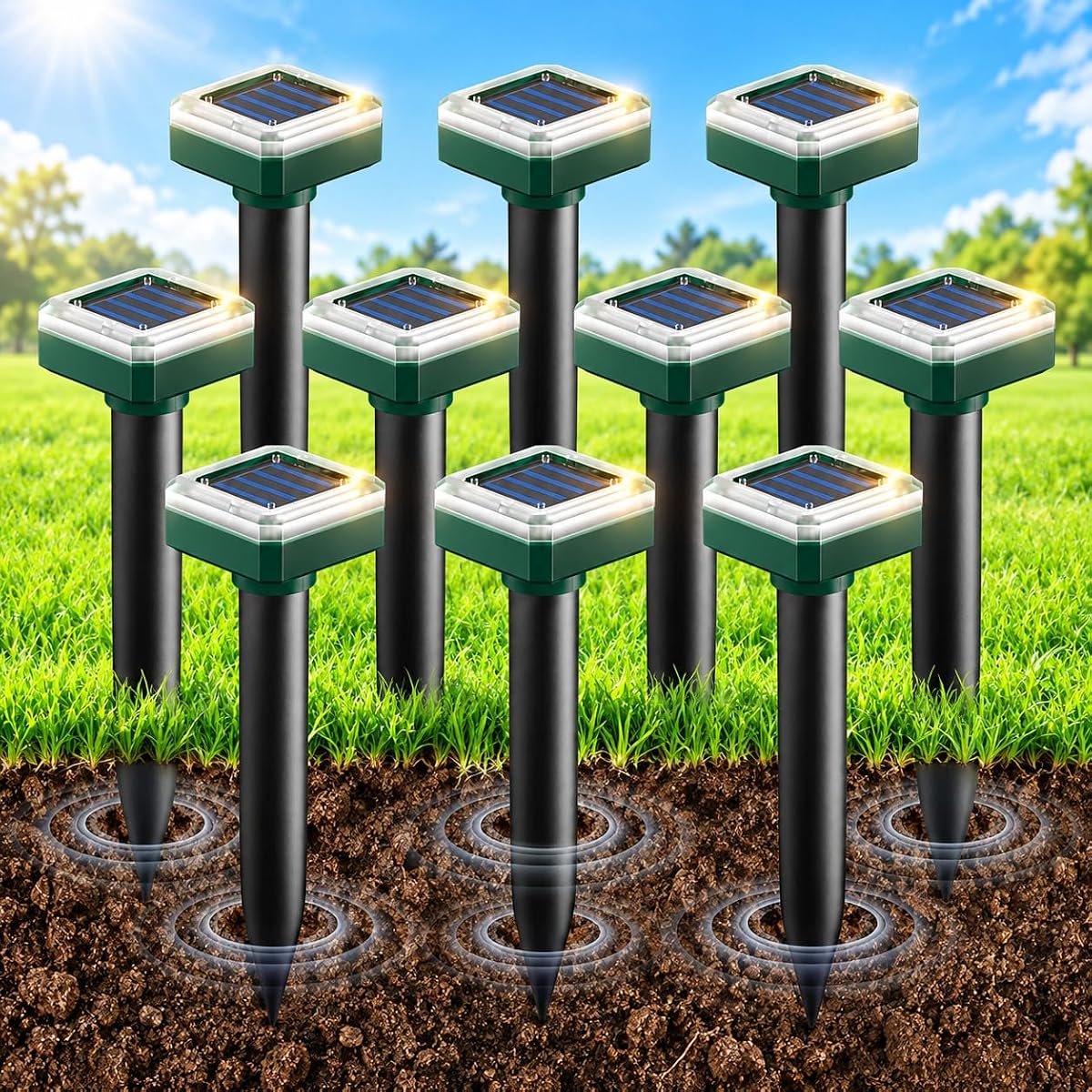
This ten-pack combines ultrasonic waves with deep-earth vibrations to create a two-part deterrent for moles, gophers, voles, snakes, rabbits, skunks, rodents, and other burrowing pests. Its 5.0 rating makes it the strongest numerical showing in this group, while the included coverage claim of up to 7,000 square feet suits gardens, lawns, orchards, chicken coops, and other outdoor areas.
We may earn a commission when you buy through this link, at no additional cost to you.
The standout feature is its combination of two deterrent methods. Solar panels supply continuous power without disposable batteries or buried wiring, and each stake is intended to remain active outdoors. Its IP44 waterproof rating and high-impact ABS construction are designed for rain, snow, and heat. The low-profile green finish also helps the stakes blend into turf rather than resembling a large piece of equipment.
Some compromises are worth noting. The stated IP44 rating is lower than the IP65 ratings offered by several other solar stakes in this guide, and the combined 7,000-square-foot figure should be understood as the listed coverage for the set rather than a guarantee around every edge. The seller also recommends consistent use for two to four weeks to disrupt established territories and nesting patterns, so it is not positioned as an instant response to a severe infestation.
This is the strongest premium choice for gardeners who want a complete, widely spaced installation rather than one isolated deterrent. Its humane approach and claimed compatibility with children, dogs, and cats make it especially attractive for households seeking to avoid poison or trapping around active play areas. For a larger garden or orchard, the ten-piece configuration provides a more practical starting point than a small four-pack.
Ultrasonic waves are combined with ground vibrations to discourage pests through two sensory channels. The stated range of targets includes rats and other burrowing rodents, making the set more versatile than a narrowly branded mole stake.
Ten units allow owners to place deterrents around tunnels, garden edges, planted beds, and other likely entry points. Spacing them across active areas is a more practical strategy than expecting one stake to protect an entire property.
We may earn a commission when you buy through this link, at no additional cost to you.
This four-unit solar stake set uses ultrasonic waves to target moles, gophers, voles, rats, squirrels, and skunks. It holds a 3.2 rating, the lowest among the ten products in this roundup, so buyers should assess the mixed customer history carefully. Its basic feature set remains easy to understand: insert the stakes, allow an initial day of charging, and place them in sunny positions.
We may earn a commission when you buy through this link, at no additional cost to you.
The construction uses ABS material with a hot-pressed waterproof design intended to resist corrosion and low temperatures. That makes it suitable for gardens, patios, farms, and orchards. Its appeal lies in straightforward deployment, absence of electrical wiring, and the supplied claim that the ultrasonic waves are safe for children, pets, and the environment. Each unit also includes a ground cap positioned about two inches above the surface.
The main drawback is that the product listing is less detailed than those of the better-rated alternatives. Its roughly 5,000-square-foot coverage description does not clearly explain how that figure relates to each unit or the complete four-piece set, which could lead to unrealistic expectations if placement is too sparse. The 3.2 rating also suggests that customer experiences have been inconsistent.
Despite that reservation, the set may suit buyers seeking a conventional ultrasonic mole deterrent without vibration technology or complex controls. It is most appropriate for small-to-medium gardens with reliable sunlight and several accessible placement points. For demanding infestations or larger properties, a higher-rated option with clearer coverage and weather specifications would be a safer choice.
After a day of initial charging, each stake can operate without wiring or replaceable batteries. Sun exposure remains the most important installation consideration because the solar panel must replenish the unit's power supply.
The hot-pressed waterproof shell is designed to tolerate rain, snow, and low temperatures. That makes the stakes suitable for seasonal use where sudden weather changes are common.
We may earn a commission when you buy through this link, at no additional cost to you.
This ten-piece solar repeller is the most complete overall option in the roundup, combining ultrasonic pulses from 400 to 1,000 Hz with intermittent vibrations every 20 seconds. Its 4.4 rating reflects generally favorable feedback, and the stated 50-foot effective radius distinguishes it from products marketed around a conventional 25-foot basic range. The set targets snakes, moles, gophers, rabbits, skunks, chipmunks, raccoons, squirrels, and other garden pests.
We may earn a commission when you buy through this link, at no additional cost to you.
Its IP65 waterproof housing is one of the strongest specifications offered in this guide. High-efficiency solar panels support continuous outdoor operation, while dynamic frequency changes are intended to reduce the chance that pests will adapt to a fixed sound pattern. The stakes do not require poisons, chemical sprays, or painful trapping, and the listing describes them as suitable around pets, plants, flower beds, farmland, and lawn roots.
The trade-off is that this is an outdoor-area system rather than a completely silent solution. It emits sound and vibration on a regular schedule, so it may be unsuitable for a very quiet setting. Its performance also depends on consistent operation and thoughtful placement. The seller advises giving the system time to work, while the inclusion of ten stakes means owners must distribute them across the garden rather than clustering them together.
This is the best overall pick for a broad garden where several animal types are troublesome and the owner wants a durable, chemical-free deterrent. Its combination of longer stated coverage, strong waterproofing, variable frequencies, and a generous pack count makes it more versatile than most of the alternatives. It is also a logical choice for readers comparing the premium ten-pack with the more economical options.
The stated 50-foot radius combines ultrasonic pulses with vibration every 20 seconds. This dual approach is useful for gardens where rats share space with moles, gophers, rabbits, snakes, or other burrowing animals.
Variable dynamic frequencies are intended to discourage habituation. This may be particularly helpful in a garden where a single unchanged deterrent sound would quickly become familiar to persistent pests.
We may earn a commission when you buy through this link, at no additional cost to you.
This solar stake emits ultrasonic waves every 30 seconds, followed by three-to-five-second vibration pulses intended to disturb underground pests. It has a 3.9 rating and explicitly targets rats, snakes, rabbits, hedgehogs, moles, and other burrowing rodents. Each unit is stated to cover as much as 5,000 square feet, making the system more relevant to open gardens and lawns than to a single vegetable bed.
We may earn a commission when you buy through this link, at no additional cost to you.
The major convenience is its choice of two-, four-, and eight-pack configurations. Gardeners can start with two units for a small yard or use more stakes for a farm, orchard, or larger property. Installation requires pushing the units into soil, while a solar panel and durable waterproof construction eliminate disposable batteries and wiring. Its vibration component may add useful disruption for pests traveling through soil.
There are some practical limitations. Like all solar devices of this type, it depends on receiving adequate sunlight to recharge, so heavily shaded areas are less suitable. The product is not designed to be completely silent, and owners should consider whether periodic ultrasonic or vibration pulses could be noticeable nearby. The broad 5,000-square-foot claim should also guide placement rather than serve as a substitute for multiple units around active tunnels.
This is a practical middle option for owners who want flexibility in pack size and a combination of ultrasonic and vibration output. It is best for gardens where rats and other burrowing pests are active below the surface and where a small number of stakes can be positioned along their routes. Buyers seeking a higher customer rating or more precisely defined waterproof rating may prefer one of the better-rated ten-pack systems.
Available pack sizes make it easier to match the deterrent count to the garden. Two units may suit a compact plot, while eight provide better distribution across larger yards, farms, or orchards.
Short vibration periods every 30 seconds add a physical deterrent element. This may make the product more versatile for subsurface pests than an audio-only stake.
We may earn a commission when you buy through this link, at no additional cost to you.
This copper mesh kit offers a different approach from active repellers. It seals holes and gaps where mice, rats, and other unwanted visitors might enter, while the product information also identifies uses around plants for slugs, snails, and birds. Its 4.5 rating is among the strongest in the roundup, and the physical barrier requires no batteries, sunlight, wiring, or scheduled operation.
We may earn a commission when you buy through this link, at no additional cost to you.
The kit contains two rolls measuring 4 inches by 16 feet each, giving 32 feet of mesh in total. A pair of scissors is included for cutting sections to fit. Its third-generation copper wool is described as rust- and corrosion-resistant, with a robust mesh structure. Because it works as an exclusion material, it can protect a specific vulnerable point rather than attempting to cover an entire garden with sound or scent.
The main limitation is that effectiveness depends on identifying and closing the actual entry route. Rats can exploit very small openings, and copper mesh must be inserted carefully enough to maintain its barrier while leaving the targeted gap inaccessible. The material is best understood as targeted protection for sheds, cold frames, raised-bed structures, storage areas, and garden edges rather than a broad deterrent for an entire property.
This is the best budget pick for readers who want inexpensive, low-maintenance physical exclusion. It is particularly valuable when damage is concentrated around a specific hole, vent, pipe penetration, or garden structure. For a comprehensive garden defense, it can complement an ultrasonic stake placed nearby. Its recyclability and lack of ongoing power requirements also make it an environmentally straightforward choice when installed responsibly.
The mesh works best after inspecting sheds, storage buildings, raised beds, pipe openings, and other vulnerable spots. Cut only the amount needed and press the copper wool firmly into each gap to create a continuous barrier.
Once properly fitted, the barrier requires no charging or adjustment. This makes copper mesh useful in remote garden areas where maintaining several solar repellers would be inconvenient.
We may earn a commission when you buy through this link, at no additional cost to you.
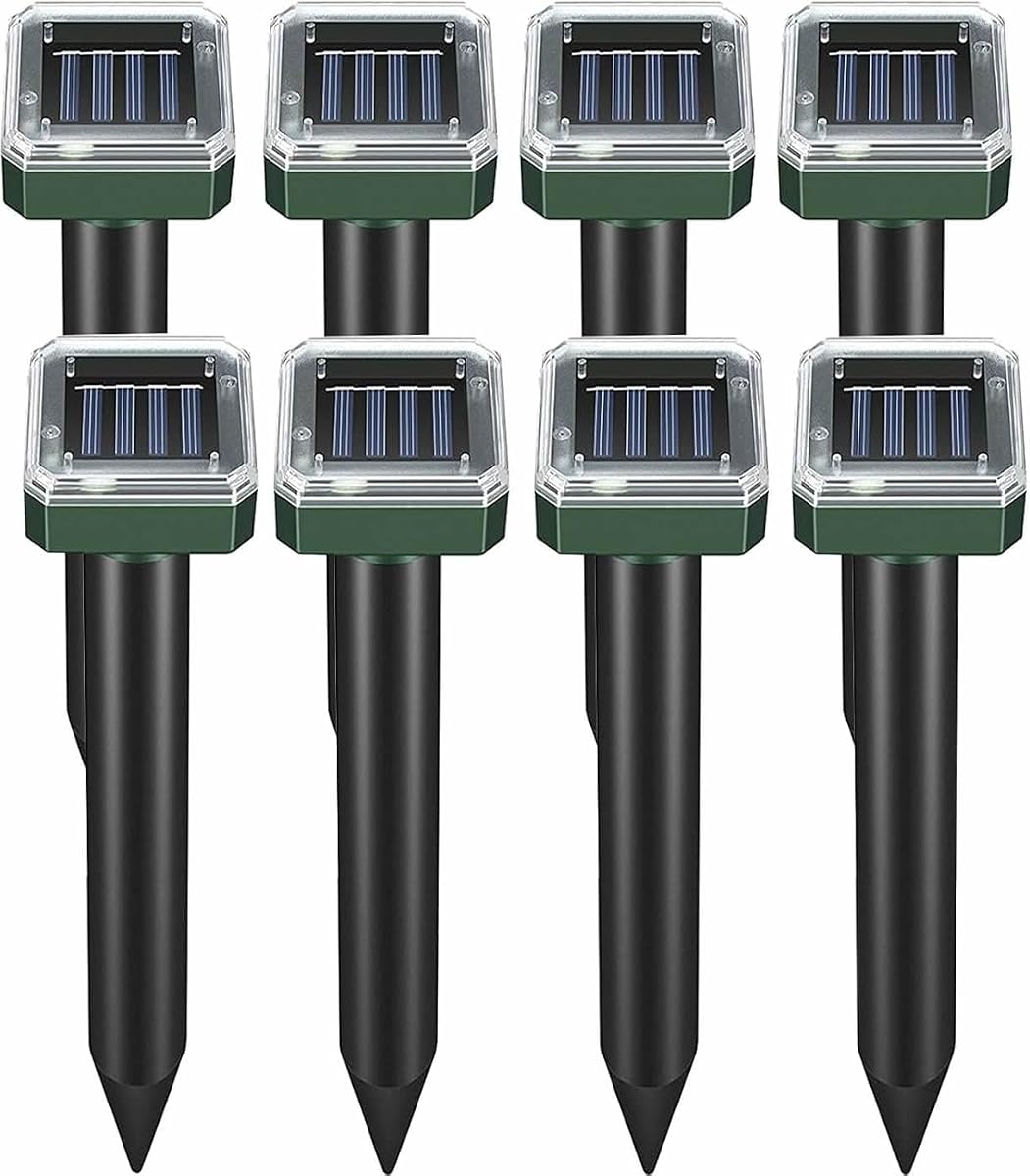
This eight-piece olive-green stake set uses intermittent ultrasonic vibration to deter moles, voles, gophers, snakes, and other burrowing rodents. Its 4.9 rating is the second-highest in the roundup and gives it a particularly strong customer-feedback profile. Each unit is stated to cover up to 5,000 square feet, while the set size makes broad distribution across gardens, lawns, orchards, and farms practical.
We may earn a commission when you buy through this link, at no additional cost to you.
Its upgraded self-charging solar panel removes the need for wiring or frequent battery replacement. An IP65 waterproof ABS shell is designed to resist rain, snow, strong sunlight, rust, and corrosion. Installation is tool-free in principle: create a small hole, insert the stake, and press the power button. The low-profile olive appearance is well suited to lawns and vegetable gardens.
The main caveat is that this is a periodic sound-and-vibration device rather than a silent solution. It may produce noticeable pulses in a very quiet setting, and the stated coverage should not be interpreted as a guarantee that every part of a large property will be protected. Consistent placement near active tunnels and recharging in unobstructed sunlight remain essential.
This is an excellent option for readers prioritizing strong ratings, all-weather construction, and a generous number of units. The eight olive stakes also allow owners to blend them into garden borders more discreetly than bright plastic devices. Although its feature set closely resembles the top-rated ten-pack, this set offers eight units, making it a solid alternative for medium and large gardens.
The IP65 ABS shell is designed for year-round outdoor exposure, including rain, snow, and strong sunlight. Its olive finish also helps the stake blend into planted borders and established turf.
The self-charging panel needs direct sunlight to replenish its power. Keep the top of each stake unobstructed, and avoid placing it beneath dense foliage or inside a shaded storage structure.
We may earn a commission when you buy through this link, at no additional cost to you.
This eight-pack is designed to protect lawns, gardens, yards, farms, orchards, and patios from rats, moles, gophers, voles, squirrels, and skunks. It has a 3.8 rating and uses a solar-powered ultrasonic stake with a stated coverage of approximately 7,000 square feet. Its eight-unit count offers a practical way to spread the deterrent across a sizable outdoor area.
We may earn a commission when you buy through this link, at no additional cost to you.
The units charge in sunlight before installation and require no wiring or disposable batteries. Installation calls for a pilot hole made with a wooden or steel rod, followed by inserting the stake until the cap sits about two inches above the ground. The outer shell uses hot-pressed ABS and is designed to withstand rainy and snowy outdoor conditions.
The seller explicitly notes that this type of device creates vibration sound, which can be noticeable in a very quiet area. That warning is important for readers with close neighbors, quiet courtyards, or sleeping areas nearby. Its 3.8 rating is also lower than the average of the higher-ranked solar options, while the broad coverage wording needs practical interpretation across eight distributed stakes.
This set is best for a reader who wants a substantial number of solar units without moving to the larger ten-pack configurations. It suits active gardens where regular placement along tunnels and boundaries can distribute the ultrasonic signal. Buyers sensitive to ambient noise should choose a physical exclusion method or a motion-activated unit that remains quiet until movement is detected.
A large set works best when each unit is placed near a likely route rather than grouped in one location. Focus on tunnel openings, garden edges, and areas where fresh soil disturbance appears.
The product description clearly warns that these devices produce noise. Check the intended placement at night and during quiet daytime hours before installing several stakes near a patio or bedroom.
We may earn a commission when you buy through this link, at no additional cost to you.
This motion-activated repeller combines ultrasonic frequencies, variable-frequency alarm sounds, and flashing LEDs to discourage mice, skunks, foxes, rabbits, owls, raccoons, and other animals. Its 4.0 rating reflects a balanced but unexceptional customer score. Unlike continuously operating stakes, the advanced PIR sensor activates the unit only after it detects movement, making it more suitable for gardens where quiet hours matter.
We may earn a commission when you buy through this link, at no additional cost to you.
The PIR sensor covers an angle of 110 degrees and a range of up to 33 feet. Five operating modes provide flexibility, while the three ultrasonic frequency levels can be adjusted for the surrounding environment. The unit also includes a rechargeable lithium battery, a solar panel, and a USB charging cable. Its IP66 waterproof ABS construction is intended for harsh outdoor conditions.
The sensor is directional rather than a complete perimeter alarm, so correct height and placement are essential. The product can be inserted into soil or mounted on a wall, but rodents approaching from outside the detection arc may not trigger it. The listing also advises waiting 10 to 15 days before expecting a visible decrease in animal visits, which underlines that deterrent results are rarely instantaneous.
This repeller is a good choice for gardens where rats, raccoons, rabbits, or stray cats are entering through a defined opening. Motion activation reduces unnecessary sound, while the light adds another visible deterrent. It works best alongside physical exclusion and garden hygiene, particularly when the goal is to discourage repeat visits without constant ultrasonic output.
PIR detection means the device waits for movement before emitting sound and flashing its light. This makes it more considerate for quiet gardens than a stake that operates continuously.
The 110-degree detection angle and 33-foot range should guide placement. Aim the sensor toward the route animals use, then adjust the mode and volume according to nearby activity and surroundings.
We may earn a commission when you buy through this link, at no additional cost to you.
BugMD Vamoose! Plus uses scented pouches to create a barrier intended to deter mice and other rodents from nesting in closets, pantries, storage areas, and garden-related structures. Its 4.0 rating places it in the middle of the roundup. The formula combines peppermint, rosemary, and clove essential oils and is described as plant-based, non-toxic, and safe for people, pets, and beneficial insects when used as directed.
We may earn a commission when you buy through this link, at no additional cost to you.
The improved formula is stated to provide protection for up to 30 days. Each pouch can be placed in a shed, garage, attic, under a sink, inside a vehicle, or around another enclosed or partially enclosed location. It is also advertised for RVs, trucks, boats, campers, barns, and storage units, protecting spaces where rats may damage upholstery, wiring, stored goods, or engine components.
Scent-based deterrence has natural limitations outdoors. Wind, rain, heat, and unrestricted airflow can disperse or dilute the odor, making a single pouch less suitable for a broad open garden. The product is most effective when placed in enclosed spaces where the scent can remain concentrated. It also does not physically block entry, so it should not be treated as a complete substitute for repairing access points.
This product is best for adding a scent-based layer of protection to sheds, garages, vegetable storage areas, and other garden buildings. It is particularly convenient for readers who want a non-powered option without installing stakes or wiring. Combining pouches in vulnerable structures with copper mesh entry blocking and a solar repeller around the wider garden can create a more balanced defense.
Place pouches inside enclosed or sheltered areas where air movement is limited. Enclosures such as sheds, cabinets, bins, and vehicle compartments allow the peppermint, rosemary, and clove scent to remain more concentrated.
Scent discouragement works best alongside physical exclusion. Block holes around pipes, doors, vents, and storage structures so rodents cannot simply enter another protected part of the garden.
We may earn a commission when you buy through this link, at no additional cost to you.
This four-pack relies on peppermint oil to discourage mice and rats from entering homes, vehicles, garages, and garden structures. Its 3.9 rating is close to the average of the reviewed group. The product information says the scent can make rodents dizzy and prevent them from invading enclosed spaces, giving it a different operating principle from ultrasonic or physical exclusion methods.
We may earn a commission when you buy through this link, at no additional cost to you.
Each container is designed to protect up to 120 square feet and may last for as long as 30 to 60 days. Installation is straightforward: remove the protective film beneath the metal lid, cover the lid tightly, and attach the container with the included three-meter adhesive strip. The four units can be distributed among cars, RVs, trucks, garages, basements, pantries, sheds, barns, boats, and storage spaces.
The listing explicitly notes that ventilated areas are not as well protected as sealed spaces. This is a significant limitation for an open garden, where wind can disperse the peppermint scent quickly. It is also a repellent rather than a physical barrier, so persistent rodents may continue testing the area if they can find another entry route. The wording about making rodents dizzy should be understood as a deterrent claim rather than a humane kill mechanism.
This product is most useful for small, enclosed garden structures and vehicles, especially when a no-power option is desired. It can supplement copper mesh and ultrasonic stakes without requiring charging. Readers seeking broad outdoor coverage should select a solar deterrent or a scent product specifically deployed inside sealed structures, rather than relying on peppermint alone across an exposed yard.
The scent is less likely to disperse when placed in basements, storage rooms, cabinets, vehicle compartments, and closed sheds. Sealing the area helps the peppermint odor remain concentrated for longer.
Use separate containers in the areas most vulnerable to chewing or nesting. Attaching one to each of several structures can be more useful than clustering all four units in a single location.
We may earn a commission when you buy through this link, at no additional cost to you.
A useful garden deterrent must fit the pest behavior, scale, and physical layout of the space. Consider exclusion versus deterrence, coverage, power, weather exposure, and the possibility of nearby pets or people before choosing.
Physical exclusion and active deterrence solve different problems. Copper mesh seals known entry points and is dependable when the vulnerable opening can be identified, while ultrasonic and vibration stakes discourage movement across a larger outdoor area. Scent products create an additional barrier in enclosed structures. If rats are repeatedly entering a shed through a damaged vent, begin with entry-point repair; if new tunnels are appearing across a lawn, a distributed outdoor deterrent may be more appropriate.
Choose the method that matches the evidence you can actually observe. Entry damage calls for sealing, while repeated travel routes may benefit from audio or vibration deterrents.
Coverage claims vary between roughly 5,000 square feet per unit, 7,000 square feet for a set, and a 50-foot radius. These figures should be treated as placement guidance rather than guaranteed boundaries. Larger properties require multiple stakes spaced around tunnels, garden borders, and other likely activity zones. Do not bunch every unit in one highly trafficked area, because broad, distributed placement is more likely to disrupt movement across a property.
Match the number of units to the property and the routes you have observed. More units are generally more useful than one unit placed in the middle of a large garden.
Solar stakes require direct sunlight and usually need an initial charging period before installation. Their advantage is continuous operation without wiring or routine battery changes, but shaded gardens may reduce charging reliability. Motion-activated repellers also use solar power but include a rechargeable battery and USB charging cable. Pepperment-based products and copper mesh require no power at all, making them dependable in remote or heavily shaded locations.
Prioritize no-power products when sunlight is limited. For solar models, ensure the panel can remain unobstructed through the seasons.
Ultrasonic repellers and vibration stakes may produce periodic sound even when people cannot hear the highest frequencies. One seller explicitly warns that these devices can be noticeable in very quiet environments. Motion-activated designs are quieter during idle periods because the alarm and light activate only after the PIR sensor detects movement. Review the placement area carefully if bedrooms, patios, neighboring homes, or livestock are close by.
Choose continuous operation for broad deterrence or motion activation for targeted, quieter control. Account for real-world ambient noise rather than assuming every unit is completely silent.
Outdoor stakes must tolerate rain, snow, heat, and soil moisture. Products in this roundup cite waterproof ABS construction, with some offering IP65 or IP66 ratings and the premium ten-pack using IP44. A higher IP designation indicates stronger protection against water ingress, but construction quality, solar-panel exposure, and installation also matter. Keep the charging panel clear of mud and debris, and check that each stake remains firmly upright after storms or freeze-thaw conditions.
Favor robust waterproof construction for exposed beds, farms, and orchards. In milder settings, a basic weather-resistant unit may be sufficient.
Stake installation is quick but still requires planning. Place units near active tunnels, damaged plant areas, feeding spots, compost zones, or other movement corridors. Avoid compacting the soil excessively around the stake and leave the cap above ground. Mesh needs a different approach: cut it to fit, push it into the gap, and inspect it regularly for wear. Adhesive scent products should be attached to clean, dry surfaces within sealed structures.
Create a placement plan before installation. Label tunnels, move units when activity shifts, and seal openings as soon as they appear.
Rats are rarely the only wildlife attracted to a productive garden. Several ultrasonic products also target moles, gophers, voles, rabbits, skunks, snakes, raccoons, chipmunks, and squirrels. Motion-activated units can address larger animals and birds, while copper mesh has useful applications around plant protection. A broader product may offer better value when several species are active, provided its range includes the pest causing the actual damage.
List the animals you have observed before choosing. A multi-pest deterrent is useful only when its capabilities align with your garden's real problem.
Several products are marketed as no-kill, poison-free, or safe for children and pets when properly used. These descriptions favor deterrents over traps or toxic pesticides, but users should still follow instructions, keep products out of reach, and avoid assuming every wildlife interaction is harmless. Scent products should be used according to their directions, and outdoor stakes should be positioned so they do not interfere with digging pets or frequent foot traffic.
Choose the least hazardous method that addresses the issue, and treat manufacturer safety claims as guidance rather than a substitute for responsible placement.
Begin by mapping where rats are active. Look for tunnels, gnawed stems, disturbed soil, droppings, damaged irrigation lines, and gaps beneath fences, sheds, vents, or raised beds. Remove food sources where possible, secure compost and seed stores, and clean the area before positioning a deterrent. For a solar stake, select a sunny location near a route but outside the path of frequent foot traffic or digging animals.
Install solar units according to their instructions. Allow the panel to charge for the recommended initial period, switch the unit on, and push it into soil with the cap remaining above ground. For copper mesh, clean the opening, cut a suitable piece, and press the copper wool into every accessible gap without creating a loose bridge for rodents. Adhesive scent units belong on clean, dry surfaces inside enclosed or sheltered spaces.
Monitor the installation rather than expecting immediate results. Review tunnels and plant damage weekly, reposition a stake if activity shifts, and replace scent pouches when their stated protection period ends. Keep solar panels free of soil, leaves, and standing water. Check mesh after storms or animal activity, and clean the motion sensor of the motion-activated unit so that dirt does not interfere with detection.
A combination of methods usually gives a vegetable garden stronger protection than a single device. Solar ultrasonic or vibration stakes can discourage travel through open beds, while copper mesh can seal gaps around cold frames, irrigation lines, and storage structures. Removing accessible food and water sources is equally important because a deterrent works best when rats have fewer attractive reasons to remain.
The products in this roundup are generally promoted as safe for children, pets, and plants because they avoid poison and trapping. Buyers should still follow the manufacturer's placement and operating instructions, particularly when animals have access to the garden. Some units produce vibration or audible sound, so avoid positioning them where repeated pulses could bother people or interfere with pets accustomed to resting in the area.
Results depend on the product, pest population, placement, and how quickly the animals establish a new route. Several sellers suggest allowing roughly two to four weeks of consistent use, while the motion-activated product advises waiting 10 to 15 days for a noticeable decline. Ongoing operation and distributed placement are generally more important than making a major change only a few days after installation.
Use copper mesh when rats are entering through a specific, identifiable gap. It physically blocks the route and does not require charging, making it reliable in shaded or remote locations. Use ultrasonic or vibration stakes for open areas where rats travel underground or across the yard. In many gardens, using both is practical: mesh protects vulnerable structures while stakes discourage movement across larger planted areas.
Peppermint oil is best in enclosed or sheltered spaces where wind cannot quickly disperse the scent. It can be useful inside sheds, storage rooms, vehicles, cabinets, and pest-proof containers, but it is less dependable across a wide, ventilated garden. The scent products in this guide are therefore better suited to supplemental protection than as the sole deterrent for an exposed yard.
The correct number depends on the property size, the stated coverage of each model, and where activity has been observed. Products claiming approximately 5,000 or 7,000 square feet are still most effective when their units are distributed around likely routes rather than clustered together. Measure the garden, identify several active areas, and use enough stakes to create overlapping coverage near tunnels, borders, and structures.
It depends on the model and the placement. Continuous ultrasonic and vibration stakes may create noticeable pulses in an otherwise quiet garden, and one seller specifically warns about this issue. A motion-activated unit remains inactive until it detects movement, which can reduce unwanted noise. Test the intended location before installing several devices, particularly near bedrooms, patios, neighboring homes, or animal enclosures.
No single deterrent should be expected to guarantee total elimination, especially where a large food supply or abundant shelter is nearby. Combining physical exclusion, distributed ultrasonic stakes, scent protection inside structures, and sanitation measures is more likely to produce lasting results. Keep monitoring for new entry points and shift deterrent placement when it becomes clear that rats have found another route.
The 2026 Upgraded Ultrasonic Deterrent stands out as the best overall choice because it combines ten solar stakes, dual ultrasonic and vibration operation, dynamic frequencies, a stated 50-foot radius, and IP65 weather protection. The 3rd Gen Copper Mesh is the best budget option when rats are entering through identifiable gaps, while the Dual-Action Solar Mole Repellent is the premium choice for extensive properties needing a larger installation.
Prioritize the method that matches the behavior you are seeing. Seal obvious openings with copper mesh, place solar stakes around active travel routes, use motion activation where quiet operation matters, and confine peppermint scent products to enclosed structures. Combine those tactics with secure food storage, clean compost management, and regular inspections to make the garden less attractive and harder for rats to navigate.
Before buying, verify the current product configuration, customer feedback, coverage wording, weather rating, and available seller details. Prices and promotions can change, so compare the final listing with the garden area you need to protect. A moderate-cost product placed strategically and maintained consistently will usually be more useful than a larger set installed without a clear plan.