
6.5ft Cat Scat Mat
4.0Editor score
Customizable 78-inch strip
Soft rounded plastic spikes
Weather-resistant construction
Cats can quickly turn a thriving garden into a stressed landscape of dug-up soil, damaged seedlings, and unwanted marking. The best cat deterrents for gardens combine scent, texture, or physical boundaries with consistent placement, helping discourage repeat behavior without relying on traps or harsh methods.
This guide compares ten garden cat deterrents across several formats, including granular treatments, ready-to-use sprays, spike mats, and slow-release scent products. The comparison considers intended area, coverage, installation, weather resistance, maintenance, and suitability for plants, people, and pets when used as directed.
Each review explains the product's strongest qualities, practical limitations, and best-fit scenario, from broad lawn coverage to narrow flowerbed edges and frequently visited indoor points. Ratings reflect the supplied customer feedback, while product availability and pricing can change, so readers should verify current listing details before purchasing.
4.0Editor score

4.6Editor score

4.1Editor score
As an Amazon Associate we earn from qualifying purchases.
This side-by-side comparison covers ten cat deterrent formats, highlighting their coverage, active approach, placement flexibility, and maintenance requirements so gardeners can find a practical fit for the spaces cats frequent.


Nature's Mace Cat Mace Cat Repellent 2.5 lb Granules has a customer rating of 3.2 and offers one of the broadest coverage claims in this guide. The granular formula is intended to discourage digging, urination, defecation, and chewing across flowerbeds, lawns, patios, potted plants, trash areas, and other indoor or outdoor locations.
We may earn a commission when you buy through this link, at no additional cost to you.
Its main advantage is flexibility. Gardeners can spread the granules across an open bed, work them into mulch, or concentrate them along a frequently visited route. The stated coverage of up to 1,400 square feet makes the 2.5-pound container appealing for larger areas, while the plant-based ingredients are described as suitable around family members, pets, and plants when applied according to directions.
The tradeoff is that this option depends on consistent maintenance. The manufacturer recommends applying when cat activity is first noticed and reapplying every two to three weeks, so it is less convenient than a longer-lasting scent ball or a mat that remains in place. The 3.2 rating also suggests that results may vary considerably depending on weather, soil, cat persistence, and local cat traffic.
This is a practical choice for gardeners who want to treat a sizeable lawn or several planting areas without assembling a physical barrier. It is less attractive for someone seeking a nearly hands-off solution. Buyers should apply it early, distribute it evenly, and combine it with prompt cleanup and other behavior-modification measures when cats remain persistent.
The listed coverage of up to 1,400 square feet is the product's defining feature. That makes it more useful for broad treatment than for a single pot or a narrow garden gate, provided the granules are spread evenly as directed.
Because the deterrent relies on maintaining a scent barrier, gardeners should plan for renewal every two to three weeks. Prompt reapplication is especially relevant in exposed beds, wet climates, and areas with heavy foot traffic.
We may earn a commission when you buy through this link, at no additional cost to you.
This 12-pack cat deterrent has a 4.6 rating, making it the highest-rated product in the guide, and it stands out for the combination of simple placement and long stated coverage. Each pack can be positioned where cats are active, allowing gardeners to build a distributed barrier without mixing or spraying a product.
We may earn a commission when you buy through this link, at no additional cost to you.
The packs are described as plant-based and intended for use around people, household pets, and plants when following directions. Their listed versatility is another important strength: they can go in gardens, lawns, porches, trash areas, carpets, and indoor marking spots. This makes them useful when the problem is not one isolated bed but several routes cats use around the property.
There is no stated coverage area in square feet, so gardeners must judge placement by the number and location of packs rather than by a measurable surface size. The 60-day protection claim also depends on environmental conditions and use as directed. A pack positioned poorly, exposed to heavy rain, or surrounded by heavily traveled surfaces may not deliver the same result as one placed at a key entry point.
This is the most balanced recommendation for a gardener who wants straightforward installation, a long replacement interval, and flexibility across indoor and outdoor spaces. Start at the places where cats are observed most often, space the packs according to the instructions, and monitor whether activity shifts. It is especially useful as part of a broader routine that includes removing scent markers and blocking favored access routes.
Individual packs remove the need to treat an entire surface uniformly. Gardeners can place several units along a fence, around a bed, beside trash containers, or at an indoor scratching area and then adjust their positions as cat patterns change.
The 4.6 customer rating and stated 60-day coverage distinguish this option from products requiring frequent attention. Although actual longevity can vary, the format offers a useful balance between convenience and targeted placement.
We may earn a commission when you buy through this link, at no additional cost to you.
The 6.5ft Cat Scat Mat has a 4.0 rating and offers a non-chemical approach based on soft, rounded plastic spikes. Its 78-by-11-inch format is designed to discourage cats and small animals from walking, scratching, or digging across an area they should avoid.
We may earn a commission when you buy through this link, at no additional cost to you.
Unlike scent products that depend on continuous odor, this mat creates a tactile boundary. It can be placed along garden borders, balcony railings, window sills, fence tops, countertops, or furniture edges. The flexible plastic can be trimmed with scissors, bent around corners, and overlapped or joined with other strips, allowing the barrier to follow irregular bed shapes.
The material is described as durable and resistant to sun, rain, and snow. A textured backing helps it remain in place on wood, tile, grass, or concrete, while the soft spike design provides a humane alternative to electric mats. The main limitation is placement precision: a mat can only protect the line where it is installed and will not cover an entire open bed.
This is an excellent choice for gardeners seeking a passive, long-lived barrier along a fence, raised bed, pot, or frequently crossed path. It is less suitable as the only solution for a wide patch of soft soil, where digging can begin outside the physical strip. Combining it with a scent deterrent and prompt removal of marked soil will generally create a more consistent training environment.
Cutting, bending, overlapping, and joining the strip makes it far more versatile than a fixed-size mat. A gardener can build a continuous edge around a bed or link several sections to span a longer garden boundary.
Soft rounded spikes make the barrier uncomfortable for paws without using an electric shock, loud noise, or harsh spray. The design remains active while it is left in place, reducing the daily upkeep associated with scent treatments.
We may earn a commission when you buy through this link, at no additional cost to you.
Bonide Go Away! Rabbit, Dog, & Cat Repellent Granules has a 3.3 rating and provides a multi-animal option for gardens affected by cats, dogs, rabbits, or a combination of them. The one-pound container arrives ready to use, with a dispenser cap designed to distribute the pellets evenly across lawns, mulch, flowerbeds, and other outdoor spaces.
We may earn a commission when you buy through this link, at no additional cost to you.
Its active ingredients include cinnamon oil and thyme oil, which are described as natural deterrents and biodegradable when used as directed. That broader purpose can make the product economical for a household dealing with several unwanted visitors rather than cats alone. It is also intended to protect trees, shrubs, lawns, gardens, and flowerbeds without harming desirable plants.
The manufacturer appropriately describes the granules as a behavior-modification tool that may need to be supported by other training techniques. A scent barrier does not erase established habits on its own, particularly when a cat has a preferred digging or resting place. Soil, rain, traffic, and the intensity of nearby cat activity can also influence how long the scent remains noticeable.
This product is a sensible option for gardeners who want one simple treatment for multiple animals and value biodegradable ingredients. It is less compelling than a dedicated cat product for a household whose only problem is cats. To improve consistency, apply it at the beginning of cat activity, keep treated zones clean, and redirect pets or cats away from the protected area.
The formula targets cats, dogs, and rabbits, making it useful for mixed-pressure gardens. Households with multiple unwanted visitors can avoid maintaining separate deterrent products for each species.
No mixing or measuring is required. The dispenser cap helps spread the granules evenly, allowing gardeners to begin treating lawn edges, mulch, and flowerbeds with minimal setup.
We may earn a commission when you buy through this link, at no additional cost to you.
The TSLBW 12-piece scat mat has a 4.1 rating and provides an economical physical barrier for smaller garden problem areas. Each plastic strip measures 6.2 by 8 inches and includes a spike surface designed to discourage animals from approaching, scratching, or digging in protected spaces.
We may earn a commission when you buy through this link, at no additional cost to you.
The product is especially useful around potted plants, vegetable plots, lawn edges, and other limited areas. Its 12 separate pieces can be arranged into lines or clusters, and the strips can be cut into different sizes and shapes as needed. The included U-shaped pegs help secure the mat in soil, making installation straightforward for gardeners without specialized tools.
Its effectiveness depends on forming a complete barrier at the point cats attempt to enter. Small gaps can invite investigation, while a determined animal may dig just beyond the edge of the mat. The spikes are described as creating paw discomfort without harming skin or paws, but the barrier should still be positioned where it will not create a trip hazard or inconvenience household pets.
This is a good budget choice for targeted garden use rather than broad-area treatment. It can protect a cluster of pots, line a short bed, or guard a small section of lawn without relying on repeated scent applications. For more comprehensive protection, arrange the pieces closely enough to form a continuous edge and pair them with a scent deterrent aimed at the broader area.
The compact strips can be combined or cut to fit irregular spaces. This makes the set more practical than one large rigid mat when protecting several pots, a small vegetable bed, or a curved border.
A spike barrier can reinforce a scent-based strategy by blocking a familiar path. Combining a physical edge with scent deterrence is often more practical than expecting either method alone to stop persistent digging.
We may earn a commission when you buy through this link, at no additional cost to you.
The Petfolio 12-pack has a 4.0 rating and consists of twelve 16-by-13-inch plastic spike mats. Each mat covers a meaningful area, making the set practical for guarding a group of pots, a garden corner, a countertop, or a furniture zone where cats are unwanted.
We may earn a commission when you buy through this link, at no additional cost to you.
The one-inch spikes are described as a humane deterrent intended to discourage access without injuring pets. The mats can be connected or cut to fit a particular area, and stickers can hold pieces in place where soil pegs would not work. This flexibility allows the same set to serve gardens, furniture, vehicles, and indoor training applications.
One area that needs attention is the product listing's coverage description, which refers to 17.33 square feet for the stated dimensions. Buyers should evaluate the physical size against the location and consider how twelve pieces will be stored and deployed. Like other spike barriers, it works best when cats encounter the full surface before entering a protected area.
This is a good choice for gardeners who want more coverage per piece than the smaller modular set offers. It is particularly helpful for broad pots, rectangular planters, and frequently used indoor surfaces. To make the installation convincing, overlap or trim pieces cleanly and avoid leaving an easy route around the edge.
At 16 by 13 inches, each mat covers substantially more space than a compact spike strip. The larger format can simplify protection around sizable planters, raised beds, and furniture groupings.
Gardeners can use the mats over soil or secure them with the included sticker method on suitable hard surfaces. The choice allows one deterrent system to cover both outdoor and indoor problem areas.
We may earn a commission when you buy through this link, at no additional cost to you.
This 10-pack of peppermint cat deterrent balls has a 4.6 rating and offers one of the clearest placement routines in the guide. Each ball is placed in a breathable mesh bag and positioned along the routes where cats frequently travel, creating distributed scent points rather than one concentrated application.
We may earn a commission when you buy through this link, at no additional cost to you.
The formula uses peppermint, lemon, and ginger extracts, with no camphor or irritating chemicals in the stated ingredients. It is intended to discourage stray, feral, domestic, and neighboring cats from defecating, scratching, or urinating in treated areas. The product can be used around gardens, lawns, porches, patios, trash cans, furniture, carpets, curtains, and vehicles.
The stated protection period is 30 to 60 days, with the scent designed to remain consistent even after rain, watering, or seasonal changes. Actual performance will still depend on exposure and placement. The recommendation to position one ball every 40 to 80 inches provides a useful starting point, with denser placement suggested for stronger protection.
This is an excellent choice for gardeners who want simple, distributed scent control without spraying. The included mesh bags reduce loose placement and make the units easy to move when a cat changes its route. The product works particularly well around trash areas, fence lines, garden gates, and other repeated passage points, especially when paired with prompt removal of existing waste and urine marks.
A ball every 40 to 80 inches creates a more continuous deterrent pattern than placing one unit in a single corner. Gardeners can follow established paths and increase density around heavily used entry points.
The 30-to-60-day release period offers a practical maintenance interval. Because the units are contained in mesh bags, they can be moved, checked, and replaced without leaving loose material in planting beds.
We may earn a commission when you buy through this link, at no additional cost to you.
The 9-piece cat deterrent ball set has a 4.0 rating and uses a slow-release blend of plant-based essential oils. Its ingredients include peppermint, camphor, lemongrass, garlic, and lemon, creating several familiar scent cues that are described as unappealing to cats.
We may earn a commission when you buy through this link, at no additional cost to you.
The balls require no spraying, mixing, or complicated installation. Gardeners can place them around gardens, flowerbeds, patios, lawns, mulch, potted plants, driveways, trash bins, and fences, focusing on locations where cats gather or repeatedly pass. Their small, discrete form also makes them less visually intrusive than a larger physical mat.
The product description does not provide a specific duration, so gardeners will need to judge replacement by odor, weather exposure, and observed cat behavior. The inclusion of camphor and garlic makes careful placement around pets and accessible garden areas especially important, even though the product is positioned as a natural, plant-based repellent. Follow all label directions and avoid inappropriate access.
This option is best for homeowners seeking a straightforward scent barrier with little installation effort. It is less suitable for a cat that ignores scent-based deterrents or for areas where a stronger physical boundary is needed. Pairing the balls with a spike mat at a key bed edge and removing old scent marks can create a more complete response.
Each unit is ready to place near the activity area. No sprayer, measuring equipment, or mixing process is necessary, which makes repositioning the deterrent easy when a cat changes habits.
Peppermint, camphor, lemongrass, garlic, and lemon create a broader scent profile than a single-oil product. Gardeners should still monitor the placement closely and follow the stated directions around pets and plants.
We may earn a commission when you buy through this link, at no additional cost to you.
This natural peppermint oil cat deterrent has a 3.7 rating and focuses on a straightforward idea: place the repellent where cats dig, spray, scratch, or otherwise damage the garden. The formula is plant-based and is described as safe for people, pets, and plants when used as directed.
We may earn a commission when you buy through this link, at no additional cost to you.
The product is intended for a broad range of spaces, including yards, gardens, lawns, flowerbeds, mulch, patios, furniture, trash areas, and indoor locations. That versatility is useful for homeowners trying to discourage several forms of unwanted behavior without maintaining several different deterrent systems. No mixing or application complexity is described.
Its main drawback is limited specificity in the available product information. The listing does not state a precise coverage area or replacement interval, only that the product should be placed as needed according to weather conditions and cat activity. That makes observation important: gardeners need to identify whether the scent is still present and whether cats are avoiding the location.
This is a reasonable choice for gardeners who prefer a single familiar active ingredient and want a no-spraying method. It may work particularly well as a supplemental treatment along gates, edges, and frequently visited objects. It is less convincing as a standalone answer for an open, heavily trafficked bed, where a physical barrier and thorough cleanup may be more effective.
Peppermint oil gives the product a simple scent-based mechanism that is easy to understand and place. It can be useful for maintaining consistent scent at known cat routes without mixing a product.
The deterrent is best positioned near boundaries, trash containers, or established paths. Combining it with a spike barrier and prompt removal of marked areas can make the overall response more consistent.
We may earn a commission when you buy through this link, at no additional cost to you.
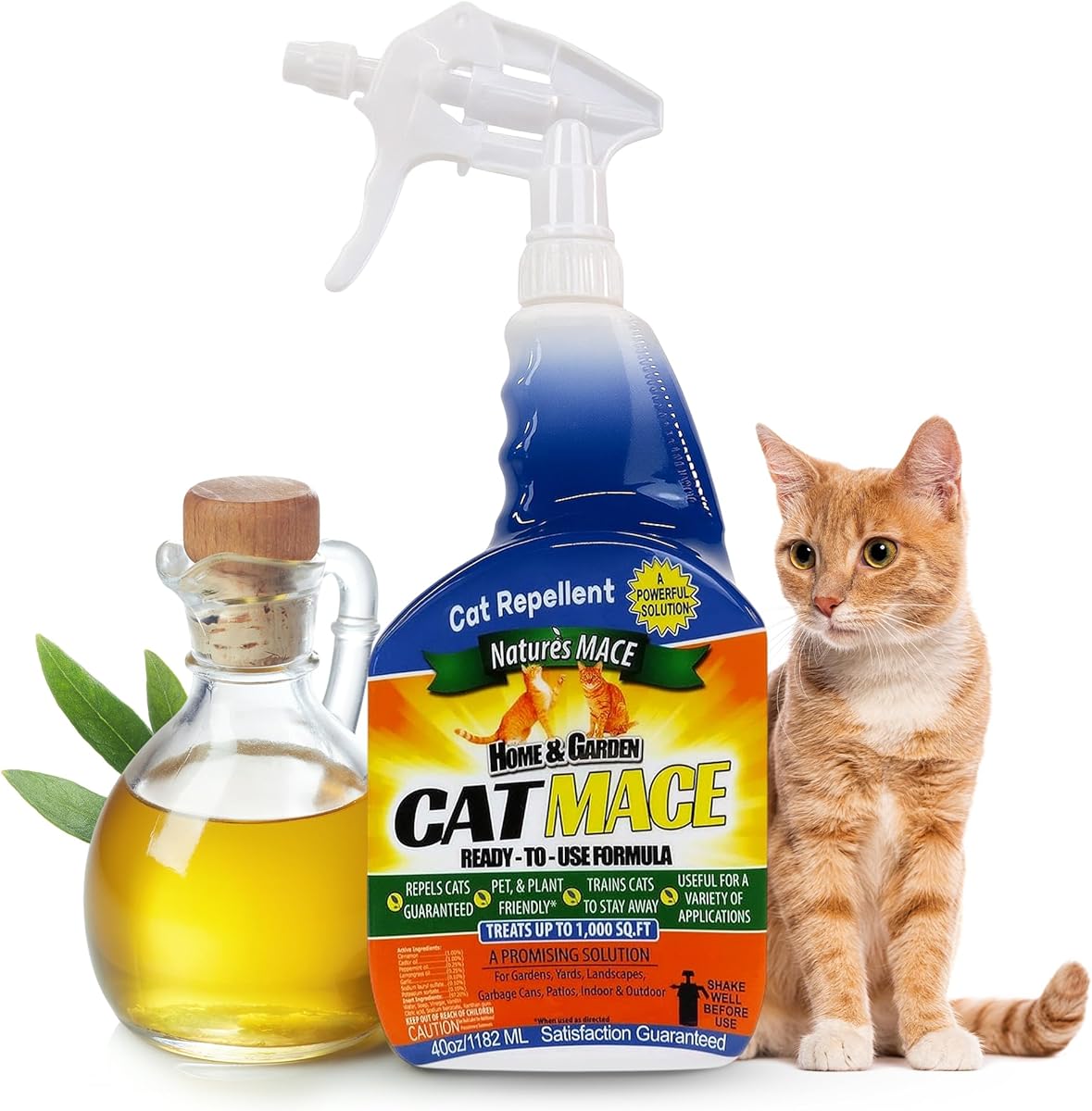
Nature's Mace Cat Mace Cat Repellent 40 oz Spray has a 3.4 rating and offers a targeted liquid option for gardens, patios, decks, walkways, trash bags, beds, and indoor surfaces. It is ready to use, with no mixing or measuring required, and the stated coverage is up to 1,000 square feet.
We may earn a commission when you buy through this link, at no additional cost to you.
The formula uses scent aversion, including peppermint and castor oils, to discourage unwanted behavior. Its application schedule is unusually clear: daily treatment during the first seven to ten days, twice during the following week, and then once per week for maintenance. This consistency may appeal to gardeners who want an established routine focused on specific locations rather than broad passive placement.
The spray also has a surface-compatibility consideration. It is generally described as fabric-safe, but the instructions recommend testing a hidden area to check for staining, particularly before applying it to upholstery, cushions, or other indoor materials. Gardeners should also consider overspray around delicate plants and use only the areas specified by the label.
This is a good pick for targeted training around a known scratching post, garden route, or marking site. It is less convenient for large gardens because the early schedule involves frequent application. Used as a supplement to physical barriers and careful cleanup, it can reinforce the idea that an established area is no longer comfortable or appealing to a cat.
A spray is well suited to a concentrated problem such as a frequently used fence base, porch corner, or furniture leg. Treating those precise locations can be more practical than covering an entire garden unnecessarily.
The stated schedule makes the required commitment clear. Applying the product consistently during the initial training period helps establish a scent boundary, while weekly maintenance can preserve it afterward.
We may earn a commission when you buy through this link, at no additional cost to you.
The most useful garden deterrent matches the behavior, location, and maintenance tolerance of the household. Consider scent versus physical protection, treatment area, exposure to weather, and the need to protect plants, pets, and neighboring animals.
Different cats create different problems. Some dig in mulch, others favor garden edges, and many repeatedly mark the same fence, pot, path, or trash area. A scent-based granule or ball may discourage a cat from lingering, while a spike mat can block a narrow access route. A spray is useful when the unwanted behavior is concentrated in a small, identifiable area. Buyers should observe where cats enter, where soil is disturbed, and where waste or urine appears before choosing a method.
Choose the format that directly addresses the habit rather than treating an entire property by default.
Coverage claims differ substantially among the products in this guide. Nature's Mace granules state up to 1,400 square feet, while the 40-ounce spray states up to 1,000 square feet. Scent balls and packs are distributed by placement instead of a stated square-foot area, and spike mats protect only the surfaces and lines where they are installed. Measure flowerbeds, lawn sections, and access points so the selected product can create a continuous and appropriately sized barrier.
For granular products, confirm whether the container is sufficient for the intended area. For point units, count entry points and follow the manufacturer's spacing guidance.
Scent deterrents range from peppermint-led formulas to blends that include lemon, ginger, lemongrass, garlic, camphor, castor oil, cinnamon, and thyme. Cats respond differently to odors, and a familiar outdoor scent may become less noticeable over time. A product with several plant-based extracts may offer a more complex scent profile, while gardeners should consider how these aromas may be perceived around the home. Placement near a frequently used entrance should always follow label directions and accessibility guidance.
Test a scent deterrent in a small area before treating an entire bed, especially if household pets or children may encounter it.
Sprays and granules often demand more frequent attention than physical mats. The Nature's Mace spray calls for daily use during an initial training period, while its granules suggest renewal every two to three weeks. Scent packs and balls may remain effective for 30 to 60 days, depending on the product and exposure. Spike mats can remain in place until the protected area changes. The most maintainable choice is the one a gardener will actually refresh and inspect before the scent or barrier loses effectiveness.
Choose a schedule that fits the season, the size of the treated area, and the gardener's willingness to monitor it.
Outdoor deterrents face rain, sunlight, irrigation, soil movement, and temperature changes. Scent products may release their aroma more quickly in exposed or wet locations, while granules can disperse or become less noticeable after watering. Spike mats must remain firmly positioned and should not create a trip hazard. Physical strips also need to bridge gaps that a cat could easily squeeze through. For exposed gardens, inspect treatments after major weather events and reposition or replenish them as necessary.
Favor a design that suits the actual exposure of the garden instead of assuming every product will last the same way in every location.
Look for products that state they are suitable around plants, children, or pets when used according to directions. That statement always depends on following the label, keeping products out of reach, and avoiding inappropriate exposure. A physical mat can be safer around food crops than a strongly scented treatment, while an outdoor scent product may need to be positioned where pets cannot chew or roll in it. The essential-oil ball containing camphor and garlic deserves especially careful placement.
Read the full directions and test on a discreet surface when compatibility is uncertain.
No single product resolves every cat problem, especially in a garden with soft soil and several favored routes. A physical mat can protect an exposed bed edge, scent units can discourage a larger area, and prompt cleanup removes the visual and olfactory signal that a location is welcoming. Changing the surface beneath a favorite pot or moving food and water sources can also reduce the reason cats return. A layered approach is usually more realistic than relying on one barrier indefinitely.
Combine methods based on the route, not simply by applying more products everywhere.
Begin by identifying the most important cat routes and damaged areas. Remove feces, rinse urine-marked soil where appropriate, and clear attractive resting or scratching spots before installing a deterrent. Clean surfaces prevent lingering scent signals from undermining a fresh treatment. Place the first barrier at the point where cats commonly enter the garden rather than treating an entire property without a clear strategy.
Apply the selected product exactly as directed. Spread granules evenly, position scent packs or balls at the recommended spacing, cut spike mats to create continuous boundaries, or spray only the targeted surfaces. Keep children and household pets away from wet spray, loose granules, and scent units until the treatment is safely placed. For fabric applications, test a hidden section first, and confirm that outdoor plants and surfaces are compatible with the label.
Maintain the deterrent by checking it regularly rather than waiting for visible damage. Refresh scent products according to their stated intervals, inspect spike mats after wind or heavy rain, and reapply granules when they become sparse or diluted. If activity shifts, move the deterrent to the new route. If a cat continues using the area, improve sanitation, vary the surface, and consider adding a second method instead of applying the same treatment more heavily.
The most effective approach usually combines a physical barrier, scent deterrence, and regular cleanup. A spike mat can block a specific bed edge, while scent products discourage cats from approaching a wider area. Removing waste and urine marks is essential because residual scent can attract cats back to the same location. Persistent problems may also require changing access routes or moving attractive food and shelter.
Only use a granular deterrent if its label specifically identifies the crop or garden application as appropriate. Some products claim that their active ingredients are safe around desirable plants, but the directions still govern use. Apply the stated amount, avoid direct contact with produce if the label calls for it, and wash any edible crops as usual. When uncertain, choose a physical barrier instead.
The spike mats in this guide use soft or rounded plastic spikes intended to create discomfort without injuring skin or paws. They work by discouraging an animal from stepping onto a protected area, so they should be installed in visible access points rather than hidden where a cat could encounter them unexpectedly. Keep household pets away from mats intended specifically for cats, and check the surface regularly for damage.
The replacement schedule depends on the format and conditions. The listed scent packs claim up to 60 days of coverage, while one scent-ball product states 30 to 60 days. The spray calls for daily application during the first seven to ten days and then weekly maintenance. Granules may need renewal every two to three weeks. Rain, heat, direct sunlight, and heavy traffic can shorten practical longevity.
The products vary in composition, so there is no universal answer. Plant-based scent formulations may be gentler, but any repellent can affect bees, wildlife, or sensitive plants if misapplied. Follow the label, avoid open blossoms when the instructions advise it, and do not place scent units where pets may chew them. Physical barriers generally minimize chemical exposure and can be safer around pollinators.
Scent products are better for distributed areas where cats roam, stop, or leave scent markers. Spike mats are better for narrow entry points such as garden borders, raised-bed edges, pot rims, windowsills, and fence tops. In many gardens, using both makes sense: a mat blocks the most obvious route while scent units discourage broader exploration.
The deterrent may have been applied too lightly, placed outside the cat's actual route, diluted by weather, or left in place without consistent follow-up. Existing urine and feces may also continue attracting the cat. Move the treatment to the actual entry point, clean the area thoroughly, repeat applications on schedule, and use a physical barrier if digging continues beyond the scent boundary.
Several products in this guide are labeled for indoor and outdoor use, including scent packs, balls, granules, sprays, and spike mats. Indoor placement should still follow the instructions and avoid food-contact surfaces, open windows, and areas accessible to children or pets. For upholstery, test the product in a hidden location to check for staining or discoloration.
The 12-pack scent repellent is the strongest all-around choice because of its 4.6 rating, plant-based formulation, and stated 60-day coverage. The 6.5-foot spike mat is the most compelling physical option for long garden edges, while the TSLBW 12-piece set provides an affordable modular barrier for pots, small beds, and short boundaries. Each approach works best when matched to a specific cat route.
Prioritize the behavior, surface, and maintenance schedule before choosing. Scent granules and sprays suit areas where a distributed or targeted odor barrier is useful, scent packs and balls are convenient for repeated hotspots, and spike mats are valuable at accessible borders. Clean marked areas, use consistent placement, and combine methods when a single deterrent proves insufficient.
Finally, check the current listing, label directions, customer feedback, and product availability before buying. Formulations, packaging, coverage guidance, and pricing can change, and a product's real-world performance will vary with weather, soil, and cat persistence. Choose the method you can maintain correctly, then reassess its performance before assuming the cat problem is solved.