
GoveeLife WiFi Refrigerator Thermometer
4.4Editor score
Two sensors and gateway
Local audible buzzer alarm
Remote multi-sensor monitoring
A freezer thermometer with app gives you remote visibility into temperatures, timely alerts, and a record of conditions that a basic dial or panel display cannot provide. The right model combines dependable sensing, flexible placement, useful alarm controls, and reliable connectivity while remaining easy to install and maintain.
We compared the ten products in this guide across temperature range, stated accuracy, app notifications, remote monitoring options, alarm behavior, data history, wireless reach, power requirements, and placement flexibility. The list covers hub-based, direct-WiFi, Bluetooth, wired, wireless-probe, long-range, and temperature-and-humidity designs for different spaces.
Each review explains the product's strongest benefits, practical compromises, and ideal use case so you can choose confidently. Ratings and specifications reflect the supplied product information, while current availability and prices can change. Always confirm compatibility, included accessories, and installation needs before purchasing.
4.4Editor score

4.6Editor score

4.6Editor score
As an Amazon Associate we earn from qualifying purchases.
This side-by-side comparison highlights each product's connectivity, sensor package, monitoring capabilities, alert options, and placement approach to help you find the right freezer thermometer for your home, garage, RV, or other monitored space.


The GoveeLife WiFi Refrigerator Thermometer Sensor with Alarm is a strong all-around choice for households that want remote monitoring and an audible warning without subscribing to a service. Its 4.4 rating reflects a generally positive reception, while the supplied specifications show a useful balance of features: two sensors, a gateway, app notifications, email alerts, and an 80dB buzzer. The monitor covers temperatures from -40°F to 158°F with stated accuracy of plus or minus 0.9°F and a two-second response time, making it suitable for freezers, refrigerators, and other spaces where a rapid reading matters.
We may earn a commission when you buy through this link, at no additional cost to you.
The main advantage is its combination of monitoring and response options. You can receive an app notification or email when a reading leaves your chosen range, and the device itself can sound a buzzer when immediate attention is needed. The gateway can support up to ten sensors within a stated range of 230 feet, allowing one setup to cover multiple appliances or rooms. Its magnetic and hanging design, included probe holder, and flexible cable placement also make it easier to position the sensors neatly inside different cabinets without leaving loose wires everywhere.
There are practical trade-offs. The probe design means each sensor has a cable that must pass through the door seal, although the supplied holder and organizer are intended to reduce clutter. You also need to connect the gateway to your network and keep it powered, which adds another piece of equipment compared with a direct-WiFi thermometer. The buzzer must be silenced from the device side or muted according to its settings, so it is not as convenient as an app-controlled hub beep. Even so, these are understandable compromises for a two-sensor package with both local and remote alarms.
This is a good choice for most home users who want app visibility, historical monitoring, and a local alarm without paying for a subscription. It is particularly helpful for monitoring a freezer and refrigerator together, or for keeping an eye on a garage unit without watching it continuously. Choose it over simpler Bluetooth-only thermometers if you want alerts that can reach you when you are away from the appliance. For larger homes or locations where a router is unavailable, a long-range LoRa system may be more suitable.
The combination of app notifications, email messages, and an 80dB local buzzer covers several real-world situations. A family member nearby may respond to the buzzer, while the remote alerts help if you are traveling, working, or away from home.
The gateway's capacity for up to ten sensors makes this package a practical starting point for whole-home monitoring. You can begin with the included sensors and later add compatible devices without relying on separate standalone connections for every location.
We may earn a commission when you buy through this link, at no additional cost to you.
The GoveeLife WiFi Refrigerator Thermometer 2-Pack with Gateway and LCD Display is a feature-rich option for users who care about historical data as much as immediate alerts. It has a 4.4 rating and comes with two temperature sensors, a WiFi gateway, and an LCD display for reading the current value directly. The stated measurement range is -40°F to 158°F, with plus or minus 0.9°F accuracy and a two-second refresh. That makes it broadly useful for standard refrigerators, freezers, fish tanks, hot tubs, and other environments listed in the product information.
We may earn a commission when you buy through this link, at no additional cost to you.
Its history features distinguish it from many simpler monitors. The app supports online temperature graphs and export of data recorded over the past two years without a subscription fee. That is valuable when you want to investigate compressor cycles, compare different shelves, or establish whether a recurring temperature problem is seasonal. Alert delays can be set from one to ten minutes, which helps prevent a short interruption from creating an unnecessary alarm while still catching conditions that remain outside the desired range.
The most important limitation is that the sensor device itself does not sound an alarm. Remote alarm functionality depends on the WiFi gateway and the app, so this is not the best choice if you need a local siren inside the freezer or refrigerator. The product also uses 2.4GHz WiFi only, and its WiFi behavior depends on the included gateway. You must account for the need to keep that gateway connected and powered, and the supplied information specifically associates the H5108 sensor with the H5151 gateway.
This thermometer is best for a data-minded homeowner, small laboratory, or shared family kitchen where historical graphs help reveal changing conditions. It also suits users who want app monitoring but do not need a separate audible siren at the appliance. If you need direct local sound, the first GoveeLife option offers a built-in 80dB buzzer. If your priority is humidity as well as temperature, consider one of the dedicated hygrometer kits later in this guide.
Long-term graph and export access can reveal patterns that a current temperature reading cannot. It is especially useful for diagnosing ventilation, defrost, compressor, or door-closure issues across days and weeks.
Configurable delay periods give normal brief door openings a chance to pass without triggering notifications. Low battery warnings further reduce the chance that the system becomes silent unexpectedly.
We may earn a commission when you buy through this link, at no additional cost to you.
The MOCREO WiFi Thermometer Freezer Alarm is a flexible monitoring system built around two remote probe sensors, an H6Lite hub, and app-based control. Its 4.4 rating is supported by a broad feature set, including app push notifications, email alerts, a 90dB hub alarm, offline and low-battery warnings, and an anti-false-alarm function. The sensors measure from -40°F to 158°F with stated accuracy of plus or minus 0.9°F, and the hub can connect to as many as 30 compatible BLE sensors within a stated 230-foot range.
We may earn a commission when you buy through this link, at no additional cost to you.
One of its strongest features is the ability to dismiss the hub's beep from the Smart App. That saves you from physically reaching the hub after a notification, a particularly welcome convenience when the hub is in a garage, basement, or another inconvenient location. The system's monitoring extends beyond ordinary kitchens, with the supplied information identifying applications including RV interiors, greenhouses, nurseries, fish tanks, hot tubs, commercial spaces, and laboratories. Online graphs and CSV export are available for two years without a subscription.
The setup is not quite as streamlined as a single direct-WiFi sensor. Each of the two wireless temperature probes uses three replaceable AAA batteries, and the stated battery life is up to two years. You also need to position and connect the central hub. The probes have thin cables designed to pass through refrigerator seals, but cable management still matters if appearance is a priority. The included magnetic backing, mounting plate, clips, and organizer help address that concern.
This MOCREO system is well suited to users who want both remote control and a loud hub alert while retaining room to expand. It is a compelling choice for a home with several monitored environments, an RV owner, or a small commercial operation that wants records without a recurring monitoring fee. Those wanting the longest wireless reach and the largest hub capacity should compare it with the H5Pro model, while buyers seeking the simplest installation may prefer a direct-WiFi design.
App-controlled hub muting reduces the need to walk to the device every time an alert sounds. This is especially helpful when the hub is mounted in a garage, utility room, or other less convenient location.
Support for up to 30 compatible sensors makes the hub useful beyond the included pair. Households can monitor several appliances or environmental zones from a single app while retaining centralized alerts and history.
We may earn a commission when you buy through this link, at no additional cost to you.
The MOCREO WiFi Remote Thermometer stands out as the most capable choice for users who need monitoring across a large property. It carries a 4.6 rating and combines an H5Pro digital hub with two LS1 wireless temperature sensors. The hub can connect to up to 100 sensors at an open-air range stated as 1,640 feet, or approximately one-third of a mile. That reach makes the system relevant to a home, farm, greenhouse, garage, restaurant, office, pet shelter, RV, or other location where a normal short-range sensor may not connect reliably.
We may earn a commission when you buy through this link, at no additional cost to you.
The hub is more versatile than a typical basic display. It connects through Ethernet or 2.4GHz WiFi, presents current readings on an LCD, and supplies information such as trends, alarms, a clock, weather, and calendar updates. App notifications, email alerts, and a 95dB hub beep give you several ways to respond. The LS1 sensors have IP66 splash-proof protection and a stated range of -4°F to 131°F, with plus or minus 0.9°F accuracy. Two years of online charts and CSV export are available without a subscription.
The primary limitation is the operating range. A minimum of -4°F makes this less appropriate for deep-freezer use than models rated down to -40°F. Signal performance can also decline inside fully enclosed metal containers, including commercial walk-in coolers or thick freezer doors. The sensors use replaceable AAA batteries, with up to two years stated when operated above 32°F. The system is more involved than a single direct-WiFi sensor, but its scale is precisely what makes it appropriate for a larger monitoring project.
Choose this model when one-third-mile reach, centralized capacity, or wired hub connectivity matters. It is particularly attractive for monitoring a primary residence and a detached garage, greenhouse, rental property, or business from a centralized location. If the monitored freezer routinely operates far below 0°F, select a deep-freezer-rated alternative instead. For smaller homes that do not need extreme reach, the less complex MOCREO H6Lite system may be easier to deploy.
The one-third-mile open-air range provides more freedom than a standard WiFi sensor, allowing the hub and sensors to be separated by buildings, floors, or outdoor distance. Ethernet support also gives users an alternative when WiFi coverage is inconvenient.
The LCD hub combines live readings with historical trends, alarm status, and other dashboard information. Supporting up to 100 sensors makes it suitable for ambitious whole-site monitoring rather than a single appliance.
We may earn a commission when you buy through this link, at no additional cost to you.
The WiFi Freezer Thermometer with App Alarm offers a notably clean installation because its two sensors are fully wireless and do not require probe cables. It has a 3.8 rating, the lowest among the products in this guide, but its core features are appealing to anyone who dislikes routing wires through a refrigerator seal. The sensors monitor temperature and humidity, connect over 2.4GHz WiFi, and send app alerts when readings leave your configured range.
We may earn a commission when you buy through this link, at no additional cost to you.
The package supports up to nine sensors and a stated range of 492 feet, allowing the system to cover a garage, basement, or separate cold-storage appliance. History graphs and CSV export are available for up to one year without a subscription. Each sensor has IP65 protection, while the included freeze-resistant AAA batteries are advertised as lasting up to two years. The absence of a probe cable also helps prevent the door from being held slightly open and reduces frost buildup around the gasket.
The specifications are less ambitious than those of many premium alternatives. Temperature accuracy is stated at plus or minus 1.8°F, and the lowest measurable temperature is -4°F, equivalent to -20°C. The product should therefore be considered more suitable for ordinary refrigerators, freezers, and cold storage than for extremely deep-freeze environments. It also uses freeze-resistant batteries, which must be replaced with the same type when they eventually run down. The lower rating and less precise sensing make it less attractive when accuracy is the primary requirement.
This thermometer is a practical pick for users who prioritize wireless freedom, humidity monitoring, and simple setup over laboratory-style precision. It may be particularly helpful in a garage or basement where a wired probe would be inconvenient. For critical deep-freezer monitoring, a model with a -40°F minimum and tighter stated accuracy would be a better choice. It can also work as a secondary system for locations that do not require the same level of precision as the main food-storage appliance.
Because the sensors contain no probe cable, they can be placed inside without creating a wire obstruction or needing a cable to pass through the door gasket. This supports cleaner placement and can reduce accidental cold-air leakage.
Tracking humidity alongside temperature helps reveal condensation, moisture, or poorly balanced storage conditions. The information can be more useful than a temperature reading alone when diagnosing a damp cold-storage area.
We may earn a commission when you buy through this link, at no additional cost to you.
The YoLink Freezer Temperature Sensor Kit is a premium three-sensor system built around long-range, low-power LoRa communication rather than ordinary WiFi. It has a 4.6 rating and includes one hub plus three temperature sensors. The supplied information states a monitoring distance of up to 2,034 feet in open air, making it one of the strongest options for locations where WiFi is unavailable, weak, or inconvenient. The sensors can also work across floors and in outdoor or difficult-to-reach spaces.
We may earn a commission when you buy through this link, at no additional cost to you.
Temperature accuracy is a defining strength. Within 32°F to 129°F, stated accuracy is plus or minus 0.36°F; from -20°F to 32°F, it is plus or minus 0.72°F. The overall measuring range is -4°F to 122°F. Users can set custom thresholds and receive text, email, or push notifications, with Critical Alerts available for Apple users and similar options for Android. IFTTT and Alexa integration adds smart-home value, although triggering full Alexa routines is not supported.
The package is well suited to reliable long-term deployment. Each sensor uses two AA batteries and has a stated lifespan of up to five years, depending on usage and environmental conditions. Low battery alerts help you replace cells before monitoring stops. One trade-off is that this kit does not measure humidity, so it is less informative in applications where moisture is important. The free SMS allocation is also limited, with the supplied information allowing five messages per device plus five and 15 free SMS per month for a hub and one sensor.
Choose this kit when accuracy, battery life, and long wireless reach are priorities. It is especially suitable for a home with a detached garage, a greenhouse, an RV, a barn, or several appliances spread across a large property. It may also appeal to users who want to avoid placing a router near every monitored location. If humidity tracking is essential, the one-sensor YoLink hygrometer alternative offers that capability, while a direct-WiFi model is simpler when long-range communication is unnecessary.
The stated accuracy is tighter than that of most competing systems in this guide. That makes the kit attractive for users who want dependable readings, careful threshold setting, and a detailed record of changing freezer conditions.
LoRa communication lets sensors operate without relying on the same WiFi network as the hub, while the five-year stated battery life reduces routine maintenance. This combination is useful across larger properties or locations with weak conventional wireless coverage.
We may earn a commission when you buy through this link, at no additional cost to you.
The GoveeLife Bluetooth Refrigerator Thermometer is a useful entry point for anyone who wants app-based readings but does not yet want to add a hub. It has a 4.4 rating and includes one H5108 sensor with an LCD display. The sensor operates over Bluetooth and can show the current temperature directly while also providing proximity alerts through the app. Its stated range is -40°F to 158°F, with plus or minus 0.9°F accuracy and a two-second refresh.
We may earn a commission when you buy through this link, at no additional cost to you.
Installation is straightforward. The slim probe, magnetic body, lanyard, and included holder allow flexible placement in a refrigerator, freezer, fish tank, hot tub, or other compatible environment. The product supports configurable temperature thresholds, an alert delay of one to ten minutes, and low battery reminders. It also offers two years of data storage and graph viewing, according to the supplied information, although remote functionality depends on the connection method.
The key limitation is that a gateway is required for genuine remote monitoring. Without one, Bluetooth range is stated as 197 feet, and the app must remain active in the background to provide proximity alerts. The sensor itself does not sound an alarm. Buyers who need notifications from outside the home or a dedicated audible warning should choose one of the WiFi gateway systems instead. The product listing also spells out compatible gateway options for enabling remote alarms.
This thermometer makes the most sense for a single appliance in a home where the phone is normally nearby. It may also serve as a useful Bluetooth sensor to pair with an existing compatible gateway later. Avoid choosing it for a garage, basement, cabin, or other remote location unless you are prepared to add the appropriate gateway. In those circumstances, a LoRa-based system or a long-range hub can provide a more dependable connection.
Standalone Bluetooth operation simplifies the initial setup and avoids another powered network device. It is a sensible option when proximity monitoring is sufficient and the phone will usually be close to the appliance.
The sensor can later connect with a compatible gateway to gain remote alarm capabilities. That makes the one-pack attractive for gradual expansion rather than requiring every monitoring location to be configured at once.
We may earn a commission when you buy through this link, at no additional cost to you.
The AcuRite Digital Wireless Fridge and Freezer Thermometer is included because it provides a different kind of solution: immediate local visibility without an app, WiFi connection, hub, or subscription. It has a 4.5 rating and includes one refrigerator thermometer and one freezer thermometer that transmit readings to a digital display. The display also tracks maximum and minimum temperatures, helping you see whether conditions moved beyond a brief point in time.
We may earn a commission when you buy through this link, at no additional cost to you.
The system focuses on straightforward household and restaurant use. Customizable temperature alarms warn about spikes that may indicate an open door or appliance problem. Magnetic backing makes it easy to attach the display to the refrigerator, while a keyhole and foldout stand offer wall and countertop placement. Silicone sensor straps can attach with the included suction cups or wrap around a wire shelf, giving you more flexibility when magnetic attachment is not possible.
Its most obvious limitation is that it does not meet the core app-based requirement of this roundup. There are no smartphone notifications, remote access, cloud history, or email alerts. It is therefore best for someone who wants a dependable indoor display rather than a smart monitoring system. Another limitation is the absence of humidity readings, which can be useful in some food-storage and environmental applications.
Choose AcuRite when you need clear current, high, and low readings directly in the kitchen and do not need to know the temperature while away. It may be especially suitable for restaurants where staff can regularly view the display and respond to an alarm. If remote awareness is important, choose one of the GoveeLife, MOCREO, or YoLink systems. If you want a simpler digital thermometer with a temperature alarm but no app, this model fills a genuine niche in the category.
The digital display provides current conditions plus maximum and minimum readings without requiring anyone to open a phone. This makes abnormal swings easy for household members or restaurant staff to notice.
Magnet, keyhole, stand, suction cup, and silicone strap options let you adapt the display and remote sensors to the appliance. That flexibility is useful in kitchens with unusual shelving or refrigerators made from materials that do not suit magnets.
We may earn a commission when you buy through this link, at no additional cost to you.
The MOCREO WiFi Freezer Alarm Refrigerator Thermometer offers a direct route from the sensor to your home network without a separate hub. It has a 4.5 rating and connects to 2.4GHz WiFi directly, sending app push notifications and email alerts when a configured threshold is crossed. The device itself flashes red and current units can beep, giving you local and remote response options without maintaining a central gateway.
We may earn a commission when you buy through this link, at no additional cost to you.
Its temperature performance is impressive. The stated range extends from -40°F to 257°F with plus or minus 0.9°F accuracy, so it can cover deep freezers as well as much warmer environments. You can calibrate the reading in the app against another thermometer to improve alignment with your own equipment. The slim 4.9-foot probe can pass through a refrigerator or freezer gasket and is also suitable for reptile enclosures and wine coolers. Up to two years of history can be viewed and exported to CSV without a subscription.
The main installation consideration is continuous power. The NS1 uses USB-C, so a wall outlet must be within reach of the probe cable, and a USB power adapter is not included. That means the appliance needs access to a nearby outlet or an existing adapter. The system also joins 2.4GHz networks only, which can be an obstacle in a garage, basement, or cabin where the router does not reach. A power or WiFi outage can therefore limit the notifications even though temperature monitoring continues locally.
This is an excellent choice for a standard kitchen freezer or refrigerator where a nearby outlet and 2.4GHz network are available. It avoids the additional hub required by several alternatives, while providing app, email, and local alerts. Choose a hub-based or LoRa system for a remote property or a location without strong WiFi. Users who prefer not to manage a cable at all should instead consider the fully wireless sensor models in this guide.
Direct 2.4GHz WiFi connection removes the hub, its power supply, and its network link from the setup. This reduces the number of components and can simplify installation in an ordinary kitchen.
The broad stated range covers deep-freezer temperatures and substantially warmer spaces than most competing products. Calibration controls also help users align the displayed value with a reference thermometer.
We may earn a commission when you buy through this link, at no additional cost to you.
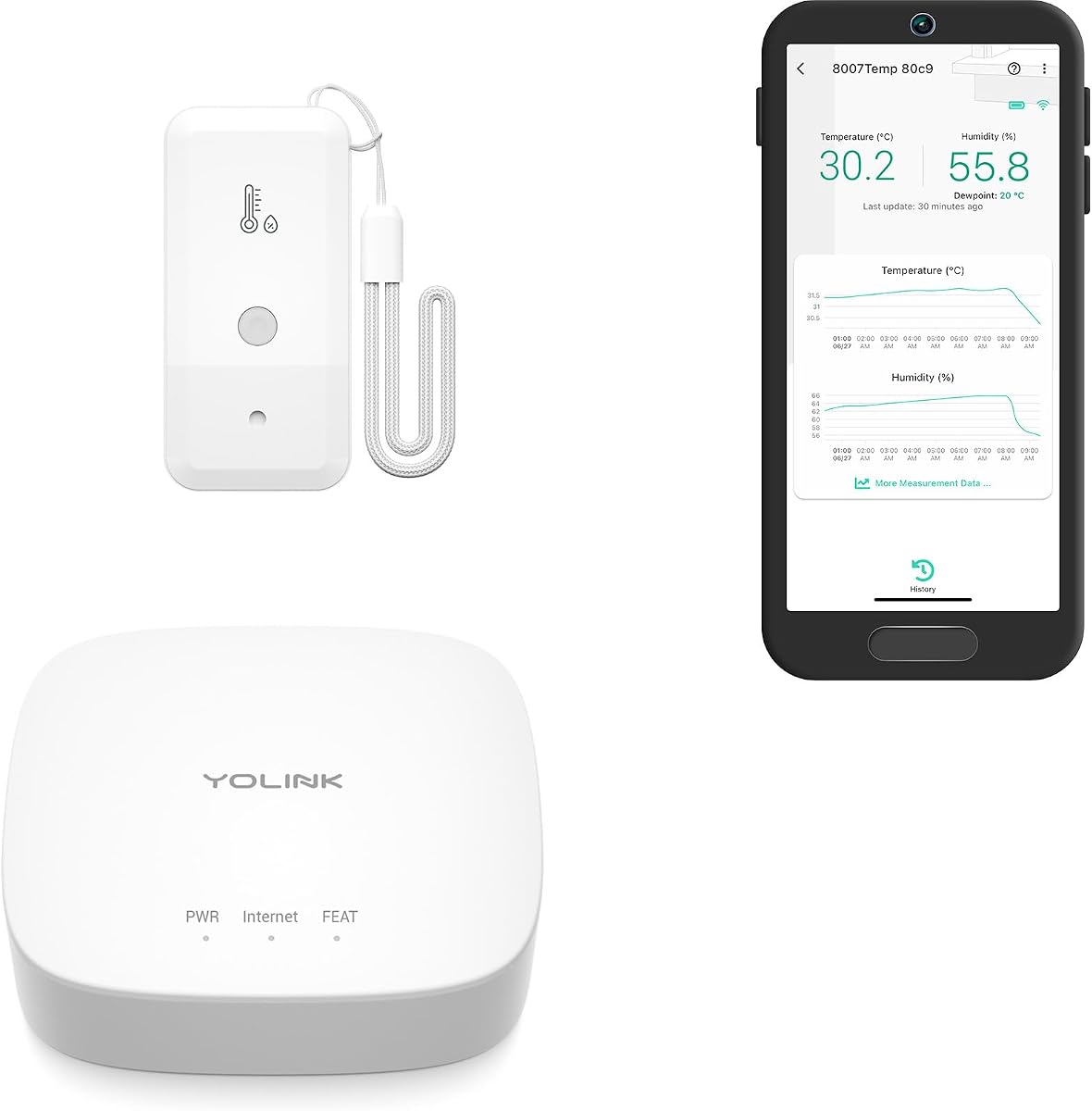
The YoLink Freezer Thermometer Hygrometer Kit combines temperature accuracy with humidity monitoring in a compact one-sensor package. It has a 4.7 rating, the highest listed rating among these products, and includes one sensor plus one hub. Temperature accuracy is stated at plus or minus 0.36°F from 32°F to 129°F and plus or minus 0.72°F from -20°F to 32°F, while the total range extends from -4°F to 122°F. Humidity readings are updated alongside the temperature data in the YoLink app.
We may earn a commission when you buy through this link, at no additional cost to you.
The system uses LoRa-based communication rather than relying on your home WiFi. Its stated open-air range is up to 2,034 feet, allowing placement in a freezer, greenhouse, barn, bedroom, chicken coop, dog kennel, plant nursery, child's nursery, or other location that may be distant from a router. Custom thresholds can trigger text, email, or push alerts. Apple users can use Critical Alerts, while Android users have comparable options, and IFTTT and Alexa temperature queries are supported.
The one-sensor format is the central limitation. If you need to watch a refrigerator and freezer separately, or several spaces across a home, the three-sensor YoLink kit offers more immediate coverage. The product also does not specify a local audible alarm, so users should confirm that remote notifications meet their needs. Free SMS is limited, with the supplied information specifying five messages per device plus five and 15 free messages monthly for a hub and one sensor.
Choose this model for a single temperature-and-humidity location where precise temperature data, long wireless reach, and low-maintenance battery operation are priorities. It is especially attractive for a greenhouse, nursery, pet area, or cold-storage room where moisture context is useful. For multiple appliances, select the three-sensor temperature-only kit or a multi-sensor hub system. If you need a built-in alarm at the appliance, choose a product whose specifications explicitly include one.
Humidity monitoring adds useful context that a temperature-only sensor cannot provide. It can help identify condensation, poor ventilation, or moisture conditions that deserve attention in a nursery, greenhouse, or enclosed storage area.
The sensor combines a tight stated temperature tolerance with a 2,034-foot open-air LoRa range. It can therefore deliver reliable remote readings in locations where ordinary WiFi coverage would be difficult.
We may earn a commission when you buy through this link, at no additional cost to you.
The right freezer thermometer with app depends on your appliance, connection, alert requirements, and desired level of precision. Use the following factors to narrow the field before comparing included accessories and final features.
Begin with the lowest temperature your appliance actually reaches. Standard freezers often remain comfortably above deep-freezer temperatures, while commercial units and dedicated deep-freezers may require a sensor rated down to -40°F. Stated accuracy also matters: several products provide plus or minus 0.9°F, while premium options reach plus or minus 0.36°F in part of their range. A tighter tolerance is helpful when setting narrow alarm limits, comparing shelves, or investigating a suspected equipment issue.
Choose a model whose complete range covers your environment and whose accuracy suits your monitoring needs. Do not rely on a narrow or unclear range when temperatures may approach the sensor's stated limits.
Decide whether the sensor must send alerts from a garage, basement, RV, greenhouse, or other detached space. Direct 2.4GHz WiFi systems are simple when a strong network is already nearby. Hub-based models can provide longer reach and a local display, while LoRa systems are designed to operate independently of ordinary WiFi. Bluetooth-only products are mainly suitable for close-range use unless a compatible gateway is added.
Match the connection method to the physical distance and network layout. For remote or multi-building monitoring, favor a dedicated hub or long-range LoRa system rather than assuming a standard WiFi connection will remain reliable.
Useful alerts should reach you in more than one way. App push notifications are convenient, email provides a visible record, and a hub beep can warn someone near the appliance. SMS and Critical Alerts may be valuable for high-priority conditions. Configurable alarm delays are equally important because normal door opening can briefly move the reading. Look for a system that lets you choose a suitable delay and adjust the acceptable range.
Prioritize remote notifications if you are often away from the freezer. If someone is normally nearby, prioritize a local audible alarm, but confirm whether it can be muted from the app or must be silenced at the device.
Temperature is only one part of cold-storage conditions. Humidity readings can help reveal condensation, dampness, or poor airflow, especially in greenhouses, nurseries, wine coolers, and pet enclosures. A dedicated hygrometer may also help you understand why a freezer feels unusually moist or why frost accumulates faster than expected. Temperature-only models can be sufficient for a straightforward kitchen freezer, so humidity is an optional but useful differentiator.
Add humidity monitoring when moisture would affect product quality or equipment. For a basic food-storage alarm, prioritize temperature range, accuracy, connectivity, and dependable notifications instead.
Power requirements affect reliability, maintenance, and installation. Continuous USB power removes the need to monitor batteries but requires a nearby outlet and a suitable cable or adapter. Replaceable-battery systems are easier to position in remote locations and can last for years, although they eventually need attention. Low-battery warnings are valuable in either case because a silent monitor provides no protection. Note that claimed battery life can vary with temperature, update frequency, and use.
Choose continuous power when an outlet is convenient and the appliance stays in place. Choose long-life replaceable batteries for remote locations or when you want minimal dependence on wall outlets. Always confirm which batteries are required and whether special cold-resistant cells are recommended.
Wired probe sensors can sit precisely beside food, beverages, or specimens and tend to deliver very consistent readings. They do require careful routing through the door seal. Fully wireless sensors avoid cables and simplify placement, but they may be larger and their accuracy can be lower. Magnetic backs, lanyards, clips, holders, and mounting plates are all worth examining because they determine how securely each sensor can be positioned.
Choose a probe model when precision placement matters and cable management is acceptable. Choose a wireless model when clean installation, portability, or monitoring several remote spaces matters more. Check the included mounting hardware before deciding.
Historical graphs can reveal compressor cycles, defrost patterns, repeated door-opening events, and gradual temperature drift. CSV export makes the data easier to archive or analyze. Some products provide one or two years of history without a subscription, while others advertise the remote app without a recurring fee but provide a less detailed export window. Confirm both the storage period and the export format before buying if documentation is important to your workflow.
Look for a system with at least the history window you need and no ongoing subscription for essential alerts. Longer history is helpful for trend analysis, but reliable real-time notifications should remain the first priority.
Capacity matters when you plan to monitor more than one appliance. Some gateways support a small number of sensors, while others accommodate dozens. A larger-capacity hub simplifies centralized management, alerts, and history. IFTTT and Alexa compatibility can add value if your monitoring system is part of a broader smart-home setup, although voice temperature queries and routine triggering are not always equivalent features.
Estimate how many locations you need now and how many you may add later. Choose enough hub capacity for realistic expansion, and verify that the integrations you want actually support the intended functions.
Begin by identifying the appliance's normal operating range, the temperature threshold that should trigger an alert, and the delay period needed for brief door openings. Install the app, create the appropriate account, and connect the gateway or sensor according to its instructions. For direct-WiFi products, confirm that the network uses 2.4GHz and is within reliable range. For hub or LoRa systems, position the hub before mounting sensors so the wireless link remains stable.
Place each sensor where it represents the space you want to monitor. Probe sensors should sit near the product area without touching walls, heating elements, freezer walls, or vents that can distort the reading. Secure cables so they do not interfere with the gasket. Wireless sensors need enough clearance for their radio signal, and the MOCREO long-range system should not be placed inside fully enclosed metal containers. Record the initial reading and compare it with another thermometer if you want greater confidence.
Test the system by opening the door or temporarily moving the sensor beyond your configured threshold. Confirm that the app notification, email, SMS, or local alarm arrives and verify the delay behaves as intended. Check the graph after normal use to learn how compressor and defrost cycles affect the reading. Replace batteries when prompted, keep sensors clean, and ensure the hub remains powered and connected. Periodically review thresholds so seasonal changes or rearranged food do not produce unnecessary alerts.
It depends on the model. Some sensors connect directly to 2.4GHz WiFi, while others require a hub to provide remote access, a display, or a local alarm. Bluetooth sensors may work near your phone without a gateway but generally need one for dependable remote notifications. Check the package contents and compatibility requirements before buying.
A system that includes power-outage or hub-offline alerts can notify you when its own gateway loses power or disconnects from the network. A battery-powered sensor may continue recording temperature, but a direct-WiFi product that loses power may also lose its network connection. Remote properties should therefore have a reliable gateway and alert path.
Choose a sensor whose stated minimum is comfortably below the lowest temperature your appliance may reach. Models rated to -40°F offer more margin than those limited to -4°F, while some systems only cover temperatures above freezing. Also consider the accuracy specification at your normal operating temperature rather than looking only at the maximum range.
The products included in this guide advertise remote monitoring without a subscription fee, although feature limits can apply. YoLink, for example, includes a limited monthly SMS allowance. Some provide one year of export while others offer two years, so compare the history and communication features you actually need before purchasing.
Place the probe beside the items you want to monitor while keeping it away from the freezer wall, vents, heating elements, and the very top where defrost cycles can cause larger swings. Secure the cable so it does not hold the door open. Allow the sensor to stabilize and compare its reading with a second thermometer before setting precise alarm limits.
Yes, if the product supports multiple sensors. Some gateways accept two sensors, while others support 10, 30, 100, or more compatible devices depending on the model and protocol. Check whether expansion sensors are included, sold separately, or must use a specific hub.
WiFi is convenient when a strong 2.4GHz network reaches the sensor. Bluetooth works well at close range but may require a gateway for remote alerts. LoRa provides long-range, low-power communication without relying on your home WiFi, making it useful for detached buildings and large properties.
It may, but metal can weaken the signal. The long-range MOCREO system specifically warns against fully enclosed metal containers because they can interfere with wireless communication. For reliable results, keep the hub in an open location, test the connection before finalizing placement, and use a longer-range system when the appliance is in a basement, garage, or metal enclosure.
The MOCREO WiFi Remote Thermometer is the strongest all-around recommendation for large properties because it combines long wireless reach, a capable hub, multiple sensors, flexible connectivity, and comprehensive alerts. The GoveeLife WiFi Refrigerator Thermometer offers the best balance of value, two included sensors, remote monitoring, and a local buzzer, while the three-sensor YoLink kit stands out for precision, battery life, and LoRa communication.
Your priorities should determine the remaining choice. Pick a direct-WiFi product for the simplest setup, a Bluetooth sensor for close-range use without a hub, a temperature-and-humidity model when moisture matters, or a wired probe when exact placement and stable readings are essential. Before buying, verify the temperature minimum, 2.4GHz or gateway requirements, included mounting hardware, alert delay behavior, and data export period.
Finally, check current availability, package contents, compatibility, and prices at the time of purchase, because configurations and offers can change. The most effective monitor is not necessarily the one with the most features, but the one whose range, connectivity, power method, and alerts fit the appliance and the way you need to be notified.