
G.SKILL Flare X5 32GB DDR5-6000 CL36
4.7Editor score
32GB dual-module capacity
6000MT/s rated speed
EXPO and XMP 3.0
Compare 10 Gskill DDR5 RAM kits by capacity, speed, latency, overclocking profiles, RGB lighting, and platform fit to find the right gaming or productivity
Gskill DDR5 RAM is a strong choice for builders seeking fast, modern desktop memory for gaming, content creation, and heavy multitasking. The right kit depends on motherboard compatibility, processor support, desired capacity, latency, and whether a coordinated RGB design is important to the finished system.
This guide compares ten 32GB and 64GB Gskill kits based on their stated 6000MT/s speed, timings, voltage, EXPO and XMP 3.0 profiles, lighting, and listed platform support. It distinguishes AMD-focused and cross-platform options while emphasizing that reaching rated performance generally requires compatible hardware and BIOS configuration.
The picks show which models suit budget-conscious gaming, performance-focused systems, large-capacity workstations, and builders seeking coordinated RGB. Ratings reflect the supplied customer feedback, while specifications and compatibility remain subject to current listings, qualified vendor lists, hardware revisions, and BIOS updates; prices change frequently.
4.7Editor score

4.8Editor score

4.7Editor score
The table below compares all ten kits by capacity, rated transfer speed, primary memory timings, profile support, and physical design. It provides a quick way to separate the understated Flare X5 models from RGB-equipped Trident Z5 variants and identify options designed specifically for AMD or both major desktop platforms.


The G.SKILL Flare X5 32GB kit is a balanced option for new desktop builds, earning a 4.7 customer rating in the supplied data. It combines a 6000MT/s target with CL36-36-36-96 timings and supports both AMD EXPO and Intel XMP 3.0, allowing buyers to use the same general kit family across both processor ecosystems.
We may earn a commission when you buy through this link, at no additional cost to you.
Its two-module, 32GB configuration is well suited to modern gaming, general productivity, streaming, and most mainstream applications. The understated matte-black design avoids adding illuminated elements to the chassis, while the listed 1.35V profile and inclusion of a JEDEC default profile give the system a sensible baseline when an overclocking profile is not enabled.
The main qualification is that 6000MT/s is a rated overclocking target rather than a guarantee at default BIOS settings. Achieving it depends on the CPU, motherboard, BIOS version, and memory controller. Users should consult the G.SKILL qualified vendor list and configurator, then update the board firmware and test stability after enabling the appropriate profile.
This is an attractive general-purpose recommendation for a 32GB gaming system or a mixed AMD-and-Intel build project. It is less compelling for workstation workloads that routinely consume more than 32GB, but within that category, its platform flexibility, clean appearance, and straightforward performance profile make it a particularly sensible starting point.
Including both AMD EXPO and Intel XMP 3.0 profiles makes this kit especially convenient for builders comparing platforms. The active profile still needs BIOS support, so processor and motherboard compatibility should be verified before purchase.
Two matched 16GB modules provide a conventional dual-channel arrangement while leaving more headroom than entry-level 16GB systems. This capacity is well aligned with modern gaming PCs, everyday office use, and applications that benefit from faster memory.
We may earn a commission when you buy through this link, at no additional cost to you.
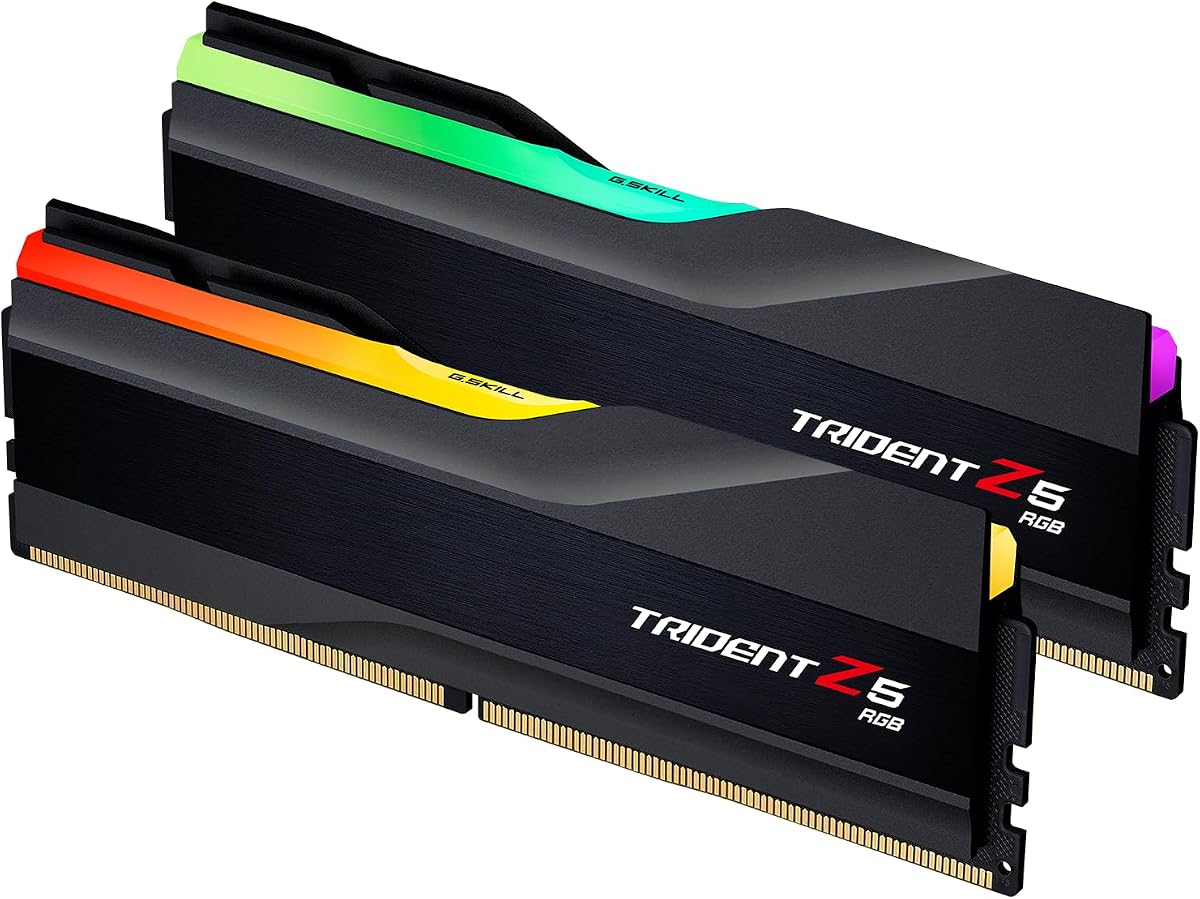
The G.SKILL Trident Z5 RGB 32GB kit combines a 6000MT/s performance target with illuminated styling and earns a 4.7 rating. Its Intel XMP 3.0 and AMD EXPO support makes it suitable for either platform, provided the selected motherboard and processor can run the rated profile.
We may earn a commission when you buy through this link, at no additional cost to you.
The CL36-36-36-96 configuration at 1.35V closely parallels other well-balanced 6000MT/s kits in this list. It offers a modern gaming specification without the tighter first-number latency of the Trident Z5 Neo CL30 and Royal Neo CL28 alternatives, making it easier to compare when visual design matters as much as raw latency.
RGB lighting is the main differentiator, but it also means the modules may not suit a deliberately minimalist or all-black build that avoids illuminated components. As with every rated 6000MT/s kit here, users should expect the memory to begin at the JEDEC default under standard BIOS settings and reach the advertised target only after enabling the proper profile.
This is a strong recommendation for a gaming PC where coordinated lighting is part of the intended design. It also works for users who want cross-platform flexibility and a familiar 32GB capacity. Buyers prioritizing lower latency or greater memory capacity should examine the CL30 or 64GB alternatives instead.
The Trident Z5 RGB treatment adds visible illumination to a matched pair of modules. It is a compelling option for glass-sided cases and systems that use lighting to unify the motherboard, case fans, cooler, and graphics card.
The 6000MT/s target is a common high-performance DDR5 objective for modern desktop systems. Its practical result remains dependent on memory-controller quality, motherboard layout, firmware, and the stability of the installed processor.
We may earn a commission when you buy through this link, at no additional cost to you.
The Trident Z5 Neo RGB 32GB CL30 is the strongest latency-focused option in this group, with a 4.8 rating, the highest among the supplied products. Its 6000MT/s target and 30-38-38-96 timings are aimed particularly at AMD systems using the EXPO profile.
We may earn a commission when you buy through this link, at no additional cost to you.
Compared with the CL36 kits, the first timing number is tighter, which is meaningful for buyers who pay close attention to memory latency. RGB lighting adds visual appeal, while two 16GB modules deliver a familiar and broadly useful 32GB capacity for gaming, streaming, productivity, and mixed workloads.
This profile is specifically designed for AMD EXPO, so the kit is not the natural choice for an Intel system that depends on XMP 3.0. Even on a listed AMD platform, reaching 6000MT/s with the tighter timings may require more favorable memory-controller behavior and careful motherboard qualification.
The Trident Z5 Neo RGB CL30 is a compelling recommendation for an AMD gaming build that values both aesthetics and lower memory latency. It may be overkill for basic office work, but for a performance-oriented system it provides a clear specification advantage over otherwise similar 6000MT/s CL36 options.
The CL30 primary timing differentiates this module from the more common CL36 choices in the roundup. Lower latency can complement a high-bandwidth DDR5 configuration in workloads sensitive to memory response.
Its 4.8 customer rating is the strongest figure among the ten supplied kits. Combined with a 32GB capacity and RGB design, that makes it an attractive all-around choice for its intended AMD platform.
We may earn a commission when you buy through this link, at no additional cost to you.
The G.SKILL Flare X5 32GB CL30 delivers the same 6000MT/s and 30-38-38-96 specification as the Trident Z5 Neo RGB model, but in a simpler unlit design. Its 4.7 rating reflects solid customer reception, and the kit is particularly well suited to AMD builders who prioritize latency over coordinated lighting.
We may earn a commission when you buy through this link, at no additional cost to you.
The matte-black modules fit easily into understated systems, dark cases, and professional workstation aesthetics. With two matched 16GB modules and an AMD EXPO profile, the kit offers a focused route to a modern 32GB gaming configuration without requiring external RGB software or lighting effects.
The absence of an Intel XMP 3.0 profile narrows its appeal compared with cross-platform Flare X5 kits. Users should also recognize that the tighter CL30 setting is not a guarantee of perfect stability at 6000MT/s. Motherboard qualification, firmware maturity, and the processor's integrated memory controller all influence the result.
This Flare X5 is a strong recommendation for an AMD gaming PC where a clean appearance and tight timings are priorities. It is particularly interesting for users who like the Trident Z5 Neo's performance profile but do not want illuminated heat spreaders.
The Flare X5 series preserves a restrained, practical appearance while retaining a high 6000MT/s target and CL30 primary latency. This makes it a natural fit for builders who prioritize specifications over decorative lighting.
The included AMD EXPO profile allows compatible systems to apply the intended performance settings through BIOS. If the board does not offer the profile, the kit can still use its JEDEC default, though rated performance will not be guaranteed.
We may earn a commission when you buy through this link, at no additional cost to you.
The 64GB G.SKILL Flare X5 CL30 is built for users who need more memory than a conventional 32GB gaming kit provides. Its 4.7 rating, 6000MT/s target, and 30-40-40-96 timings make it a compelling high-capacity option for advanced desktop configurations.
We may earn a commission when you buy through this link, at no additional cost to you.
Two 32GB modules provide enough capacity for demanding applications, extensive browser use, high-resolution media, virtual machines, and simultaneous creative workflows. The memory remains in a low-profile, unlit design, which is useful for systems where capacity is more important than visual effects.
The 1.40V rating reflects the greater demands of 64GB modules, and stability at the stated speed can be more difficult than with 32GB kits. The product is designed around AMD EXPO, with listed support for current AMD X870, X670, B850, B840, and B650 platforms. Users should verify their exact board and processor combination.
This kit is best for content creators, developers, engineers, and power users who regularly need more than 32GB. It is less necessary for many games, which may not use the additional capacity, but it provides a more future-resistant foundation for demanding applications when paired with compatible hardware.
A 64GB capacity helps when applications, virtual machines, media timelines, and browser tabs compete for available memory. It can also reduce the temptation to rely on slower storage-based swap behavior when the working set grows.
Reaching 6000MT/s with 64GB modules is not automatic. Users should update the motherboard BIOS, enable EXPO, monitor temperatures, and run appropriate stability tests to confirm that the complete system configuration is reliable.
We may earn a commission when you buy through this link, at no additional cost to you.
This 64GB Flare X5 kit combines substantial memory capacity with support for both AMD EXPO and Intel XMP 3.0. Its 4.6 rating is still solid, while the 6000MT/s target, 36-36-36-96 timings, and 1.35V rating make it a flexible choice for high-capacity builds.
We may earn a commission when you buy through this link, at no additional cost to you.
The matched pair of 32GB modules can benefit creative professionals, developers, simulation users, and power users who routinely exceed 32GB. Unlike RGB-equipped alternatives, the modules maintain a restrained appearance, and the broad platform support makes the kit easier to consider when the processor decision is less certain.
Its 4.6 rating is slightly below the 4.7 ratings attached to most other products in the list, though the difference should not be treated as a direct measure of hardware quality. Actual performance and stability depend on the full platform, while the larger module density can make 6000MT/s more demanding than on a 32GB kit.
The main audience is a builder who values both capacity and platform flexibility. It is a particularly sensible option for a workstation-style PC that needs 64GB but does not need illuminated modules, provided the user is willing to validate the memory profile after installation.
Supporting both EXPO and XMP 3.0 gives this high-capacity kit broader usefulness than the AMD-only 64GB alternative. It still requires compatible firmware and processor support for the rated 6000MT/s target.
The 64GB total gives demanding applications more room to operate. That makes the kit more relevant to advanced productivity than a purely gaming-focused 32GB package, particularly for users who regularly run several memory-intensive programs together.
We may earn a commission when you buy through this link, at no additional cost to you.
The Trident Z5 Neo RGB 32GB CL36 blends the visual appeal of the Neo range with both EXPO and XMP 3.0 support. Its 4.7 rating, 6000MT/s target, and 36-36-36-96 timings position it as a flexible option for builders who want lighting without committing to one processor brand.
We may earn a commission when you buy through this link, at no additional cost to you.
The kit is especially useful for a system with a glass side panel, RGB case fans, or a motherboard whose lighting ecosystem is already established. Its 32GB capacity remains versatile for modern games and productivity, and the two-module format avoids the complications associated with mixing separate kits.
Compared with the Neo RGB CL30, this version has a less aggressive primary latency, which may make the rated speed easier to achieve on some systems but does not guarantee that outcome. It also has more platform flexibility because it includes both major overclocking profiles. The stated 1.35V rating is modest for a performance DDR5 kit.
This is a good recommendation for a visually coordinated gaming PC that may use either AMD or Intel. It gives up a small amount of latency tightness compared with the CL30 Neo model, but the broader profile support may be more useful to builders who have not settled on a platform.
The combination of illuminated styling and dual-profile support separates this kit from the AMD-only Neo CL30 model. It is well suited to a build where aesthetics and uncertain platform choice matter equally.
A 6000MT/s target and CL36 timings represent a conventional balance of transfer rate and latency. The 32GB capacity supports a broad range of current gaming and productivity scenarios without moving into high-density memory territory.
We may earn a commission when you buy through this link, at no additional cost to you.
This second listed G.Skill Flare X5 32GB CL36 offering shares the same model number and core specification as the top-ranked Flare X5 listing, but carries a 4.5 customer rating. It remains a valid option for builders seeking the series' restrained design and cross-platform profile support.
We may earn a commission when you buy through this link, at no additional cost to you.
The kit provides a 6000MT/s target with 36-36-36-96 timings at 1.35V. Two matched 16GB modules form a 32GB kit with both AMD EXPO and Intel XMP 3.0 profiles, giving it broad usefulness for mainstream gaming and productivity builds.
The lower 4.5 rating gives this listing slightly less customer feedback than the otherwise similarly specified rank-one kit. Because the listings share the same model designation, buyers should compare the exact ASIN, seller details, warranty presentation, and current listing information before deciding between them.
It is worth considering if the specific listing is better stocked, shipped, or supported than an alternative Flare X5 version. Beyond the listing-level differences, the underlying memory specification is well suited to a 32GB system, although reaching 6000MT/s still depends on the installed platform and proper BIOS setup.
The matching model number and specifications make the distinction between this and another Flare X5 offering easy to overlook. Reviewing the ASIN, seller information, warranty details, and current stock status can prevent accidental ordering of a less suitable listing.
The underlying 32GB configuration remains well matched to contemporary gaming PCs and general-purpose desktops. Its support for both EXPO and XMP 3.0 also keeps the option relevant across AMD and Intel platforms.
We may earn a commission when you buy through this link, at no additional cost to you.
The Trident Z5 Neo RGB 64GB CL30 combines three appealing characteristics: ample capacity, a 6000MT/s performance target, and illuminated styling. Its 4.7 rating indicates positive customer feedback, while the 30-40-40-96 timings offer tighter primary latency than the CL36 64GB alternative.
We may earn a commission when you buy through this link, at no additional cost to you.
For an AMD workstation or advanced gaming PC, the two 32GB modules provide substantial memory headroom without requiring four physical modules. RGB lighting adds a coordinated visual element, making the kit more suitable for showcase systems than the plain Flare X5 high-capacity models.
The AMD EXPO profile limits direct cross-platform convenience, and the 1.40V rating reflects the demands of high-density 64GB modules. Obtaining 6000MT/s requires more than simply installing the kit: the board must support the profile, the CPU must cooperate, and the system must pass meaningful stability testing.
This is an excellent option for a high-end AMD build that needs 64GB and wants coordinated lighting. It is less practical for a system that only games and will not use the extra capacity, or for an Intel user who requires a listed XMP 3.0 profile.
This kit bridges the visual appeal of the Trident Z5 Neo range and the memory headroom needed by advanced applications. It is a strong fit for systems where both productivity and presentation matter.
The CL30 primary latency is attractive for a 64GB kit, though 64GB modules can be more demanding to stabilize than 32GB versions. Users should treat 6000MT/s as a target and validate it carefully on the finished system.
We may earn a commission when you buy through this link, at no additional cost to you.
The Trident Z5 Royal Neo 32GB CL28 stands out for having the tightest primary latency in the roundup and a premium silver finish. Its 4.7 rating and 6000MT/s target make it a high-specification option for an AMD system where memory performance and visual presentation both matter.
We may earn a commission when you buy through this link, at no additional cost to you.
The 28-36-36-96 timings are tighter than the CL30 and CL36 options elsewhere in the list, while the 32GB capacity remains practical for high-end gaming and advanced productivity. Its distinctive appearance can provide a strong focal point in a system with a glass side panel or coordinated silver components.
The 1.40V rating and aggressive timings make platform qualification especially important. The kit is listed with an AMD EXPO profile and support for AMD X870, X670, B850, B840, and B650 platforms. Even on a listed board, processor variation, BIOS maturity, and memory-controller quality may limit the final result.
This is the premium recommendation for an enthusiast AMD build that values tight memory timings, a distinctive finish, and a high 6000MT/s target. Buyers who only need a general-purpose 32GB kit may find the simpler Flare X5 or Trident Z5 options more appropriate.
Its CL28 primary latency gives the Royal Neo a clear specification advantage over the CL30 and CL36 kits. That distinction is most meaningful to enthusiasts who consider memory response and timings alongside raw transfer rate.
The silver Royal Neo styling offers a more distinctive alternative to the matte-black modules that dominate the list. It is well suited to systems in which the memory should be visible and should coordinate with other premium components.
We may earn a commission when you buy through this link, at no additional cost to you.
Choosing among these Gskill DDR5 kits requires balancing processor platform, motherboard qualification, capacity, memory timings, lighting, and the reliability required by your workload. The headline speed alone does not determine which kit is the right upgrade.
Choose a kit whose profile matches the system you already own or plan to build, and verify exact motherboard compatibility before ordering.
Choose 32GB for most mainstream systems and 64GB when advanced applications regularly need more memory than a gaming-focused configuration provides.
Prioritize a proven balance of transfer rate and timings, then confirm stability on the exact hardware rather than assuming every 6000MT/s kit behaves identically.
Expect a conservative default first, then enable the appropriate profile in BIOS and test stability before using the system for important work.
Use the G.SKILL qualified vendor list or RAM Configurator and check the exact board revision before making a final decision.
Choose RGB for a showcase-oriented system, or select the understated Flare X5 design when appearance should remain neutral and practical.
Prioritize CL28 or CL30 when tuning memory is a stated goal, but evaluate stability and platform support alongside the timing number.
Update the BIOS, enable only the intended memory profile, run sustained tests, and keep a known-good configuration available for troubleshooting.
Before installation, power the system down completely, disconnect its power cable, and follow the motherboard or case manual. Confirm that the selected EXPO or XMP profile appears in the BIOS and verify the exact kit against the motherboard's qualified vendor list. The modules are supplied as matched sets and should be installed as a pair in the recommended slots, commonly slots two and four for a four-slot board.
After the first boot, enter the BIOS and update its firmware if needed. With compatible hardware and default settings, the memory should use its JEDEC profile. Enable EXPO for an AMD-focused kit or XMP 3.0 for a compatible Intel kit, save the settings, and allow the system to complete its memory training process. Do not expect 6000MT/s to be guaranteed if the processor or board cannot support the selected profile.
After configuration, test the memory under sustained and realistic workloads, checking for crashes, application errors, incorrect benchmark results, and unusual instability. Keep the case unobstructed, maintain reasonable airflow around the modules and heat spreaders, and avoid powering down or unplugging the system while it is operating. If problems appear, return to the JEDEC default first, then update the BIOS or test a lower memory frequency before troubleshooting the individual modules.
No. The listed 6000MT/s speed is an overclocking profile and requires compatible hardware plus a BIOS setting. With default settings, the modules should use their JEDEC profile. AMD EXPO and Intel XMP 3.0 can apply the rated settings, but processor memory-controller quality and motherboard compatibility ultimately determine the result.
A 32GB kit is sufficient for most modern gaming PCs and general productivity systems. A 64GB kit is more appropriate for video editing, large creative projects, virtual machines, software development, and heavy multitasking. Choose capacity according to how many memory-intensive applications you expect to run simultaneously.
Tighter CL28 and CL30 timings can be preferable for memory-sensitive performance, especially when paired with a high transfer rate. They may also be more difficult to run at the rated speed on every processor. CL36 offers a more conventional profile and may have broader practical stability, though hardware variation means no rating is guaranteed.
Mixing separate memory kits is not recommended, even when the modules appear similar. G.SKILL states that its kits are sold as matched sets designed to work together, and mixing can cause instability or system failure. Use one complete matched kit and avoid combining it with another retail kit.
No. EXPO and XMP are platform profile formats, and many memory manufacturers offer compatible kits. The important factors are that the kit supports the profile used by your processor, the motherboard can run it, and the complete hardware combination remains stable.
RGB lighting is primarily an aesthetic feature and does not directly improve gaming performance. Performance comes from the underlying capacity, transfer rate, and timings. Choose an illuminated kit when appearance is important, or save for a different component if visual design is not a priority.
The supplied information lists numerous supported Intel and AMD platforms, but the exact motherboard and CPU still matter. Consult the G.SKILL qualified vendor list or RAM Configurator using the precise board model and revision. Also check whether your board has the required BIOS support for the chosen EXPO or XMP profile.
Update the BIOS, enable the intended profile, and run sustained memory and system stability tests under a realistic workload. Watch for crashes, application errors, and benchmark inconsistencies. If instability appears, revert to the JEDEC profile, then try a lower speed and update or review the motherboard's memory compatibility guidance.
The G.SKILL Flare X5 32GB CL36 is the most versatile general recommendation, offering both EXPO and XMP 3.0 support in a restrained design. The Trident Z5 Neo RGB CL30 stands out for its 4.8 rating and tighter latency, while the Trident Z5 Royal Neo CL28 provides the roundup's most premium appearance and tightest listed primary timing.
Prioritize exact platform compatibility, adequate capacity, and stable profile behavior over the headline transfer rate. AMD builders may prefer EXPO-specific CL30 models, cross-platform buyers can use dual-profile kits, and high-capacity users should consider the 64GB options while allowing more time for stability testing. RGB is an appearance decision rather than a performance metric.
Before purchasing, verify the current listing, exact model number, motherboard qualification, warranty details, and current price. Memory prices and availability can change, and retailer listings may be updated. Checking those details at the time of purchase helps ensure that the selected Gskill DDR5 RAM kit is both compatible and available through the source you trust.