WEN DF1100T
4.6Editor score
Dual-fuel 120V/240V output
Eight-and-a-half-hour half-load runtime
Electric key start
Our 10000 Watt Propane Generator guide compares 10 dual- and tri-fuel models for running watts, fuel flexibility, outlets, safety, and home backup use.
A 10,000-watt propane generator is a substantial investment for home outages, RV travel, jobsites, and large-event backup. The right model must deliver enough continuous power, start conveniently, provide compatible outlets, and operate safely. Fuel flexibility, monitoring equipment, and easy maintenance are also important considerations.
We compared all 10 models using their stated specifications, including fuel options, starting and running output, engine design, outlet configurations, electric starting, carbon-monoxide protection, and transfer-switch readiness. The guide includes conventional dual-fuel generators, tri-fuel models, and open-frame inverter options, with attention to the needs of homeowners and portable users.
Each review highlights the model's strongest use case and any limitations that shoppers should understand. Ratings and specifications reflect the supplied product information, while operational experience can vary with load, fuel, installation, and maintenance. Current prices and availability change, so compare the latest listings before making a final purchasing decision.
4.6Editor score

4.3Editor score

The comparison below evaluates all 10 generators by fuel support, output, starting method, and electrical connections. Some models emphasize whole-home capability, while others prioritize inverter-sensitive power, compactness, or flexible fuel use.


The DuroMax XP10000HX is a 10,000-watt dual-fuel portable generator designed for storm outages, RV use, emergency preparation, and potential whole-home backup. Its 4.3 rating reflects a generally positive customer reception, while the key selling points are its 439cc OHV engine, push-button starting, gasoline-and-propane flexibility, and unusually broad power panel.
We may earn a commission when you buy through this link, at no additional cost to you.
The electrical layout is one of the model's most useful attributes. It includes four 120V GFCI household outlets, one 120V 30-amp outlet, one 120/240V 30-amp twist-lock outlet, and a 120/240V 50-amp outlet. That final connection makes the unit transfer switch ready, allowing a properly installed system to feed eligible household circuits rather than relying only on extension cords.
Its all-copper winding design is another differentiator, particularly for buyers who intend to keep a generator for years. The front-facing interface allows the fuel type to be changed in seconds, and the push-button start reduces the inconvenience of dealing with a recoil starter during an outage. CO Alert is included to help warn users when dangerous carbon-monoxide levels are detected.
The principal trade-off is that this is a conventional portable generator rather than an inverter model. Users should not assume it is suitable for every sensitive electronic device without checking surge requirements and manufacturer guidance. It is most appropriate for homeowners seeking a versatile 10,000-watt dual-fuel unit, especially those who want 240V and transfer-switch capability in a portable format.
The XP10000HX can operate on gasoline or propane, giving owners more options when one fuel is unavailable or impractical to store. Switching between fuel types is handled through the front-facing control interface, which is useful when priorities shift during a prolonged emergency.
The mix of GFCI, twist-lock, and 50-amp outlets lets the generator support ordinary household devices as well as heavier 240V equipment. Transfer-switch compatibility expands its usefulness for professionally installed backup circuits, subject to correct sizing and local electrical requirements.
We may earn a commission when you buy through this link, at no additional cost to you.
The Champion 12,500-Watt Tri Fuel is built for buyers who want maximum flexibility during outages. It has a 4.5 rating and supports natural gas, propane, and gasoline, while its gasoline configuration delivers 12,500 starting watts and 10,000 running watts. That makes it a natural match for the 10,000-watt propane-generator search category and a flexible choice for home backup.
We may earn a commission when you buy through this link, at no additional cost to you.
The 500cc Champion engine uses a handy rocker-switch electric start, and the battery is included. The Intelligauge tracks voltage, frequency, session runtime, and total runtime, giving users a practical way to monitor output and maintenance intervals. CO Shield provides automatic shutoff when carbon-monoxide conditions become unsafe.
Output changes with fuel. Gasoline produces 12,500 starting and 10,000 running watts; propane produces 11,250 starting and 9,000 running watts; natural gas produces 10,000 starting and 8,000 running watts. Buyers should calculate loads against the output for the fuel they expect to use most often rather than relying on peak figures alone.
This generator makes the most sense for households that value fuel availability over a smaller footprint. Natural gas and propane hoses are included, along with engine oil, and Champion backs the model with a three-year limited warranty and lifetime technical support. It is less compelling for buyers who need only two fuels or prefer a compact inverter design.
The Intelligauge consolidates electrical information and runtime data in one place. It can help owners notice changes in frequency or voltage and keep track of service intervals, adding convenience without requiring a separate monitoring device.
Natural gas, propane, and gasoline support gives this model an advantage in regions where one fuel may be easier to obtain than another. Included hoses reduce setup work, though users should still consult the manual for connection and operating instructions.
We may earn a commission when you buy through this link, at no additional cost to you.
The Champion 10,000-Watt Electric Start Tri Fuel Open Frame Inverter Generator combines three-fuel operation with inverter-style power quality. A current customer rating is not available in the supplied information, so this recommendation rests on the documented specifications: low harmonic distortion, cold-start technology, electric starting, and a five-mode Intelligauge.
We may earn a commission when you buy through this link, at no additional cost to you.
Its standout feature is stable output with less than 3% harmonic distortion, making it more appropriate for electronics, chargers, and other sensitive equipment than a conventional generator. The open frame also supports cooling and service access, while covered outlets help protect connected cords and keep them organized.
Fuel flexibility is excellent. Natural-gas and propane hoses are included, and the Fuel Select Dial lets the operator change fuel sources. Cold Start technology is designed to simplify startup in chilly conditions, while push-button electric starting and the included battery improve everyday convenience. The monitoring gauge tracks voltage and runtime through five modes.
The trade-off is the open-frame format, which is less compact than a fully enclosed portable unit and may be better suited to owners with a dedicated operating area. Buyers should also recognize the lack of a current rating. For users who specifically need cleaner power and three-fuel flexibility, however, this is a compelling premium option.
Low harmonic distortion is the key reason to consider an inverter model for computers, audiovisual systems, chargers, and other sensitive electronics. The stated performance makes this generator more versatile than a standard open-frame unit with the same headline wattage.
Natural gas, propane, and gasoline support give users multiple emergency supply options. Included hoses and the fuel-select control simplify use, although fuel output and load calculations should always follow the manual.
We may earn a commission when you buy through this link, at no additional cost to you.
The DuroStar DS13000MX provides more headroom than the 10,000-watt target, with 13,000 watts of power for home, RV, jobsite, and emergency use. It carries a 4.4 rating and is backed by a 500cc engine, dual-fuel operation, remote electric starting, CO Alert, and transfer-switch-ready electrical connections.
We may earn a commission when you buy through this link, at no additional cost to you.
Remote starting is particularly useful during outages because the generator need not be approached in poor weather or darkness. A front-facing fuel selector makes gasoline-to-propane changes convenient, while the heavy-duty 50-amp outlet supports a properly configured transfer switch. Its steel frame and reinforced power panel are intended to withstand demanding use.
Compared with the XP10000HX, this model offers additional starting capacity and remote operation but may be bulkier and more than a buyer strictly needs. It is also a conventional generator, so sensitive electronics should be checked against its electrical characteristics before connection. The headline 13,000-watt rating should not be confused with continuous output on either fuel.
It is best for households that want extra surge headroom for pumps, compressors, or multiple startup loads. Buyers seeking an especially compact 10,000-watt unit may prefer the DuroMax, but this DuroStar is a strong pick for convenient remote starting and whole-home preparation.
Remote electric starting improves convenience and safety during bad weather. It can reduce the need to walk to the generator in darkness or while rain, wind, or other conditions make the operating area less accessible.
The 13,000-watt figure gives users more margin than a literal 10,000-watt model when motors, pumps, or compressors start simultaneously. The actual load still needs to remain within the generator's continuous output for the selected fuel.
We may earn a commission when you buy through this link, at no additional cost to you.
The DuroMax XP13000EH is a rugged 13,000-watt dual-fuel generator with a 4.5 rating. It is designed for home backup, RV trips, and jobsites, combining gasoline or propane operation with push-button starting, a transfer-switch-ready 50-amp outlet, and a frame made entirely of metal.
We may earn a commission when you buy through this link, at no additional cost to you.
Its 100% copper windings distinguish it from generators that use less costly alternatives. Copper is an effective heat conductor, and DuroMax presents this construction as a way to extend service life. The heavy-duty all-metal frame and power panel also avoid the plastic construction used in some competing portable models.
Users can move the unit with its no-flat tires, which are designed to roll over varied terrain. The front-facing interface allows quick fuel changes, and the broad outlet panel supports home and RV applications. Compared with remote-start alternatives, operation requires approaching the generator, which is a minor inconvenience in some circumstances.
This model is most attractive to buyers who want a durable dual-fuel unit with substantial capacity and all-metal construction. It exceeds the 10,000-watt search target, but that extra power can be useful for motor-driven equipment. It is less suited to users seeking inverter-grade output or remote operation.
The all-metal frame and power panel are intended to tolerate frequent transport and demanding outdoor use. No-flat tires add mobility across uneven surfaces, making the generator easier to reposition around a home, campsite, or work area.
The generator's copper windings are a meaningful construction feature for owners focused on long-term use. While proper maintenance remains essential, robust electrical components complement the heavy-duty frame and engine platform.
We may earn a commission when you buy through this link, at no additional cost to you.
The Westinghouse 12,500-Watt Dual Fuel stands out with a 4.7 customer rating, the highest numerical rating among the listed models. It offers 9,500 running watts on gasoline, 8,500 on propane, remote starting with a key fob, electric and recoil starting, and transfer-switch-ready outlets for practical home backup.
We may earn a commission when you buy through this link, at no additional cost to you.
Its 457cc four-stroke OHV engine uses a cast-iron sleeve and includes automatic low-oil shutdown. The VFT display supplies real-time voltage, frequency, and lifetime-hour information. Outlets include two GFCI household receptacles, a 30-amp transfer-switch-ready connection, and a 50-amp RV-ready receptacle, all protected by rubber covers.
The included package is extensive. Buyers receive a remote key fob, battery charger, oil, oil funnel, tool kit, and user's manual, with only minimal assembly required. The six-gallon tank is advertised at up to 12 hours of runtime, and the fuel gauge helps users monitor remaining supply.
One limitation is that the generator is not an inverter model, so buyers with sensitive electronics should verify compatibility. The presence of recoil starting is useful as a fallback, although the key fob and electric start already simplify routine operation. Overall, it is an approachable and well-equipped choice for households wanting remote starting without a three-fuel configuration.
The VFT display gives users immediate information about voltage, frequency, and accumulated engine hours. Combined with automatic low-oil shutdown, it helps simplify routine monitoring and maintenance during extended outages.
Remote starting allows operation from outside the immediate area of the generator, while electric and recoil options provide multiple ways to get it running. The included accessories reduce the need for separate purchases before first use.
We may earn a commission when you buy through this link, at no additional cost to you.
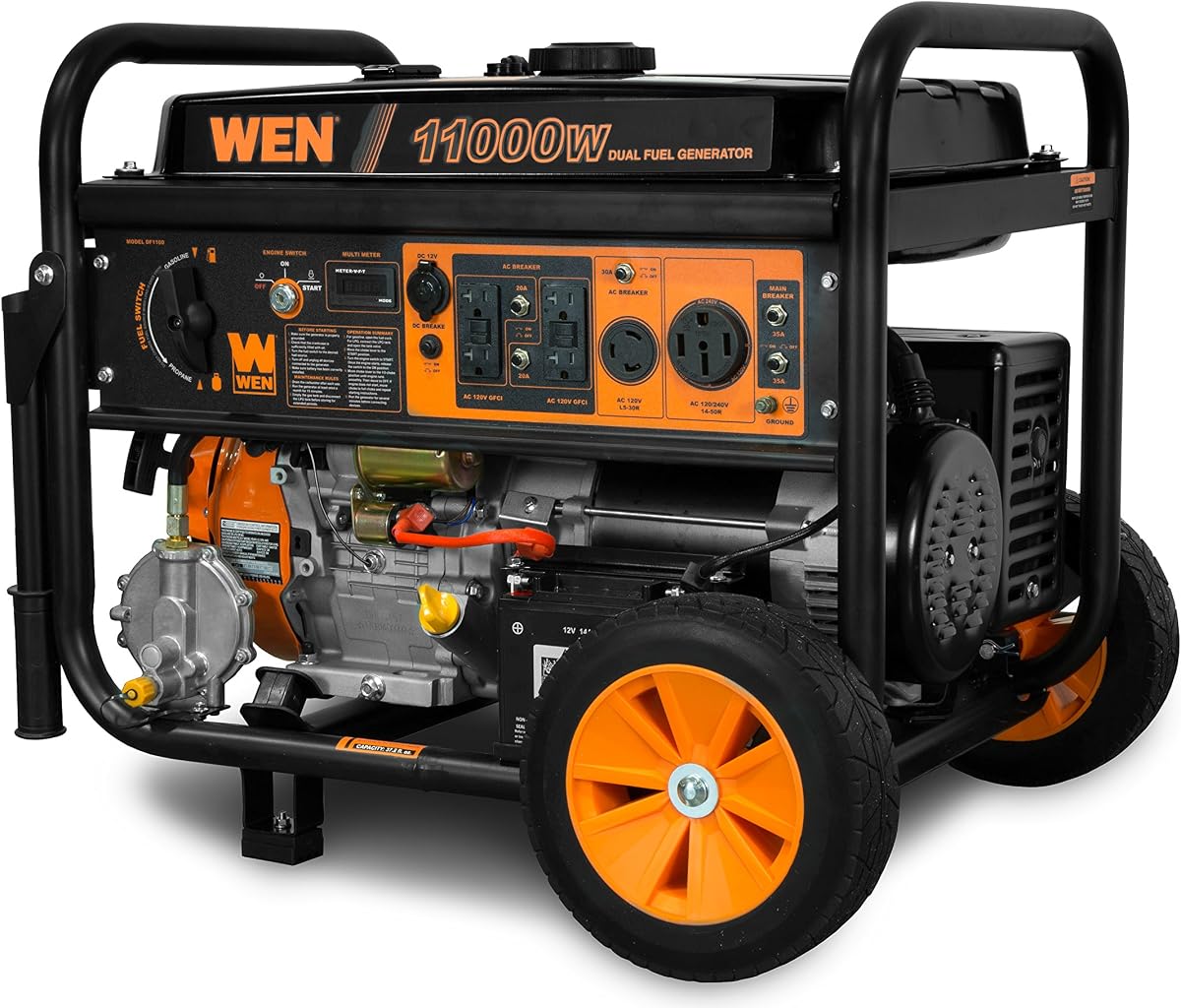
The WEN DF1100T is an 11,000-watt dual-fuel portable generator with a 4.6 rating and a broad selection of household and heavy-duty connections. It produces 11,000 surge watts and 8,300 running watts on gasoline, or 9,500 surge and 7,500 running watts on propane.
We may earn a commission when you buy through this link, at no additional cost to you.
Electric key starting powers the 457cc four-stroke OHV engine, and a simple dial changes fuel type. The generator can deliver both 120V and 240V, making it suitable for compatible transfer switches and emergency backup. Its 6.6-gallon tank provides up to 8.5 hours of runtime at half load.
The outlet panel includes four 120V GFCI outlets, a 30-amp twist lock, a NEMA 14-50R 120/240V outlet, and a 12V DC cigarette-lighter-style plug. A wheel kit, oil bottle, and 47-inch LPG connection hose are included, along with a two-year warranty.
This generator is a good fit for users seeking a straightforward dual-fuel model with generous outlet options. It does not provide the cleaner output associated with an inverter, remote starting, or three-fuel operation. Even so, its 4.6 rating, electric start, and long advertised half-load runtime make it a practical option for many outage-preparation needs.
Output can move between 120V and 240V, allowing the generator to serve both ordinary household devices and compatible high-power equipment. Users should confirm plug type, amperage, and transfer-switch requirements before connecting larger loads.
The advertised 8.5-hour runtime at half load gives the generator useful endurance for overnight or extended use. Actual results depend on the selected fuel, load level, ambient conditions, and generator condition.
We may earn a commission when you buy through this link, at no additional cost to you.
The Genkins 11,000-Watt Dual Fuel is aimed at home essentials, tools, outdoor equipment, and basic RV loads. It has a 4.5 rating, 8,000 running watts on gasoline, 7,200 running watts on propane, and both electric and recoil starting for operational flexibility.
We may earn a commission when you buy through this link, at no additional cost to you.
Its connection set includes two 120V 20-amp GFCI outlets, a 120V 30-amp L5-30R outlet, and a 120/240V 30-amp L14-30R outlet. These support compatible appliances, pumps, compressors, and power tools. A steel frame, muffler, fuel gauge, wheels, handle kit, and circuit-breaker protection reinforce its practical outdoor design.
Automatic low-oil shutdown is a valuable protection feature, while weather-protected outlets help reduce exposure during outdoor use. The recoil-start provision gives owners a backup method if the electric system cannot start the engine. Low-oil shutdown, however, cannot compensate for neglected maintenance, so the oil level still needs regular attention.
The model is best for owners with moderate power needs and a clear understanding of its 8,000-watt gasoline running capacity. The supplied information specifically recommends checking requirements before operating sensitive electronics, RV systems, or other sensitive devices. That caveat makes it less attractive for buyers seeking inverter-quality power.
The generator's output and outlet configuration are aimed at practical loads such as refrigerators, lights, fans, pumps, compressors, and compatible tools. Starting wattage and surge behavior should be checked before operating multiple motor-based appliances.
Recoil starting offers a useful fallback when electric starting is unavailable. Weather-protected outlets, a muffler, wheels, and a steel frame support dependable outdoor operation, provided the generator is operated in a safe, ventilated location.
We may earn a commission when you buy through this link, at no additional cost to you.
The FIRMAN H08051 is a hybrid dual-fuel portable generator with a 4.6 rating and a focus on true 30-amp and 50-amp power. It is listed for emergency backup, jobsites, farms and ranches, large RVs, and buses, making it a versatile choice where high-current 240V output is important.
We may earn a commission when you buy through this link, at no additional cost to you.
Electric start simplifies operation, while the eight-gallon fuel tank is advertised for up to 12 hours of use. A 5.5-foot propane hose and a padded handle improve fuel access and handling. Its durable, compact tubular roll-cage frame is designed to protect the generator while preserving a relatively manageable footprint.
The generator operates at 120/240 volts and uses a 60-hertz frequency. The advertised 30A and 50A capabilities make it relevant to RV and larger-load applications, but buyers should verify exact receptacle configuration and load limitations in the current product documentation.
The H08051 is best for owners who prioritize current capacity, straightforward electric starting, and a compact high-output design. Its supplied feature list is less detailed than those of newer competitors, and it does not highlight remote starting, an inverter display, or three-fuel operation. It remains a compelling choice for portable high-current use.
The stated true 30-amp and 50-amp capability is the model's defining advantage. These outputs are relevant to RV systems and larger 240V equipment, subject to the generator's operating limits and correct connection.
The tubular roll-cage frame protects the unit while maintaining a compact profile, and the padded handle improves handling. These features suit users who need to move substantial generator power between a home, vehicle, farm, or work site.
We may earn a commission when you buy through this link, at no additional cost to you.
The Champion 11,000-Watt Remote Start Tri Fuel Portable Inverter Generator combines wireless control, three-fuel operation, and inverter power in one package. Its customer rating is 4.3, and the remote key fob can start or stop the generator from up to 80 feet away.
We may earn a commission when you buy through this link, at no additional cost to you.
Gasoline output is 11,000 starting watts and 9,000 running watts. Propane also provides 11,000 starting watts but 8,100 running watts, while natural gas produces 11,000 starting watts and 7,290 running watts. This difference makes careful fuel and load planning especially important for households that may switch sources.
The outlet selection includes two 120V 20-amp GFCI household duplex receptacles, a 120/240V 30-amp locking outlet, a 120/240V 37.5-amp outlet, and a 12V automotive-style outlet. The inverter configuration is aimed at reliable power for sensitive electronics, while CO Shield provides automatic carbon-monoxide shutoff.
This model is best for users who need remote operation, clean output, and the ability to use three fuels. The absence of a listed 50-amp outlet may limit some transfer-switch or RV applications, and continuous output falls when using natural gas. For sensitive loads and convenient remote starting, however, it is a strong premium-style alternative.
The included wireless key fob allows starting and stopping from as far as 80 feet away. That can be valuable when the generator is safely positioned outside the occupied space but inconvenient to reach frequently.
Inverter output makes this model better suited to electronics and connected devices, while tri-fuel capability provides emergency supply options. The lowest running output occurs on natural gas, so users should base load calculations on the fuel most likely to be available.
We may earn a commission when you buy through this link, at no additional cost to you.
Selecting a high-output portable generator requires matching the machine to your loads, fuel plans, operating environment, and installation. The most important distinction is between starting watts, running watts, and the output available on each fuel.
Starting watts describe the brief maximum available when motors or compressors turn on, while running watts represent the sustained output. Compare the running output on propane with the combined load of essential equipment, then allow reasonable margin for startup demand. A generator operating near its continuous limit may run hot, produce voltage fluctuations, and have a shorter service life. For example, the WEN provides 7,500 running watts on propane, whereas the DuroMax XP10000HX is marketed around 10,000 watts of power. Those headline figures should be checked against each model's fuel-specific specifications.
Choose continuous capacity above your realistic load, and treat surge capacity as additional starting headroom rather than usable sustained power.
Dual-fuel generators let owners choose between propane and gasoline, which can be useful when one fuel is easier to obtain, store, or transport. Propane is convenient for storage, while gasoline may provide different output and runtime characteristics. Check output figures for each fuel because the same generator can have different starting and running ratings. Tri-fuel Champion models add natural gas for homes with a suitable gas supply, but that fuel has the lowest running output in the featured specifications.
A dual-fuel model is usually the most practical compromise for general emergency preparation, while tri-fuel operation offers added supply options at the cost of greater setup complexity.
Conventional generators are suitable for many appliances, tools, and backup circuits, but inverter generators are better suited to electronics that respond poorly to unstable or noisy power. The Champion 10,000-Watt Open Frame Inverter and Champion 11,000-Watt Remote Start Inverter emphasize clean output, while the DuroMax, DuroStar, Westinghouse, WEN, Genkins, and FIRMAN models are conventional portable designs. If you plan to operate computers, network equipment, audio systems, medical equipment, or certain battery chargers, inverter output deserves careful consideration.
Choose an inverter generator when sensitive loads are central to your plan; choose conventional output when power tools, resistance heating, and standard household backup dominate.
The outlet panel determines what can be connected without adapters. Standard GFCI 120V receptacles serve standard plugs, 30-amp twist-lock outlets support heavier portable loads, and 50-amp receptacles are relevant to transfer switches and large RV connections. The DuroMax XP10000HX, DuroStar DS13000MX, DuroMax XP13000EH, and Westinghouse include prominent 50-amp or transfer-switch-ready connections. A transfer-switch-ready outlet does not automatically make a generator suitable for installation; a qualified electrician should assess the wiring, grounding, inlet, and local code.
Match every planned load to a properly rated outlet, and arrange professional installation when connecting a home to standby-style transfer equipment.
Electric starting removes much of the physical effort required during an outage. Key switches, rocker switches, and push buttons are common, while remote controls add convenience. The Westinghouse, DuroStar, and Champion 11,000-Watt models offer remote starting; the latter reaches 80 feet. The Champion 12,500-Watt model uses an Intelligauge to report voltage, frequency, and runtime, while the 10,000-Watt Champion inverter has a five-mode display. Monitoring is valuable because it helps owners identify load changes and track service intervals.
Prioritize electric starting for routine use, remote starting if the generator is placed far from living areas, and a detailed gauge if you want ongoing operating information.
Engine displacement alone does not determine suitability, but it provides useful context when comparing 439cc, 457cc, 500cc, and 505cc platforms. Tank size, fuel efficiency, and expected load have a more direct effect on runtime. Westinghouse advertises up to 12 hours on its six-gallon tank, WEN lists up to 8.5 hours at half load, and FIRMAN cites 12 hours with its eight-gallon tank. These are not identical test conditions, so they should not be compared as if they were. Construction details such as an all-metal frame, copper windings, cast-iron cylinder sleeve, and no-flat tires can influence durability and mobility.
Evaluate runtime under comparable load conditions and inspect construction features that support the environment in which the generator will live.
Never operate a generator indoors, in an enclosed porch, inside a garage, or near an open door or window. Carbon monoxide is odorless and can become dangerous without warning. Several featured models include automatic shutoff systems such as CO Alert or CO Shield, but these are not substitutes for proper placement. Outdoor operation also requires attention to exhaust direction, weather, fuel handling, and separation from children and animals. GFCI outlets add protection against shock for suitable connected equipment, and automatic low-oil shutdown helps protect engines from inadequate lubrication.
Choose a safety shutoff system when possible, but always place the generator outdoors in open air and follow the manual and local safety codes.
A 10,000-watt-class generator is heavy even when its wheel kit makes movement easier. Consider handle design, wheel type, frame dimensions, and the route from storage to the operating location. The FIRMAN lists compact dimensions and a padded handle, while the DuroMax XP13000EH emphasizes no-flat tires for varied terrain. Accessories can also affect the setup experience. Westinghouse includes a key fob, battery charger, oil, funnel, toolkit, and manual; WEN includes a wheel kit, oil, and a 47-inch LPG hose. The Champion tri-fuel models include fuel hoses and engine oil.
Confirm that the included accessories cover your connection needs, and measure the storage and operating area before choosing a model that may be difficult to move.
Before first use, read the complete manual, identify the generator's running and surge output for each fuel, and confirm that every intended appliance and circuit is compatible. Set the generator outdoors on a stable, level surface in open air, with the exhaust pointing away from doors, windows, vents, vehicles, and occupied areas. A generator should never be operated in a home, garage, basement, shed, or partially enclosed porch, even when a carbon-monoxide shutoff feature is present.
Before adding fuel, stop the engine and allow hot components to cool. Use the recommended fuel and oil, connect the correct propane hose or natural-gas supply when applicable, secure fuel connections, and keep containers away from sparks and flames. Electric-start models require a charged battery, while checking the oil level and fuel system before startup helps prevent avoidable problems. Turn connected loads on gradually, especially motors, compressors, pumps, and other equipment with high startup demand.
For long-term care, follow the manufacturer's maintenance schedule, inspect the air filter, spark plug, fuel system, and connections, and preserve fuel quality. Never overload the generator, keep it away from combustible materials, and use weather protection only in a manufacturer-approved way that still allows ventilation. Before every use, inspect for leaks, damaged cords, loose outlets, unusual noises, or signs of overheating, and stop operation if a fault is suspected.
The required capacity depends on both running and starting loads. Add the running watts of essential appliances, then allow enough surge capacity for motors, compressors, and pumps to start. Compare the result with the generator's propane running and surge specifications, not merely its headline wattage. Keeping a healthy margin also reduces the risk of overloading the unit during an extended outage.
It may power selected essential circuits when paired with a correctly sized transfer switch, but it cannot automatically support every circuit in a typical home. Heating, air conditioning, well pumps, refrigeration, electronics, and other large loads can consume the available capacity very quickly. A qualified electrician should determine whether the generator and transfer equipment meet the home's needs and applicable electrical codes.
Propane is convenient to store and can offer cleaner operation with less fuel-spill concern, while gasoline is widely available and may offer different output or runtime. The best choice depends on fuel availability, storage conditions, expected use, and the generator's fuel-specific ratings. Dual-fuel models provide flexibility, but users should never switch fuel while the engine is running unless the manual explicitly directs them to do so.
An inverter generator is generally the better choice for computers, network gear, audio equipment, and other sensitive electronics because it produces more stable, low-distortion power. A conventional generator may still operate some sensitive devices, but compatibility should be confirmed in advance. Buyers should also consider surge requirements and use quality surge protection or appropriate uninterruptible power supplies where recommended.
No. A propane generator must be operated outdoors in open air because carbon monoxide can accumulate quickly in enclosed or poorly ventilated spaces. CO Alert and CO Shield systems are protective safeguards, not permission to run indoors. Place the unit at least as far from the structure as the manual and local authorities advise, with exhaust directed away from openings, and never use it in a garage, basement, or enclosed porch.
It means the generator has a suitable high-current outlet and electrical configuration for connection to a correctly installed transfer switch. It does not mean the generator can be wired directly into household wiring by an unqualified person. A licensed electrician should evaluate the generator, inlet, transfer switch, wiring, grounding, and local code before energizing home circuits.
Run it for as long as needed to support essential loads, but do not exceed the unit's fuel, oil, thermal, or maintenance limits. Long operation makes regular checks more important, particularly fuel level, oil condition, cooling airflow, and exhaust clearance. If the generator develops leaks, overheating, voltage abnormalities, or unusual sounds, stop it and address the issue before restarting.
Keep the manual, approved fuel and oil, a suitable fuel container, the supplied LPG hose, basic hand tools, and a battery charger or maintenance battery where applicable. A weather cover, extension cords rated for the load, and properly rated transfer-switch equipment may also be useful. Extension cords should support both the device's amperage and the generator's output, and only manufacturer-approved weather covers should be used.
The DuroMax XP10000HX is the most direct fit for buyers seeking a 10,000-watt dual-fuel generator with extensive outlet options and transfer-switch readiness. The WEN DF1100T offers a strong alternative with a 4.6 rating, 120V/240V flexibility, electric starting, and useful runtime. For premium inverter performance, the Champion 10,000-Watt Tri Fuel Open Frame Inverter provides low harmonic distortion and three-fuel capability.
Prioritize propane-specific running output, outlet compatibility, and the type of equipment you need to power. Conventional models can handle many tools and household essentials, while inverter models are better suited to sensitive electronics. Remote starting, carbon-monoxide protection, monitoring gauges, durable construction, and access to natural gas are additional features that should be matched to your operating preferences rather than treated as automatic upgrades.
Before purchasing, verify the current product listing, fuel-specific ratings, included accessories, warranty terms, and available outlets. Specifications and prices can change, and local electrical codes affect how a generator may be connected. A careful load plan and proper installation will make a greater difference to backup performance than a small headline-wattage difference.
