
AARVI Guitar Tuner Clip On
4.3Editor score
Six instrument tuning modes
Rotating LCD viewing angle
Includes four guitar picks
The best Auto Tuner for Singing guide compares ten clip-on instrument tuners for accuracy, displays, instrument modes, portability, charging options, and
An auto tuner can make instrument setup faster and more consistent, but singers should understand that a guitar, bass, ukulele, or violin tuner does not automatically correct a human voice. The products in this guide detect musical instrument vibrations, show the detected pitch, and help players reach the intended note before they begin performing.
We compared the ten featured tuners by examining their rating, supported instrument modes, display design, calibration options, charging method, clip construction, portability, and stated accuracy features. The list covers rechargeable and battery-powered models for acoustic guitar, electric guitar, bass, ukulele, violin, viola, cello, banjo, and chromatic tuning.
Each review identifies the product's strongest features and practical trade-offs, while the comparison and buying guide show which options suit different routines. Ratings and specifications reflect the supplied product information, and prices and availability can change, so readers should verify current listing details before buying.
4.3Editor score

4.5Editor score

4.6Editor score
The table below compares all ten tuners by their core capabilities, including supported instruments, display characteristics, power method, and headline tuning features. It is designed to help singers who also play an accompanying instrument, as well as instrumentalists, identify the most appropriate setup.


The Fender FCT-2 Professional Multi-Instrument Clip-On Tuner is a strong all-purpose choice for singers who accompany themselves on guitar, bass, ukulele, or violin. Its supplied rating is 4.5, and the product combines five dedicated modes with a color LCD needle display. The broad B0 to B7 range and A440 calibration make it particularly approachable for players who want a tuner that can cover several instruments without a complicated setup.
We may earn a commission when you buy through this link, at no additional cost to you.
Its vibration-based sensing is one of the most important strengths in a performance setting. The tuner is designed to sense vibrations directly from the instrument, helping it remain useful in both quiet practice rooms and loud venues. The needle responds clearly and moves toward center pitch, while the dual-hinge clip can sit on either side of the headstock. That flexibility makes the display easy to see without forcing the player to twist into an uncomfortable position.
The main limitation is that the tuner uses a standard A440 calibration and an included CR2032 battery rather than offering the adjustable calibration found on several premium alternatives. A singer or instrumentalist who works with historical pitch standards may need more control, and those who dislike disposable batteries may prefer a rechargeable model. Neither issue undermines its general usefulness for everyday standard tuning.
We recommend the FCT-2 to most readers who want a proven, straightforward multi-instrument tuner. It is especially well suited to singer-songwriters who move between guitar and ukulele, student musicians building one setup for several instruments, and performers who need quick visual feedback without navigating a complicated menu. It is the most balanced option in this guide for versatility, readability, and ease of placement.
Because the FCT-2 senses instrument vibrations rather than relying only on ambient sound, it is designed to remain useful when rehearsals or stages are noisy. This approach gives players direct feedback from the instrument itself and reduces confusion from nearby sounds.
The dual-hinge clip adjusts to either side of the headstock, allowing the color LCD to face the player naturally. That flexibility is valuable for left-handed players, singer-songwriters, and anyone who changes the angle of an instrument between seated and standing performances.
We may earn a commission when you buy through this link, at no additional cost to you.
The Fender Flash 2.0 is designed for musicians who want a dependable clip-on tuner without recurring battery replacements. It carries a supplied rating of 4.6 and includes a rechargeable lithium-ion battery, a micro USB charging cable, and a conventional tuner battery. The stated battery life reaches 20 hours, while an automatic shutoff after 10 minutes of inactivity helps conserve power between sessions.
We may earn a commission when you buy through this link, at no additional cost to you.
This tuner supports electric guitar, acoustic guitar, and bass, with additional modes for ukulele, violin, and chromatic tuning. That range makes it more versatile than a tuner designed around only one instrument. Alternate settings include half-step flat, full-step flat, and open G, D, and E tunings, which are useful for singer-songwriters experimenting with open chords and players working in nonstandard tunings.
Its charging connection is micro USB rather than the more widely used USB-C format found on several competing products. It is also sold as a single tuner, so musicians who need separate devices for different instruments may need another unit. Even so, these are modest inconveniences when weighed against the long stated battery life and reusable power system.
The Flash 2.0 is a compelling premium choice for touring singers, rehearsal-room regulars, and anyone who dislikes disposable batteries. It offers broad modes, long operation between charges, and a practical automatic shutoff. For a singer who primarily works with guitar, it is one of the strongest choices for maintaining consistent instrument tuning across a busy schedule.
A stated 20-hour operating window means many players can charge less often than they would replace button cells. Automatic shutoff also reduces wasted energy, making the tuner practical for lessons, rehearsals, recording sessions, and regular performances.
Open G, D, and E plus flat tuning presets give singer-songwriters more ways to shape familiar songs. These modes are particularly helpful for musicians moving between standard accompaniment and alternate voicings without wanting to retune manually.
We may earn a commission when you buy through this link, at no additional cost to you.
The T2 Smart Automatic Guitar & Ukulele Tuner stands apart because it combines a tuner with a 180RPM electric string winder. It has a supplied rating of 4.4 and is aimed primarily at acoustic guitar and ukulele players. For a singer-songwriter who wants to move quickly from a fresh string set to playable tuning, the integrated winder is a feature no other tuner in this list provides.
We may earn a commission when you buy through this link, at no additional cost to you.
The device offers three functions: Auto for everyday tuning, Semi-Auto for a wide tuning range, and Custom for alternative tunings. An advanced tuning-distance display presents percentages, while a large 2600mAh USB-rechargeable lithium battery supports repeated use. The ergonomic, nonslip body and easy-to-plug peg connector are designed to reduce the handling involved in conventional tuning.
Because its focus is narrower than the multi-instrument models, the T2 may not be the most logical choice for a vocalist who plays bass, violin, or a large collection of string instruments. Its string-winder feature also adds bulk and complexity compared with a simple clip-on tuner. For guitar and ukulele players who value rapid string changes, however, those traits function as meaningful advantages.
Choose the T2 if your performances repeatedly involve fresh strings, broken strings, or quick changes between standard and alternative tunings. It is a specialist answer for the singer who wants more than pitch detection alone, combining automatic tuning, a winder, rechargeable power, and clear distance feedback in one desktop-style device.
The electric 180RPM winder removes much of the manual effort involved in bringing new strings to tension. For performers who replace strings often or want to prepare an instrument quickly before a session, combining the two functions can streamline setup.
Auto, Semi-Auto, and Custom modes give users a quick starting point while retaining deeper control for nonstandard setups. Percentage-based distance feedback makes it easier to judge how far a string remains from the target pitch.
We may earn a commission when you buy through this link, at no additional cost to you.
The New Bee Guitar Tuner Clip-On Rechargeable has a supplied rating of 4.5 and combines a vivid color display with a 360-degree rotatable screen. It supports guitar, bass, ukulele, violin, and cello, along with chromatic tuning and automatic open tuning detection for guitar. This makes it one of the broadest clip-on options for a singer who performs with several string instruments.
We may earn a commission when you buy through this link, at no additional cost to you.
The high-resolution screen is designed to keep note names visible in different lighting conditions. A silicone-padded clamp grips the instrument securely while seeking to avoid damage. Its rotatable display allows the player to choose a comfortable viewing angle, which is useful on stage, during studio work, and in ordinary practice.
The stated battery life of up to 10 hours is shorter than the 20- and 24-hour figures associated with several premium rechargeable competitors. It also arrives as a black one-pack, so users needing matching tuners for multiple instruments must purchase additional units. These are worth considering if portability and display quality are more important than maximum endurance between charges.
The New Bee is a strong pick for singer-songwriters whose set list moves among guitar, bass, ukulele, violin, or cello. It is also a natural choice for players who want a colorful, highly visible interface and modern USB-C charging. Its combination of open tuning detection and flexible screen positioning makes it especially approachable for both beginners and experienced musicians.
Color note indicators and a high-resolution screen can reduce the time needed to interpret a needle-only display. Clear visibility is especially useful during quick changes or for players who are still learning how pitch names relate to their instruments.
Dedicated modes for guitar, bass, ukulele, violin, and cello are supplemented by chromatic and automatic guitar open tuning. This range reduces the need to keep separate devices in a rehearsal bag or instrument case.
We may earn a commission when you buy through this link, at no additional cost to you.
The Snark SN5X Clip-On Chromatic Tuner combines a full-color display with a compact format for guitar, bass, and violin. Its supplied rating of 4.6 is among the strongest in this roundup, making it an attractive option for players who want a straightforward clip-on tuner with a colorful display. Its primary appeal is visual clarity without the broader control systems found on more specialized models.
We may earn a commission when you buy through this link, at no additional cost to you.
The frequency range is tailored to guitar and bass, while chromatic capability provides additional flexibility for other pitched strings. The tuner can be mounted on the front or back of the headstock, giving the player a choice depending on instrument shape, string layout, and viewing angle. That placement flexibility is particularly useful for bass players whose headstocks differ from those of standard guitars.
The supplied information is less detailed about power management than it is for the rechargeable products in this list, and the documented instrument emphasis is narrower than that of the New Bee, Fender FCT-2, or AARVI. It may therefore be less attractive to someone who wants explicit mode lists, calibration details, or a stated battery duration.
The SN5X is a good fit for guitar, bass, and violin players seeking a compact tuner with clear color feedback. Singer-songwriters who value straightforward operation and front-or-back mounting will appreciate its design. It is also a practical pick for anyone who wants a higher-rated clip-on option without moving into a more feature-heavy model.
The full-color display provides an immediately recognizable tuning interface while preserving a compact silhouette. That makes the SN5X easy to carry in a pocket, gig bag, or instrument case without adding unnecessary bulk.
Using the tuner on either side of the headstock adds flexibility for different instruments and playing positions. It can improve visibility while keeping the setup familiar and uncomplicated.
We may earn a commission when you buy through this link, at no additional cost to you.
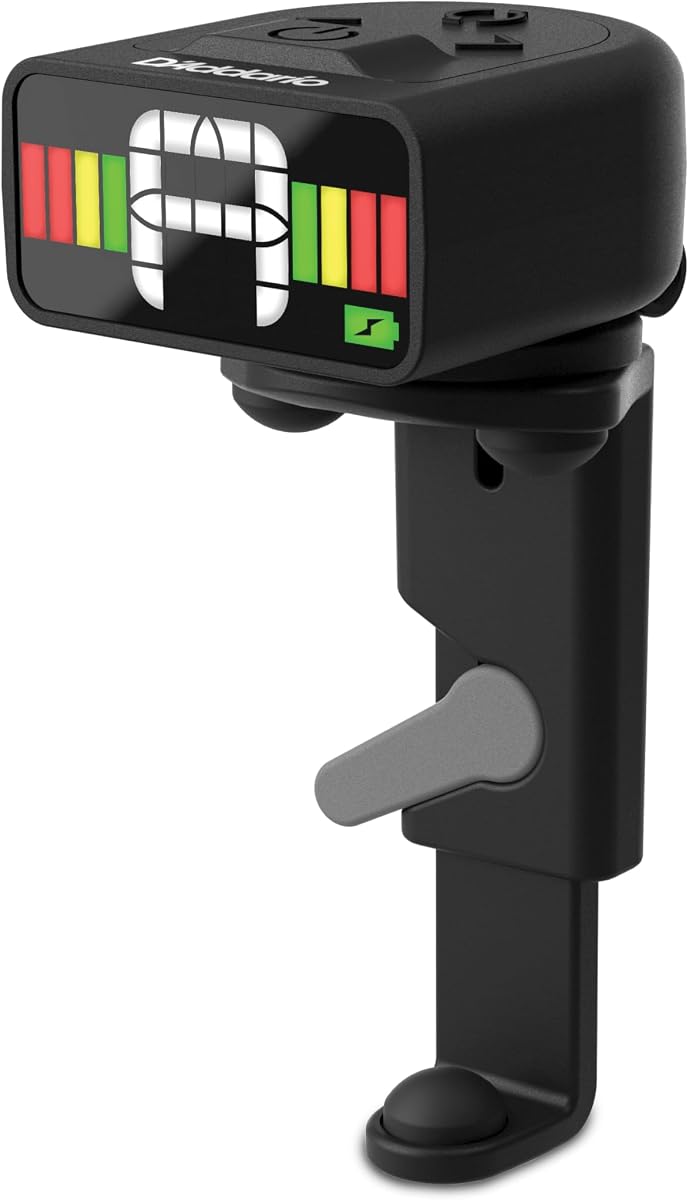
The D'Addario Nexxus 360 Rechargeable Violin Tuner is purpose-built for violinists, and it has a supplied rating of 4.4. A high-performance piezo pickup is optimized for a wide range of high and low frequencies, allowing the tuner to detect the instrument's vibration quickly and accurately. It is an especially logical choice for a singer who accompanies a classical, folk, or orchestral performance on violin.
We may earn a commission when you buy through this link, at no additional cost to you.
The tuner offers up to 24 hours of tuning time per charge and includes a USB-C cable. Automatic power-off helps preserve the remaining charge, while the bright full-color LED can rotate through 360 degrees for a suitable viewing angle. The non-marring clamp can attach to any part of the violin shoulder, giving the player freedom over placement.
Its dedicated violin focus is the main limitation for multi-instrumentalists. Unlike general-purpose models with guitar, bass, ukulele, and chromatic modes, this tuner is optimized around one instrument. A player who changes between violin and guitar should consider a multi-instrument model or keep separate tuners in each instrument case.
The Nexxus 360 Violin Tuner is a strong specialist recommendation for players who want detailed, dependable pitch feedback in a compact rechargeable design. Its long stated endurance, bright screen, flexible clip, and vibration pickup all support rehearsal, practice, and performance use without requiring frequent battery changes.
The piezo pickup is optimized for the violin's range of high and low frequencies. Direct vibration sensing can remain useful in rehearsal environments where ambient noise would make a microphone-based tuner less precise.
Attaching the tuner to any part of the violin shoulder gives the player more control over screen visibility. The non-marring clamp helps preserve the instrument while keeping the display in a practical line of sight.
We may earn a commission when you buy through this link, at no additional cost to you.
The D'Addario Nexxus 360 Rechargeable Clip-On Guitar Tuner has a supplied rating of 4.6 and stands out for its adjustable calibration range. The tuner covers 415 to 465Hz, giving guitar and bass players more control than a tuner fixed at standard pitch. That makes it useful for ensembles working at a nonstandard concert pitch or for musicians accustomed to a particular historical reference.
We may earn a commission when you buy through this link, at no additional cost to you.
The bright LED display rotates 360 degrees to match the player's position, and the strong clamp can mount anywhere on the headstock without slipping. It provides quick, accurate tuning for guitar and bass, with a design that remains compact enough for rehearsal, stage use, and travel. A supplied USB cable supports recharging, while the stated 24-hour operating time is among the strongest figures in this group.
Unlike the broader models in the list, this tuner is focused on guitar and bass rather than ukulele, violin, cello, or chromatic workflows. Adjustable calibration is useful, but newer performers may not know when or why to change the reference pitch. A clearly labeled setting and a quick reference guide can prevent accidental calibration changes.
The Nexxus 360 Guitar Tuner is a premium recommendation for players who want long battery life, a flexible display, and fine pitch control. Singer-songwriters who perform standard guitar accompaniment may still value the adjustment for matching another musician, while bassists can benefit from the stable headstock clamp and bright screen.
The broad 415 to 465Hz range helps a player match different pitch references. This is valuable in ensemble settings, rehearsals at alternate pitch, and situations where a partner's instrument has been set to a different standard.
The clamp can be mounted anywhere on the headstock, while the 360-degree display rotation keeps the reading visible from different positions. Together, these details make the tuner more adaptable during a live performance.
We may earn a commission when you buy through this link, at no additional cost to you.
The EX-GEAR Professional Clip-On Tuner is built around a large, high-contrast LCD that is intended to remain readable on dark stages or in bright sunlight. Its supplied rating is 4.1, lower than the ratings attached to the other products, but its screen size and broad tuning range make it a distinct option for players who prioritize visibility and specification.
We may earn a commission when you buy through this link, at no additional cost to you.
The display supports a 135-degree tilt and 360-degree rotation, providing a wide range of viewing positions. A high-sensitivity vibration sensor is designed for quick, precise tuning of acoustic guitar, electric guitar, bass, and ukulele, even in noisy surroundings. Dedicated modes for those instruments and chromatic tuning help users find the appropriate setup faster.
Calibration can be adjusted from 430 to 450Hz, and the overall tuning range extends from A0 to C8. These are useful specifications for broad pitch coverage. The tuner is explicitly not compatible with violin, however, and its lower supplied rating gives a buyer less evidence of broad customer satisfaction than the more highly rated alternatives.
The EX-GEAR is best suited to guitar, bass, ukulele, and chromatic users who want a large screen and many viewing angles. It may appeal to outdoor performers, teachers, and anyone who has struggled to read a smaller display. The trade-off is that violin players should choose another model, and buyers who place greater weight on ratings may prefer a higher-rated alternative.
The extra-large, high-contrast display is intended to remain legible under both stage lighting and sunlight. A larger interface can also reduce squinting and make note identification more comfortable during long rehearsals.
An A0 to C8 range covers a wide musical spectrum, while adjustable calibration supports different tuning references. Together, they suit players who move between instruments, alternate tunings, and changing ensemble standards.
We may earn a commission when you buy through this link, at no additional cost to you.
The D'Addario Rechargeable Viola Tuner is a specialist choice for viola players, with a supplied rating of 4.0. Its piezo transducer detects the instrument's vibration rather than ambient sound, and the stated 410 to 480Hz calibration range offers a wide choice of reference pitches. That makes the tuner particularly relevant to singers who perform classical repertoire on viola.
We may earn a commission when you buy through this link, at no additional cost to you.
The compact multicolor display is designed for easy reading, and the lever-lock non-marring clamp holds the tuner securely without damaging the instrument. It provides up to 22 hours of tuning time per charge, includes a USB-C cable, and uses automatic power-off to preserve the remaining charge.
Its dedicated viola design is also its main constraint. Players who switch between viola and another instrument need a general tuner with multiple modes or separate devices. The supplied rating is the lowest in the roundup, so buyers who prioritize a broad set of customer feedback may want to compare the available reviews and warranty information before deciding.
This tuner is a compelling option for a committed viola performer who values secure placement, precise vibration detection, and a rechargeable design. It is less suitable as a general household tuner, but for the correct instrument and player, its focused features can provide a convenient professional workflow.
The piezo transducer picks up vibration directly from the instrument, which helps produce a reliable reading without relying on nearby sound. Its broad calibration range gives viola players flexibility in different performance environments.
The lever-lock clamp is intended to hold firmly while remaining non-marring to the instrument. That combination gives performers confidence that the tuner will stay in position without leaving marks on the viola's finish.
We may earn a commission when you buy through this link, at no additional cost to you.
The AARVI Guitar Tuner Clip On offers a broad set of instrument modes at an accessible position in this roundup, with a supplied rating of 4.3. It supports acoustic guitar, electric guitar, bass, violin, banjo, and ukulele, then adds a chromatic mode for wider pitch detection. That range makes it a practical choice for a singer who performs with several different string instruments.
We may earn a commission when you buy through this link, at no additional cost to you.
The advanced processor is designed to reach standard pitch within seconds, while the high-sensitivity vibration sensor helps maintain reliable performance in noisy environments. Its wide-opening universal clip is intended to fit all instrument headstocks, and the 360-degree rotating LCD can be set to the player's preferred angle. These details make the tuner adaptable to different instruments and playing positions.
It uses an included CR2032 battery and automatically powers off after three minutes of inactivity. Compared with rechargeable models, this means the player will eventually need another button cell, although the automatic shutdown reduces waste. The dedicated mode list also does not explicitly include cello, even though chromatic tuning can provide additional flexibility.
The AARVI is a sensible value-oriented choice for singer-songwriters who need guitar, ukulele, bass, violin, or banjo support without buying several dedicated tuners. The included four guitar picks add a small practical bonus for instrumental practice. Its strongest appeal is the combination of broad modes, a universal clip, chromatic support, and a simple rotatable display.
Six dedicated modes cover the instruments most likely to appear in singer-songwriter and folk performances. Chromatic mode broadens the options further when a player uses an alternate tuning or another pitched string instrument.
The wide-opening clip is designed to accommodate different headstocks, while the rotating display makes the reading easier to see. This makes the tuner easy to move between instruments without searching for a separate device.
We may earn a commission when you buy through this link, at no additional cost to you.
For singers, the best tuner is usually an instrument tuner that supports the instruments used in rehearsals and performances. Prioritize vibration detection, readable feedback, correct instrument modes, secure attachment, convenient power, and enough range to handle the music you actually play.
Begin by deciding which instruments must be supported. Guitar and bass are common choices, but ukulele, violin, viola, cello, and banjo each have different pitch ranges and tuning conventions. Some products offer dedicated modes for several instruments, while others are specialized for a single instrument. A general model is more convenient for a singer moving between multiple accompanying instruments; a dedicated model may provide more focused vibration sensing for one instrument.
Choose dedicated modes for every instrument you expect to use, and confirm that chromatic mode is available for alternate tunings. Do not assume that a guitar-focused tuner can accurately cover a violin, viola, or cello.
A tuner that senses instrument vibration is generally less vulnerable to noise than one that depends primarily on microphone input. This matters in rehearsals, cafes, studios, and stages where a singer may be competing with drums, amplifiers, and audience noise. Piezo-based pickup systems are common among the featured clip-on products, and their usefulness depends on attaching the tuner firmly to a resonant part of the instrument.
Look for a stable clamp and a pickup designed for the frequency range you need. Secure placement improves the chance of a steady reading and reduces the need to pluck the same string repeatedly while making small adjustments.
The display should show the target note, the direction of tuning, and whether the pitch is centered clearly enough to interpret quickly. Color screens can make note identification more intuitive, while large LCDs are easier to read at a distance or in strong light. A needle display offers a direct visual comparison between the current note and the target, which some players find easier to interpret than menus or text-heavy interfaces.
Consider the environment rather than screen size alone. For dark stages, a bright display helps; for bright outdoor use, high contrast and a large face matter. A rotating or tilting screen also lets you preserve visibility without twisting the clip awkwardly.
Rechargeable tuners reduce repeated battery purchases, while disposable button cells keep the hardware simple. The featured rechargeable models state operating times ranging from 10 to 24 hours, and several include automatic shutdown. Battery-powered options such as the Fender FCT-2, Snark SN5X, and AARVI use button cells, which may be convenient but require occasional replacement.
Match the power system to your schedule. A musician who rehearses and performs regularly may favor a rechargeable model with USB-C, while an occasional player may prefer a simple tuner that can sit in a drawer for months. Check connector type, included cables, and automatic power-off behavior before buying.
Calibration determines the reference pitch the tuner uses to judge whether a note is correct. Many players can safely use the common A440 standard, but a wider adjustable range can help when matching an ensemble, a piano, or an instrument tuned to a historical pitch. A broad pitch range is also useful for bass, low-string instruments, and chromatic work.
Fixed calibration is easier for beginners, while adjustable calibration provides more control. If you perform in varied groups or use a digital piano that can be tuned to different standards, choose a model with a clearly labeled reference-pitch control. Otherwise, standard A440 will cover most needs.
The clip must hold the tuner securely without scratching the instrument. A dual hinge or rotating joint allows the display to face the player from more than one angle, and a wide-opening clip may fit unusual headstocks. For bowed instruments, shoulder placement can be more practical than attaching the device to the end of the instrument. Consider your dominant hand, typical playing position, and any existing hardware that could obstruct the clip.
A secure, non-marring clamp is the safest general choice. Test the placement on every regularly used instrument if possible, because a tuner that reads clearly but shifts during a performance can be more distracting than one with a smaller display.
A tuner that accompanies you to every rehearsal should be compact, lightweight, and easy to operate. Clip-on models fit neatly into a pocket or case, while the T2 occupies more space because it includes an electric string winder. Extra features such as included picks, alternate tuning presets, or a chromatic mode can be useful, but they should support your routine rather than add confusing controls.
Prioritize simple operation and reliable attachment over novelty. A dedicated mode, quick display, and stable clip matter more during a live set than a feature you rarely use. A larger kit can be worthwhile for a singer who changes instruments frequently or replaces strings between performances.
Start by selecting the correct instrument mode and confirming the calibration reference. If the tuner offers a custom or chromatic mode, use it when a standard mode does not represent your intended tuning. Mount the tuner on a suitable part of the headstock or instrument, rotate the display toward you, and play one string at a time. Wait for the note and direction indicator to settle before adjusting the tuning peg.
For the T2, allow the string to reach tension through its 180RPM electric winder, then use the relevant automatic, semi-automatic, or custom tuning function. On clip-on models, attach the clamp firmly but gently, avoid forcing it near delicate finishes, and test it in the position you will use during performance. If the reading is unstable, move the tuner slightly and retest rather than repeatedly turning the tuning peg.
Remove the tuner when it is not needed, especially if you use a separate headstock cover. Wipe the clip and screen with a soft, dry cloth, and keep moisture or cleaning liquids away from the electronics. Rechargeable models should be charged with the supplied or compatible cable, while button-cell models should be replaced when the display becomes dim or unreliable. Periodic use helps ensure the battery, clip, and sensor remain ready for rehearsals and performances.
No. The tuners in this guide measure instrument vibrations and help a player tune a guitar, bass, ukulele, violin, viola, cello, or banjo. They do not alter a singer's pitch in real time. A singer who wants automatic vocal pitch correction needs a dedicated vocal effects processor or monitor system rather than an instrument tuner.
The Fender FCT-2, Fender Flash 2.0, and AARVI are all strong choices for guitar accompaniment. The FCT-2 emphasizes multi-instrument versatility, the Flash 2.0 offers rechargeable power and alternate tunings, and the AARVI provides broad modes at a value-oriented position in the list. The right choice depends on whether other instruments, battery life, or tuning presets matter most.
A properly positioned vibration-based tuner can remain effective where ambient sound would interfere with a microphone-based model. The product must be firmly attached to a resonant area and the string played clearly. Models described as using piezo pickups or high-sensitivity vibration sensors are designed for this type of use, although room acoustics can still affect consistency.
Rechargeable tuners are convenient for frequent use because they can be replenished rather than repeatedly fitted with new button cells. Disposable-battery models may be simpler and useful for occasional playing. Consider how often you rehearse, whether you already own suitable cables, and how easily you can keep spare batteries available.
Chromatic mode identifies notes across a broad range, making it useful for alternate tunings and unfamiliar intervals. Instrument-specific modes use a preset range and display behavior tailored to common strings, which can be faster for routine playing. A general tuner that includes both gives you a simple path for normal work and greater flexibility when needed.
No. A customer rating can indicate how satisfied buyers are, but it does not directly measure pitch precision or suitability for a particular instrument. Accuracy also depends on sensor quality, calibration range, attachment position, and the condition of the instrument. Review the documented specifications alongside ratings and the manufacturer's guidance.
Yes, if the model includes compatible modes and its clip can fit each headstock. The Fender FCT-2, New Bee, Fender Flash 2.0, EX-GEAR, and AARVI support multiple instrument categories. The D'Addario viola and violin tuners are more specialized, while the T2 focuses on guitar and ukulele with its built-in string winder.
An unstable reading can result from a loose clip, ambient noise, a string that is not producing a clear sustained vibration, or movement of the instrument. Try repositioning the tuner, playing the string more deliberately, and checking that the headstock is stable. If the problem continues, test the tuner on another instrument or replace the battery if the display appears weak.
The Fender FCT-2 is the most balanced overall choice, combining a color needle display, five instrument modes, vibration sensing, and flexible placement. The Fender Flash 2.0 stands out for rechargeable power, a stated 20-hour operating life, and alternate tuning modes, while the T2 offers the most specialized workflow through its 180RPM electric string winder.
Prioritize the features that support your real routine. A singer who performs with several instruments should examine dedicated modes and a universal clip. Frequent performers may value rechargeable power and automatic shutdown, while specialists can choose the Nexxus models for violin or viola. Display size, calibration control, and viewing angle become more important when visibility or changing pitch standards are central to your setup.
Ratings provide a useful starting point, but the best tuner is the one that is accurate for your instrument, secure during use, easy to read, and simple enough for the moment. Verify the current product listing, included accessories, compatibility, warranty terms, and price before purchasing, since availability and pricing can change over time.