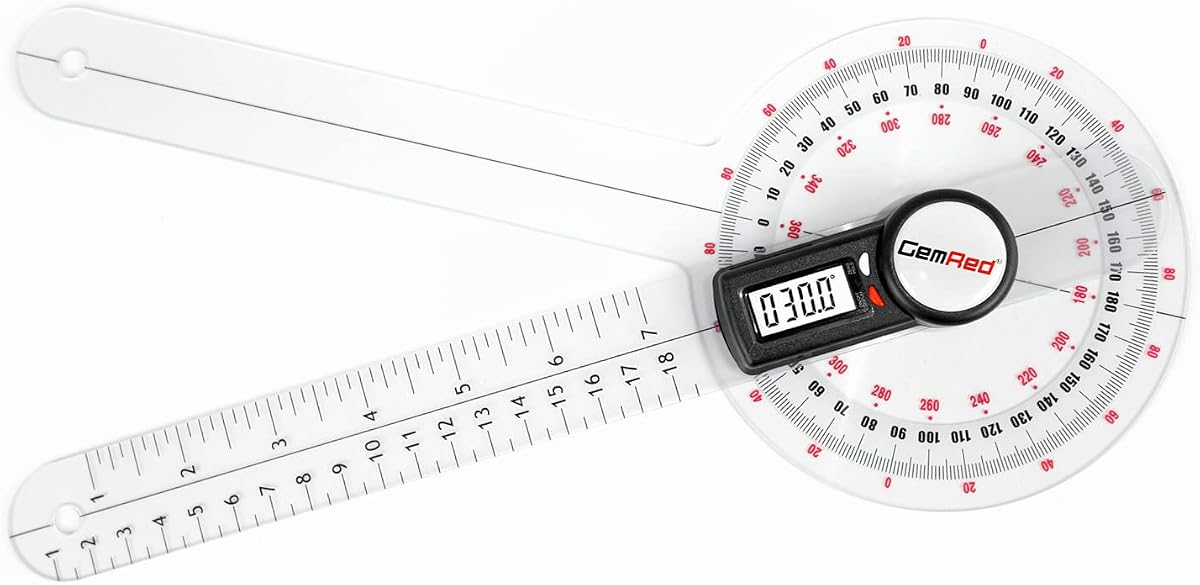
GemRed 12-Inch Digital Goniometer
4.2Editor score
Quick one-button zeroing
Invertible LCD display
Hold and reset functions
Includes CR2032 battery
A digital goniometer measures joint angles and range of motion with an electronic display, making it useful for physical therapy, rehabilitation, fitness assessment, and clinical documentation. The right model should be accurate, easy to position, readable in different working positions, and appropriate for the joints or applications you routinely evaluate.
We compared the 10 available digital goniometer options by examining their stated measurement functions, display features, zeroing options, power systems, construction, intended applications, and available ratings. The list covers compact digital protractors, multifunction clinical tools, magnetic models, and dedicated joint-mobility instruments for both professional and home use.
Each review highlights what makes a model useful, where it may fall short, and the type of user it suits best. The GemRed, Jamar Plus+, and EasyAngle represent three distinct purchasing priorities, while the remaining products provide specialized alternatives. Product availability and prices can change, so verify the current listing before purchasing.
4.2Editor score

4.3Editor score

3.9Editor score
As an Amazon Associate we earn from qualifying purchases.
This side-by-side comparison organizes each digital goniometer by its core measurement capabilities, display and positioning features, power method, and most suitable application, helping you compare clinical tools, general-purpose digital protractors, and rehabilitation instruments.


The GemRed 12-Inch Digital Goniometer is a straightforward joint-measurement tool with a 4.2 rating and several user-friendly controls. Its most appealing qualities are the one-button zero reset, invertible display, hold function, and 12-inch format, which make it practical for measuring larger joints and documenting movement without relying on a separate analog protractor.
We may earn a commission when you buy through this link, at no additional cost to you.
The revised controls are color-coded so each button has a distinct purpose, reducing the need to memorize operating steps. Pressing the white button once resets the instrument to zero degrees, while the red button inverts the display for measurements taken in awkward positions. The hold function freezes a result so it can be transferred to a record or compared with another reading.
Its tradeoff is that the tool focuses on core goniometer functions rather than advanced inertial measurements or device-specific mobility protocols. It is a one-direction joint-angle instrument rather than a comprehensive alternative to an inclinometer, BROM, CROM, or scoliosis assessment device. The large arm is also unlikely to be the most convenient option for very small finger joints.
This is a strong choice for physical therapy students, home rehabilitation users, fitness professionals, and clinicians who need an uncomplicated 12-inch digital goniometer. It is particularly useful when fast zeroing, readable results, and easy transfer of a held measurement matter more than a broad collection of specialized assessment modes.
The one-button reset allows the user to establish a new reference angle quickly. That convenience can reduce setup time when comparing several movements or checking progress during a rehabilitation session.
The inverted display turns the reading toward the user when the arm must be positioned from an uncomfortable direction. This makes the tool less visually disruptive without requiring the user to twist repeatedly.
We may earn a commission when you buy through this link, at no additional cost to you.
The Jamar Plus+ Digital Goniometer carries a 4.3 rating and is purpose-built for professional hand and finger range-of-motion measurement. Its transparent 8-inch body, precision digital display, and controls for zeroing, holding, and flipping the numbers make it a focused clinical instrument rather than a general-purpose digital protractor.
We may earn a commission when you buy through this link, at no additional cost to you.
Measurements display down to a tenth of a degree, which supports detailed documentation of finger flexion, extension, dexterity, and changes in patient movement. The zero button lets the clinician begin from any starting angle, while the hold button preserves the current reading for reference. Flippable numbers improve visibility when the tool is positioned from the opposite side.
The main limitation is its specialized size. An 8-inch arm is well matched to hand and finger assessment, but it may not provide the reach or positioning convenience required for some larger-joint measurements. The stated one-year limited warranty excludes the battery, and the included CR2032 battery will eventually need replacement.
For occupational therapists, hand therapists, physical therapists, and rehabilitation clinics that routinely document small-joint motion, this is one of the most purpose-focused options in the list. It is also a sensible choice for anyone who values a tenth-degree readout and simple digital documentation over broad multipurpose functionality.
A tenth-degree display is particularly helpful when small changes in finger or hand motion are being recorded. The transparent construction also allows the user to see the underlying anatomy and tool alignment while positioning the arms.
Zeroing from any position, holding the result, and flipping the displayed numbers are all useful during repeated assessments. Automatic shutoff adds another practical benefit by conserving the replaceable CR2032 battery.
We may earn a commission when you buy through this link, at no additional cost to you.
The EasyAngle Digital Goniometer is a premium multifunction assessment device with a 3.9 rating. Instead of limiting itself to conventional goniometer measurements, it is designed to replace or complement a goniometer, inclinometer, BROM, CROM, and scoliosis assessment tool, making it the broadest option in this roundup.
We may earn a commission when you buy through this link, at no additional cost to you.
Its inertial measurement capabilities allow clinicians to assess mobility with greater quantification than a visual estimate. The device can measure trunk and back range of motion, cervical range of motion, and scapular mobility across all three orthogonal planes. That three-dimensional scapular information is a notable feature for professionals who want more detailed information about shoulder girdle movement.
That versatility also creates the main trade-off. A user who only needs a simple joint-angle reading may find the platform excessive, while a clinic replacing several separate tools may find it more relevant. The product also carries a substantially higher cost than the compact digital models, and the supplied information does not provide details about carry case, warranty, battery life, or specific calibration procedures.
EasyAngle is best suited to physical therapists, clinics, and rehabilitation professionals who need a consolidated assessment system rather than a single simple measurement. Interactive demonstration support may help new users understand the device, but buyers should confirm their specific assessment requirements and desired workflow before committing.
The inertial sensor platform adds information that a conventional arm-and-axis goniometer cannot provide. Three-plane scapular measurement is especially valuable when shoulder mobility is being evaluated in detail.
Combining goniometer, inclinometer, BROM, CROM, and scoliosis-related functions may reduce the need to maintain several separate instruments. The benefit is strongest for practices that perform varied assessments every day.
We may earn a commission when you buy through this link, at no additional cost to you.
The Baseline-12-1057 Digital Inclinometer has the highest listed rating in the group at 5.0. It is designed specifically for measuring a patient's range of motion and offers absolute and relative measurement modes, giving clinicians more control over how an angle is referenced and recorded.
We may earn a commission when you buy through this link, at no additional cost to you.
One especially useful feature is the LCD's ability to display total range of motion after the joint has passed through the inclinometer's measurement range. Screw-in legs create two points of contact on surfaces that are not level, including the spine and cervical spine, which can improve positioning consistency in assessments where a single-point contact would be unstable.
The instrument is an inclinometer rather than a traditional two-arm goniometer, so buyers seeking finger-specific measurements or a large measuring arm should check dimensions before ordering. The extension legs also introduce an assembly step compared with a permanently rigid instrument. The supplied listing highlights the included case but does not specify battery details in the provided information.
This is a compelling option for clinicians who regularly assess spinal, cervical, or other linear range-of-motion measures and value both absolute and relative readings. Its perfect listed rating is notable, though customer ratings should be considered alongside the specific measurement modes and physical design that match your practice.
Absolute horizontal zero and relative measurement modes offer different ways to establish a baseline. This flexibility can make the tool more adaptable to different assessments and starting positions.
The screw-in legs are intended to maintain two-point contact on uneven surfaces. That design supports steadier positioning when the spine or cervical spine cannot be approached as a perfectly level surface.
We may earn a commission when you buy through this link, at no additional cost to you.
The Magnetic Digital Goniometer with Electronic USB Rechargeable Protractor combines electronic angle measurement with a magnetic platform. Its USB rechargeability is a notable practical distinction from instruments that rely on disposable coin cells, potentially reducing interruptions caused by depleted batteries.
We may earn a commission when you buy through this link, at no additional cost to you.
The magnetic design may help secure the tool to a suitable metal surface or hold a component in position while an angle is checked. That could make the device useful for setup, alignment, and general measurement tasks where a freestanding conventional goniometer would be less convenient.
The supplied product information is limited, so important purchasing details such as arm length, measurement range, degree increments, zeroing behavior, included accessories, and warranty are not established here. The listing also has no available customer rating, making it harder to evaluate long-term user satisfaction from the provided data.
This model is best for buyers who specifically want a magnetic, rechargeable electronic protractor and have confirmed that its dimensions suit their workflow. It may be especially appealing for home users who dislike replacing batteries, although professional buyers should request complete specifications before relying on it for clinical documentation.
The electronic USB charging system offers a reusable power source. For frequent users, this can make the instrument more convenient than a model that depends on replaceable coin-cell batteries.
A magnetic platform can make temporary positioning easier when the tool needs to remain in place. Its usefulness depends on the user's setup and the availability of an appropriate magnetic surface.
We may earn a commission when you buy through this link, at no additional cost to you.
The Digital Goniometer with LCD Backlight is a simple product whose defining feature is an illuminated display. A backlight can make the reading easier to see in dim rooms, shadowed treatment areas, or other settings where an ordinary reflective LCD may be difficult to read.
We may earn a commission when you buy through this link, at no additional cost to you.
Like other digital protractors, this model removes the need to interpret markings on a moving arm against a printed scale. Digital angle output can make repeated measurements and progress notes more consistent, while the backlit screen helps preserve that readability under less-than-ideal lighting.
The available product data contains only the phrase Measurement Kits, so the arm size, accuracy, display resolution, zeroing method, power source, included components, and warranty cannot be confirmed from the supplied information. There is also no published rating. These omissions are important because two visually similar digital instruments can differ substantially in measurement range and construction.
The model is best considered by buyers who prioritize a backlit readout and want a straightforward digital angle tool. Before ordering, check the full product listing for calibration details, accessories, dimensions, and power requirements. Those checks are especially important if the instrument will be used for formal patient records rather than occasional reference angles.
The LCD backlight illuminates the display when ambient light is limited. This can reduce squinting and improve readability during bedside, home, or low-light screening work.
The product appears designed for straightforward angle measurement without a large catalog of clinical modes. That simplicity may appeal to users seeking a portable instrument, although detailed specifications should be verified.
We may earn a commission when you buy through this link, at no additional cost to you.
The 1pcs Magnetic Digital Goniometer with Electronic Laser USB Rechargeable Protractor adds laser guidance to the magnetic and rechargeable feature set. The laser can provide a visible reference line, while the digital display supplies an electronic angle measurement and the magnetic platform assists with temporary positioning.
We may earn a commission when you buy through this link, at no additional cost to you.
For users who repeatedly align a tool to a reference surface, combining several visual cues can make setup more intuitive. The USB rechargeable design also avoids routine battery replacement, making the instrument convenient for frequent home or professional use.
As with other sparsely documented listings in this category, the available information does not establish the measurement range, display resolution, magnet strength, charging time, included accessories, or warranty. There is no available customer rating, so feedback cannot be used to judge durability or ease of operation. Users should also confirm whether the laser is intended only as an alignment aid rather than a distance-measuring device.
This product is most appropriate for buyers who actively want laser-assisted alignment and magnetic placement. It is a more specialized choice than a basic digital goniometer, so the full listing should be reviewed carefully to ensure the included component count and physical dimensions match the intended application.
A visible laser reference can make it easier to line up the instrument with a surface or axis. The digital readout then supplies the corresponding electronic angle for measurement.
Magnetic positioning and USB charging address two common workflow issues: keeping the instrument steady and keeping it powered. Together they may be useful for repeated setups.
We may earn a commission when you buy through this link, at no additional cost to you.
The Digital Inclinometer Goniometer for Measurement Digital Inclinometer is a lightweight instrument designed for quick readings across the neck, shoulders, hips, elbows, knees, ankles, and wrists. Its user-friendly format places it between a clinical inclinometer and a simpler general-purpose digital angle meter.
We may earn a commission when you buy through this link, at no additional cost to you.
A smooth rotating mechanism is intended to provide degree readings for flexion, extension, and lateral motion. Because the tool is designed for multiple large and small joints, it can serve as a general screening instrument in a clinic, school, office, or home rehabilitation environment.
The ABS plastic construction keeps the device lightweight and resistant to impact and wear. That makes it easy to carry between appointments, although the product listing does not provide a numerical accuracy claim, measurement increment, power source, display resolution, or included carrying accessories. It also has no published rating for additional user feedback.
This model is well suited to users who want an uncomplicated, broadly applicable inclinometer without a large clinical feature set. It may be especially useful for tracking general rehabilitation progress at home or conducting frequent quick screens where simple placement and an immediate digital readout are the priorities.
The listed applications cover most major joint regions. That broad compatibility makes the tool practical for general screening rather than restricting it to a single specialized measurement.
Users place the tool against the joint and read the angle on the dial. The straightforward workflow supports quick checks and routine progress monitoring without advanced menus.
We may earn a commission when you buy through this link, at no additional cost to you.
The Goniometer Electronic Protractor Digital Multi-Angle Measuring Instrument 360 Degrees is designed for general electronic angle measurement across a full 360-degree range. That range makes it broader than a simple 180-degree protractor and potentially useful for measurements that continue around a pivot.
We may earn a commission when you buy through this link, at no additional cost to you.
A digital display reduces the need to estimate values from closely spaced printed markings. The multi-angle format also suggests that the tool can accommodate different orientations rather than being restricted to a single perpendicular or horizontal reference.
The supplied product data is limited to Measurement Kits, leaving the size, accuracy, resolution, power source, zeroing controls, locking mechanism, and included accessories unknown. No customer rating is available, which means user feedback cannot provide additional insight into build quality or ease of use.
Buyers seeking a versatile electronic protractor should examine the full listing to verify the angle range in practice and whether the tool includes any base, extension arm, or storage case. It is most appropriate for general measuring, construction-oriented angle checks, and users who want more coverage than a semicircular digital protractor.
The stated 360-degree range allows the measuring arm to be evaluated through a complete rotation. This is useful for setups that extend beyond conventional semicircular protractors.
An electronic readout is easier to interpret than a mechanical scale, especially when the arm moves quickly or when the measurement needs to be recorded as a numeric value.
We may earn a commission when you buy through this link, at no additional cost to you.
The second Goniometer Electronic Protractor Digital Multi-Angle Measuring Instrument 360 Degrees shares the same product title, image, and basic measurement description as the preceding listing. It is therefore best understood as an alternate ASIN for the same or a closely related 360-degree electronic measuring instrument.
We may earn a commission when you buy through this link, at no additional cost to you.
Its stated strengths are a digital protractor format, multi-angle measurement capability, and 360-degree coverage. Those characteristics make it relevant to users who need flexible orientation and a broader range than a basic semicircular tool, particularly in general measurement, fabrication, alignment, or multi-angle assessment work.
The limited data prevents a meaningful product-level distinction from the other listing: there is no published rating, accuracy figure, resolution, included accessory list, battery information, or warranty detail. Shoppers should compare the two ASIN pages carefully to determine whether the listings represent separate sellers, slightly different packages, or duplicate entries for the same item.
Because the specifications are nearly indistinguishable, selection should focus on verified package contents, physical dimensions, power method, and warranty. This listing remains a viable option for a 360-degree digital protractor, but buyers should not assume it provides a clinical range-of-motion workflow or specialized joint-mobility analysis.
The 360-degree format supports measurements that would be difficult with a limited semicircular tool. It can be useful for workflows involving rotation, compound angles, or unrestricted arm orientation.
Because two entries use the same title and image, confirm the current ASIN, included parts, dimensions, and warranty before ordering. This prevents accidental selection based on an assumed difference that the listings do not show.
We may earn a commission when you buy through this link, at no additional cost to you.
The best digital goniometer depends on whether you need a focused clinical instrument, a compact digital protractor, or a multifunction mobility platform. Consider joint range, display readability, positioning, power, accuracy, and the documentation workflow before choosing.
Start with the body regions and movements you expect to measure. A small arm and fine degree increments can be valuable for hand and finger assessment, while a longer body may be more convenient for larger joints. A 360-degree digital protractor serves general orientation tasks, and a multifunction clinical platform may be appropriate for trunk, cervical, or scapular assessments. Choose based on documented use rather than assuming that a larger digital range automatically produces a better clinical tool.
Display resolution determines how precisely a value can be observed and recorded. The Jamar Plus+ is documented to display to a tenth of a degree, which may be useful for small-joint measurements, while other listings do not state their increment. Also consider whether the display can flip or invert, whether it includes a backlight, and whether the digits remain visible when the tool is positioned from the patient's side.
Reliable measurements depend on establishing a correct reference angle. Some digital goniometers zero from any starting position, while the Baseline offers both absolute horizontal zero and relative measurement modes. Quick one-button reset can save considerable time during repeated tests. For clinical use, understand whether the device measures from true vertical, gravity, the current starting position, or another configured reference.
An accurate display cannot compensate for poor alignment. Consider the arm length, body length, transparency, locking mechanism, magnetic base, extension legs, and number of contact points. The Baseline's screw-in legs are intended to improve stability on uneven surfaces, while magnetic models may assist with temporary placement. Transparent bodies, such as the Jamar Plus+, can help users see the anatomy and axis underneath the instrument.
Disposable batteries are inexpensive and easy to carry, but replacements are needed over time. The GemRed and Jamar Plus+ include CR2032 batteries, and the Jamar automatically shuts off to conserve power. USB-rechargeable models remove routine battery replacement but require access to a charging cable and adequate battery life. Consider how often the tool will be used and whether a spare power source is practical for your setting.
Clinical range-of-motion tools and general electronic protractors serve different purposes. A dedicated joint goniometer may emphasize transparent arms, fine readings, zeroing, and finger support, while a general protractor may provide magnetic placement, laser guidance, or a 360-degree range. The EasyAngle extends into inertial, BROM, CROM, and scapular assessment. Verify that the instrument supports the exact clinical task rather than relying on a broad product category label.
ABS plastic can provide a lightweight body that resists impact and wear, which is useful in clinics, schools, and home environments. More specialized devices may include storage cases, extension parts, batteries, or charging cables. Consider the size of the instrument, the frequency of transport, the availability of replacement parts, and whether the listing includes everything needed for immediate use.
A warranty can provide useful protection against manufacturing defects, while ratings and product documentation can indicate how well a model performs for buyers with similar needs. The Jamar Plus+ includes a one-year limited warranty, although its battery is excluded. Several listings in this category have no published rating or minimal technical details, so confirm accuracy, resolution, power requirements, included accessories, warranty coverage, and return terms before purchasing.
Before measuring, inspect the tool and confirm that the display, controls, arms, magnets, extension legs, or accessories are in good condition. Read the model's instructions, install or charge the specified power source, and test the display. Position the patient's joint in a consistent, comfortable posture and identify the appropriate axis and reference landmarks. For repeated progress checks, keeping posture, landmark selection, and procedure consistent is essential.
Place the reference arm along the relevant body segment and align the moving arm with the segment being assessed. Avoid measuring through clothing when it obscures landmarks, and do not force a joint beyond a safe or comfortable range. Use the zero or reference control as intended, wait for the display to stabilize, and record the result. If the instrument offers a hold function, freeze the value before moving the tool, and use the display flip or inversion feature when it improves visibility.
After use, switch off the instrument and remove the battery if the manual recommends long-term storage. Wipe the measuring surfaces and display with a soft, dry or lightly dampened cloth, avoiding harsh chemicals and flooding the controls. Keep magnetic models away from sensitive electronics and metal objects that could be damaged by the magnet. Store the tool in its case when available, protect the battery contacts, and arrange periodic checks against a known reference or replacement of the battery if readings become erratic.
A digital goniometer measures joint angles and range of motion. Therapists, trainers, and rehabilitation users can track flexion, extension, lateral movement, and progress over time. Some digital instruments also function as electronic protractors or inclinometers for general angle measurement.
A digital goniometer can make readings easier to interpret and record because it displays the angle numerically. Accuracy still depends on proper positioning, correct landmarks, a stable instrument, and consistent technique. A digital display does not correct an incorrect measurement setup.
The Jamar Plus+ is specifically designed for professional hand and finger range-of-motion measurement. Its 8-inch transparent body, tenth-of-a-degree display, and flip and hold functions suit detailed small-joint assessment. Buyers should also consider their patient population and documentation requirements.
A hold function is useful when you need to preserve a result while repositioning yourself, the patient, or a recording device. It can also help compare a current reading with a previous value. For occasional simple measurements, it may be optional, but it improves efficiency in repeated clinical assessments.
Rechargeable models are convenient for frequent use because they can be replenished through USB rather than replaced with coin cells. Battery-powered models may be simpler to deploy and easy to keep in a kit with spare cells. The best choice depends on charging access, expected battery life, and how often the device is used.
The Baseline-12-1057 is designed for patient range-of-motion measurement and includes screw-in legs intended to create two contact points on unlevel surfaces such as the spine or cervical spine. A clinician should still use the instrument according to established assessment procedures and consistent anatomical landmarks.
Check the magnet strength, body dimensions, angle range, display resolution, zeroing method, power system, and included accessories. Magnetic positioning can be useful for temporary placement, but it should not be relied upon if it interferes with careful clinical alignment. Verify whether laser guidance is included and what it is intended to measure.
Keep the device in a clean, dry environment and use its case when one is supplied. Remove batteries during long-term storage if the manufacturer recommends it, protect contacts from moisture, and keep magnetic tools away from objects that could be affected. A periodic accuracy check helps identify a depleted battery or a damaged measuring edge.
The GemRed 12-Inch Digital Goniometer is the most approachable option for general joint measurement, offering quick zeroing, an invertible display, a hold function, and a 12-inch format. The Jamar Plus+ is the more focused clinical choice for hand and finger assessment, while the EasyAngle supports the broadest range of specialized mobility measurements. Each serves a distinct workflow rather than serving as a universal replacement for every other model.
Prioritize the requirements that directly affect your measurements: size for the intended joint, degree resolution, reference and zeroing modes, stable positioning, readable controls, and appropriate power. Compact digital protractors may suit general use, whereas clinics performing spinal, cervical, or three-dimensional scapular assessment may benefit from more specialized tools. Always verify full specifications and package contents, particularly for listings with limited information.
Finally, check the current price, availability, warranty, included accessories, and return terms before ordering. These details can change and may influence which model offers the best overall value for your particular needs. The right digital goniometer is the one that produces repeatable readings, fits your body regions, and supports a workflow you can use consistently.