
YARONGTECH T5577 Rewritable Hotel Key Card
4.5Editor score
Programmable 125kHz T5577 chip
Supports common proximity formats
Compatible with major card printers
Twenty-card pack
Compare the best Blank Rewritable Rfid Cards by frequency, chip type, capacity, printing support, and compatibility for access control and DIY projects in 2026.
Blank rewritable RFID cards are unprogrammed access or identification cards designed to receive credentials or data from a compatible writer. Their usefulness depends heavily on reader frequency, chip type, memory, security, printability, and whether the intended system supports rewriting. A well-matched card can simplify temporary access, attendance, inventory labeling, and other authorized uses.
This guide compares ten blank and rewritable RFID card products across 13.56MHz and 125kHz technologies, including MIFARE Classic 1K, NTAG Ultralight EV1, and T5577 options. We evaluated the stated specifications, package sizes, programming requirements, reader compatibility, physical construction, printing support, and important limitations rather than claiming hands-on testing.
Each review explains what the card is best suited for, which equipment it requires, and where compatibility can be confusing. The list includes both genuinely rewritable cards and one locked-UID comparison option, making that distinction especially clear. Product availability, reader configurations, and prices can change, so verify current specifications before purchasing.
4.5Editor score

4.6Editor score

4.2Editor score
The table below highlights the operating frequency, chip, rewrite capability, and primary use case of all ten products. Remember that blank, rewritable, and locked-UID cards are not interchangeable, and every programmed card must match the reader system that will read it.




The LEXI 20pcs Rewritable UID Smart Card holds a 4.2 rating and is built around changeable 13.56MHz MIFARE Classic 1K technology. Its standout attraction is a unique encrypted UID that can be reprogrammed rather than permanently fixed at the factory. That makes it more flexible than a conventional blank card with an immutable serial number.
We may earn a commission when you buy through this link, at no additional cost to you.
The cards support reading, writing, and copying, with more than 100,000 rewrite cycles listed in the product information. They follow the MIFARE Classic 1K layout of 16 sectors and four blocks, and work with compatible readers at a stated range of 0–10 centimeters. The reference to Block 0 makes the product particularly relevant to projects involving changeable identifier sectors.
The principal trade-off is that flexibility requires a correctly configured reader and writer. These are not NFC phone cards in the casual sense, and their 13.56MHz operation is fundamentally different from 125kHz proximity systems. They also arrive without a finished credential, so users need compatible programming equipment and basic knowledge of the required sector or UID format.
This is our Best Premium pick for authorized access-control testing, reusable identity projects, and compatible MIFARE workflows where changing the UID matters. Buyers should confirm that their reader, writer, and access-control platform support the exact chip and sector behavior. If the goal is printing a large volume of ordinary 125kHz credentials instead, a T5577 option will be more appropriate.
A programmable UID lets an authorized administrator assign or update identifiers without replacing the physical card. This can streamline controlled testing, temporary credentials, and internal systems that are designed for changeable MIFARE identifiers.
The listed rewrite endurance and familiar MIFARE Classic 1K organization suit reusable workflows. Compatibility remains the deciding factor because a capable card cannot overcome a reader configured for another chip or frequency.
We may earn a commission when you buy through this link, at no additional cost to you.
The NTAG Ultralight EV1 NFC Cards have a 4.1 rating and specialize in short data records rather than the larger memory blocks offered by MIFARE Classic cards. They use an original NTAG Ultralight EV1 chip with a unique manufacturer-programmed seven-byte UID, 48 bytes of user-rewritable memory, and a listed 100,000 write-cycle capability.
We may earn a commission when you buy through this link, at no additional cost to you.
Security is unusually detailed for a general-purpose NFC card. The stated feature set includes configurable password protection, an access-attempt limit, one-time-programmable memory, anti-tamper counters, lock bits, CRC checking, and an ECC originality signature. A maximum read distance of 100 millimeters is listed with matched readers, making these cards relevant for admission tickets, temporary visitor records, and links or small custom payloads.
The cards are factory-locked and require the supplied NFC Tools setup commands before they can operate like standard writable NTAG215 cards. That extra setup is not a minor inconvenience, but it protects the memory model and provides more deliberate control over access. The uncoated white surface supports thermal sublimation and specialized card-printing equipment, not ordinary household inkjet printing.
This is the strongest choice for personal NFC projects, event tickets, visitor authorization, and smartphone shortcut or profile-link workflows using compatible Android devices. It is less suitable for access systems expecting a large MIFARE memory structure. Users should follow the provided formatting sequence carefully and write only content they are legally authorized to store.
Password protection, lock bits, counters, and one-time-programmable areas give this card a more configurable security model than a basic writable tag. These controls are useful when access to the stored data should be limited.
The matte white PVC surface is suited to thermal sublimation, UV, retransfer, and direct-to-card thermal workflows. Organizations can personalize visitor and admission cards, but should not expect ordinary desktop inkjet output.
We may earn a commission when you buy through this link, at no additional cost to you.
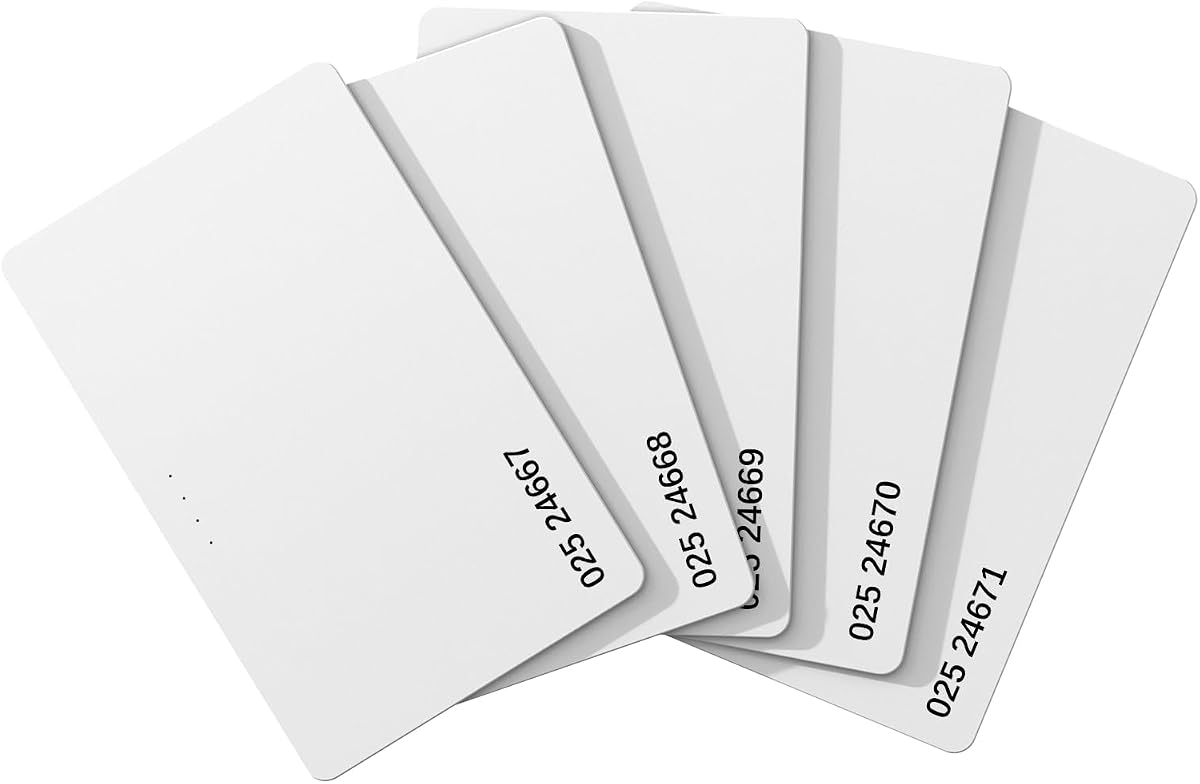
The YARONGTECH 125kHz T5577 pack carries a 4.5 rating and offers an approachable way to create blank 125kHz proximity credentials. It contains 20 white plastic cards built with an original T5577 chip. Because the cards arrive without a preprogrammed ID, they must be written before a reader can recognize them.
We may earn a commission when you buy through this link, at no additional cost to you.
The chip supports standard 125kHz ID and H-ID WG formats and can be programmed by a compatible 125kHz writer or copier. The listed use cases include hotel key cards, access control, attendance, and ticketing. The white card surface is printable by Zebra, Fargo, and Evolis card printers, making the product more versatile than an untagged generic PVC card.
Its main drawback is unavoidable setup complexity. A phone with NFC cannot normally read or write this low-frequency card, and a card reader alone does not program it. Compatibility also depends on the selected ID format, access-control controller, and writer. The product should only be used to create credentials for systems the user owns or is authorized to administer.
This is our Best Budget pick for small access-control, hotel-card, attendance, and authorized duplication projects. It offers more format flexibility than a fixed-ID blank and a useful twenty-card quantity without requiring a large inventory. Users should confirm their equipment supports 125kHz T5577 before ordering.
Support for multiple 125kHz ID formats makes these cards useful across different proximity workflows. A matching writer and reader configuration are still necessary, since the hardware determines which formats can be stored and recognized.
The plain white surface works with widely used professional card printers, allowing visual identification after programming. Combined with rewritable silicon, one physical card can support repeated credential changes in authorized systems.
We may earn a commission when you buy through this link, at no additional cost to you.
The 12-Pack T5577 Proximity Card has a 4.5 rating and offers a small, credit-card-sized inventory for 125kHz deployments. Each blank card uses a T5577 ID chip, measures like a standard CR80 card, and is listed at 0.8 millimeters thick. The thin construction can fit ordinary badge sleeves and compact wallets.
We may earn a commission when you buy through this link, at no additional cost to you.
These cards support 125kHz duplication, 125kHz ID and H-ID WG formats, and customization to 26-bit proximity format. That makes them candidates for hotel keys, access control, time and attendance, ticketing, and other internal workflows. The manufacturer notes lanyard punch markings on both short and long sides, adding a small convenience for badge-style deployments.
There is no preprogrammed ID, so a 125kHz writer is required before the cards will read. The wording on the listing includes several selectable quantities, but the supplied product data identifies this option as a 12-card pack. Users should not treat the visible T5567 and T5557 references as evidence that every card contains those chips; the specified chipset is T5577.
This is a sensible choice for technicians, small offices, and short projects requiring a modest number of programmable 125kHz cards. Its advantages are compact dimensions, format support, and a manageable pack size. As with every blank T5577 product, compatible programming hardware and authorization to create the credentials are prerequisites.
The CR80 size makes these cards straightforward to file in standard holders and badge sleeves. Their 0.8-millimeter thickness is thinner than several other T5577 options reviewed here, which can be useful where space is limited.
The T5577 chip can hold several common 125kHz ID arrangements. This reduces hardware friction when an existing system uses one of the supported formats, although the writer and reader must be configured consistently.
We may earn a commission when you buy through this link, at no additional cost to you.
The 10-Pack T5577 Smart Card has a 5.0 rating, the highest numerical rating among the products supplied. It provides ten blank, writable 125kHz T5577 cards in white PVC, with a stated thickness of approximately 1.8 millimeters. The cards are described as waterproof, wear-resistant, and suitable for repeated erase-and-write workflows.
We may earn a commission when you buy through this link, at no additional cost to you.
Its strongest feature is the clear attention to reader compatibility. The listing specifically references 1386, 1326, and H10301-format readers alongside access-control systems. It also identifies uses including smart door locks, employee and school identification, membership programs, parking systems, and hotel applications. The guidance to confirm device compatibility before purchase is especially important for blank cards.
The cards are not automatically accepted by smart locks or readers, and they cannot function before programming. Their physical size resembles a credit card, but at approximately 1.8 millimeters they are noticeably thicker than the 0.8-millimeter option in this guide. The listing also warns against direct use on metal surfaces because metal can interfere with radio coupling.
This product is a strong fit for testing a known 125kHz environment, replacing lost internal credentials, and building authorized access or attendance cards. The five-point rating reflects strong customer satisfaction, but it does not eliminate the need to match the chip, frequency, and supported format to the reader. That verification step should come before purchase.
The card is framed around common 125kHz reader families, making it easier to shortlist against existing equipment. Users should still check the precise chip and ID format accepted by the controller rather than relying on a broad frequency label alone.
The waterproof PVC body is suitable for everyday badges, employee cards, and repeat-use credentials. Its stated thickness favors durability over slimness, and metal placement should still be avoided.
We may earn a commission when you buy through this link, at no additional cost to you.
The 100-Pack T5577 Proximity Card is the bulk-oriented option in this 125kHz group, carrying a 4.5 rating. It uses T5577 chips and a thin 0.8-millimeter CR80 format, allowing the cards to fit standard badge sleeves. The large quantity makes it more relevant to hotels, campuses, offices, or managed access installations than to casual experiments.
We may earn a commission when you buy through this link, at no additional cost to you.
The product supports 125kHz ID and H-ID WG formats and customization to 26-bit proximity. Stated applications include hotel key cards, access control, time attendance, ticketing, and packing cards. Lanyard punch markings are present on both short and long sides, allowing flexible attachment methods after cards are personalized and issued.
The main operational challenge is scale. Every card needs an ID written before use, so administrators need a compatible writer, a consistent identifier policy, and a tracking process for issued credentials. Although the cards are rewritable, changing a credential is not the same as changing it safely: old access permissions should be removed from the controller when appropriate.
This is the most practical selection in the guide for a controlled bulk deployment of 125kHz cards. It provides the same core chip characteristics as the 12-card version but in an operational quantity suited to an organization. Confirm reader compatibility and prepare a programming workflow before ordering or issuing the cards.
A hundred-card package helps standardize physical credentials across a site or team. Using one card family can simplify procurement, printing, and replacement, provided the system remains on the supported 125kHz format.
At 0.8 millimeters, the cards are thinner than many conventional proximity credentials. That profile helps them fit standard wallets, sleeves, and lanyards without requiring a specialized bulky holder.
We may earn a commission when you buy through this link, at no additional cost to you.
The JASAG 100pcs Premium Rewritable UID Smart Card earns a 4.6 rating and combines a large package with genuine UID reprogramming. Built for 13.56MHz MIFARE Classic 1K systems, each card has a unique encrypted ID that can be read, written, copied, and reprogrammed. The listed endurance exceeds 100,000 rewrites.
We may earn a commission when you buy through this link, at no additional cost to you.
Its memory matches the familiar MIFARE Classic 1K structure of 1,024 bytes across 16 sectors and four blocks. The product information states compatibility with ISO/IEC 14443A and a reading distance of 0–10 centimeters. This makes it relevant to door access control and other 13.56MHz RFID products that accept compatible MIFARE Classic credentials.
The central limitation is interoperability. The cards cannot copy 125kHz credentials, and a reader designed only for T5577 or other low-frequency formats will not work with them. Reprogramming a UID also does not guarantee acceptance by access-control equipment that validates fixed UIDs, encrypted enterprise credentials, or proprietary protocols. Equipment compatibility should be established before a large purchase.
This is our Editor's Choice and the most balanced selection for organizations wanting a large inventory of genuinely rewritable 13.56MHz cards. It offers useful memory, strong stated endurance, and clear UID flexibility in a 100-card pack. Choose it when your system specifically supports MIFARE Classic 1K and changeable four-byte identifiers.
The familiar 16-sector, four-block organization gives programmers access to a standard MIFARE Classic 1K structure. This is more practical than choosing an unknown format when working with established 13.56MHz access-control equipment.
A 100-card inventory paired with reprogrammable UIDs supports reusable credential management. The cards are particularly useful for authorized internal testing and temporary identity workflows where replacing physical media is inconvenient.
We may earn a commission when you buy through this link, at no additional cost to you.
The 80-Pack MIFARE Classic 1K RFID Card has a 4.7 rating and is a strong standard-credential option, but it is not a rewritable-UID card. Its Fudan FM11RF08 chip conforms to MIFARE Classic 1K and ISO 14443A, while Sector 0 Block 0 and the four-byte UID remain permanently factory-locked.
We may earn a commission when you buy through this link, at no additional cost to you.
This distinction matters. Data blocks can be accessed and written after successful authentication, but the identifier itself cannot be altered. The product information specifies 1,024 bytes across 16 sectors with dual A and B keys, which supports more granular permission management than a small NFC memory tag. The default access key is listed as six FF bytes, and the packaging includes a protective storage box.
Compatibility is extensive but not universal. The cards are listed for mainstream devices such as ACR122U, PN532, and RC522, and the information mentions Android data editing with the default key. However, they are not compatible with iPhone writing, 125kHz equipment, ISO 14443 Type B, or named proprietary systems including HID, Salto, Assa Abloy, and Verkada AC33.
This product is a good choice for an organization issuing permanent employee, student, attendance, hotel, or gym credentials that will be printed and managed normally. It is not suitable for someone specifically seeking a changeable UID. Its high customer rating reflects the appeal of a standard MIFARE platform, not an ability to rewrite the locked identity.
Dual A and B keys and sector-level permissions allow administrators to separate access functions. That structure is useful where a standard issued badge must carry several data types while retaining controlled write access.
The immutable four-byte UID is the key limitation for anyone seeking reprogrammability. It also provides a stable identity for ordinary issued credentials, preventing the card number from being casually altered.
We may earn a commission when you buy through this link, at no additional cost to you.
The 5-Pack T5577 Rewritable RFID Cards provide a small batch for testing, replacement, and tightly controlled projects. They operate at 125kHz, use the T5577 chip, and are described as rewritable and erasable. The blank white design keeps them adaptable for custom identifiers and authorized access credentials.
We may earn a commission when you buy through this link, at no additional cost to you.
Intended applications include access control, asset tracking, inventory labeling, personal identification, time attendance, and do-it-yourself RFID work. The limited package quantity is the defining feature: it suits technicians who need to validate a reader setup, replace a few records, or experiment before purchasing a larger supply.
These cards cannot be read or used as finished credentials until a compatible 125kHz writer programs them. The listing also appropriately notes that unauthorized duplication of third-party access cards may be illegal in some jurisdictions. Users should create identifiers only for systems they own or have permission to program, and should remove old permissions when reassigning a card.
This is a practical choice for small-scale testing and replacement rather than a full organizational rollout. The absence of a numerical customer rating means there is less visible feedback than for several ranked products, so buyers should rely on confirmed reader compatibility. For owners of compatible 125kHz equipment, the compact quantity keeps trial projects economical.
Five cards are enough to verify a writer-reader workflow, test multiple identifiers, or maintain a small replacement stock. This makes the pack a less intimidating entry point than a large bulk order.
The erasable chip can be rewritten as inventory status or assigned access details change. Organizations should maintain a clear association between each card's physical identifier and its record in the asset or access system.
We may earn a commission when you buy through this link, at no additional cost to you.
The T5577 Thick Smart Card has a 4.7 rating and provides 12 blank 125kHz T5577 cards in a thick 1.8-millimeter CR80 format. The additional thickness makes the cards feel more substantial than slim PVC alternatives and may suit clamshell-style credentials that need a little more body.
We may earn a commission when you buy through this link, at no additional cost to you.
The cards can be written with a compatible 125kHz writer and support 125kHz ID, H-ID WG, and customizable 26-bit proximity formats. The stated reader families include 1386, 1326, and H10301. Applications include hotel keys, access control, attendance, ticketing, packing cards, and keyless entry systems. The chip can be erased and rewritten up to 100,000 times.
Several restrictions deserve attention. The cards are not NFC chips and will not work with NFC-enabled phones. The product information says they do not work with ONITY systems or Proxmark3 RDV4, and they must be programmed before use. None of those limitations is unusual for a low-frequency proximity card, but they rule out certain workflows.
This is a good option for users who want a sturdy, thicker credential for compatible 125kHz access equipment. Its twelve-card quantity and broad format support make it practical for small offices, workshops, or controlled replacement stock. Confirm the access-control platform and writer first, since the physical card's broad appearance does not guarantee system compatibility.
The 1.8-millimeter construction provides a sturdier feel and can suit thicker badge or clamshell arrangements. It is less discreet than the 0.8-millimeter T5577 cards but may handle regular handling better.
The product is explicitly limited with ONITY, Proxmark3 RDV4, and NFC phones. Checking those boundaries early can prevent a frustrating purchase that looks correct by frequency but cannot communicate with the intended reader.
We may earn a commission when you buy through this link, at no additional cost to you.
The most important choice is not the package size or appearance; it is compatibility with the reader, writer, access-control software, and credential format already in use. The following factors help separate a genuinely programmable card from a blank card with a permanent identifier or a tag intended only for a different frequency.
Operating frequency is the first technical filter. The 13.56MHz products in this guide use MIFARE Classic 1K or NTAG Ultralight EV1 chips, while most 125kHz products use T5577 proximity chips. A 13.56MHz reader cannot be expected to read a 125kHz card, and an ordinary NFC phone generally will not read a 125kHz T5577 card. Matching the card to the existing reader is more important than choosing a card simply because it is labeled RFID.
Chip type determines memory layout, commands, identifiers, and reader support. MIFARE Classic 1K offers 1,024 bytes across 16 sectors and four blocks, NTAG Ultralight EV1 provides 48 bytes of user-writable memory, and T5577 is designed for common 125kHz ID formats. A reader may support the same frequency as the card while still expecting a different chip or data format, so confirm both specifications before buying.
A blank card is not automatically a rewritable card. The T5577 and changeable-UID MIFARE products can have new identifiers written and updated, whereas the 80-pack F08 MIFARE option has a permanently locked four-byte UID. Its data blocks may be writable after authentication, but its identity cannot be changed. This distinction matters for temporary access, rotating credentials, authorized testing, and replacement workflows.
Most blank cards arrive without a usable identifier and cannot be read before programming. The T5577 products specifically require a compatible 125kHz writer or copier, while the 13.56MHz MIFARE options require suitable writing equipment. NTAG Ultralight EV1 cards can be handled through compatible NFC phone software after the specified setup and formatting commands are completed. Check writer protocols, supported formats, reader model, and access-control controller together.
Memory needs vary by project. A shared badge with balances, attendance records, or room permissions may benefit from the larger MIFARE Classic 1K structure, while a profile link, short note, ticket label, or NFC shortcut may fit comfortably in 48 bytes. More memory is not automatically better because sector structure, authentication, command support, and reader compatibility also determine whether the data can be used. Choose the simplest format your application actually requires.
Security requirements vary with the application. NTAG Ultralight EV1 provides password protection, access limits, one-time-programmable areas, counters, lock bits, and anti-tamper controls. MIFARE Classic cards use authentication keys and sector permissions, with write access denied when authentication fails. T5577 cards are often simpler proximity credentials whose security depends heavily on the surrounding access-control system rather than sophisticated on-card storage.
Consider how the cards will be identified and carried. The white PVC options can suit Zebra, Fargo, Evolis, thermal-sublimation, UV, retransfer, and specialized direct-to-card equipment, but they cannot be printed directly by ordinary household inkjet printers. Thickness also matters: the guide includes both 0.8-millimeter and 1.8-millimeter T5577 cards, which fit different holders and handling preferences. Credit-card dimensions alone do not guarantee a perfect fit.
Package sizes range from five cards for testing to 100 cards for institutional use. A small pack is appropriate for evaluating a reader setup, while larger quantities suit hotel keys, school cards, employee badges, and inventory labels. Consider the time required to program, print, issue, and track every card. A large inventory is valuable only when a consistent identifier plan and compatible programming workflow already exist.
Begin by documenting the exact reader, writer, access-control controller, chip type, ID format, and authentication method. Test one card before programming a batch, then read it through the intended reader and confirm that the identifier and permissions appear correctly. For NTAG Ultralight EV1 cards, follow the supplied NFC Tools setup commands and formatting requirement carefully before attempting a custom write.
Program only credentials for systems you own or have explicit authorization to administer. Keep a secure record linking each physical card with its assigned identity, owner, and access rights. When reassigning a card, remove the old credential from the access system and erase or rewrite the chip as needed. Avoid direct contact between low-frequency cards and metal surfaces, and do not expose cards to excessive heat, bending, or harsh chemicals.
For printed cards, use the recommended thermal, retransfer, UV, or specialized card-printing process and allow the surface to cool before handling. Store blank and programmed cards in a clean, dry holder protected from direct sunlight and physical abrasion. Test a sample after printing or lamination, since a damaged antenna or incompatible surface treatment can reduce read reliability. Retire cards that no longer read consistently rather than troubleshooting them repeatedly in a live access system.
A blank card contains an unprogrammed chip and normally cannot be recognized as a finished credential until an identifier is written. A rewritable card can be erased and programmed again, while some blank cards retain a permanent factory UID. Always check whether the card number, memory blocks, or both are programmable.
No, not in the ordinary sense. The T5577 products reviewed here operate at 125kHz, while NFC phones generally communicate with 13.56MHz tags. A phone may be able to read or write a compatible 13.56MHz MIFARE or NTAG card, but it cannot substitute for the dedicated 125kHz writer needed by T5577 cards.
No. Their data blocks may be writable after successful authentication, but the physical identifier can be factory-locked. The JASAG and LEXI options advertise changeable UIDs, while the 80-pack F08 product has a permanently locked four-byte UID and does not support custom UID modification.
The best card is the one supported by the complete access-control system. MIFARE Classic 1K options fit compatible 13.56MHz platforms, while T5577 cards fit many 125kHz readers and writers. Confirm the chip, frequency, format, security method, and any named system exclusions before purchasing.
Most cannot be printed directly with an ordinary home inkjet because the specialized PVC surfaces and embedded antennas are not designed for that process. The NTAG and MIFARE options mention thermal sublimation, UV, retransfer, direct-to-card thermal, and all-in-one laminating card printers. Zebra, Fargo, and Evolis compatibility is specifically stated for the YARONGTECH T5577 cards.
The NTAG Ultralight EV1, JASAG, LEXI, and T5577 products state write or rewrite endurance of approximately 100,000 cycles, depending on the product. Actual lifespan depends on the write method, card condition, and environment. The limit is not a guarantee that every card will perform identically for every user.
Most do. The T5577 cards are specifically programmed with a compatible 125kHz RFID writer or copier, and changeable 13.56MHz UID cards also require compatible programming equipment. The NTAG Ultralight EV1 cards can be prepared through NFC Tools on a compatible phone, but the factory-locked setup and formatting instructions should be followed exactly.
It depends on your authorization, the system, and local law. Copying a credential for a system you own or administer may be appropriate, but duplicating a third party's access card can violate policies or laws and may create security risks. Use blank cards only for legitimate credentials and obtain permission whenever the existing credential belongs to another person or organization.
The JASAG 100-pack stands out as the Editor's Choice for high-volume 13.56MHz workflows because it combines a changeable encrypted UID, MIFARE Classic 1K memory, and substantial rewrite endurance. The YARONGTECH 20-pack is the Best Budget selection for compatible 125kHz hotel, attendance, and access-control projects, while the LEXI 20-pack earns the Best Premium designation for its reprogrammable UID and established MIFARE Classic 1K layout.
Prioritize exact system compatibility over package quantity, attractive wording, or a shared RFID label. A 125kHz T5577 card cannot substitute for a 13.56MHz MIFARE card, and a card with a locked UID cannot meet a requirement for changeable identifiers. Review the reader format, writer support, memory, authentication, print process, and physical dimensions before making a final selection.
Prices and product configurations can change, so check the current listing and manufacturer information at the time of purchase. Also verify that any required writer, reader, software, access-control platform, or printer is already supported. With the right match between card and system, a blank rewritable card can provide a practical foundation for authorized access, identification, attendance, ticketing, and asset-management programs.