
UGREEN NAS DH2300 2-Bay
4.5Editor score
Simple private media storage
Up to 64TB raw capacity
1GbE wired networking
Automatic multi-device backups
Compare the best NAS for Home Media Server options for streaming, storage, backups, privacy, expansion, and easy setup in this expert buying guide today.
A NAS for Home Media Server gives movies, television, music, photographs, and family files a private, always-accessible home. The right unit balances drive capacity, network speed, media applications, backup options, quiet operation, and setup complexity, helping you build a dependable library without depending entirely on cloud storage.
We compared all 10 models using the supplied specifications, focusing on bay count, processor and memory, network interfaces, expandable storage, app support, surveillance features, photo organization, and protection functions. The guide covers beginner-friendly enclosures, creator systems, four-bay family models, premium performance options, and a drive-equipped alternative.
Each review identifies the strongest use case and important limitations, so you can choose according to your collection size and technical comfort rather than specifications alone. Ratings and product details reflect the information provided, while prices and availability can change at any time and should be checked before purchasing.
4.5Editor score
4.6Editor score

4.6Editor score
This side-by-side comparison highlights the major differences in capacity, networking, applications, and hardware, helping home media buyers match each enclosure to their storage scale, device mix, and desired level of technical control.




The UGREEN DXP2800 2-Bay is a strong all-around choice for a home media server, combining an Intel N100 quad-core processor, 8GB of DDR5 RAM, 2.5GbE networking, and room for two M.2 NVMe SSDs. Its 4.6 rating reflects a capable package for households that want more flexibility than a simple personal file hub without moving to a four-bay or premium system.
We may earn a commission when you buy through this link, at no additional cost to you.
Its greatest strength is the balance between media performance and expandability. Two SATA bays can house a pair of hard drives, while the M.2 slots add fast local storage that can support applications, caches, or enhanced data workflows. The enclosure can run Docker, virtual machines, and compatible Plex applications, giving media enthusiasts a broader application library than many basic NAS models. It also supports access from Windows, macOS, Android, iOS, browsers, and compatible smart TVs.
The photo and surveillance features make the system useful beyond simple streaming. AI tools can recognize people, objects, scenes, and locations, organize albums, and identify duplicates. Compatible network cameras can be connected for locally stored recordings, with face, people, and pet detection helping surface important events. The 2.5GbE port is also a meaningful upgrade over 1GbE when copying large files, although actual throughput still depends on the router, storage, and client.
This is a good recommendation for a family or creator who wants a private media library, automatic device backups, advanced applications, and future expansion in a two-bay enclosure. It is less suitable for someone who wants a completely hands-off appliance with no interest in Docker or NAS management. Hard drives and SSDs are not included, so the total system cost also depends on the storage you choose.
The N100 processor and 2.5GbE connection create a useful foundation for media libraries, regular backups, and Docker-based services. The two M.2 NVMe slots add an important upgrade path for users who want faster application data or cache storage.
AI photo management and local camera recording extend the enclosure into a broader digital hub. These capabilities are especially valuable for families accumulating years of photographs, videos, and surveillance footage.
We may earn a commission when you buy through this link, at no additional cost to you.
The UGREEN NAS DH2300 2-Bay is an approachable way to begin building a home media server, particularly for viewers who want centralized personal storage without a large learning curve. It carries a 4.5 rating and focuses on simple file access, automatic backups, photo organization, and broad device compatibility rather than advanced server applications.
We may earn a commission when you buy through this link, at no additional cost to you.
The enclosure includes 4GB of onboard RAM and a 1GbE network port. With two drive bays, advertised raw capacity reaches 64TB under the stated RAID 0 configuration. That is ample room for many personal film, music, and photo collections, and the automatic backup functions can work across Windows, macOS, Android, and iOS devices. AI tagging can recognize faces, locations, text, and objects, while duplicate-photo detection helps keep an expanding collection manageable.
The honest drawback is that this is an entry-level appliance. It does not support Docker or virtual machines, and Plex cannot be run through Docker on this model. The 1GbE connection also means transfer speed is more modest than on 2.5GbE or 10GbE systems. It supports wired Ethernet only, and any Wi-Fi use would require a compatible external USB adapter. The product is therefore best viewed as a capable private storage and backup server, not a highly expandable application platform.
Choose the DH2300 if you are moving away from scattered external drives, want automatic phone and computer backups, and primarily need reliable access to media and photographs. It is a sensible starting point for one or two users and modest libraries. Users who expect to install many self-hosted applications or move multi-gigabyte files constantly should consider a more powerful model.
The DH2300 emphasizes straightforward setup, automatic backups, and access from widely used operating systems. That focus makes it approachable for users who want the benefits of a NAS without immediately managing containers or virtual environments.
Two bays and up to 64TB of raw capacity suit personal libraries, while RAID options, two-factor authentication, permissions, and encrypted transfers help protect the data stored on your own drives.
We may earn a commission when you buy through this link, at no additional cost to you.
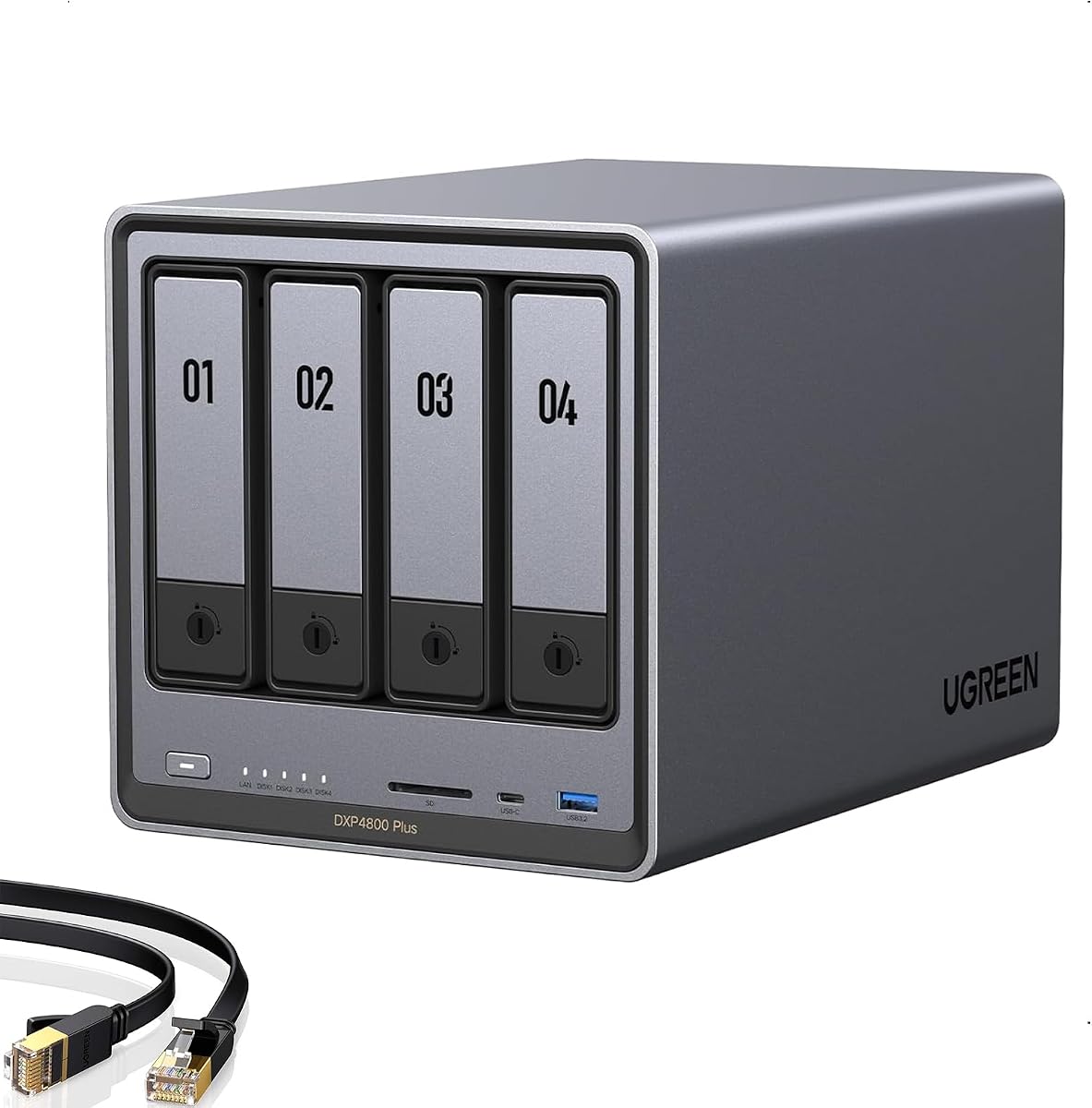
The UGREEN DXP4800 Plus 4-Bay is a compelling family and creator NAS because it combines four-bay capacity with a 10GbE connection, 10Gbps USB ports, Docker support, and virtual machines. Its 4.6 rating is supported by a specification set oriented toward fast backups, collaboration, large libraries, and flexible self-hosted applications.
We may earn a commission when you buy through this link, at no additional cost to you.
The network interface is the headline feature. The product information states that a 1GB file can be backed up in less than a second using either 10GbE or the 10Gbps USB connections. That performance is most useful for editors moving large camera files, families backing up multiple devices, and teams sharing sizable media projects. Four bays provide room for growth, while advertised raw capacity of up to 144TB gives a large collection considerable room to grow.
The enclosure also supports Docker and virtual machines, allowing it to run media software such as Plex through Docker. It works across Windows, macOS, Linux, iOS, Android, and Google services, with an interface for file sharing on desktop systems, mobile devices, browsers, and smart TVs. AI photo albums can recognize faces, scenes, objects, and locations and remove duplicates. Encryption, flexible permissions, RAID choices, and centralized backup functions make it relevant to households that want private control over shared data.
The important trade-off is that storage drives are not included, and the stated maximum capacity is based on RAID 0. Wired Ethernet is the only built-in network option, so users must plan for a compatible 10GbE switch, router, and client adapter to realize the full network benefit. This is a strong recommendation for a family library, creative studio, or small team that wants one system to handle media, backups, applications, and secure collaboration.
A 10GbE port and 10Gbps USB connections make this model better suited to large media files than a standard 1GbE NAS. A compatible network and client are necessary to take full advantage of those interfaces.
Four bays, RAID flexibility, Docker, virtual machines, and cross-platform access create a broad foundation. The system can begin as a media server and later accommodate backup, collaboration, and application workloads.
We may earn a commission when you buy through this link, at no additional cost to you.
The UGREEN NAS DH4300 Plus 4-Bay is designed for beginners, home users, and remote workers who want a four-bay media server without paying for the highest tier of processing hardware. Its 4.2 rating makes it a solid, accessible option, particularly when the priority is straightforward setup, phone backups, and private media access.
We may earn a commission when you buy through this link, at no additional cost to you.
Eight gigabytes of LPDDR4X and a 2.5GbE port provide enough headroom for everyday household tasks. The product data states that a 1GB file can transfer in about three seconds, though real results vary with the router, processor, drive, and file size. The four bays support up to 128TB of advertised raw capacity using RAID 0, offering more growth room than a typical two-bay beginner enclosure.
The DH4300 Plus supports Docker, making it more versatile than the DH2300, although it does not support virtual machines. Plex can be run through Docker. Automatic phone photo and video backup, semantic search, custom learning, and recognition of people, objects, pets, and similar images make the AI album tools particularly relevant to family collections. Setup through NFC, a beginner-friendly manual, and video instructions help reduce the initial learning curve.
Its main limitation is the lack of virtual machine support, which narrows the appeal for advanced users. The system is also wired Ethernet only, and storage disks are not included. It is best suited to families that want four-bay expansion, 2.5GbE performance, automatic backups, and basic self-hosted services without moving to premium desktop processors.
Real-time phone backup and AI album tools reduce the effort required to preserve family memories. Recognition and semantic search can make older images easier to locate as the collection grows.
The 2.5GbE network and 128TB advertised raw capacity suit active households. Docker support adds optional media-server flexibility, though the enclosure cannot run virtual machines.
We may earn a commission when you buy through this link, at no additional cost to you.
The UGREEN NAS DXP4800 GT 4-Bay is the premium performance choice in this guide, built around an AMD Ryzen Embedded R2514 processor with four cores, eight threads, and speeds up to 3.70GHz. It includes 8GB of DDR4 memory that can be expanded to 64GB and offers dual 10GbE networking, making it particularly persuasive for high-resolution media, 4K and 8K editing, and demanding multi-user workloads.
We may earn a commission when you buy through this link, at no additional cost to you.
UGOS Pro combines guided setup with advanced file management, search, backup, photos, Docker, virtual machines, and SAN Manager. The application ecosystem can include Plex, Emby, Jellyfin, Home Assistant, and other self-hosted workflows. For photographers and videographers, the built-in SD card slot is a thoughtful convenience: insert a card and use the app to copy or back up files without a separate reader. USB-A 10Gbps, USB-C 10Gbps, USB 2.0, and 4K HDMI connectivity further improve direct-transfer options.
The built-in Surveillance Center is another major strength. Compatible ONVIF or RTSP cameras can be managed for live multiview, pan-tilt-zoom control, event detection, recording, and timeline playback. Footage remains on local storage, reducing dependence on camera-specific cloud services. Security features include TLS/SSL, RSA, AES, SHA-512, a Security Manager, permissions, and RAID support.
Dual 10GbE ports can theoretically deliver up to 20Gbps with link aggregation on compatible equipment, enabling multi-user access and large-file transfers. That level of networking is exceptional for a home media server. The trade-offs are that drives are not included, Plex needs manual Docker setup, and the pre-installed memory is non-ECC. Users wanting automatic memory error correction must install compatible ECC RAM. This model is best for technically confident creators, enthusiasts, and small offices that will use its advanced ports and applications.
Dual 10GbE ports and a Ryzen R2514 processor provide a large performance margin for high-bitrate media and simultaneous access. A compatible switch, client, and storage configuration remain necessary for maximum throughput.
The built-in surveillance center, local recording, and direct SD import broaden the enclosure beyond entertainment. Creators can consolidate footage, project files, photographs, and security video under one management interface.
We may earn a commission when you buy through this link, at no additional cost to you.
The Synology DS223 is a straightforward two-bay NAS for consolidating files from computers, phones, and external drives into one locally controlled hub. Its 4.6 rating and focus on backups, collaboration, and surveillance make it a practical choice for home users who value an established ecosystem over high-end specifications.
We may earn a commission when you buy through this link, at no additional cost to you.
The supplied information emphasizes straightforward organization and sharing. Users can sync documents across devices, share projects with clients, and maintain version control without relying on a third-party file-sharing subscription. Automated backup scheduling can protect Macs, PCs, and mobile devices, with destinations that include cloud storage and external drives. This combination makes the DS223 useful as both a media repository and a safety net for important working files.
Synology's established software environment is another reason to consider this model. The DS223 can transform compatible IP cameras into a monitoring system with motion alerts, recording schedules, and remote viewing. That extends the value of the enclosure to users who want home or small-office surveillance. The product also includes a two-year warranty, expert customer support, and ongoing software updates.
Detailed processor, memory, and networking figures were not supplied for this particular listing, so buyers should verify current specifications and media application compatibility before ordering. It is a diskless enclosure, meaning compatible storage drives must be purchased separately. The DS223 is best for users who want a recognized, approachable NAS with strong backup and surveillance functions, particularly if they already use other Synology products or appreciate its management software.
The DS223 gathers media and working files into a single owned repository. Automated backups and multi-destination recovery options help protect that data from device loss or accidental deletion.
Compatible IP cameras can provide motion alerts, scheduled recording, and remote viewing. That makes the NAS useful for both household media and property monitoring rather than entertainment alone.
We may earn a commission when you buy through this link, at no additional cost to you.
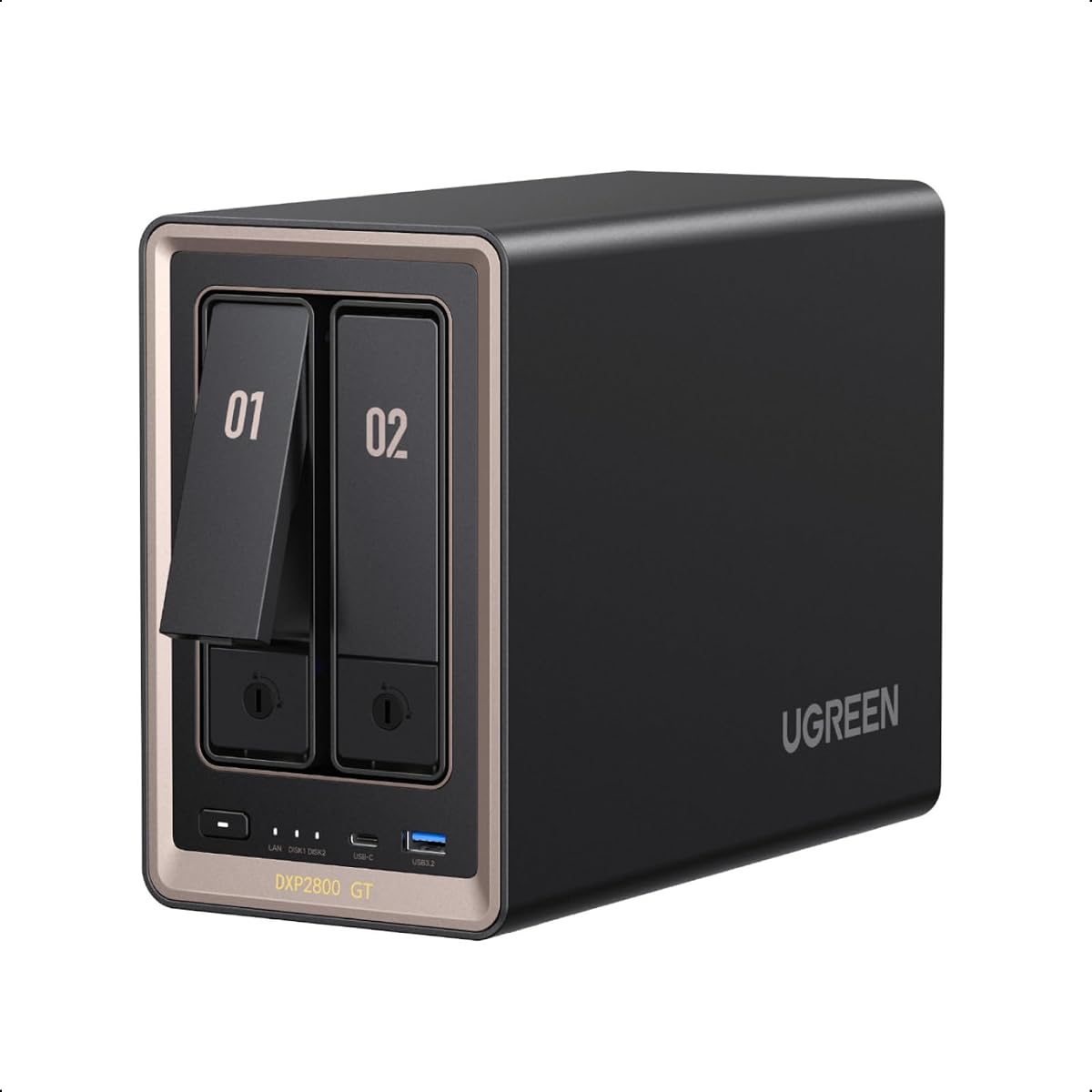
The UGREEN DXP2800 GT NAS pairs the performance of a higher-end platform with a two-bay enclosure. Its AMD Ryzen Embedded R2514 processor, 8GB of expandable DDR4 memory, and 10GbE networking make it a compelling option for creators and freelancers who want fast media access but do not need four drive bays.
We may earn a commission when you buy through this link, at no additional cost to you.
UGOS Pro provides the familiar combination of file management, global search, photo tools, and backup tools while adding Docker, virtual machines, and SAN Manager. Those features allow the unit to run Plex, Emby, Jellyfin, Home Assistant, and other services. Two SATA bays can accept drives up to 32TB each, and the model can also use NVMe expansion, producing an advertised total of up to 80TB.
A built-in Surveillance Center supports compatible ONVIF and RTSP cameras with live viewing, continuous recording, event review, and centralized storage. Layered protection includes TLS/SSL, RSA, AES, SHA-512, Security Manager tools, flexible permissions, and RAID 1 support. This makes the enclosure attractive to smart-home users who want local control over recordings and personal files.
Its 4.3 rating is still solid, but the smaller bay count is the main compromise for a growing household. The 10GbE network also needs compatible infrastructure, and Plex requires manual Docker setup. As with the DXP4800 GT, the pre-installed memory is non-ECC, so error correction needs a compatible upgrade. This model makes the most sense for a two-user creative setup or a tech enthusiast who prioritizes speed and applications over maximum raw drive expansion.
The Ryzen processor, 10GbE interface, and expandable memory provide unusually strong performance for a two-bay NAS. This is useful for large backups, media libraries, and self-hosted applications without requiring four bays.
Surveillance recording and locally stored data give smart-home users greater control over privacy. RAID 1 and layered security features complement the local-first approach.
We may earn a commission when you buy through this link, at no additional cost to you.
The Synology DS425+ stands out as a four-bay private cloud and media server, earning the highest rating in this group at 4.7. Its stated 278MB/s transfer speed and support for more than 10 concurrent users make it especially attractive to families and small offices that need shared access to large media collections.
We may earn a commission when you buy through this link, at no additional cost to you.
Beyond raw performance, the enclosure is positioned as a centralized repository for company documents, client files, and media assets. Granular access controls and audit logs help organize collaboration, while RAID redundancy, automated backups, and snapshot technology provide multiple layers of protection. These are valuable features for anyone storing files that must remain available without depending entirely on public cloud platforms.
Surveillance support is another major strength. The DS425+ can work with up to 30 IP cameras and provides motion detection and secure remote access, making it suitable for a home, small business, or mixed personal environment. A three-year warranty adds coverage, while dedicated technical account management is available for business-critical production use. That support is more relevant to teams than to a single-user media library.
The listing is a diskless four-bay model, so compatible drives are not included. Detailed processor, memory, and expansion specifications were not included in the supplied product information, and buyers should verify them against their media software and camera requirements. The DS425+ is a strong recommendation for a busy household or small creative team seeking fast four-bay access, professional protection features, and broad surveillance capability.
The stated 278MB/s speed and concurrent access for more than 10 users position the DS425+ for shared media. Network infrastructure and drive configuration still determine what users experience in practice.
Snapshots, automated backups, access auditing, and permissions create a layered approach to recovery and control. These functions make the model more relevant to business or collaborative home use.
We may earn a commission when you buy through this link, at no additional cost to you.
The Synology DS225+ 8TB Bundle is distinctive because it arrives with two 4TB Seagate IronWolf drives, making it more immediately useful as a home media server than a diskless enclosure. Its 4.6 rating and familiar two-bay design suit first-time NAS owners who want the storage hardware included in one package.
We may earn a commission when you buy through this link, at no additional cost to you.
The enclosure uses an Intel Celeron J4125 quad-core processor and includes 2GB of non-ECC DDR4 SODIMM memory, expandable to 6GB by adding a 4GB module. Two RJ45 ports provide both 2.5GbE and 1GbE connectivity, giving you the option to use the faster connection with compatible network equipment or the 1GbE port as a fallback.
Synology Hybrid RAID provides flexible management for the included drives, while the Btrfs file system and snapshot technology add stronger data-protection options. The supplied information also notes that the DS225+ is compatible with third-party drives since DSM 7.3, offering more freedom when expanding or replacing storage later. The included 8TB total is a useful starting capacity for a family collection, though it is small compared with the raw capacities advertised for larger multi-bay systems.
The bundle is especially convenient for users who do not want to select and install drives themselves. However, buyers who already own compatible hard drives may find a diskless option more economical. The 2GB starting memory is modest, and media-heavy workloads may benefit from the supported upgrade. It is a strong recommendation for a straightforward two-bay private media server, particularly for Synology users who value bundled IronWolf storage and established data-protection features.
Two 4TB Seagate IronWolf drives provide 8TB of raw bundled capacity. This simplifies setup and gives a new owner usable media storage without an immediate additional drive purchase.
Synology Hybrid RAID, Btrfs, and snapshot technology provide useful safeguards for shared household files. The 2.5GbE port also offers a faster path for larger media transfers when the rest of the network supports it.
We may earn a commission when you buy through this link, at no additional cost to you.
The QNAP TS-264 8GB is a compact two-bay NAS with a 4.7 rating, matching the highest rating in this guide. Its eight gigabytes of installed memory and support for an M.2 2280 NVMe PCIe SSD make it especially interesting for media users who want more responsive application and cache performance than a basic enclosure normally provides.
We may earn a commission when you buy through this link, at no additional cost to you.
The supplied specifications also highlight port trunking, which can deliver faster aggregate network speeds over existing CAT5e cabling when the required networking equipment is compatible. That can be useful for moving large libraries between computers and the NAS or for serving several users at once. An optional M.2 2280 NVMe SSD can improve overall NAS performance and act as a useful complement to the two main drive bays.
Dual screen extensions are another distinguishing feature. The TS-264 can support extended displays for monitoring or 4K high-definition video playback, which may appeal to users who want a compact local dashboard, status display, or dedicated media interface. Its 8GB of RAM also provides a better foundation for multiple services than many entry-level systems with fixed or minimal memory.
The key caveat is that the M.2 SSD is sold separately, and advanced networking features depend on compatible switches, cables, and configuration. Detailed processor and media application information was not included in the supplied listing, so current specifications should be verified. The TS-264 is a strong recommendation for an enthusiast who wants a two-bay, memory-rich system with NVMe expansion, flexible networking, and direct display possibilities.
Eight gigabytes of installed RAM supports a more capable software environment, while the M.2 slot creates a clear upgrade path. The optional NVMe drive can help accelerate suitable workloads without occupying a main media bay.
Port trunking and dual display extensions provide uncommon flexibility for a compact NAS. These features are most valuable when paired with compatible network equipment and carefully planned media services.
We may earn a commission when you buy through this link, at no additional cost to you.
A useful NAS purchase starts with your library, devices, network, and tolerance for administration. The following factors connect everyday home media needs with the technical differences among these ten models.
Drive bays determine how many hard disks or SATA SSDs you can install and how easily the system can grow. A two-bay model is a sensible starting point for one household when paired with RAID 1, while a four-bay enclosure offers greater expansion potential and more complex storage options. Advertised capacities generally represent raw totals under RAID 0 and should not be confused with protected usable space. Buyers should also remember that most listings do not include drives, except for the Synology DS225+ bundle, so the complete system requires a storage budget beyond the enclosure itself.
The application platform determines how easily you can organize and stream a collection. The DH2300 does not support Docker or virtual machines, while the DH4300 Plus supports Docker but not virtual machines. Every listed DXP model supports Docker and virtual machines, and Plex can run through Docker on those units, though manual setup may be required. Synology systems bring a mature package and media ecosystem, while the QNAP model is intended for users comfortable with a broader enthusiast feature set. Check the current compatibility list for the exact Plex, Emby, Jellyfin, or other applications you plan to use before buying.
A fast network interface is useful only when the router, switch, cables, and playback devices can also handle the higher speed. The DXP4800 Plus has 10GbE and 10Gbps USB, the DXP4800 GT has dual 10GbE, and the DXP2800 GT has one 10GbE port. The DXP2800 and DH4300 Plus use 2.5GbE, while the DH2300 uses 1GbE. Higher speeds help with initial library imports, large creative files, and simultaneous access, but they rarely make ordinary streaming dramatically faster after a library is stored.
The processor and installed memory influence responsiveness when several people access files, backups run, photo indexing occurs, or additional services are active. The Intel N100-based DXP2800 and AMD Ryzen-based GT models are better suited to demanding or multi-user workloads than the entry-level DH2300. The DH2300 provides 4GB of onboard memory, the DH4300 Plus includes 8GB of LPDDR4X, and both GT models provide 8GB that can be expanded to 64GB. The QNAP TS-264 also includes 8GB. Applications demanding memory, such as multiple virtual machines, deserve particular attention.
A NAS is a storage and access device, not a substitute for every backup strategy. RAID can preserve availability after a drive failure, but it does not protect against accidental deletion, ransomware, fire, or equipment theft. Automated device backups, snapshots, external-drive copies, and versioned cloud destinations provide stronger layers of protection. The DS425+ emphasizes RAID, backups, and snapshots, while the Synology DS223 supports multi-destination backups. UGREEN models provide RAID, permissions, encryption, and automated backup functions, with local account modes in some cases.
AI photo tools can automatically group images by people, objects, scenes, locations, and even detect duplicates. The DXP2800, DH2300, DH4300 Plus, and DXP4800 Plus all provide some form of AI album organization, which is useful for large family collections. The DXP4800 GT and DXP2800 GT include a dedicated Surveillance Center for compatible ONVIF or RTSP cameras. The Synology models also support IP camera monitoring, with the DS425+ listing stating support for up to 30 cameras. Verify camera compatibility and consider the privacy and retention requirements of continuously recorded footage.
Beginner-friendly setup can make a large difference for a first NAS. The DH4300 Plus offers NFC-assisted connection, simple setup, a manual, and video instructions. More advanced systems provide deeper controls, richer connectivity, and more ways to expand through NVMe slots, USB ports, HDMI, dual displays, SD cards, and virtualized services. The DXP4800 GT includes USB-A 10Gbps, USB-C 10Gbps, USB 2.0, 4K HDMI, and an SD card slot. Also verify whether Wi-Fi is built in; none of the listed models provides built-in Wi-Fi, and the DH2300 requires an external USB adapter for wireless use.
A NAS that serves media may remain powered throughout the day, making efficiency, heat, and noise relevant to a living space. None of the supplied product information provides a formal noise rating, so reviews and current documentation are important for a shared room. Placement near a router or switch may necessitate a long Ethernet run, while a media center near televisions may be more convenient for direct playback. Check the enclosure dimensions, thermal design, and included accessories before installation, and avoid placing drives in locations exposed to vibration, moisture, or excessive heat.
Begin by choosing compatible drives, populating the enclosure, and connecting it to the network with Ethernet. Follow the manufacturer's guide for inserting drives, creating the administrator account, and selecting a RAID or storage configuration. Decide on the RAID layout before adding important files, because changing storage arrangements later can affect how the volume is used. After initialization, create separate user accounts for family members and assign only the permissions each person needs.
Install and configure your chosen media application, organize the library into clear folders, and set appropriate library permissions. Enable automatic backups for phones, laptops, and desktop computers, then maintain at least one additional backup destination outside the NAS. Update the system software, media applications, and drive firmware on a regular schedule. If the NAS includes camera support, configure recording schedules, retention, and access permissions rather than enabling every feature without a plan.
Maintain the system by monitoring drive health, keeping the enclosure ventilated, and avoiding abrupt shutdowns during writes. Create regular offline or external-drive backups for irreplaceable files, and test that important media and archives can be restored. Clean the vents gently, keep the unit away from moisture and direct heat, and review user access whenever household devices or collaborators change. Updating the NAS is not the same as backing up its data, so keep both routines in place.
A NAS is useful when you want a permanent, organized library that several household devices can access without managing separate files on each computer. It can also provide automatic backups, remote access, and local photo or surveillance storage. If you only stream from an existing service and keep few personal files, a simpler setup may meet your needs. For a growing collection, a NAS offers greater control and convenience.
A two-bay NAS can be appropriate for many families, especially when the drives are configured for resilience and a clear expansion plan exists. A four-bay model offers more flexibility for growth, mixed drive types, and larger collections. Consider the size and quality of your existing library, how often you add media, and whether anyone wants to run surveillance recording on the same system.
Most 4K streaming does not require 10GbE once media is stored on the NAS. Faster networking matters most when importing large libraries, backing up high-resolution camera files, or serving several users simultaneously. A 1GbE connection is usually adequate for basic playback, while 2.5GbE offers a practical middle ground and 10GbE targets demanding creative workflows.
They can provide private local storage, remote access, and automatic backups without making cloud storage the primary location. However, no single local system protects against every accident, so important files should also have another backup. An external drive, another NAS, or a selected cloud destination can provide recovery from theft, fire, ransomware, and accidental deletion.
No. The DXP series supports Docker, and Plex can be run through Docker with the required manual setup. The DH4300 Plus also supports Docker for Plex, but the DH2300 does not support Docker or virtual machines. Synology and QNAP systems have their own application ecosystems, so verify current media compatibility for the exact model before purchasing.
Most of the listed products are diskless and require compatible drives to be purchased separately. The Synology DS225+ 8TB Bundle is the exception, as it includes two 4TB Seagate IronWolf drives. Check the current listing carefully because bundle contents can change, and confirm that any separately purchased drives are compatible with the enclosure and intended workload.
RAID and backups solve different problems. RAID can keep a volume available when a drive fails, but deleted files, ransomware, and hardware destruction can still affect every copy in the array. Use RAID as one layer of drive-failure resilience, and maintain separate, tested backups for family archives and irreplaceable creative work.
Several models in this guide support compatible IP cameras. The UGREEN DXP4800 GT and DXP2800 GT include Surveillance Center features for ONVIF or RTSP cameras, while the Synology models also support camera monitoring. Compatibility, channel limits, recording behavior, and secure remote access should be checked against the current documentation and camera models before installation.
The UGREEN DXP4800 Plus is the strongest balanced recommendation, combining four bays, 10GbE, fast USB, Docker, virtual machines, and a 144TB advertised raw capacity. The DH2300 is the easiest entry point for personal storage and backups, while the DXP4800 GT represents the premium option for creators, multi-user workloads, fast networking, and built-in surveillance management.
Prioritize the features your household will actually use. Choose two bays for a modest library, four bays for growth, 2.5GbE or faster for large transfers, and Docker support if you want self-hosted media applications. Always plan separate backups, verify camera and software compatibility, and remember that most NAS purchases also require compatible storage drives.
Product ratings, software capabilities, availability, and prices can change over time. Before ordering, check the current Amazon listing and manufacturer documentation for drive compatibility, supported applications, memory upgrades, networking requirements, and warranty coverage. Those final checks will help ensure the enclosure you choose remains suitable as your media library and household ecosystem evolve.