
Uniden SDS100 True I/Q Digital Handheld Scanner
4.4Editor score
True I/Q reception
Updatable systems database
GPS-compatible location scanning
A handheld frequency scanner can make local radio activity easier to observe, whether you follow public safety transmissions, aviation bands, marine channels, amateur radio, or nearby RF signals. The right device depends on the systems you expect to receive, the accuracy of the information displayed, and how often you will use it away from a desk.
This guide compares ten products with different roles. Some are conventional communication scanners designed to receive programmed radio traffic, while others are spectrum analyzers that reveal signal energy across a broad frequency range. We compared their stated capabilities, supported radio formats, memory, portability, display features, search functions, and setup options.
Each pick highlights a different reason to buy, from a straightforward analog scanner to advanced trunked-radio receivers and touchscreen analyzers. Ratings reflect the supplied customer feedback, while specifications are based on the product information. Prices and availability change frequently, so confirm the current listing before purchasing.
4.4Editor score

4.2Editor score

4.0Editor score
As an Amazon Associate we earn from qualifying purchases.
The table below separates conventional radio scanners from touchscreen spectrum analyzers, making it easier to compare intended use, supported formats, frequency reach, and practical features.
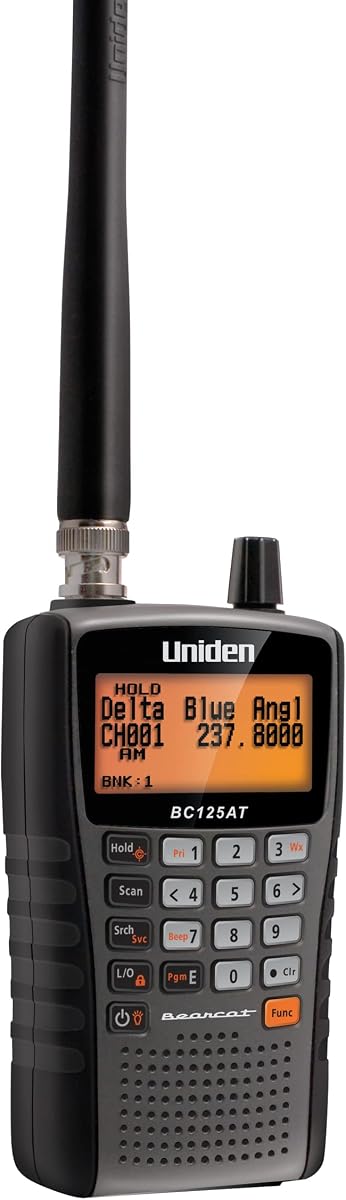


The Uniden Bearcat BC125AT is a conventional handheld scanner rated 4.0 stars by customers. It is designed for listeners who want organized access to analog radio traffic without navigating a complex digital platform. Its 500 alpha-tagged channels, 10 storage banks, and preset service bands make it approachable while retaining room for personalized favorites.
We may earn a commission when you buy through this link, at no additional cost to you.
Close Call RF capture is the standout feature because it can automatically tune toward nearby transmitters that may not already be stored in the scanner. Alpha tagging helps users identify channels at a glance, and the orange backlight supports operation in dim conditions. The device is receive-only, so it is intended for listening rather than transmitting or two-way communication.
Its essential limitation is digital compatibility. The BC125AT cannot receive formats such as Project 25, DMR, or NXDN, and it will not follow digital trunked systems used by some public safety agencies. That makes it a sensible choice for analog broadcasting, aviation, marine, railroad, and local conventional traffic, but a poor match for areas dominated by digital radio.
Choose the BC125AT if you want a straightforward, compact scanner with useful presets and readable channel organization. It is especially attractive to beginners and travelers who do not need advanced digital decoding. Confirm the radio formats used around you first, and favor this model only when conventional analog reception meets your monitoring goals.
Each of the 500 channels can carry a descriptive name, making it simpler to separate departments, locations, and areas of interest. The 10-bank structure also keeps favorite groups from becoming an unwieldy single list.
Close Call RF capture watches for nearby transmissions and quickly retunes the scanner to detected activity. It is useful when exploring a new area or finding frequencies that were not previously programmed.
We may earn a commission when you buy through this link, at no additional cost to you.
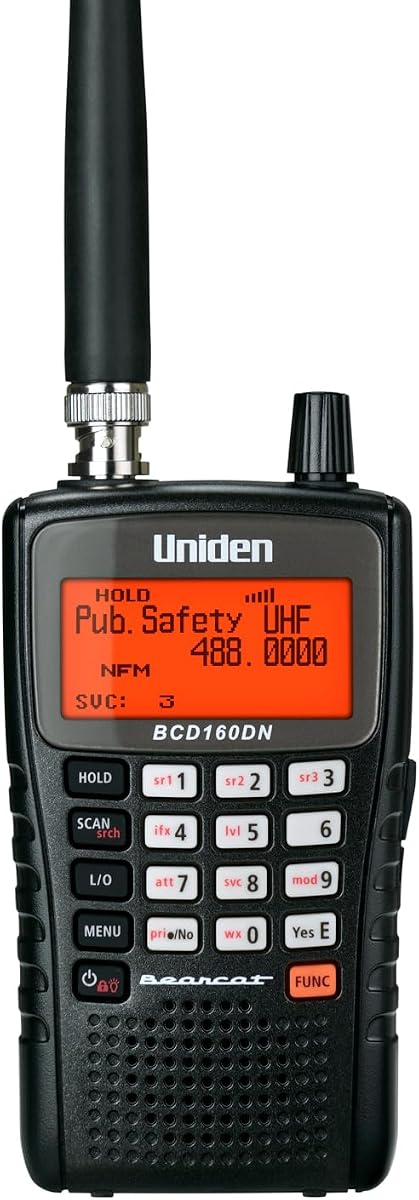
The Uniden Bearcat BCD160DN is a handheld digital scanner with a 3.2-star customer rating. It targets a specific middle ground: listeners who need DMR and NXDN capability and want rapid signal detection without moving directly to a premium trunked-radio receiver. Its 1,000-channel memory and preloaded formats make it a relevant upgrade over analog-only models.
We may earn a commission when you buy through this link, at no additional cost to you.
Rapid DCS and CTCSS decoding can expose subaudible tones that help identify system settings, while narrow-band reception and the Band Scope support faster signal discovery. Custom Search can begin at the displayed frequency or accept a manually entered one. PC programming adds flexibility for profiles, favorite lists, databases, and firmware management.
The stated limitations matter. The scanner includes DMR and NXDN but does not support APCO P25 or trunking. It is therefore not a universal digital scanner, particularly for public safety users whose local agencies rely on P25 Phase I or Phase II. Its lower customer rating also suggests that buyers should examine the current listing carefully for fit.
The BCD160DN suits users interested in conventional digital radio who specifically need DMR or NXDN. It is less appropriate for broad public safety coverage or travelers who may cross into different trunked formats. Confirm the systems in your area, then choose it if its supported formats align and the lower rating does not reflect a concern for your intended use.
DMR and NXDN are preloaded, reducing the initial setup required to begin monitoring supported conventional digital systems. Users still need to configure locations and channels relevant to their area.
Rapid tone decoding, narrow-band reception, and searchable ranges help users locate elusive signals. Custom Search also supports direct frequency entry when a user already knows what to monitor.
We may earn a commission when you buy through this link, at no additional cost to you.
The Uniden Bearcat SR30C is an entry-level 500-channel handheld scanner with a 4.0-star customer rating. It gives users access to more than 32,000 preset frequencies across ten service banks, including weather, marine, aviation, railroad, ham radio, racing, and conventional public safety bands.
We may earn a commission when you buy through this link, at no additional cost to you.
Turbo Search, Close Call RF capture, and priority scanning help users explore nearby activity and keep important channels prioritized. PC programming provides greater control over memory, while memory backup helps retain programmed frequencies if power is lost. Its triple-conversion design is another useful feature for receiving a range of conventional signals.
Power can come from two AA alkaline batteries, two AA rechargeable Ni-MH batteries, or a USB source through the included cable. Rechargeable cells are not included with the scanner, so buyers should account for that separately. Like the BC125AT, it cannot receive Project 25, DMR, NXDN, or other digital systems.
The SR30C is a strong budget choice for analog listeners who want presets, PC programmability, and more storage than a very basic radio. It works well for aviation, marine, railroad, weather, racing, and other conventional activity. Users in digitally dominated areas should choose a more capable receiver instead.
Preset banks cover popular categories and provide a convenient starting point for new users. Favorites can then be arranged in memory for the bands and channels used most often.
USB power and two AA battery options support use at a desk, in a vehicle, or outdoors. The ability to charge compatible Ni-MH cells internally adds flexibility without requiring a separate charger.
We may earn a commission when you buy through this link, at no additional cost to you.
The Uniden SDS100 is the premium radio-scanner option in this group, earning a 4.4-star customer rating. Its True I/Q receiver is designed to improve digital decoding, error correction, and signal recovery in weak-signal or simulcast areas, making it appealing to listeners who encounter difficult reception conditions.
We may earn a commission when you buy through this link, at no additional cost to you.
A HomePatrol database includes known radio systems in the United States and Canada, and the main database is updated weekly. Setup can begin with a ZIP or postal code, while an auto-locate feature can estimate the general position. The customizable color display allows different fields to use preferred colors and available information.
An external GPS receiver is not included, although the scanner is compatible with one. When connected, GPS can support precise system selection and automatic reselection while traveling. The built-in battery charger and JIS 4 weather-resistant construction also suit mobile and outdoor use, although buyers should still protect the device from severe weather.
The SDS100 is recommended for enthusiasts who need robust digital reception, broad system selection, and dependable performance in challenging RF environments. It is less compelling for someone who only wants a few analog channels, but it offers the most purpose-built scanner feature set here. Its higher specification level makes it the strongest choice for serious monitoring.
The receiver captures the complete signal waveform in three dimensions, supporting better digital error correction and recovery. This can make a meaningful difference where simulcast overlap or weak signals are common.
The frequently updated system database reduces manual research, while optional GPS assistance can automatically select relevant radio systems as the user moves between locations.
We may earn a commission when you buy through this link, at no additional cost to you.
The Whistler WS1040 is a digital handheld scanner rated 4.1 stars, with particular relevance to users who need P25 Phase I and trunked-radio monitoring. It supports multiple radio systems and includes programmable operation, a PC interface, LED and audio alerts, and same-area weather alert functionality.
We may earn a commission when you buy through this link, at no additional cost to you.
Unlike scanners with rigid memory banks, dynamic memory allocation assigns capacity as needed, making efficient use of limited memory. Scan lists can also be organized according to preference. Context-sensitive help provides guidance directly beside menu items, which can reduce the learning curve for new or occasional users.
Its primary strength is focused digital support rather than the broader format collection associated with some Uniden models. P25 users and those who need trunking may find that combination especially useful, but buyers should confirm the exact systems operating in their area. Menu-driven programming also takes more setup than a simple postal-code receiver.
The WS1040 is a good match for P25 Phase I users who want a programmable handheld platform with flexible memory. It is less suitable for travelers who want automatic location-based system selection, because no GPS capability is listed. Overall, it offers a strong digital feature set for users who prefer explicit programming control.
Dynamic allocation reduces waste compared with fixed memory-bank arrangements. More space can be directed toward the scan lists and systems that a particular user actually monitors.
Context-sensitive explanations appear near the relevant option, helping users understand unfamiliar settings. This makes the PC-based setup process more approachable for less experienced operators.
We may earn a commission when you buy through this link, at no additional cost to you.
The Uniden BCD436HP combines approachable setup with substantial monitoring features, earning a 4.2-star customer rating. Entering a ZIP code can be enough to begin receiving compatible public safety, aviation, military, weather, and other nearby systems, which makes it the most user-friendly full-featured scanner in this roundup.
We may earn a commission when you buy through this link, at no additional cost to you.
TrunkTracker V, Close Call RF capture, radio system analysis, and discover modes give users several ways to locate traffic. The large display presents channel and system information clearly, while GPS connectivity can support more precise system selection when an appropriate GPS accessory is used. The supplied information states a scanning speed of 85 channels per second.
Custom alerts can be tied to channel or unit IDs, Close Call hits, emergency alerts, and tone-outs. Users can choose from multiple tone patterns, volume levels, colors, and flash patterns. Instant Replay can play back up to 240 seconds of recent transmissions, helping users catch a conversation that began before they started listening.
This is the most versatile choice for someone who wants capable digital scanning without navigating a complex programming process. It is less suitable for users who require only a few analog channels or for those whose local systems use radio formats the scanner does not support. For a balanced combination of features, convenience, and travel functionality, it is the strongest overall recommendation.
The radio system database and automatic selection methods handle much of the initial configuration. Users can begin with a location and then refine the resulting list.
Programmable alerts can react to identifiers, tone-outs, emergency indicators, and Close Call activity. The wide selection of tones, colors, and flash patterns helps make important events easier to notice.
We may earn a commission when you buy through this link, at no additional cost to you.
The SeeSii TinySA Ultra+ ZS406 is a 4.5-rated handheld spectrum analyzer with a 4-inch touchscreen, broad RF coverage, and a 32GB storage card. It is designed to identify and measure signal energy across frequency bands rather than decode programmed radio conversations, making it most useful for technical monitoring and RF investigation.
We may earn a commission when you buy through this link, at no additional cost to you.
Its stated measurement range extends from 100kHz to 5.4GHz, with Ultra mode reaching as high as 6GHz. Users can adjust resolution bandwidth from 200Hz to 850kHz and view up to 450 scan points. A built-in LNA offers up to 20dB of additional gain for low-level signals below 3.5GHz, which can help reveal weaker activity.
The device also works as a signal generator with sine, square, and dual-tone outputs, and it includes a calibration generator for self-testing and low-input calibration. USB connectivity enables PC control through the TinySA-APP, while Windows and Linux support simplifies data transfer. Data can also be recorded directly to the included card for later sharing.
Choose the ZS406 when you want a visual view of RF activity across a wide range rather than decoded audio from known radio systems. Its 4-inch screen, generous storage, and long-term field use make it a strong portable analysis tool. Users primarily interested in listening to agencies or hobby channels should instead choose a communication scanner.
The large color screen and adjustable resolution bandwidth help separate nearby signals and reveal activity across a broad span. Ultra mode extends the useful range for users investigating higher frequencies.
A built-in 32GB microSD card allows measurements to be saved without a computer. USB control and the TinySA-APP add more advanced measurement and data-handling options when needed.
We may earn a commission when you buy through this link, at no additional cost to you.
The AURSINC TinySA Ultra+ ZS407 is a 4.4-star spectrum analyzer whose defining advantage is its stated 7.3GHz reach. The 4-inch IPS display presents up to 450 scan points, giving users a clear visual of RF activity while the base range covers 100kHz to 900MHz and Ultra mode extends to the higher ceiling.
We may earn a commission when you buy through this link, at no additional cost to you.
The integrated LNA can provide up to 20dB of gain as high as 7.3GHz, improving reception of weak signals during analysis. Low phase noise is also stated, making the device relevant to users who care about frequency stability and spectral purity. A 5000mAh rechargeable battery supports extended field measurements and outdoor work.
Signal-generation functions broaden its use beyond simple observation. It can produce sine waves from 0.1MHz to 900MHz, square waves, and RF test signals up to 7.3GHz. PC control, a built-in 32GB card, and a package of RF cables and an antenna support a more complete measurement workflow.
The ZS407 is recommended for radio-frequency enthusiasts, electronics learners, and field technicians who need more high-frequency range than conventional scanners. It will not decode voice traffic, and interpreting a spectrum display requires some RF knowledge. For visual signal discovery and test work, however, its range and portability are compelling.
The extended 7.3GHz ceiling opens analysis to more Wi-Fi, microwave, and other high-frequency activity. Ultra mode and calibration up to the same range support a more complete survey.
Sine, square, and RF test outputs let users verify components and systems after identifying spectrum activity. The built-in calibration source supports routine self-testing.
We may earn a commission when you buy through this link, at no additional cost to you.
The AURSINC TinySA V0.3.1 is a compact 2.8-inch touchscreen spectrum analyzer with a 4.5-star customer rating. It offers a practical introduction to visual RF monitoring across 100kHz to 960MHz, with 290 scan points and separate high-quality and UHF input characteristics for different operating needs.
We may earn a commission when you buy through this link, at no additional cost to you.
Switchable resolution bandpass filters range from 2.6kHz to 640kHz, allowing users to balance scan speed against frequency detail. A built-in calibration generator supports automatic self-tests and low-input calibration. The device can also act as a signal generator, producing MF/HF/VHF sine waves or UHF square-wave output.
PC control is available through a USB serial-over-CDC interface, with automatic Windows driver installation and built-in Linux support. Firmware can be updated through the TinySA ecosystem, which helps keep the tool adaptable. ESD protection is highlighted as a feature for improving stability, sensitivity, and longevity around sensitive electronics.
The small 500mAh battery makes this most convincing as a lightweight pocket or travel tool rather than an all-day field instrument. It is a good fit for beginners learning to read spectrum displays, hobbyists checking local activity, and users who need a low-cost visual supplement to a radio scanner. Its 960MHz ceiling is the main limit.
The 2.8-inch display and compact construction make the analyzer easier to carry than a larger bench instrument. It is well suited to quick surveys of MF, HF, VHF, and UHF activity.
A higher-quality input serves the 0.1MHz–350MHz range, while a separate UHF input covers 240MHz–960MHz. Switchable filters help adapt the display and sweep to the band being examined.
We may earn a commission when you buy through this link, at no additional cost to you.
The AURSINC TinySA Ultra+ ZS406 is a 4.5-star handheld analyzer that balances a large display, wide frequency coverage, and strong measurement specifications. It covers 100kHz to 5.4GHz, extends into Ultra mode up to 6GHz, and can display up to 450 points across a full-band sweep.
We may earn a commission when you buy through this link, at no additional cost to you.
The minimum 200Hz resolution bandwidth helps separate adjacent signals and supports listed SSB two-tone intermodulation testing. A 0–31dB input-step attenuator provides control over signal levels, while the integrated LNA adds up to 20dB of gain below 3.5GHz. The stated phase-noise and DANL figures indicate attention to measurement quality.
As a signal generator, the unit provides sine waves from 100kHz to 900MHz, square waves from 800MHz to 4.4GHz, and mixed signals through 5.4GHz. A calibration generator supports self-test and low-input calibration. The 32GB card stores measurements, and USB connectivity provides PC control through the TinySA-APP.
The stated battery provides at least three hours of continuous operation, making it practical for extended field sessions. Choose this model when you want a capable visual RF tool without moving to the larger stated frequency ceiling of the ZS407. It is especially useful for wireless testing, signal identification, and technical troubleshooting rather than monitoring decoded conversations.
The 200Hz minimum resolution bandwidth helps distinguish nearby activity and supports more exacting measurements. The adjustable attenuator gives users additional control over crowded spectrum views.
Spectrum analysis, signal generation, calibration, card-based recording, and PC control are combined in one enclosure. That breadth makes it useful for lab work, field diagnosis, and learning.
We may earn a commission when you buy through this link, at no additional cost to you.
The right handheld device depends on whether you want decoded radio traffic, a visual survey of RF energy, or a combination of both. Consider radio formats, frequency coverage, programming burden, battery life, and field readability before making a choice.
A communication scanner receives programmed radio channels and provides audio, often with identifiers and system information. A spectrum analyzer displays signal energy across a broad frequency range, making it better for locating interference, checking Wi-Fi or other RF activity, and evaluating signal strength. These are different tools, and a spectrum display does not automatically decode radio conversations.
Buy a scanner for listening to agencies, aviation, marine, railroad, or hobby channels. Choose an analyzer for RF discovery, technical testing, and signal measurements.
Analog scanners are suitable for conventional FM and AM traffic but cannot decode digital systems. Digital formats can include DMR, NXDN, Project 25, and various trunking standards. Support is not interchangeable: the BCD160DN includes DMR and NXDN but excludes P25 and trunking, while the SDS100 is specifically positioned for advanced digital trunk tracking.
Research the technologies used by the services you intend to monitor. Confirm both the local systems and the formats you may encounter while traveling.
For analyzers, look at the base range, Ultra-mode ceiling, scan-point count, and resolution bandwidth. A wider range is useful for finding unfamiliar activity, but sensitivity and filtering determine whether close or weak signals can be distinguished. The 200Hz minimum resolution of the newer ZS406 models offers finer separation than the smaller AURSINC V0.3.1.
For scanners, prioritize the bands and radio systems you need rather than focusing only on a headline frequency number. Input quality and the scanner's receiver design are equally important.
Zip-code setup and a current system database can remove most of the work associated with identifying nearby radio systems. This makes the BCD436HP and SDS100 approachable despite their advanced capabilities. By contrast, PC-programmable models offer detailed control but require a computer, compatible software, and more user input.
Choose automatic database selection for convenience. Choose manual programming when channel organization, custom lists, or specific system behavior matters more than fast setup.
Channel count alone does not tell the whole story. The 500 channels in the BC125AT and SR30C are divided into organized banks, while the BCD160DN offers 1,000 channels, and the WS1040 dynamically allocates memory according to need. Alpha tags, editable scan lists, favorites, and programmable alerts can be more valuable than raw capacity.
Think about how many departments or bands you expect to organize. A well-structured setup with fewer channels may be easier to use than a large but confusing database.
Field use makes size, weight, display readability, charging method, and battery endurance essential. The analyzers range from the compact 2.8-inch V0.3.1 to larger 4-inch models, while radio scanners generally use AA batteries or internal rechargeable packs. Some scanners include rechargeable cells and some require the buyer to supply them.
Estimate realistic operating time before purchasing. A 500mAh analyzer may be ideal for short inspections, while a 5000mAh model better suits extended outdoor measurement sessions.
Close Call can help conventional scanners find nearby transmissions, while rapid tone decoding and narrow-band reception can speed the identification of digital activity. Analyzers use resolution bandwidth, attenuation, and LNA gain to expose weak or closely spaced signals. Alert customization is also useful when particular channels or identifiers deserve immediate attention.
Prioritize features that solve a problem you actually have. A simple analog scanner does not need advanced generation controls, while a field technician may value calibration and PC transfer more than stored channels.
A large color screen helps with spectrum traces, system details, and menu navigation. PC control and removable-card storage can be valuable for recording measurements, sharing results, and maintaining settings. Smaller screens may be easier to carry but require closer attention, particularly outdoors or while moving between locations.
Match the display to your environment. A touchscreen helps direct interaction, while programmable radio scanners may benefit more from a large display and clear physical controls than from general-purpose app support.
Begin by identifying the services, radio formats, and frequency bands you want to receive. For a communication scanner, enter a location where supported and review the suggested systems before saving favorites. For a spectrum analyzer, attach the appropriate antenna, select the expected frequency range, and begin with a wide resolution bandwidth before narrowing the view.
For digital scanners, update the radio-system database and scanner software before relying on automatic selection. Save important channels into organized lists, set useful priority or alert conditions, and adjust audio levels before driving. Analyzers benefit from calibration, especially when making absolute measurements, while USB connection can support saved data and deeper PC-based control.
Protect either type from moisture, excessive heat, impact, and prolonged direct sunlight. Use compatible batteries or the specified charging method, keep contacts clean, and tighten antenna connections without applying unnecessary force. Periodically verify programmed channels, inspect the display and controls, and back up important settings so they can be restored after a power loss or software change.
No. Handheld scanners support specific radio formats, and one model may support DMR or NXDN without supporting P25 or trunking. The BCD160DN, for example, includes DMR and NXDN but does not support APCO P25 or trunking. Check the systems used by the agencies and services in your area before buying.
A radio scanner receives programmed communication channels and usually provides decoded audio, identifiers, and system information. A spectrum analyzer displays signal energy over a frequency range, helping users locate signals, study interference, or perform measurements. It generally does not turn a visual spectrum trace into intelligible radio traffic.
The Uniden BCD436HP is especially beginner-friendly because entering a ZIP code can automatically configure nearby compatible systems. The BC125AT and SR30C are also approachable conventional scanners with preset service bands. Beginners who want to visualize RF activity can consider the AURSINC V0.3.1, although interpreting spectrum displays introduces a different learning curve.
GPS is not required for basic monitoring, but it can make traveling easier by selecting systems relevant to the current location. The BCD436HP and SDS100 support GPS connectivity, while the SDS100 can also estimate a general location automatically. A separate GPS receiver is not included with the SDS100.
The products in this guide are primarily monitoring devices. The BC125AT is explicitly receive-only and has no two-way communication function. Users who need to communicate over a radio network should choose a suitable two-way transceiver rather than assuming a scanner can perform that role.
The needed capacity depends on how many departments, systems, and bands you monitor. The 500-channel BC125AT and SR30C are sufficient for many conventional listening needs, while the 1,000-channel BCD160DN provides additional room for digital channels. Good organization and alpha tags matter more than a large number alone.
Yes, within its supported range and signal conditions. A spectrum analyzer can reveal peaks that indicate active transmitters, helping users identify frequencies worth investigating. It may also reveal Wi-Fi, Bluetooth, ISM equipment, and other RF sources that are unrelated to voice radio, so users may need additional research to identify a detected signal.
Update the system database, save the systems needed for your route, and verify regional radio formats. Bring the appropriate power source or charged batteries, and consider a GPS accessory for a scanner that supports it. For analyzers, check the required adapters, cables, and antenna for the bands you intend to examine.
The Uniden BCD436HP stands out as the most balanced communication scanner because it combines automatic setup, a large display, trunk tracking, GPS connectivity, and detailed alerts. The Uniden SDS100 is the premium option for users who need True I/Q reception and stronger performance in weak-signal or simulcast environments, while the Uniden SR30C offers the most approachable entry point.
Prioritize the format and task that matter most. Choose a radio scanner for decoded audio from known services, and choose a spectrum analyzer for visual signal discovery, RF measurement, or test work. Among analyzers, the SeeSii and AURSINC ZS406 models provide a balanced combination of touchscreen operation, wide range, and portability, while the ZS407 extends the stated upper frequency limit.
Before purchasing, verify compatibility with the radio systems and bands you intend to use, check the included accessories, and consider how long you will operate the device away from a power source. Customer ratings can provide useful context, but feature fit matters more. Prices and availability change, so review the current listing and final specifications before ordering.