
Vogzone MCX4121A-ACAT
4.7Editor score
Dual SFP28 25GbE ports
Mellanox ConnectX-4 Lx controller
Broad virtualization protocol support
Explore the best 25GbE network cards for servers, NAS systems, and creative workstations, with side-by-side comparisons of ports, controllers, and features
A 25GbE network card can transform how servers, NAS systems, and creative workstations exchange files, but choosing the right adapter requires more than comparing link speeds. Controller quality, port layout, PCIe compatibility, operating-system support, and intended workload all influence whether a card delivers practical performance.
This guide compares ten PCIe and Thunderbolt 25GbE adapters across essential factors such as dual-port capability, SFP28 connectivity, RDMA and virtualization features, physical form factors, and supported platforms. It includes purpose-built QNAP and Synology models, broadly compatible server cards, and workstation-oriented options for demanding storage workflows.
Each selection highlights the product's strongest use case, notable technical capabilities, and important limitations. The awards identify the standout choices for balanced value, overall capability, and premium design, while the buying guide explains how to match a network card to your infrastructure before making a final compatibility check.
4.7Editor score

5.0Editor score

5.0Editor score
The comparison below places all ten adapters side by side, emphasizing controller family, port configuration, bus interface, and the features most relevant to modern storage, virtualization, and high-speed networking environments.




The QXG-25G2SF-E810 is a purpose-built two-port 25GbE card for demanding QNAP storage environments. It uses the Intel E810-XXVAM2 controller and supports QNAP QTS, QuTS hero, Windows, and Linux. Its standout combination is dual high-speed ports, forward error correction, and extensive bracket compatibility for different QNAP chassis.
We may earn a commission when you buy through this link, at no additional cost to you.
Both ports can operate at 25GbE and support 10Gbps connections, giving administrators a practical migration path when part of a network remains on older infrastructure. Port trunking can combine the two links for aggregate transfer performance, making the card especially relevant to intensive file sharing, large backups, and other data-heavy NAS operations.
The card uses a PCIe Gen 3 x8 interface and can operate with narrower x4 or x1 configurations, although x4 slots are recommended. It comes with a low-profile bracket installed and includes a full-height bracket plus a specialized bracket for selected QNAP NAS models. That hardware package reduces the chance of a bracket mismatch, but buyers should still verify their exact enclosure.
This is the strongest recommendation for a QNAP owner seeking a native high-speed expansion path. It is less attractive for a generic PC because the included special bracket and the product's clear QNAP emphasis are tailored to that ecosystem. Confirm DSM or QTS compatibility, connector requirements, and the physical layout of your system before installation.
Rather than treating QNAP as merely one supported platform, this card includes a specialized bracket for selected QNAP NAS models. That focus makes installation and deployment more straightforward for compatible systems.
Forward Error Correction helps maintain dependable data transfer on enterprise networks. Combined with trunking and two 25GbE connections, it provides useful tools for storage-intensive workloads.
We may earn a commission when you buy through this link, at no additional cost to you.
The Synology E25G30-F2 is a two-port SFP28 adapter designed for Synology systems that need more network headroom. It supports high-performance storage applications, simultaneous throughput, port failover, and load balancing. Those features make it a natural choice for Synology owners seeking a supported rather than generic PCIe option.
We may earn a commission when you buy through this link, at no additional cost to you.
The adapter is especially relevant where a NAS serves several demanding clients or handles large files that can overwhelm a 10GbE path. Two independent 25GbE connections can separate traffic, support failover, or provide greater aggregate capacity when the NAS, switches, storage, and configuration all support the intended design.
Its primary limitation is ecosystem focus. The product is purpose-built for Synology and must be checked against the manufacturer's compatibility list. It also requires DSM 7.1.1-42962 Update 5 or later, making operating-system maintenance an important part of deployment planning.
For a compatible Synology NAS, this is the most straightforward dedicated choice in the group. Its customer rating is lower than several alternatives, so buyers should examine recent feedback as well as the official compatibility information. It is less appropriate for a mixed-brand server or a workstation that needs broader operating-system support.
Failover and load balancing are more relevant to sustained NAS availability than a basic high-speed link. This adapter brings both functions into a Synology-specific design intended for storage-heavy deployments.
The specified DSM update requirement matters because unsupported firmware revisions can prevent recognition or full operation. Review the current compatibility list and update status before ordering.
We may earn a commission when you buy through this link, at no additional cost to you.
The Vogzone MCX4121A-ACAT offers a capable dual-port 25GbE configuration based on the Mellanox ConnectX-4 Lx controller. It supports 1GbE, 10GbE, and 25GbE per SFP28 port, giving it broad relevance for storage, data analysis, database, web, and cloud-oriented workloads. Its 4.7 rating also places it among the strongest reviewed products.
We may earn a commission when you buy through this link, at no additional cost to you.
The card's feature set is notably comprehensive for its tier. It lists iPXE, DPDK, iSCSI, TCP/IP, UDP/IP, jumbo frames, RDMA with RoCE v1 and v2, ASAP², VMDq, SR-IOV, RSS, and IPsec. These capabilities make it more than a basic file-transfer adapter and allow it to serve virtualization, storage, and low-latency networking environments.
Operating-system support includes Windows, Windows Server, Linux, Ubuntu, VMware ESXi, Citrix XenServer, Debian, RHEL, CentOS, FreeBSD, and several additional distributions. The package includes a low-profile bracket, but buyers should verify physical fit and confirm the precise requirements of their chosen operating system and virtualized environment.
This is an attractive way to add two 25GbE connections without selecting a dedicated NAS-brand adapter. Its feature density and rating make it our budget pick, though the absence of an explicit Mac OS claim means Mac users should look elsewhere. It is best suited to a compatible server or Linux-based professional workstation.
RDMA, SR-IOV, DPDK, and ASAP² support give the card a server-oriented feature set. These functions can improve efficiency in storage fabrics and virtualized environments without requiring a proprietary platform.
Each SFP28 port can negotiate 1GbE, 10GbE, or 25GbE. This flexibility helps buyers connect the adapter to a mixed network while they transition infrastructure.
We may earn a commission when you buy through this link, at no additional cost to you.
The 10Gtek 25GbE Network Card combines an Intel E810-XXVDA2 controller, two SFP28 ports, and a PCIe 4.0 x8 interface. It supports 25GbE, 10GbE, and 1GbE per port and carries a 5.0 customer rating. The result is a balanced choice for Windows or Linux servers that need high-speed storage and virtualization connectivity.
We may earn a commission when you buy through this link, at no additional cost to you.
Its protocol support is extensive, including iWARP and RDMA, RoCEv2, iSCSI, NFS, SR-IOV, PXE, DPDK, and jumbo frames up to 9.5KB. The card also supports DAC cables, optical transceivers, and AOC cables, making it easier to accommodate different switch and server topologies. Both low-profile and full-height brackets are included.
The title lists an extensive operating-system matrix, including Windows 10 and 11, several Windows Server releases, CentOS, Ubuntu, VMware ESXi, SUSE, and multiple Linux distributions. Mac support is explicitly excluded, which is an important limitation for creative professionals. The SFP28 connectors also mean that compatible networking hardware is required.
This is the Editor's Choice because it balances strong customer feedback, a capable Intel controller, multi-rate SFP28 connectivity, and broad server feature support. Choose it for a compatible Windows or Linux system that uses RDMA, iSCSI, NFS, or virtualized services. Verify the card's physical dimensions, slot access, and transceiver requirements before installation.
Windows, Windows Server, Linux, and major virtualization platforms are all represented. That breadth makes the card practical for mixed infrastructure where a narrowly branded NAS adapter would be restrictive.
RDMA, RoCEv2, iSCSI, and NFS capabilities make the adapter more useful for modern storage fabrics. These features can reduce processing overhead and improve efficiency in well-designed server networks.
We may earn a commission when you buy through this link, at no additional cost to you.
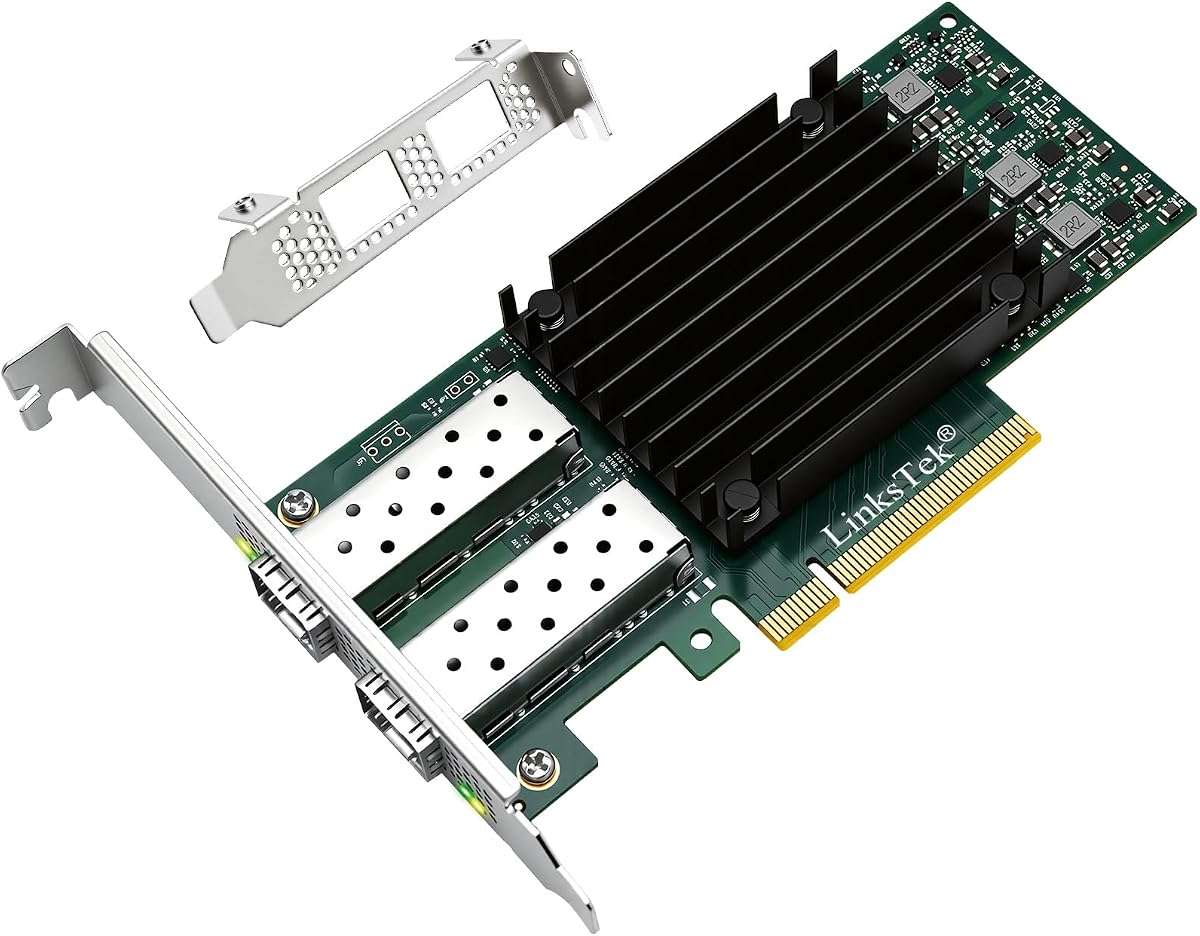
The LinksTek CX4121A is a dual 25GbE SFP28 adapter based on the Mellanox ConnectX-4 Lx EN MT27711A0 controller. It targets web, cloud, database, analytics, and storage servers, combining RDMA over RoCE with PCI Express 3.0 x8 connectivity. Its 4.9 customer rating makes it one of the most consistently well-regarded products in this comparison.
We may earn a commission when you buy through this link, at no additional cost to you.
Storage and virtualization features form the core of the design. It supports SR-IOV, NVGRE, VXLAN, and GENEVE overlay networks, as well as PXE, iSCSI, and RoCE. IEEE features cover 25GbE, 10GbE, Energy Efficient Ethernet, link aggregation, VLAN tagging, PTP, and jumbo frames up to 9.6KB, giving administrators a broad feature set to work with.
The bus interface auto-negotiates to x8 or x4 lanes and can switch between PCIe generations, which offers some flexibility when the card is installed in a server designed around older expansion hardware. It is listed for plug-and-play use across current and older 64-bit Windows releases, Windows Server, RHEL, CentOS, FreeBSD, VMware, and other Linux systems.
This card is best for administrators building a virtualized or RDMA-enabled storage server and already working with SFP28 transceivers, DAC cables, or AOC cables. The product is described as a drop-in alternative to the MCX4121A-ACAT, but the actual fit still depends on your server, bracket, firmware, and software stack.
RDMA over RoCE can improve efficiency for latency-sensitive and high-throughput workloads when the entire network path supports it. The adapter's offload capabilities are a major reason to consider it for advanced server use.
Support for VXLAN, NVGRE, and GENEVE is valuable in environments that separate virtual workloads across physical networks. It gives administrators more options for building scalable fabrics.
We may earn a commission when you buy through this link, at no additional cost to you.
The Intel Ethernet Network Adapter XXV710-DA2 is an established enterprise 25GbE option built around a PCIe 3.0 x8 interface. It complies with IEEE 802.3by and 25GbE specifications and carries a 5.0 customer rating. Its strongest appeal is a mature feature set centered on virtualization, packet processing, and precise traffic control.
We may earn a commission when you buy through this link, at no additional cost to you.
Intel Ethernet Flow Director enables hardware-based application traffic steering, while Dynamic Device Personalization is intended to improve packet-processing efficiency for network functions virtualization and cloud deployments. The card is optimized for DPDK, emphasizes small-packet performance, and provides intelligent offloads for servers using Intel Xeon processors.
Virtualization support is another major strength. The adapter offers offloads for VXLAN, GENEVE, NVGRE, MPLS, and VXLAN-GPE with Network Service Headers. It also includes I/O virtualization innovations and Adaptive Link Establishment for interoperability with other 25GbE-capable switches and host controllers.
For an enterprise server or advanced infrastructure deployment, this is a premium choice because it focuses on operational capabilities rather than simply offering two high-speed ports. Buyers should still verify bracket fit, operating-system drivers, SFP28 hardware, and the exact cabling arrangement. Its server-oriented design makes it less natural for a simple desktop upgrade.
Intel Ethernet Flow Director is a meaningful advantage when applications need to be assigned to specific traffic classes or queues. Hardware-based steering can make large-scale network behavior more predictable.
DPDK optimization, small-packet handling, I/O virtualization, and Intel processor offloads reflect a focus on NFV and cloud-style workloads. These features go beyond the needs of an ordinary home network.
We may earn a commission when you buy through this link, at no additional cost to you.
The GLOTRENDS ST7400 is a two-port 25GbE SFP28 server card designed around the OCP 3.0 SFF 4C+ mezzanine form factor. It uses an original Intel E810-XXVAM2 controller and a PCIe 4.0 x8 interface. This makes it a specialized but potentially excellent option for servers built around Open Compute Project expansion standards.
We may earn a commission when you buy through this link, at no additional cost to you.
Both ports support 25GbE, 10GbE, and 1GbE auto-negotiation. The slots are described as unlocked, allowing use with MSA-compliant SFP28 modules, DAC cables, and AOC cables without vendor lock-in. Two 25GbE links can provide up to 50Gbps aggregate bandwidth when the host, switch, and workload are configured appropriately.
The controller brings on-chip QoS, Flexible Port Partitioning, SR-IOV, IEEE 1588 PTP, iWARP and RDMA, RoCEv2, Intel Data Direct I/O, VMDq, PXE, DPDK, and jumbo frames up to 9.5KB. These features make the card relevant to server, NAS, storage, and virtualization networks where traffic management and offload support matter.
This recommendation applies to OCP-compatible server platforms rather than standard desktop PCIe slots. The stated operating-system coverage includes Windows, Windows Server, RHEL, SLES, Ubuntu, Debian, and FreeBSD, but Mac systems are excluded. Confirm the chassis offers the correct OCP 3.0 mezzanine connector and the intended SFP28 equipment before ordering.
The OCP 3.0 SFF 4C+ format is the defining feature of this product. It suits density-focused and modular server builders but excludes buyers seeking a conventional desktop card.
Support for MSA-compliant modules, DAC cables, and AOC cables gives administrators flexibility across compatible networking vendors. The physical transceivers are not included, so infrastructure planning remains essential.
We may earn a commission when you buy through this link, at no additional cost to you.
The Sonnet Twin25G T5 is a Thunderbolt 5 network adapter for creative workstations, shared-storage systems, and other high-bandwidth computing environments. It adds two 25GbE SFP28 connections to computers with Thunderbolt 5, Thunderbolt 4, Thunderbolt 3, or USB4. Its 5.0 rating and included transceivers distinguish it from basic PCIe-only choices.
We may earn a commission when you buy through this link, at no additional cost to you.
The package includes two 25GBASE-SR SFP28 optical transceivers and a Thunderbolt 5 cable. This is a significant convenience because buyers can connect to compatible fiber infrastructure without sourcing transceivers separately. The adapter also supports 10GbE, making it possible to begin with existing 10GbE switches or NAS systems and migrate later.
Sonnet states that both 25GbE ports can operate simultaneously at full performance when connected to a Thunderbolt 5 computer. Newer Thunderbolt 4, Thunderbolt 3, and USB4 systems are also supported, although the host interface may impose different practical limitations. The device includes two Thunderbolt 5 ports, with the second capable of supporting a peripheral or display and up to 15W of power delivery.
This is the top choice for a Mac or other workstation that lacks a usable PCIe slot but does have a modern Thunderbolt or USB4 connection. The compact, nearly noiseless design suits offices and editing suites. Confirm the host's available bandwidth, the type of fiber or cable infrastructure, and operating-system recognition before committing to this external form factor.
Two 25GBASE-SR transceivers are included, reducing the number of separate components needed for a fiber connection. A Thunderbolt cable is also part of the package.
The adapter makes high-speed networking available to compact workstations and Thunderbolt-based computers. It is particularly useful for shared storage, media workflows, and post-production tasks that benefit from faster transfers.
We may earn a commission when you buy through this link, at no additional cost to you.
The Sonnet Twin25G PCIe is designed to bring dual optical 25GbE connectivity to computers with compatible expansion card slots. It is marketed for Mac, Windows, and Linux environments, making it particularly relevant to creative workstations that need access to high-speed shared storage. Two 25GBASE-SR SFP28 transceivers are included.
We may earn a commission when you buy through this link, at no additional cost to you.
The adapter supports 25GbE and 10GbE, which offers a practical upgrade path for users who currently operate 10GbE infrastructure. It can also be used with Sonnet Thunderbolt expansion systems, giving owners of certain Thunderbolt-based setups another way to add high-speed networking without relying solely on an external adapter.
Compatibility requires attention. The product information says it is not compatible with macOS 15.3.1 or 15.4, while an Apple update was pending. Because operating-system support can change, buyers should verify the current driver and firmware situation for their exact Mac model and operating-system version before installation.
This card is a strong creative-workstation option for users who want internal dual-port 25GbE and already own compatible SFP28 infrastructure. It is less suitable for generic servers that need advanced RDMA, virtualization offloads, or server operating-system support. Confirm the chassis, slot layout, macOS version, and transceiver type before ordering.
Dual optical 25GbE connectivity can substantially improve access to shared media, large project files, and centralized storage. The included transceivers simplify initial optical deployment.
Although designed as a PCIe card, the adapter can also be used with Sonnet Thunderbolt expansion systems. That flexibility extends its value to selected Thunderbolt-centric creative setups.
We may earn a commission when you buy through this link, at no additional cost to you.
The Mellanox Technologies MCX512A-ACAT is a dual-port 25GbE SFP28 card built on the ConnectX-5 EN controller. It uses a PCIe 3.0 x8 interface and carries a tall-bracket configuration. With a 4.0 rating, it is a proven option for infrastructure buyers who specifically want the ConnectX-5 platform.
We may earn a commission when you buy through this link, at no additional cost to you.
The product is described as an intelligent, RDMA-enabled network adapter with advanced application offload capabilities. Those characteristics make it relevant to web, cloud, storage, and telecommunications platforms where efficient networking and application acceleration are more important than a simple desktop connection.
Its physical bracket is an important consideration. The tall configuration may fit enterprise servers but can be unsuitable for compact or low-profile systems. The supplied product information is also abbreviated compared with the more detailed entries in this guide, so buyers should review the current manufacturer documentation for exact bracket, airflow, and system requirements.
This is the best fit for an existing ConnectX-5-oriented server ecosystem or a buyer who specifically values that controller family. It is not the first choice for a Mac, a QNAP or Synology-specific system, or a workstation without a suitable full-height slot. Confirm server support, driver availability, and transceiver requirements before installation.
RDMA and advanced application offload support are central to the MCX512A-ACAT's positioning. These capabilities suit properly engineered storage, cloud, and communications environments.
The tall bracket is a decisive compatibility detail. Server owners should inspect the chassis layout, available mounting points, and airflow arrangement before purchasing.
We may earn a commission when you buy through this link, at no additional cost to you.
Choosing a 25GbE network card starts with the host system and the network it must join. Port format, controller capabilities, PCIe topology, operating system, and workload should all be evaluated before comparing individual models.
Start with the system that will host the adapter. The QXG-25G2SF-E810 includes a specialized bracket for selected QNAP systems, while the Synology E25G30-F2 is purpose-built for compatible Synology hardware and specific DSM versions. General-purpose PCIe options offer broader reach but require the buyer to confirm chassis clearance, slot layout, cooling, and driver support independently.
Choose a dedicated model when the manufacturer explicitly supports your exact appliance. Choose a general-purpose card when the host is a standard server or workstation and its documentation confirms the required interface and operating system.
The card's PCIe interface must be supported by the motherboard and must have enough lanes for the intended workload. Products in this guide use PCIe 3.0 x8 or PCIe 4.0 x8 configurations, and some can negotiate narrower widths. A Gen 4 card can operate in a compatible Gen 3 slot, but it will be limited by the slower generation.
Check the number and physical location of available slots, not merely the chipset's advertised support. A mechanically x16 slot may be electrically limited to fewer lanes, and a card installed in a crowded server can also create airflow or access problems.
Most cards in this comparison use SFP28 ports, allowing administrators to select compatible optical transceivers, DAC cables, or AOC cables. Some products include SFP28 transceivers, notably the two Sonnet adapters, while most standard server cards do not. Others require you to source the correct modules and cables for the switches and systems being connected.
Do not assume that an SFP28 port guarantees a particular link distance or medium. The transceiver and cable determine reach, while the switch and endpoint must support compatible speeds and 25GBASE-SR or other appropriate signaling. Multi-rate support at 10GbE and 1GbE can ease phased upgrades.
The controller determines which optimizations are available. Intel's XXV710 includes Ethernet Flow Director, DDP, DPDK optimization, and a broad set of network virtualization offloads. The E810-based cards provide QoS, traffic management, Flexible Port Partitioning, and SR-IOV. Mellanox-based adapters emphasize RDMA, ASAP², VMDq, and server-oriented offload features.
For ordinary NAS file transfer, these advanced features may not materially change the result. For virtual machines, distributed storage, low-latency applications, or software-defined infrastructure, they can be central to achieving efficient performance. Match the controller's strengths to the workload rather than choosing on controller name alone.
RDMA over Converged Ethernet can reduce CPU involvement and latency in suitable storage fabrics, but it requires compatible software, adapters, switches, and configuration on the entire path. Cards supporting RoCEv2, iSCSI, NFS, jumbo frames, and PXE can fit many enterprise workflows, while a simpler adapter may be enough for a single file server.
Consider how storage traffic is organized. Two ports can provide failover, aggregation, or separation of client and back-end traffic, but each approach has different switch and cabling requirements. Verify that the NAS or server operating system can actually use the selected offload and networking features.
An impressive hardware specification is of limited value if the operating system does not recognize the card or lacks the required driver. The guide includes cards listed for Windows, Windows Server, Linux, VMware ESXi, and other environments, but support can vary by release. The Synology card has a specific DSM update requirement, while the Sonnet PCIe card carries a stated macOS version restriction.
Download or review the latest driver before installation, and confirm that the host kernel or operating-system build includes the necessary functionality. Virtualization environments also need the correct guest driver, host driver, and adapter assignment model.
A dual-port server card can occupy a substantial amount of space and may require a full-height or specialized bracket. Some products include both low-profile and full-height brackets, while the MCX512A-ACAT is specified with a tall bracket and the GLOTRENDS ST7400 uses an OCP 3.0 mezzanine form factor. The correct interface alone does not guarantee that the card will fit.
Measure the available opening, check screw and bracket alignment, and consider nearby heat sinks or drive cages. For OCP designs, verify the server's mezzanine connector and lane assignment. For external adapters, consider host bandwidth and whether both links can operate at their intended rates.
A 25GbE card cannot deliver its full potential if the connected switch, NAS, client, cables, and storage devices are slower. Plan the upgrade across the entire path, including inter-switch uplinks and peer device interfaces. A 25GbE endpoint connected through a 10GbE link remains limited by the slower segment.
For a phased deployment, multi-rate ports and 10GbE compatibility are useful. However, the most reliable performance gain comes when the storage appliance, switch ports, clients, and storage path are aligned. A thoughtful infrastructure plan is more important than a small difference in benchmark claims.
Begin by confirming the card, host system, and network equipment are compatible. Check the physical bracket, PCIe lane capability, operating-system version, driver requirements, SFP28 module type, and switch compatibility. Install the appropriate driver before or immediately after inserting the card, following the host manufacturer's shutdown and antistatic procedures.
After installation, connect the correct SFP28 transceiver and cable to each planned port, then verify negotiated speed, link status, and error counters through the operating system. Configure addresses, routes, VLANs, jumbo frames, link aggregation, RDMA, or iSCSI only when the complete network design supports those features. Test one function at a time before moving important data onto the new path.
For ongoing care, keep the card seated firmly, maintain proper airflow, and avoid repeated hot-plugging unless the card and system explicitly support it. Watch operating-system logs and adapter diagnostics for link changes, packet errors, or driver faults. Clean compatible optical connectors and transceivers using approved methods, protect unused ports from dust, and document firmware, driver, bracket, and cable configurations for future maintenance.
Yes, to achieve a 25GbE connection, the other endpoint and the switch ports in the path must support 25GbE. The card may negotiate 10GbE or 1GbE with compatible equipment, but the available speed will be limited by the slowest active segment. Storage devices, clients, inter-switch links, cables, and transceivers all need to be included in that compatibility check.
No. Most server-oriented cards in this guide require compatible SFP28 modules or cables to be purchased separately. The Sonnet Twin25G T5 and Sonnet Twin25G PCIe are notable because their product information states that two 25GBASE-SR SFP28 transceivers are included. Always verify the exact contents of the package and the type of infrastructure you intend to connect.
Many of the listed cards support 10GbE as well as 25GbE, so they may negotiate a 10GbE connection with compatible equipment. The result will be a 10GbE link rather than a 25GbE link. You also need a switch, cable, and transceiver combination that supports the lower rate on every relevant connection.
RDMA allows data to move between systems with less involvement from the host CPU and lower latency than conventional network stacks in suitable workloads. It can benefit high-throughput storage, clustered applications, and large data movements. Realizing those benefits requires compatible adapters, switches, operating-system software, and configuration across the complete path.
Yes. A bracket that does not match the chassis may prevent installation or leave fastening points unsecured. Several cards include low-profile and full-height brackets, while the MCX512A-ACAT uses a tall bracket and the GLOTRENDS ST7400 is an OCP 3.0 mezzanine card. Check the case, server tray, and mounting holes rather than assuming every PCIe card has the same shape.
The Sonnet Twin25G T5 is designed for Thunderbolt and USB4 systems and supports Mac, Windows, and Linux. The Sonnet Twin25G PCIe also targets Mac, Windows, and Linux, but its information lists a macOS version restriction and notes that an Apple update was pending. Check the current operating-system and driver status before buying either card.
It depends on your design. Two ports can support failover, traffic separation, link aggregation, or simultaneous connections to multiple devices, but they also require additional compatible networking. A single-port path is simpler if one high-speed link meets your needs. For storage systems and virtualized workloads, dual-port flexibility can be especially valuable.
Shut down the system, disconnect power, follow the manufacturer's antistatic guidance, and open the chassis. Install the correct bracket and connect the card firmly in a compatible PCIe slot, then secure the bracket and any required power or other connection. After closing the system, install the appropriate driver and verify the link in the operating system's network diagnostics.
The Vogzone MCX4121A-ACAT stands out as the best budget option, offering two SFP28 ports, a Mellanox ConnectX-4 Lx controller, and an impressive range of virtualization and RDMA features. The 10Gtek card earns the Editor's Choice for its balanced combination of an Intel E810 controller, a 5.0 rating, broad operating-system coverage, and practical server features. The Intel XXV710-DA2 is the premium selection for enterprise users who prioritize traffic steering, DPDK optimization, and mature virtualization offloads.
For appliance-specific systems, the QXG-25G2SF-E810 and Synology E25G30-F2 are generally more natural than general-purpose cards. The GLOTRENDS ST7400 is suited to OCP 3.0 server designs, while the Mellanox MCX512A-ACAT targets ConnectX-5 infrastructure. Creative users should examine the two Sonnet adapters: the Thunderbolt model avoids the need for an internal slot, while the PCIe model offers dual optical connectivity for compatible workstations.
Before purchasing, verify the host platform, physical bracket, PCIe width, operating system, driver, transceiver, switch, and cable compatibility as one complete system. Product availability and market conditions can change, so check the current listing and manufacturer documentation before ordering. The right card is the one that fits your infrastructure and supports the workload you actually intend to run.