
Deeper PRO+ 2
4.2Editor score
Three selectable sonar beams
Built-in GPS mapping
Connectivity up to 330 feet
Detailed fish target separation
Compare the best castable wireless fish and depth finder options, including sonar range, display features, portability, mapping, and battery life.
A castable wireless fish and depth finder gives shore anglers, kayak fishermen, and small-boat anglers a way to explore water beyond easy casting distance without installing permanent electronics. The best units combine portable sonar, clear displays, wireless range, useful fish and structure information, and dependable battery life in a package that is simple enough for a first trip.
This guide compares ten popular castable wireless fish and depth finder models using the information supplied for each product. It evaluates depth capability, wireless distance, sonar beam coverage, display size, app compatibility, mapping options, portability, battery behavior, and the kinds of fishing each unit supports, while separating handheld-only models from phone and tablet options.
Each review identifies the strongest features and the practical compromises behind them, helping you match a unit to your preferred water, fishing style, and level of technical involvement. Ratings and specifications can change as manufacturers revise their products, so verify the latest listing details and current prices before making a purchase.
4.2Editor score

4.5Editor score

4.1Editor score
This side-by-side overview highlights the main differences in display design, wireless range, depth capability, sonar coverage, mapping, and portability. It is the quickest way to narrow the field before reading the detailed reviews.

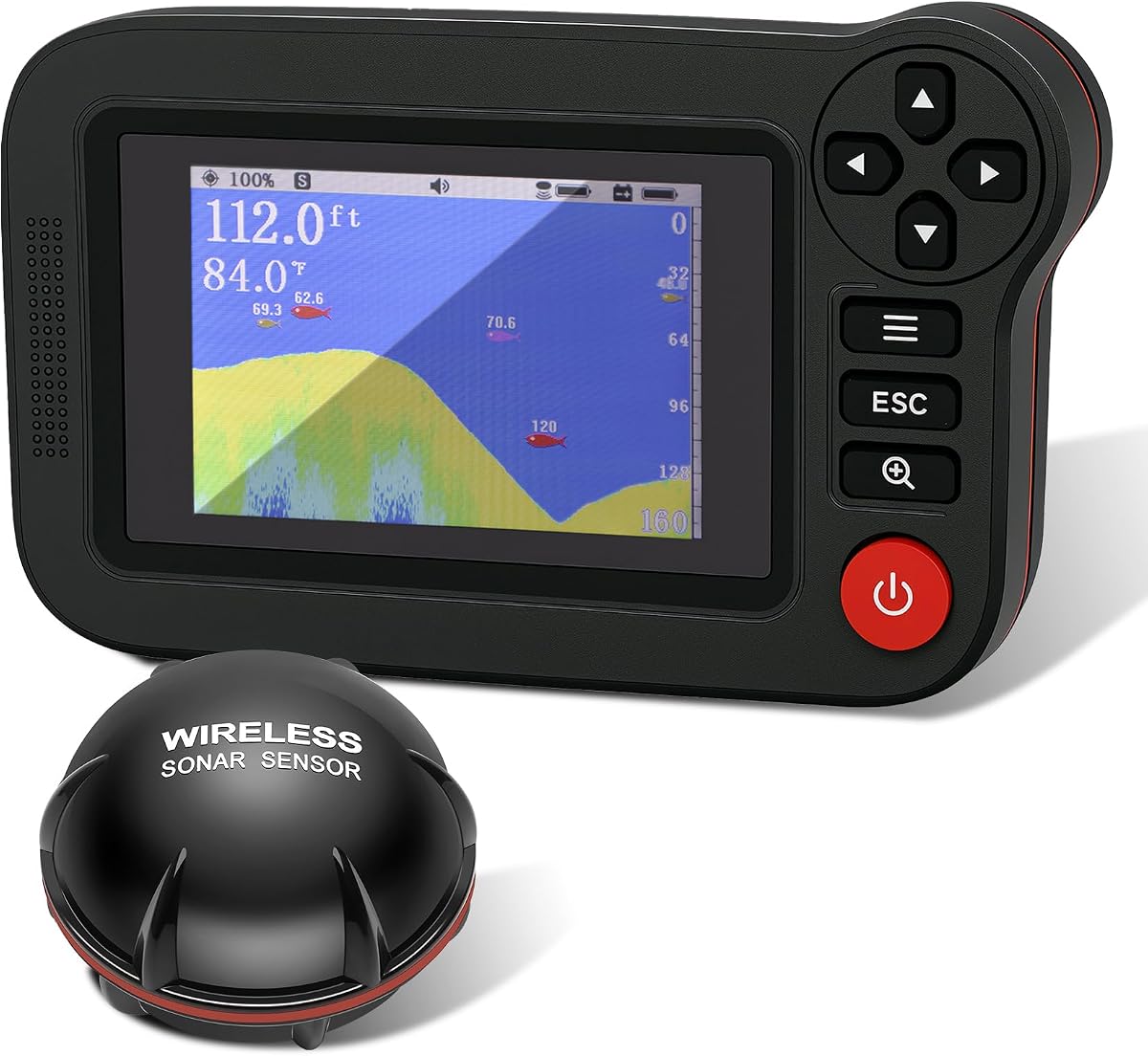


This Portable Rechargeable Fish Finder combines a wireless castable sensor with a dedicated color LCD, giving it more independence than phone-dependent alternatives. Its 4.3 rating reflects a solid balance of useful fish information, portability, and straightforward operation. It can display water depth, temperature, fish size, fish depth, and bottom contour.
We may earn a commission when you buy through this link, at no additional cost to you.
The standout feature is its 105-degree beam, which covers a generous area around the sensor while still identifying targets at different depths. A working range of 80 meters provides ample room to cast from shore, a kayak, or a boat, and the sensor can be tethered with fishing line. Convertible depth and temperature units, selectable display backgrounds, and both work and simulation modes add practical flexibility.
Its limitations are most apparent when compared with newer units offering longer wireless reach, larger displays, or app-based mapping. The 80-meter range may be restrictive when fishing from a high bluff or a long shoreline, and the two background choices offer less visual flexibility than three-mode TFT screens. Even so, the standalone display avoids dependence on a phone, which is a meaningful benefit in remote areas.
This is a strong choice for anglers who want a compact, self-contained sonar package and do not need cloud mapping or elaborate analysis tools. It also suits users who appreciate a two-year warranty and responsive brand support. For uncomplicated fish and depth information across lakes, rivers, seas, kayaks, boats, shores, and ice, it delivers dependable versatility.
The unit gives you the core information needed to decide where to fish: fish size, depth, water depth, temperature, and bottom contour. Those readouts make it useful for finding drop-offs, channels, and productive structure without requiring a separate depth instrument.
Selectable black and white backgrounds support daylight and low-light readability, while the simulation mode lets you learn the interface before heading onto the water. Its stated applicability to shore, boat, kayak, open-water, and ice fishing broadens its usefulness across seasons.
We may earn a commission when you buy through this link, at no additional cost to you.
Deeper PRO+ 2 is the most technically sophisticated product in this guide, combining castable sonar, wireless connectivity, built-in GPS, and bathymetric mapping. Its 4.2 rating reflects a feature-rich option aimed at anglers who want more control than a basic handheld display provides. It works with the Fish Deeper app for viewing sonar and creating maps.
We may earn a commission when you buy through this link, at no additional cost to you.
Wide, mid, and narrow beams allow you to cover water efficiently or concentrate on a specific target. The narrow beam provides 0.4-inch target separation, while the wide and mid beams use one-inch separation, making the unit useful for identifying individual fish and tracking a lure during vertical jigging. The stated accuracy reaches 330 feet, and built-in GPS lets you save maps created from a shore, dock, or bank.
The main tradeoff is dependence on the app and a compatible phone or tablet. While that unlocks richer mapping and navigation features, it can also make the system less convenient when a device runs low on power or when an angler prefers a dedicated screen. Wireless reliability and app navigation may also require a short learning period compared with a straightforward handheld unit.
Choose PRO+ 2 if you routinely cast from shorelines and banks, want to create reusable bottom maps, or need finer target separation for close-range work. It is especially compelling for kayak, boat, and ice anglers who want advanced sonar without a permanent installation. For those priorities, it earns the premium recommendation.
Wide coverage is useful for scanning an unfamiliar area, mid-range beams balance resolution and coverage, and the narrow beam helps separate close targets. Switching modes makes it possible to move from broad reconnaissance to a more focused search without changing equipment.
Built-in GPS supports bathymetric map creation from locations where a boat would be inconvenient. Saved maps in the Fish Deeper app can help you revisit promising contours, compare areas, and build a more considered understanding of a lake or coastal water.
We may earn a commission when you buy through this link, at no additional cost to you.
The LUCKY MT-202 stands out as the most balanced recommendation in this roundup, earning a 4.5 rating with an impressive combination of wireless reach, fish detail, and portability. Its 853-foot operating distance is the longest stated among these products, making it particularly effective for casting well beyond shore or kayak range.
We may earn a commission when you buy through this link, at no additional cost to you.
A wide 90-degree beam scans a 3-to-147-foot depth range and identifies fish depth relative to nearby structure. The 3.5-inch horizontal LCD presents fish icons with exact depth numbers and scrolls from right to left, preserving a continuous record of what passed beneath the sensor. That history makes it easier to follow movement, compare targets, and understand whether a school is holding above or below a feature.
The tradeoffs are modest but worth noting. A 90-degree beam is narrower than the 105-degree options offered by two handheld competitors, so very broad scans may cover less area in a single position. The unit also lacks the built-in GPS mapping of the Deeper PRO+ 2 and depends on a proprietary handheld display rather than a mobile app.
This is an excellent choice for anglers who want a dedicated screen, exceptional casting reach, and enough information to find structure without a complex phone workflow. It supports shore, kayak, canoe, boat, pontoon, and ice fishing, making it one of the broadest all-purpose options here. Its combination of portability, readable fish data, and long wireless distance makes it the editor's choice.
The 853-foot operating distance allows the sonar sensor to be placed in areas a conventional cast cannot reach. This can open access to deeper channels, weed edges, submerged timber, and other structure from a shoreline position.
The horizontal screen scrolls continuously, allowing you to observe a sequence of targets rather than a single isolated snapshot. Depth labels beside fish icons make the display more useful for comparing fish holding depth across a productive area.
We may earn a commission when you buy through this link, at no additional cost to you.
This Portable Kayak Fish Finder is built around a 3.5-inch TFT display, a floating wireless probe, and one of the longer operating distances in the group. Its 4.2 rating reflects a capable, approachable package for kayakers, shore anglers, and boat users who want a 105-degree beam and extended wireless reach.
We may earn a commission when you buy through this link, at no additional cost to you.
The unit detects depth, temperature, fish size, fish depth, and bottom contour, with fish and depth alarms for added awareness. A 105-degree beam and depth range from 2.6 to 164 feet make it suitable for both shallow structure and deeper channels. Its stated transducer-to-screen distance of 656 feet provides room to cast beyond normal line reach.
The supplied mounting bracket and lanyard help position the display on a kayak or keep it accessible around the neck. Three backlight modes—black, blue, and white—offer more flexibility than the two-background screens found elsewhere in this guide. The tradeoffs are the lack of a mobile app and built-in mapping, which will matter most to anglers who want to save and revisit detailed sonar surveys.
This model is a strong match for kayak anglers who need extended range, a broad beam, and a large display without managing a phone. Adjustable sensitivity, depth range, and noise filtering also let you adapt the sonar to different environments. Its eight-hour stated operating time makes it well suited to full days on the water.
The compact display, mounting bracket, and lanyard give kayak users several practical placement options. You can mount the screen where it is easy to glance at while keeping the probe tethered to a short line or casting it ahead of the kayak.
A 105-degree beam covers more of the surrounding water than a narrow scanning cone, while the 656-foot wireless distance keeps the display linked from a meaningful casting distance. This combination is useful when searching broad weed fields or drop-offs.
We may earn a commission when you buy through this link, at no additional cost to you.
Deeper START makes castable sonar approachable for recreational anglers by placing the display in a free mobile app instead of a dedicated handheld screen. Its 4.1 rating reflects an easy-to-learn system with useful fish, depth, bottom, and vegetation information. The Fish Deeper app is free and compatible with iOS and Android devices.
We may earn a commission when you buy through this link, at no additional cost to you.
The START generates its own Wi-Fi connection, so it does not use mobile data while sonar is being viewed. It can cast and detect depth to 165 feet, includes a night fishing mode, and automatically saves every scan with its time and location for later revisits. The included app makes setup as simple as pairing the device with a phone.
Its most obvious limitation is the 40-degree sonar beam. That narrower coverage is designed for accuracy and can be useful around specific targets, but it will not scan as broadly as 90-degree or 105-degree systems. The need for a compatible mobile device also adds a potential point of failure, and the six-hour battery life is shorter than several alternatives.
Choose START if you want a lightweight castable sonar, already use your phone while fishing, and appreciate automatic recording of scans. It is well suited to casual trips from a dock, bank, shore, or kayak. Those who prefer a standalone display, wider coverage, or longer operating time should weigh the more specialized options in this guide.
Because the sonar creates its own Wi-Fi network, you can view readings without consuming a cellular data allowance. This is useful in areas with weak reception and gives the device a simpler connection method than a conventional Bluetooth accessory.
Every scan is saved with time and location, making it easier to return to a promising area or compare conditions later. This feature gives the otherwise simple START model a useful element of long-term data collection.
We may earn a commission when you buy through this link, at no additional cost to you.
Portable HD Fish Finder is a compact standalone unit that puts fish size, fish depth, temperature, depth, bottom contour, and water-surface information on a 2.4-inch color LCD. Its 4.3 rating indicates a satisfying feature mix for anglers who want more information without navigating a phone app.
We may earn a commission when you buy through this link, at no additional cost to you.
The rechargeable sensor supports underwater detection to 147 feet with a 90-degree beam. It activates automatically upon contact with water, and its lamp is intended to attract fish. A fish alarm provides both an on-screen indication and an emitted alert when a fish enters the sensor's coverage area.
The 2.4-inch display is smaller than the 3.5-inch screens found on the LUCKY MT-202 and the two longer-range kayak models, which may require closer attention when interpreting fine details. It also lacks app-based mapping and GPS features. Those limitations make it more of a focused fish and depth finder than a complete sonar mapping system.
This product is a good fit for kayak, ice, river, lake, and sea anglers who value a compact dedicated unit, immediate fish alarms, and a colorful display. Its 21-language interface is unusually broad for this category, and the sensor's water-activated behavior reduces setup effort. Choose it for straightforward fish detection rather than advanced survey work.
The combination of a visual alert and an emitted alarm makes it easier to notice a fish while you are focused on the rod, line, or surrounding water. Fish size and depth information helps you decide whether the target warrants a closer attempt.
The sensor turns on when it touches water, simplifying deployment from a dock, bank, kayak, or ice hole. Its integrated lamp also serves as an attraction feature during low-light or murky conditions.
We may earn a commission when you buy through this link, at no additional cost to you.
Garmin STRIKER Cast is a rugged, phone-and-tablet-oriented sonar designed to bring familiar fishfinding features into a portable package. Its 4.4 rating makes it one of the strongest choices for anglers who want extended runtime, straightforward wireless streaming, and access to Garmin's broader mapping ecosystem.
We may earn a commission when you buy through this link, at no additional cost to you.
The free STRIKER Cast app works with compatible Apple or Android devices and streams sonar from as far as 200 feet away. Both traditional 2-D and ice-fishing flasher modes are available, and the unit performs in shallow and deep water. Garmin Quickdraw Community maps add contours with up to one-foot spacing, allowing users to download or contribute maps relevant to their fishing area.
Like the Deeper models, STRIKER Cast relies on a mobile device rather than including a screen. That reduces the amount of dedicated hardware in the package but requires your phone or tablet to remain powered and properly connected. The unit also lacks a built-in GPS, so its mapping workflow depends on the mobile device and community map services.
This is a compelling option for anglers who already use Garmin products, appreciate a rugged body, and want a sonar capable of traditional and flasher-style viewing. Its 10-plus-hour stated battery life is among the strongest here. It suits shore, boat, and ice fishing when a phone or tablet is an acceptable part of the setup.
Traditional 2-D sonar offers a familiar view for general fish and structure detection, while flasher mode offers a different presentation suited to ice fishing and close-range observation. Having both modes in one unit expands its usefulness across seasons.
Quickdraw Community provides access to downloadable contours and allows users to contribute their own mapping data. Maps with up to one-foot contours can add useful detail when navigating unfamiliar water or recalling previously productive areas.
We may earn a commission when you buy through this link, at no additional cost to you.
LUCKY 147-Foot Fish Finder is a feature-rich standalone fishfinder with a 2.4-inch TFT color display, rechargeable handheld, and rechargeable sonar sensor. Its 4.1 rating reflects a capable traditional unit that offers more adjustment options than many simpler alternatives without requiring a mobile device.
We may earn a commission when you buy through this link, at no additional cost to you.
The system detects underwater contour, depth, temperature, fish size, and fish depth. You can adjust sensitivity, brightness, depth range, zoom, alarms, fish icons, units, and language, providing extensive control over how information appears. Wireless and simulation modes offer both real operation and a way to explore the interface before fishing.
Its 492-foot wireless operating distance is generous, though the external antenna must be extended for correct performance. The sensor can run for a stated 10 hours, while the handheld lasts four hours, so charging priorities differ depending on how long you fish. There is no phone app or built-in GPS mapping, and the 2.4-inch display is smaller than the best large-screen options.
This finder works well for ice, river, sea, shore, kayak, and night fishing. Its transparent replacement cover makes the sensor easier to see in darkness, and the fish-attractive lamp may help in low-light conditions. Choose it when you want many settings, a dedicated screen, and long sensor runtime rather than mobile mapping.
Sensitivity, zoom, depth range, brightness, units, language, and icon controls let you tailor the display to different water conditions. Fish and depth alarms add another layer of awareness while you are focused on retrieving your lure or line.
The transparent replacement cover allows you to see the sensor in the dark, while the built-in lamp is designed to attract fish. These details make the unit particularly practical for evening shore trips and ice fishing.
We may earn a commission when you buy through this link, at no additional cost to you.
Portable Kayak Depth Finder offers a balanced combination of a 3.5-inch TFT screen, 105-degree beam, long range, and deep detection. With a 4.2 rating, it is a practical choice for anglers who want a large display and broad sonar coverage without depending on an app for every reading.
We may earn a commission when you buy through this link, at no additional cost to you.
Its wireless distance reaches 500 feet, and depth detection extends from 2.6 to 164 feet. The display shows depth, temperature, fish size, fish depth, and bottom contour, with fish and depth alarms plus background switching. Adjustable sensitivity, depth range, and noise filtering help you tune the unit to different conditions.
Three backlight modes—black, blue, and white—make the screen adaptable to bright daylight and darker conditions. A mounting bracket and lanyard support kayak or boat use, while the lightweight sensor can be tied to fishing line and cast ahead. The main limitation is the absence of GPS, saved maps, and app-based analysis, which may discourage anglers focused on repeatable survey work.
This model suits shore, kayak, saltwater, and ice fishing, especially when you want the information on a dedicated screen. Its stated eight-hour operating time is suitable for long outings, and low-battery alerts on both the unit and sensor help with planning. It is a versatile option for users who value readable fish data and flexible backlighting.
The 105-degree beam gives the model more lateral coverage than narrow-beam units, while its 164-foot depth ceiling handles deeper channels and drop-offs. The combination is useful when you want both a broad search and enough depth reach in one device.
Black, blue, and white backlight modes let you optimize readability for glare, changing light, and personal preference. The 3.5-inch TFT screen provides a dedicated view that remains available without unlocking a phone.
We may earn a commission when you buy through this link, at no additional cost to you.
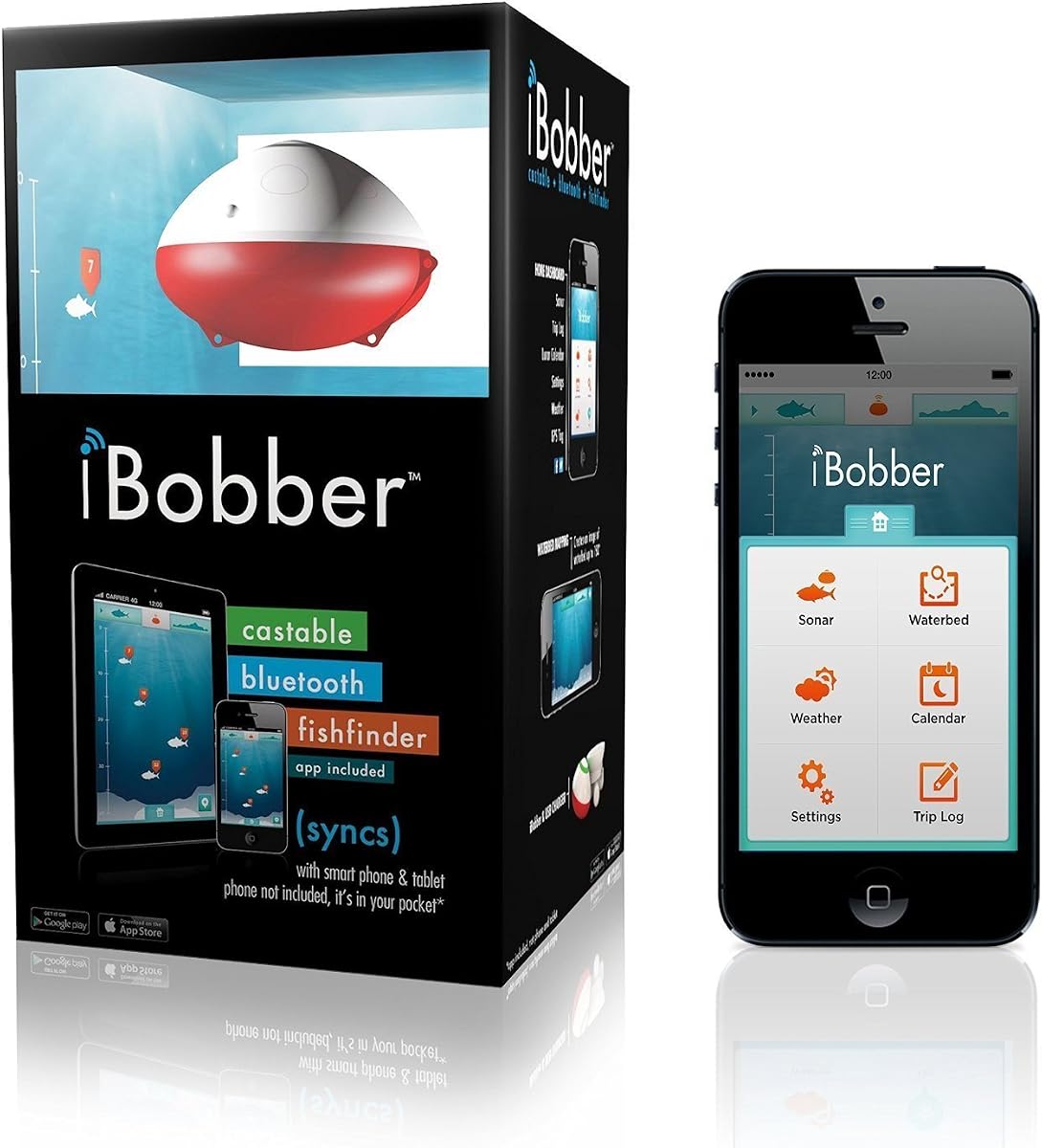
Reelsonar iBobber is a straightforward Bluetooth sonar designed for quick pairing with an iOS or Android device. Its 4.0 rating reflects an approachable product with a useful depth range, long battery life, and visual fish information rather than an extensive suite of advanced settings.
We may earn a commission when you buy through this link, at no additional cost to you.
The sonar detects to 135 feet and displays depth-tagged fish icons that are color-coded by size. A fish alarm can alert you when fish gather under docks or piers, while a strike-alert feature is designed to notify you when a fish is biting. The app and watch app support extend the information to compatible devices.
Its primary limitation is a 135-foot depth ceiling, which is shallower than most competing units in this guide. The specification also does not highlight a wide beam or long wireless casting range, so it is better suited to nearby structure than expansive remote surveys. It also depends on Bluetooth connectivity and a compatible mobile device.
Choose iBobber for simple dock, pier, freshwater, saltwater, shore, and ice fishing where portable alerts and size-coded fish icons are the priority. Its 10-plus-hour stated battery life makes it convenient for extended outings. Advanced users seeking wider coverage, deeper readings, or saved mapping should consider one of the more specialized castable systems.
The fish alarm is useful when fish gather beneath structures, while strike alerts are designed to reduce the chance of missing a bite. These notifications make the device practical for anglers who cannot watch the display continuously.
A stated battery life of more than 10 hours supports extended sessions without frequent charging. Bluetooth connectivity keeps the system simple, although the user must ensure that the paired phone or watch remains powered.
We may earn a commission when you buy through this link, at no additional cost to you.
The right castable sonar depends on where you fish, how far you cast, whether you prefer a dedicated screen or mobile app, and how much detail you need from each scan. These factors help narrow the field before you compare range, depth, battery, and display specifications.
Wireless range determines how far the transducer can be placed from the display. A long range is valuable from a shoreline, high bank, or large kayak because it lets you investigate distant channels, weed edges, and structure that cannot be reached with an ordinary cast. Among the products reviewed, stated reach varies considerably, from about 80 meters on the basic Venterior unit to more than 250 meters on the LUCKY MT-202. The most useful figure is the one that comfortably covers your typical fishing position with a margin for wind, current, and imperfect placement.
Choose enough wireless reach for your normal casting distance, not merely the largest number available. Very long range can help, but signal behavior, antenna positioning, and actual water conditions also affect the experience.
Maximum depth tells you whether the sonar can reach the bottom of your target water. Many lakes and coastal areas contain structure shallower than 100 feet, so a 135-foot rating may be perfectly adequate. Anglers targeting deep channels, reservoirs, or steep offshore contours should give more attention to the upper end of the range. Products here reach from 135 feet to 164 feet, with the Deeper models also offering dual casting and depth figures.
Match stated depth capability to the deepest water you realistically expect to scan. Paying attention to the minimum depth is also useful when fishing very shallow margins or vegetation.
Beam angle controls the width of the area around the transducer. Wider beams such as 90 and 105 degrees can cover more water per cast and are effective for broad searches. A narrower 40-degree beam concentrates the sonar signal, which can help when targeting a specific object but requires more careful positioning. The right choice depends on whether you value rapid area coverage or focused accuracy.
Widen the beam when exploring unfamiliar water and narrow it when inspecting known structure. Remember that actual target resolution is also influenced by the unit's electronics and processing.
A dedicated handheld screen gives you immediate readings without a phone battery, data connection, or app interface. It is often more convenient for casual trips and for anglers who want fewer screens to manage. App-based systems such as Deeper PRO+ 2, Deeper START, Garmin STRIKER Cast, and Reelsonar iBobber can provide richer maps, automatic recording, and community features, but they depend on a compatible device.
Choose a dedicated display for simplicity and choose an app for mapping and data portability. Whichever format you select, practice the connection and controls before an important fishing trip.
A larger display can make fish icons, depth labels, and bottom contours easier to interpret at a glance. The 3.5-inch horizontal screens on the LUCKY MT-202 and the two portable kayak models offer more visual room than the 2.4-inch color screens on several alternatives. Bright sunlight also makes background selection important. Black, blue, and white backlight modes give you more control than a single fixed color scheme.
Prioritize a screen that is large enough for your eyesight and offers adjustable backlighting. A vivid color display is attractive, but contrast and readability in direct sun matter more than maximum brightness.
GPS and bathymetric mapping allow you to save underwater contours and revisit productive areas. Deeper PRO+ 2 has built-in GPS and supports map creation from shore, dock, or bank, while Garmin STRIKER Cast can use downloadable Quickdraw Community maps. Other units focus on live readings and do not offer comparable navigation tools. If repeatable survey work is central to your fishing, mapping deserves more weight than it might for casual use.
Check whether maps are created automatically, stored in an app, or downloaded from a community. Also consider whether phone reception is needed for normal map use.
Battery life determines whether a sonar can support a full day of fishing without an interruption. Stated runtimes range from four hours on one handheld to more than ten hours for the Garmin STRIKER Cast and Reelsonar iBobber. Recharge time is another consideration, with the Deeper START reaching a full charge in about 2.5 hours and one portable kayak unit stating a two-hour charging period. Battery figures can vary with screen brightness and sonar use.
Choose a model whose stated runtime comfortably exceeds your longest outing. Keep a charging plan for all-day trips and verify whether the display and probe are charged separately.
The best unit is one you will actually carry and deploy. Lightweight handheld units are easy to pack into a kayak, attach to a mounting bracket, wear on a lanyard, or keep in a shore-fishing bag. Every product here supports castable operation, but the supplied accessories differ. The LUCKY 147-Foot Fish Finder includes a USB cable, while the kayak-focused models mention a bracket and lanyard for hands-free access.
Check the included accessories, controls, and sensor tether before purchasing. Choose a package that suits your usual platform and includes the mounting or carrying items you need.
Begin by fully charging the display and sonar sensor, then install the companion app if your model requires one. Pair the device with your phone, tablet, or watch, confirm that readings appear, and adjust the display brightness, depth range, sensitivity, units, and alarms. Use simulation mode where available to learn how fish icons and contour markings behave before deploying the sensor.
Tie the sonar to fishing line or use its supplied safety tether, then cast it into a promising area while keeping the wireless link within the stated range. Move the display and sensor slowly at first so you can learn how the readings change over weed, rock, sand, or drop-off structure. Raise or retrieve the sensor before changing positions, and avoid pulling it sharply across rocks, docks, or submerged timber.
After each outing, rinse the sensor and handheld with fresh water, remove surface moisture, and let them dry fully before storage. Keep ports and connectors clear, inspect the tether for wear, and recharge the units before putting them away for a long period. Store the equipment away from extreme heat and direct prolonged sunlight, and follow the manufacturer's guidance for any app updates, replacement parts, or firmware changes.
A castable fish finder uses a small wireless sonar sensor that you cast into the water and retrieve afterward. It does not require drilling into a boat hull or running permanent cables, making it convenient for kayaks, small boats, docks, banks, and shorelines. A permanently mounted system generally stays attached to the hull and can provide a more consistent view while the boat moves.
Yes, and shore fishing is one of the main use cases for this category. The sensor can be cast beyond ordinary line reach and then held or lightly retrieved while the display shows depth, contours, and fish signals. Your wireless range must comfortably cover the distance between your position and the sensor.
A wider beam generally covers more water around the transducer and can make broad searches faster. A narrower beam concentrates energy and may be better for carefully examining a specific target. The ideal choice depends on your fishing method, the size of the structure you are searching, and how precise the unit's target separation is.
Several models in this guide specifically support ice fishing. You lower the sensor through the hole and read the display while it remains below the surface or is held just beneath the ice. Cold conditions can affect battery performance, so a full charge and a way to keep the display warm are advisable.
No. Products such as the LUCKY MT-202, the Portable Rechargeable Fish Finder, Portable HD Fish Finder, and LUCKY 147-Foot Fish Finder include dedicated screens. Deeper and Garmin models use phone or tablet apps, while Reelsonar uses a Bluetooth connection to compatible mobile devices.
The most useful displays provide water depth, bottom contour, fish depth, and often fish size or frequency. Temperature can help you understand seasonal water conditions, while alarms can notify you of a fish passing through the sonar coverage. GPS or saved mapping is useful when you want to revisit the same productive area.
Rinse the sensor with clean freshwater after fishing and allow both the sensor and handheld to dry before storage. Check the tether and cable for damage, keep charging contacts clean, and avoid leaving the electronics submerged while they are switched off or charging. Follow any model-specific storage instructions provided by the manufacturer.
Use your casting distance plus a safety margin as the starting point. If you regularly fish beneath a steep bank, from a long dock, or beside a distant structure, a model with several hundred feet of reach offers more flexibility. For shorter casts, a lower range may still be sufficient and can simplify your setup.
The LUCKY MT-202 is the strongest all-around choice because it combines exceptional stated wireless reach, a large horizontal display, scrolling sonar history, useful fish depth information, and broad fishing compatibility. Deeper PRO+ 2 takes the lead for advanced users who want multiple beams, built-in GPS, bathymetric mapping, and fine target separation, while Deeper START offers the most approachable phone-based entry point.
Your priorities should guide the remaining selection. Choose a long-range handheld for shore access, a larger TFT screen for easy daylight reading, a bright sensor lamp for night or ice fishing, and app-based mapping when you want to save and revisit sonar surveys. Whichever model you select, make sure its range and depth capability match the water you actually fish.
Ratings, specifications, accessories, app compatibility, and prices can change over time. Before purchasing, confirm the current listing details, check that your phone or tablet is supported, and verify the latest specifications and price. That final check helps ensure the selected castable wireless fish and depth finder remains the right fit for your next trip.