
KTC 24.5-inch 240Hz Monitor
240Hz fast IPS refresh
Full HD native resolution
Adaptive Sync support
A high-refresh gaming monitor can make fast movement feel more immediate, but the Best540hz Gaming Monitor search brings together screens with very different resolutions, panel sizes, and capabilities. The most important consideration is matching refresh rate and response performance to the games, graphics hardware, and display resolution you actually use.
This guide compares ten products using the supplied specifications, including refresh rate, response time, resolution, adaptive sync, color coverage, ports, speakers, and adjustability. Only one model offers a 540Hz refresh rate, while the alternatives reach 240Hz, 310Hz, 180Hz, 165Hz, or 144Hz and emphasize features such as QHD clarity, ultrawide immersion, OLED contrast, or compact construction.
Each review explains what the monitor does best, where its specification set is less suitable, and which players may benefit most from it. Ratings reflect the available customer feedback, and product availability and pricing can change, so readers should verify the current listing and confirm important specifications before making a final purchase.

4.2Editor score

4.1Editor score
As an Amazon Associate we earn from qualifying purchases.
The comparison below highlights the major differences among all ten monitors, from the CRUA's 540Hz refresh rate and the ASUS TUF's overclocked 310Hz to the Predator's 4K QD-OLED panel. It is designed to make it easier to identify the most relevant option for competitive play, immersive gaming, productivity, or mixed use.




The CRUA 27-inch model is the only product in this guide that directly matches the 540Hz focus of the search, combining a 540Hz refresh rate with a 1ms MPRT response time. Its 4.2 rating indicates generally favorable customer feedback, while the supplied specifications make it the clear choice for readers who want the highest listed refresh rate available here.
We may earn a commission when you buy through this link, at no additional cost to you.
The monitor uses a 27-inch IPS panel at 1920 by 1080 resolution and covers 120% of sRGB. It reaches up to 400cd/m² brightness with 1000:1 static contrast, specifications that should suit fast action, general entertainment, streaming, and content creation. AMD FreeSync is included to help reduce tearing, while HDMI 2.1 and DisplayPort 1.4 provide modern connections for gaming PCs and compatible devices.
Its most practical strength is the stand. The support offers 120mm of height adjustment, tilt from negative five to positive 15 degrees, swivel from negative 15 to positive 15 degrees, and 90-degree rotation into portrait mode. That flexibility is unusual in a high-refresh model and makes the screen more useful for coding, long documents, and side-by-side multitasking. A 75 by 75mm mounting pattern is also supported.
The tradeoff is resolution. Full HD is less detailed than QHD or 4K, and a 540Hz refresh rate is beneficial only when the connected hardware and game can drive frame rates that high. This is the most direct match for a 540Hz-focused purchase, especially for competitive players, but buyers who value image detail, HDR capability, or a larger screen may prefer one of the QHD and OLED alternatives.
A 540Hz panel can present several new frames during movements that appear as a single moment on slower displays. The practical benefit is greatest in fast shooters, racing games, and competitive multiplayer titles, although actual smoothness still depends on frame rate, game settings, and display synchronization.
The unusually adjustable stand lets users optimize height, angle, and orientation. Portrait rotation is particularly valuable for coding, chat windows, spreadsheets, or reading long documents without forcing a wide 16:9 display into a narrower workspace.
We may earn a commission when you buy through this link, at no additional cost to you.
The KTC H25T7-A offers a 240Hz refresh rate, 1ms MPRT response, and a 24.5-inch Fast IPS panel, making it a practical alternative when the absolute highest refresh rate is less important than a compact, straightforward competitive display. No customer rating is supplied, so its reputation is less measurable than that of the rated alternatives in this list.
We may earn a commission when you buy through this link, at no additional cost to you.
Full HD resolution and a 240Hz refresh rate form a familiar esports combination. Adaptive Sync is designed to reduce screen tearing, while the claimed 1ms response helps minimize visible motion blur. The screen covers 114% of sRGB, supports HDR 10, and has 1000:1 contrast, giving it more emphasis on vivid imagery than the most basic entry-level gaming panels.
Connectivity includes HDMI 2.0 and DisplayPort 1.4, with stated support for desktop PCs, gaming laptops, Switch, Xbox, and PlayStation gaming consoles. Low blue light and flicker-free operation are additional eye-care features. The stand allows tilt from negative five to positive 15 degrees, and VESA 100 by 100mm mounting provides another installation option.
This monitor is best suited to competitive players who want a fast, familiar 24.5-inch format and value practical connectivity over 4K detail, OLED contrast, or extensive ergonomic control. Because no customer rating is available, buyers should examine recent reviews, warranty terms, and compatibility details before ordering. It is a sensible value-centered choice, not a direct 540Hz alternative.
The 24.5-inch format closely resembles the size of many dedicated competitive gaming monitors. That makes it familiar for shooters, strategy games, and other titles where broad peripheral visibility is useful without the footprint of a large ultrawide.
HDMI 2.0 and DisplayPort 1.4 cover the essential connections for a modern gaming PC, laptop, or compatible console. DisplayPort is generally the appropriate choice when the goal is to take full advantage of the display's high refresh rate.
We may earn a commission when you buy through this link, at no additional cost to you.
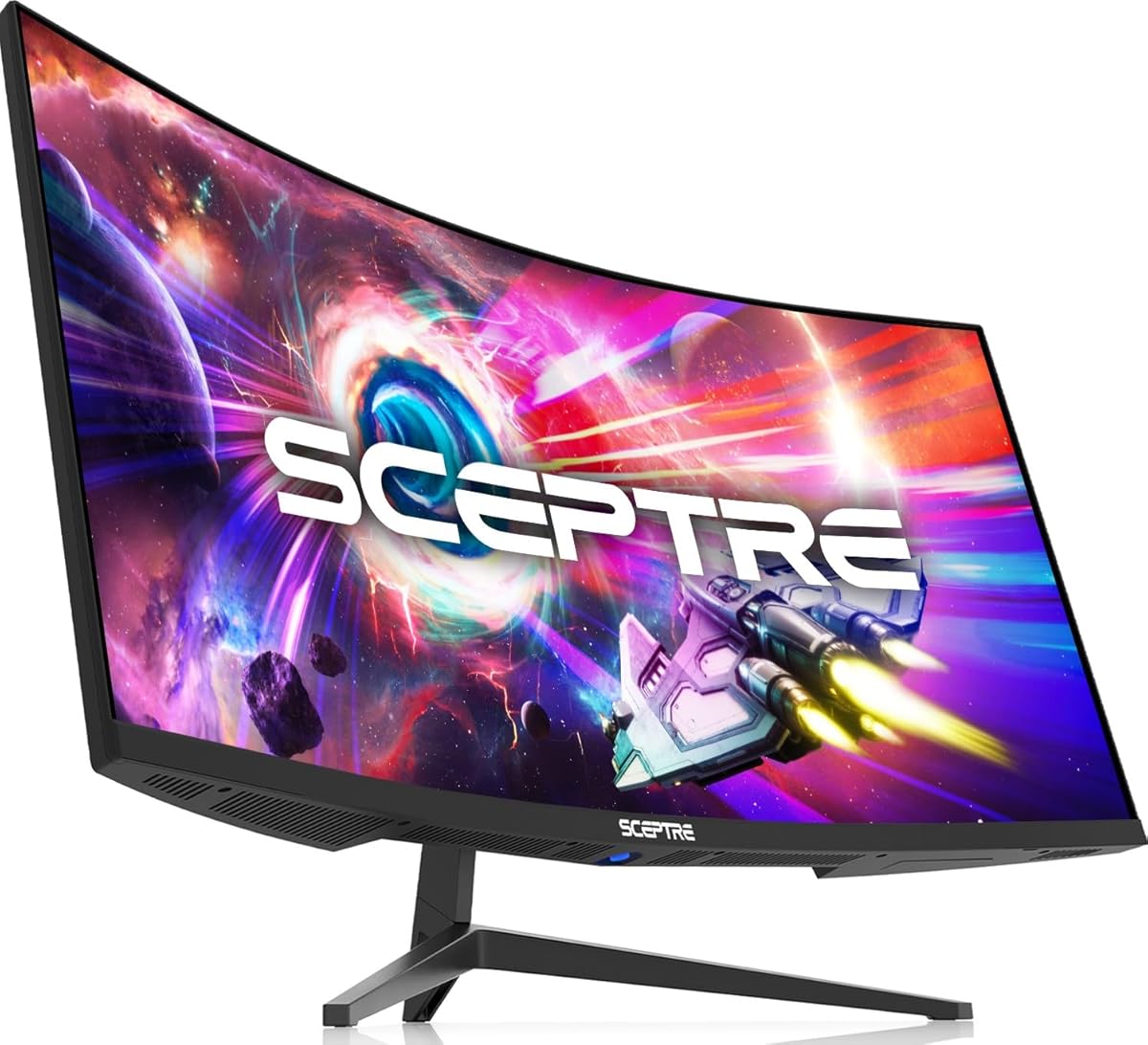
The Sceptre C345B-QU240T combines a 34-inch curved ultrawide panel, 3440 by 1440 resolution, a maximum 240Hz refresh rate, and a 1ms response time. Its 4.4 rating makes it one of the better-reviewed products here, and its feature set is aimed at players who want more visible space without moving up to a 4K panel.
We may earn a commission when you buy through this link, at no additional cost to you.
The 1500R curve provides a less extreme form of immersion than very tightly curved displays, which can make it a comfortable all-day option. A 100% sRGB color gamut supports vivid game imagery, while Blue-Light Shift is included to reduce blue light during long sessions. Built-in speakers and an audio output jack add flexibility for casual media use.
The monitor provides two HDMI ports and two DisplayPort connections, which makes it easier to switch among a gaming PC, laptop, and other devices. A 1ms response specification supports clean movement in fast action, and the 240Hz ceiling is well suited to competitive and high-frame-rate gaming. The tradeoff is that pushing both ultrawide resolution and a high refresh rate places substantial demands on a graphics card.
This is a strong option for players who want racing games, simulators, shooters, and strategy titles to benefit from extra horizontal space. It may be less convenient for general office work because windows and text become smaller, and its size requires desk space. Compared with the CRUA, it trades headline refresh rate for resolution, curvature, and a more expansive workspace.
The 21:9 format is especially useful in games that benefit from a wide field of view. It can also reduce the need to alt-tab frequently when combining streaming tools, chat, and game clients side by side.
Integrated speakers keep everyday audio close at hand, while the audio output jack allows connection to headphones or a larger speaker system. For serious competitive play, low-latency wired headphones may still provide a more consistent experience.
We may earn a commission when you buy through this link, at no additional cost to you.
The LG 32GS60QC-B is a 32-inch curved QHD gaming monitor with a 180Hz refresh rate and 1ms G-to-G response time. Its 4.4 rating reflects strong customer feedback, while the gaming-oriented feature set makes it especially appealing to players who value practical competitive assists alongside a sharp 2560 by 1440 picture.
We may earn a commission when you buy through this link, at no additional cost to you.
AMD FreeSync is included for synchronization with compatible graphics hardware, and Dynamic Action Sync is intended to reduce input lag. Black Stabilizer can brighten dark scenes, while the built-in FPS Counter gives players an immediate view of performance. Gamer, FPS, and RTS modes allow the display to be adjusted for different game genres without relying on every external utility.
The 1000R curve gives the display a dramatic shape and broad peripheral coverage. Its three-side virtually borderless design reduces visual distractions, while 99% sRGB coverage and HDR10 support improve color presentation. Two HDMI ports and DisplayPort connectivity cover the essential source options, and the included tilt adjustment is the primary ergonomic control mentioned in the supplied data.
This monitor is a good match for gamers who want QHD clarity, a large 16:9 format, and useful in-game features. Its 180Hz refresh rate is below the 240Hz and 310Hz alternatives, and the supplied data does not state the maximum HDMI refresh rate. Players seeking the quickest possible frame presentation should compare the complete port specifications, while general QHD gamers may find the larger screen and gaming tools more valuable.
Black Stabilizer, an FPS counter, and genre-specific modes are useful additions that can be more practical than raw refresh rate alone. They help players inspect performance, reveal dark areas, and quickly change the viewing profile for different kinds of games.
A 32-inch 16:9 screen with 2560 by 1440 resolution offers more desktop room than a compact Full HD monitor while preserving familiar aspect-ratio proportions. It is a practical middle ground for gaming, browsing, video, and general productivity.
We may earn a commission when you buy through this link, at no additional cost to you.
The Sceptre E225W-FW144 is a compact 22-inch Full HD monitor with a maximum refresh rate of 144Hz. Its 4.4 rating suggests favorable buyer reception, and its most convincing use case is a smaller gaming setup where desk space, simplicity, and an affordable specification mix matter more than ultra-high refresh rates or high-resolution immersion.
We may earn a commission when you buy through this link, at no additional cost to you.
The 1080p panel is straightforward and familiar, making it suitable for esports titles, casual gaming, study, browsing, and everyday office tasks. HDMI and DisplayPort connections cover the main source types, while built-in speakers reduce the need for separate desktop audio in less latency-sensitive situations. Blue-Light Shift is included for users concerned about comfort during extended viewing.
The nearly bezel-free design is intended to create a clean appearance and support dual-monitor arrangements. That makes the monitor relevant to users who want to supplement a larger primary display or create a compact two-screen workstation. Its small footprint can also help preserve desk space for a keyboard, mouse, and other accessories.
This is not the fastest option in the guide. The 144Hz ceiling is below the 240Hz, 310Hz, and 540Hz models, and no specific response-time figure is provided. However, for a smaller display, the simple feature set can be an advantage. It suits smaller rooms, secondary-monitor roles, and players who value a modest physical footprint more than extreme motion specifications.
A 22-inch footprint is easier to position than a 32-inch display or wide ultrawide. That can reduce crowding and make the monitor more comfortable to use in a compact bedroom, dormitory, or home office.
The slim, nearly bezel-free design is intended to look clean in a two-monitor arrangement. It can provide space for chat, system monitoring, documents, or a secondary game while the main display handles the primary experience.
We may earn a commission when you buy through this link, at no additional cost to you.
The Sceptre C345B-QUT168 combines a 34-inch 1500R curved panel with 3440 by 1440 WQHD resolution, a refresh rate of up to 180Hz, and 1ms MPRT response time. Its 4.2 rating indicates generally positive feedback, and the display is a strong candidate for users who want an ultrawide workspace as much as they want a fast gaming screen.
We may earn a commission when you buy through this link, at no additional cost to you.
The 21:9 format provides 30% more screen space than a conventional monitor according to the supplied product information. That extra width can show more of a game world, allow multiple applications to remain open, or fit a video timeline and other creative tools side by side. The WQHD panel contains roughly five million pixels, offering finer detail than 1080p.
A 1ms MPRT response is intended to reduce ghosting in fast scenes, while two DisplayPort connections provide flexible desktop and gaming setups. The monitor also includes built-in speakers and luminous back-cover lights that add visual character to the desk. Color coverage is listed at 99% sRGB, which is suitable for many gaming and general multimedia uses.
The important compromise is refresh rate. At up to 180Hz, the monitor trails several QHD and Full HD alternatives, and some systems may need to rely on the listed 165Hz mode. Ultrawide resolution can also require scaling support in games and applications. Buyers should verify their titles and productivity software handle 3440 by 1440 well, but those who do will gain a particularly useful workspace.
Multiple windows, editing timelines, spreadsheets, and communication tools can be arranged without stacking them vertically. The additional space often makes a 34-inch ultrawide more valuable for everyday work than two smaller panels, provided desk depth is sufficient.
The stated 1ms MPRT is useful for reducing visible smearing during movement. Actual perceived clarity still depends on frame rate and the game engine, but the specification makes this screen more competitive for action than a basic office-focused ultrawide.
We may earn a commission when you buy through this link, at no additional cost to you.
The Samsung Odyssey G55C offers a 32-inch 1000R curved QHD display with a 165Hz refresh rate and 1ms MPRT response. Its 4.4 rating places it among the stronger customer-rated products in the list. The monitor is best viewed as a polished general-purpose gaming display rather than an extreme-speed esports option.
We may earn a commission when you buy through this link, at no additional cost to you.
QHD resolution provides noticeably more detail than Full HD while remaining less demanding on a graphics card than 4K. The 1000R curve wraps around the viewer more strongly than the 1500R Sceptre ultrawides, creating an immersive enclosure that can make action and scenery feel more encompassing. Its 16:9 format remains conventional and easier to manage for office work.
AMD Radeon FreeSync synchronizes compatible displays and graphics hardware to reduce image tearing. HDR 10 support, deep dark blacks, and luminous whites are intended to give games greater impact. Eye Saver Mode reduces blue light, while the monitor also reduces screen flicker to help with comfort during longer sessions.
The main limitation is its 165Hz refresh rate, which is lower than the 240Hz and 310Hz choices elsewhere in the guide. It is still well suited to fast-paced titles and high-refresh GPUs that run at common lower frame rates. Buyers should seek a strong balance of image quality, curved immersion, and everyday usability rather than chasing the highest possible frame rate.
The tighter curve is designed to pull the edges of the display closer to the viewer and expand the perceived field of view. It may feel more enveloping than a modest curve, particularly in racing, flight, and open-world games.
Eye Saver Mode and reduced flicker target common sources of visual fatigue. These features are particularly useful for players and users who spend long periods reading, browsing, or watching video on the same display.
We may earn a commission when you buy through this link, at no additional cost to you.
The ASUS TUF Gaming VG259QMRL5A is a 24.5-inch Fast IPS monitor that can overclock to a 310Hz refresh rate. It pairs that headline speed with a 0.3ms minimum G-to-G response time and a 4.4 rating. While it falls short of the CRUA's 540Hz, it is one of the strongest high-speed alternatives for competitive gaming.
We may earn a commission when you buy through this link, at no additional cost to you.
FreeSync Premium and G-SYNC compatibility provide flexible adaptive synchronization options, while Extreme Low Motion Blur Sync allows ELMB to operate with variable refresh rate. These features are designed to keep motion clear and reduce tearing. The 1920 by 1080 resolution follows the established competitive-gaming pattern of pairing a small, fast panel with demanding frame rates.
The display covers 99% of sRGB and carries DisplayHDR 400 certification, adding respectable color and light characteristics without moving into the premium HDR range. DisplayWidget Center provides mouse-based access to on-screen display settings, and TUF Gaming A.I technology adds AI-oriented gaming features. A height-adjustable stand supports more comfortable positioning during extended sessions.
This monitor is best for competitive players who want an extremely high refresh ceiling without moving to a 4K or OLED display. The 310Hz figure is an overclocked maximum rather than the standard mode, so users should understand which setting their graphics card and game can maintain. A hardware limitation that prevents the display from reaching its maximum will reduce the benefit.
At an overclocked 310Hz, the ASUS can present substantially more frames than a conventional 144Hz or 165Hz display. It is especially relevant for competitive players with hardware capable of driving very high frame rates, even though it does not directly meet the 540Hz target.
The 0.3ms minimum G-to-G response works alongside ELMB Sync and variable refresh rate support. This combination is designed to improve clarity during rapid movement while helping synchronize the image with the graphics output.
We may earn a commission when you buy through this link, at no additional cost to you.
The Acer Nitro XV272U combines a 27-inch IPS panel, 2560 by 1440 resolution, and a 240Hz refresh rate over DisplayPort. Its 4.2 rating indicates positive customer feedback, while the mixture of high resolution, fast response, and extensive stand adjustment makes it one of the most balanced options for gaming and productivity.
We may earn a commission when you buy through this link, at no additional cost to you.
The supplied specifications distinguish between connections: DisplayPort 1.4 supports up to 240Hz, while the two HDMI 2.0 ports are listed at up to 144Hz. AMD FreeSync Premium is included, and response time is stated as 1ms G-to-G, with the possibility of reaching 0.5ms G-to-G. Buyers using a console or HDMI source should therefore recognize that they will not access the headline refresh rate.
Ergonomics are a major strength. The stand offers 4.7 inches of height adjustment, swivel through 360 degrees, pivot through plus or minus 90 degrees, and tilt from negative five to positive 15 degrees. A 100 by 100mm VESA pattern adds mounting flexibility. Two 2-watt speakers and an audio output jack cover basic desktop audio needs, and DisplayPort and HDMI cables are included.
This monitor suits players who want 240Hz motion without sacrificing QHD detail and who value a flexible ergonomic setup. Its 144Hz HDMI limitation is the main issue for console or laptop users, while a 27-inch footprint is easier to accommodate than a large ultrawide. It is also a strong choice for office work and content viewing when one display must handle both roles.
Height, swivel, tilt, and pivot controls make it easy to change the display between gaming, reading, and shared viewing. The 360-degree swivel and vertical pivot are especially useful when desk space or seating position changes.
This specification pairing delivers sharper visuals than a 240Hz Full HD monitor while avoiding the extreme graphics workload associated with 4K at the same refresh rate. It is a practical middle ground for modern gaming PCs.
We may earn a commission when you buy through this link, at no additional cost to you.
The Acer Predator X32 is a 31.5-inch curved 4K QD-OLED gaming monitor with a 240Hz refresh rate and 0.03ms G-to-G response time. Its 4.1 rating is the lowest among the rated products in the guide, but the supplied specifications identify it as the premium image-quality option with true 10-bit color, DCI-P3 99% coverage, and exceptional black-level performance.
We may earn a commission when you buy through this link, at no additional cost to you.
The 3840 by 2160 panel provides four times the pixel count of Full HD, giving games, video, and desktop applications a high level of visible detail. Its 1700R curve wraps around the field of view for a more enclosed gaming environment. VESA DisplayHDR True Black 400 certification and a listed minimum brightness of 0.0005 nits emphasize deep blacks, strong contrast, and cinematic image presentation.
Response performance is the standout gaming specification. The stated 0.03ms G-to-G time is exceptionally quick, so moving objects should appear sharply defined with minimal visible trail. Image-retention refresh is included to help reduce image persistence, an important consideration for any OLED display that may be used for long sessions or static interfaces.
This is the premium choice for players with a powerful graphics card who want 4K clarity, OLED contrast, and high refresh rate in one screen. It is not the fastest model here, and 4K gaming at 240Hz is considerably more demanding than Full HD at 540Hz. Users should consider GPU capability, desk space, and sensitivity to OLED characteristics before finalizing the purchase.
The QD-OLED panel combines a very high pixel count with near-black contrast and true 10-bit color. This makes it compelling for detailed games, cinematic content, photo viewing, and creative work where both resolution and color depth matter.
A 0.03ms G-to-G response is the fastest response figure listed in the guide. The practical benefit is clean movement with minimal visible ghosting, although the system still needs enough graphical performance to deliver frame rates appropriate for a 4K panel.
We may earn a commission when you buy through this link, at no additional cost to you.
Choosing a very high-refresh gaming monitor involves balancing speed, resolution, panel technology, synchronization, connectivity, ergonomics, and the capabilities of the connected PC. The most valuable specification on paper is the one that your games and hardware can consistently support in everyday use.
Refresh rate controls how many times the display redraws each second, and competitive players often value higher rates because they can expose more intermediate frames during rapid movement. The CRUA reaches 540Hz, the ASUS TUF offers an overclocked 310Hz, and several alternatives reach 240Hz. However, a high refresh rate has little value if the game or graphics card produces far fewer frames. Reviewers should check typical frame rates, not only the theoretical display ceiling, and use the highest mode the hardware can sustain.
Resolution determines how much information the screen can show and directly influences the work required from a graphics card. The 540Hz CRUA and 310Hz ASUS use Full HD, which is easier to drive at extreme frame rates. QHD models provide a sharper image but need more GPU capability, while the Acer Predator combines 4K with 240Hz and therefore represents the greatest processing demand. Resolution also affects the size of text and interface elements, making it important for mixed gaming and productivity use.
Fast response reduces the chance that changing pixels will appear as a trail behind moving objects. Some listings use MPRT, while others specify G-to-G or GtG, and these measurements are not perfectly interchangeable. The 0.03ms G-to-G rating of the Predator and the 0.3ms minimum GtG rating of the ASUS are especially aggressive claims. Real-world clarity also depends on refresh rate, frame pacing, motion-blur processing, and the game itself, so response specifications should be considered alongside adaptive sync rather than in isolation.
Adaptive synchronization coordinates the display refresh with the graphics output to reduce tearing. The list includes AMD FreeSync, FreeSync Premium, Radeon FreeSync, and G-SYNC-compatible hardware. The compatibility of the monitor, graphics card, and driver matters, so users should verify support before buying. Synchronization is especially useful because many games do not sustain the maximum frame rate, and it can provide a more stable image when frame delivery varies.
Color gamut and HDR performance influence how vivid and detailed a game looks. Most IPS alternatives in the guide cover between 99% and 120% sRGB, while the Predator uses QD-OLED with DCI-P3 99% coverage, true 10-bit color, and DisplayHDR True Black 400 certification. IPS screens are often preferred for fast competitive use, while OLED technology can deliver deeper blacks and greater contrast. Users should consider both the hardware and the brightness or color claims listed for the specific panel.
Screen size changes more than physical footprint; it also changes immersion, readability, and peripheral awareness. A 22-inch Full HD model is compact, a 25- to 27-inch screen suits many competitive setups, and a 32-inch QHD display provides a familiar 16:9 workspace. The 34-inch ultrawides add horizontal room for racing, simulation, and productivity, while their curves can vary from 1500R to 1700R. Tighter curves may feel more immersive but occupy more desk depth and can make some users uncomfortable.
The right connections determine which refresh rates and devices you can actually use. DisplayPort is the common choice for high-refresh PC gaming, while HDMI versions and supported console modes vary. For example, the Acer Nitro reaches 240Hz through DisplayPort but is listed at up to 144Hz through HDMI. Several products include built-in speakers, which are convenient for casual use, although dedicated headphones or speakers usually provide better sound and more consistent positioning for competitive play.
A fast monitor should also be comfortable to use for long sessions. The CRUA offers substantial height adjustment and portrait rotation, while the Acer Nitro includes height, swivel, tilt, and pivot controls. Other options may offer tilt only. Wall mounting through VESA can improve positioning on smaller desks, but buyers should verify the pattern and compatible adapter. Cable management, stand footprint, screen curvature, and desk depth are equally important for a stable and accessible setup.
Begin by connecting the PC through the port that supports the intended refresh rate. For high-refresh PC gaming, DisplayPort is often the most straightforward option, while HDMI may be necessary for a console or laptop. After connecting the cable, select the highest resolution and refresh rate supported by both the monitor and graphics card in the operating system's display settings. Install the graphics-card driver and confirm the on-screen display reports the expected mode.
Use the included or compatible DisplayPort and HDMI cables, avoiding unverified adapters or long cable runs that can reduce signal stability. If the available refresh rate is lower than expected, check the graphics card, cable, monitor port, Windows display settings, and game graphics configuration. Adaptive sync should be enabled only when the monitor and graphics hardware support the same standard. In-game frame-rate caps can also help maintain smooth pacing and consistent latency.
For a high-refresh or OLED screen, use the on-screen display to set brightness, color mode, and overdrive according to the manufacturer's guidance. Avoid leaving static menus, chat windows, or desktop icons onscreen for long periods, especially on OLED models. Clean the panel with a soft, lint-free cloth, keep liquids away from the display, and leave ventilation openings unobstructed. Periodically checking for firmware updates can improve compatibility and monitor control.
A 540Hz monitor can present twice as many refresh cycles per second as a 240Hz model, which may make fast movement look smoother. The visible advantage depends on whether the game and graphics card can produce a high enough frame rate. If performance remains near 240 frames per second or below, the two displays will not look dramatically different.
Yes, achieving consistently high frame rates at 540Hz usually requires capable hardware, especially in demanding games. The CRUA's Full HD resolution reduces the graphics workload compared with QHD or 4K, but the CPU, GPU, game settings, and frame-pacing behavior still influence the final experience. A high refresh rate cannot compensate for consistently low frame delivery.
Neither is universally better. A 540Hz Full HD monitor prioritizes motion smoothness, while a 4K OLED monitor prioritizes detail, contrast, and color depth. Competitive players may prefer maximum refresh in simpler games, while those playing simulation, strategy, or cinematic games may value the Predator's 4K QD-OLED presentation more highly.
Full HD is common at refresh rates of 240Hz and above because it requires less graphics processing than QHD or 4K. QHD at 240Hz offers a stronger balance of detail and motion for a capable gaming PC. The best choice depends on your GPU, display size, game genre, and willingness to adjust graphics settings.
Both describe different ways of measuring pixel response, so their numbers are not directly interchangeable. MPRT may include visual persistence from backlight behavior, while G-to-G or GtG values focus more directly on pixel transition speed. A faster stated value can indicate strong motion performance, but adaptive sync, frame rate, and the quality of the implementation also influence what the player sees.
It depends on the game and the player's preference. Some competitive titles support ultrawide resolutions and provide a wider peripheral view, while others limit field of view or apply letterboxing. A 34-inch ultrawide can also be less practical for a small desk, so players should check game support before choosing one over a conventional 16:9 display.
Adaptive sync is generally useful when the graphics card cannot consistently match the display's maximum refresh rate. It reduces tearing and stabilizes frame delivery within its supported range. Correct setup matters, so the monitor and graphics card must support compatible versions of FreeSync or G-SYNC, and the feature should be enabled through the appropriate control menu.
Place the screen at a comfortable viewing distance with its center near eye level, then adjust tilt, height, swivel, or pivot to keep the viewing position neutral. Curved models need adequate desk depth, and their edges should remain within the player's field of view. If a 34-inch or larger screen causes eye strain, a smaller display may be more comfortable.
The CRUA 27-inch 540Hz model is the most direct answer to the search because it uniquely combines a 540Hz refresh rate, 1ms MPRT response, Full HD IPS, and a highly adjustable stand. The KTC 24.5-inch 240Hz display serves as a value-centered competitive option, while the Acer Predator X32 delivers the premium combination of 4K detail, QD-OLED contrast, 240Hz refresh, and extremely fast response.
The right priority depends on the intended use. Competitive players should focus on achievable frame rates, synchronization, response clarity, and compact size. Mixed-use buyers may prefer QHD, speakers, and extensive ergonomic adjustment, while premium enthusiasts can justify the Predator for its color depth, HDR characteristics, and 4K resolution.
Before purchasing, verify the current listing, connection capabilities, supported refresh modes, warranty information, and physical dimensions. Prices and promotions can change, and availability may vary, so current retailer information is essential. The most capable specification is useful only when it fits the user's graphics hardware, favorite games, desk, and viewing preferences.