
Taramps TS 400×4
4.3Editor score
Four-channel Class D design
Two bridged output modes
RCA inputs for car systems
Amp for Component Speakers guide compares 10 amplifiers for power, channel flexibility, sound quality, connectivity, car-audio use, and home-audio fit needs.
An amp for component speakers must supply clean power, accommodate the impedance and channel configuration of the speaker set, and provide useful controls without overwhelming the installation. The best choice depends equally on accurate output specifications, compatible inputs, thermal design, crossover flexibility, and the environment in which the system will operate.
This guide compares ten amplifiers suited to component-speaker applications, including compact home-audio units, streaming amplifiers, full-range car amplifiers, and multi-channel models designed for tweeters, mid-bass drivers, and subwoofers. We evaluated the supplied output claims, connectivity, control features, protection details, and intended use rather than assuming every amplifier belongs in the same installation category.
The selections reveal different paths to a strong component-speaker system. Some prioritize easy Bluetooth playback and compact home use, while others emphasize car-audio power, high- and low-level inputs, flexible crossovers, or dedicated multi-channel amplification. Ratings, specifications, availability, and prices can change, so confirm current product details before buying.
4.3Editor score

4.5Editor score

4.6Editor score
The table below places the ten amplifiers side by side, highlighting their channel layouts, output capabilities, signal connections, control features, and most practical installation environments.




The Taramps TS 400×4 is a compact four-channel car amplifier built around a total 400-watt RMS output claim. Its four-channel architecture makes it more flexible than a conventional two-channel unit, particularly for a vehicle that needs separate amplification for front and rear component sets or multiple speaker zones. The supplied rating of 4.3 reflects a generally positive reception, although buyers should judge the model on fit, wiring, and output needs rather than the headline total alone.
We may earn a commission when you buy through this link, at no additional cost to you.
The strongest feature is the choice of operating modes. Four independent channels can suit a straightforward multi-speaker installation, while the two bridged-channel options allow the amplifier to serve different system architectures. Class D efficiency also makes this compact amplifier practical in a vehicle where every inch matters. RCA inputs provide a familiar path for conventional head units and signal processors, making the unit relevant to anyone moving from an OEM-style car audio system to externally amplified component speakers.
The tradeoff is that the TS 400×4 is not a general-purpose home amplifier. It is designed for automotive electrical systems, and its installation instructions explicitly call for professional setup to ensure safety, correct operation, and optimal performance. A qualified technician should use appropriate tools, protective equipment, insulated gloves, and suitable wiring. The compact size is helpful, but smallness does not remove the need for correct fusing, grounding, and airflow.
This is a compelling budget choice for a multi-speaker car build, especially when four-channel flexibility and bridging are important. It is less suitable for a living-room system requiring wireless music streaming, television integration, or a bundled power supply. For a driver who wants to power several passive component speakers in one compact car-audio unit, the Taramps is a practical and adaptable starting point.
The four-channel design can serve separate front and rear speaker groups, split a system into distinct zones, or use the available bridged configurations for a different layout. That versatility makes the amplifier more adaptable than a basic two-channel model without requiring several separate units.
RCA inputs and a compact Class D format fit naturally into car-audio installations. Proper power distribution, grounding, fusing, and ventilation remain essential, so professional installation is strongly recommended by the manufacturer.
We may earn a commission when you buy through this link, at no additional cost to you.
The Fosi Audio BT20A Pro combines a compact two-channel Class D amplifier with Bluetooth 5.0, making it an appealing centerpiece for passive bookshelf, desktop, patio, or outdoor speakers. It has a 4.4 rating and a stated maximum output of 300 watts x2, but that headline figure should not be confused with continuous power into every impedance. Its main appeal is the combination of wireless convenience, flexible tone controls, and an unusually upgrade-oriented internal design.
We may earn a commission when you buy through this link, at no additional cost to you.
At the heart of the unit is a Texas Instruments TPA3255 chip amplifier with a stated signal-to-noise ratio of at least 108 dB and total harmonic distortion of no more than 0.005 percent. The Pro version also supports replaceable plug-in NE5532 Op-Amps, and the supplied information lists compatible alternatives including LME49720HA, MUSES02, OPA2604AP, OPA2134PA, LM4562, and NJM4556AD. This gives technically inclined listeners a way to explore different sound characteristics, although the neutral setting remains a practical starting point.
Bluetooth pairing can be cleared by holding the volume control for five seconds, and a memory function makes reconnecting familiar devices convenient. Bass and treble knobs allow basic tonal adjustment, with the center position providing an uncolored baseline. The package includes the amplifier, antenna, 32V/5A adapter, AC cord, and manual. Buyers should still verify speaker impedance compatibility, especially if they expect the maximum power claim to be delivered under real conditions.
Choose the BT20A Pro for a small home or outdoor audio system that values wireless playback and compact construction. It is a better fit for passive component speakers than for an automotive installation, and it does not provide the television-oriented features or room-correction tools of a network amplifier. For a simple two-speaker system with convenient streaming, however, it offers an engaging combination of features and sound-quality credentials.
The replaceable Op-Amp design is the distinguishing technical feature. Listeners can begin with the supplied NE5532 chips and explore compatible alternatives later, making the amplifier more engaging for hobbyists who enjoy refining system tone.
Bluetooth 5.0, pairing memory, and a clear pairing-reset procedure simplify everyday listening. The amplifier also supports a conventional wired signal path, giving users flexibility between streamed and connected sources.
We may earn a commission when you buy through this link, at no additional cost to you.
The Fosi Audio TB10D is a compact TPA3255-based two-channel amplifier built for passive speakers, desktop audio, home theater, gaming, and bass-shaker use. Its 4.5 rating and 600-watt total maximum-output claim make it appealing to shoppers seeking more headline power than a typical mini integrated amplifier. The TPA3255 platform also provides a strong technical foundation, while built-in protection circuits support stable operation.
We may earn a commission when you buy through this link, at no additional cost to you.
The amplifier is advertised as delivering up to 300 watts per channel and as being capable of driving bookshelf speakers rated from 2 to 8 ohms. Because the supplied specifications describe maximum output rather than continuous RMS power across those impedances, listeners should treat the figure as a peak capability rather than a promise of continuous performance. For realistic component-speaker use, the speaker manufacturer’s recommended amplifier power and the included power supply remain the decisive considerations.
RCA inputs and passive speaker terminals make the TB10D broadly compatible with phones, computers, DVD players, CD players, PCs, laptops, TVs, turntables with a phono preamp, and other line-level sources. The bass and treble controls allow modest tonal adjustment, while the physical power switch makes daily operation straightforward. Its small enclosure is useful for shelves, desktop setups, game rooms, dining areas, and compact home-theater installations. It can also feed a bass shaker when the system design calls for that kind of low-frequency reinforcement.
The TB10D is a good choice for users who want a small, simple amplifier with a generous maximum-output specification and broad source support. It does not include Bluetooth, HDMI ARC, streaming applications, or multiroom control, so it is less convenient as a modern network-audio hub. For wired passive-speaker systems, though, it offers a focused combination of compactness, useful controls, and amplifier power.
RCA input and passive speaker output provide a straightforward path for many line-level sources. This makes the TB10D especially convenient for legacy equipment, desktop listening, and simple home-theater arrangements.
The small Class D enclosure reduces visual and spatial clutter. Bass and treble controls, a dedicated power switch, and built-in protection circuits add everyday convenience without complicating the core design.
We may earn a commission when you buy through this link, at no additional cost to you.
The AIYIMA A07 Premium is a compact two-channel TPA3255 amplifier intended for passive bookshelf speakers and desktop or home-audio systems. Its 4.4 rating reflects a strong balance of useful features, and the full-metal enclosure gives it a more substantial appearance than many plastic mini amplifiers. The standout addition is the 3.5 mm AUX pre-out, which can feed an active device, another power amplifier, or a powered subwoofer amplifier.
We may earn a commission when you buy through this link, at no additional cost to you.
The amplifier uses TPA3255 amplification technology alongside a replaceable NE5532 dual Op-Amp stage. The supplied information notes that the Op-Amps can be upgraded with compatible OPA, LM, and MUSES series alternatives. Internal component choices include ELNA capacitors, 63V filter capacitors, and WIMA capacitors. A 2025-upgraded version adds enhanced cooling, improved knobs, a full-metal housing, and professional audio components, although the product does not support Wi-Fi.
Power output is stated at up to 300 watts x2 and maximum total output at 600 watts. The included 32V/5A adapter supports operation, but the information specifically notes that a suitable 48V/10A supply can be used to pursue maximum power. Users are warned not to use an industrial power supply and to select a supply appropriate for the passive speakers. Those details make power-supply matching an essential part of setup rather than an afterthought.
The A07 Premium is particularly appealing to listeners who value a wired hi-fi system and enjoy the possibility of upgrading internal chips. The pre-out is useful for building a 2.1-channel arrangement or adding a second stage. It is not a convenient selection for wireless-heavy users because it lacks Bluetooth and network functions. For a compact, component-based two-channel system, however, it offers refined construction and considerable flexibility.
The 3.5 mm AUX pre-out sends a full-range, volume-controlled signal to active speakers, a separate power amplifier, or a powered subwoofer amplifier. That feature lets users expand a stereo system without replacing the main integrated amplifier.
Replaceable NE5532 Op-Amps offer a clear upgrade path for listeners who want to experiment with sound. A quality power supply and correct speaker pairing remain necessary to extract the intended performance.
We may earn a commission when you buy through this link, at no additional cost to you.
The Rockford Fosgate Punch P300X2 is a full-chassis two-channel car amplifier with a clearly stated 300 watts of RMS power. Its 4.5 rating, familiar Class A/B topology, and extensive signal controls make it one of the strongest general-purpose choices for component speakers in this comparison. It is especially useful when the system must accept signals from either a traditional aftermarket head unit or a factory-style high-level output.
We may earn a commission when you buy through this link, at no additional cost to you.
The amplifier produces 100 watts x2 at 4 ohms, 150 watts x2 at 2 ohms, and 300 watts x1 at 4 ohms when bridged. That range allows the same unit to serve a stereo front stage or a dedicated bridged subwoofer channel. RCA inputs can accept high- and low-level signals without a separate converter, eliminating a common installation obstacle. On-board Punch EQ provides up to 18 dB of boost at 45 Hz, and variable 12 dB-per-octave Butterworth crossovers support frequency-managed setups.
Rockford Fosgate’s C.L.E.A.N. setup system helps users configure the amplifier for reduced noise and cleaner operation. The full chassis measures 2.38 by 7.76 by 9.86 inches, so it occupies more space than the smallest Class D units but is appropriately sized for a car installation. The trade-off is weight and size, but that physical footprint supports a conventional automotive chassis, robust controls, and a build intended for vehicle electrical environments.
Choose the P300X2 for a front component-speaker stage, a compact stereo system, or a subwoofer installation that needs a dependable hard-wired amplifier. It lacks home conveniences such as Bluetooth, HDMI, and streaming applications, and its controls require knowledge to set correctly. Within a car build, however, the combination of RMS power, flexible input handling, crossover controls, and an established one-year warranty makes it the most versatile premium-oriented selection here.
Accepting both high- and low-level signals means the P300X2 can work with aftermarket head units, factory integration, or an external signal processor. That flexibility can simplify a car build and reduce the need for extra adapters.
The amplifier can run as a stereo unit, deliver higher power into lower-impedance channels, or bridge for one high-power output. Crossover controls and Punch EQ allow the same platform to serve several component-system roles.
We may earn a commission when you buy through this link, at no additional cost to you.
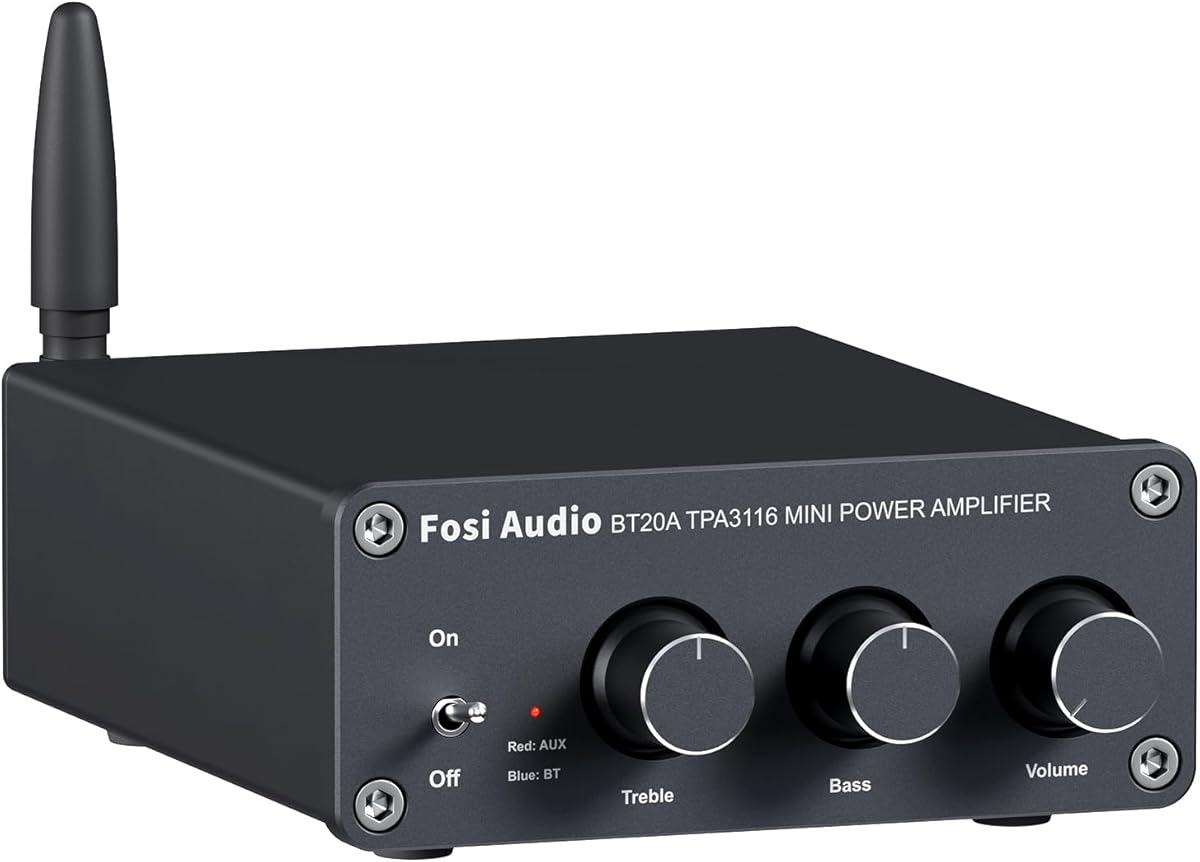
The Fosi Audio BT20A is an entry-level compact Class D amplifier created for passive speakers in homes, offices, bedrooms, garages, patios, and small venues. It carries a 4.5 rating and combines Bluetooth with RCA inputs, bass and treble controls, and an easy one-touch power switch. Its purpose is straightforward: provide uncomplicated amplification for a two-speaker setup without requiring a large receiver.
We may earn a commission when you buy through this link, at no additional cost to you.
Maximum output is listed at 100 watts x2. As with other mini amplifiers, that number should be understood as a maximum capability rather than a continuous rating across all speaker impedances. The compact body and integrated Class D design are suitable for shelf placement, and the smooth tone controls make basic matching to a room or speaker pair straightforward. Bluetooth allows a phone to become the primary music source without a separate streamer.
The BT20A also supports conventional RCA input, giving users a wired path for a turntable with a built-in preamp, a television line output, a CD player, or another source. Its one-piece all-black construction gives it a restrained appearance and a durable integrated form. The simplicity is a benefit for first-time amplifier buyers, although it also means there are no advanced crossover filters, pre-outs, multiroom functions, or room-correction tools.
This is a sensible choice for a straightforward pair of bookshelf or ceiling speakers where Bluetooth convenience matters more than nuanced control. It may not be ideal for a demanding component system that requires precise crossover management or substantial continuous power. For a small room, garage, patio, or office, the BT20A offers an attractive mix of compactness, straightforward controls, and flexible source selection.
The BT20A focuses on the functions a basic passive-speaker system needs: a line-level input, wireless streaming, volume control, and basic tone adjustment. It avoids unnecessary complexity and suits compact installations.
The small, one-piece black enclosure is easy to place on a shelf or cabinet. Its understated appearance works in home and office environments, and the simple power control reduces setup friction.
We may earn a commission when you buy through this link, at no additional cost to you.
The WiiM Amp is the most connectivity-focused amplifier in the group, designed to turn passive speakers into a modern streaming and television system. Its 4.6 rating is the highest among the ten products, and the feature set extends well beyond basic amplification. It supports streaming services, the WiiM Home App, HDMI ARC, voice-assistant control, multiroom integration, high-resolution playback, room correction, and independent EQ settings.
We may earn a commission when you buy through this link, at no additional cost to you.
Power is rated at 60 watts per channel into 8 ohms and 120 watts per channel into 4 ohms, making it suitable for many bookshelf, floor-standing, architectural, and outdoor passive speakers. The HDMI ARC port allows a television to send audio to the amplifier over a single cable, and a powered subwoofer can be added for deeper low-frequency impact. This makes the WiiM Amp a natural centerpiece for a living room where music and home theater share the same speakers.
The WiiM Home app provides control over volume, room synchronization, favorites, alarms, and settings. It can work with Alexa, Google Assistant, or Siri and can combine with AirPlay 2 speakers, Amazon Echo, Google Home, and other WiiM devices. Streaming support extends to services such as Spotify, Amazon Music, TIDAL, Qobuz, and personal libraries, with playback stated at up to 24-bit/192 kHz. Room correction and separate EQ controls help tailor the output to the listening space.
One important limitation is that the unit is an AirPlay receiver only; it cannot transmit its AirPlay stream to other AirPlay-enabled devices. The WiiM Amp is also not a car amplifier and does not provide automotive RCA inputs or crossover filters. Choose it when passive speakers should join a connected home ecosystem. For a simple wired stereo system, its capabilities may be more than necessary, but for streaming, television audio, and multiroom control, it is the clear premium choice.
HDMI ARC gives the amplifier a direct connection to television audio, while the RCA input remains available for traditional sources. A powered subwoofer can supplement the stereo output for a more complete home-theater presentation.
The app, voice-control support, streaming applications, and multiroom compatibility make the WiiM Amp more than a conventional integrated amplifier. Its AirPlay receive-only limitation should be considered if transmitting audio to other AirPlay devices is important.
We may earn a commission when you buy through this link, at no additional cost to you.
The Sundown Audio SFB-500.4D is a high-output, four-channel car amplifier intended for demanding component-speaker and tweeter systems. Its listed specifications are the most power-focused in the comparison: 500 watts x4 at 1 ohm with a 14.4-volt supply, 450 watts x4 at 1 ohm with a 12-volt supply, 320 watts x4 at 2 ohms, and 200 watts x4 at 4 ohms. It can also bridge to deliver 1,000 watts x2 at 2 ohms under the stated 14.4-volt condition.
We may earn a commission when you buy through this link, at no additional cost to you.
That output makes the amplifier relevant to enthusiasts who are building a more elaborate vehicle audio system. Four channels can power separate tweeter and mid-range or mid-bass sections, while the bridged mode can create two higher-power channels. The 1-ohm capability also opens the door to multi-speaker arrangements, assuming the individual speaker loads and wiring plan are designed correctly.
The principal drawback is that the supplied product information focuses almost entirely on power and offers little detail about filter controls, input flexibility, or other setup conveniences. Buyers should verify the full manufacturer specification and terminal arrangement before finalizing an installation. The 4.0 rating is the lowest here, but rating alone does not capture the appeal of a specialized high-power platform in the right vehicle project.
Choose the SFB-500.4D for a serious car build where multiple high-output channels and bridging are central requirements. It is not a home amplifier and has no stated streaming, television, or wireless functionality. Proper automotive electrical design, appropriate fusing, and careful impedance calculations are essential. When those priorities matter more than convenience, the amplifier’s high-output four-channel architecture is the central attraction.
The supplied output matrix covers 1-, 2-, and 4-ohm loads. That range gives installers flexibility when powering tweeters, mid-bass drivers, and other component sections within one compact four-channel platform.
Bridging creates two higher-power channels from the four-channel amplifier. It can simplify certain car-system layouts, although exact speaker loads and wiring must be checked carefully before installation.
We may earn a commission when you buy through this link, at no additional cost to you.
The Skar Audio RP-75.4AB is a four-channel Class A/B car amplifier that combines a 500-watt MOSFET design with practical system controls. It shares the highest product rating in this comparison at 4.6, and its published outputs are more conservative and clearly differentiated: 125 watts x4 at 2 ohms and 75 watts x4 at 4 ohms. For shoppers comparing real channel power rather than a large aggregate headline, those figures are especially useful.
We may earn a commission when you buy through this link, at no additional cost to you.
The amplifier includes adjustable gain, a variable low-pass filter, a variable high-pass filter, and a three-position bass EQ switch offering 0, +6, or +12 dB. Those controls make it easier to allocate channels correctly in a component system. A high-pass filter can keep low frequencies away from small drivers, while the low-pass filter can manage a subwoofer or other bass-focused section. Four-way protection circuitry adds support for reliable operation.
The stated frequency response is 20 Hz to 20,000 Hz, and signal-to-noise ratio is 105 dB. These figures indicate that the amplifier is designed for full-range reproduction, matching its intended use with component speakers. Compared with a high-power specialist unit such as the SFB-500.4D, the RP-75.4AB offers less extreme maximum output but a clearer combination of crossover and EQ controls in the supplied information.
This is a strong all-around choice for a multi-speaker vehicle system that needs useful frequency management across four channels. It is not a home amplifier, and the 500-watt description should not be read as 500 watts per channel. The actual outputs depend on channel impedance. For installers prioritizing balanced four-channel flexibility, documented protection, and straightforward bass controls, the Skar Audio deserves serious consideration.
The stated 75 watts x4 at 4 ohms and 125 watts x4 at 2 ohms make channel output easier to compare with speaker recommendations. The 500-watt designation describes the broader amplifier design rather than individual channel performance.
Variable high-pass and low-pass filters help assign appropriate frequency ranges to different drivers. The selectable bass EQ adds another level of control for vehicle systems that need to compensate for cabin reflections.
We may earn a commission when you buy through this link, at no additional cost to you.
The Daakro AK45 is a straightforward stereo amplifier with Bluetooth 5.1, a 300-watt maximum-output claim, and controls for volume, bass, and treble. It is positioned as an accessible option for a basic pair of passive speakers, and the included remote allows volume changes when the amplifier itself is not within easy reach. Its 4.1 rating is lower than those of the other models, making this a choice best suited to uncomplicated listening rather than demanding system design.
We may earn a commission when you buy through this link, at no additional cost to you.
The remote-control feature is especially useful in a bookcase, entertainment center, or other setup where the amplifier may be placed out of sight. Removing the isolation plastic sheet before using the remote is an important first step, as noted in the supplied information. Bluetooth 5.1 provides a convenient modern source path, while the front-panel tone controls let users make quick bass and treble adjustments without navigating a complex software interface.
The main limitation is the amount of objective information supplied. While maximum power, wireless capability, remote control, and tone controls are stated, the product data does not provide a detailed continuous-output matrix, impedance range, input configuration, protection list, or frequency-response specification. Buyers who need a rigorously specified amplifier for a multi-way passive system may find the other models easier to compare.
The AK45 may suit a bedroom, office, shop, or casual listening area where simple wireless playback and remote control are the primary needs. It is not the most obvious choice for a car system, a high-end home-theater role, or an installation requiring precise crossover and output information. Its value lies in uncomplicated functionality, so matching it to modest passive speakers and straightforward source requirements is the best path to a satisfying result.
The supplied remote can adjust volume from across the room, making the amplifier easier to operate when it is installed inside furniture or on a shelf. Remove the isolation plastic sheet before using the controller.
Bluetooth 5.1 gives users a direct route for music playback, while front-panel bass and treble controls provide quick manual refinement. The limited published specification detail is the main consideration for advanced system builders.
We may earn a commission when you buy through this link, at no additional cost to you.
The correct amplifier depends on speaker impedance, power requirements, system architecture, source connections, and installation environment. These factors help prevent wasted power, distorted output, incompatible wiring, and an amplifier that lacks the controls needed by a particular component-speaker setup.
In short, compare like-for-like power figures and avoid assuming that a large maximum-output number guarantees stronger everyday performance.
In short, check every speaker’s nominal impedance and make sure it remains within the amplifier manufacturer’s supported operating range.
In short, count the powered channels, compare driver sections, and confirm that the amplifier provides the crossover flexibility the design requires.
In short, use a purpose-built automotive amplifier for a vehicle and a home amplifier with suitable power, controls, and connectivity for a living space.
In short, confirm that the amplifier accepts your planned source and includes any pre-out, high-level input, or wireless connection the system requires.
In short, prioritize documented continuous or RMS output and use maximum wattage only as a loose indication of amplifier capability.
In short, choose controls that solve a real setup need and verify that thermal, overload, or short-circuit protection is documented.
In short, leave room for connections and airflow, and follow the manufacturer’s mounting, wiring, cooling, and power-supply guidance.
Begin by confirming that every speaker is passive and compatible with the amplifier’s supported impedance. Connect the source, power supply, and speaker cables with the system powered off. Home users should follow the supplied adapter and ventilation instructions, while car installers must use appropriate automotive wiring, fusing, and grounding. Check polarity and tighten every terminal before turning up the volume.
Set the amplifier’s gain and tone controls conservatively at first. For a car system, configure high-pass and low-pass filters so each driver receives the intended frequency range, and use the manufacturer’s setup guidance to minimize noise. Home users can start with bass and treble at the center position, select the source, and make small tonal adjustments while evaluating the result over familiar recordings.
Operate the amplifier within its specified load, power, temperature, and input conditions. Do not ignore repeated protection cycling, abnormal heat, buzzing, or channel imbalance. Allow the enclosure to remain ventilated, keep controls and connectors free of moisture, and avoid switching the unit off during file transfers or while it is delivering substantial output. For automotive use, have wiring and fusing inspected by a qualified technician whenever the system is changed.
Yes, if the amplifier has enough channels and suitable crossover controls. A four-channel unit can power two tweeters and two mid-bass drivers, allowing each set to receive its appropriate frequency range. Verify the speaker impedances, ensure the amplifier supports the resulting loads, and set the filters correctly before increasing the volume.
No. A suitable amplifier should provide the clean power recommended for the speakers without exceeding their safe thermal limits or operating beyond its own specifications. Maximum-output claims can be misleading, so compare continuous or RMS figures, impedance ratings, controls, and protection rather than choosing only by the largest number.
A two-channel amplifier normally powers one stereo speaker pair, while a four-channel amplifier can power two stereo pairs or separate driver sections. Four-channel models may also support bridging into two higher-power channels. The best choice depends on speaker count, filtering needs, vehicle layout, and the rest of the system architecture.
Generally, a home amplifier should not be used in a car without manufacturer approval and proper automotive power conversion. Vehicle systems experience voltage variation, vibration, heat, and different signal sources. An automotive-rated amplifier and correctly specified vehicle wiring are safer and more reliable, while a home unit with an AC adapter is intended for a stable household supply.
Passive speakers require an external amplifier because they do not contain their own power amplification. The amplifier supplies both power and the signal needed to drive the drivers. Its impedance handling and available output should match the speakers, and crossover controls may be necessary when separate tweeters and mid-bass drivers are used.
Bridging combines two amplifier channels into one higher-power output with an appropriate wiring arrangement. It can help a subwoofer or a single high-power driver receive more voltage. The total speaker impedance must remain within the bridged specification, and the manufacturer’s terminal and wiring instructions must be followed exactly.
They provide a rough indication of potential output, but they are most useful when interpreted alongside impedance, supply voltage, channel configuration, and continuous-power data. For example, a clearly stated 75 watts x4 RMS specification gives more planning information than a 500-watt total label without channel-level details.
Check the included power supply, supported speaker impedance, input options, continuous output, ventilation needs, and whether the required sources are wired, Bluetooth, HDMI, or network-based. A pre-out can also be valuable if the system includes a powered subwoofer or a second amplification stage. The amplifier should then be matched to the speakers’ recommended power.
The Taramps TS 400×4 stands out as a budget-friendly, compact four-channel car option, while the Rockford Fosgate Punch P300X2 is the most versatile overall pick for vehicle component systems because of its RMS power, flexible inputs, crossover controls, and bridging capability. The WiiM Amp takes the premium position for connected homes, combining passive-speaker amplification with streaming, HDMI ARC, multiroom control, and room-oriented adjustment.
Prioritize speaker compatibility first: check impedance, recommended continuous power, required channel count, crossover needs, and source connections. Then consider installation conditions, cooling, protection, and convenience. A Bluetooth-equipped mini amplifier may be ideal for a simple room, while a car system benefits from an automotive model with the appropriate signal inputs and hard-wired installation design.
Ratings, specifications, product availability, and prices can change, so verify the current listing and manufacturer documentation before purchasing. Use the comparison table to narrow the field, then read the detailed review for the model that best matches your speakers, sources, room or vehicle, and preferred level of control.