
Wireless Digital Microscope, Skybasic
4.2Editor score
50X–1000X magnification
Wi-Fi and USB operation
Eight adjustable LED lights
Photo and video capture
Includes adjustable stand
Digital microscopes make the structure of insects easier to explore by combining close magnification, built-in lighting, and image or video capture. The right model depends on whether you want simple handheld exploration, detailed specimen work, phone connectivity, or a larger display for classroom and laboratory viewing.
This guide compares ten digital microscopes for studying insects based on magnification, resolution, lighting, display design, supported connections, storage options, portability, and included accessories. It covers models aimed at children, families, teachers, and adult hobbyists, while also noting important differences between handheld devices and larger all-purpose instruments.
Each review explains the product's strongest features, practical limitations, and ideal user. The top recommendations range from a compact child-friendly microscope to a multi-lens model with a movable stage, and product availability and pricing can change, so readers should verify current specifications before purchasing.
4.2Editor score
4.6Editor score

4.4Editor score
As an Amazon Associate we earn from qualifying purchases.
The comparison below highlights each microscope's magnification, viewing method, lighting, and connection options. It helps distinguish pocket-friendly tools for young explorers from stand-mounted instruments suited to prepared slides, larger displays, and more demanding observations.
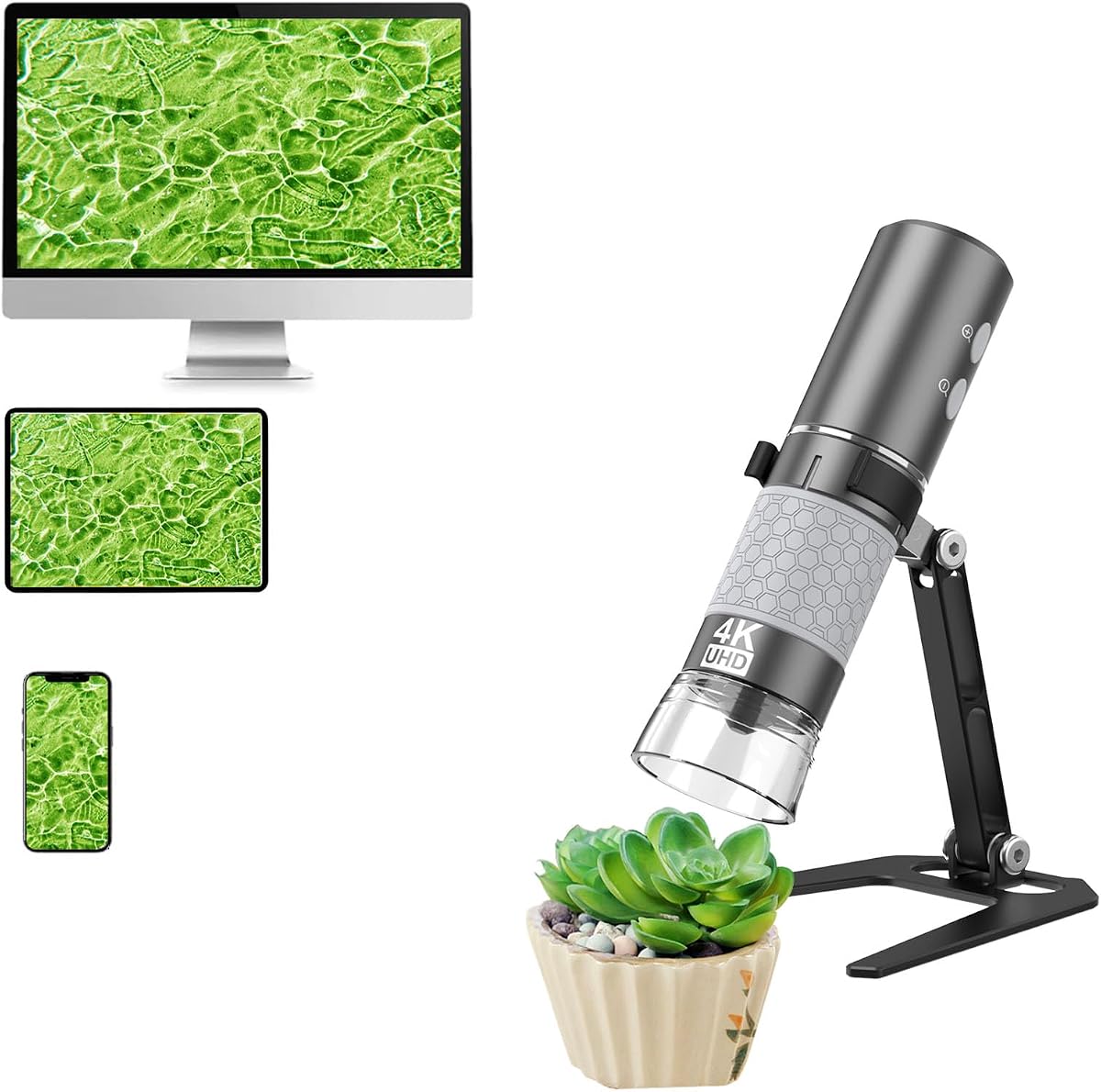


The Skybasic Wireless Digital Microscope is a straightforward handheld option for viewing insects, leaves, fabric fibers, coins, and other small subjects. It carries a 4.2 rating and offers 50X–1000X magnification, Wi-Fi operation for mobile devices, and USB connectivity for computers. Its main appeal is the combination of phone support, an adjustable stand, and eight adjustable LED lights without requiring a separate traditional microscope.
We may earn a commission when you buy through this link, at no additional cost to you.
The 2MP CMOS sensor can capture images and video, while the listed output reaches 1920×1080 for smartphone viewing and 720P for computer use. The built-in LEDs help reveal surface patterns and insect structures that may be difficult to see in ambient light. A three-to-60-millimeter working distance provides useful guidance when positioning the lens, and the included base can stabilize observations of larger or more active specimens.
There are some practical compromises. The product is described as a fixed-focus magnifying device rather than a professional biological microscope, so its high magnification figure should not be treated as equivalent to laboratory-grade optical performance. Users may also need to install the Max-see application, update it, remove the protective film, and adjust operating-system camera permissions. The zoom and capture controls work in Wi-Fi mode but are not supported during USB operation.
This is a sensible choice for a family, teacher, or beginner who wants to explore insects on a phone without purchasing a large display microscope. It is particularly useful for examining antennae, wing patterns, legs, and body texture at close range. For more demanding scientific imaging, the Andonstar and Elikliv models offer larger screens, more interchangeable optics, and better workflow features, but the Skybasic remains an economical and highly portable starting point.
Connecting through the microscope's own Wi-Fi hotspot makes it easy to view a live image on a compatible phone or tablet. USB offers another route for computers, although setup and control differ between the two methods.
Eight adjustable LEDs provide useful illumination for examining small insects and plant material. The light can be adjusted to reduce glare or compensate for dim surroundings during a backyard investigation.
We may earn a commission when you buy through this link, at no additional cost to you.
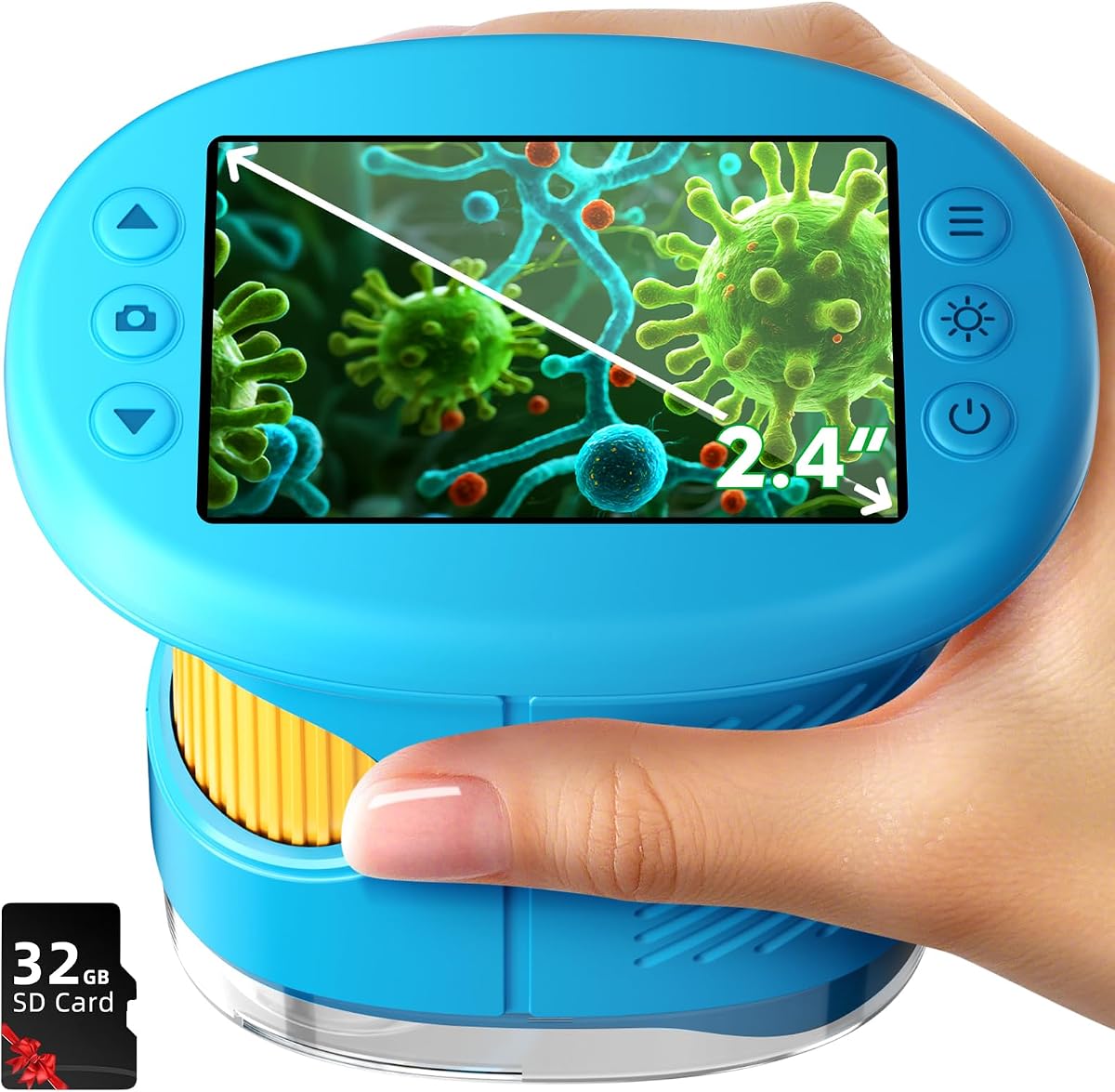
The Odatay 4K 1000X Digital Microscope is a self-contained microscope kit aimed at children aged three to 12. Its 4.5 rating reflects a feature set that avoids requiring a separate phone, computer, or storage card purchase. Four magnification levels from 200X to 1000X, a 2.4-inch screen, and 12 prepared slides make it convenient for immediate insect and plant exploration.
We may earn a commission when you buy through this link, at no additional cost to you.
The included 32GB TF card provides substantial room for photographs and video, while the built-in screen allows children to inspect specimens without crowding around a phone. Three brightness levels and eight LED lights help reveal fine insect features. A slide viewing cover and prepared slides broaden the educational use beyond live outdoor specimens, and the lanyard, protective silicone screen cover, and data cable make the package practical for travel and classroom use.
The microscope weighs only half a pound and includes a tripod hole for steadier viewing. It can also connect to a PC for file transfer and extended use, although the principal experience is designed around the on-device display. The listed age guidance includes preschool and school-age children, so adult supervision may still be appropriate for younger users or delicate specimens. It is more of an educational discovery tool than a laboratory-grade microscope.
This is a strong choice for a child who wants a ready-to-use digital microscope with plenty of included materials. The 32GB card, prepared slides, and screen-focused design reduce setup barriers for parents and teachers. For users needing Wi-Fi sharing, a much larger monitor, interchangeable lenses, or professional measurement software, one of the other recommended models will be a better match.
A card, prepared slides, cover, cable, lanyard, and protective case make this one of the most complete beginner packages. The included materials let young researchers begin examining specimens immediately.
The lowest magnification level supports wider, longer-distance views of larger subjects. Higher levels bring fine details into view when examining small insects, plant structures, or prepared specimens.
We may earn a commission when you buy through this link, at no additional cost to you.
This 4K Wi-Fi Handheld Microscope combines 50X–1000X magnification with wireless phone viewing, USB computer support, and a four-hour battery. Its 4.5 rating and 3840×2160 image capability make it a strong option for outdoor insect observation where users want clearer recordings than a basic camera microscope can provide.
We may earn a commission when you buy through this link, at no additional cost to you.
Eight adjustable LED lights help reveal detail across different specimens, and the upgraded bracket rotates 180 degrees with an anti-slip base. That flexibility is useful when studying insects on bark, leaves, stones, or other uneven surfaces. The device can also be used without the stand, which makes it easier to move quickly between specimens. Its compatibility list includes major phone, tablet, desktop, and laptop systems.
As with many wireless microscopes, the host screen may not display the full 4K resolution if it does not support that format. The device also depends on software for phone operation, and the absence of a built-in screen may be less convenient for children or anyone working without a nearby mobile device. A USB cable and stand are included, but no memory card or extensive biological accessory kit is listed.
Choose this microscope for field researchers, teachers, and families who regularly want to document insects on a phone or tablet. The long battery and high-resolution capture are particularly useful for outdoor trips, where charging opportunities may be limited. Buyers who need an integrated display and prepared slides should look toward the Odatay or BEAVERLAB options instead.
The 4K sensor supports more detailed video and still-image capture than many compact alternatives. It is especially useful for recording wing venation, body segmentation, and surface textures.
A stated four-hour battery life supports longer walks and nature sessions. The wireless connection also removes the need to remain tethered to a computer while viewing live images.
We may earn a commission when you buy through this link, at no additional cost to you.
The Andonstar AD246S-M is a stand-mounted digital microscope aimed at adults, serious hobbyists, and classrooms. It combines 2160P HDMI video, three interchangeable lenses, a seven-inch display, and a substantial metal boom-arm stand. The 4.5 rating and broad accessory package distinguish it from simple handheld magnifiers.
We may earn a commission when you buy through this link, at no additional cost to you.
Lens A provides a wider view for whole insects, plants, stones, and coins. Lens D is intended for biological slides, while Lens L supports close work such as soldering and repair. The listed magnifications vary by lens, and the system can reach up to 2000X when output is viewed on a larger monitor with digital zoom. External lighting offers eight intensity levels, while a remote control allows operation away from the microscope.
This model is less convenient for spontaneous backyard observation because the stand and multiple components are more substantial. Swapping lenses requires removing and reinstalling screws, and the screen or HDMI display is necessary to use many of its features. It also does not function as a compact Wi-Fi tool for viewing on a phone. Its strengths lie instead in stable positioning, external display support, and repeatable specimen work.
The AD246S-M is a strong recommendation for an adult who wants one instrument for insects, prepared biological slides, coins, and electronics. The included slide holder, five prepared slides, tweezers, observation box, memory card, and cables create a more complete laboratory-style setup. A child seeking playful portability would be better served by a lightweight screen-based microscope.
The three lenses cover wide specimen views, biological slide observation, and close inspection. This versatility makes the instrument useful beyond insects and reduces the need for separate tools.
The adjustable metal stand reduces shake and permits extended observation. HDMI output expands the view to a compatible monitor, which can be easier on the eyes during detailed or shared inspections.
We may earn a commission when you buy through this link, at no additional cost to you.
The 2-Inch Screen Handheld Digital Microscope is designed to make close-up exploration approachable for children. It combines 1000X optical and digital magnification, a 2MP camera, a 2-inch IPS screen, manual focusing, and eight LEDs. The 4.5 rating suits a compact option focused on straightforward operation and durable handling.
We may earn a commission when you buy through this link, at no additional cost to you.
Oversized focus dials are easier for small fingers, while a shock-absorbent rubber casing helps protect the unit during outdoor use. Three brightness settings allow users to balance illumination against glare, and the light diffuser helps produce a clearer image. A 600mAh battery supports approximately two hours of continuous discovery and can be powered through USB when a longer session is planned.
Photos and AVI videos can be stored in the included 32MB of memory, with transfer to Windows or Mac systems through USB. That capacity is convenient for a small collection but is much more limited than the storage offered by models with a dedicated memory card. The two-inch display is also smaller than the BEAVERLAB's four-inch screen, which may matter when several family members want to view an insect together.
This microscope suits young naturalists who will benefit from large controls, a protective shell, and simple on-device viewing. It is also a sensible birthday or educational gift for children interested in backyard insects. Adults who need laboratory focus control, extensive file storage, or shared viewing should consider a larger or more specialized unit.
The enlarged focus controls and lightweight 200-gram body make the microscope easier for children to manipulate. The protective casing adds a practical layer of durability for outdoor use.
Eight LEDs with off, medium, and high settings adapt to shaded soil, bright leaves, or indoor specimens. The diffuser helps reduce harsh reflections on shiny insect bodies.
We may earn a commission when you buy through this link, at no additional cost to you.
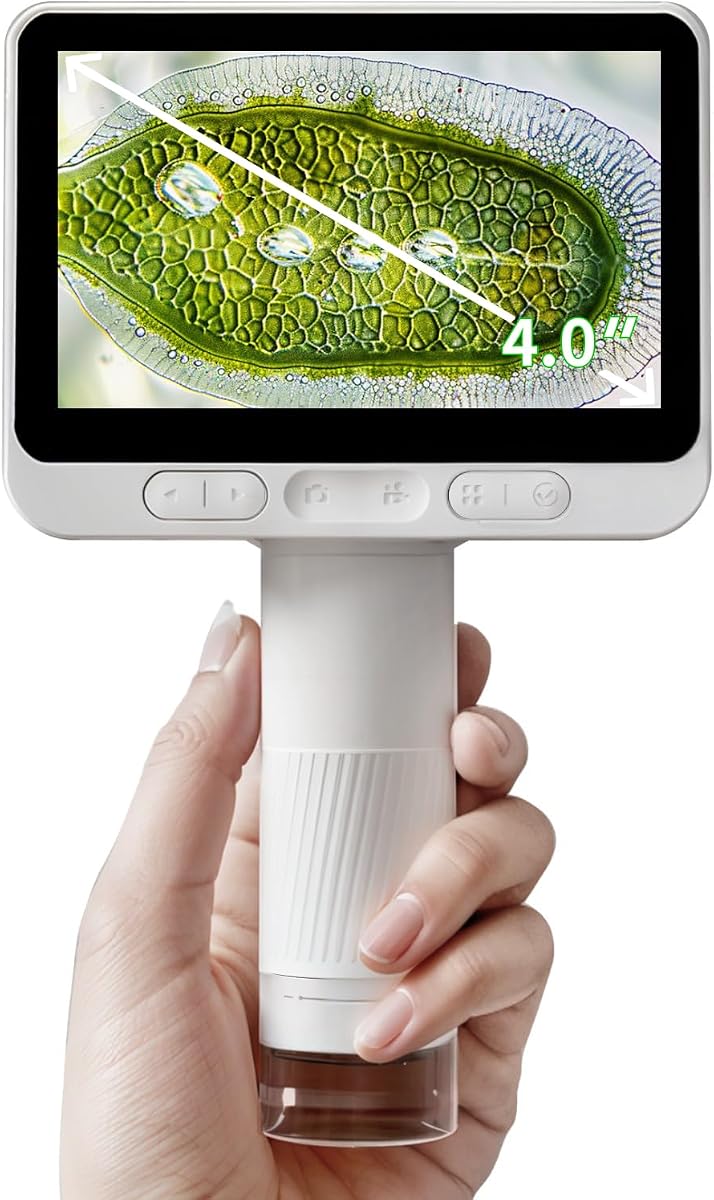
The BEAVERLAB Finder 4.0-inch Microscope is the most balanced recommendation for children and families studying insects. It has the highest rating in this group at 4.6, a generous 4-inch IPS screen, 100X–1600X magnification, and 1080P photo and video capture. It provides enough capability for close insect examination without becoming as large as a laboratory workstation.
We may earn a commission when you buy through this link, at no additional cost to you.
A 2MP CMOS sensor records images at 1920×1080, and eight adjustable lights help reveal wings, eyes, scales, and body segmentation. The built-in hotspot provides a convenient way to upload observations to a phone and share them with family or on social platforms. The larger display also makes it easier for a child to focus, compare features, or show a specimen to another person without passing around a phone.
The product is compact but not as minimal as a true pocket microscope. Storage and standalone file-transfer options are not described in detail, so users may need to confirm the current configuration before expecting the same convenience as a model with a bundled memory card. The wide magnification range also should not be interpreted as a guarantee of laboratory-grade resolution at every level. Actual detail depends on the specimen, distance, lighting, and sensor.
For a child who wants to find insects, study them at home, save observations, and share what they discover, this is the strongest overall balance. The four-inch screen and straightforward controls are particularly effective for younger users. Adults wanting interchangeable lenses, measurement software, or a much larger professional display should move up to the Andonstar or Elikliv models.
The four-inch IPS display gives young observers a clear view without requiring a phone. It is large enough to make fine features easier to notice and comfortable enough for repeated nature sessions.
A built-in hotspot makes it possible to transfer images to a mobile device for documentation or sharing. This keeps the microscope useful for both private study and collaborative classroom projects.
We may earn a commission when you buy through this link, at no additional cost to you.
The 1000X Digital Handheld Microscope for Kids is built for outdoor nature exploration. It has a 4.4 rating, a 2MP camera, a two-inch color display, 100X–1000X magnification, and a rechargeable 600mAh battery rated for up to three hours of continuous use. Its design prioritizes easy handling, illumination, and portable insect observation.
We may earn a commission when you buy through this link, at no additional cost to you.
An enhanced stabilization design helps keep moving or unevenly placed subjects in view, while a large textured focus wheel is designed for children to operate. Eight LEDs offer four brightness settings, and an anti-glare diffuser makes the image more comfortable to inspect. The microscope can save more than 200 photos or AVI videos internally, with USB-C transfer to Windows or Mac computers.
It weighs 200 grams and includes a detachable neck strap, making it straightforward to carry on hikes, camping trips, museum visits, or backyard outings. The BPA-free ABS body is described as durable, while CPC, CE, and FCC certifications provide stated safety assurances. On the other hand, its internal storage is limited, and it does not list SD-card support, so extensive projects would require frequent transfers to a computer.
This is a good choice for families who want a ready-to-carry microscope for children aged five to 13. The longer battery life is more convenient for extended outings than the two-hour unit, and the USB-C interface simplifies charging with modern accessories. It is less suitable for shared viewing because of its two-inch screen and less appropriate for prepared-slide work than the multi-lens Andonstar models.
The stabilization design helps maintain a clearer image when a child adjusts position around a specimen. Combined with a large focus wheel, it reduces the difficulty of keeping active insects in frame.
The rechargeable battery provides up to three hours of use, while the lanyard and 200-gram weight support easy carrying. USB-C also offers a familiar charging and transfer connection.
We may earn a commission when you buy through this link, at no additional cost to you.
The Elikliv EM4K-AF is the premium selection in this guide, combining an eight-inch IPS display, 4K UHD video, 52MP image capability, and AI-assisted autofocus. It is designed for users who want more precise observation and less manual focus adjustment when examining insects, coins, electronic components, or other detailed subjects.
We may earn a commission when you buy through this link, at no additional cost to you.
The time-of-flight sensor supports distance measurement and can adjust focus in about two seconds, while the autofocus algorithm is designed to reevaluate clarity even with moving objects. The 1280×800 display has a 178-degree viewing angle, and HDMI or USB outputs can extend the image to a larger monitor. A smart controller provides capture, recording, and zoom controls without requiring users to touch the screen.
Freeze and split-screen functions are useful when comparing multiple specimens or examining a still reference. A 16GB memory card supplies storage, and the built-in rechargeable battery adds flexibility for outdoor use. The 10-inch stand and broad base provide stability, but the entire setup is larger and less pocketable than the handheld units. It also uses more screen space and may take up more desk or field space than a simple phone microscope.
Choose the EM4K-AF when image clarity, autofocus, large-screen comfort, and advanced comparison features matter more than minimal size. It is particularly appealing to an adult naturalist, teacher demonstrating insects, or hobbyist who frequently compares details. A family seeking a simple child-friendly introduction will find the Odatay or BEAVERLAB more approachable and less complex.
AI-assisted autofocus and the time-of-flight sensor reduce the need for repeated manual adjustments. This is valuable when an insect crawls across a leaf or when specimens are at varying distances.
The eight-inch display, 4K video, 52MP images, freeze function, and split-screen mode support close analysis. These features make it easier to compare a live subject with a captured reference.
We may earn a commission when you buy through this link, at no additional cost to you.
The Ninyoon 4K Wi-Fi Microscope is a phone-centered digital microscope with 50X–1000X magnification and 3840×2160 wireless video. Its 4.2 rating reflects a capable device that supports phones, tablets, and numerous computer systems, making it a practical option for users who already have a suitable display.
We may earn a commission when you buy through this link, at no additional cost to you.
The distinction between wide-angle and long-focal-length viewing is useful in insect study. A wider view can help fit an entire insect or a larger area into the frame, while the telephoto option offers a more distant working position. This can be valuable when examining bees on flowers, insects on a nest, or subjects in an enclosure where maintaining distance is desirable.
The microscope connects wirelessly to mobile devices and by cable to PCs. Compatibility includes iOS, Android, iPad, Mac, Windows, Linux, and Chrome OS. However, the zoom buttons are stated to work with iPhone, iPad, and Android rather than desktop or Chrome OS systems. The host device also determines the displayed resolution when it cannot present the full 4K format.
This microscope suits an adult or student who wants flexible wireless viewing and the ability to alternate between broad and distant perspectives. It lacks a built-in screen and is less convenient as a standalone gift for a young child. Compared with the 4K Wi-Fi Handheld Microscope, its strongest distinguishing feature is the combination of wide-angle and telephoto viewing.
The wide-angle perspective can show an entire specimen and its immediate surroundings. Switching to a longer focal view helps inspect smaller features while keeping the microscope farther from the subject.
Extensive operating-system compatibility makes the microscope useful in mixed-device homes and classrooms. Wireless viewing provides mobility, while USB offers a wired route for computer work.
We may earn a commission when you buy through this link, at no additional cost to you.
The Andonstar AD266S is the most extensive microscope in the group, combining a seven-inch monitor, 2160P UHD video, five interchangeable lenses, and an X-Y movable stage. It is designed to function as a stereo microscope, compound-style digital microscope, and handheld laboratory tool for insects, slides, coins, stones, and electronics.
We may earn a commission when you buy through this link, at no additional cost to you.
Lens A offers broad views of insects and other larger objects. Lenses B, C, and M cover higher biological magnification ranges, while Lens L is intended for soldering and repair. The product lists maximum on-screen ranges of 4.5–180X for Lens A, 390–510X for Lens B, 690–1020X for Lens C, 3600–5100X for Lens M, and 15–60X for Lens L. Larger-monitor output with digital zoom changes those displayed ranges.
External LED lights support broad and close work, while bottom lighting is designed for the high-magnification biological lenses. The movable stage makes it easier to position a slide or small insect under the selected lens. Measurement software for Windows adds a useful analytical function, and the 32GB card stores photos and videos. Five prepared biological slides, tweezers, backdrop boards, cables, a remote, and a power adapter create a comprehensive kit.
The AD266S is best suited to an adult, student, teacher, or serious hobbyist who wants the broadest range of observation methods in one system. It is a poor fit for a child needing a simple pocket toy or a family wanting to carry one device casually into a garden. Setup and lens changes are more involved, but the reward is a flexible instrument capable of both specimen slides and large-area inspection.
Five lenses cover wide-area views, progressively higher biological magnification, and close electronics work. This makes the microscope adaptable as the user's observation goals change.
The X-Y movable stage and bottom illumination help position and illuminate slide-mounted material. These features give the system a more methodical workflow than a basic handheld magnifier.
We may earn a commission when you buy through this link, at no additional cost to you.
Choosing a digital microscope for insects means balancing magnification with image quality, illumination, working distance, and the way you expect to observe. The following factors help separate simple child-oriented tools from flexible wireless models and larger laboratory-style instruments.
Magnification is only one part of image quality. A device may advertise 1000X or 5000X, but the finest details can still be limited by sensor resolution, optical quality, working distance, lighting, and digital zoom. For observing an insect's antennae, wing veins, eyes, or body segmentation, a 2MP or higher camera, accurate focus control, and a close but stable working distance can be more useful than a very large headline magnification figure. Look for several usable magnification levels so you can first locate the insect and then move closer to a selected feature.
Prioritize a broad enough range and strong close-focus performance rather than choosing solely by the largest printed number.
A built-in screen is convenient for children, shared family viewing, and field use because no phone is required. Two-inch screens are portable, while four-inch and larger displays are easier for detailed viewing and demonstrations. Phone-connected models can provide an excellent large display when using a modern phone, but they introduce app setup, wireless dependence, and the possibility that the host device will not display the microscope's full resolution. Decide whether independence or portability matters more than screen size.
Choose a built-in screen for standalone learning and a wireless design for flexible phone or tablet viewing.
Insects may be seen in deep shade beneath leaves, on dark soil, or under bright outdoor light. Adjustable LEDs help reveal surface texture and reduce dependence on ambient light. Brightness controls are particularly useful because more light is not always better: excessive illumination can wash out pale wings or create glare on shiny bodies. A diffuser and side or bottom illumination can improve visibility on different specimens, but fixed lighting may be less versatile under a stereo-style stand.
Look for multiple brightness levels and LEDs positioned close enough to illuminate the working area evenly.
A live insect rarely holds still, and the surface beneath it may be curved, rough, or unstable. Manual focus wheels give direct control but require practice, while autofocus can be faster and more convenient. Stabilization features or a solid adjustable stand help keep the image steady. For children, large textured focus controls are easier to use than small knobs. For adult biological work, a movable stage makes precise slide positioning more practical than holding the microscope over a moving insect.
Match focus controls to the user, and use a stand when precision matters more than handheld freedom.
Wi-Fi models are convenient for phone and tablet viewing, while USB offers a dependable wired connection to computers. Confirm that the relevant operating system appears in the compatibility list, and check whether the manufacturer's application requires updates. Some older systems or restricted devices may not connect even when the hardware itself is compatible. Also verify whether zoom, capture, and storage controls work in both wireless and wired modes, because they are not always identical across platforms.
Check the current app, operating system, connection method, and control limitations before buying a wireless model.
A microSD card provides the most convenient way to retain high-resolution photos and videos without constant transfers, but the card's capacity and inclusion vary among models. Internal storage is useful for a small number of observations, and USB transfer suits a child building a digital collection on a computer. When sharing findings from a field trip, consider whether the microscope can upload images directly to a phone. Remember that the number of stored files also depends on image quality, video length, and the chosen file format.
For heavy documentation, favor a larger memory card; for casual use, built-in storage may be sufficient.
Outdoor insect study benefits from a lightweight body, carrying strap, long battery life, and simple controls. A screen-based model weighing around half a pound is easy to move between the garden, classroom, and home. Wireless handheld microscopes are also portable, but their dependence on a phone and app can interrupt spontaneous observation. Stand-mounted multi-lens systems provide superior precision but are best reserved for a desk or dedicated workspace.
Frequent field users should prioritize weight, battery runtime, and included carrying accessories over large-screen capability.
Child-oriented models emphasize large controls, safety certifications, simple screens, and included slides or cases. Adult models more often provide interchangeable lenses, measurement software, HDMI output, memory cards, and larger stands. Prepared slides are valuable for introducing a young learner to biological specimens, while tweezers and specimen containers help with collecting and handling. Decide whether the microscope is primarily a STEM toy, a family exploration tool, an educational demonstration device, or a serious observation instrument.
Select accessories and controls that match the intended user instead of choosing the model with the most headline features.
Begin with a clean lens and a stable specimen. Remove the protective film if the product includes one, charge the battery, and install or update the required application before heading outside. Place the insect on a smooth, light-colored surface for initial viewing, or use a prepared slide for a more controlled observation. Keep the lens within the stated working distance and adjust brightness gradually until the specimen is visible without washing out pale details.
For live insects, minimize movement rather than trying to force an active subject to remain still. Use the focus control slowly, stabilize the microscope or stand, and adjust the light angle to reduce glare. Capture a wider view first to document the insect's overall form, then move to closer magnification for wings, antennae, legs, or body texture. Keep children supervised, avoid unnecessary handling of stinging or unknown insects, and do not place live specimens directly on powered electrical equipment.
After use, disconnect the microscope, switch it off, and wipe the lens gently with a soft, lint-free cloth. Store it in its case away from moisture, dust, and direct heat, and keep the charging cable with the device. Transfer important files to a computer or storage location, and format the memory card only if the manufacturer's instructions recommend it. For stand-mounted models, retract or loosen adjustable arms carefully to avoid stressing the joints, lenses, or display.
For general backyard observation, 100X–1000X is often sufficient to inspect body structures, wings, and antennae. Higher advertised magnification can be useful for fine features, but sensor resolution, focus, lighting, and working distance determine the actual level of detail. Begin at a lower setting to locate and center the insect, then increase magnification gradually.
Most modern digital microscopes provide live color video on a built-in screen or connected phone, tablet, or computer. The built-in LED lights help preserve color and reveal detail in dim conditions. For the most natural color, keep illumination moderate and avoid overheating or prolonged direct exposure of a small live specimen.
A phone-based microscope is more compact and can take advantage of a large phone display, but it requires a compatible app and wireless connection. A screen-based model is usually more self-contained, easier for a child to use independently, and better for shared viewing. Phone models are often preferable for adults who already manage images through their mobile device.
Yes, they can photograph and record live insects, although movement can make focusing difficult. A stable stand, slower focus adjustments, and patience will improve results. Avoid handling dangerous or stinging insects, and do not confuse a digital observation tool with a safety tool for collecting wild specimens.
A digital microscope sends the magnified image to a screen or connected device and can record it directly. A compound microscope uses an eyepiece and is generally designed for prepared biological samples viewed through lenses. Many digital models can approximate compound-style observation with interchangeable high-magnification lenses, but their image quality and workflow differ.
A few dozen photos can fit comfortably on modest internal storage, while high-resolution video and large photo collections benefit from a microSD card. The included 32GB card on models such as the Odatay and Andonstar provides room for extensive documentation. If your priority is school projects or long-term archiving, check both card support and transfer speed before purchasing.
Most models in this guide support USB computer connections, and most Wi-Fi models also support phones or tablets. Compatibility varies by operating system and software version, so review the latest instructions and application requirements. Some models limit the on-device zoom and capture buttons to mobile connections, while others support wider control through the supplied software.
Move the microscope within its recommended working range, steady the stand, and adjust focus in small increments. Use the lowest LED brightness that still provides clear illumination, because excessive light can create glare. If the image remains soft, change the viewing angle to reduce reflections and make sure the lens and specimen are not touching.
The Skybasic Wireless Digital Microscope is the practical budget choice for users who want phone connectivity, an adjustable stand, and solid LED illumination without a large display. The Odatay stands out as a complete educational kit, the 4K Wi-Fi Handheld Microscope offers strong field documentation, and the BEAVERLAB Finder 4.0-inch provides the best balance for young insect explorers.
For more advanced observation, the Andonstar AD246S-M provides interchangeable lenses, a stable metal stand, HDMI output, and measurement software. The Elikliv EM4K-AF adds rapid autofocus, a large display, 4K video, and split-screen comparison, while the Andonstar AD266S offers the broadest laboratory-style configuration. Prioritize focus, lighting, and working distance over the largest magnification number.
Check the current specifications, included accessories, software compatibility, and warranty details before making a final purchase. Product configurations and availability can change, and live marketplace pricing also varies. Once you select the right tool, begin with simple backyard specimens, adjust the lighting gradually, and build a nature journal that records each discovery.