
Goldeep SL750A Sound Level Meter
4.7Editor score
30–130 dB measurement range
A/C weighting and SONE
MAX/MIN tracking
Anti-slip portable design
This Decibel Meter guide compares accuracy, weighting modes, displays, logging, alarms, portability, and features to help you choose the right model for home
A decibel meter turns an invisible environmental factor into a readable number, helping you evaluate household noise, workplace sound, music systems, machinery, traffic, and many other conditions. A useful model should combine an appropriate measurement range with clear readings, selectable weighting and response modes, dependable accessories, and an interface you can understand quickly.
The products in this guide were compared using the information available for each model, including measurement range, stated accuracy, microphone coverage, weighting options, response speeds, display design, recording functions, alarms, power arrangements, and portability. The list covers handheld, wall-mounted, and data-logging decibel meters suited to different monitoring needs and experience levels.
Each review explains the standout functions, practical trade-offs, and likely type of buyer. The top three selections provide distinct choices for value-conscious users, versatile everyday monitoring, and more advanced data collection. Product availability, features, and prices can change, so readers should confirm the current listing and specifications before purchasing.
4.7Editor score

4.4Editor score

4.2Editor score
The comparison below highlights the core differences among ten decibel meters, from basic handheld monitors to a USB-connected data logger and a wall-mounted alarm display. It is designed to help readers identify the measurement functions, recording capabilities, display style, and practical accessories that matter most for their intended environment.



The TopTes TS-501B Orange is a well-rounded handheld sound level meter with a 4.5 rating and a useful combination of display size, measurement modes, and portability. Its stated 30–130 dB range and ±1.5 dB accuracy make it suitable for checking household activity, offices, automotive noise, workshops, schools, and industrial environments without restricting it to one narrow use.
We may earn a commission when you buy through this link, at no additional cost to you.
The 2.25-inch backlit LCD is one of its strongest practical features because it remains readable in dim conditions. A/C weighting supports both ambient-noise assessment and stronger mechanical-noise analysis, while MAX/MIN captures peaks and lows over a measurement period. Data hold freezes the current result, which is helpful when the meter is not being observed continuously.
Its main limitation is the absence of documented recording or computer-export functions. It is designed to provide immediate readings and captured extremes rather than a historical noise log. The 30–8,000 Hz frequency coverage is solid for a general-purpose instrument, although buyers with specialized acoustic analysis needs may want broader technical specifications.
This model suits users who want one meter for several environments without navigating a complicated interface. The included three AAA batteries, carry case, automatic power-off function, and low-battery reminder add convenience. For users prioritizing readable results, accurate general measurements, and portable construction, it is a strong all-around recommendation.
The large backlit screen helps users take readings quickly in dim rooms, workshops, or outdoor spaces where a small display would be difficult to interpret.
MAX/MIN tracking and data hold make it easier to monitor intermittent household noise, machinery, traffic, and other sounds that fluctuate during a test.
We may earn a commission when you buy through this link, at no additional cost to you.
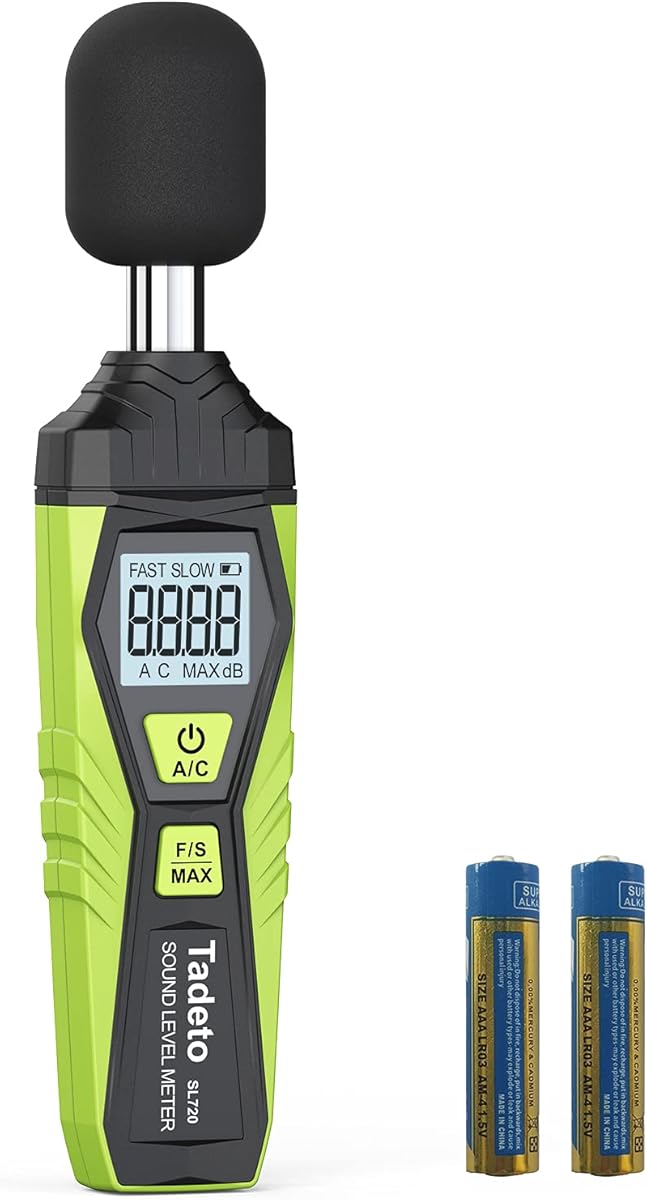
The Tadeto Portable SPL Meter is a straightforward option for users who need reliable readings from a compact device. It carries a 4.5 rating, a 30–130 dB measurement range, and a stated accuracy of ±2.0 dB. That figure remains practical for general household, office, school, automotive, and construction-site checks.
We may earn a commission when you buy through this link, at no additional cost to you.
Its four-digit LCD displays readings at 0.1 dB resolution and includes a backlight for dark locations. A/C weighting helps match the response to different environments, while the fast setting of 0.125 seconds captures changing noise and the one-second slow setting is more appropriate for relatively stable conditions. A low-voltage icon prompts battery replacement.
Compared with the higher-ranked TS-501B, the Tadeto offers a slightly less precise stated accuracy and does not list SONE measurement or audible/visual alarms. Nevertheless, its portable body, straightforward display, and selection of measurement modes cover the basics needed for most non-specialist users.
Choose this model when portability, ease of reading, and fast/slow selection matter more than advanced logging or a broad accessory ecosystem. It is particularly convenient for checking sound levels around the home, in a baby room, at work, or inside a vehicle. Users needing formal acoustic analysis should verify whether its specifications satisfy their required standard.
Selectable response speeds make the meter adaptable to both fluctuating sources and steadier environmental sound, reducing the need to interpret every changing reading in the same way.
The four-digit display provides a practical 0.1 dB resolution, while the backlight improves visibility in dim rooms and other low-light conditions.
We may earn a commission when you buy through this link, at no additional cost to you.
The DURFICST Color Screen Meter combines a 4.6 rating with a colorful display and a generous collection of measurement functions. Its stated 30–130 dB range, ±1.5 dB accuracy, and 0.1 dB resolution place it among the stronger general-purpose specifications in this list.
We may earn a commission when you buy through this link, at no additional cost to you.
The color LCD is particularly useful for users who want an easy-to-interpret interface. The meter can display sound intensity in decibels and perceived loudness in SONE, making it relevant to music performance, instruments, and audio-system checks. It also offers A/C weighting, fast and slow response, MAX/MIN recording, and data hold.
Portability receives thoughtful attention through a handheld shape, soft rubber wrapping, a windbreak ball, and a cloth carrying case. These details make it more suitable for outdoor checks than a bare display-only instrument. However, it does not document historical logging, export software, or computer connectivity.
This is a compelling choice for musicians, teachers, parents, and home users who appreciate a more colorful and informative screen. It is also a strong general tool for environmental and mechanical-noise checks. For projects requiring downloadable evidence or long-duration analysis, the DANOPLUS logger offers a more suitable feature set.
A color display gives the meter a more approachable appearance and can make live readings, modes, and recorded extremes easier for non-specialists to understand.
The SONE unit broadens the tool beyond conventional dB readings, while the windbreak and carrying case support louder and outdoor monitoring scenarios.
We may earn a commission when you buy through this link, at no additional cost to you.
The Goldeep SL750A earns a 4.7 rating, the highest among the products included here, while offering a broad collection of functions in a portable format. Its 30–130 dB range and ±1.5 dB accuracy are well suited to home noise, traffic, offices, construction, factories, classrooms, baby rooms, and musical instruments.
We may earn a commission when you buy through this link, at no additional cost to you.
A/C weighting supports environmental and industrial measurements, while the dB and SONE units offer both sound intensity and loudness-oriented information. FAST and SLOW response settings accommodate changing and steady sources, and MAX/MIN tracking preserves the highest and lowest observed values. Data hold, a clear LCD, an anti-slip grip, and a windbreak ball add everyday usability.
The package includes the meter, two AAA batteries, and a manual, making it relatively straightforward to begin using. It lacks documented rechargeable power, historical data storage, and computer export, so it is not the right tool for formal long-duration analysis or the creation of downloadable noise records.
For most household and workplace buyers, this model offers the strongest balance of listed rating, accuracy, modes, and portability in the roundup. It is especially attractive for users who want SONE readings in addition to standard decibels without moving to a more specialized instrument.
The combination of A/C weighting, SONE units, fast/slow response, and MAX/MIN tracking covers common environmental, industrial, and music-related checks in one device.
An anti-slip grip, windbreak ball, and clear display improve handling during quick checks in homes, offices, workshops, and outdoor environments.
We may earn a commission when you buy through this link, at no additional cost to you.
The green TopTes TS-501B shares the core strengths of the orange version while adding displayed temperature and humidity information. It carries a 4.5 rating, a 30–130 dB range, and stated accuracy of ±1.5 dB, making it a capable choice for users who want sound measurements alongside basic environmental context.
We may earn a commission when you buy through this link, at no additional cost to you.
A/C weighting, MAX/MIN tracking, and data hold provide the core functions required for monitoring home noise, neighbors, offices, workshops, schools, factories, and audio systems. The 2.25-inch backlit LCD keeps values visible in dim spaces, and the included carry case supports portable use.
Its environmental readings are the distinguishing feature, but they do not turn the meter into a comprehensive environmental instrument. It still lacks documented SONE support, rechargeable power, historical data logging, and PC export. Buyers primarily interested in dB measurements may consider whether the added humidity and temperature readouts address a genuine need.
The product is well suited to property occupants, facility staff, educators, and industrial users who recognize that noise conditions can be influenced by temperature, ventilation, or seasonal activity. The listed three-year warranty and lifetime technical support also add reassurance. For ordinary sound checks with environmental context, it is a capable and approachable instrument.
Showing temperature and humidity alongside sound levels provides useful context when comparing readings taken across different parts of a room, building, or work period.
The supplied carrying case, three AAA batteries, manual, and listed warranty make the meter convenient to store, transport, and begin using.
We may earn a commission when you buy through this link, at no additional cost to you.
The RISEPRO HT-80A is a practical digital sound level meter for basic checking, monitoring, and controlling noise. Its 4.4 rating accompanies a 30–130 dB range and stated accuracy of ±1.5 dB, which are useful specifications for general personal, family, business, study, and industrial applications.
We may earn a commission when you buy through this link, at no additional cost to you.
The meter provides fast timing at 125 milliseconds, Type A frequency weighting, data hold, maximum and minimum tracking, an automatic power-off function, and a backlit display. Dual ranges make it possible to work with different sound levels, although users should consult the manual to understand how the range switching behaves during a test.
Compared with the A/C-equipped models in this guide, the HT-80A does not offer C weighting or SONE units. Its stated frequency range of 31.5 Hz to 4 kHz is also narrower than the 8 kHz coverage listed for several alternatives, making it less attractive for users who need broader frequency analysis.
A black carrying pouch and premium color gift box are included, which add value for storage or gifting. This model makes sense for uncomplicated household and workplace monitoring where fast readings, held values, and recorded extremes are more important than advanced modes or downloadable records.
Fast response, Type A weighting, data hold, and MAX/MIN tracking cover the essential actions most buyers perform during a basic environmental sound check.
Automatic power-off helps manage battery use, while the included carrying pouch makes the handheld meter easier to store between jobs.
We may earn a commission when you buy through this link, at no additional cost to you.
The DANOPLUS Data Logger is the most specialized instrument in this guide, offering a recording capacity of up to 43,000 values and a connection to a computer. It has a 4.2 rating, a 30–130 dB measurement range, and stated accuracy of ±1.5 dB, making it relevant for users who need evidence rather than only a momentary reading.
We may earn a commission when you buy through this link, at no additional cost to you.
Recorded data can be viewed on the unit or a PC, then exported as an Excel file. The color screen presents a line chart, analog bars, date and time, and real-time values. A three-color light alarm uses green, yellow, and red indicators for low, medium, and high conditions, with manually adjustable thresholds for immediate visual warnings.
A/C weighting, adjustable fast and slow response, and a DC output expand the measurement options. USB charging provides approximately 1.5 hours of charging with the stated 1,000 mAh battery, and compatibility is listed for Windows 7, 10, and 11. Compared with basic handheld models, it is more capable but more complex to operate.
This meter is best for facilities managers, environmental monitors, educators, and anyone building a documented noise history. It is less appropriate for a quick household reading or for users who want a simple device with no setup. The data capacity and export workflow are the reasons to pay attention to this premium-focused option.
Storing up to 43,000 values and exporting them as Excel files creates a much more useful audit trail than relying only on a single displayed measurement.
The configurable green, yellow, and red light alarm gives users fast visual feedback when ambient sound crosses a chosen level.
We may earn a commission when you buy through this link, at no additional cost to you.
The SW-525A takes a different approach from most handheld products in the roundup by using a wall-hanging format. Its 4.4 rating, 30–130 dB range, large red LCD, and alarm function position it as a permanent display for monitoring noise in a fixed environment.
We may earn a commission when you buy through this link, at no additional cost to you.
A large screen can be useful in workshops, offices, classrooms, production spaces, or other locations where an operator should be able to see the current reading from a distance. The red display is visually distinctive, while the alarm adds an immediate notification when sound reaches a relevant condition.
The available product information is limited compared with the detailed descriptions available for the handheld models. It does not document weighting modes, response speeds, accuracy, data logging, included batteries, or export capabilities. Buyers should therefore confirm the full technical specifications and installation requirements before ordering.
The SW-525A is most appropriate for someone who wants a stationary noise indicator rather than a portable tool. It could complement a broader acoustic setup, but it should not be selected on the assumption that it offers the same recording or measurement flexibility as the advanced handhelds. Its appeal lies in visibility and persistent monitoring.
Wall mounting keeps the meter in a consistent location, making it more appropriate for ongoing observation than a handheld spot check.
The prominent red LCD and audible alert can make changing sound conditions easier to notice in a shared work or production area.
We may earn a commission when you buy through this link, at no additional cost to you.
The Tadeto Five-Range Meter is designed for users who want more than a basic reading, with audible and visual alarms among its distinguishing functions. It has a 4.3 rating, a 30–130 dB range, and stated accuracy of ±1.5 dB, making it appropriate for family, business, study, personal, and industrial monitoring.
We may earn a commission when you buy through this link, at no additional cost to you.
Five adjustable measurement ranges offer flexibility as sound levels change, while A/C weighting supports both ambient and higher-intensity mechanical-noise analysis. MAX/MIN recording, data hold, fast and slow response, a backlit LCD, and a low-voltage warning provide a well-rounded set of immediate measurement tools.
The alarms may be particularly helpful in a workshop, office, classroom, or household where someone needs to notice a noise threshold without constantly watching the screen. Nevertheless, the product does not document historical logs, Excel export, or PC connectivity, so it is less suitable than the DANOPLUS model for formal trend analysis.
This meter is a sensible choice for users who value threshold alerts and selectable ranges in a portable format. It can be used for noise engineering, product quality control, health-related monitoring, and general sound checks. Buyers should consult the manual to understand the five range settings and the exact alarm behavior.
Audible and visual alarms provide a noticeable response when a monitored noise condition occurs, which is useful when the display is not under constant attention.
Five adjustable ranges, A/C weighting, and fast/slow timing give the meter more control than a basic single-purpose sound indicator.
We may earn a commission when you buy through this link, at no additional cost to you.
The FNIRSI FDM-02 combines a modern 2-inch IPS display with real-time monitoring and a 4.4 rating. Its 30–130 dB range and ±1.5 dB accuracy suit TVs, speakers, kitchen appliances, toys, pool pumps, office equipment, and many household sound checks.
We may earn a commission when you buy through this link, at no additional cost to you.
Light and dark themes keep the display readable in different environments, while curve mode shows 30 seconds of changes for quick visual context. A/C weighting, fast and slow response, configurable high and low thresholds, and access to the 30 most recent alarms make this more versatile than a basic meter.
The rechargeable 1500 mAh battery, automatic-off function, sleep mode, compact body, and carrying case support regular portable use. However, the stored alarm history is limited, and the product does not document PC connectivity or file export. It is better suited to live observation and recent-event review than long-term institutional logging.
The FDM-02 is a strong option for parents, musicians, power-tool users, office workers, and home theater enthusiasts. Its curve display and theme choices also make it appealing to people who find conventional LCD meters difficult to read. For long-duration analysis, consider the data logger instead.
The 30-second curve view makes short-term fluctuations easier to understand than a single number, helping users see when a source becomes briefly louder.
A rechargeable battery, sleep mode, automatic shutoff, and compact carrying case make the meter convenient for repeated use around the home or workplace.
We may earn a commission when you buy through this link, at no additional cost to you.
The right decibel meter depends on the sounds you need to measure, the environment, and how you will use the readings. Accuracy, response controls, display quality, alerts, power, and recording functions should be evaluated in that order rather than treating every specification as equally important.
A sound level meter should cover the range of sound expected in the intended setting without forcing users to work near its limits. All products listed here offer a stated 30–130 dB range, but accuracy varies from ±1.5 dB to ±2.0 dB among the handhelds. For general checks, that difference may not be decisive, while users comparing results over time should favor a tighter stated tolerance.
In short: choose a range that fits the environment and prioritize the more accurate specification when measurement consistency matters.
A-weighting is widely suited to lower-level environmental sounds because it reflects the ear's frequency sensitivity at those levels. C-weighting is more useful for stronger mechanical, industrial, motor, aircraft, or equipment noise. Devices with both modes are more versatile because the user can align the response with the type of sound rather than forcing one setting to cover every environment.
In short: select both weighting modes for mixed home and industrial use, or A weighting alone for simpler environmental monitoring.
Fast response reacts quickly and is useful for traffic, changing household activity, music, and other non-steady sounds. Slow response smooths readings over a longer interval and is more suitable for relatively stable noise. A meter that switches between 0.125-second and one-second response can cover both quick events and longer environmental readings with greater consistency.
In short: variable-speed response is valuable when the sound changes frequently, while slow-only operation suits steadier conditions.
A large, backlit display is important for interpreting readings in dim rooms, workshops, and outdoor settings. Color screens and light or dark themes can improve visibility further, while a simple numeric display may be sufficient for users who only need occasional spot checks. Resolution should also be considered: a 0.1 dB display step gives a more detailed numerical view than a coarser readout.
In short: prioritize a large, illuminated screen and readable controls, with color and theme options serving as useful secondary benefits.
MAX/MIN functions retain the highest and lowest readings encountered, which helps characterize intermittent sources. Data hold freezes a selected result for easier viewing and note-taking. Audible and visual alarms can be valuable when a user needs immediate notice of a threshold crossing. These are monitoring aids, not substitutes for formal historical records.
In short: add alarms for unattended awareness and MAX/MIN for short-term extremes, but choose a logger when you need a complete time history.
A data logger stores many readings and may create a chronological record that can reveal when noise occurred, how long it persisted, and whether it followed a schedule. The DANOPLUS model goes furthest in this roundup with up to 43,000 records, PC viewing, and Excel export. Simpler handhelds remain easier to carry and quicker to understand but cannot provide the same documented history.
In short: choose USB export and large storage for analysis, records, or workplace documentation; choose a basic handheld for immediate readings.
Battery-powered meters are convenient for mobile use, while rechargeable models reduce the need to carry spare cells. A non-slip grip, compact body, windbreak, and carrying case improve practical handling. Fixed wall meters serve a different purpose and may be more appropriate when readings must be observed consistently from the same location rather than carried around.
In short: prioritize comfortable grip, manageable power, and useful protection for mobile checks, or choose wall mounting for fixed monitoring.
Decibels measure sound level using a logarithmic scale, while SONE offers a way to express perceived loudness. The extra unit is particularly relevant to music, instruments, home theaters, and other listening environments. It is unnecessary for many basic industrial or property checks, so users should avoid paying attention to features they will never use while ensuring the fundamentals are present.
In short: dB and SONE support broad acoustic work, while straightforward dB models are better suited to conventional noise checks.
Before taking a reading, place the meter in the intended measurement position, install the batteries or fully charge the unit, and allow it to stabilize according to the user manual. Choose the weighting and response mode that suit the sound source. For a fair comparison, keep the microphone position, orientation, distance, and nearby conditions consistent between sessions.
Use MAX/MIN or data logging when a sound fluctuates or occurs only briefly. If a threshold alarm is available, choose a level that reflects the monitoring goal and avoid leaving the meter where reflections, wind, or an obstructed microphone distort the result. For audio-system work, take measurements from the actual listening position rather than directly in front of a speaker.
Handle the microphone gently and keep the wind protection intact. Do not expose the meter to moisture, excessive heat, or impacts, and remove the batteries before extended storage if the model uses disposable cells. Clean the exterior with a dry or lightly damp cloth, keep the microphone openings clear, and consult the manual for calibration procedures and replacement accessories.
A decibel meter measures sound pressure level and displays the result in decibels, or dB. Because the decibel scale is logarithmic, relatively small numerical changes can represent meaningful changes in sound level. The scale and weighting settings should be interpreted together rather than treating every dB reading as a direct physical weight measurement.
A-weighting emphasizes frequencies in a way that better reflects the ear at lower sound levels, making it common for ambient and residential noise checks. C-weighting is flatter across a wider frequency range and is often used for louder mechanical or industrial noise. A meter that offers both modes can be adapted to different environments.
Fast response is preferable when the noise changes quickly, such as passing vehicles, appliances switching on, or people moving around. Slow response gives a more stable reading for continuous equipment or ventilation noise. Recording several readings with the same mode gives more useful results than mixing response settings during one comparison.
Yes, provided it offers suitable weighting and response controls. A and C weighting allow it to address both environmental and strong mechanical sounds, while SONE is helpful for perceived loudness in music applications. A basic model with only A weighting remains more practical for one category than a broad range of sound sources.
A handheld meter is designed for portable spot checks and can be moved to different rooms, devices, or noise sources. A wall-mounted meter is intended to remain in a fixed location, making it more useful for continuous observation and visible alerts. The right choice depends on whether the user needs mobility or consistent placement.
Not for most basic checks. MAX/MIN, data hold, and live readings are enough for comparing appliances, monitoring a room, or investigating a recurring noise. A data logger becomes valuable when you need timestamps, historical trends, exported evidence, or analysis of sound changes over a long period.
Distance, orientation, reflections, background noise, and nearby activity can change the result substantially. Repeating the measurement in a consistent position and with the same settings makes comparisons more meaningful. For the most reliable result, note the microphone position, selected mode, and conditions alongside each reading.
Keep the microphone opening and wind protection clean, and avoid moisture, dust, and impact damage. Store the device in its case, remove disposable batteries during long-term storage, and recharge rechargeable models according to the instructions. Periodic comparison with a known reference or calibration process helps identify drift.
The Goldeep SL750A stands out as the strongest value-oriented option, combining a 4.7 rating with ±1.5 dB stated accuracy, A/C weighting, SONE, MAX/MIN tracking, and portable construction. The TopTes TS-501B Orange is another versatile choice with a large backlit display and useful environmental monitoring features, while the FNIRSI FDM-02 offers a modern IPS screen and clear live sound curves.
For users who need a documented noise history rather than only live readings, the DANOPLUS Data Logger is the leading advanced option because it stores up to 43,000 values and supports PC viewing and Excel export. Prioritize the fundamentals first: adequate range, suitable accuracy, correct weighting, appropriate response speed, and a display you can read. Add alerts, data logging, environmental readings, or SONE only when they support a real monitoring need.
Ratings, included accessories, charging arrangements, software compatibility, and product prices can change over time, and marketplace listings may be updated. Before purchasing, verify the current specifications, package contents, warranty details, and seller information on the product page.