
M.2 NVMe & SATA USB-C Dock
4.5Editor score
NVMe and SATA support
Tool-free installation
Broad device compatibility
Explore the best NVME to USB Docking Stations, comparing speeds, drive compatibility, cooling, cloning features, setup, and everyday use for every workflow.
NVME to USB Docking Stations turn an internal M.2 solid-state drive into fast, flexible external storage without requiring a permanent installation in a computer. The most useful models combine broad SSD compatibility, quick tool-free installation, effective cooling, and a host connection fast enough to avoid wasting the capabilities of a modern NVMe drive.
This guide compares ten docking stations across essential factors including USB interface speed, support for NVMe and SATA M.2 drives, physical dimensions, operating-system compatibility, heat management, and specialized features such as offline cloning or Mac mini integration. The list includes conventional single-bay readers, a dual-bay cloner, and two purpose-built Mac mini stands.
Each review explains where a particular model stands out, identifies limitations buyers should understand, and clarifies the type of user most likely to benefit. Ratings and product details reflect the supplied information, while availability, configurations, and prices can change. Always verify the connector, SSD key, and physical dimensions before ordering.
4.5Editor score

4.6Editor score
4.5Editor score
The comparison highlights each dock's core capabilities, from single-bay NVMe and SATA support to offline cloning and integrated Mac mini expansion. Specifications are concise, while the detailed reviews explain compatibility limits, cooling approaches, and the best use case for every option.


The ACASIS 10Gbps M.2 NVMe & SATA SSD to USB Docking Station is a strong all-around choice for anyone who wants to reuse or connect an M.2 SSD through a fast USB port. It carries a 4.6 rating and combines a 10Gbps USB 3.2 Type-C interface with support for both PCIe NVMe and SATA-based M.2 drives. That flexibility makes it useful for backups, file transfers, system upgrades, and accessing a spare drive without opening a computer.
We may earn a commission when you buy through this link, at no additional cost to you.
Its aluminum enclosure is one of the most appealing features in a category where compact adapters often use plastic. Aluminum provides a more effective heat-dissipation path, while the open horizontal toaster-style layout encourages airflow around the installed SSD. The tool-free insertion design also makes the product easier to use than a permanently installed drive or an enclosure that requires screws for routine access.
The principal trade-off is that advertised interface speed does not mean every drive will deliver identical results. SATA M.2 SSDs have a lower native ceiling than NVMe drives, and host ports, cables, operating systems, and file sizes also influence real-world transfers. Buyers should still confirm that their SSD uses a supported M.2 key and matches one of the listed dimensions: 2230, 2242, 2260, or 2280.
This is a good recommendation for a home user, technician, or mobile professional who wants a simple dock that supports both major M.2 protocols. It avoids the complexity of a dedicated cloner while adding a more purposeful aluminum design and broad operating-system support. For most buyers, it offers the most convincing balance of speed, versatility, cooling, and ease of use.
Supporting both NVMe and SATA means the dock can handle modern high-performance drives as well as many older or lower-cost M.2 SSDs. That single-bay flexibility is especially useful for technicians who encounter different protocols across client systems.
The aluminum body and open layout help move heat away from the SSD during extended file operations. While any high-speed drive can still become warm, the enclosure's design is better suited to sustained transfers than a completely sealed plastic shell.
We may earn a commission when you buy through this link, at no additional cost to you.
The green ACASIS NVMe to USB Docking Station shares many of the qualities that make the first-ranked model appealing: a 4.6 rating, USB 3.2 Type-C connectivity, and a maximum interface speed of 10Gbps. It supports M.2 PCIe NVMe drives with M Key or B+M Key layouts, as well as compatible SATA M.2 SSDs, giving users flexibility across common drive standards.
We may earn a commission when you buy through this link, at no additional cost to you.
Aluminum alloy housing is the defining construction detail. It gives the adapter a durable, premium appearance and helps dissipate heat generated during sustained transfers. The horizontal toaster-style arrangement also improves airflow and leaves the drive accessible, so changing storage does not require a screwdriver. Installation and operation are described as plug-and-play, with no separate driver required.
There are no specialized cloning controls or multi-bay functions, so this is primarily a direct-attachment reader and external storage adapter. Buyers seeking to duplicate a drive offline should examine the SSK dual-bay model later in this guide. Likewise, a Mac mini owner who wants storage and front ports in a dedicated stand may find the integrated Satechi or Acer products more appropriate.
The ACASIS is best for users who want a straightforward way to access compatible M.2 SSDs over USB. It suits everyday backup, media transfer, and drive-testing tasks while adding enough capacity and protocol flexibility to be useful beyond a single-device workflow. Its 4.6 rating and thoughtful thermal design make it a confident alternative within the ACASIS range.
M.2 is a physical form factor, not a single storage protocol. This adapter supports both the NVMe and SATA variants most likely to appear in personal and service environments, reducing the need to maintain separate enclosures.
The open, horizontal layout makes insertion straightforward and helps air circulate around the drive. Aluminum construction then assists with passive cooling, which is valuable when moving large project files or copying full drive images.
We may earn a commission when you buy through this link, at no additional cost to you.
This dual-protocol USB-C docking station is a value-oriented alternative for users who need broad compatibility without paying for a specialized multi-device accessory. It has a 4.5 rating and supports M.2 NVMe and SATA/NGFF drives in 2230, 2242, 2260, and 2280 formats. The USB interface reaches up to 10Gbps with NVMe and 6Gbps with SATA, reflecting the natural difference between the two protocols.
We may earn a commission when you buy through this link, at no additional cost to you.
Its broad system support is a major strength. The supplied information lists Windows, macOS, Linux, and Android, along with use with computers, laptops, smartphones, tablets, and smart TVs. A 2-in-1 USB-A-to-USB-C data cable is included, making it easier to connect hosts with different physical ports. Installation is tool-free, and no additional drivers are needed.
Compatibility exclusions require attention. The dock does not support M.2 SATA AHCI B-key SSDs or drives that already have heat sinks attached. The operating temperature of the SSD may exceed 60°C during use, so touching an exposed drive while operating is specifically discouraged. These limitations make careful drive identification essential before purchase.
The product is a good fit for students, travelers, and everyday users who need a straightforward way to read compatible M.2 storage. It is particularly appealing when a single adapter must serve several device types. Those seeking premium aluminum cooling, a dedicated cloner, or integration with a Mac mini should move up the list for a more specialized design.
The included 2-in-1 cable and broad device compatibility make the adapter convenient for mixed ecosystems. It can provide a familiar external-storage route for systems with USB-A or USB-C connectivity.
Physical M.2 size alone does not guarantee compatibility. Check whether the drive is SATA or NVMe, confirm its key, and determine whether it has an attached heat sink before attempting installation.
We may earn a commission when you buy through this link, at no additional cost to you.
The compact plastic NVMe and SATA docking station is designed for portability and general-purpose drive access. It supports NVMe and SATA/NGFF M.2 SSDs across five listed dimensions, including 22110, and provides up to 10Gbps USB 3.2 Gen 2 performance. Its 4.4 rating reflects a practical package of compatibility, plug-and-play operation, and a small 61-gram footprint.
We may earn a commission when you buy through this link, at no additional cost to you.
The supplied 2-in-1 USB-A-to-USB-C cable allows the adapter to work with a wider range of host devices. Windows 10 and 11, macOS, Linux, Android, and Chrome OS are listed, extending its potential use beyond conventional desktop computers. The product is also positioned for IT professionals, data-recovery work, backup, and OS migration, where quick access to multiple drive standards is useful.
Its enclosure uses plastic rather than aluminum, although the internal layout is designed for passive airflow and includes a non-slip silicone base. That makes it lighter and smaller than many metal docks. The trade-offs are a stated 4TB maximum capacity and the absence of the stronger heat-dissipation potential offered by aluminum alternatives. As with several competitors, it does not support M.2 SATA AHCI B-key SSDs or drives fitted with heat sinks.
This is a sensible pick for technicians, students, and mobile users who value size and device flexibility. It is less compelling for sustained heavy workloads where maximum capacity and metal cooling are priorities. The included one-foot cable, user manual, and 12-month manufacturer warranty add support, while a USB 3.2 Gen 2 or Thunderbolt 3/4 host port is recommended for the stated 10Gbps performance.
At 66 by 51 by 13mm and 61g, the adapter is easy to carry between locations. Its silicone base keeps it stable on a desk when a cable is attached or an SSD is being inserted.
The ability to read common NVMe and SATA M.2 drives makes the adapter relevant to technicians recovering data or moving an operating system to a new drive. Compatibility should still be verified before the drive is inserted.
We may earn a commission when you buy through this link, at no additional cost to you.
The standard ACASIS 10Gbps docking station delivers the same core concept found in the leading model: a compact USB 3.2 Type-C adapter for common M.2 NVMe and SATA drives. It has a 4.6 rating, supports listed capacities up to 8TB, and handles 2230, 2242, 2260, and 2280 drive sizes. For buyers comparing ACASIS variants, the supplied details place this model firmly within the same performance and compatibility class.
We may earn a commission when you buy through this link, at no additional cost to you.
The toaster-style aluminum construction serves both usability and thermal management. The open layout allows airflow around the drive, while the metal shell helps disperse heat during intensive tasks. A tool-free mechanism lets the SSD slide into place without a screwdriver, and the dock is driver-free and plug-and-play. These details make routine switching between drives more convenient.
It is worth distinguishing the 10Gbps interface from the speed of the installed drive. NVMe can use the higher interface bandwidth, while SATA M.2 SSDs have a lower native limit. The host computer also needs a suitable USB port, and large files require enough host storage and processing power. There is no dedicated cloning bay, so the product is better viewed as a fast external reader than a maintenance workstation.
This ACASIS model is recommended for users who want substantial supported capacity, fast access, and a metal enclosure in a straightforward format. It suits backups, media libraries, and testing spare drives across Windows, Linux, and supported macOS systems. Buyers wanting offline duplication should choose a dedicated cloner, while Mac mini users seeking an integrated stand should consider the more specialized entries.
A single bay can still hold a high-capacity M.2 SSD, with the supplied information indicating support for up to 8TB. That makes the adapter useful for large archives, project media, and local backup volumes.
The horizontal toaster format makes the drive easy to insert and remove while keeping the SSD exposed to circulating air. That simplicity is useful for users who regularly swap between storage devices.
We may earn a commission when you buy through this link, at no additional cost to you.
The ACASIS NVMe SSD Reader Adapter is another well-rounded single-drive option, combining a 4.6 rating with 10Gbps USB connectivity and an aluminum alloy housing. It supports M.2 NVMe SSDs using M Key or B+M Key configurations and SATA-based M.2 SSDs, covering the two dominant protocols encountered in both newer and older systems.
We may earn a commission when you buy through this link, at no additional cost to you.
Its product information emphasizes heat dissipation, open airflow, and tool-free installation. These features make it more appropriate for sustained copying than a basic adapter with a fully closed plastic body. Users can connect the drive through USB 3.2 Type-C, access it without installing additional software, and swap compatible drives by hand as their storage needs change.
Capacity is listed up to 8TB, while supported physical lengths include 2230, 2242, 2260, and 2280. As with the other ACASIS models, actual transfer speed depends on whether the SSD uses NVMe or SATA and on the capabilities of the host port. It also lacks a second bay and offline copy controls, so it does not replace a purpose-built duplicator.
The adapter is a good recommendation for users who appreciate a refined metal enclosure and want a single dock capable of handling both NVMe and SATA. It works well for routine backups, media access, and drive evaluation. Its stated operating-system support includes Windows variants, Linux, and macOS 10.3 or higher, offering useful flexibility for mixed personal and work environments.
A dock that handles NVMe and SATA is more future-proof for a collection of existing drives. Users can repurpose compatible storage from an older laptop or build external storage without searching for a protocol-specific enclosure.
Aluminum alloy provides passive heat dissipation during demanding file transfers. The open toaster-style configuration additionally allows air to circulate, helping the drive remain stable during extended work.
We may earn a commission when you buy through this link, at no additional cost to you.
This aluminum dual-protocol dock combines a 4.4 rating with support for M.2 NVMe and SATA/NGFF drives. It handles 2230, 2242, 2260, 2280, and 22110 sizes, making it a flexible option for users with several generations of storage. Through USB 3.1 Gen 2, it can provide up to 10Gbps with NVMe and up to 6Gbps with SATA.
We may earn a commission when you buy through this link, at no additional cost to you.
The aluminum alloy shell, silicone base, and compact 66 by 51 by 13mm dimensions give it a more substantial feel than a typical plastic reader. At 61g, it remains easy to carry in a technician's toolkit. The dock is driver-free and uses tool-free drive insertion, while the supplied two-in-one USB-A-to-USB-C cable broadens host-device compatibility.
Its limitations are clearly defined: maximum capacity is listed at 4TB, M.2 SATA AHCI B-key SSDs are not supported, and SSDs with attached heat sinks cannot be used. The drive may also exceed 60°C during operation. Those restrictions make it less accommodating than some premium ACASIS alternatives, particularly for users with high-capacity or heatsink-equipped drives.
The product is a good middle-ground choice for a home or office user who values a metal enclosure and mixed-protocol support. It also suits technicians who need to connect a range of standard M.2 drives quickly. For offline duplication, integrated Mac mini use, or a higher stated capacity, the later dual-bay and stand-based products offer more specialized functionality.
The enclosure combines durable aluminum with a compact footprint and a non-slip base. That makes it practical for travel and service work where both protection and easy packing matter.
Supporting both NVMe and SATA lets users repurpose common M.2 drives for backup or data access. The included cable also simplifies connections to systems using either USB-A or USB-C.
We may earn a commission when you buy through this link, at no additional cost to you.
The SSK dual-bay M.2 duplicator is the first product in this list that adds a major function beyond reading an SSD. It combines two M.2 bays with a one-key offline cloning control, allowing a source drive to be duplicated without involving a computer. The product carries a 4.4 rating and uses an RTL9210CDP chip to support both NVMe and SATA M.2 SSDs.
We may earn a commission when you buy through this link, at no additional cost to you.
USB 3.2 Gen 2 provides transfer speeds up to 10Gbps, with UASP protocol support for responsive operation. SATA drives remain constrained to their native ceiling of up to 6Gbps. The offline cloning button creates a 1:1 duplicate, but the process must stay within one protocol: NVMe can be cloned to NVMe, and SATA can be cloned to SATA, but one type cannot be used as the target for the other.
For drive maintenance, the dock includes S.M.A.R.T. health checking and adaptive TRIM optimization. Its open-frame construction supports airflow and heat dissipation, although the supplied guidance warns that drives can become hot and should be allowed to cool before handling. These are practical features for IT departments, repair professionals, and users preparing replacement drives.
This is the pick for someone who needs reliable offline duplication rather than merely external access. It can also function as a normal USB-connected storage dock, giving it broader day-to-day usefulness. Users focused only on transferring files can choose a lighter single-bay adapter, while technicians who regularly duplicate SSDs will find the dedicated two-bay format much more valuable.
Offline cloning removes the need to configure a source drive, target drive, and backup application on a host system. Pressing the cloner button starts a 1:1 duplication, provided both drives use the same protocol.
S.M.A.R.T. checking provides a way to examine drive health information, while adaptive TRIM supports ongoing maintenance. These features make the dock more relevant to technicians and users managing SSD fleets.
We may earn a commission when you buy through this link, at no additional cost to you.
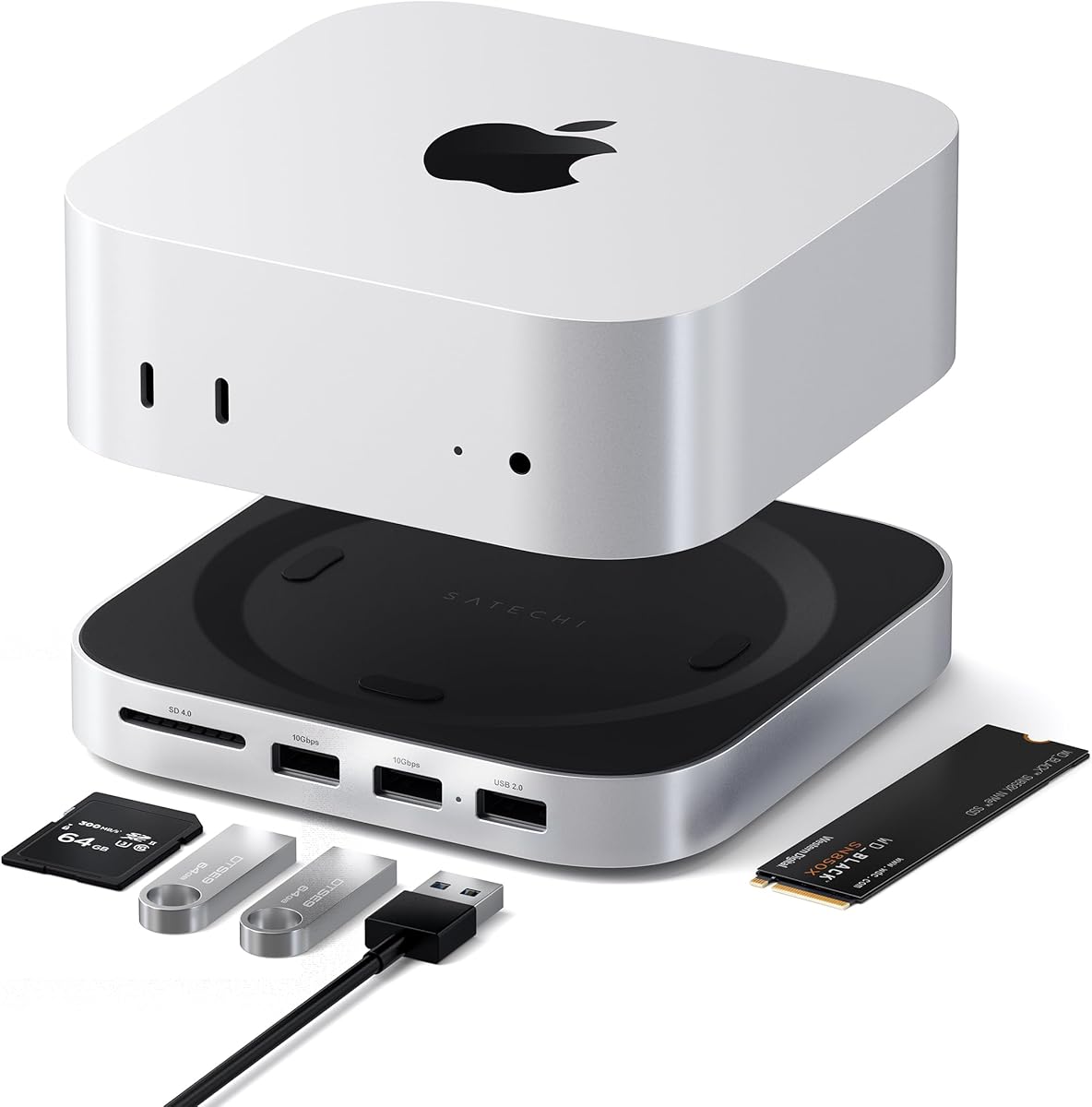
The Satechi Mac mini M6, M5 Pro, M4 Hub & Stand is the premium choice for users who want their compact Mac desktop to gain both storage and conveniently placed ports. It has a 4.5 rating and integrates an NVMe SSD enclosure with a USB-C hub and physical stand. Unlike a generic reader, it is designed specifically for the listed Mac mini models.
We may earn a commission when you buy through this link, at no additional cost to you.
The enclosure supports M.2 NVMe SSDs in 2230, 2242, 2260, and 2280 sizes, with transfer speeds up to 10Gbps and capacity listed up to 4TB. Its five front-facing expansion points include two USB-A 3.2 ports at up to 10Gbps, one USB-A 2.0 port at 480Mbps, and a UHS-II SD card reader capable of up to 312MB/s. These features serve storage, peripherals, and media workflows in one accessory.
Thermal management and physical fit are central to the design. Bottom vents promote heat dissipation, while a recessed top avoids obstructing the Mac mini M4 fan. The aluminum housing measures 12.7 by 12.7 by 2.06cm, and a dedicated power button remains accessible. Buyers must note that SSDs with heat sinks or double-sided drives are incompatible, and the SSD itself is not included.
This product makes the most sense for a Mac mini owner who values a clean desk and frequently uses removable NVMe storage or card media. It replaces several separate accessories with a purpose-built platform and includes a screw, screwdriver, thermal pad, and manual. A two-year limited warranty also provides stated coverage for defects under normal use.
Instead of occupying desk space with a separate stand, hub, and card reader, the Satechi package consolidates these functions. Front-facing ports reduce the need to reach behind the Mac mini for routine connections.
Bottom vents and the recessed upper section help route heat away from the enclosed SSD while preserving clearance around the Mac mini fan. The included thermal pad supports installation of a compatible bare drive.
We may earn a commission when you buy through this link, at no additional cost to you.
The Acer Mac mini Dock Hub is a feature-rich alternative to the Satechi stand, combining NVMe expansion, front connectivity, card readers, and elevated Mac mini positioning. It holds a 4.9 rating, the highest in this group, and supports M.2 NVMe PCIe and NGFF SATA SSDs in standard 2230, 2242, 2260, and 2280 sizes with capacity listed up to 8TB.
We may earn a commission when you buy through this link, at no additional cost to you.
Its display and data capabilities extend beyond a basic storage enclosure. HDMI 2.1 supports 4K at 144Hz, with HDR support and the possibility of pairing it with the Mac mini's native HDMI output for a dual-display arrangement. Actual results depend on the monitor and cable. The hub also provides 10Gbps USB-C and USB-A connectivity plus integrated SD and TF card readers reaching up to 104MB/s.
The all-aluminum elevated stand functions as a passive heat sink for the SSD and promotes airflow around the Mac mini. The package includes a USB-C cable, screwdriver, two thumb screws, thermal pad, and a 5V/3A power adapter. Buyers are advised to connect the power supply before peripherals, especially when using a high-capacity SSD or multiple connected devices.
This dock is a strong recommendation for a Mac mini creator or professional who needs storage, fast media ingestion, and display expansion in a single assembly. Its rated capabilities make it particularly compelling for high-resolution video and large media libraries. It remains a platform-specific purchase, so buyers should confirm that their Mac mini model appears in the stated compatibility list.
Support for up to 8TB makes the enclosure relevant to editors and photographers who need a large local working volume. A single Mac mini can then handle both its internal storage and fast external media.
The HDMI 2.1 connection supports a stated 4K 144Hz mode, while the Mac mini's native output can provide a second display. Actual refresh rates remain dependent on the displays, source capabilities, and cables used.
Connecting the included power adapter before other accessories establishes a stable power base. This is especially important with high-capacity SSDs or multiple peripherals during demanding transfers.
We may earn a commission when you buy through this link, at no additional cost to you.
The right NVMe to USB docking station depends on your SSD protocol, intended transfer volume, host devices, and need for specialized functions. Review the following factors before choosing a model to ensure its connector, capacity, cooling, and physical design fit your setup.
In short, confirm both NVMe and SATA support when you own a mixed drive collection.
In short, match the dock, host port, and cable to avoid an interface bottleneck.
In short, compare both drive length and key with the manufacturer's compatibility list.
In short, choose enough capacity for your current files and anticipated growth.
In short, prioritize airflow and metal construction for sustained high-speed work.
In short, choose a dual-bay cloner only when disk duplication is a core requirement.
In short, check the host list, port type, and platform restrictions together.
In short, prioritize portability for travel or integrated desk access for workstations.
Begin by identifying the SSD's protocol, key, length, and physical condition. Make sure the drive is supported and does not have an attached heat sink unless the product documentation explicitly permits it. Connect the dock's data cable to a compatible host port before inserting the drive, then insert the SSD into the tool-free bay and secure it in the manner described by the manufacturer.
After connection, use the computer's normal file manager or disk utility to recognize the new volume. Before formatting or erasing a drive, copy any important files to another location and confirm that the storage appears healthy. For a clone-capable model, select the source and destination carefully, follow the offline duplication procedure, and never interrupt the process once it begins. A full disk image can take much longer than a typical file transfer.
Good airflow and careful handling help preserve both the drive and the dock. Avoid touching exposed SSDs during operation, particularly when the manufacturer warns that they may exceed 60°C. Disconnect the host before changing drives, let a hot SSD cool, and keep the dock away from obstructed or enclosed spaces. Periodically inspect cables, contacts, and the enclosure for damage, and use reliable surge and power protection for long or unattended transfers.
No. Although all M.2 SSDs share a similar card shape, their protocols and electrical interfaces can differ. Several docks in this guide support both NVMe and SATA, but others are designed only for NVMe. Always check the protocol, M Key or B+M Key layout, and any listed exclusions before inserting a drive.
The 10Gbps figure describes the USB interface ceiling rather than the guaranteed speed of every drive or host system. SATA M.2 SSDs have a lower native limit, while cable quality, the computer's USB port, operating-system overhead, and the size and number of files can also affect results. Use a compatible 10Gbps host port and cable for the best available performance.
NVMe SSDs communicate over PCIe and generally deliver higher performance, while SATA M.2 SSDs use the SATA interface and have a lower native speed limit. They can have similar physical dimensions, so visual inspection may not reveal the protocol. Read the drive label or check its original specifications to determine which type you own.
It depends entirely on the dock. Several products explicitly state that SSDs with attached heat sinks are unsupported because the enclosure may not provide the required clearance or thermal path. A bare drive is generally more broadly compatible. Always consult the individual product's notes rather than assuming an external heat sink will fit or operate safely.
The products in this roundup are generally described as plug-and-play and do not require additional drivers for normal use. The operating system may take a moment to recognize the drive, and standard disk-management or formatting tools may be needed to prepare a new SSD. Specialized cloning and health features use controls or software provided with the relevant product.
The SSK dual-bay dock in this guide supports one-key 1:1 cloning, but its stated rules require matching protocols. That means cloning NVMe to NVMe or SATA to SATA. Cross-protocol cloning is not supported, so a different, more specialized workflow or tool would be needed for that conversion.
They are primarily designed for compatible Mac mini M6, M5 Pro, and M4 configurations and include additional stand, hub, display, or card-reader functions. Although they include an NVMe enclosure, their value and physical integration are tied to the stated Mac mini models. Buyers should confirm exact model compatibility before purchasing.
Stop unnecessary activity, disconnect the host according to the product instructions, and allow the drive and dock to cool before touching or removing the SSD. Several listed products warn that operating temperatures can exceed 60°C. Improve ventilation and avoid long periods of transfer when the enclosure is crowded or its airflow is obstructed.
The ACASIS gray dock is the strongest general recommendation because it balances 10Gbps connectivity, NVMe and SATA support, aluminum cooling, tool-free operation, and broad system compatibility. The dual-protocol USB-C model is the value-focused alternative for users who prioritize broad host-device support, while the Satechi Mac Mini Hub earns the premium position by integrating storage, a stand, front ports, and card access.
Your priorities should determine the remaining choice. Select the SSK dual-bay cloner when offline duplication and drive-health features are essential, or choose one of the compact aluminum docks for portable, protocol-flexible access. The Acer Mac mini Dock Hub stands apart with 4K 144Hz HDMI output, card readers, and support for larger SSD capacities, making it ideal for a compatible Mac mini creator setup.
Before ordering, verify the SSD protocol, key, dimensions, capacity, and heat-sink arrangement, then check the computer's available port. Prices, configurations, ratings, and availability can change, so compare current listing details at the time of purchase. The right dock is the one that matches your drives, workflow, and host system without paying for features you do not need.