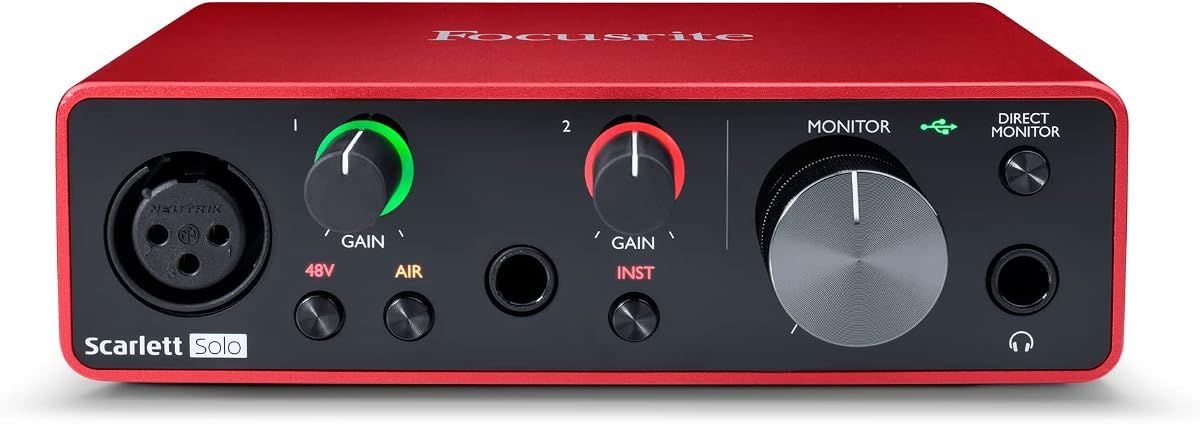
Focusrite Scarlett Solo 3rd Gen USB-C Audio Interface
4.6Editor score
Two instrument-capable inputs
Switchable Air voicing
Low-noise balanced outputs
Recording software bundle
Explore the best microphone preamps for home studio in a 10-product guide comparing gain, noise, connectivity, phantom power, and recording flexibility.
A home studio microphone chain depends on more than the microphone itself. A capable preamp or audio interface must provide clean gain, useful controls, reliable connections, and enough flexibility for vocals, instruments, streaming, and spoken content without introducing avoidable noise or distortion.
This guide compares ten products that represent several practical ways to build a home recording setup. We evaluated their supplied gain figures, noise claims, input and output options, phantom-power arrangements, converter specifications, bundled equipment, and intended uses, paying particular attention to the needs of a compact personal studio.
Each review explains what the product does best, where it fits into a signal chain, and which limitations deserve consideration. The top picks represent a budget-oriented interface, a complete recording bundle, and a premium solo interface, although product availability and prices can change over time.
4.6Editor score

4.7Editor score

4.6Editor score
This side-by-side comparison highlights each product's core hardware, gain or converter capabilities, connection style, and best-fit recording scenario so home studio users can quickly narrow their choices.


The Focusrite Scarlett Solo 3rd Gen is a compact USB-C audio interface that brings several credible studio tools to an affordable home recording setup. Its 4.6 rating reflects a generally favorable reception, and the supplied specifications show why it remains a practical option for singers, guitarists, podcasters, and musicians building a first recording system. It is a one-person-at-a-time interface rather than a full production console, but its core recording functions are clearly defined.
We may earn a commission when you buy through this link, at no additional cost to you.
Its most useful features are the two high-headroom instrument inputs, the switchable Air mode, and the Gain Halos that make level adjustment easier. The instrument inputs allow a guitar or bass to be recorded alongside a microphone, making it possible to capture a performance without requiring a second interface. Air mode adds brightness and presence, while the high-performance converters support recording and mixing at up to 24-bit/192kHz. Low-noise balanced outputs support clean playback through studio monitors or connected headphones.
The main compromise is its single-channel recording workflow. It is built for one microphone or instrument at a time, so someone planning to record a full band simultaneously will need a larger interface. The three-year warranty adds reassurance, and the included Pro Tools Intro+, Ableton Live Lite, Cubase LE, and Hitmaker Expansion provide a useful starting software collection. Even so, the Solo 3rd Gen is primarily a focused recording interface, not a channel-strip bundle or an external preamp with multiple specialized inputs.
This is a strong recommendation for a new home studio owner who wants vocals, acoustic instruments, and electric guitar in one compact package. Choose it when a simple layout, useful recording features, and broad software inclusion matter more than simultaneous multi-microphone capture. It works especially well for songwriters, voice-over artists, and podcasters who need a dependable first interface.
Connecting a microphone to the XLR input and a guitar to an instrument input creates a simple capture chain for demos, songs, and narrated content. The gain controls and visual level aids help reduce the chance of taking a clipped take.
The bundled production tools can shorten the path from first recording to a finished draft. They do not replace learning the fundamentals of gain staging, microphone placement, or mixing, but they provide several credible starting points.
We may earn a commission when you buy through this link, at no additional cost to you.
This compact microphone preamplifier is designed for mobile and lightweight home recording situations, including karaoke, podcasting, and voice-over work. Its 4.0 rating places it among the more moderately rated products in this list, so buyers should evaluate compatibility carefully before committing. The supplied information highlights high sensitivity, automatic level control, and an ability to amplify weak signals by as much as 1000 times.
We may earn a commission when you buy through this link, at no additional cost to you.
Its strongest appeal is portability. The enclosure measures 63 by 52 by 22mm, making it easy to store, carry, or place beside a mobile recording setup. The aluminium alloy shell provides a more substantial feel than a lightweight plastic accessory, while the stated anti-interference design is intended to preserve the signal. It can directly drive headphones for monitoring and uses a 3.5mm connection for mobile-phone recording.
The trade-off is that this is not a conventional studio preamp with clearly specified balanced XLR input and output stages. Its connection approach appears better suited to simplified consumer or mobile workflows than to a professional multi-device chain. The very large stated amplification factor also makes correct gain staging essential, since simply turning the amplification up will also make the noise floor more audible. Automatic level control may help simplify operation, but it should not be mistaken for the gain automation and clipping protection found in a full audio interface.
The product makes most sense for a creator who records through a phone or simple setup, needs direct headphone monitoring, and values a tiny metal unit over extensive connectivity. It is less appropriate as the centerpiece of a conventional home studio with microphones, mixers, and powered monitors. For that broader use, an interface with clearly defined inputs and outputs offers a more transparent path.
The small footprint and 3.5mm connection make this device convenient for karaoke, voice-over, and phone-based recording. Its direct headphone output is particularly useful when the user needs to hear the signal without involving a larger desktop interface.
ALC can make the device approachable for users who are unfamiliar with preamp gain staging. Careful listening remains important because a very high amplification level can reveal the inherent noise of a weak source.
We may earn a commission when you buy through this link, at no additional cost to you.
The Focusrite Scarlett 2i2 Studio 4th Gen Bundle stands out as the most complete package in this guide. It combines a 4.7-rated two-input interface with a CM25 MkIII microphone, SH-450 headphones, recording software, plugins, and a range of production tools. For a new home studio, that breadth makes the bundle easier to start with than an interface purchased on its own.
We may earn a commission when you buy through this link, at no additional cost to you.
Technical performance is centered on a 120dB dynamic range and converters described as the same type used in Focusrite's flagship interfaces. Auto Gain automatically selects a suitable level for a connected microphone or guitar, while Clip Safe helps prevent an overload from ruining a take. Air mode adds presence and harmonic character to vocals and guitars. Two inputs support more flexible recording than a single-input design, allowing a microphone and instrument to be captured together.
The included software mirrors the broader Scarlett package: Pro Tools Intro+, Ableton Live Lite, Cubase LE, and Hitmaker Expansion, along with the stated collection of record-making plugins. The tradeoff is that a creator with suitable software and equipment already in place may not need every bundled item. A two-input interface also remains limited compared with a multichannel production interface, and the additional microphone and headphones create a larger package that may be more than a focused buyer needs.
This is the recommendation for someone starting a home studio from a minimal setup and wanting a microphone, interface, headphones, and software in one coordinated purchase. It also suits podcasters and singer-songwriters who want a straightforward two-input workflow. The 4.7 rating, automatic level tools, strong dynamic range, and extensive bundle make it the most balanced all-around choice here.
Auto Gain is particularly helpful for a new user who is still learning how different microphones and instruments respond. Clip Safe adds a second layer of protection by helping prevent an accidental overload.
The microphone, headphones, interface, software, and plugins cover a broad path from recording through mixing. This reduces the need to research each component separately and creates a more coherent starting setup.
We may earn a commission when you buy through this link, at no additional cost to you.
The StudioMan DPM1 is an inline XLR preamp intended to give low-output dynamic and passive ribbon microphones a useful increase in level before the signal reaches an interface or mixer. Its 4.4 rating indicates a generally positive reception, while the stated 29dB of gain directly addresses the needs of microphones such as dynamic broadcast models and passive ribbon designs that may produce a quiet signal.
We may earn a commission when you buy through this link, at no additional cost to you.
The central benefit is source-level improvement. Boosting the signal before it reaches a noisy interface preamp can improve the overall signal-to-noise relationship, and the DPM1's metal casing is intended to provide shielding against electronic interference. It fits into a standard XLR signal path between a microphone and another device, making it convenient for podcasting, vocals, stage work, or home recording when the host interface has limited clean gain.
Important restrictions apply. The DPM1 is specifically for dynamic and ribbon microphones and should not be used with condenser microphones. It requires 48V phantom power to operate, but the power is not included and does not pass through to the microphone. That arrangement can be confusing for beginners because the unit must receive phantom power from another component while still forwarding the audio signal. The manufacturer also states a one-year warranty and technical support, which adds some confidence to the purchase.
The DPM1 is best for a creator who already owns a low-gain dynamic or passive ribbon microphone and has an interface with limited gain. It is a specialized upgrade rather than a general-purpose home studio preamp. New users or users recording primarily with condensers should instead choose an interface with native high-quality preamps and a straightforward phantom-power arrangement.
Adding gain at the microphone end can preserve a better signal-to-noise ratio when the destination device adds substantial noise. The approach is especially relevant for quiet dynamic and passive ribbon microphones.
The DPM1 is not intended as a general condenser preamp or a standalone USB recording device. Its value depends on an existing XLR chain and access to suitable external phantom power.
We may earn a commission when you buy through this link, at no additional cost to you.
The Audio-Technica AT2020 is a cardioid condenser studio microphone rather than a preamp, but it is relevant to this guide because choosing the right microphone changes how much gain and preamp quality the home studio needs. It carries a 4.7 rating and is specifically described as suitable for project and home studio applications. Its best-known characteristics include a custom-engineered low-mass diaphragm, extended frequency response, strong transient response, and high SPL handling.
We may earn a commission when you buy through this link, at no additional cost to you.
The cardioid polar pattern reduces pickup from the sides and rear, improving isolation of the desired source. That makes the microphone practical for a vocalist, acoustic guitarist, or narrator working in a room that is not perfectly treated. The wide dynamic range and high SPL capability provide versatility across both quiet studio material and louder sources. Its integral three-pin XLR output connects directly to an interface, mixer, or preamp with an XLR microphone input.
Because it is a condenser microphone with an XLR output, it cannot work by itself. The user still needs an interface or preamp with appropriate gain and 48V phantom power. The included stand mount, threaded adapter, and protective pouch improve convenience but do not supply the missing electronic conversion and recording path. A home studio that selects a high-gain dynamic microphone for quieter sources may need less preamp headroom than one using the AT2020.
The AT2020 is a sensible companion recommendation for a creator building a vocal-first home studio. It is especially attractive for a singer, voice artist, acoustic performer, or podcast host who values focused pickup and straightforward XLR integration. Pair it with one of the more fully featured interfaces on this list rather than treating the microphone as a complete recording system.
The cardioid pattern concentrates sensitivity toward the front of the microphone while reducing side and rear pickup. It cannot remove room reflections, but it can help a source stand out more clearly in a treated or carefully positioned setup.
A condenser microphone with XLR output needs reliable gain and phantom power. Matching the AT2020 to a capable interface ensures that the microphone's potential is not limited by a weak preamp.
We may earn a commission when you buy through this link, at no additional cost to you.
The ART Tube MP Studio V3 is a single-channel tube microphone and instrument preamplifier with variable valve voicing. Its 4.5 rating places it favorably among the specialist products in the list, while its defining feature is the deliberate inclusion of a tube-based signal path. It is aimed at creators who want more than a neutral utility preamp and value adjustable tonal character.
We may earn a commission when you buy through this link, at no additional cost to you.
Tube voicing can shape a recording in ways that feel more organic or harmonically rich than a purely solid-state design. The ART model accepts both microphone and instrument sources, making it appropriate for vocals, acoustic instruments, and electric instruments. The single-channel format keeps the signal path focused, which can be advantageous in a compact setup where a full mixer would occupy more space than necessary.
Its limitation is equally clear: it does not provide a complete computer recording system, and its single channel means it cannot capture two independent sources at once. Users will still need an interface, preamp, or recorder with the necessary inputs and outputs. Tube equipment can also introduce its own response characteristics, so a user seeking perfectly transparent amplification may prefer a modern solid-state interface. The product is better viewed as a color and character tool than as a universal recording hub.
This preamp is best for a home studio artist who already has a reliable digital recording interface and wants to add a distinct vocal or instrument flavor. It suits someone willing to evaluate gain, tone, and microphone pairing carefully. For a first-time creator, a bundled interface or complete audio interface may deliver a more direct path from microphone to recorded track.
Variable valve voicing gives the creator another dimension to explore when selecting a vocal or instrument sound. Rather than choosing only gain settings, the user can make deliberate tonal decisions during recording.
Because it handles one channel, the Tube MP works best in front of an existing recording chain. It can serve as a character preamp while the interface handles conversion, monitoring, and multitrack capture.
We may earn a commission when you buy through this link, at no additional cost to you.
The RO03 is a 2026-upgraded microphone preamp designed to cover dynamic, condenser, ribbon, and instrument sources. Its 4.2 rating is moderate, but the supplied specifications present a flexible feature set for a home studio. The most notable figures are a 19–66dB gain range, a stated equivalent input noise of 120dB, and multiple XLR, TRS, and TS line-output options.
We may earn a commission when you buy through this link, at no additional cost to you.
The updated gain range is framed as more realistic than the previous version's nominal maximum, with the product description emphasizing usable performance even at the upper end. The new 1MΩ instrument input impedance is intended to improve compatibility with musical instruments by reducing the mismatch that can distort or narrow their frequency response. A Type-C power input also makes the unit suitable for mobile or portable use, which reflects the growth of remote and outdoor recording.
There are important operational limits. The two input ports cannot work at the same time, so this is not a dual-channel preamp despite offering several connection types. The product description specifically recommends connecting the output to a TRS line input on an audio interface for lower noise than an XLR-to-XLR arrangement. That recommendation makes sense: placing the preamp before a very clean line input can be more effective than feeding another low-gain microphone input.
The RO03 is well suited to a creator with a low-output microphone, an interface that lacks enough usable gain, or a portable recording arrangement that needs flexible output connections. It is not the easiest option for recording a microphone and instrument together, and users should follow the stated connection guidance carefully. For multi-source home recording, an interface with simultaneous inputs remains more convenient.
A wide maximum gain figure is not useful if the signal becomes noisy before reaching that point. The revised 19–66dB range emphasizes attainable, real-world gain rather than an inflated headline specification.
The recommended TRS line-input route can preserve a cleaner result than feeding the preamp into another microphone input. This makes signal flow and input selection central parts of using the RO03 correctly.
We may earn a commission when you buy through this link, at no additional cost to you.
The Focusrite Scarlett Solo 4th Gen is a compact USB-C interface for recording one microphone or one instrument at a time. Its 4.6 rating and stated 120dB dynamic range position it as a strong premium choice for a focused home studio. The product description emphasizes the same converter family found in Focusrite's flagship interfaces, along with an improved Air mode and a complete collection of music software.
We may earn a commission when you buy through this link, at no additional cost to you.
The Solo 4th Gen is designed for songwriters who want a straightforward path from performance to a usable multitrack recording. It can accept a microphone or guitar, connect to a computer through USB-C, and provide a home-studio recording foundation without the channel count of a larger interface. The 120dB dynamic range gives ample headroom for varied sources, while the improved Air mode can bring vocals and guitars forward with added presence and harmonic drive.
The package also includes Pro Tools Intro+, Ableton Live Lite, Cubase LE, Hitmaker Expansion, and a collection of recording plugins. The limitation is the Solo format itself. It records one source at a time, which is suitable for writing, overdubbing, streaming, and voice work but not for recording an entire band simultaneously. The included software also represents a substantial part of the package, so buyers should consider whether they need every listed tool.
The Scarlett Solo 4th Gen is the premium recommendation for a creator who values a polished, familiar recording platform and wants a focused desktop interface. It is especially appropriate for singer-songwriters, podcasters, and producers who record one performer or instrument at a time. It may not be the correct choice for a busy room requiring several simultaneous inputs, but it delivers a streamlined and capable recording experience.
A 120dB dynamic range provides room to capture quiet passages and louder performances without repeatedly changing the recording level. The interface is therefore adaptable to vocals, spoken content, and instruments within a focused setup.
The bundled DAWs, instruments, effects, and mastering tools provide multiple ways to develop a project. They make the Solo 4th Gen a convenient option for users who want to begin producing without assembling a software library from scratch.
We may earn a commission when you buy through this link, at no additional cost to you.
This balanced microphone preamplifier is a compact booster designed for vocals, podcasts, home recording, and live streaming. Its 4.1 rating indicates a middle-tier user reception, while the defined 20dB gain figure gives it a clear purpose: adding moderate, clean amplification to a microphone signal without trying to cover every role performed by a full audio interface.
We may earn a commission when you buy through this link, at no additional cost to you.
Its fully balanced circuitry is described as low noise and transparent, with no intended sonic coloration. The unit supports dynamic and condenser microphones through its 48V phantom-power arrangement. This broad compatibility is useful for a creator who changes microphone types or records several sources, because a single preamp can potentially serve both. The compact, lightweight metal casing also makes the device easy to transport and less likely to occupy valuable desk space.
The main limitation is the amount of gain. Twenty decibels can solve a moderate headroom problem, but it may not be enough for a very quiet passive ribbon or dynamic microphone connected to a weak interface. The device also appears to be an inline booster rather than a complete USB recording system, so it must work with another interface, mixer, or recorder. Users need to confirm how the XLR output and power arrangement interact with their destination equipment.
This preamp is best for someone with a reasonably capable interface who needs a small amount of additional gain or wants a cleaner headroom solution for a particular microphone. It is less suited to replacing a full interface because it does not provide the complete recording and monitoring package. Its modest rating reinforces the importance of checking signal routing before purchase.
The balanced circuit is intended to raise the level without deliberately shaping the sound. That makes it useful when the goal is to improve headroom rather than add a recognizable vintage color.
Dynamic and condenser support allows the preamp to serve different recording tasks. Phantom power must be handled correctly, and a condenser should never be connected to an input that cannot supply the required voltage.
We may earn a commission when you buy through this link, at no additional cost to you.
The StudioMan CL-100 is a compact XLR preamp intended to raise the level of dynamic and passive ribbon microphones. Its 4.3 rating reflects a generally favorable reception, and the 25dB gain figure makes it a useful middle ground between a modest booster and a high-gain device. It is designed for home studios, podcasting, streaming, live sound, and more traditional recording workflows.
We may earn a commission when you buy through this link, at no additional cost to you.
The CL-100 uses standard balanced XLR input and output connections, making it straightforward to place inline between a microphone and an audio interface or mixer. Its stated frequency response extends from 10Hz to 20kHz, while the listed input and output impedances are intended to work with common microphones and connected devices. The 7kΩ input impedance matches many microphones, and the 2kΩ output impedance is presented as suitable for driving high-load equipment.
The metal housing provides EMI and RFI shielding in addition to physical protection, and the compact dimensions keep the unit practical on a desk or in a mobile bag. The main limitation is its role: it is not a complete USB interface and cannot independently send audio to a computer. It is also oriented mainly toward dynamic and passive ribbon microphones rather than serving as a universal condenser preamp. The supplied 48V compatibility information should be checked against the exact connection arrangement before use.
The CL-100 is a good option for a creator who needs additional clean gain in an existing XLR chain. It is particularly relevant for a low-output dynamic microphone used with an interface that has limited headroom. For a new studio, an all-in-one interface may be more economical, but for expanding a working setup, this compact booster adds focused utility without requiring a large piece of equipment.
The 25dB boost can help move a quiet dynamic microphone away from the noise contribution of a downstream preamp. It is a sensible amount of gain for improving headroom without demanding the extremely high settings that often reveal background noise.
Standard XLR input and output make the unit familiar to users who already work with microphones, mixers, and interfaces. The balanced path supports a predictable signal chain and reduces the need for adapters in conventional studio setups.
We may earn a commission when you buy through this link, at no additional cost to you.
The right choice depends on the microphones you own, the recorder you use, the number of sources you need to capture, and whether you prioritize clean gain, tonal character, or a complete production package.
An audio interface is the central hub of a modern home studio because it converts analog microphone signals into digital audio, provides preamps, and usually handles headphone or monitor output. A standalone preamp primarily boosts an existing signal and still needs an interface, mixer, or recorder to capture the result. The Scarlett Solo 3rd Gen and 4th Gen are complete interfaces, while the ART Tube MP Studio V3, RO03, and StudioMan boosters are more appropriate as links within a larger chain.
Choose a standalone preamp when you already have a dependable recording interface but need more gain, a different input format, or a distinct tonal color. Choose an interface when starting from scratch, setting up a computer-based workflow, or wanting the fewest separate components in the signal path.
Microphone preamps must raise quiet source signals to a usable recording level without clipping or adding excessive noise. The products in this guide range from a 19–66dB gain range on the RO03 to fixed boosts of 20dB, 25dB, and 29dB, while the Focusrite interfaces emphasize high-performing preamps and broad headroom. Dynamic and passive ribbon microphones often require more gain than condenser models, so matching the preamp to the source is essential.
Look for enough gain for your quietest microphone while leaving comfortable room for louder sources. Avoid the temptation to crank a high-gain control into visible noise. A clean signal at a moderate gain is normally more useful than a weak microphone recorded at an excessively high amplification level.
Low noise matters because the preamp amplifies both the intended source and the background noise present in the recording. Relevant figures include the RO03's stated equivalent input noise of 120dB, the Focusrite interfaces' low-noise preamp and converter claims, and the StudioMan boosters' low-noise signal-conditioning descriptions. These numbers are not directly interchangeable because measurement methods can differ, but the general design priorities are useful.
A better signal-to-noise ratio preserves vocal detail, quiet passages, and subtle instrument articulation. When a downstream interface has a noisy preamp, adding gain closer to the microphone can sometimes improve the result, provided the booster itself is clean and correctly connected.
The number of inputs determines how many performers or sources can be recorded at once. A solo interface is ideal for overdubbing, streaming, voice work, and tracking one instrument. A two-input interface can capture a microphone and guitar together, while a dedicated multichannel interface is needed for bands, drum recordings, and larger ensembles. Many standalone preamps in this guide process only one source at a time.
Count actual simultaneous sources rather than simply comparing the number of sockets. The Scarlett 2i2 Studio 4th Gen and Solo 3rd Gen support more flexible two-input workflows, whereas the RO03 explicitly states that its two input ports cannot work simultaneously.
Condenser microphones generally require 48V phantom power, while dynamic microphones usually do not. Passive ribbon microphones are often very quiet and may need considerable clean gain. The balanced 20dB preamplifier and StudioMan CL-100 support both dynamic and condenser use, while the StudioMan DPM1 is restricted to dynamic and ribbon microphones. The DPM1 requires externally supplied phantom power for its own operation, and that power does not pass through to the microphone.
Check every connector before building the chain. Phantom power must never be sent to a microphone that cannot tolerate it, and a preamp that requires power does not necessarily provide phantom power to the connected microphone. Clear documentation and a correct routing plan prevent both silence and microphone damage.
XLR is the standard balanced connection for studio microphones, while TRS and TS line connections are common on compact preamps, mixers, and consumer recording devices. The RO03 includes XLR, TRS, and TS output options, and the compact 1000x unit uses a 3.5mm connection for mobile-phone workflows. The Focusrite interfaces use USB-C for computer connectivity while providing appropriate analog microphone and instrument connections.
Match the output of the preamp to the input of the next device. The RO03 description recommends a TRS line input on the audio interface for lower noise than an XLR microphone-input route. Balanced connections are generally preferable for longer cable runs, while simpler formats may be necessary for portable consumer equipment.
Some creators want the flattest possible path from microphone to converter, while others use preamps as part of the sound-design process. The ART Tube MP Studio V3 offers variable valve voicing and therefore a more overt analog character. The Focusrite Air modes add brightness and harmonic presence, while the balanced 20dB unit is described as transparent. Each approach can work, but they suit different musical priorities.
Choose a neutral preamp when accuracy, consistency, and easy gain control are the main goals. Choose a voiced model when movement and harmonic texture are desirable. Remember that the microphone remains the dominant source of vocal character, so the preamp should complement rather than obscure the performance.
A complete bundle can be more valuable to a beginner than a technically advanced standalone unit. The Scarlett 2i2 Studio 4th Gen includes a CM25 MkIII microphone, SH-450 headphones, recording software, and plugins. The Scarlett Solo 3rd Gen and Solo 4th Gen also include Pro Tools Intro+, Ableton Live Lite, Cubase LE, Hitmaker Expansion, and related tools. The AT2020 includes a stand mount, threaded adapter, and protective pouch.
Bundles reduce the number of separate purchases and can make a coherent starting system easier to assemble. However, they are not automatically the best value for an experienced creator who already owns microphones, headphones, and software. Review the included components and choose the package that fills a genuine gap in your setup.
Begin by mapping the signal path. A typical chain runs from the microphone into the preamp or interface input, through its gain stage and analog-to-digital conversion, and finally into the recording software. If using a standalone booster, decide whether it should feed a line input or another microphone input. Follow the manufacturer's guidance, especially for the RO03, and verify that any condenser microphone receives appropriate phantom power.
Set gain before recording and listen carefully. Begin with source and monitoring levels low, increase the preamp gain while watching the meter, and leave enough headroom for louder phrases or instrumental peaks. Avoid correcting clipping after the fact. For a standalone preamp, test the signal path with a quiet passage and then a loud one so both noise and overload risk become apparent.
Protect the equipment by using proper cables, balanced connections where possible, and stable mounting for the microphone and nearby accessories. Keep ventilation openings clear, avoid placing preamps directly beside noisy power supplies, and do not force unfamiliar XLR, TRS, or 3.5mm connectors. Store the unit in a padded location when it is not in use, and follow the included warranty and support procedures for service or replacement.
Usually, no. A modern interface with sufficient clean gain can serve as the primary preamp for common home studio microphones. An external preamp becomes useful when the interface lacks gain, a dynamic or ribbon microphone produces a very quiet signal, you want a different tonal character, or you need a specialized routing option. Always test the full signal chain rather than assuming more equipment will improve the result.
The StudioMan DPM1 and CL-100 are specifically designed to add substantial gain to low-output dynamic microphones. The DPM1 provides 29dB, while the CL-100 provides 25dB, and both use XLR connections. The RO03 may also suit quiet sources, but its higher maximum gain should be used carefully. The correct choice depends on your interface, microphone output, and phantom-power arrangement.
Only with appropriate caution. Passive ribbon microphones are especially sensitive to phantom power and should generally be connected through a properly designed passive or phantom-blocking path. The StudioMan DPM1 supports ribbon microphones but requires external phantom power for its own operation and states that power does not pass through. The safest approach is to verify both the preamp design and the microphone manufacturer's instructions before connecting them.
A microphone preamp amplifies a microphone-level signal and may add tonal character, but it normally does not provide the full recording path. An audio interface includes preamps, analog-to-digital conversion, USB connectivity, and monitoring outputs. Standalone preamps can add gain or flavor to an existing chain, while an interface is the central hub for recording directly into a computer.
Most dynamic microphones do not require phantom power, and many active dynamic models do not need it. Condenser microphones usually do. Some preamps always supply phantom power and some pass it through to the microphone, so users should check the labeling and documentation. Connecting a microphone that cannot tolerate phantom power to an active supply can damage it.
A complete bundle is usually more convenient for a beginner because it can supply a microphone, headphones, software, and an interface in one coordinated package. The Scarlett 2i2 Studio 4th Gen is the clearest example in this guide. An interface alone offers more flexibility and may be better value for an experienced creator who already owns suitable recording equipment.
No. A preamp should provide enough gain to record a clean source with headroom, not force the user to turn it to an extreme. Excessively high gain can reveal the noise floor and make it harder to judge the recording. The practical target is a healthy level with room for louder moments, backed by careful listening during setup.
Yes, if the device provides two simultaneous inputs. The Scarlett Solo 3rd Gen and Scarlett 2i2 Studio 4th Gen both offer two high-headroom inputs that can accommodate a microphone and instrument. The RO03 explicitly cannot use its two inputs simultaneously, so it is better suited to one-source boosting within a more complex chain.
The Focusrite Scarlett Solo 3rd Gen is the practical budget selection for a creator building a simple vocal and instrument setup, while the Scarlett 2i2 Studio 4th Gen Bundle is the most complete package and an easy starting point. The Scarlett Solo 4th Gen provides a more premium, focused interface experience for users who value its 120dB dynamic range, Air mode, and software ecosystem.
Prioritize the part of the chain that is actually limiting your recordings. If you need conversion, monitoring, and computer connectivity, choose a capable interface. If you already record reliably but need more clean gain for a low-output microphone, consider a focused XLR or multi-format booster. Match phantom power, connectors, and gain to the microphone rather than choosing from headline specifications alone.
Finally, check current product availability, included components, and prices before purchasing, since both may change over time. Compare the current interface, accessories, software terms, warranty details, and connection requirements with the needs of your room, microphones, and recording software. The right preamp should make cleaner recordings easier without adding complexity that your home studio does not need.