
Hand Crank Emergency Radio 7400mWh
4.6Editor score
7,400mWh battery capacity
Three built-in charging cables
Four backup power sources
SOS alarm and reading lights
Compare the best hand crank radio cell phone chargers for emergency power, weather alerts, solar charging, portability, and phone-charging capability in this
Hand crank radio cell phone chargers combine emergency weather reception, backup lighting, hand-generated power, and phone charging in one device. A capable model can provide valuable communication and illumination when conventional electricity and cellular service are unavailable, making it especially useful for hurricanes, tornadoes, outages, camping trips, and emergency kits.
This guide compares ten hand crank radio cell phone chargers based on battery capacity, supported charging methods, radio bands, emergency lighting, portability, weather alerts, and device-charging features. The list covers compact and higher-capacity models with NOAA reception, hand cranks, solar panels, SOS alarms, and built-in or standard USB charging options.
Each selection highlights a different reason to own one of these radios, from lightweight household preparedness to substantial battery reserves and rapid cranking. Ratings and specifications reflect the supplied product information, while availability and prices can change, so readers should confirm current details before purchasing.
4.6Editor score
4.7Editor score

4.7Editor score
The table below compares all ten emergency radios across capacity, charging flexibility, radio reception, and portability, helping shoppers identify the model that best matches their emergency kit and phone-power needs.



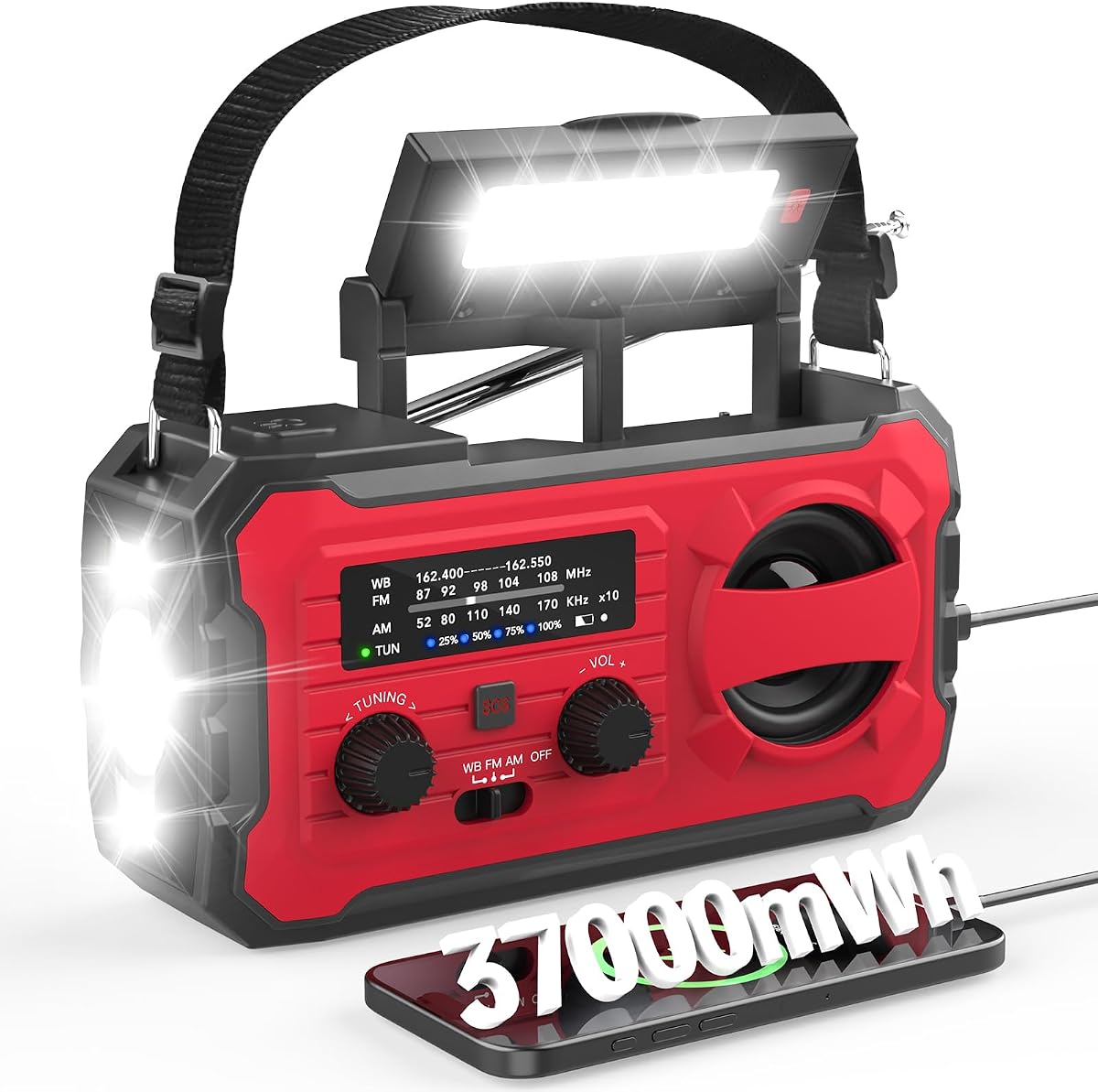

The WVL 7400mWh Emergency Radio is a compact all-purpose radio for people who want weather information, lighting, and limited phone charging without carrying a large power station. Its 4.6 rating reflects a generally strong balance of useful functions, and its 7,400mWh internal battery provides a useful middle ground between compact radios and higher-capacity models.
We may earn a commission when you buy through this link, at no additional cost to you.
Its standout feature is the combination of three charging methods: hand crank, solar panel, and built-in rechargeable lithium-ion battery. A 2,000mAh portable charger can provide emergency power to a phone or small tablet. The radio also tunes AM, FM, and NOAA weather channels, while a 1.5W LED flashlight and motion-sensor reading lamp make it more useful than a radio alone.
The trade-off is capacity. It does not offer the reserve of a 12,000mAh or 20,000mAh radio, so repeated phone charging may consume much of its available energy. Nevertheless, the 130 by 50 by 60mm size and 231g weight make it easier to place in a drawer, go bag, vehicle, or small travel kit than a higher-capacity unit.
This is a practical choice for households seeking a reasonably small emergency radio with more functions than a basic pocket model. It is particularly suitable for a bedroom, kitchen, vehicle, or camping kit where portability matters more than extended phone-power reserves. For that use, its charging flexibility and 7,400mWh capacity make it a well-rounded first emergency radio.
The 2,000mAh phone-charging function makes the radio useful for brief calls, navigation, or device checks when the main battery is unavailable. Its solar and crank inputs add flexibility, although the 7,400mWh total capacity is best reserved for essential communications rather than intensive phone use.
At 231g, the WVL is small enough to keep readily accessible instead of buried in a storage closet. AM, FM, NOAA reception, two forms of lighting, and an SOS siren give it several useful emergency roles in one package.
We may earn a commission when you buy through this link, at no additional cost to you.
The Solar Radio Emergency Hand Crank stands out as the most balanced all-around model in this guide, earning a 4.7 rating for its combination of charging speed, radio reception, lighting, and usable capacity. Its 12,000mAh battery can power a phone or keep the radio and lights operating during outages, storms, and off-grid activities.
We may earn a commission when you buy through this link, at no additional cost to you.
The large 8,500mm² monocrystalline solar panel is a major strength because it captures considerably more sunlight than a small decorative panel. The upgraded generator, reinforced magnets, and extended crank arm are designed to make hand operation more efficient, with the manufacturer stating that three minutes of cranking can power the radio or phone. A high-sensitivity chip, noise-reduction circuitry, and extended antenna support clearer NOAA, FM, and AM reception.
Its size and weight are the main compromises. The radio measures 6.8 by 2.9 by 4.7 inches, making it less pocket-friendly than the WVL or Emgykit models. Buyers should also follow the instruction to check the battery upon receipt and fully charge it before first use, since a dependable emergency device is most useful when it starts with a complete reserve.
This model is a strong recommendation for a primary household emergency radio, a camping kit, or a vehicle backup where solar exposure and phone charging are both important. It offers more capacity and faster cranking than compact units without moving into the largest category of power stations. Its broad combination of features makes it the most versatile option for general preparedness.
The enlarged crank and upgraded generator target an important practical issue: generating useful power without exhausting the user. The stated three-minute charging time makes this radio particularly helpful when a quick burst of energy is needed and conventional charging sources are unavailable.
The 8,500mm² panel offers a meaningful advantage over smaller panels, especially during prolonged outages with intermittent sunlight. Keeping the radio near a window or outside in suitable conditions can help maintain the battery and reduce dependence on hand cranking.
We may earn a commission when you buy through this link, at no additional cost to you.
The Emergency Weather Radio with Large Solar Panel offers a 4.7 rating and focuses on fast energy recovery, strong lighting, and flexible charging. Its 12,000mAh battery can charge a phone and operate the radio, lights, and alarm, giving it ample capacity for a home emergency or outdoor kit.
We may earn a commission when you buy through this link, at no additional cost to you.
Its stated one-minute crank cycle is the most notable efficiency claim in the group. The reinforced crank arm and high-efficiency dynamo are intended to produce usable power quickly, while the large 8,500mm² monocrystalline panel supports solar charging. It also offers five charging methods, an adjustable-beam 5W flashlight, a 12-LED reading lamp, and IPX6 waterproofing.
The 5W flashlight is unusually powerful for a portable emergency radio and may be more than some users need. Likewise, having several charging options can make the controls less immediately obvious when users need to act quickly. Buyers should identify the relevant input and output ports before an emergency rather than waiting until the event to learn the interface.
It is a good recommendation for people who prioritize rapid hand-generated power, strong lighting, and weather-ready construction. The combination of IPX6 protection, NOAA alerts, a nine-second alarm, and substantial battery capacity is especially compelling for outdoor users, households in storm-prone areas, and anyone who wants a radio that can charge a phone during an extended outage.
A one-minute crank target is valuable when someone needs to power a flashlight, listen to an alert, or begin a phone charge without a wall outlet. The claim should be understood in the context of the manufacturer's stated use, and the battery should still be kept at a healthy level beforehand.
The adjustable 5W beam can serve as a powerful area light, while the softer 12-LED reading lamp provides a more comfortable option for close tasks. This dual-light arrangement covers both emergency navigation and practical use during a blackout.
We may earn a commission when you buy through this link, at no additional cost to you.
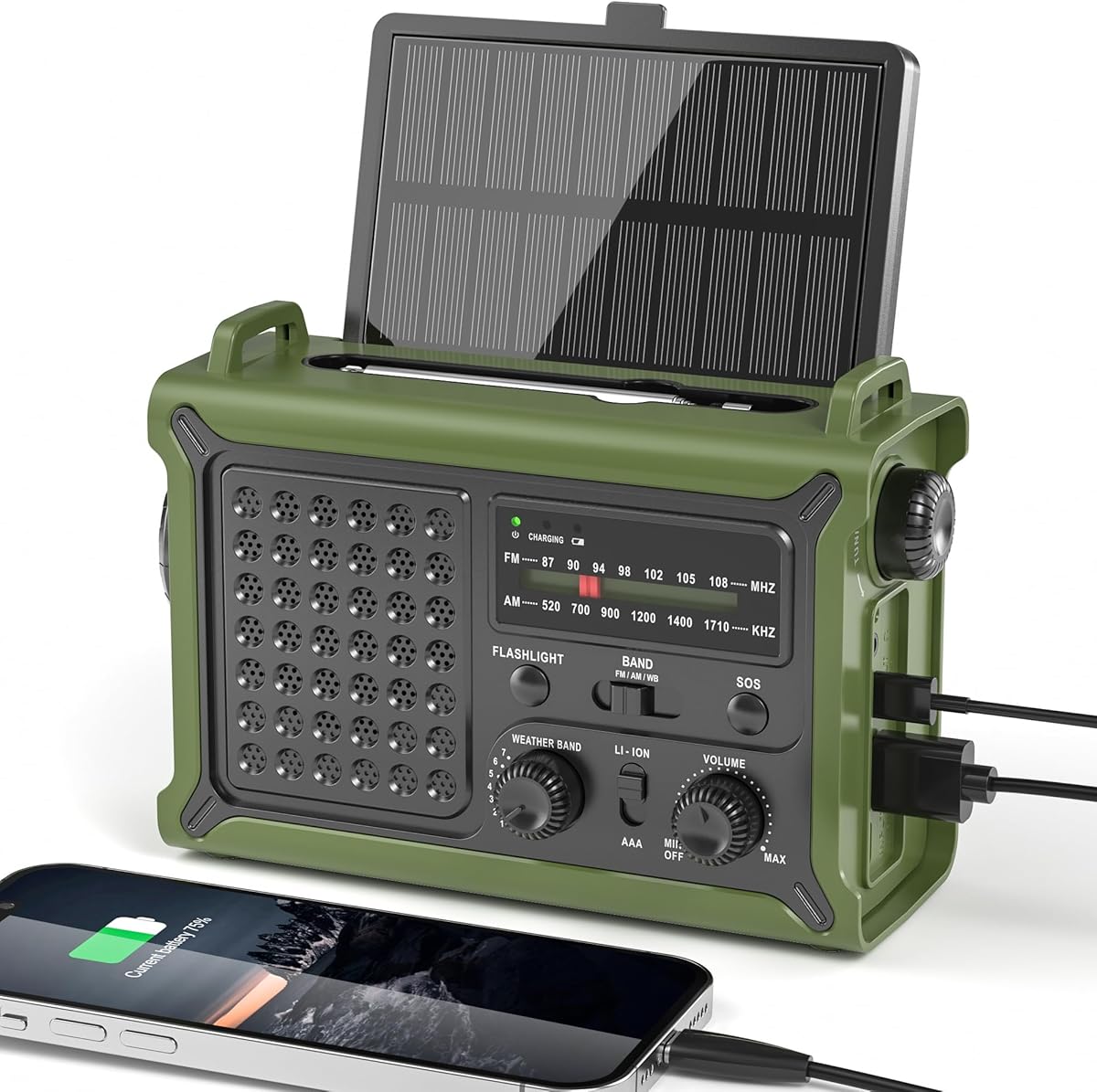
The Hand Crank Emergency Radio 7400mWh is an unusually practical budget-oriented choice because it stores three built-in charging cables directly in the housing. Its 4.6 rating reflects a versatile feature set, and the 7,400mWh battery gives it enough reserve for radios, lights, alarms, and selected phone charging.
We may earn a commission when you buy through this link, at no additional cost to you.
The built-in Lightning, USB-C, and Micro-USB leads address a common emergency-kit problem: discovering that the correct charging cable is missing. Four power sources add another layer of resilience through USB-C charging, hand cranking, solar power, and AAA batteries. An extended antenna and DSP chip support NOAA weather broadcasts and AM/FM reception.
Its 2,000mAh charging capacity means it is better suited to topping up a phone than running a demanding device for an extended period. The six-LED reading light and three brightness modes are helpful, but buyers should not expect the raw illumination of the 5W flashlight in the preceding model. These are reasonable compromises for a compact and practical emergency radio.
This radio is an excellent match for people building a kit for a family, renter, camper, or traveler who values organization and multiple charging options. Keeping the three cables attached reduces the chance of losing them, while the radio, lighting, and alarm functions cover several common outage needs. It is the strongest budget pick in this comparison.
Storing Lightning, USB-C, and Micro-USB leads inside the radio removes a surprisingly common failure point from emergency preparation. It is particularly helpful for households with older phones and newer USB-C devices that may otherwise require several separate adapters.
USB-C, hand crank, solar, and AAA battery inputs make the radio useful even if one charging method is damaged or unavailable. The radio should still be regularly charged so its own lithium-ion battery, rather than the alternative input, carries the load when conditions worsen.
We may earn a commission when you buy through this link, at no additional cost to you.
The Emgykit Hand Crank Radio is built around portability. With a 4.6 rating, it provides NOAA, AM, and FM reception, a 2,000mAh rechargeable battery, phone charging, SOS signaling, and three charging methods in a housing that measures 5.1 by 2.1 by 2.4 inches and weighs 0.51 pounds.
We may earn a commission when you buy through this link, at no additional cost to you.
Its upgraded flashlight uses three LED beads with a stated 140-lumen output, which is a meaningful improvement over a basic single-LED emergency light. The SOS function requires a three-second press and activates a siren described as exceeding 80 decibels, giving it a clear role in attracting attention during a roadside, storm, or wilderness incident.
The principal limitation is its relatively small 2,000mAh battery. While it can provide emergency phone power, it cannot offer the extended reserve of the 10,000mAh, 12,000mAh, or 20,000mAh choices. It also lacks the higher-capacity models' larger solar surfaces and advanced automatic alert features.
Emgykit is a good choice for a personal go bag, small hiking kit, vehicle glove box, or lightweight household backup. It prioritizes size and essential emergency functions over long-duration energy storage. For users who need a radio every day but want something that can be carried without adding substantial weight, its compact construction is a meaningful advantage.
The 0.51-pound weight and pocket-friendly dimensions make this radio practical for individuals who may need to grab it quickly. Its radio reception, flashlight, and siren provide useful functions even when there is not enough time or energy to handle a more complicated device.
A long-press SOS control reduces accidental activation while making the alarm easy to reach in a crisis. The stated siren output is designed to help rescuers or nearby people locate someone, though it should complement rather than replace a personal distress plan.
We may earn a commission when you buy through this link, at no additional cost to you.
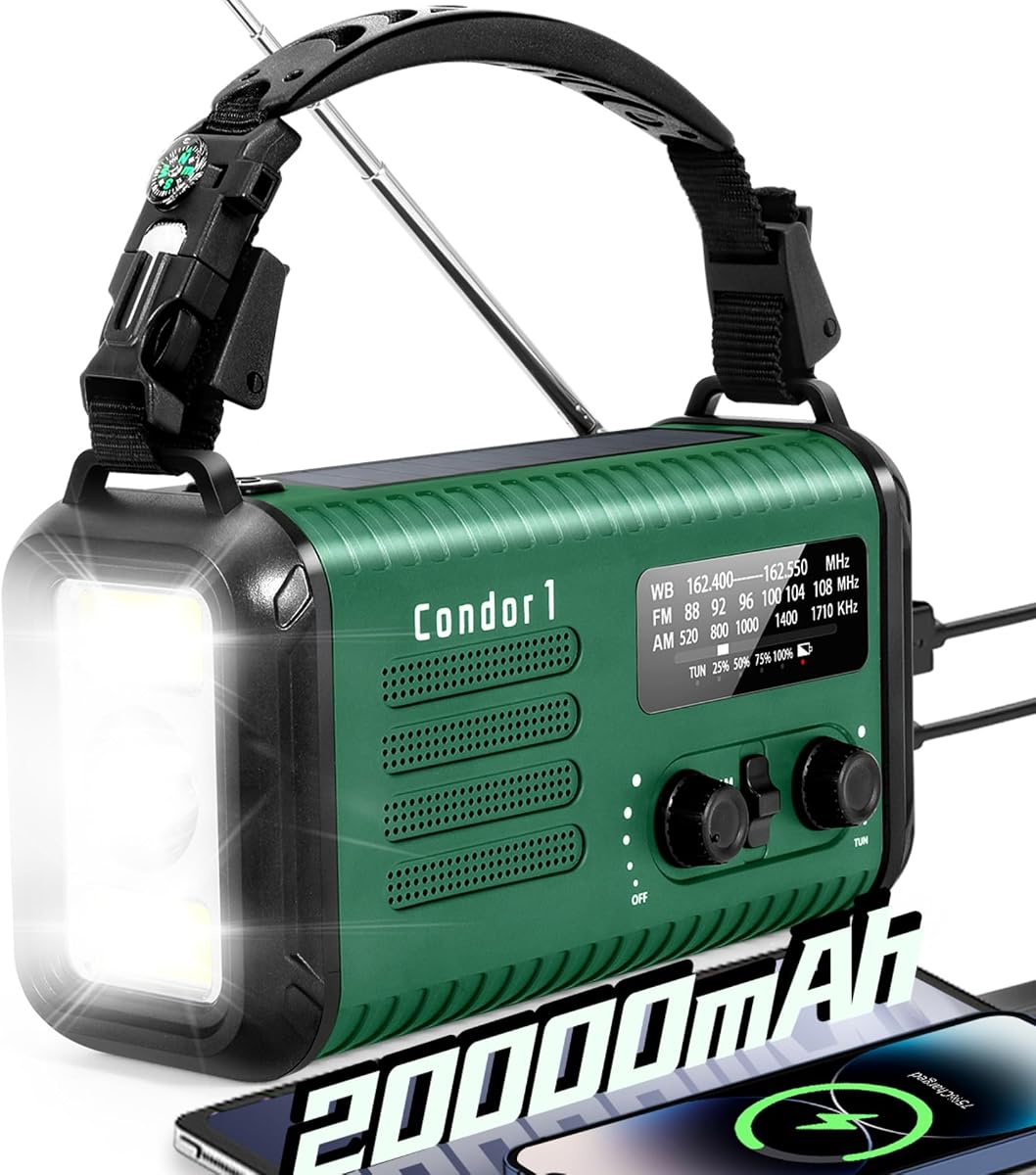
The Emergency Crank Radio offers one of the largest stated battery reserves in this guide, with a 4.4 rating and a 20,000mAh rechargeable battery rated at 74,000mWh. Its capacity is intended to support phones and other mobile devices during prolonged outages, and the product supports charging two devices at the same time.
We may earn a commission when you buy through this link, at no additional cost to you.
A bidirectional USB-C interface handles both charging the radio and providing power to compatible devices. The crank lever and solar panel can regenerate the battery, while the radio provides NOAA, AM, and FM reception. A four-mode flashlight, rear reading lamp, and 3.5mm headphone jack further extend its use for camps, travel, and household preparedness.
The most distinctive element is the multifunctional survival handle, which incorporates a compass, cutter, whistle, and fire starter. That adds useful emergency equipment, but it also contributes to the radio's 1.8-pound weight and broad 6.93 by 3.94 by 3-inch footprint. Its IPX3 water resistance is suitable for general outdoor conditions but does not match the IPX6 ratings of two other selections.
This model is best for families or groups that want to charge several phones and keep a large emergency reserve in one place. The capacity and two-device output distinguish it from smaller radios. Its lower 4.4 rating, heavier design, and lower water-resistance rating mean it is not automatically the best choice for every traveler, but it is a serious household backup option.
A 20,000mAh battery and two-device charging support are meaningful advantages when several family members need to contact services or coordinate after an outage. Actual phone runtime varies by device and condition, so essential communications should remain the priority.
The compass, cutter, whistle, and fire starter consolidate small survival tools into the carrying handle. This makes the radio more useful in remote settings, although users should still inspect these tools periodically and ensure they understand how to operate them.
We may earn a commission when you buy through this link, at no additional cost to you.
The Raynic Emergency Radio is a 4.5-rated model distinguished by automatic NOAA scanning and a large HD LCD display. It can scan for emergency and weather warnings when switched on or placed in standby, allowing alerts to reach the user without continuously monitoring an audio broadcast.
We may earn a commission when you buy through this link, at no additional cost to you.
The screen displays battery level and the current tuning frequency, while digital tuning and auto-scan functions simplify station selection. Reception covers AM, FM, SW, and NOAA. A 5,000mAh battery supports phone charging through a USB connector, and the listed six-way charging design provides several ways to keep the radio operational.
Its 1.2-pound body and IPX3 water resistance place it in the middle of the portability range. The 5,000mAh battery is less substantial than the 10,000mAh and 20,000mAh models, so heavy phone use could deplete it more quickly. A 3W flashlight, 2.5W reading lamp, flashing red SOS light, headphone jack, and Type-C charging broaden its everyday functions.
Raynic is an attractive option for users who want warnings without constantly listening to the radio, especially overnight or when family members may not hear a standard broadcast. It works well in a bedroom, office, or travel setup. Those seeking maximum phone reserve may prefer a larger-battery model, but Raynic's display and alert automation are especially convenient.
Automatic scanning can surface emergency notifications while the radio is on or in standby. This is especially useful overnight, when weather conditions can develop quickly and a person may not be actively tuning the NOAA band.
The large LCD displays the selected frequency and battery level, reducing the need to rely entirely on sound. Digital tuning, clearly labeled buttons, and a backlight dimmer make the radio easier to check quickly.
We may earn a commission when you buy through this link, at no additional cost to you.
The NITIGO Weather Radio has a 4.7 rating and combines a 10,000mAh battery with NOAA, AM, and FM reception. It is a balanced choice for household preparedness because it can charge USB devices, power lighting, provide emergency signaling, and receive weather information without reaching the size of the highest-capacity radios.
We may earn a commission when you buy through this link, at no additional cost to you.
An adjustable high-gain antenna is designed to improve reception across indoor, outdoor, and remote settings. The radio supports solar charging, hand cranking, and USB charging, and includes a 3.5mm headphone jack for private listening. Its lighting features consist of an ultra-bright LED flashlight and a retractable reading lamp that rotates up to 180 degrees.
The main uncertainty is environmental durability because no numeric water-resistance rating is provided in the supplied information. It also does not claim automatic scanning of emergency alerts. Those omissions matter for users seeking a rugged radio specifically for harsh conditions or unattended overnight warnings.
NITIGO is a strong recommendation for a home, RV, or general camping kit that needs meaningful phone reserve without an oversized power station. Its 10,000mAh battery provides more headroom than compact models, while the antenna, rotating lamp, and three charging inputs make it easy to operate in several environments. It is one of the cleanest general-purpose options in the roundup.
The 10,000mAh battery creates a useful middle ground: greater phone-charging potential than compact radios without the weight of the 20,000mAh models. It also leaves more reserve for listening to alerts and operating lights after a phone has been topped up.
The retractable 180-degree lamp can direct soft light toward a work surface, book, or tent wall. That flexibility makes it more useful than a fixed reading light for reading, repairs, and nighttime household tasks.
We may earn a commission when you buy through this link, at no additional cost to you.
The 20000mah Hand Crank Emergency Radio is the premium selection in this guide, earning a 4.7 rating for its 20,000mAh battery, long antenna, solar and crank charging, phone output, and emergency lighting. It is aimed at buyers who want more energy reserve and broader radio coverage than a compact emergency radio provides.
We may earn a commission when you buy through this link, at no additional cost to you.
Its 20.5-inch telescopic antenna supports NOAA, AM, FM, and SW reception, while a noise-reduction chip is intended to improve clarity. The four-level power indicator and digital display help manage the remaining charge. For illumination, it combines a 3W spotlight with a 96LED low-blue reading lamp and adds a stated 120dB SOS siren with a reflective rescue strap.
Some manufacturer performance claims should be considered promotional, particularly the stated phone-equivalence, charging-time, and siren comparisons. Nevertheless, the listed 20,000mAh battery, IPX6 certification, and one-pound weight distinguish it from many lower-capacity alternatives. It is still a sizable object, so maximum portability is not its primary strength.
This is the best premium option for a serious outdoor kit, vehicle, or family emergency station where extended phone availability matters. The long antenna is particularly appealing for camping, mountains, and remote travel. Buyers should test the controls and confirm their intended charging cables before relying on the phone-charging function in a real emergency.
A 20,000mAh battery provides one of the largest reserves in this roundup, supporting extended radio operation and selected phone charging. Its stated four charging methods—solar, hand crank, Type-C, and the built-in battery—give users several ways to manage energy.
The 20.5-inch antenna, four radio bands, and noise-reduction electronics are useful for travel beyond dense urban areas. IPX6 protection and a reflective rescue strap add practical visibility and weather resistance for outdoor preparations.
We may earn a commission when you buy through this link, at no additional cost to you.
The Kaito KA500 is a 4.5-rated radio with a strong reputation for multi-band reception and flexible power options. It supports AM, FM, two-band shortwave, and seven pre-programmed NOAA channels, making it useful for weather information, news, sports, talk radio, and international broadcasts.
We may earn a commission when you buy through this link, at no additional cost to you.
Six-way power support includes a hand-crank generator, solar panel, compartment for three AA batteries, 5V USB input, and AC/DC input through a separately sold wall adapter. Its replaceable NiMH battery pack adds another layer of serviceability compared with radios that use a sealed battery.
A standard 5V USB output can charge mobile phones, GPS units, MP3 players, and digital cameras. The 14.5-inch telescopic antenna, signal-strength indicator, built-in speaker, five-LED reading lamp, flashlight, and red SOS beacon make the radio a broad-purpose communication and lighting tool.
Kaito is a good fit for long-term preparedness buyers who value replaceable components and broad radio coverage over a high stated phone-battery capacity. Users must supply their own AA batteries and separately sold wall adapter if needed, and should verify charging limitations for modern USB-C phones before an outage.
AM, FM, shortwave, and seven NOAA channels offer more listening options than a standard three-band emergency radio. The long antenna and signal-strength indicator help users tune more precisely, especially for shortwave or distant local stations.
The replaceable NiMH pack and three-AA battery option provide more replacement flexibility than many sealed designs. These options also allow the radio to continue operating if one charging method becomes unavailable, provided the alternative batteries are ready.
We may earn a commission when you buy through this link, at no additional cost to you.
The right emergency radio depends on how much energy you need, where it will be used, and which radio functions matter most. Compare battery capacity, crank efficiency, solar size, connectivity, lighting, and physical design before making a final choice.
Battery capacity is the clearest indicator of how much useful energy a radio can store for radio reception, lighting, alarms, and phone charging. Models range from 2,000mAh compact units to 20,000mAh power reserves. Higher capacity is valuable when several people may need to charge devices, but it generally adds weight and requires more careful planning for long-term storage.
Choose the smallest capacity that meets your expected use, or the largest that you can comfortably carry. For essential calls and short phone top-ups, a 2,000mAh radio may suffice; for family outages or multi-day preparedness, 10,000mAh to 20,000mAh models provide more flexibility.
A hand crank matters when grid power and sunlight are both unavailable. Efficient generators, extended crank arms, reinforced magnets, and larger coils can produce useful energy with less repetitive effort. Some models make especially fast recovery claims, but those figures should be treated as manufacturer specifications rather than guaranteed results.
For frequent use or users with limited strength, choose a model with a long crank arm and an easy rotational motion. Test the crank periodically because a mechanism that feels stiff or noisy may discourage routine charging.
The solar panel's physical size affects how much sunlight it can collect. Large monocrystalline panels generally provide a stronger foundation for maintaining a battery than small decorative panels, although charging speed still depends on sunlight intensity, angle, weather, and panel condition.
Place the radio where it can receive unobstructed sunlight without exposing the unit to excessive heat. A large panel is especially useful for prolonged outages, while a smaller panel can still maintain a topped-up radio when paired with hand cranking or wall charging.
NOAA reception is essential for U.S. weather and hazard alerts, while AM and FM provide local news, public information, and entertainment. Shortwave adds useful long-distance reception for travelers and outdoor users. Digital displays, signal-strength indicators, and automatic NOAA scanning can make alerts easier to receive and understand.
For households in storm-prone areas, prioritize automatic scanning if available. For campers and international travelers, a multi-band model with a long telescopic antenna is more valuable. Verify that NOAA coverage is applicable to your region before relying on it.
An emergency radio should do more than receive broadcasts. Useful lighting includes a focused flashlight for navigation or search, a softer reading lamp for close tasks, multiple brightness settings, and an SOS siren or flashing beacon. The best models let you switch between a broad beam and gentle illumination.
Choose brighter lighting for outdoor and search use, or a softer, movable lamp for household tasks. Test the SOS control so you understand the activation method and can avoid accidental alarms while the radio is stored.
Phone charging depends on the output port and the connector used by your device. Some radios include built-in Lightning, USB-C, and Micro-USB leads, while others use a standard USB output that requires a separate cable. Bidirectional USB-C is particularly convenient when the same port can recharge the radio and power a device.
Check the output specification and confirm compatibility with your phone before the emergency. It is wise to keep the correct cable in the same kit, because a radio with a depleted battery may not have enough energy to operate its radio and lights while troubleshooting a missing adapter.
Size, weight, water resistance, and handle design determine whether a radio will remain accessible or disappear into a cupboard. Compact units fit personal go bags and vehicles, while high-capacity models work well as a central household or campsite power source. Water-resistance ratings and impact-resistant materials add confidence for outdoor use.
Match the radio to its storage location. A lightweight model is more likely to be carried and used, while a large model should have a designated place near essential supplies. Inspect seals, ports, crank motion, cables, and battery condition every few months.
Before relying on the radio, fully charge its internal battery using the recommended input and check that the radio, flashlight, reading lamp, siren, antenna, and phone output all work. Learn the SOS activation method, identify the correct charging cable for your phone, and note which ports are inputs versus outputs.
Keep the device charged rather than waiting for an emergency to test it. Recharge it periodically through wall or USB power and use the solar panel or crank as supplemental methods. Store it in a dry, accessible place with the antenna extended but protected from impacts. For travel, check the local NOAA and weather-band coverage before relying on the radio for official alerts.
Charge only essential devices first and monitor the remaining battery level. Low battery warnings should prompt you to stop phone charging and preserve energy for weather reception and lighting. Clean the housing and solar surface with a dry or lightly damp cloth, keep ports free of debris, and never open or modify the battery. If the radio is wet, power it down and allow it to dry before charging.
Most models can provide emergency power to phones through USB, but connector compatibility and charging speed vary. Some include Lightning, USB-C, and Micro-USB leads, while others require the correct cable to be stored separately. Higher-capacity units are better suited to repeated charging, although actual runtime depends on the phone, battery condition, and power losses.
It depends on the radio, crank efficiency, phone, and starting battery level. Some manufacturers advertise recovery in as little as one to five minutes, but those figures do not necessarily mean a full phone charge. Cranking is generally more appropriate for maintaining the radio, emergency lighting, or making a brief call than fully replenishing a modern smartphone.
A sufficiently large solar panel can maintain or recharge a radio over time, but speed depends heavily on sunlight and positioning. A larger monocrystalline panel is more effective than a small panel, especially during cloudy weather. For dependable readiness, use solar as a supplemental source and recharge the radio through a wall or USB input when practical.
All ten products listed support NOAA weather-band reception, but they do not all scan automatically. Some models require manual tuning or continuous listening, while others can scan for alerts when switched on or in standby. Automatic scanning is more convenient for overnight warnings, but users should still maintain a separate plan for receiving local emergency information.
The best capacity depends on the number of people you hope to support and how long the outage may last. A 2,000mAh radio is best viewed as a compact emergency option, while 10,000mAh to 20,000mAh radios offer more capacity for multiple devices, lighting, and prolonged radio use. The best value is the largest unit you can realistically keep charged and transport.
Yes. Every model listed includes a hand crank, a rechargeable internal battery, and a solar charging method as part of its backup-power configuration. Keeping the internal battery topped up allows the radio to operate without external power, while the crank and solar panel provide ways to replenish it when conventional electricity is unavailable.
No. Higher capacity is beneficial for extended phone use and multiple devices, but it often makes a radio heavier and more expensive to prepare. A compact model may be more useful for a personal go bag, while a high-capacity model is better for a household, vehicle, or campsite where weight is less important.
Store them fully charged, dry, and in an accessible location where family members can find them without searching through boxes. Keep cables with the device, leave room around the solar panel, and protect the unit from extreme heat or moisture. Recharge and test the radio every few months, including the flashlight, siren, radio reception, and phone output.
The Solar Radio Emergency Hand Crank is the strongest all-around choice because it combines a 12,000mAh battery, a large solar panel, efficient cranking, clear NOAA reception, and useful lighting. The Hand Crank Emergency Radio 7400mWh is the best budget-oriented option because its three built-in cables simplify device charging, while the 20000mah Hand Crank Emergency Radio offers the most premium extended reserve and outdoor-oriented features.
Prioritize the needs that matter during an outage. Lightweight users may prefer a compact radio, families may need a 10,000mAh or 20,000mAh model, and campers may value a large solar panel, long antenna, and IPX6 protection. Whichever capacity you choose, confirm phone compatibility, understand the SOS control, and maintain the internal battery before an emergency.
Ratings, availability, and prices can change, so check the current product listing and specifications before purchasing. Buy the model that fits your preparedness plan and can realistically be stored, charged, and carried where you need it. A maintained emergency radio is far more valuable than a more advanced unit left uncharged and difficult to reach.