
Four-Piece Brass Test Cock Set
4.7Editor score
Four quarter-inch female test cocks
Includes PTFE sealant tape
Hand-operated ergonomic valves
A backflow preventer test kit gives service technicians the gauges, hoses, valves, and adapters needed to evaluate pressure differentials and check backflow assemblies in the field. The right kit should fit the device being tested, meet applicable testing standards, and remain portable enough for routine maintenance work.
This guide compares ten products related to backflow testing, including a complete professional test kit, replacement test cocks, and several pressure vacuum breaker assemblies. We evaluated compatibility, included components, pressure ratings, connection details, portability, and suitability for irrigation, residential, commercial, or industrial installations.
The rankings reveal an important category distinction: only one option is a comprehensive testing kit, while the remaining products provide test connections or perform a specific backflow-prevention function. Each review identifies the product’s practical role, and prices and availability can change, so confirm current listings before ordering.
4.7Editor score


As an Amazon Associate we earn from qualifying purchases.
This side-by-side comparison covers the complete Watts testing kit, replacement test cocks, and multiple pressure vacuum breaker assemblies. The table highlights each product’s principal function, connection size, compatibility, pressure limit, and key included component.



The Watts TK-9A Series is the only product in this guide that functions as a complete portable backflow testing kit. It is designed to test reduced pressure zone backflow prevention assemblies, double check valve assemblies, pressure vacuum breakers, and spill-resistant vacuum breakers to USC and ASSE 5000 standards. No customer rating is supplied for this listing, so the recommendation rests on its stated coverage and included equipment rather than a numerical score.
We may earn a commission when you buy through this link, at no additional cost to you.
The package contains a gauge, test valves, three hoses with female-threaded swivel couplings, three adapters, a securing strap, an instruction guide, and a carrying case. That combination gives a technician the principal pieces needed to connect to compatible assemblies and evaluate pressure differentials. Its maximum working pressure of 175 psi provides a stated operating limit, while the shock-resistant case and lightweight handheld format support transport between job sites.
The main advantage is breadth. A dedicated kit can help identify fouled check valves, zone or relief valve pressure differential issues, and related problems that are difficult to detect through visual inspection alone. The trade-off is that it is a specialized tool rather than a general plumbing kit. Users must still confirm assembly compatibility, connection details, local procedures, and applicable certification requirements before performing field tests.
This is the strongest choice for plumbers, backflow technicians, facility maintenance teams, and water-treatment professionals who need a portable kit spanning several assembly types. It is less suitable for an irrigation homeowner seeking only one replacement test fitting. For professional testing, however, the included gauge, hoses, adapters, valves, instructions, and case create the most complete package in the comparison.
The kit is designed around more than a single valve category. Support for RPZAs, DCVAs, pressure vacuum breakers, and spill-resistant vacuum breakers makes it useful across a broader mix of commercial, industrial, and irrigation installations.
The lightweight handheld format, securing strap, and shock-resistant carrying case make storage and transport more convenient. Three swivel-coupled hoses and the supplied adapters reduce the need to assemble a fragmented collection of testing accessories.
We may earn a commission when you buy through this link, at no additional cost to you.
This four-piece test cock set offers a focused and economical way to add accessible test connections to compatible backflow prevention devices. It carries a 4.7 customer rating, making it the strongest numerically rated product in this list, although it is an accessory rather than a full diagnostic kit. Each valve has a one-eighth-inch male NPT end and a one-quarter-inch female end.
We may earn a commission when you buy through this link, at no additional cost to you.
The set includes four test cocks and a roll of PTFE sealant tape. Brass construction provides rust and corrosion resistance, while the ergonomic handles are intended for quick tightening and removal by hand. These characteristics make the valves convenient for seasonal irrigation maintenance, pressure testing, and other work involving compatible non-potable backflow equipment.
Its limitation is scope. This package does not include a pressure gauge, hoses, or the flow-control equipment needed to diagnose a complete assembly. The product description also limits intended use to non-potable water, and exact compatibility depends on a backflow device having a one-eighth-inch male NPT connection that mates with the one-quarter-inch female side. Measuring and checking the existing device is essential.
Choose this set when the need is replacement test cocks for an irrigation system rather than a general diagnostic kit. It is particularly attractive for technicians or property managers who want several durable brass fittings and sealant tape in one purchase. It should not substitute for a full kit when determining pressure differential or inspecting RPZA and DCVA performance.
The ergonomic handles are designed to open, close, tighten, or remove the test cocks without special plumbing tools. That convenience can simplify routine seasonal work when the valve type and thread dimensions match the equipment being serviced.
Compatibility is not universal. Buyers should inspect the installed backflow device and confirm that its one-eighth-inch male NPT connection is compatible with the set's one-quarter-inch female end before purchasing or installation.
We may earn a commission when you buy through this link, at no additional cost to you.
The one-inch 720A brass pressure vacuum breaker is a complete backflow-prevention assembly rather than a testing accessory. Its listed rating is 4.2, and the product is marketed for non-potable irrigation and industrial water systems. It uses automatic pressure vacuum breaker technology intended to block polluted water from flowing backward toward a clean supply.
We may earn a commission when you buy through this link, at no additional cost to you.
The thickened brass body is stated to resist rust, corrosion, freezing, and rain cracking, with a maximum pressure rating of 400 psi. An engraved flow arrow and detailed installation guide support setup, while plumber-grade PTFE tape is included. The package also provides a matching repair kit covering oxidation-sensitive wear parts, allowing minor maintenance without sourcing a separate assortment of components.
Several cautions accompany the listed capabilities. The assembly is specifically presented for non-potable water applications, so it should not be selected for potable-water protection without appropriate approval. The description notes that disassembly can break the PVB seal. Connection size, orientation, local requirements, and system suitability must also be confirmed before installation.
This option best suits a buyer who needs to install or replace a one-inch pressure vacuum breaker in a compatible irrigation or industrial non-potable system and values included service parts. It does not help a technician perform a backflow test because it lacks a complete measuring kit. For that purpose, the Watts TK-9A remains the more directly relevant choice.
The thick brass construction and 400 psi stated maximum rating target demanding outdoor applications. Its flow marking and supplied PTFE tape help support correct assembly, while the repair kit addresses common service wear.
The stated non-potable use and warning about seal damage from disassembly make this unsuitable as a casual universal replacement. Confirm the system type and obtain any required professional approval before installation.
We may earn a commission when you buy through this link, at no additional cost to you.
This three-quarter-inch brass pressure vacuum breaker is designed to interrupt vacuum conditions before irrigation water can back-siphon toward a clean supply. It has a 4.5 customer rating and targets compatible lawn sprinkler, garden, and outdoor non-potable water-line applications. The product is an entire backflow-prevention assembly, not merely a fitting used during testing.
We may earn a commission when you buy through this link, at no additional cost to you.
Its stated maximum pressure is 400 psi, and the thickened brass body is intended to resist corrosion in outdoor environments. A compact form, clearly marked flow-direction arrow, and centerline test plug support installation, inspection, and routine maintenance. Those visible and accessible details make it easier for service personnel to orient the valve correctly and work on the assembly.
The most important qualification is that this is not a pressure gauge, hose set, or universal tester. Its stated function is anti-siphon protection in compatible irrigation setups, and the description explicitly says it is not a repair kit, pressure regulator, double-check assembly, or reduced-pressure-zone device. Connection size and local installation requirements should be confirmed before ordering.
This pressure vacuum breaker is a good fit for a homeowner, irrigation contractor, or maintenance team needing a compact three-quarter-inch assembly for a compatible outdoor system. Buyers seeking a portable test kit should choose the Watts product instead. For its intended role, however, the assembly offers straightforward installation cues and strong outdoor construction.
The centerline test plug and marked flow arrow make important orientation and service points easier to identify. These features are useful where routine irrigation checks are part of seasonal maintenance.
The three-quarter-inch configuration suits compatible lawn and garden lines. Confirm both inlet and outlet requirements, available space, pressure conditions, and local rules before choosing it for a replacement project.
We may earn a commission when you buy through this link, at no additional cost to you.
The Febco 765 in the one-and-a-half-inch size is a bronze pressure vacuum breaker assembly intended to protect potable water from health-hazard and non-hazard back-siphonage involving toxic or non-toxic liquids. It carries a 4.6 customer rating and is described as meeting specifications in the USC FCCCHR Manual. Its scale and construction make it more appropriate for institutional or commercial work than a small irrigation repair.
We may earn a commission when you buy through this link, at no additional cost to you.
The lead-free bronze body is designed for low head loss and includes a plastic bonnet for freeze protection, a spring-loaded check valve, an air relief valve with opening port, two resilient-seated shutoffs, test cocks, and NPT end connections. Its maximum working pressure is 150 psi, with a stated operating range of 32 to 140 degrees Fahrenheit.
A freeze sensor compatible with SentryPlus Alert technology adds monitoring value by signaling personnel when temperatures approach freezing. The optional connection kit is separate, however, and the core need remains a properly selected and correctly installed assembly. The product also does not provide a gauge or hoses, so it cannot serve as the diagnostic equipment sought by a technician searching for a test kit.
This Febco model is most suitable for a contractor or facility manager responsible for potable-water assemblies in industrial plants, laboratories, laundries, pools, or irrigation systems where the one-and-a-half-inch inlet and operating range fit the installation. It offers more elaborate monitoring than the generic irrigation assemblies in this guide, but installation must follow applicable requirements.
The spring-loaded check, air relief valve, resilient shutoffs, test cocks, and protective bonnet form a feature-rich pressure vacuum breaker assembly. These elements support its stated role in preventing back-siphonage across varied liquid applications.
The compatible freeze sensor can notify facility personnel as temperatures near freezing. This is particularly relevant where an exposed assembly could suffer damage, although the optional monitoring connection kit must be obtained separately.
We may earn a commission when you buy through this link, at no additional cost to you.
The two-inch Febco 765 is the larger-inlet version of the same bronze pressure vacuum breaker family. It is intended for continuous-pressure applications where protection of potable water is important, including services to industrial plants, hospitals, mortuaries, chemical plants, irrigation systems, boiler feeds, and other installations. The listing carries a 4.6 customer rating.
We may earn a commission when you buy through this link, at no additional cost to you.
Its feature set includes a spring-loaded check valve, an air relief valve with an opening port, two resilient-seated shutoffs, test cocks, NPT end connections, and a plastic bonnet designed to protect against freeze damage. The maximum working pressure is 150 psi. The stated temperature range is 32 to 140 degrees Fahrenheit, which must be considered in environments that may exceed those limits.
The freeze sensor can work with SentryPlus Alert technology to alert personnel about approaching freezing conditions, while an optional connection kit is available for activation of a monitoring system. Like the smaller Febco version, this product is an assembly rather than a test kit. It cannot measure pressure differential without compatible external testing equipment and should not be evaluated as a replacement for a gauge-and-hose kit.
Choose the two-inch model when the installation requires that inlet size and the specified pressure, temperature, and application conditions are satisfied. It is a credible option for facility and industrial water systems where robust potable-water protection and freeze awareness are priorities. Correct orientation, NPT compatibility, and professional installation remain essential.
The two-inch inlet provides an option for larger water-service applications where a compact residential assembly would be inadequate. Its listed uses span industrial, medical, chemical, irrigation, and boiler-feed environments.
The lead-free bronze body is intended to provide low head loss and durable construction. Combined with the freeze sensor and bonnet, it gives facility operators several ways to protect and monitor a critical assembly.
We may earn a commission when you buy through this link, at no additional cost to you.
This two-pack provides two complete three-quarter-inch brass pressure vacuum breaker assemblies for compatible lawn irrigation, garden water lines, and outdoor non-potable applications. It has a 4.5 customer rating. The duplicated configuration is useful for planned replacements or for maintaining matching assemblies across separate outdoor zones.
We may earn a commission when you buy through this link, at no additional cost to you.
Each assembly has thickened brass construction, a stated maximum pressure of 400 psi, a clearly marked flow arrow, and a centerline test plug. The compact body is intended to simplify setup, inspection, and maintenance. The product is designed to interrupt vacuum conditions so irrigation water does not back-siphon toward a clean supply when the assembly is used in a compatible system.
This listing does not include a repair kit and is not a pressure regulator, double-check assembly, reduced-pressure-zone device, or diagnostic tester. That distinction matters for buyers who search broadly for backflow equipment but specifically need test gauges, hoses, and adapters. It is also important to confirm whether both assembly sizes, flow configurations, and local installation conditions are needed before buying a two-pack.
The two-pack is a good match for irrigation contractors, property managers, or homeowners responsible for more than one compatible three-quarter-inch installation. Its main advantage is having two matching assemblies available at once. For a single installation, the one-unit version may be more appropriate; for testing equipment, the Watts TK-9A offers much broader diagnostic capability.
Two complete assemblies can simplify replacement planning when separate lawn or garden zones use the same connection configuration. The matching design also keeps flow orientation and service access consistent.
The flow-direction arrow and centerline test plug improve installation and inspection visibility. These practical details help crews orient each unit correctly and identify a service point.
We may earn a commission when you buy through this link, at no additional cost to you.
The GASHER set consists of three solid brass backflow test cock valves with one-eighth-inch male NPT and one-quarter-inch female NPT connections. No customer rating is supplied, so its value should be judged from the stated materials, thread specifications, and intended use. It is built for backflow systems, lawn sprinkler assemblies, irrigation valves, and water-pressure testing equipment.
We may earn a commission when you buy through this link, at no additional cost to you.
Each valve has a top slotted control screw that accepts a flathead screwdriver for opening or shutting off flow. Solid brass is used for corrosion resistance, temperature tolerance, and durability in indoor or outdoor plumbing environments. The package includes three valves and one roll of PTFE thread sealant tape, providing the basic materials for a secure, leak-resistant installation.
The comparison with the four-piece set comes down to configuration rather than a simple count. GASHER explicitly describes screwdriver-controlled valves and emphasizes compatibility with test gauge setups, while the other listing emphasizes hand-operated ergonomic handles. Neither substitutes for a pressure gauge, hoses, adapters, or a complete assembly tester, and both require exact confirmation of the installed connection dimensions.
This set is best for a technician or irrigation maintainer who prefers controlled flow through slotted screws and needs three compatible test connections. It is a premium accessory choice within the test-cock category rather than a premium complete kit. For broad professional testing of RPZA, DCVA, and vacuum-breaker assemblies, the Watts TK-9A remains the far more comprehensive option.
The slotted brass control screws allow a flathead screwdriver to open or close flow during testing and maintenance. This provides direct control without relying on an ergonomic hand handle.
Solid brass is specified for corrosion resistance, temperature tolerance, and long service life. The included PTFE tape supports thread sealing during installation on compatible NPT connections.
We may earn a commission when you buy through this link, at no additional cost to you.
The two-pack one-inch pressure vacuum breaker provides two complete brass assemblies for compatible lawn irrigation, garden water lines, and other outdoor non-potable applications. Its listed rating is 4.5. Like the three-quarter-inch two-pack, it is designed for anti-siphon protection rather than the measurement work performed by a backflow test kit.
We may earn a commission when you buy through this link, at no additional cost to you.
Each unit has thickened brass construction, a stated maximum pressure of 400 psi, a compact body, a marked flow arrow, and a centerline test plug. The design is intended to simplify setup, inspection, and routine maintenance. The included pair can be useful for separate installations or as a planned replacement for compatible one-inch outdoor lines.
The product description clearly states that it is not a repair kit, pressure regulator, double-check assembly, or reduced-pressure-zone device. It therefore does not cover the broad testing functions represented by the Watts kit. Buyers must also verify that one-inch connections, non-potable downstream conditions, available space, and installation requirements fit their irrigation system.
This two-pack is a practical choice for contractors or property managers handling multiple one-inch irrigation locations. Its benefit is straightforward: two matching, complete assemblies with service-identifying features are supplied together. It is less appropriate when only one valve is needed or when the primary requirement is diagnostic equipment for an RPZA, DCVA, or pressure vacuum breaker.
The one-inch size fills a common gap between smaller sprinkler components and larger water-service assemblies. Buyers should still verify both connection dimensions and system pressure before installation.
Keeping two matching assemblies on hand can streamline planned replacements. The compact body and visible flow marking help crews install and inspect each unit consistently.
We may earn a commission when you buy through this link, at no additional cost to you.
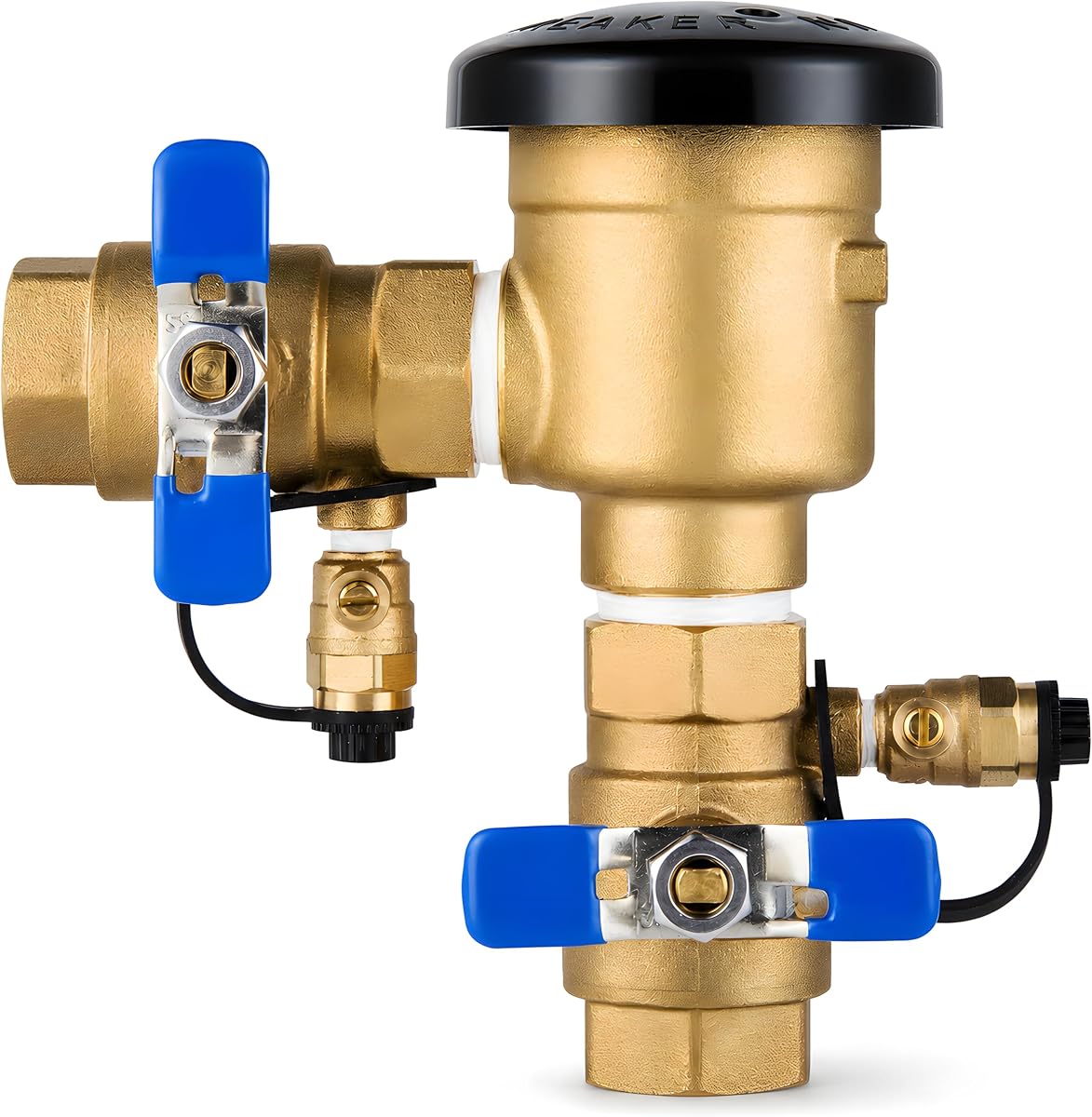
This one-inch pressure vacuum breaker combines a complete brass backflow assembly with a set of replacement service components. No customer rating is supplied for the listing, so its differentiation comes from the included repair kit and metal top cap. It is intended for compatible lawn irrigation, garden watering setups, and outdoor water lines requiring anti-siphon protection.
We may earn a commission when you buy through this link, at no additional cost to you.
The stated maximum working pressure is 400 psi, while the thickened brass body and upgraded metal top cap are designed for outdoor durability, corrosion resistance, and serviceability. The repair package includes a spring, O-rings, washer, gasket, diaphragm, retainer, top cap, and valve assembly. Together with flow-direction marking, shutoff valves, and accessible test ports, it supports installation and future maintenance.
The word repair kit should not be mistaken for a diagnostic kit. No pressure gauge, differential gauge, hoses, or multi-device test adapters are described, and the assembly is expressly for compatible irrigation applications. Buyers should also verify one-inch connection size, local requirements, water classification, and installation orientation before ordering.
This is a compelling option for a property owner or irrigation technician who wants both a replacement assembly and commonly needed wear parts on hand. It is especially useful where routine maintenance is expected and keeping matching service components reduces future inconvenience. Nevertheless, professionals conducting formal pressure testing still need a dedicated kit such as the Watts TK-9A.
The package includes the types of components commonly replaced during PVB service, including seals, springs, a diaphragm, retainer, and valve assembly. Having the matching parts included can simplify planned maintenance.
The metal top cap is presented as a sturdier serviceable feature than a typical lightweight cap. It complements the brass body for outdoor installations where durability is important.
We may earn a commission when you buy through this link, at no additional cost to you.
Choosing the correct product starts with distinguishing a diagnostic test kit from test fittings and backflow-prevention assemblies. Match the device type, connection sizes, operating conditions, and required components before comparing convenience or included accessories.
A complete backflow preventer test kit is intended to evaluate assembly performance, typically by connecting gauges and isolating valves to controlled test points. That is a different job from supplying a replacement test cock or installing a pressure vacuum breaker. If you need pressure readings, controlled isolation, and differential measurements, choose a kit with a proper gauge, test valves, hoses, adapters, instructions, and a carrying case rather than a single assembly or fitting.
Prioritize a kit designed for the exact backflow categories found in your service area, such as RPZA, DCVA, pressure vacuum breaker, or spill-resistant vacuum breaker assemblies.
Not every test kit supports every backflow device. The Watts TK-9A is described as covering four categories: reduced pressure zone assemblies, double check valve assemblies, pressure vacuum breakers, and spill-resistant vacuum breakers. It also references testing to USC and ASSE 5000 standards. Match those claims against the devices you actually maintain and confirm whether local certification or procedure calls for a specific test method.
A product marketed only as a backflow preventer valve should not be assumed to function as a tester merely because it has test ports.
Connection compatibility is a frequent source of wasted purchases. The two test-cock sets in this guide use one-eighth-inch male NPT and one-quarter-inch female NPT connections, but the exact orientation and physical fit must match the installed device. Measure the existing port, note whether it is NPT, and account for the fact that thread nominal size does not always equal hose or gauge connection size. Adapters may be needed, but they must be present in the kit or purchased separately.
Do not force a fitting, assume an adapter is universal, or rely on a listing photo alone to establish thread compatibility.
Pressure limits protect both the test equipment and the assembly being evaluated. The Watts kit has a stated maximum working pressure of 175 psi, while the generic brass pressure vacuum breakers are rated up to 400 psi and the Febco assemblies have a stated maximum working pressure of 150 psi. These are different operating envelopes. Review the pressure and temperature of the installation before selecting equipment or a replacement valve, and do not treat a component rating as proof that the entire system is suitable.
For prolonged or seasonal installations, also consider freezing conditions and whether freeze protection or monitoring is necessary.
Some products in this comparison are explicitly limited to non-potable irrigation or industrial water, while the Febco assemblies are described for protecting potable water. This distinction affects both suitability and regulatory compliance. Confirm whether the assembly protects a potable supply, whether the downstream water is non-potable, and what local authority having jurisdiction requires. A device should never be selected solely by size or appearance.
When the application is uncertain, consult the local water authority or a qualified backflow professional before purchasing.
Field testing often involves repeated stops, storage in a service vehicle, and protection from impact. A complete kit should include organized hoses, adapters, valves, instructions, and a durable case. The Watts TK-9A is lightweight and handheld, includes a securing strap, and comes with a shock-resistant case. For smaller test-cock sets, a simple organizer may be needed because the listing does not describe a dedicated carrying case.
Portable organization matters when a technician must quickly verify that every required component is present before leaving the shop.
A repair kit can extend the usefulness of a pressure vacuum breaker, but it is different from a testing package. The one-inch assembly at number ten includes a spring, O-rings, washer, gasket, diaphragm, retainer, top cap, and valve assembly. The one-inch 720A also includes a matching repair kit. These additions are useful for maintenance, yet they do not replace the gauge, hoses, adapters, and isolation equipment required to diagnose a backflow assembly.
Separate your maintenance needs from your diagnostic needs before deciding which type of product offers the most value.
For replacement assemblies, look for clear flow arrows, accessible test cocks, identifiable shutoffs, freeze-resistant bonnets, NPT end connections, and serviceable caps. The Febco 765 includes a plastic bonnet and a SentryPlus-compatible freeze sensor, while several generic irrigation assemblies use metal or plastic top caps and centerline test plugs. These features do not determine compatibility alone, but they influence setup, inspection, and ongoing service.
Always confirm dimensions, flow direction, pressure conditions, freeze exposure, and local installation rules before ordering.
Before testing, identify the backflow assembly, confirm that the kit supports its category, and inspect every hose, valve, gauge, and adapter for damage. Verify connection sizes and compare the assembly's operating pressure and temperature conditions with the kit's stated limits. Read the included instructions and follow the applicable standard and local test procedure rather than improvising an isolation sequence.
For a replacement test cock, shut off and depressurize the relevant water line, confirm zero pressure, and drain the isolated section as required. Clean the existing threads, check the valve and sealing surfaces, apply the appropriate PTFE sealant sparingly to compatible male threads, and hand-tighten the test cock without over-torquing it. Reopen the system slowly and check the connection for leakage before returning the assembly to service.
After each job, bleed residual pressure, disconnect hoses, and wipe the kit clean without immersing the gauge in water. Store hoses loosely in the carrying case, protect the gauge from impact, and keep fittings dry and free of dirt. Inspect threads and seals for damage, replace worn components with matching parts, and periodically verify gauge accuracy through an approved calibration process. For PVB assemblies, avoid unauthorized disassembly because breaking the seal can impair performance.
A backflow preventer test kit is used to connect gauges and isolation equipment to a backflow assembly so its pressure differential and valve performance can be evaluated. The correct procedure varies by device category and governing standard. A kit cannot reliably test an assembly unless its fittings, adapters, pressure range, and intended device coverage match the installation.
No. Connection size, pressure, temperature, water classification, and installation code all matter. Some products in this guide are explicitly for non-potable irrigation, while the Febco assemblies are described for potable-water protection. Always verify the required device type and obtain local approval before selecting a replacement assembly.
No. A test cock is an isolation or connection fitting installed on a compatible assembly. A complete kit also needs a suitable gauge, test valves, hoses, and adapters. The four-piece and GASHER products can support testing work, but they cannot replace the diagnostic equipment included with the Watts TK-9A.
Measure the installed connection and identify whether it is NPT before ordering. Both test-cock sets in this guide list a one-eighth-inch male NPT and one-quarter-inch female NPT configuration, but physical compatibility still depends on the device and the intended hose or gauge connection. Do not rely on visual similarity or force incompatible fittings.
A kit can support multiple device categories only when its manufacturer states that coverage. The Watts TK-9A is described for RPZAs, DCVAs, pressure vacuum breakers, and spill-resistant vacuum breakers, with testing to USC and ASSE 5000 standards. Even then, use the exact procedure required for each assembly and comply with local testing rules.
A freeze sensor can provide an alert when temperatures approach conditions that could damage an exposed assembly. The Febco 765 models include compatibility with SentryPlus Alert technology and require an optional connection kit for monitoring activation. The sensor supplements physical freeze-resistant construction; it does not replace correct installation or protection from cold conditions.
Avoid unauthorized disassembly unless the manufacturer's instructions and applicable service procedure specifically permit it. The one-inch 720A listing states that disassembly can break the PVB seal, and other assemblies may contain spring-loaded, resilient-seated, or sealed components. If a leak appears, isolate the assembly and consult the applicable service guidance.
Store the gauge away from impact, keep hoses uncoiled or loosely arranged, and keep adapters and valves in the supplied case or a labeled organizer. Clean and dry the components after use, especially any PTFE-covered threads. Periodic visual inspections and gauge calibration help ensure that the kit remains dependable for future service work.
The Watts TK-9A is the clear choice for professional diagnostics because it combines a gauge, test valves, three swivel-coupled hoses, adapters, instructions, a strap, and a carrying case in one portable package. It supports RPZA, DCVA, pressure vacuum breaker, and spill-resistant vacuum breaker testing, while the two test-cock sets are better understood as focused replacement connections for compatible equipment.
If the requirement is an assembly rather than a tester, prioritize connection size, potable or non-potable classification, operating pressure, temperature exposure, freeze monitoring, and serviceability. The Febco 765 models offer detailed commercial construction and monitoring features, while the generic brass PVB options target compatible outdoor irrigation applications with simpler assemblies and stated 400 psi maximum ratings.
Check current prices, availability, seller details, and the latest manufacturer instructions before ordering. The product category includes both diagnostic tools and protective valves, so a close fit for the exact assembly is more important than a broad label or a large number of included parts.