
KOTTO Solder Smoke Absorber
4.7Editor score
3000 RPM suction fan
Replaceable carbon filter
Included replacement filter
Our Soldering Fume Extractor guide compares airflow, filtration, noise, adjustability, and build quality to help you choose a safer workspace with confidence.
Soldering fumes can expose you to uncomfortable odors, fine particles, and airborne flux residue, especially when working in a small room for long periods. A useful soldering fume extractor combines focused airflow, effective filtration, adjustable capture, and quiet operation without taking over the workbench or interfering with the soldering process.
This guide compares ten fume extractors using the specifications supplied for each model, including airflow, filtration layers, suction range, motor design, noise controls, voltage support, and included accessories. The list covers compact units for electronics repair, versatile models for craft work, and higher-capacity machines for demanding benches.
Each review explains which type of workspace and user the product is likely to suit, while noting the practical compromises that come with its design. Ratings and availability can change over time, and current prices vary, so readers should compare the latest specifications and listings before making a final purchase.
4.7Editor score

4.5Editor score

4.3Editor score
The comparison below highlights the major differences in airflow, filtration, positioning, and workspace suitability across all ten models.


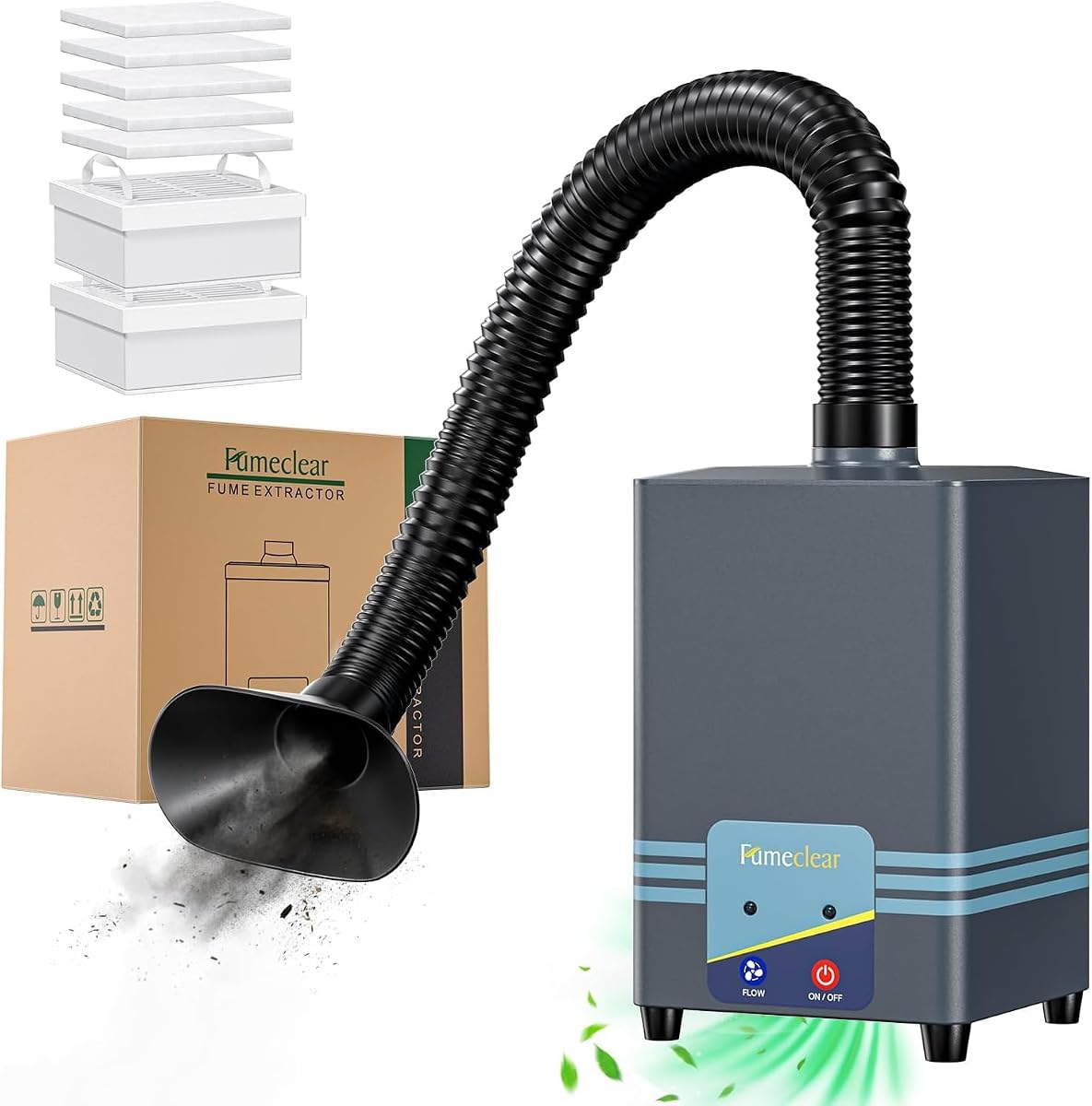


The KOTTO Solder Smoke Absorber is a straightforward desktop extractor that brings useful fume capture to a modest electronics or repair bench without introducing a complicated control system. It carries a 4.7 rating, the highest among the ten products in this guide, and its core specifications center on a 3000 RPM fan, a replaceable 0.4-inch activated carbon filter, and effective capture from approximately five to six inches away.
We may earn a commission when you buy through this link, at no additional cost to you.
Its appeal lies in a practical combination of features. The four heavy-duty rubber feet help keep the unit stable during delicate work, while the carrying handle makes it straightforward to move between a kitchen-table workspace and a shared workshop. A replacement smoke filter is included, and the filter is designed to be changed without a complex disassembly process. The 30W motor is specified for 120V, 50/60Hz operation, making the model suitable for standard US electrical setups.
The main limitation is that this is a simpler filtration system than several higher-ranked alternatives. It uses activated carbon to absorb fumes, odors, gases, and other contaminants, but it does not list a HEPA pre-filter or a multi-stage particle filtration arrangement. Users who frequently repair dusty circuit boards, use flux-heavy processes, or work around fine airborne debris may want more explicit particle-filtration specifications.
This extractor is best for hobbyists, students, and occasional repair technicians who want dependable local capture at a modest entry point. It offers enough power for routine soldering, repair, and basic electronics work, provided the nozzle is placed within its stated capture distance. For uncomplicated performance, included replacement media, and easy maintenance, it is a particularly persuasive budget-oriented recommendation.
The product's 4.7 rating should not be interpreted as a universal performance score for every work environment. It is an especially strong match for users who value compactness, straightforward operation, and effective capture more than an elaborate multi-stage filtration system.
The 3000 RPM fan is specified to remove fumes from five to six inches away, making nozzle placement relatively easy. Keeping the intake close to the solder joint reduces the distance that smoke must travel before entering the filter.
The included replacement filter and accessible design reduce the learning curve for first-time owners. Routine care should focus on allowing the activated carbon media to cool and handling the replacement part without damaging its sealing surfaces.
We may earn a commission when you buy through this link, at no additional cost to you.
The FumeClear FC-2001S is designed for soldering enthusiasts who want more explicit filtration performance than a basic carbon-only fan can offer. Its 4.4 rating reflects a well-rounded package that combines an airflow of up to 128–168m³/h with a three-stage system consisting of a pre-filter, H12 HEPA filter, and high-iodine activated carbon.
We may earn a commission when you buy through this link, at no additional cost to you.
The pre-filter handles larger contaminants before they reach the finer media, while the H12 stage captures fine particles and the activated carbon layer addresses odors and gaseous components. The carbon is described as coconut-shell material with an iodine content of 500–700mg/g. These specifications make the FC-2001S appealing for precision soldering, electronics repair, and workspaces where the visual presence of rosin smoke is especially undesirable.
An extendable hose provides the flexibility needed to keep the suction nozzle close to the source while the machine itself remains nearby. The supplied operating guidance is direct: align the nozzle with the smoke-producing area to achieve the intended effect. Universal voltage support for 110V and 220V environments also makes this version more adaptable than many US-only desktop models.
The trade-offs are normal for a compact, filter-based extractor. Although the three-stage construction is sophisticated, it necessarily creates a more complex media stack that must be maintained according to the manufacturer's replacement guidance. The listed capture percentage is also a filtration specification rather than a guarantee that every contaminant at every concentration will be removed in every real-world setup.
This FC-2001S is a strong choice for users who want both particle and odor control, travel between different workspaces, or operate the equipment in regions with more than one standard voltage. It suits serious hobbyists and repair professionals who value a portable format without giving up the documented benefits of HEPA and activated carbon stages.
Separating coarse debris, fine particles, and gaseous odors gives the filtration system a clearer purpose than a single carbon sheet. Users who work with dense rosin smoke or dusty boards can benefit from that broader approach.
The extendable hose allows the unit to remain stable while the intake moves closer to the work. Positioning the nozzle correctly is essential, so operators should adjust it whenever the soldering point changes.
We may earn a commission when you buy through this link, at no additional cost to you.
This KOTTO listing offers the same practical formula as the higher-ranked KOTTO model: a 3000 RPM fan, a replaceable 0.4-inch activated carbon filter, and a documented capture distance of approximately five to six inches. Its 4.6 rating makes it one of the most highly rated products here, while the straightforward layout is appropriate for routine soldering and electronics work.
We may earn a commission when you buy through this link, at no additional cost to you.
The carbon filter is intended to absorb and capture fumes associated with solder, flux, chemicals, and gases. A replaceable filter is included, which is helpful for owners who want a fresh starting point or a spare for later servicing. The four rubber feet add stability, and the carrying handle makes it easy to shift the machine when a more permanent bench position becomes available.
Like other compact carbon-filter extractors, it lacks a clearly documented HEPA stage. That distinction matters if the main concern is microscopic particle removal rather than odor and smoke capture. Its 120V, 30W electrical specification is also less versatile than models with 110V–220V or 100–240V support, limiting international use without an appropriate converter and compatible supply.
For hobbyists and repair technicians who work at a comfortable pace and can position the extractor within a few inches of the joint, the trade-offs are reasonable. It avoids the complexity of digital displays, articulated arms, and multi-layer filter cassettes while still delivering a useful 3000 RPM suction system and a convenient replacement-media approach.
This model is worth considering for home workshops, educational benches, and occasional solder repairs. Buyers who need only basic local extraction will appreciate its straightforward operation, while those with heavy fumes or fine airborne debris may benefit more from one of the multi-stage alternatives in the comparison.
Its combination of a high-RPM fan and short documented capture range suits common bench tasks. The unit is designed to remove smoke close to the source rather than clean an entire room.
Replaceable filtration is valuable because activated carbon gradually becomes saturated. Keeping a fresh filter available helps maintain capture performance and makes upkeep predictable.
We may earn a commission when you buy through this link, at no additional cost to you.
The WEP 948DQ-I is built for compact soldering stations where every bit of bench space matters. It has a 4.4 rating, measures 3.5 by 5.7 by 6.5 inches, and combines front-and-rear filtration adsorbers with an adjustable tilt angle. The included helping hands and side fenders make it more than a simple fan.
We may earn a commission when you buy through this link, at no additional cost to you.
Its filtration is positioned on both the front and rear of the unit, allowing smoke to be drawn toward the adsorbers as the extractor angle changes. The adjustable stand is intended to improve suction coverage, while the side fenders reduce the negative effects of disruptive airflow around the work area. A built-in power switch provides straightforward operation without additional controls.
A particularly useful feature is the pair of attachable helping hands, which measure 11.8 inches, or 30 centimeters. These can hold a circuit board, wires, or small components while the user works. That accessory makes the 948DQ-I especially attractive for delicate electronics tasks in which a secure work position is just as important as smoke removal.
The limitation is its modest stated working distance of approximately 10 centimeters. Operators must bring the tilted intake close to the solder joint for the best result. The unit is also rated for 110–127V, making it suitable for standard US installations but less convenient for users operating across different voltage systems.
This extractor is a good match for apartment hobbyists, students, and repair professionals who value a small footprint and built-in component support. It may be less suitable for heavy laser work, continuous welding, or users who need a long hose and greater distance between the machine and soldering point.
The removable helping hands can stabilize small boards or wiring while keeping hands away from the heated iron. This is especially helpful for beginners learning to solder or for fine work performed on unstable prototypes.
Changing the angle lets the operator redirect the intake as the work rotates. Side fenders help limit the fan's disruptive turbulence, although the nozzle still needs to remain close to the source.
We may earn a commission when you buy through this link, at no additional cost to you.
The FumeClear FC-2001SG is a portable three-stage extractor for soldering users who prioritize filtration detail and flexible positioning. Its 4.4 rating is supported by a specification package that includes airflow of up to 128–168m³/h, an H12 HEPA filter, a pre-filter, and high-iodine coconut-shell activated carbon.
We may earn a commission when you buy through this link, at no additional cost to you.
The layered media addresses different classes of contamination. The pre-filter catches larger particles, the H12 stage targets fine material, and the activated carbon layer handles odors and gaseous fumes. According to the supplied description, the carbon contains 500–700mg/g iodine, a figure intended to indicate stronger adsorption than conventional lower-specification carbon media.
An extendable hose gives users freedom to place the suction nozzle near the solder while keeping the main unit at a convenient distance. The product description specifically advises aligning the nozzle directly with the source of smoke. Universal voltage support allows operation in 110V and 220V environments, which is useful for owners who travel or move equipment between locations.
As with any compact extractor, performance depends on keeping the intake appropriately positioned and replacing filters as they become saturated. The unit is not presented as a room-wide ventilation system. Its purpose is local capture at the workbench, and users with heavy solder use should not expect it to replace proper facility ventilation.
The FC-2001SG is well suited to precision soldering, PCB repair, and compact workspaces where odor removal and particulate filtration are both important. It offers a balanced combination of portability, documented filtration, and voltage flexibility, making it a strong all-around choice for frequent hobbyists and traveling technicians.
The documented iodine range provides a more specific measure of carbon performance than many competing descriptions. It is particularly relevant in soldering environments where residual rosin odor can otherwise dominate the workspace.
The stated 110V and 220V support reduces the need for region-specific equipment. Users should still verify local electrical requirements and follow the manufacturer's guidance when connecting the unit.
We may earn a commission when you buy through this link, at no additional cost to you.
The FumeClear FC-2001A is a more substantial desktop extractor for users who want an all-metal enclosure, H13 filtration, and stronger stated airflow than compact entry-level models. It has a 4.4 rating and an airflow capacity of 120–180m³/h, with effective operation documented at a working distance of approximately 15 centimeters.
We may earn a commission when you buy through this link, at no additional cost to you.
Its brushless motor is listed as a high-speed design released in November 2026. That motor supports the unit's broader airflow range and is paired with True H13 HEPA media and activated carbon having a stated iodine value of 600–800mg/g. The combination is designed to address both fine particles and odors while maintaining a larger dust-holding capacity than smaller compact units.
The all-metal housing is a notable upgrade for a frequently used bench machine. It also incorporates voltage-inverter technology for stable operation across 110V and 220V systems. The supplied specifications emphasize filter longevity, including a claim that the filter can last three times longer than those used in other compact units, although actual intervals will depend on workload and maintenance.
There are trade-offs in size, weight, and ongoing filter expense. A more capable HEPA-and-carbon cassette generally requires more care than a simple activated carbon sheet, and replacement planning is important for anyone who solder frequently. The 15-centimeter working range is still relatively close compared with machines designed for larger industrial processes.
This FC-2001A is a compelling option for professional repair benches, electronics classrooms, and dedicated hobby workspaces where filtration class and motor longevity matter. It is less suitable for users wanting the smallest possible unit or the simplest possible maintenance routine.
The H13 stage adds a clearly defined fine-particle filtration layer to the activated carbon media. This is useful for solder jobs that also involve dusty circuit boards, powdered coatings, or other fine workshop debris.
The metal housing is more appropriate for permanent bench placement than a lightweight portable fan. It should still be positioned where it does not obstruct essential movement or interfere with the soldering iron.
We may earn a commission when you buy through this link, at no additional cost to you.
The NT-M1 Desktop Solder Fume Extractor is designed for users who need effective filtration but have little room for a bulky machine. It carries a 4.4 rating, measures 5.1 by 5.1 by 6.3 inches, weighs three pounds, and delivers a stated airflow of 168m³/h through a high-speed centrifugal motor.
We may earn a commission when you buy through this link, at no additional cost to you.
Its H13 HEPA system is combined with carbon powder for odor reduction and a high-density, 10-millimeter pre-filter intended to catch large particles and flux splatters. The supplied specifications state that the system captures 99.99% of microscopic dust and dense rosin smoke. As with all percentage claims, actual performance depends on the contaminant, condition of the filter, and correct positioning.
The shape-retaining hose extends up to 25.6 inches and can bend through 360 degrees, providing more reach than a short fixed intake. A stepless rotary knob allows users to increase suction for dense smoke or reduce it for quieter operation. These controls make the machine adaptable to both solder joints and less demanding craft applications.
The unit is also presented as a broader ventilation tool for stained glass, pyrography, resin printing, and jewelry work. That versatility is useful, but the phrase does not change its core identity: it is a desktop extractor for local capture rather than a replacement for building ventilation. Its three-pound weight makes it easy to relocate, though that also means it may move more readily during active use.
The NT-M1 is a strong choice for apartment hobbyists, small home offices, and education benches where a compact footprint, flexible hose, and speed adjustment matter. Users with very heavy workloads may want a higher-capacity unit, but for everyday electronics work this model offers an unusually well-rounded feature set.
The square five-inch footprint and modest weight make the unit practical where shelves, drawers, and bench depth are limited. Its compactness also allows it to be stored away when it is not needed.
Variable speed is useful when a strong fan is not necessary for a small repair. Lower settings may reduce distraction and energy use, while higher settings suit soldering that produces a visible plume.
We may earn a commission when you buy through this link, at no additional cost to you.
The YIHUA 948DQ-I is a compact, tilting fume extractor with a 4.5 rating and a distinctive accessory package. It includes eight filtration adsorbers, two side fenders, and a tiltable stand. The design can be used for soldering or wood burning, making it a practical option for mixed electronics and pyrography benches.
We may earn a commission when you buy through this link, at no additional cost to you.
Front-and-rear filters provide two-sided adsorption, while the stand allows a 30-degree adjustment to change the effective filtering area. The side fenders are intended to reduce disruptive airflow and help maintain extraction around the work. Fumes generated within a straight-line distance of approximately 10 centimeters can be captured effectively when the unit is positioned correctly.
The five-blade fan is described as combining effective extraction with a longer operating lifespan and relatively low noise. That balance may be particularly useful for a small workshop where continuous high-speed operation would be distracting. Its simpler architecture also avoids digital displays and complicated menu settings, which can be an advantage for users who want to position the machine and begin working.
The main constraint is its short effective distance. It should be placed close to the joint and readjusted as the work moves. It is also designed for 110–127V with a US-standard plug, so users in other regions must confirm compatibility and obtain an appropriate power solution. The adsorption media will require replacement as it becomes saturated.
The YIHUA 948DQ-I fits occasional users, students, and mixed-craft hobbyists who value an adjustable stand, multiple included filters, and straightforward operation. It is less appropriate for heavy industrial workloads or benches requiring a flexible remote hose and a greater capture distance.
Tilting the unit changes the relationship between the intake and the work surface. This makes it easier to maintain useful capture when a board is rotated or when the iron approaches the joint from a different angle.
Eight adsorbers provide multiple media pieces at the outset, while the two fenders help stabilize the airflow around the active area. The package supports regular use without requiring users to locate every accessory separately.
We may earn a commission when you buy through this link, at no additional cost to you.
The Zericuf is the highest-capacity model in this guide, pairing a 180W brushless pure copper motor with a stated airflow of 320m³/h. Its 4.3 rating is slightly below the leaders, but the specifications distinguish it as a premium machine for soldering, laser work, and 3D-printer exhaust where a compact desktop fan may be insufficient.
We may earn a commission when you buy through this link, at no additional cost to you.
The all-metal chassis and soundproof chamber use acoustic and damping foam to reduce motor noise, with a stated operating level below 58dB even at maximum airflow. A downward-sloping rear vent directs hot exhaust away from the desk and floor. The supplied information also gives an effective capture range of more than 30 centimeters, allowing the intake to remain farther from the source than smaller machines require.
Filtration uses three stages: ten included double-thickness pre-filter sponges, True H13 HEPA media, and activated carbon with a stated iodine value of 800–900mg/g. The HEPA stage is stated to capture 99.997% of 0.3-micron particles, while the pre-filter is intended to protect the main media from larger debris. A clog-alert buzzer adds a useful maintenance prompt.
The articulated arm rotates continuously, and four swivel casters have front brakes for moving and securing the unit. Stepless speed control provides precise adjustment, while the industrial-style construction and five-year warranty support long-term use. The main caveat is the supplied note that replacement filters are scheduled to become available later; users should confirm current availability before buying if immediate media access matters.
Despite its larger construction, the Zericuf is the strongest choice here for heavy users, shared studios, laser equipment, or advanced hobbyists who prioritize airflow and capture distance. The extra capacity and specialized noise control justify the premium positioning, although the machine is less practical for a tiny temporary work surface.
The 320m³/h airflow substantially exceeds the capacity listed for the compact models in this comparison. That difference is meaningful when smoke is generated rapidly or when the extractor must work from more than 30 centimeters away.
The acoustic chamber and damping foam are intended to contain motor noise. This makes the machine more suitable to prolonged work in a home office or shared studio where a louder fan could become distracting.
Braked casters allow the unit to move between stations without being dragged across delicate work surfaces. Once positioned, the brakes and articulated arm help keep the intake stable and directed toward the active task.
We may earn a commission when you buy through this link, at no additional cost to you.
The YC60 is a versatile desktop extractor that combines a 4.5 rating with a useful balance of capacity, filtration, controls, and voltage support. Its stated airflow ranges from 120 to 180m³/h, with wind speed up to 21 feet per second and a listed airflow of 71 CFM. Those figures place it between compact hobby models and the highest-capacity machine in this guide.
We may earn a commission when you buy through this link, at no additional cost to you.
The filtration system combines a pre-filter with an H13 HEPA and activated carbon layer. It is stated to capture particles as small as 0.3 microns with efficiency up to 99.97% and to adsorb gases such as benzene, formaldehyde, and ammonia. The pre-filter also protects the finer media from larger particles and supports a larger overall dust-holding capacity.
A 360-degree, heat-resistant arm rotates and locks into position, making it possible to bring the intake close to the joint without moving the entire machine. The digital display shows the current fan speed, while stepless adjustment allows the user to balance capture and noise. A stated operating level below 50dB is particularly helpful for a shared or quiet workspace.
The all-metal frame and brushless motor are intended to support durability, and the listed 100–240V AC range makes the unit unusually adaptable across regions. The trade-offs are the need to position the arm correctly and the ongoing care required by a multi-layer filter. Like every desktop extractor, it captures local fumes rather than ventilating an entire room.
The YC60 is an excellent general recommendation for electronics repair, light welding, stained glass, pyrography, resin printing, and jewelry work. Users seeking a premium-capacity industrial machine may prefer the Zericuf, while the YC60 delivers the more balanced option for ordinary professional and serious hobbyist benches.
The real-time display and stepless adjustment make it easier to increase airflow when a plume develops or reduce it for quieter tasks. This flexibility is useful across different solder temperatures, fluxes, and project types.
The locking arm provides a stable way to direct the intake near the work. Because the arm can move, it should be checked after each major repositioning to avoid pulling fumes past the machine.
A 100–240V AC specification supports use across a wide range of locations without requiring a separate voltage-conversion arrangement. Users should still inspect the plug and follow all local electrical safety guidance.
We may earn a commission when you buy through this link, at no additional cost to you.
The right extractor depends on the volume and type of fumes, available bench space, filtration expectations, noise sensitivity, and electrical requirements. Use the following factors to narrow the options before comparing replacement-filter availability and current listings.
Choose stronger airflow for frequent soldering, dense smoke, welding, laser work, or a shared workshop. For occasional electronics repair, a smaller unit placed close to the joint may be sufficient. Always consider whether the nozzle can reach the fumes before they drift toward your breathing zone.
Prioritize a layered system when your work produces both particles and persistent odors. If you mainly solder clean electronics with modest rosin fumes, a replaceable carbon filter may be adequate. Confirm replacement specifications and availability before purchasing any unit that relies on proprietary media.
Measure the available area before buying, including space needed to open filters and service the fan. Choose a compact model for temporary work or a rolling system for a dedicated station. The extraction performance still matters more than portability once a machine is permanently installed.
Consider the lowest setting that still captures smoke effectively. A quieter operating level is beneficial, but it should not come at the expense of leaving fumes uncollected. Check whether the control method is stepless, stepped, or tied directly to a fixed-speed setting.
Choose an adjustment method that matches your bench. Ensure the intake can be directed toward the solder joint without pulling the machine, iron, or board out of position. Check that a locking mechanism or stable base keeps the chosen position steady during active work.
Verify the voltage, frequency, plug type, and power-cord configuration before ordering. Wide-range models are convenient for travelers and international users, while local models may be less expensive and easier to power. Never rely on an improvised adapter to solve an unsupported electrical specification.
Check the type and dimensions of replacement media, not just the initial filter package. A unit with excellent filtration is less attractive if suitable replacements are difficult to find. Users with heavy workloads should maintain a spare filter and replace media according to airflow and odor changes rather than waiting for visible smoke to escape.
List the tasks you expect to perform before choosing based on appearance alone. Match airflow and filtration to the most demanding activity, while considering whether the machine needs to fit in a temporary workspace. The most suitable purchase is the one that captures your normal workload without overwhelming the bench.
Begin by placing the extractor on a stable, level surface with the intake unobstructed. Keep the nozzle close to the soldering joint—within the model's documented capture distance—and position it on the side of the plume so fumes enter the filter rather than passing around it. Connect the unit to a compatible power supply, switch it on, and allow the fan to reach its intended speed before beginning the work.
Adjust the nozzle, hose, arm, or tilt angle whenever the workpiece moves. Use a lower setting for light tasks when airflow remains adequate, and increase it for denser smoke. Do not obstruct the exhaust with tools, cords, or loose materials. Allow hot filters and metal components to cool before servicing, and unplug the unit before replacing media or inspecting the fan.
Monitor airflow, unusual noise, odor, and the condition of the pre-filter. Replace saturated or visibly damaged media according to the manufacturer's guidance, and keep spare filters available for frequent use. Clean accessible pre-filter surfaces without using liquids that could damage electrical parts. For workshop machines, check casters, arm locks, hose connections, and the power cord periodically so that the unit remains stable and well sealed.
For occasional electronics repair, a compact unit with activated carbon or a simple pre-filter is usually adequate. A three-stage HEPA and carbon model is preferable for frequent soldering, strong odors, dusty circuit boards, or a shared workspace. High-capacity machines make more sense for welding, laser work, or continuous production rather than a small hobby bench.
The nozzle should be as close to the smoke source as practical while remaining clear of the hot iron and solder. Compact models often specify an effective distance of only five to ten centimeters, whereas higher-capacity units may work at greater distances. Smokes should enter the intake directly, and the nozzle should be readjusted whenever the board or workpiece moves.
Activated carbon is effective for many odors and can adsorb certain gaseous contaminants, but it is not the only consideration when fine particles are also present. A pre-filter protects the carbon media, while a HEPA stage captures fine particles. Owners doing frequent or dusty work gain more from a layered system than from carbon alone.
Replacement timing depends on workload, filter type, airflow, and the condition of the media. Slower airflow, stronger odors, visible residue, or increased noise can indicate that attention is needed. Follow the manufacturer's guidance and keep a compatible spare on hand, especially if the unit is used every day or in a multi-user workshop.
Several models are explicitly designed for wood burning, stained glass, resin printing, and similar processes. The important factors are airflow, capture distance, and whether the filtration media suit the particular smoke. A soldering extractor should not be assumed to handle every chemical or combustible process, so users should verify compatibility with the material being worked.
A local fume extractor captures smoke at the workbench, but it does not replace sound general ventilation. Keep the room ventilated to control heat, humidity, and any contaminants the extractor does not capture. This is especially important in a small workspace where solder fumes, adhesives, cleaning chemicals, and heated materials may be used together.
Higher airflow can improve capture when fumes are dense or when the nozzle must remain farther from the joint, but it also increases noise, energy use, and potentially the machine's physical size. The best unit is one that captures your normal workload at a comfortable distance and noise level. Extra capacity is most valuable for intensive or varied work.
No. Replacement media should match the manufacturer's model, dimensions, sealing arrangement, and filtration layer specification. A generic filter may fit physically but provide poor sealing, restricted airflow, or unsuitable media. Verify the compatibility information and replacement part number before ordering.
The KOTTO Solder Smoke Absorber stands out as the budget-focused selection because it combines a 3000 RPM fan, a replaceable carbon filter, an included spare, and a 4.7 rating in a simple package. The YC60 is the most balanced editor's choice, offering H13 HEPA and carbon filtration, a lockable positioning arm, digital speed control, wide voltage support, and quiet operation. The Zericuf takes the premium position with 320m³/h airflow, a brushless motor, extended capture distance, acoustic construction, and mobile positioning.
Most users should prioritize correct nozzle placement, suitable filtration, and airflow that matches the actual workload. Small electronics projects may be well served by a compact carbon or dual-adsorber model, while frequent soldering, dusty repair work, welding, or shared benches justify a HEPA-based design. Always check the electrical requirements and the availability of compatible replacement filters before finalizing a purchase.
Ratings, features, and current listings can change, and prices fluctuate over time. Review the latest product description, replacement media details, and customer feedback on the day of purchase. This November 2026 guide provides a structured starting point, but the most reliable choice is the extractor whose capacity, filtration, and placement features match your specific workspace.